 Скачать презентацию Obesity prevention and control Lessons from campaigns
78f5bfb0a9b3f36ab043f5c95c0dcd54.ppt
- Количество слайдов: 18



Obesity prevention and control Lessons from campaigns, intervention and advocacy Obesity – the elephant in the room in cancer communities Professor Annie S. Anderson Centre for Public Health Nutrition Research Centre for Research into Cancer Prevention and Screening Ninewells Medical School, University of Dundee email: a. s. anderson@dundee. ac. uk @anniescotta @thescpn
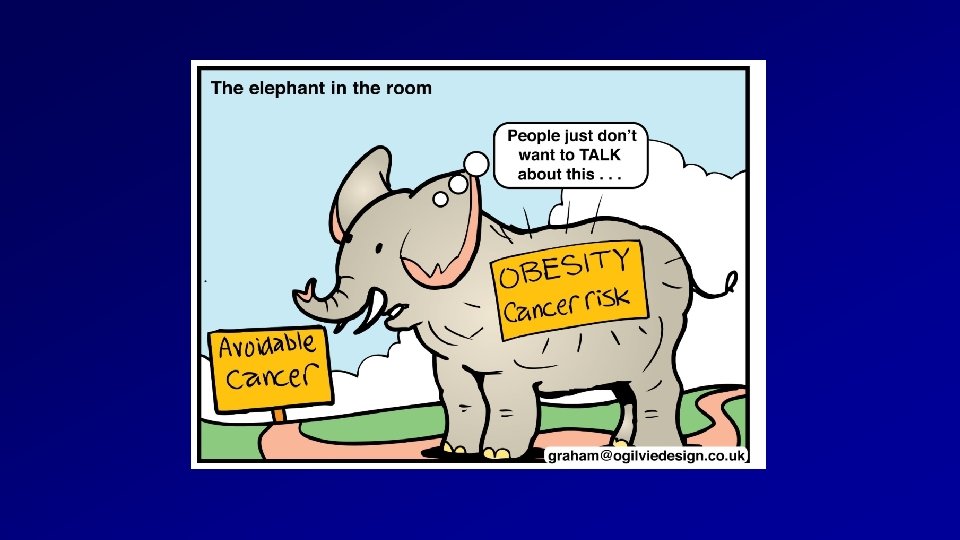
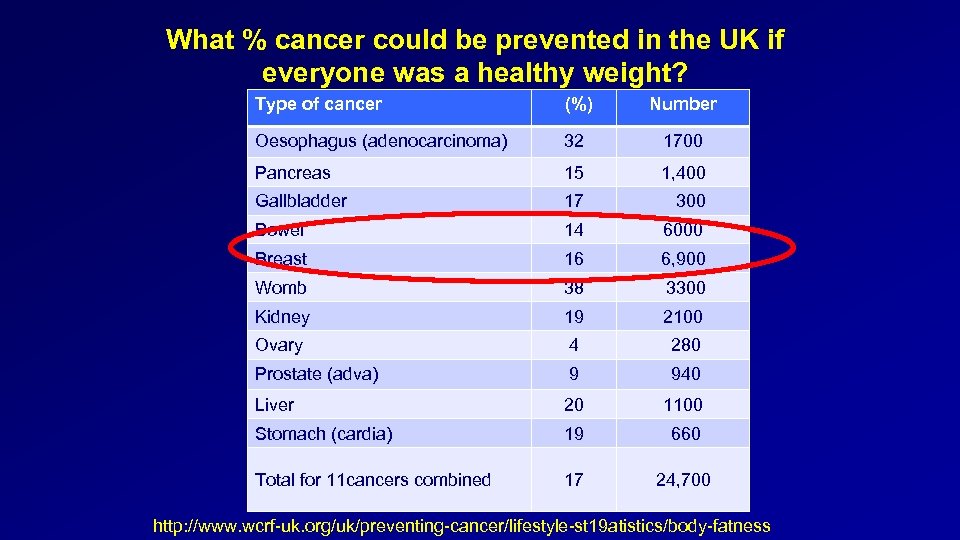
What % cancer could be prevented in the UK if everyone was a healthy weight? Type of cancer (%) Number Oesophagus (adenocarcinoma) 32 1700 Pancreas 15 1, 400 Gallbladder 17 300 Bowel 14 6000 Breast 16 6, 900 Womb 38 3300 Kidney 19 2100 Ovary 4 280 Prostate (adva) 9 940 Liver 20 1100 Stomach (cardia) 19 660 Total for 11 cancers combined 17 24, 700 http: //www. wcrf-uk. org/uk/preventing-cancer/lifestyle-st 19 atistics/body-fatness
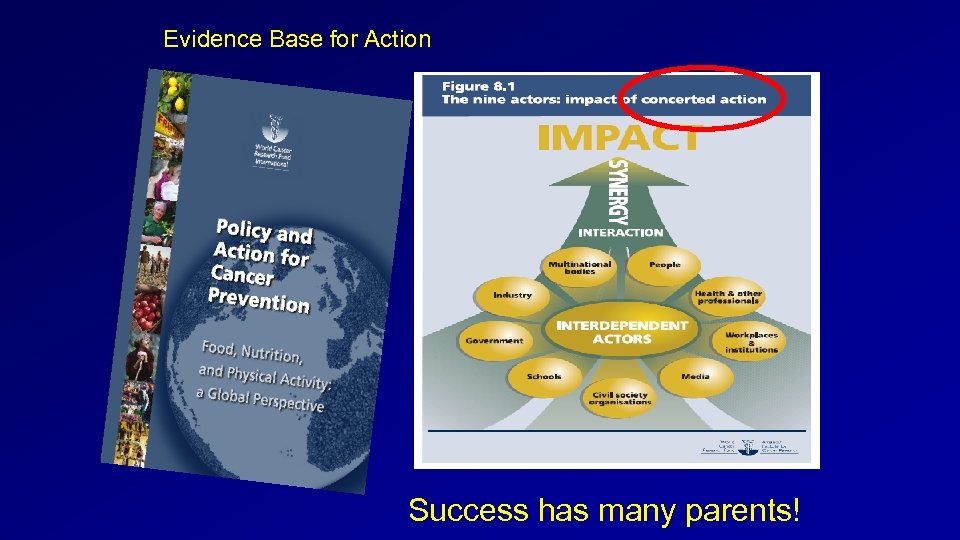
Evidence Base for Action Success has many parents!
Why explore the screening setting? Screening “awakens curiosity” about disease and causes (Bankhead et al, 2003) Existing healthcare setting and structure Re-enforcement of public health efforts Endorsement by cancer experts (as opposed to prevention messages from corn flakes packets, newspapers etc)
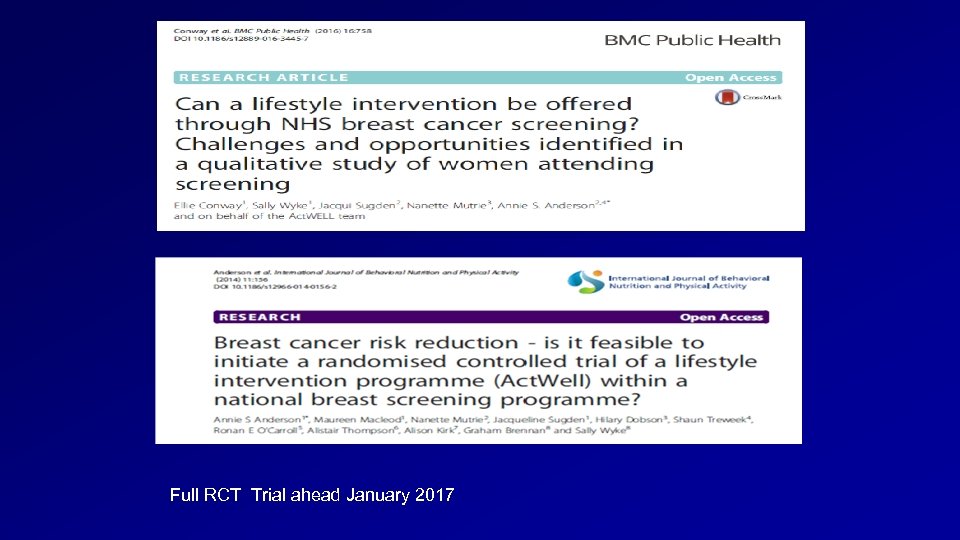
Full RCT Trial ahead January 2017
Shared and accepted understanding of lifestyle and risk? “You're lucky or you're unlucky. . . if it's going to be, it's going to be. ” “if it's for you, it won't go by you, whether or not you do all these things”
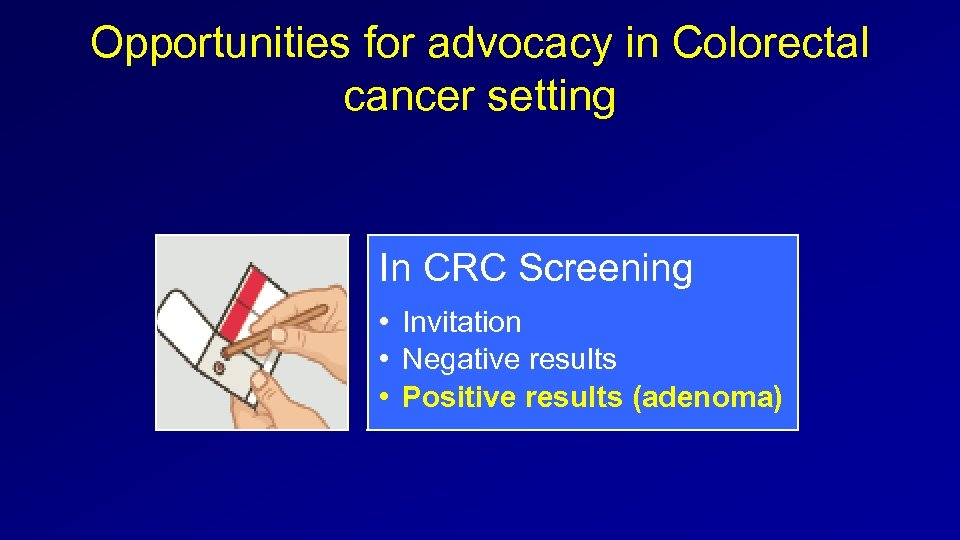
Opportunities for advocacy in Colorectal cancer setting In CRC Screening • Invitation • Negative results • Positive results (adenoma)
People know it all already
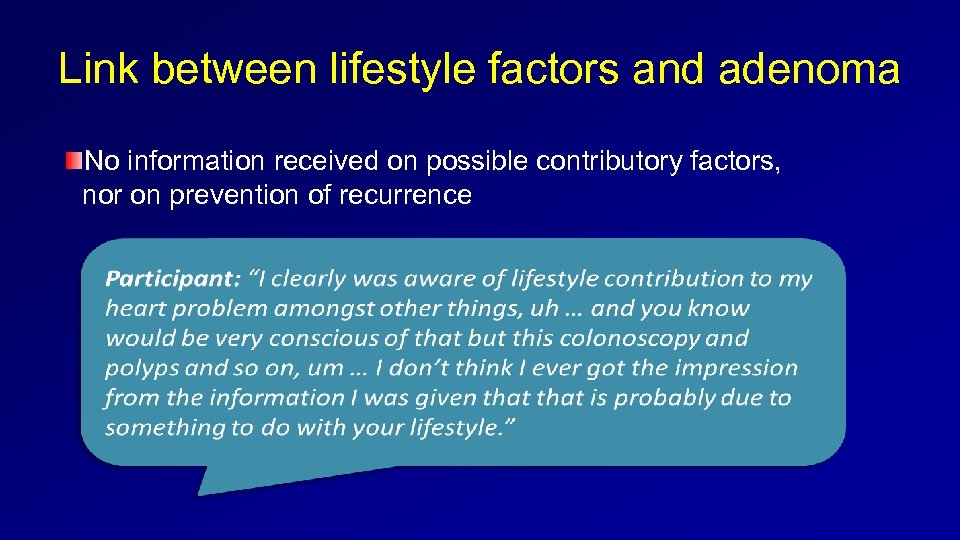
Link between lifestyle factors and adenoma No information received on possible contributory factors, nor on prevention of recurrence
People don’t want to know about lifestyle things at this age
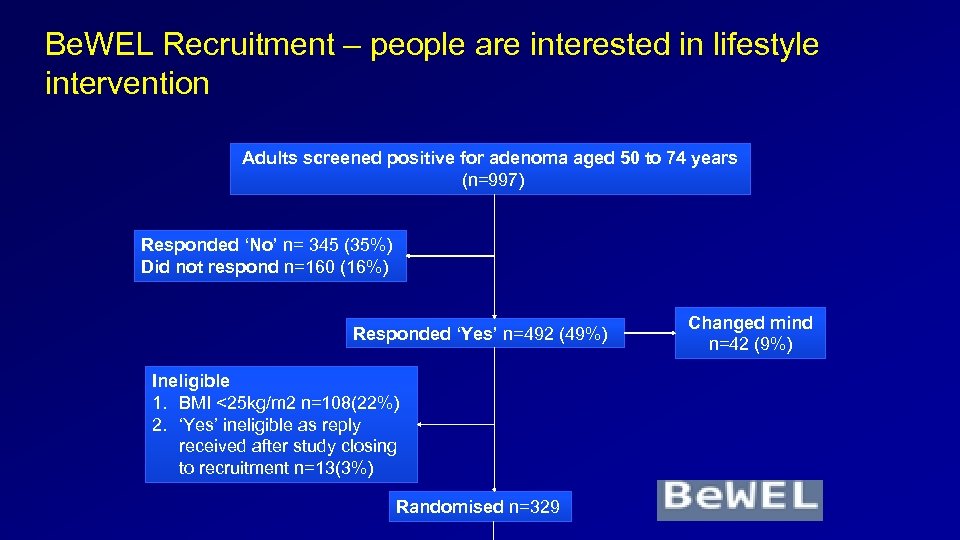
Be. WEL Recruitment – people are interested in lifestyle intervention Adults screened positive for adenoma aged 50 to 74 years (n=997) Responded ‘No’ n= 345 (35%) Did not respond n=160 (16%) Responded ‘Yes’ n=492 (49%) Ineligible 1. BMI <25 kg/m 2 n=108(22%) 2. ‘Yes’ ineligible as reply received after study closing to recruitment n=13(3%) Randomised n=329 Changed mind n=42 (9%)
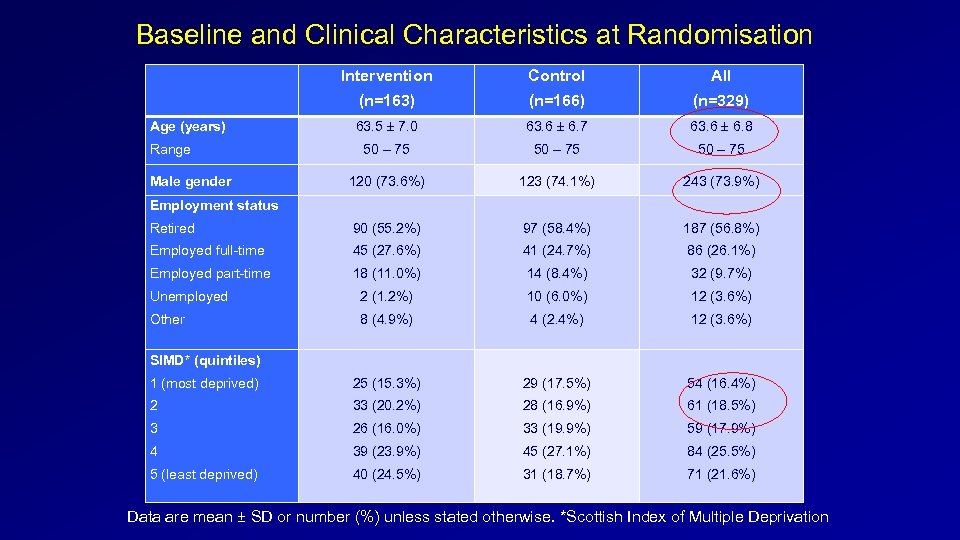
Baseline and Clinical Characteristics at Randomisation Intervention Control All (n=163) (n=166) (n=329) 63. 5 7. 0 63. 6 6. 7 63. 6 6. 8 50 – 75 120 (73. 6%) 123 (74. 1%) 243 (73. 9%) Retired 90 (55. 2%) 97 (58. 4%) 187 (56. 8%) Employed full-time 45 (27. 6%) 41 (24. 7%) 86 (26. 1%) Employed part-time 18 (11. 0%) 14 (8. 4%) 32 (9. 7%) Unemployed 2 (1. 2%) 10 (6. 0%) 12 (3. 6%) Other 8 (4. 9%) 4 (2. 4%) 12 (3. 6%) SIMD* (quintiles) 1 (most deprived) 25 (15. 3%) 29 (17. 5%) 54 (16. 4%) 2 33 (20. 2%) 28 (16. 9%) 61 (18. 5%) 3 26 (16. 0%) 33 (19. 9%) 59 (17. 9%) 4 39 (23. 9%) 45 (27. 1%) 84 (25. 5%) 5 (least deprived) 40 (24. 5%) 31 (18. 7%) 71 (21. 6%) Age (years) Range Male gender Employment status Data are mean ± SD or number (%) unless stated otherwise. *Scottish Index of Multiple Deprivation
It’s the worried well again…
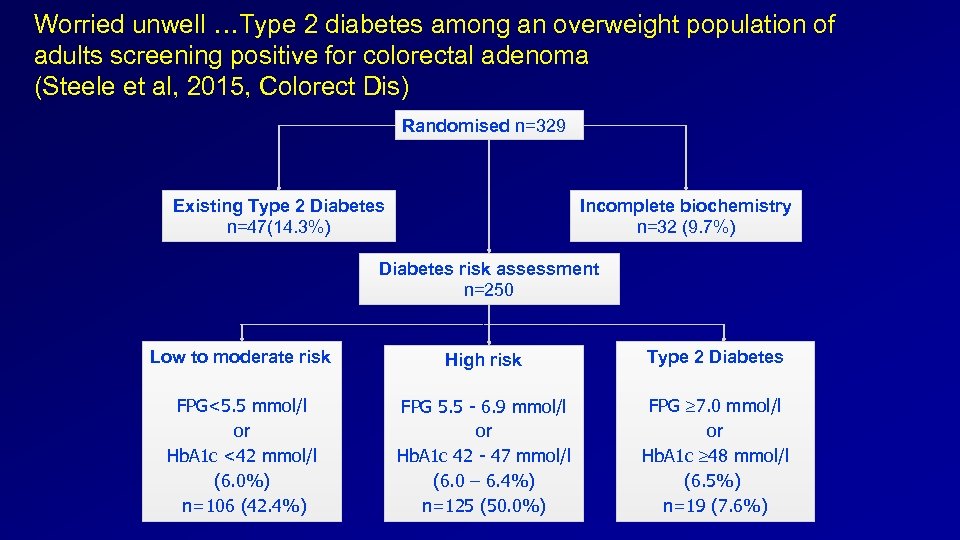
Worried unwell …Type 2 diabetes among an overweight population of adults screening positive for colorectal adenoma (Steele et al, 2015, Colorect Dis) Randomised n=329 Existing Type 2 Diabetes n=47(14. 3%) Incomplete biochemistry n=32 (9. 7%) Diabetes risk assessment n=250 Low to moderate risk High risk Type 2 Diabetes FPG<5. 5 mmol/l or Hb. A 1 c <42 mmol/l (6. 0%) n=106 (42. 4%) FPG 5. 5 - 6. 9 mmol/l or Hb. A 1 c 42 - 47 mmol/l (6. 0 – 6. 4%) n=125 (50. 0%) FPG 7. 0 mmol/l or Hb. A 1 c 48 mmol/l (6. 5%) n=19 (7. 6%)
But can people really change their lifestyle?
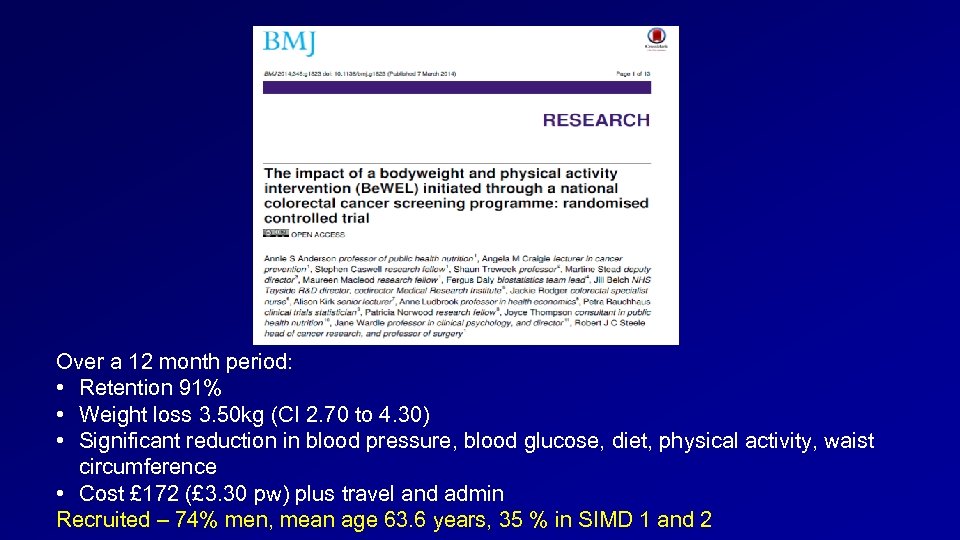
Over a 12 month period: • Retention 91% • Weight loss 3. 50 kg (CI 2. 70 to 4. 30) • Significant reduction in blood pressure, blood glucose, diet, physical activity, waist circumference • Cost £ 172 (£ 3. 30 pw) plus travel and admin Recruited – 74% men, mean age 63. 6 years, 35 % in SIMD 1 and 2
Conclusions Screening settings offer an opportunity for expert endorsement of lifestyle change for older adults, men and wide SES Absence of advice may create health certificate effect People ARE NOT knowledgeable about lifestyle and CRC People ARE interested in lifestyle intervention related to CANCER People with adenomas do respond positively to intervention initiation and maintenance Interventions can have positive effects on body weight and other health outcomes Lets not wait till diagnosis………….
Скачать презентацию Obesity prevention and control Lessons from campaigns
78f5bfb0a9b3f36ab043f5c95c0dcd54.ppt