 Скачать презентацию Obama s Health Insurance Reform is Simply a Bandaid
90fcdd02ae958ad5860963eb12b8f627.ppt
- Количество слайдов: 36



Obama’s “Health Insurance Reform” is Simply a Bandaid Leonard Rodberg, Ph. D Urban Studies Dept. , Queens College/CUNY and NY Metro Chapter, Physicians for a National Health Program PHIMG-PNHP-HCN Teach-in April 24, 2010 www. pnhpnymetro. org
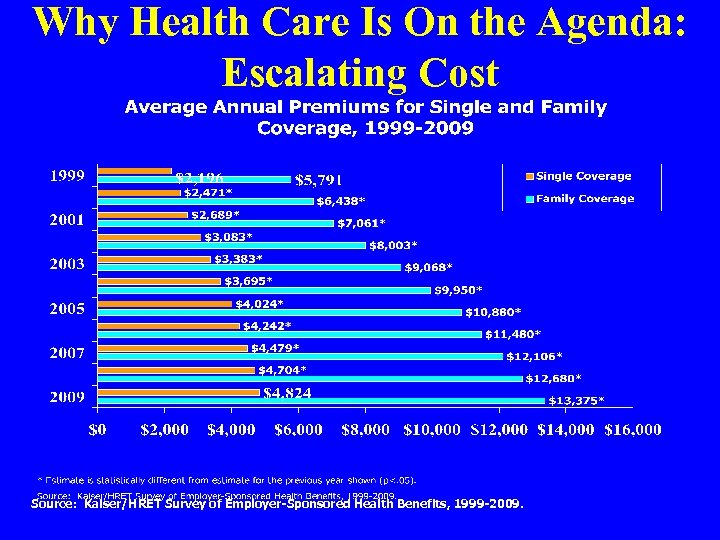
Why Health Care Is On the Agenda: Escalating Cost Source: Kaiser/HRET Survey of Employer-Sponsored Health Benefits, 1999 -2009.
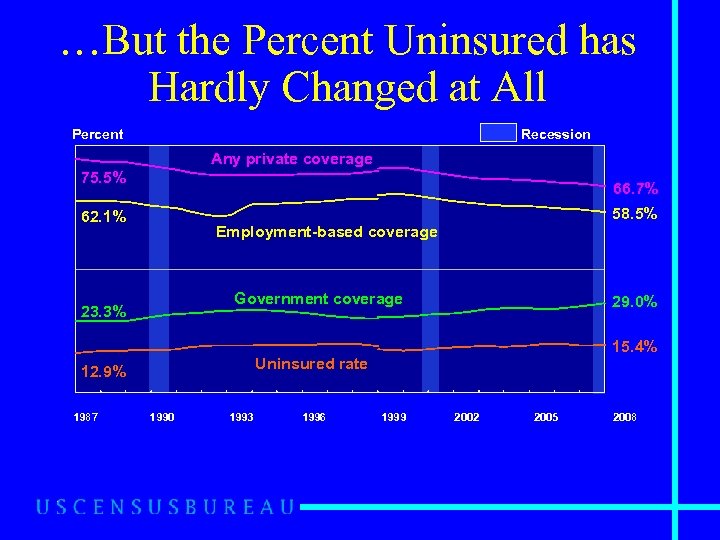
…But the Percent Uninsured has Hardly Changed at All 80 Percent Recession Any private coverage 75. 5% 60 66. 7% 62. 1% 58. 5% Employment-based coverage 40 Government coverage 23. 3% 29. 0% 20 15. 4% Uninsured rate 12. 9% 0 1987 1990 1993 1996 1999 2002 2005 2008 Note: The estimates by type of coverage are not mutually exclusive. Source: U. S. Census Bureau, Current Population Survey, 1988 to 2009 Annual Social and Economic Supplements. 19
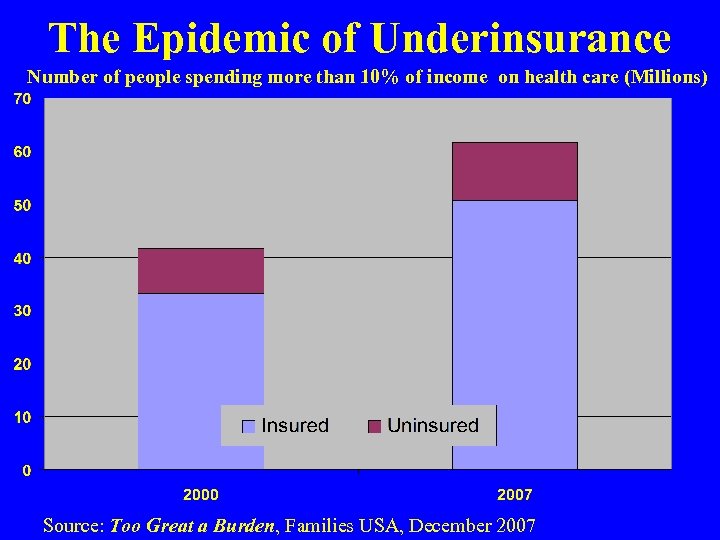
The Epidemic of Underinsurance Number of people spending more than 10% of income on health care (Millions) Source: Too Great a Burden, Families USA, December 2007
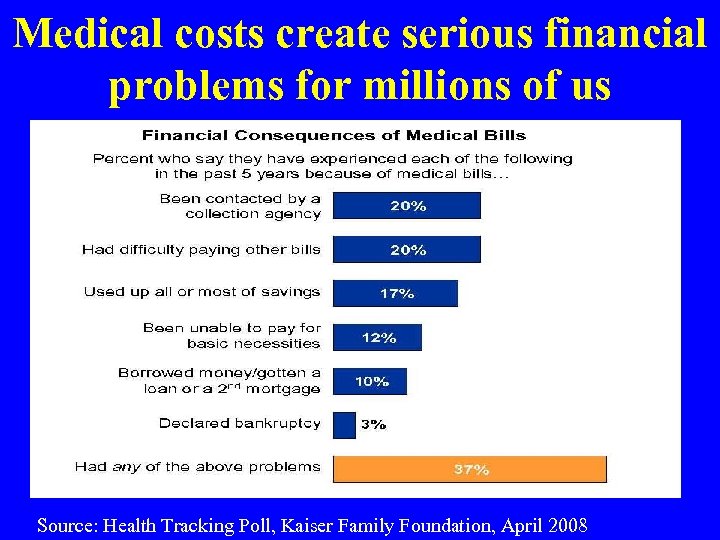
Medical costs create serious financial problems for millions of us Source: Health Tracking Poll, Kaiser Family Foundation, April 2008
Goals of Health Care Reform • Assure access to health care for everyone • At a cost that the nation, and every individual, can afford. Obama’s “health insurance reform” fails to achieve either universal access or cost containment.
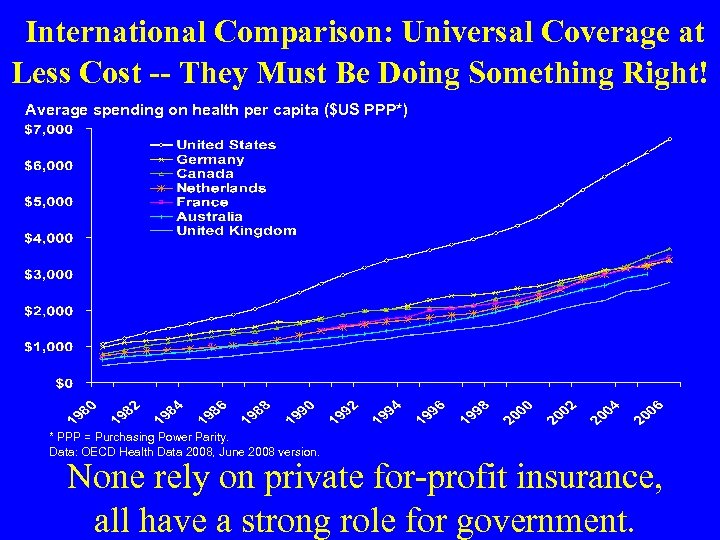
International Comparison: Universal Coverage at Less Cost -- They Must Be Doing Something Right! Average spending on health per capita ($US PPP*) * PPP = Purchasing Power Parity. Data: OECD Health Data 2008, June 2008 version. None rely on private for-profit insurance, all have a strong role for government.
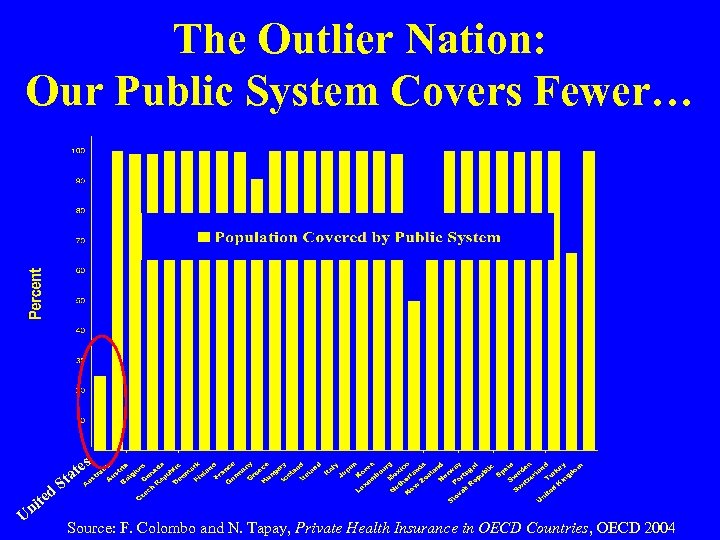
The Outlier Nation: Our Public System Covers Fewer… te ni U d tes a St Source: F. Colombo and N. Tapay, Private Health Insurance in OECD Countries, OECD 2004
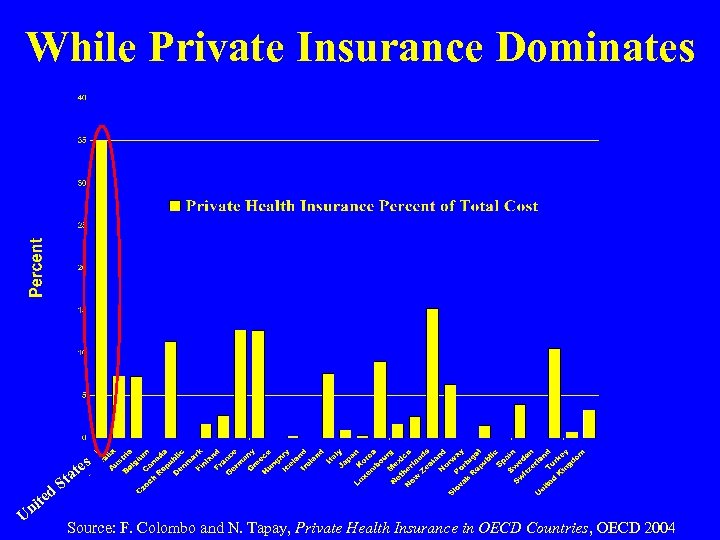
While Private Insurance Dominates te ni U d tes a St Source: F. Colombo and N. Tapay, Private Health Insurance in OECD Countries, OECD 2004
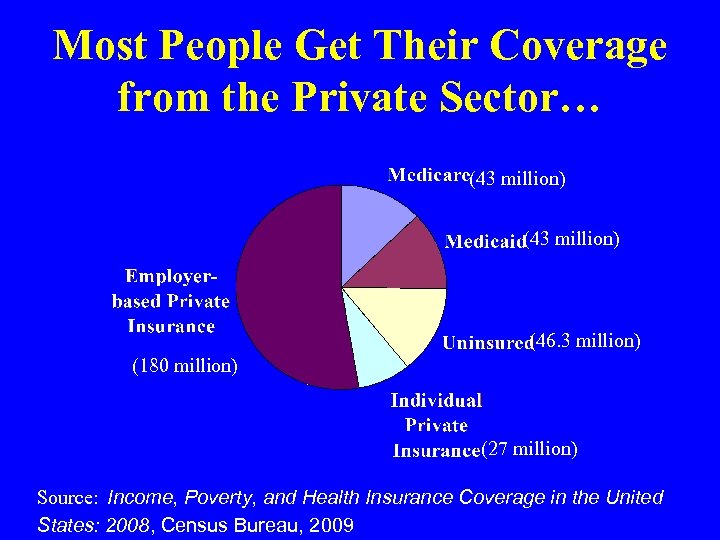
Most People Get Their Coverage from the Private Sector… (43 million) (46. 3 million) (180 million) (27 million) Source: Income, Poverty, and Health Insurance Coverage in the United States: 2008, Census Bureau, 2009
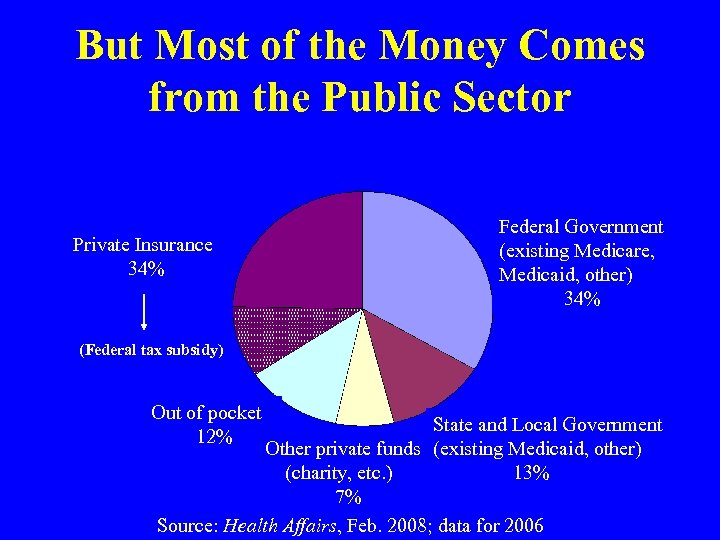
But Most of the Money Comes from the Public Sector Private Insurance 34% Federal Government (existing Medicare, Medicaid, other) 34% (Federal tax subsidy) Out of pocket 12% State and Local Government Other private funds (existing Medicaid, other) 13% (charity, etc. ) 7% Source: Health Affairs, Feb. 2008; data for 2006
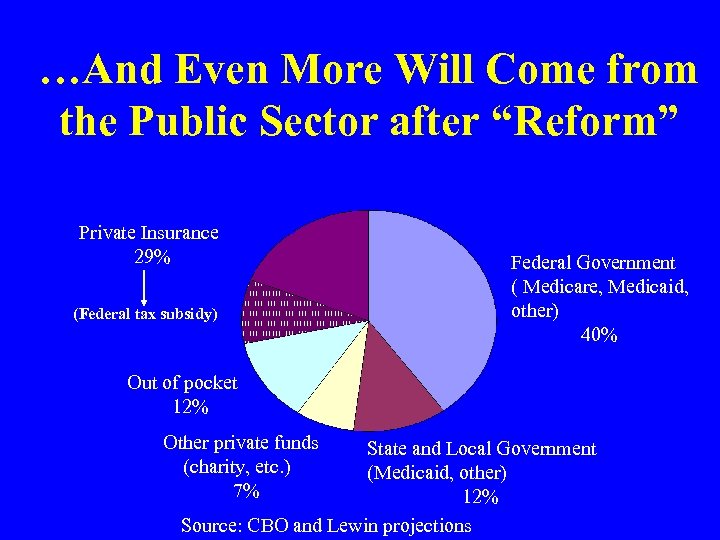
…And Even More Will Come from the Public Sector after “Reform” Private Insurance 29% (Federal tax subsidy) Federal Government ( Medicare, Medicaid, other) 40% Out of pocket 12% Other private funds (charity, etc. ) 7% State and Local Government (Medicaid, other) 12% Source: CBO and Lewin projections
The President’s Fateful Choice • In creating a reform plan, the President could have chosen to -- build on the public sector, especially Medicare, or -- expand the private sector. • He chose to expand private insurance. • Since private insurance is unaffordable to many and deficient in so many ways, he has created a program that will not achieve the basic goals of health care reform.
The Great Dealmaker The Obama Administration made a series of deals to pass this law: • The insurance industry: Assured that everyone would be required to buy their product, and there would be no public option • The drug industry: No negotiation on price • The AMA: No cut in physician fees • Hospitals: No cut in reimbursements, only slower growth in payments • Employers: Continued control of health benefits • Nervous members of the public: “You can keep what you have”
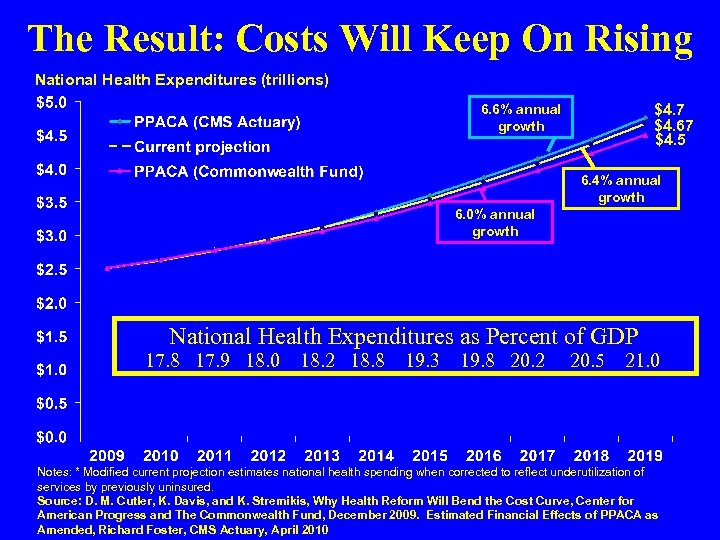
The Result: Costs Will Keep On Rising National Health Expenditures (trillions) $4. 7 $4. 67 $4. 5 6. 6% annual growth 6. 4% annual growth 6. 0% annual growth National Health Expenditures as Percent of GDP 17. 8 17. 9 18. 0 18. 2 18. 8 19. 3 19. 8 20. 2 20. 5 21. 0 Notes: * Modified current projection estimates national health spending when corrected to reflect underutilization of services by previously uninsured. Source: D. M. Cutler, K. Davis, and K. Stremikis, Why Health Reform Will Bend the Cost Curve, Center for American Progress and The Commonwealth Fund, December 2009. Estimated Financial Effects of PPACA as Amended, Richard Foster, CMS Actuary, April 2010
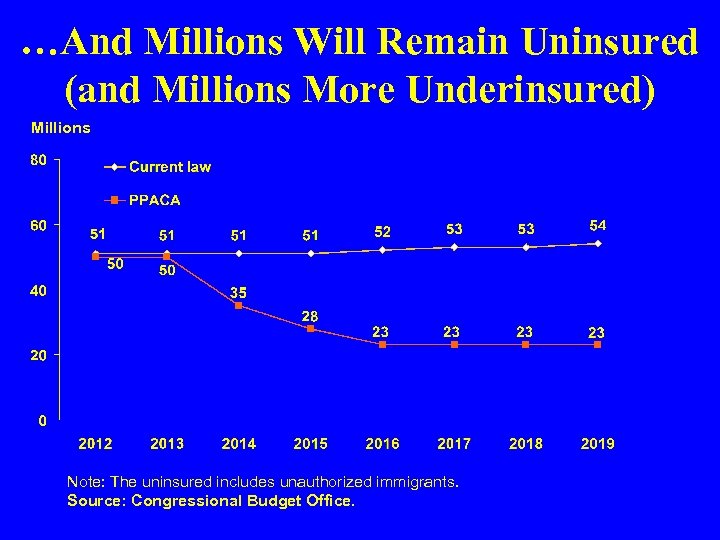
…And Millions Will Remain Uninsured (and Millions More Underinsured) Millions Note: The uninsured includes unauthorized immigrants. Source: Congressional Budget Office.
The Patient Protection and Affordable Care Act (PPACA) will be implemented over ten years… Between 2010 – 2013: • Insurance companies required to cover dependent children up to age 26 • Establishes high-risk insurance pool for persons with preexisting conditions • Prohibits lifetime limits on coverage • Tax credits for small (<25) employers to buy insurance • Require reporting of medical loss ratios, consumer rebates if they are less than 80% • Government review of increases in insurance premiums • Simplify health insurance forms and claims filing
Between 2010 – 2013 (cont. ): • Increase supply and training of health professionals, especially in primary care • Increase funding for community health centers • Increase Medicare reimbursement for primary care • Begin closing the Medicare drug benefit “donut hole”, finally closed in 2020 • Limits payments to private Medicare Advantage plans • Creates pilot programs in Medicare to reduce costs • Increases Medicare taxes on the wealthy in 2013 • States allowed to expand Medicaid to all below 133% poverty
Starting in 2014: The Insurance Mandate • Citizens and legal immigrants required to buy insurance • Penalties up to 2. 5% of income for failing to be insured • Large (>50) employers must offer insurance or pay fine of $2000 per employee • Employment-based insurance otherwise unchanged, so most people will see little change • Continued reliance on private insurance • No regulation of insurance company premiums, or payment and denial practices • No public option • No cost savings or realistic way to control costs No change in the structure of health care finance
Starting in 2014 (cont. ) : • The uninsured and small employers can access a statebased insurance exchange • Premiums can vary with age (3: 1), geography, family composition, tobacco use, not medical condition • Subsidies in the exchange up to 400% of Federal poverty level ($43 K individual/$73 K family) • Undocumented immigrants cannot use the exchange • No subsidies for abortions • Deductibles/copays up to $5, 950 individual/$11, 900 family • “Hardship waiver”: If premium > 8% of income, can remain uninsured • Medicaid expanded to all below 133% of poverty level
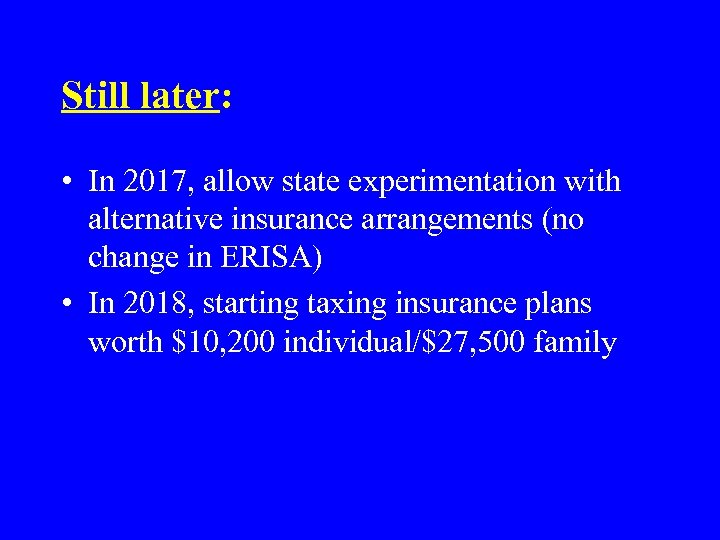
Still later: • In 2017, allow state experimentation with alternative insurance arrangements (no change in ERISA) • In 2018, starting taxing insurance plans worth $10, 200 individual/$27, 500 family
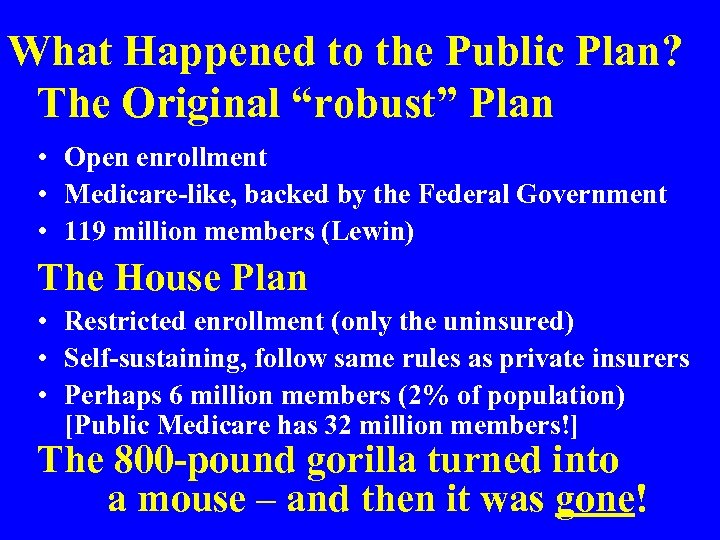
What Happened to the Public Plan? The Original “robust” Plan • Open enrollment • Medicare-like, backed by the Federal Government • 119 million members (Lewin) The House Plan • Restricted enrollment (only the uninsured) • Self-sustaining, follow same rules as private insurers • Perhaps 6 million members (2% of population) [Public Medicare has 32 million members!] The 800 -pound gorilla turned into a mouse – and then it was gone!
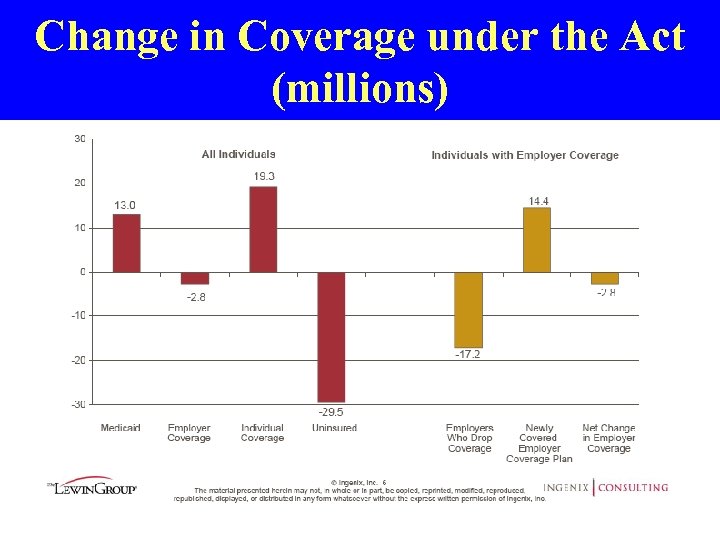
Change in Coverage under the Act (millions)
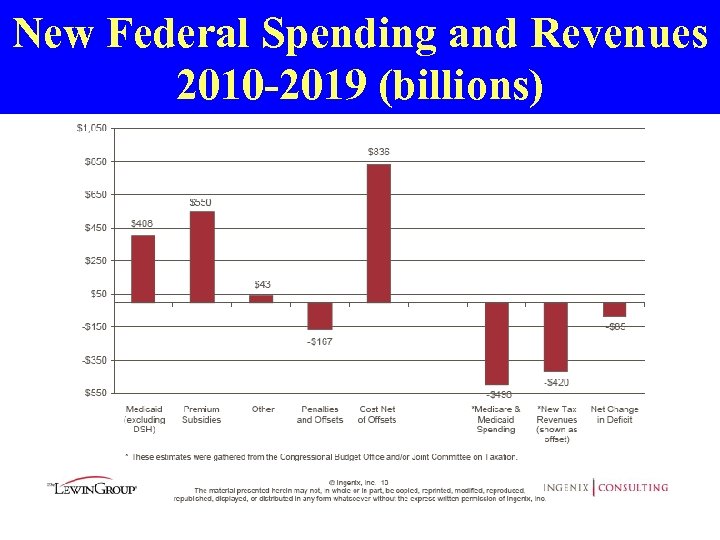
New Federal Spending and Revenues 2010 -2019 (billions)
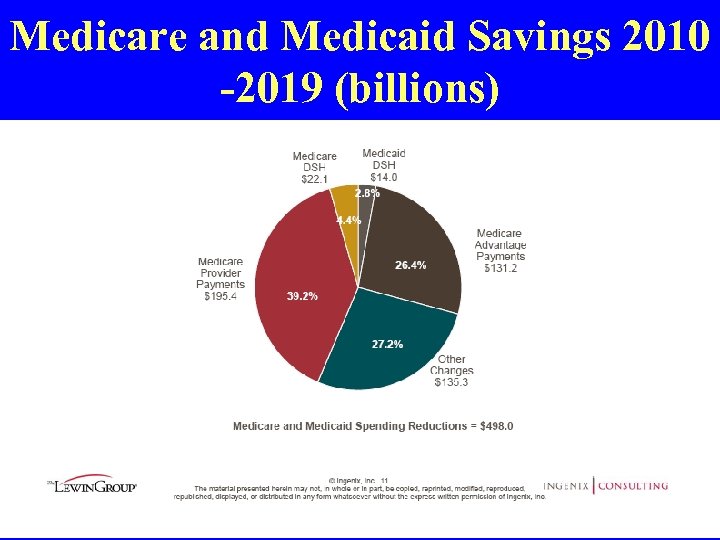
Medicare and Medicaid Savings 2010 -2019 (billions)
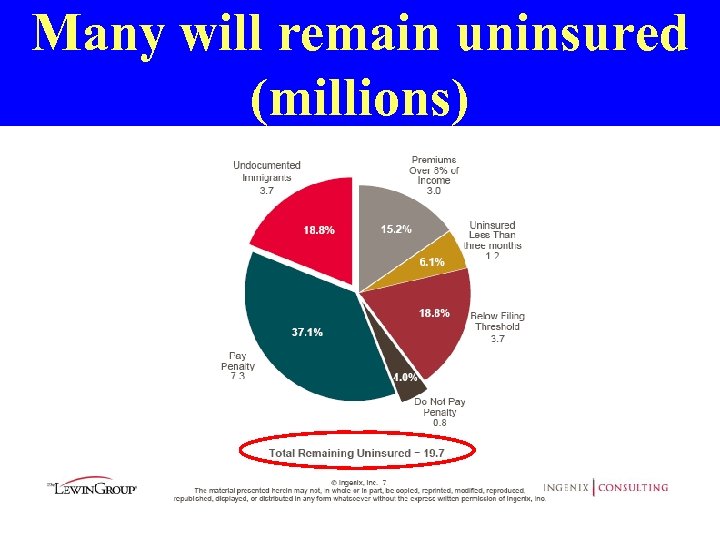
Many will remain uninsured (millions)
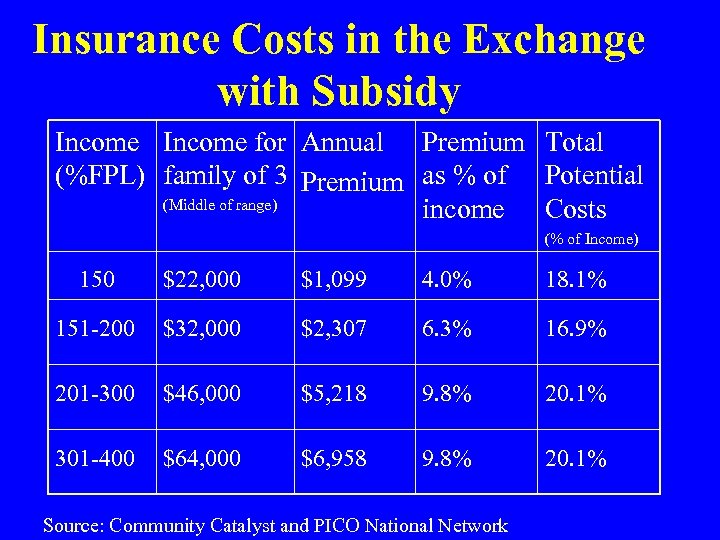
Insurance Costs in the Exchange with Subsidy Income for Annual Premium Total (%FPL) family of 3 Premium as % of Potential (Middle of range) income Costs (% of Income) 150 $22, 000 $1, 099 4. 0% 18. 1% 151 -200 $32, 000 $2, 307 6. 3% 16. 9% 201 -300 $46, 000 $5, 218 9. 8% 20. 1% 301 -400 $64, 000 $6, 958 9. 8% 20. 1% Source: Community Catalyst and PICO National Network
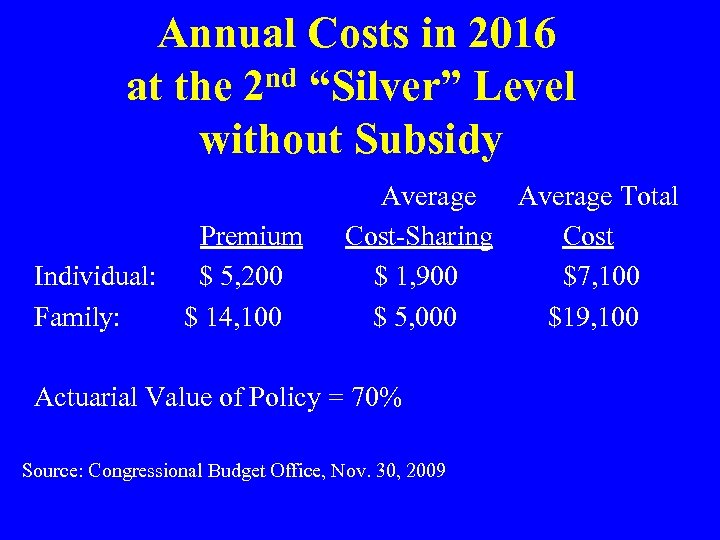
Annual Costs in 2016 nd “Silver” Level at the 2 without Subsidy Premium Individual: $ 5, 200 Family: $ 14, 100 Average Total Cost-Sharing Cost $ 1, 900 $7, 100 $ 5, 000 $19, 100 Actuarial Value of Policy = 70% Source: Congressional Budget Office, Nov. 30, 2009
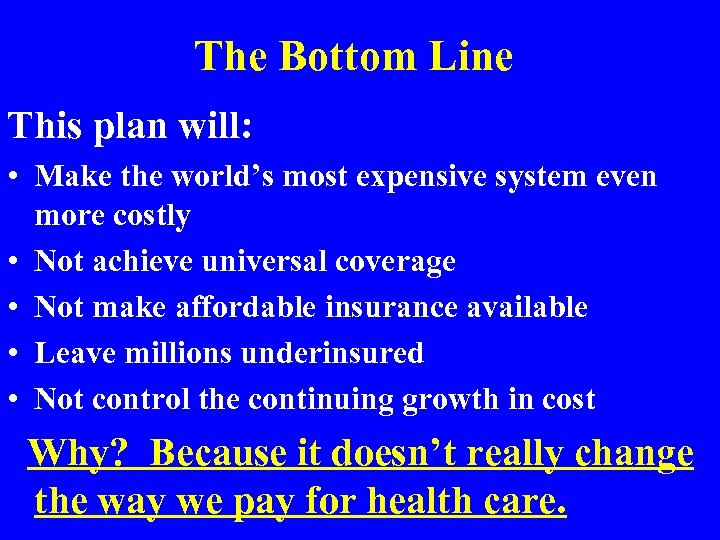
The Bottom Line This plan will: • Make the world’s most expensive system even more costly • Not achieve universal coverage • Not make affordable insurance available • Leave millions underinsured • Not control the continuing growth in cost Why? Because it doesn’t really change the way we pay for health care.
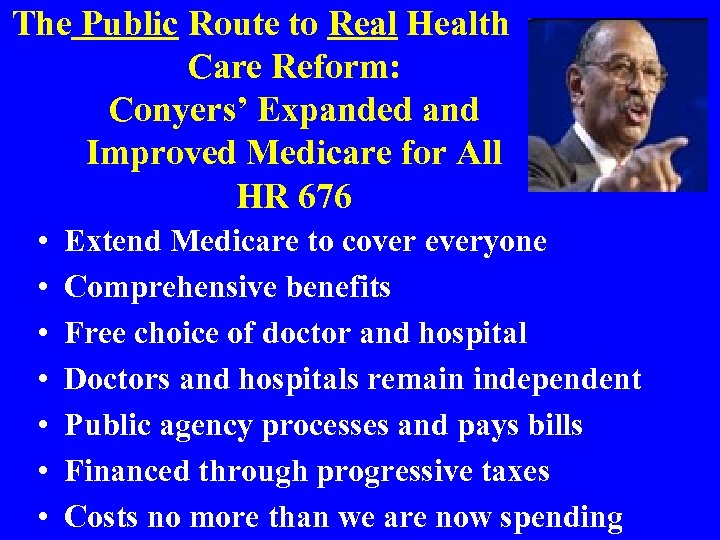
The Public Route to Real Health Care Reform: Conyers’ Expanded and Improved Medicare for All HR 676 • • Extend Medicare to cover everyone Comprehensive benefits Free choice of doctor and hospital Doctors and hospitals remain independent Public agency processes and pays bills Financed through progressive taxes Costs no more than we are now spending
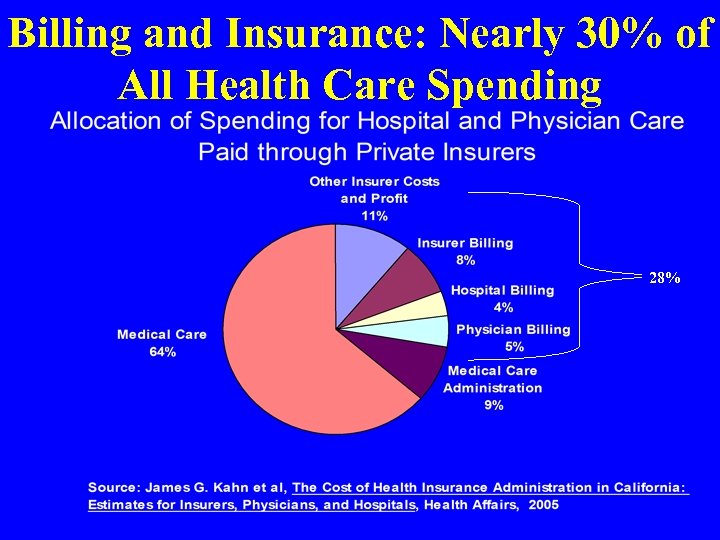
Billing and Insurance: Nearly 30% of All Health Care Spending 28%
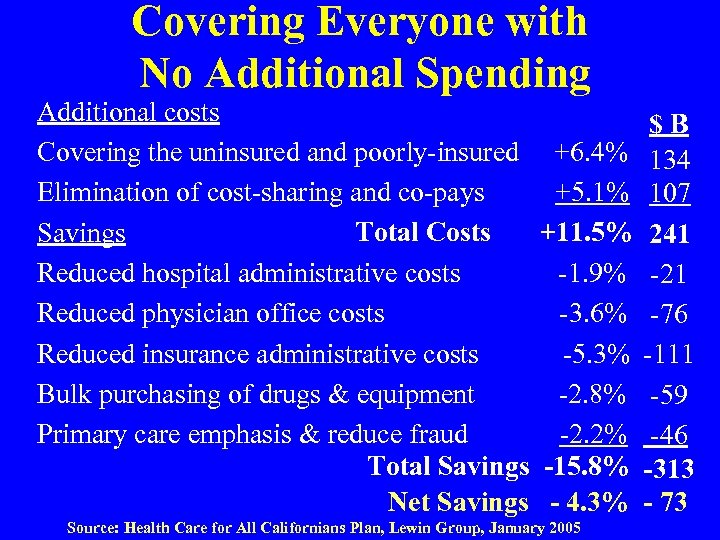
Covering Everyone with No Additional Spending Additional costs Covering the uninsured and poorly-insured Elimination of cost-sharing and co-pays Total Costs Savings Reduced hospital administrative costs Reduced physician office costs Reduced insurance administrative costs Bulk purchasing of drugs & equipment Primary care emphasis & reduce fraud Total Savings Net Savings +6. 4% +5. 1% +11. 5% -1. 9% -3. 6% -5. 3% -2. 8% -2. 2% -15. 8% - 4. 3% Source: Health Care for All Californians Plan, Lewin Group, January 2005 $B 134 107 241 -21 -76 -111 -59 -46 -313 - 73
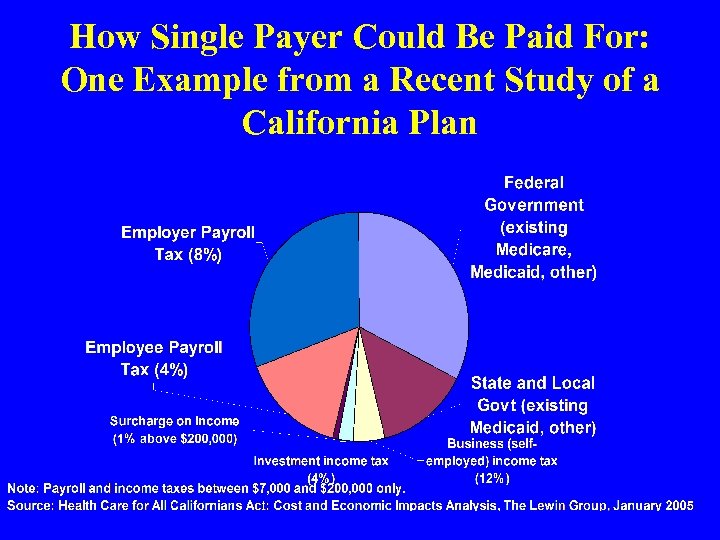
How Single Payer Could Be Paid For: One Example from a Recent Study of a California Plan
Single payer offers real tools to contain costs • Budgeting, especially for hospitals • Capital investment planning • Emphasis on primary care, coordination of care, and alternative ways of paying for services • Bulk purchasing
Conclusion • • This system based on private insurance plans will not lead to universal coverage, and it cannot control costs. An expanded Medicare for All system can provide comprehensive services while costing no more than we now spend and providing tools to control costs in the future. The problems of the health care system will not go away. Real health care reform, built on Medicare for All, continues to be essential.
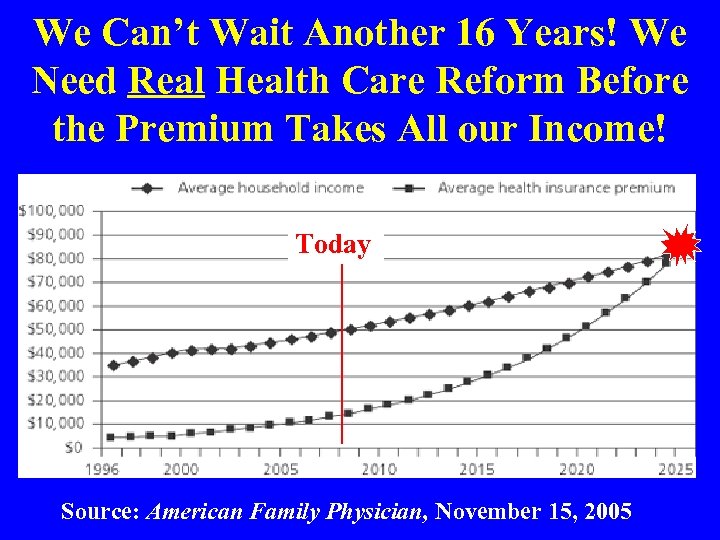
We Can’t Wait Another 16 Years! We Need Real Health Care Reform Before the Premium Takes All our Income! Today Source: American Family Physician, November 15, 2005
Скачать презентацию Obama s Health Insurance Reform is Simply a Bandaid
90fcdd02ae958ad5860963eb12b8f627.ppt