


 Скачать презентацию Ø В какое время писал Д Чосер Ø
21197d2ab190b60548ee0f98f81903b2.ppt
- Количество слайдов: 26
 Ø В какое время писал Д. Чосер? Ø На каком диалекте писал Д. Чосер? Ø В чем заключается ценность Кентерберийских рассказов (с точки зрения истории английского языка)? Ø О чем это произведение?
 Middle English Vocabulary
 Internal means of enriching the vocabulary Ø Suffixation - er (it was used to form nouns both from originally OE words and borrowed ones): leader, worker, traveler, hunter, gardener Ø - ing: meeting, fighting Ø
 Ø - man: craftsman, gentleman Ø - y (from - iʒ): angry, happy, hearty Ø - ful, - less: doubtful, doubtless, Ø -en: happen, loosen, blacken
 Ø Prefixes Ø Mis -, un -, be - : betray, belong, unbind, misunderstand Ø New way of word-building: from homonymous forms of nouns and verbs: chance, call, smile Ø Compounding: penknife, bonfire, breakfast, afternoon.
 Scandinavian borrowings Ø The consequences of various borrowing were different: Ø 1. A new word was added to the vocabulary (because there was no synonym in English): law, fellow (fē +laga – ‘имущество’ и ‘складывать’)
 2. The English synonym was replaced by the borrowing: Ø niman - taken Ø clypian - callen Ø ēāʒþyrel (‘глаз’ ‘отверстие’) - wundoʒe «глаз ветра» vindauga
 3. Both the English and the corresponding Scandinavian words are preserved but they become different in meaning: Ø heaven - sky Ø starve - die
 Ø 4. Etymological doublets (words originating from the same source in Common Germanic): Ø shirt - skirt Ø shatter - scatter Ø raise - rear
 5. Doublets that were the same in meaning but slightly different phonetically: give, get (from Sc. gefa, geta, cf. OE Ʒiefan, Ʒietan) 6. There may be a shift of meaning: dream – in OE had the meaning of ‘joy, pleasure’, bread – ‘a piece’.
 French borrowings Ø The words borrowed from French are found in many areas: Ø Government and Administration: govern, government, administer, crown, state, empire, royal, majesty, treaty, statute, parliament, tax, rebel, traitor, treason, exile, chancellor, treasurer, major, noble, peer, princess, duke, squire, peasant, slave, servant, vassal.
 Ø Law: justice, equity, plaintiff, judge, advocate, attorney, petition, inquest, felon, evidence, sue, accuse arrest, blame, libel, slander, felony, adultery, property, estate, heir, executor.
 Ø Military: army, navy, peace, enemy, arms, battle, spy, combat, siege, defence, ambush, soldier, guard, mail, buckler, banner, lance, besiege, defend, array.
 theology, sermon, confession, clergy, cardinal, friar, crucifix, miter, censer lectern, abbey, convent, creator, savior, virgin, faith, heresy, schism, solemn, divine, devout, preach, pray, adore, confess. Ø Religion:
 Ø Clothing: habit, gown, robe, garment, attire, cape, coat, collar, petticoat, train, lace, embroidery, pleat, buckle, button, tassel, plume, satin, taffeta, fur, sable, blue, brown, vermilion, russet, tawny, jewel, ornament, broach, ivory, turquoise, topaz, garnet, ruby, pearl, diamond
 Ø Food: feast, repast, collation, mess, appetite, tart, sole, perch, sturgeon, sardine, venison, beef, veal, mutton, port, bacon, toast, cream, sugar, salad, raisin, jelly, spice, clove, thyme.
 Ø Art, Learning, Medicine: painting, sculpture, music, beauty, color, image, cathedral, palace, mansion, chamber, ceiling, porch, column, poet, prose, romance, paper, pen, volume, chapter, study, logic, geometry, grammar, noun, gender, physician, malady, pain, gout, plague, pulse, remedy, poison.
 Turns of phrase: by heart, on the point of, without doubt, have mercy on, come to a head, take pity on.
 Ø Productive affixes from French: pre-, super-, inter-, sub-, dis-, -ance, -ence, ant, -ment, -tion.
 Borrowings from French had several effects on English: Ø Native words were replaced: Ø OE aeðele – F. noble; Ø OE aeðeling – F. nobleman; Ø OE here – F. army; Ø OE campa – F. warrior; Ø OE sibb – F. peace; Ø OE leod – F. people; Ø OE stow - Fr. place.
 Ø English and French words were retained with a differentiation in meaning: Ø hearty – cordial; Ø ox – beef; Ø sheep – mutton; Ø swine – pork; Ø calf – veal; Ø house – mansion.
 Latin Borrowings Ø In a sense the French words were Latin borrowings since French developed from Vulgar Latin--as did all the Romance languages. Ø The borrowings that came directly from Latin tended to be more learned in character – e. g. , allegory, index, magnify, mechanical, private, secular, zenith.
 Ø It has been pointed out that as a result of Middle English borrowing from French and Latin, Modern English has synonyms on three levels: popular (English), literary (French), and learned (Latin), as in rise – mount – ascend; ask – question – interrogate; fire – flame – conflagration; holy – sacred – consecrated.
 Norman French vs. Parisian French Ø Norman French (northern dialect of French) dominated for 200 years (Norman loans into English) Ø Paris becomes the center of France Ø Parisian French became the prestigious dialect (Parisian loans)
![Norman French Sound [w] Parisian French No sound [w], it was replaced by g(u)](https://present5.com/presentation/21197d2ab190b60548ee0f98f81903b2/image-25.jpg "Norman French Sound [w] Parisian French No sound [w], it was replaced by g(u)") Norman French Sound [w] Parisian French No sound [w], it was replaced by g(u) Warrant Warden reward wile William = Guillaume war (werre) =guerre Guarantee Guardian regard guile
Norman French Sound [w] Parisian French No sound [w], it was replaced by g(u) Warrant Warden reward wile William = Guillaume war (werre) =guerre Guarantee Guardian regard guile
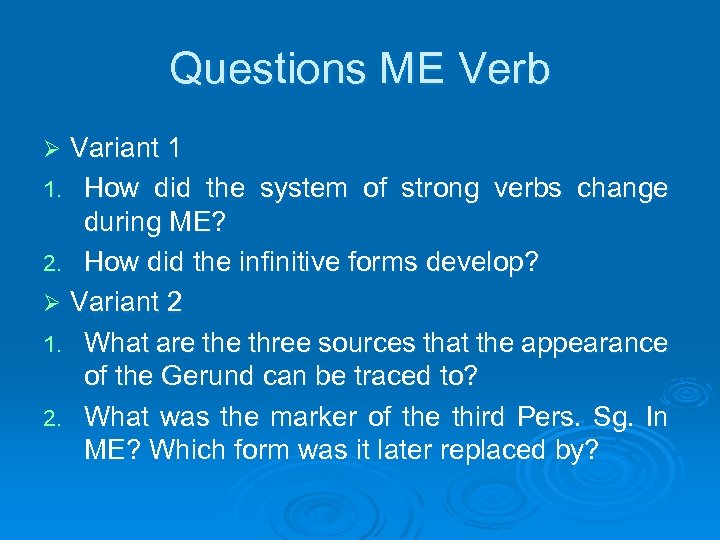 Questions ME Verb Variant 1 1. How did the system of strong verbs change during ME? 2. How did the infinitive forms develop? Ø Variant 2 1. What are three sources that the appearance of the Gerund can be traced to? 2. What was the marker of the third Pers. Sg. In ME? Which form was it later replaced by? Ø