 Скачать презентацию º— December 9 th 2008 Bar-coding of CIP s
6399698bb8ebd93ebc5838a82a068a13.ppt
- Количество слайдов: 25



º--- December 9 th, 2008 Bar-coding of CIP’s Genebank and adoption by other CGIAR centers Edwin Rojas System Analyst & Research Database Administrator Research Informatics Unit (RIU) CIP Workshop 2008 for WARDA CIP, Peru
Agenda • • Genebank & Barcode Technology Benefits of Barcode KIT Implementation Outputs: Software for CIP Genebank Support Outcomes: CGIAR Centers & ISO Support • Continue Extending Barcode Facilities (pilots)
Agenda • • • Genebank & Barcode Technology Benefits of Barcode KIT Implementation Outputs: CIP Genebank Support Outcomes: CGIAR Centers & ISO Support Continue Extending Barcode Facilities (pilots)
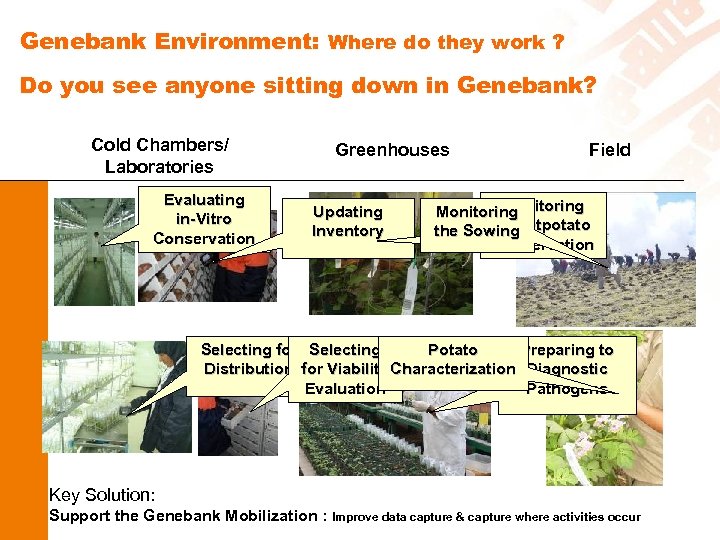
Genebank Environment: Where do they work ? Do you see anyone sitting down in Genebank? Cold Chambers/ Laboratories Evaluating in-Vitro Conservation Greenhouses Updating Inventory Field Monitoring Sweetpotato the Sowing Conservation Selecting for Selecting Potato Preparing to Distribution for Viability Characterization Diagnostic Evaluation Pathogens Key Solution: Support the Genebank Mobilization : Improve data capture & capture where activities occur
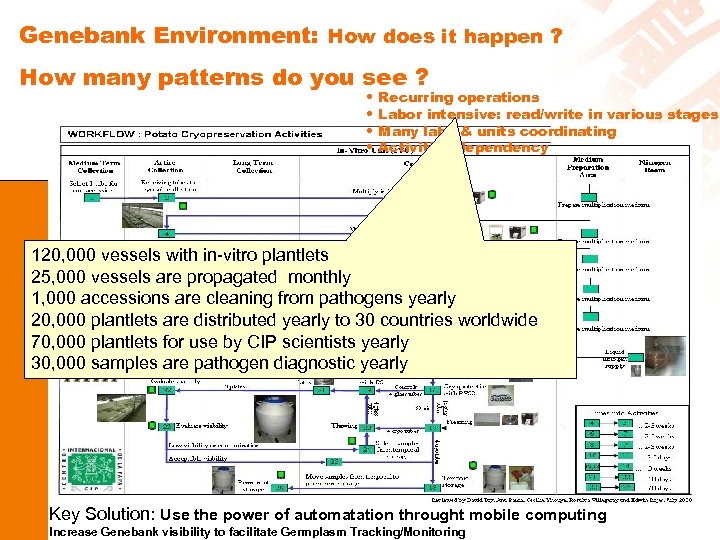
Genebank Environment: How does it happen ? How many patterns do you see ? • • Recurring operations Labor intensive: read/write in various stages Many labs & units coordinating Activities dependency 120, 000 vessels with in-vitro plantlets 25, 000 vessels are propagated monthly 1, 000 accessions are cleaning from pathogens yearly 20, 000 plantlets are distributed yearly to 30 countries worldwide 70, 000 plantlets for use by CIP scientists yearly 30, 000 samples are pathogen diagnostic yearly Key Solution: Use the power of automatation throught mobile computing Increase Genebank visibility to facilitate Germplasm Tracking/Monitoring
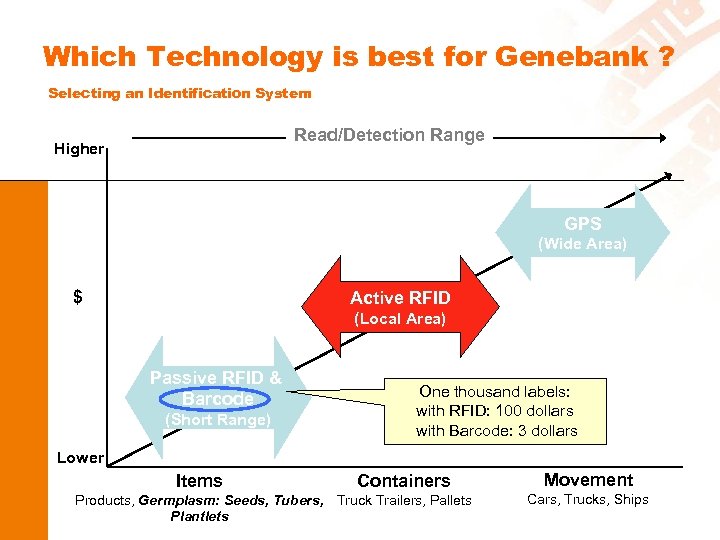
Which Technology is best for Genebank ? Selecting an Identification System Read/Detection Range Higher GPS (Wide Area) $ Active RFID (Local Area) Passive RFID & Barcode (Short Range) One thousand labels: with RFID: 100 dollars with Barcode: 3 dollars Lower Items Containers Products, Germplasm: Seeds, Tubers, Truck Trailers, Pallets Plantlets Movement Cars, Trucks, Ships
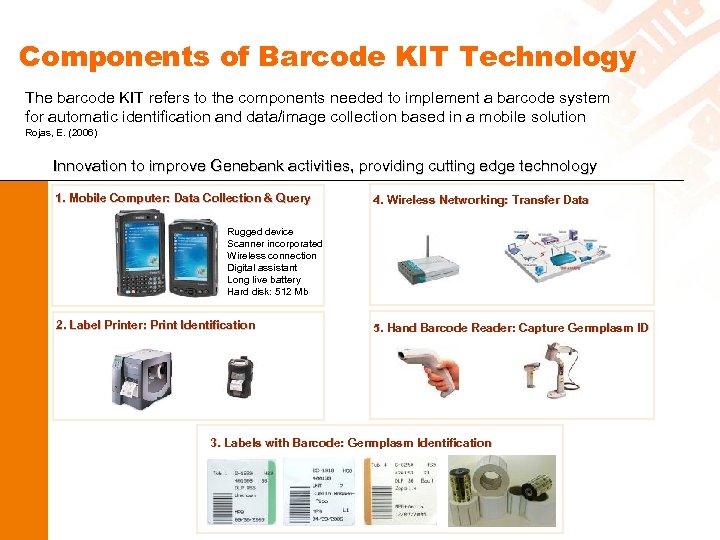
Components of Barcode KIT Technology The barcode KIT refers to the components needed to implement a barcode system for automatic identification and data/image collection based in a mobile solution Rojas, E. (2006) Innovation to improve Genebank activities, providing cutting edge technology 1. Mobile Computer: Data Collection & Query 4. Wireless Networking: Transfer Data Rugged device Scanner incorporated Wireless connection Digital assistant Long live battery Hard disk: 512 Mb 2. Label Printer: Print Identification 5. Hand Barcode Reader: Capture Germplasm ID 3. Labels with Barcode: Germplasm Identification
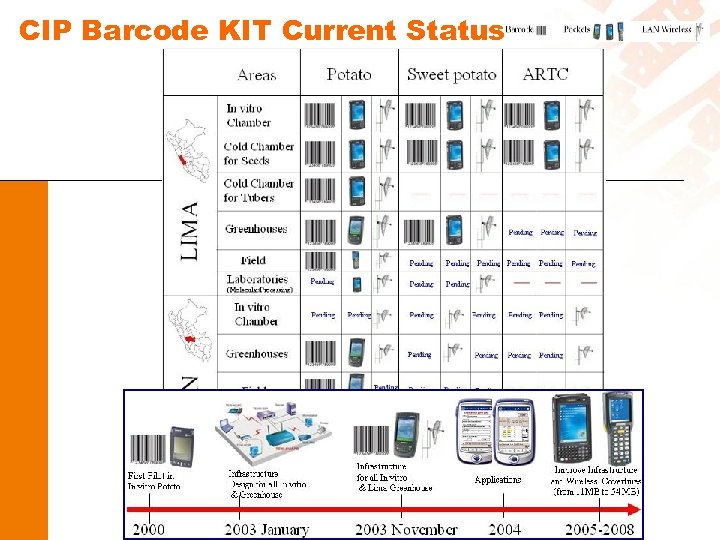
CIP Barcode KIT Current Status
Agenda • • • Genebank & Barcode Technology Benefits of Barcode KIT Implementation Outputs: CIP Genebank Support Outcomes: CGIAR Centers & ISO Support Continue Extending Barcode Facilities (pilots)
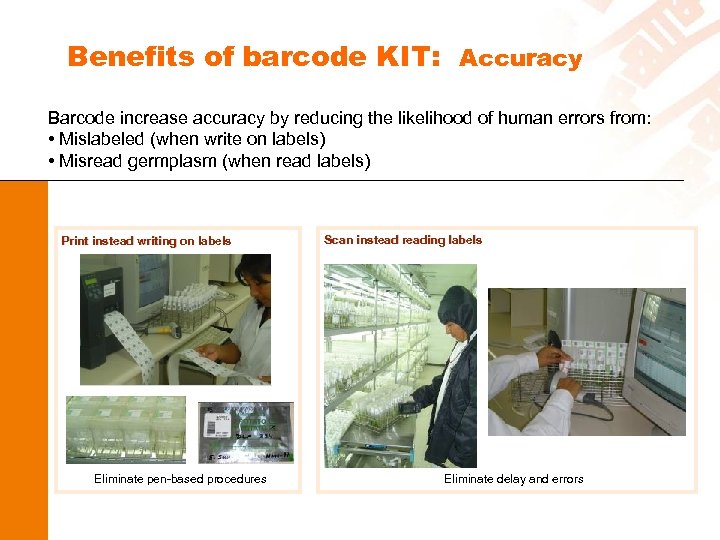
Benefits of barcode KIT: Accuracy Barcode increase accuracy by reducing the likelihood of human errors from: • Mislabeled (when write on labels) • Misread germplasm (when read labels) Print instead writing on labels Eliminate pen-based procedures Scan instead reading labels Eliminate delay and errors
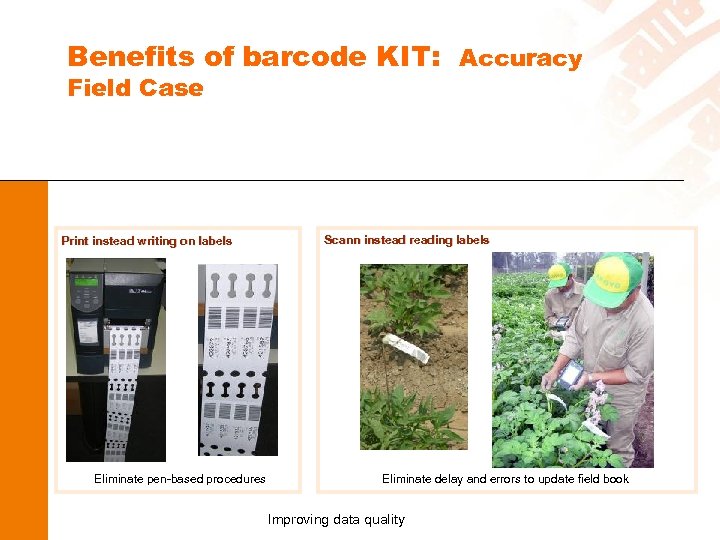
Benefits of barcode KIT: Accuracy Field Case Print instead writing on labels Eliminate pen-based procedures Scann instead reading labels Eliminate delay and errors to update field book Improving data quality
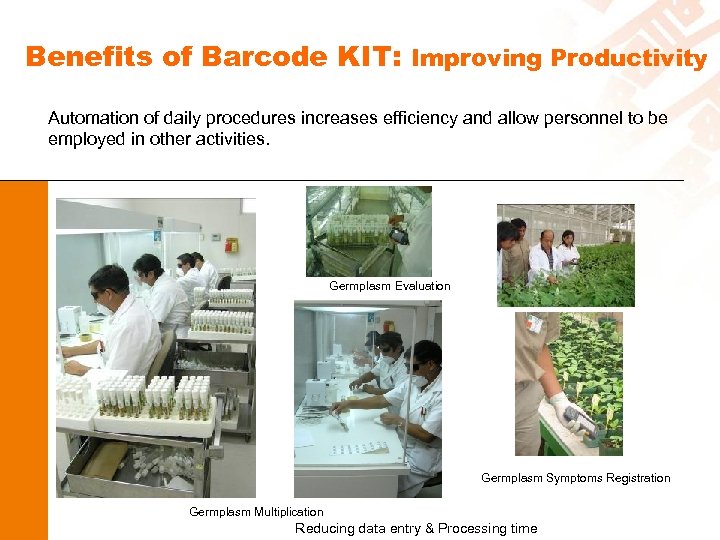
Benefits of Barcode KIT: Improving Productivity Automation of daily procedures increases efficiency and allow personnel to be employed in other activities. Germplasm Evaluation Germplasm Symptoms Registration Germplasm Multiplication Reducing data entry & Processing time
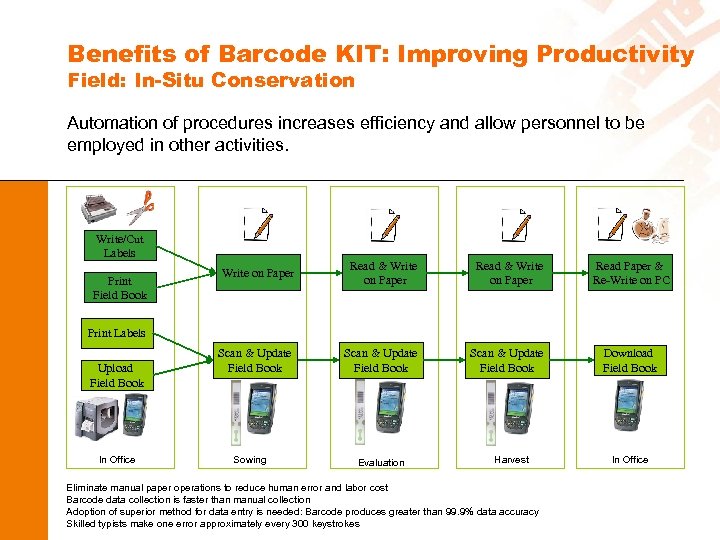
Benefits of Barcode KIT: Improving Productivity Field: In-Situ Conservation Automation of procedures increases efficiency and allow personnel to be employed in other activities. Write/Cut Labels Print Field Book Write on Paper Read & Write on Paper Read Paper & Re-Write on PC Scan & Update Field Book Download Field Book Print Labels Upload Field Book In Office Sowing Evaluation Harvest Eliminate manual paper operations to reduce human error and labor cost Barcode data collection is faster than manual collection Adoption of superior method for data entry is needed: Barcode produces greater than 99. 9% data accuracy Skilled typists make one error approximately every 300 keystrokes In Office
Agenda • • • Genebank & Barcode Technology Benefits of Barcode KIT Implementation Outputs: CIP Genebank Support Outcomes: CGIAR Centers & ISO Support Continue Extending Barcode Facilities (pilots)
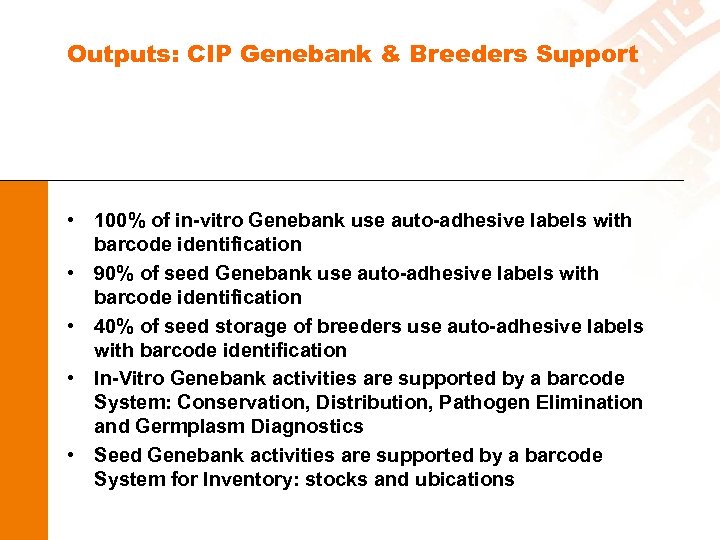
Outputs: CIP Genebank & Breeders Support • 100% of in-vitro Genebank use auto-adhesive labels with barcode identification • 90% of seed Genebank use auto-adhesive labels with barcode identification • 40% of seed storage of breeders use auto-adhesive labels with barcode identification • In-Vitro Genebank activities are supported by a barcode System: Conservation, Distribution, Pathogen Elimination and Germplasm Diagnostics • Seed Genebank activities are supported by a barcode System for Inventory: stocks and ubications
Agenda • • • Genebank & Barcode Technology Benefits of Barcode KIT Implementation Outputs: CIP Genebank Support Outcomes: CGIAR Centers & ISO Support Continue Extending Barcode Facilities (pilots)
Support to CGIAR Centers on Barcodes • Already in 2006 the barcode systems was recognized as providing CIP with comparative advantages to support Genebank activities: By an external review by the World Bank • Further recognition was provided implicitly through the World Bank funded project ’Global Public Goods 2 where CIP leads an activity to disseminate respective best practices and tools • Representative of CGIAR Centers were present in CIP workshop 2008: • Training for IT support staff on barcode • Exchange of best practices on barcode
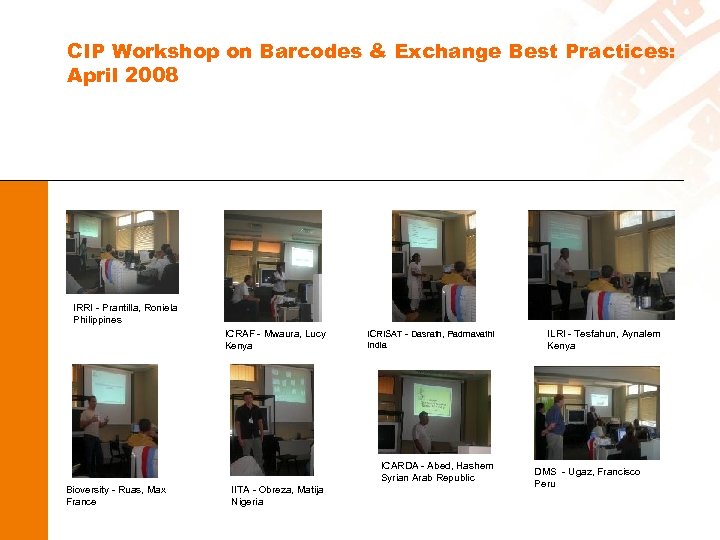
CIP Workshop on Barcodes & Exchange Best Practices: April 2008 IRRI - Prantilla, Roniela Philippines ICRAF - Mwaura, Lucy Kenya ICRISAT - Dasrath, Padmavathi India ICARDA - Abed, Hashem Syrian Arab Republic Bioversity - Ruas, Max France IITA - Obreza, Matija Nigeria ILRI - Tesfahun, Aynalem Kenya DMS - Ugaz, Francisco Peru
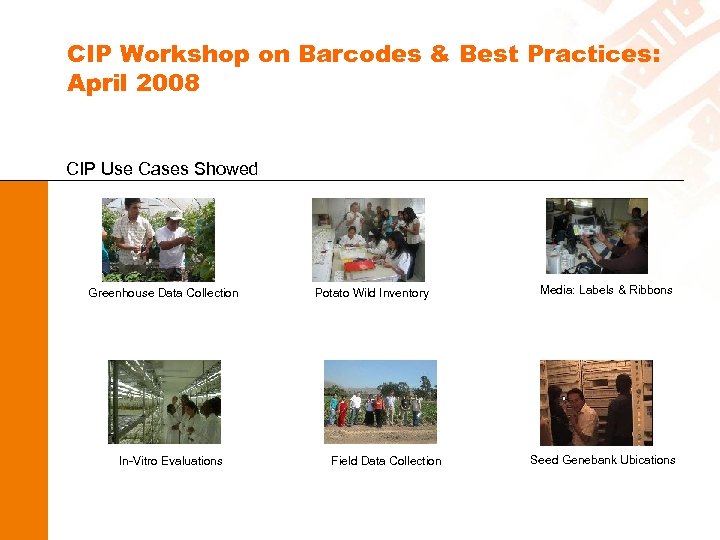
CIP Workshop on Barcodes & Best Practices: April 2008 CIP Use Cases Showed Greenhouse Data Collection In-Vitro Evaluations Potato Wild Inventory Field Data Collection Media: Labels & Ribbons Seed Genebank Ubications
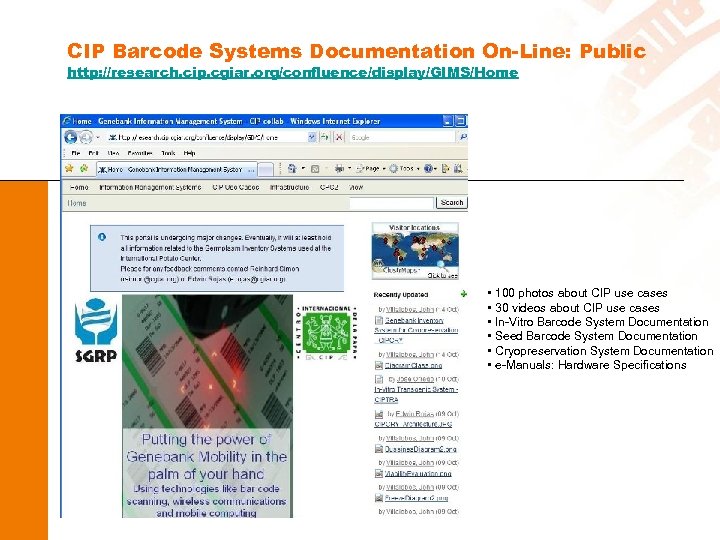
CIP Barcode Systems Documentation On-Line: Public http: //research. cip. cgiar. org/confluence/display/GIMS/Home • 100 photos about CIP use cases • 30 videos about CIP use cases • In-Vitro Barcode System Documentation • Seed Barcode System Documentation • Cryopreservation System Documentation • e-Manuals: Hardware Specifications
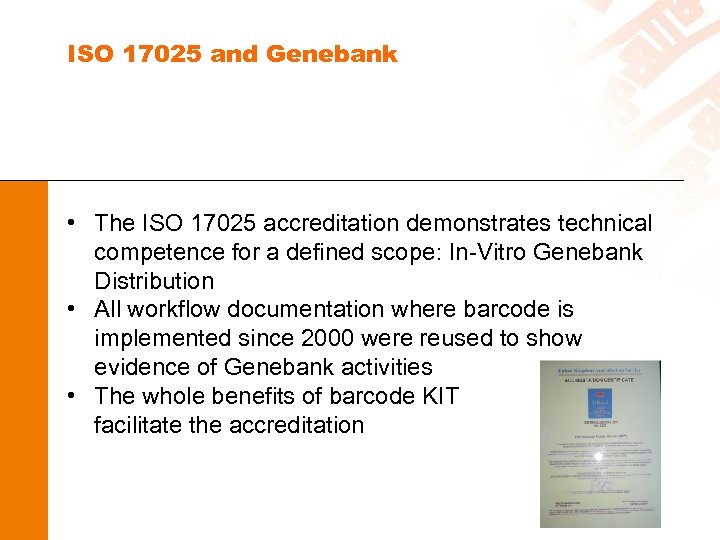
ISO 17025 and Genebank • The ISO 17025 accreditation demonstrates technical competence for a defined scope: In-Vitro Genebank Distribution • All workflow documentation where barcode is implemented since 2000 were reused to show evidence of Genebank activities • The whole benefits of barcode KIT facilitate the accreditation

ISO Accreditation: Auditor Testimonial In terms of the whole system I think the information management system that you have is absolutely superior and I wish we’d have a similar system in my own organization. Dr. Colin Jeffires – ISO Assessment Team 2008
Agenda • • • Genebank & Barcode Technology Benefits of Barcode KIT Implementation Outputs: CIP Genebank Support Outcomes: CGIAR Centers & ISO Support Continue Extending Barcode Facilities (pilots)
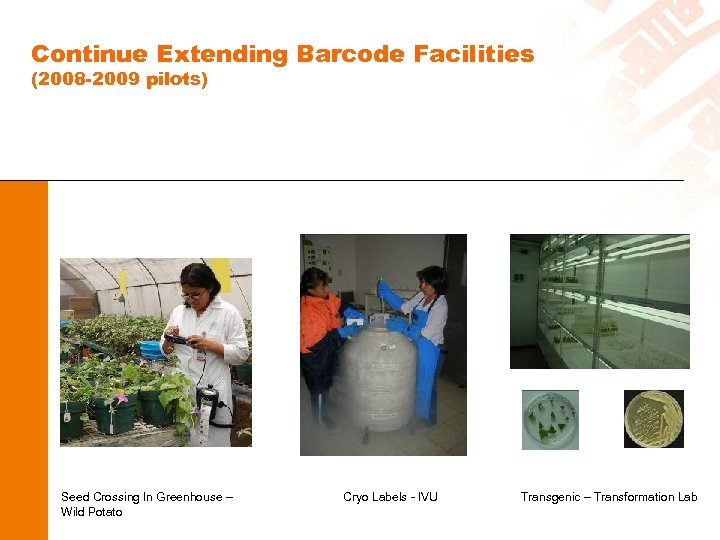
Continue Extending Barcode Facilities (2008 -2009 pilots) Seed Crossing In Greenhouse – Wild Potato Cryo Labels - IVU Transgenic – Transformation Lab
CIP Thanks and Spark your Imagination ! GPG Participants & Collaborators: Ana Panta Mario Ruiz Martin Ramos Alberto Salas Rene Gomez Genoveva Rossel Carlos Arbizu Maria Vargas William Roca David Tay Giovanna Muller Marco Meza Segundo Fuentes Carlos Chuquillanqui Ian Barker Enrique Grande Isabel Mel Rosario Falcon Enrique Chujoy Jose Orrego John Villalobos Reinhard Simon Edwin Rojas Rolando Navarro Roberto Del Villar Anthony Collins IRRI Graham Mc. Laren Arllet Portugal Roniela Prantilla Lilibeth Sison CIAT Fernando Rojas Tania Jordan
Скачать презентацию º— December 9 th 2008 Bar-coding of CIP s
6399698bb8ebd93ebc5838a82a068a13.ppt