 Скачать презентацию o BIX Are we there yet FMOC Summer
2adce67923ae3dd9c4f73e0612da2b53.ppt
- Количество слайдов: 25



o. BIX: Are we there yet? FMOC Summer 2005 n n n Toby Considine Co-Chair, OASIS o. BIX TC Toby. Considine@unc. edu
Overview of Presentation The Five Questions: n What is o. BIX (short version)? n Why OASIS and Web Services? n Why an Enterprise Architecture? n Where we are now? n What can I do to help?
o. BIX is: an Interface to Building Control Systems n n Enabling mechanical and electrical control systems in buildings to communicate with enterprise applications o. BIX promises to improve operational effectiveness, giving facility managers and building owners increased knowledge and control of their properties.
Which Building Control Systems? n Nearly 50 identified control silos l l l l HVAC Access Control Event Management Intrusion Detection Lighting Life / Safety Electric Metering . . . many more
Interface to Building Control Systems n n What kind of data can we get from control systems? Simple: l n Lengthy: l n List of people currently in East Wing with time of entry Complex: l n Room Temperature of Lobby Current state of all systems across an entire campus Reports: l Variation of internal humidity of sports hall over the last 6 months
Why Enterprise Interface to Control Systems? n Mundane l n Transforming l l l n Energy = Money Power Grid Reliability Hydrogen Economy Knowledge-based M&R Vision: Control Systems as stars in l l Minority Report Terminator
But there are so many standards… n o. BIX is an open standard developed around XML to support web services and service oriented architecture This leads to…
Why OASIS and Open Standards n Open – all technical details freely available Building – any and all building systems Information – pertinent system data e. Xchange – interoperability n Cost of non-interoperability (15. 8 B / year) n n n l http: //www. bfrl. nist. gov/oae/publications/gcrs/04867. p df
Why OASIS and Web Services? n n OASIS is a not-for-profit, international consortium dedicated to the development, convergence, and adoption of e-business standards. OASIS Standards are developed through an open process, one that provides for fairness, transparency and full participation from the entire community. o. BIX is an OASIS Technical committee developing a standard for communication between building controls and the enterprise OASIS Standards: UDDI, WSDL, WSDM, WSSecurity, SAML, WS-Policy, BPEL. . .
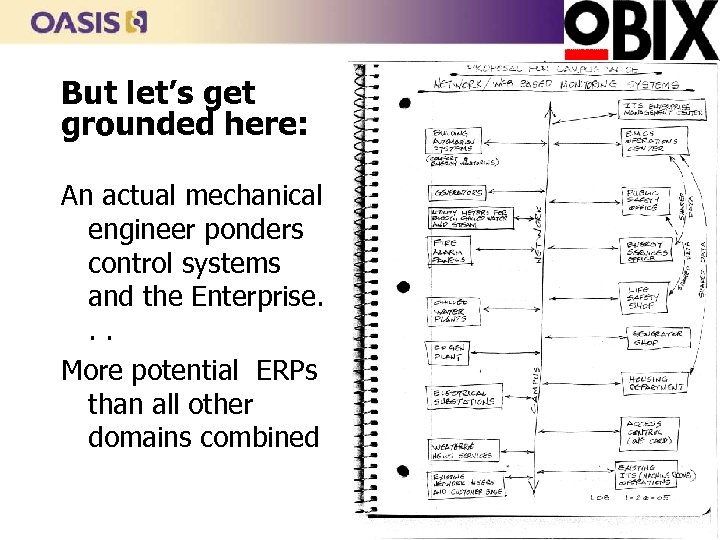
But let’s get grounded here: An actual mechanical engineer ponders control systems and the Enterprise. . . More potential ERPs than all other domains combined
o. BIX is not just about buildings n o. BIX is about Buildings and the Enterprise based upon Enterprise IT standards and Enterprise architectures So what does it mean when we say “Enterprise IT standards”?
Why an Enterprise Architecture n n Highlight Issues Faced by to Enterprise IT Discuss Web services and Service Oriented Architectures
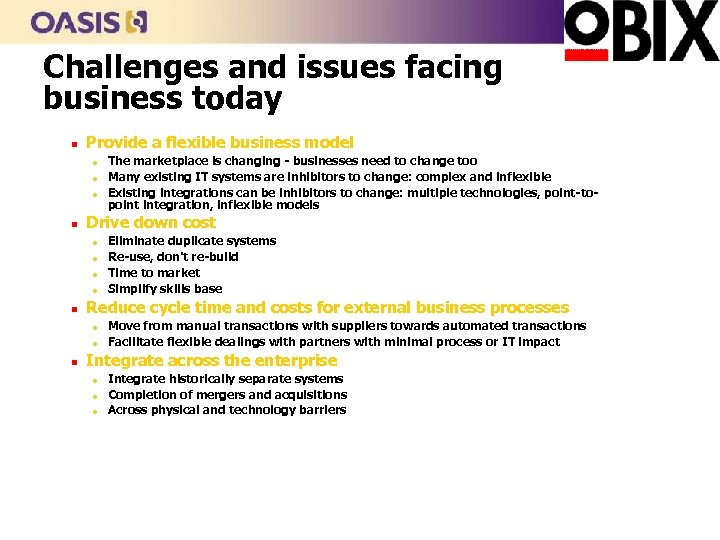
Challenges and issues facing business today n Provide a flexible business model l n Drive down cost l l n Eliminate duplicate systems Re-use, don't re-build Time to market Simplify skills base Reduce cycle time and costs for external business processes l l n The marketplace is changing - businesses need to change too Many existing IT systems are inhibitors to change: complex and inflexible Existing integrations can be inhibitors to change: multiple technologies, point-topoint integration, inflexible models Move from manual transactions with suppliers towards automated transactions Facilitate flexible dealings with partners with minimal process or IT impact Integrate across the enterprise l l l Integrate historically separate systems Completion of mergers and acquisitions Across physical and technology barriers
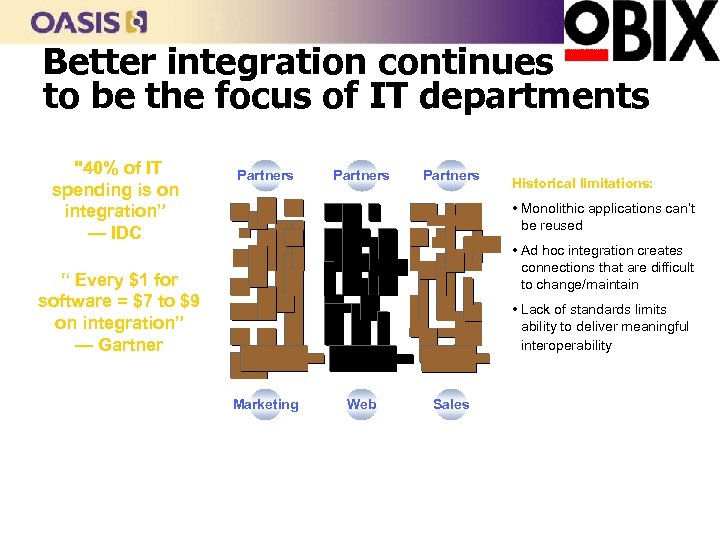
Better integration continues to be the focus of IT departments "40% of IT spending is on integration” — IDC Partners Historical limitations: • Monolithic applications can’t be reused • Ad hoc integration creates connections that are difficult to change/maintain “ Every $1 for software = $7 to $9 on integration” — Gartner • Lack of standards limits ability to deliver meaningful interoperability Marketing Web Sales
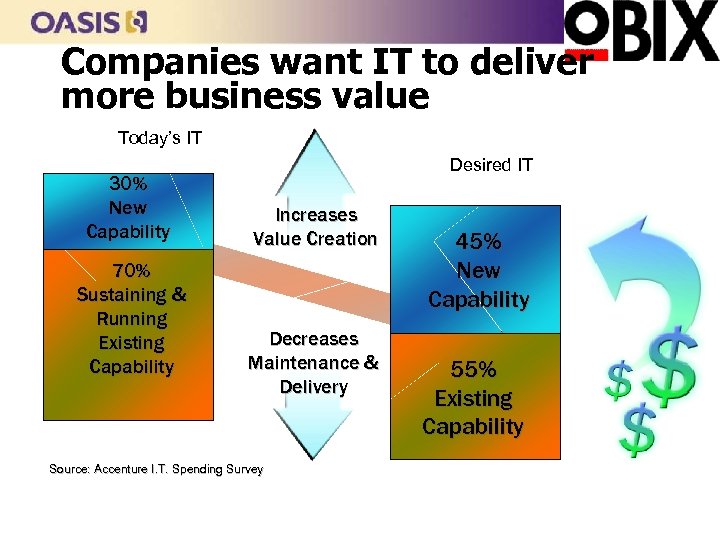
Companies want IT to deliver more business value Today’s IT 30% New Capability 70% Sustaining & Running Existing Capability Desired IT Increases Value Creation Decreases Maintenance & Delivery Source: Accenture I. T. Spending Survey 45% New Capability 55% Existing Capability
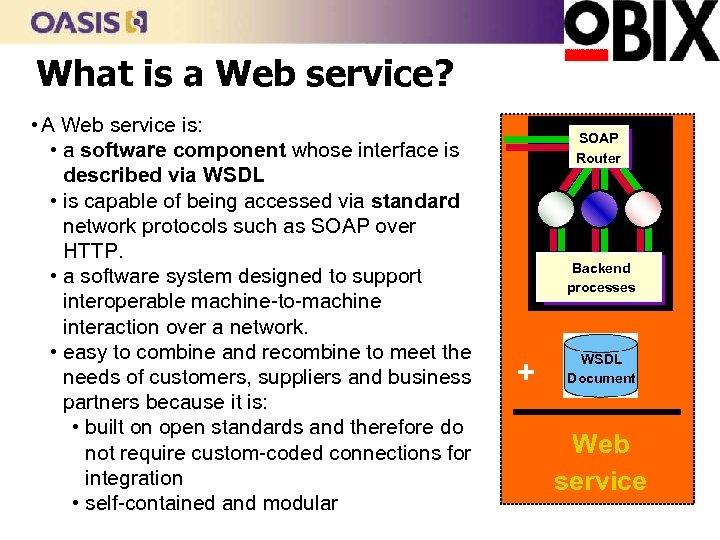
What is a Web service? • A Web service is: • a software component whose interface is described via WSDL • is capable of being accessed via standard network protocols such as SOAP over HTTP. • a software system designed to support interoperable machine-to-machine interaction over a network. • easy to combine and recombine to meet the needs of customers, suppliers and business partners because it is: • built on open standards and therefore do not require custom-coded connections for integration • self-contained and modular SOAP Router Backend processes + WSDL Document Web service
What is SOA? n A service-oriented architecture (SOA) is an enterprise-scale IT system architecture in which application functions are built as business aligned components (or "services") that are loosely-coupled and well-defined to support interoperability, and to improve flexibility and re-use. l An SOA separates out the concerns of the Service requestors and Service Providers (and Brokers). n A Service is a discoverable software resource which has a service description. The service description is available for searching, binding and invocation by a service requestor. The service description implementation is realized through a service provider who delivers quality of service requirements for the service requestor. Services can be governed by declarative policies. l SOA is not a product – it is about aligning IT and business needs
An IT Consultant view of Web Services n n n Web services can be a part of the answer Service Oriented Architecture (SOA) is another part The two are not the same thing: l l n n Most of today's production Web services systems aren't service oriented architectures - they're simple remote procedure calls or point-to-point messaging via SOAP or well structured integration architectures Most of today's production service oriented architectures don't primarily use Web services - they use ftp, batch files, asynchronous messaging etc. - mature technologies Achieving the promoted benefits requires both SOA and Web services Organizations should get interested in the combination of SOA + Web services l l business flexibility requires IT flexibility business flexibility enables a company to support the one constant of change business Thanks to Steve Graham, whose power Points I stole.
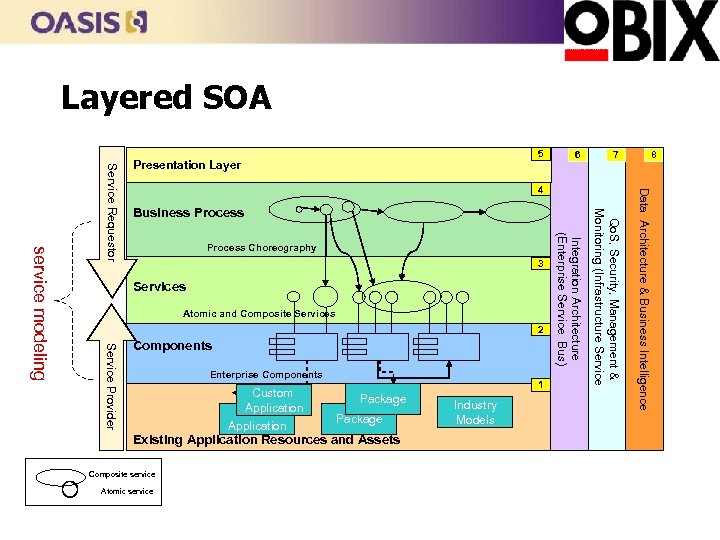
Layered SOA Business Process Choreography 3 Atomic and Composite Services 2 Components Enterprise Components Custom Application 1 Package Existing Application Resources and Assets Composite service Atomic service Industry Models 8 Data Architecture & Business Intelligence 4 Services Service Provider 7 Qo. S, Security, Management & Monitoring (Infrastructure Service) Service Requestor service modeling 6 Integration Architecture (Enterprise Service Bus) 5 Presentation Layer
Where is o. BIX now? n n n 6 Vendor interoperability demo of v 0. 6 at April 2005 Builcon v 0. 8 is current working draft V 1. 0 due out in Fall 2005 Strong support from Niagra, LONMARK, et al. Many back-room conversations with BACnet-WS committee
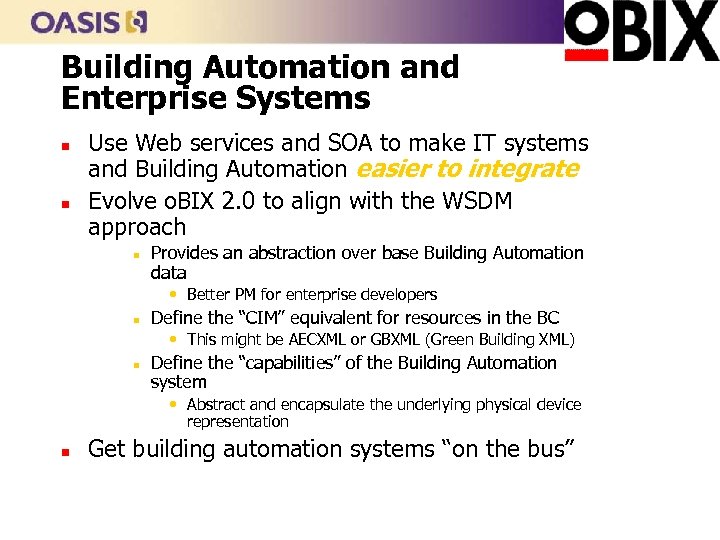
Building Automation and Enterprise Systems n n Use Web services and SOA to make IT systems and Building Automation easier to integrate Evolve o. BIX 2. 0 to align with the WSDM approach n Provides an abstraction over base Building Automation data • Better PM for enterprise developers n Define the “CIM” equivalent for resources in the BC • This might be AECXML or GBXML (Green Building XML) n Define the “capabilities” of the Building Automation system • Abstract and encapsulate the underlying physical device representation n Get building automation systems “on the bus”
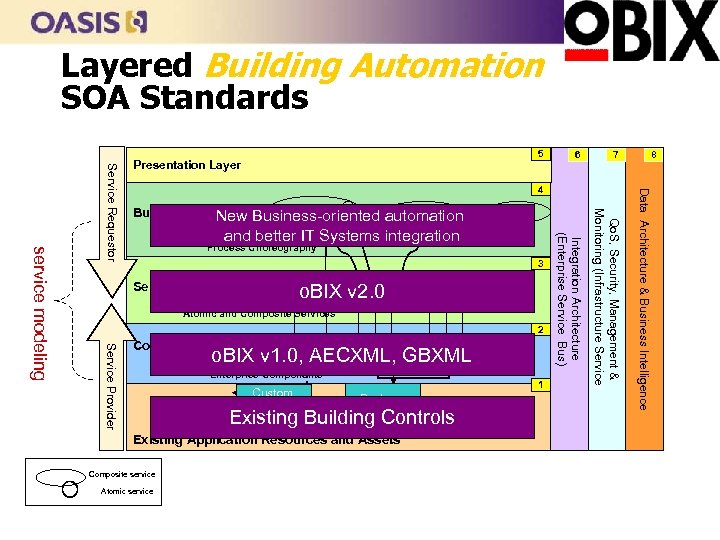
Layered Building Automation SOA Standards Business Process New Business-oriented automation and better IT Systems integration Process Choreography 3 o. BIX v 2. 0 Atomic and Composite Services 2 Components o. BIX v 1. 0, AECXML, GBXML Enterprise Components Custom Application Custom 1 Package Industry Models Existing Building Controls Application Package Existing Application Resources and Assets Composite service Atomic service 8 Data Architecture & Business Intelligence 4 Services Service Provider 7 Qo. S, Security, Management & Monitoring (Infrastructure Service) Service Requestor service modeling 6 Integration Architecture (Enterprise Service Bus) 5 Presentation Layer
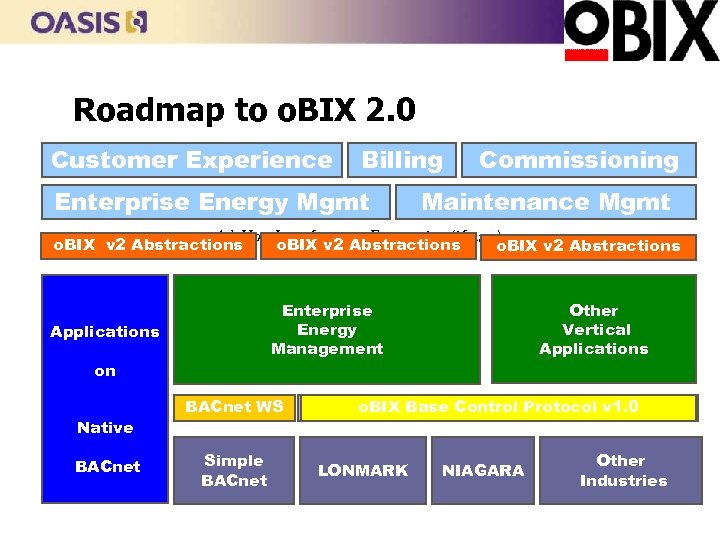
Roadmap to o. BIX 2. 0 Customer Experience Billing Enterprise Energy Mgmt Commissioning Maintenance Mgmt Ad-Hoc Interfaces Abstractions any) o. BIX v 2 Abstractions o. BIX v 2 to Enterprise (if o. BIX v 2 Abstractions Applications on Native BACnet Other Vertical Applications Enterprise Energy Management BACnet WS BACnet IP Simple BACnet “LON” o. BIX Base Control Protocol v 1. 0 WS NIAGRA EJB Proprietary LONMARK NIAGARA Other Industries
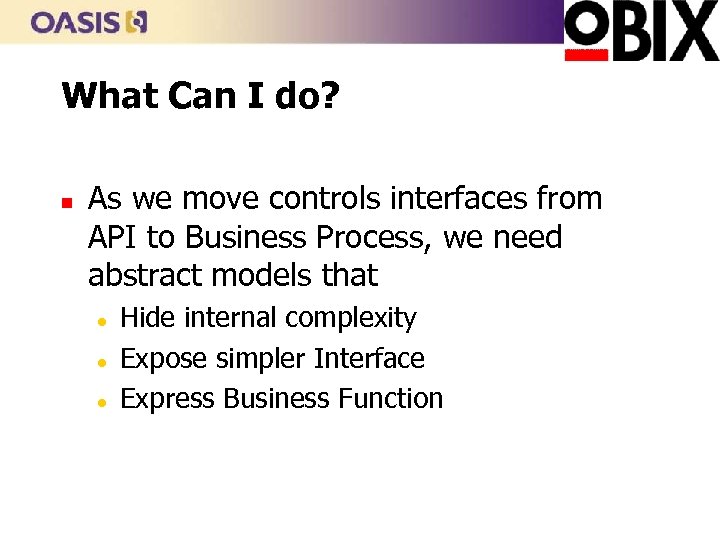
What Can I do? n As we move controls interfaces from API to Business Process, we need abstract models that l l l Hide internal complexity Expose simpler Interface Express Business Function
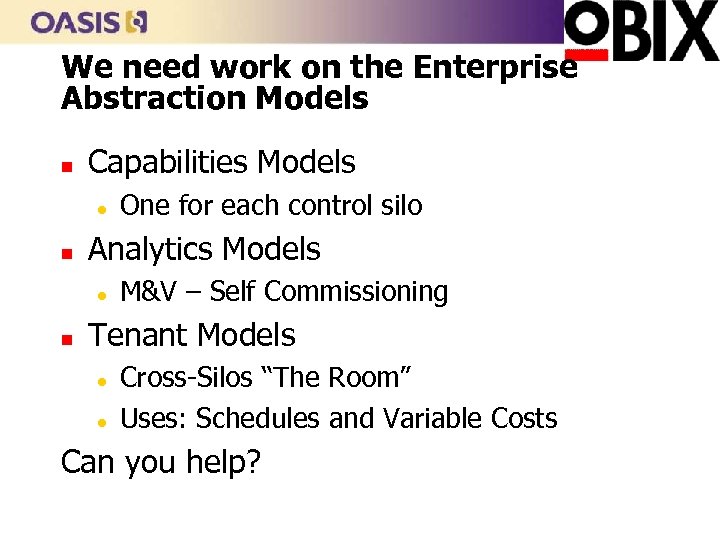
We need work on the Enterprise Abstraction Models n Capabilities Models l n Analytics Models l n One for each control silo M&V – Self Commissioning Tenant Models l l Cross-Silos “The Room” Uses: Schedules and Variable Costs Can you help?
Скачать презентацию o BIX Are we there yet FMOC Summer
2adce67923ae3dd9c4f73e0612da2b53.ppt