


 Скачать презентацию NYC SPIN UNDERSTANDING and EFFECTIVELY USING FUNCTIONAL MEASUREMENT
6df6afdb4e8fdf3c4ded193df2c08755.ppt
- Количество слайдов: 27
 NYC SPIN UNDERSTANDING and EFFECTIVELY USING FUNCTIONAL MEASUREMENT Presented By The David Consulting Group www. davidconsultinggroup. com 1 Copyright © 2003. The David Consulting Group, Inc.
 PRESENTATION HIGHLIGHTS q The Need for Sizing q Function Point Overview q Effective Use of Function Points 2 Copyright © 2003. The David Consulting Group, Inc.
 CRITICAL SOFTWARE ISSUES ä Understanding the Customer’s Requirements ä Effectively Sizing the Requirements ä Accurately Estimating the Deliverable ä Managing a Successful Delivery 3 Copyright © 2003. The David Consulting Group, Inc.
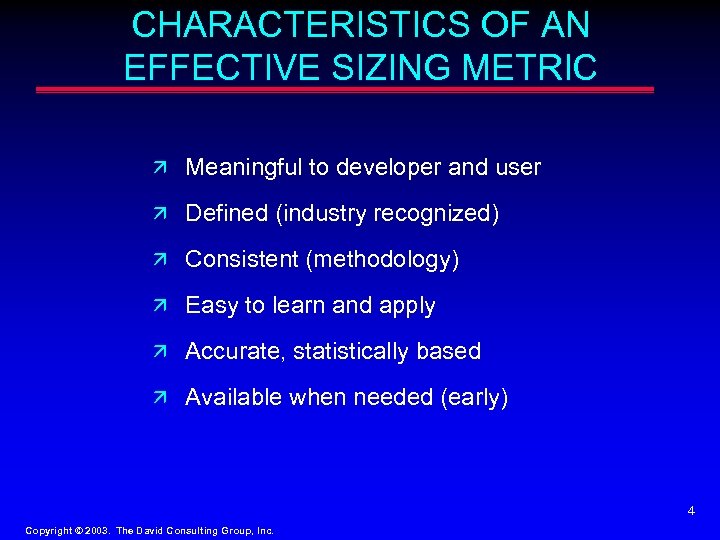 CHARACTERISTICS OF AN EFFECTIVE SIZING METRIC ä Meaningful to developer and user ä Defined (industry recognized) ä Consistent (methodology) ä Easy to learn and apply ä Accurate, statistically based ä Available when needed (early) 4 Copyright © 2003. The David Consulting Group, Inc.
 FUNCTION POINTS IS AN EFFECTIVE SIZING METRIC Function Point Analysis is a standardized method for measuring the functionality delivered to an end user. ä Consistent method ä Easy to learn ä Available early in the lifecycle ä Acceptable level of accuracy ä Meaningful internally and externally ä Results are normalized across different environments 5 Copyright © 2003. The David Consulting Group, Inc.
 FUNCTION POINT ANALYSIS Definition ä Standard method for measuring software development from the customer’s point of view Objectives ä Measure software development and maintenance independently of technology used for implementation ä Measure functionality that the user requests and receives 6 Copyright © 2003. The David Consulting Group, Inc.
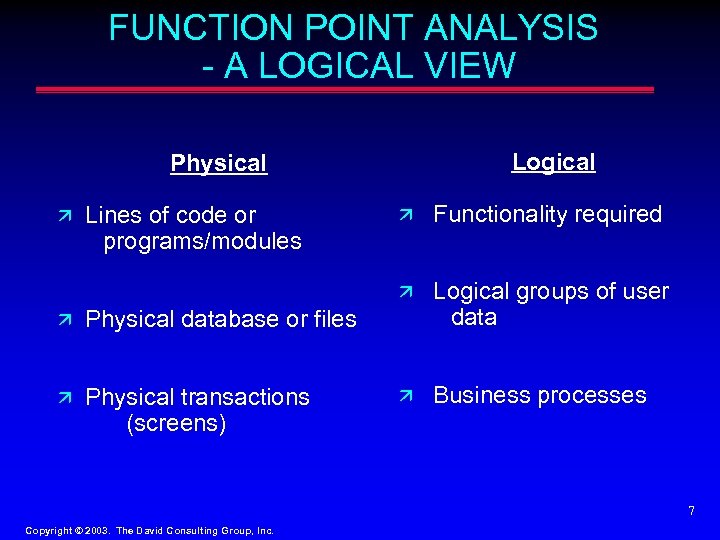 FUNCTION POINT ANALYSIS - A LOGICAL VIEW Logical Physical Lines of code or programs/modules ä Physical transactions (screens) Functionality required Logical groups of user data ä Business processes Physical database or files ä ä 7 Copyright © 2003. The David Consulting Group, Inc.
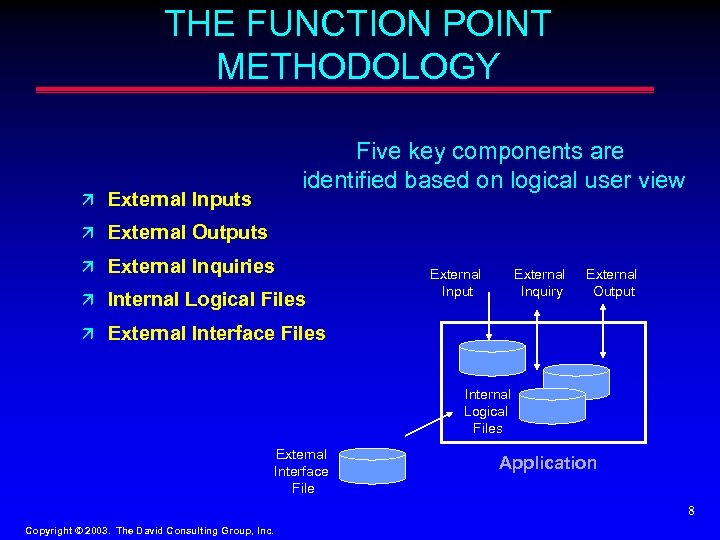 THE FUNCTION POINT METHODOLOGY Five key components are identified based on logical user view ä External Inputs ä External Outputs ä External Inquiries ä Internal Logical Files External Input External Inquiry External Output ä External Interface Files Internal Logical Files External Interface File Application 8 Copyright © 2003. The David Consulting Group, Inc.
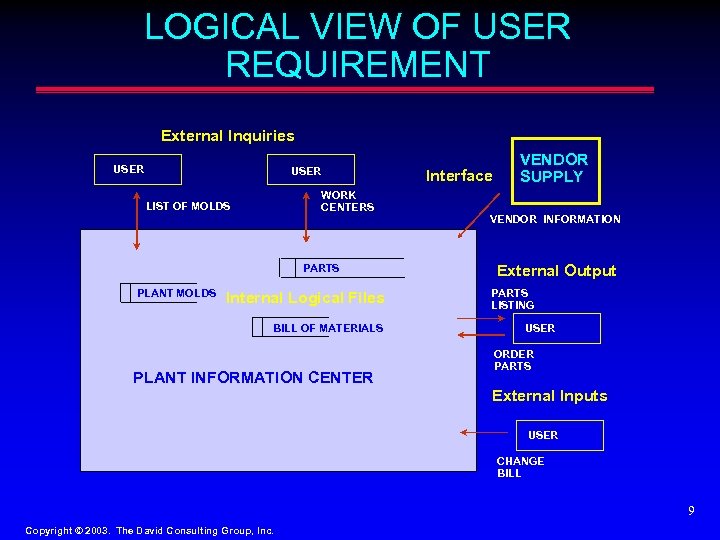 LOGICAL VIEW OF USER REQUIREMENT External Inquiries USER Interface WORK CENTERS LIST OF MOLDS PARTS PLANT MOLDS Internal Logical Files BILL OF MATERIALS PLANT INFORMATION CENTER VENDOR SUPPLY VENDOR INFORMATION External Output PARTS LISTING USER ORDER PARTS External Inputs USER CHANGE BILL 9 Copyright © 2003. The David Consulting Group, Inc.
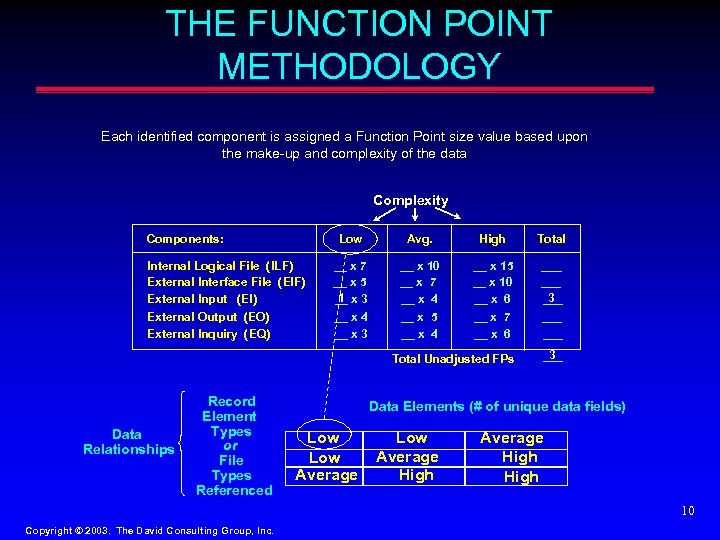 THE FUNCTION POINT METHODOLOGY Each identified component is assigned a Function Point size value based upon the make-up and complexity of the data Complexity Components: Low Data Relationships Record Element Types or File Types Referenced High Total __ x 7 __ x 5 1 __ x 3 __ x 4 __ x 3 __ x 10 __ x 7 __ x 4 __ x 5 __ x 4 __ x 15 __ x 10 __ x 6 __ x 7 __ x 6 ___ 3 ___ Total Unadjusted FPs Internal Logical File (ILF) External Interface File (EIF) External Input (EI) External Output (EO) External Inquiry (EQ) Avg. 3 ___ ___ Data Elements (# of unique data fields) Low Average High 10 Copyright © 2003. The David Consulting Group, Inc.
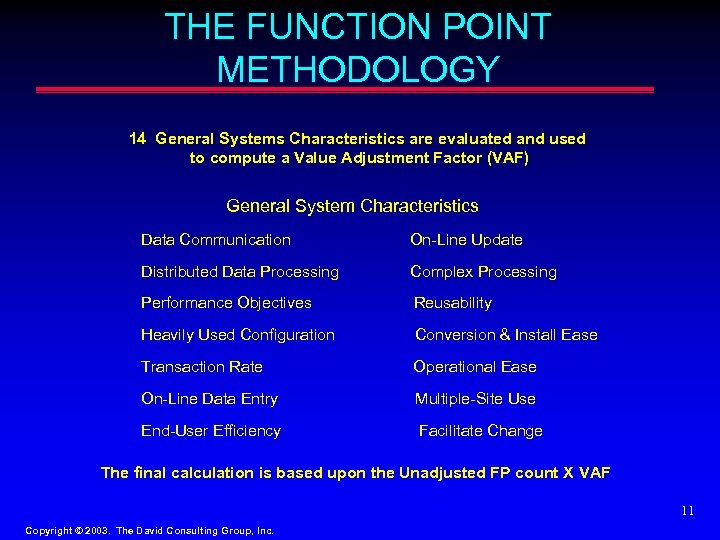 THE FUNCTION POINT METHODOLOGY 14 General Systems Characteristics are evaluated and used to compute a Value Adjustment Factor (VAF) General System Characteristics Data Communication On-Line Update Distributed Data Processing Complex Processing Performance Objectives Reusability Heavily Used Configuration Conversion & Install Ease Transaction Rate Operational Ease On-Line Data Entry Multiple-Site Use End-User Efficiency Facilitate Change The final calculation is based upon the Unadjusted FP count X VAF 11 Copyright © 2003. The David Consulting Group, Inc.
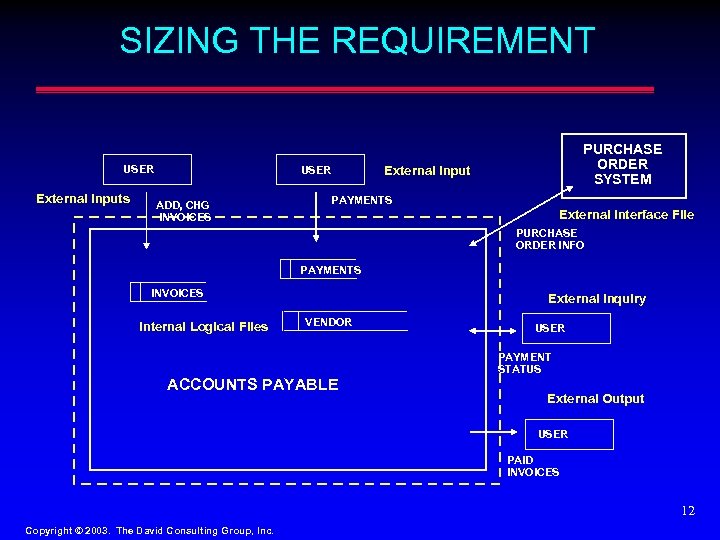 SIZING THE REQUIREMENT USER External Inputs External Input USER ADD, CHG INVOICES PURCHASE ORDER SYSTEM PAYMENTS External Interface File PURCHASE ORDER INFO PAYMENTS INVOICES Internal Logical Files External Inquiry VENDOR USER PAYMENT STATUS ACCOUNTS PAYABLE External Output USER PAID INVOICES 12 Copyright © 2003. The David Consulting Group, Inc.
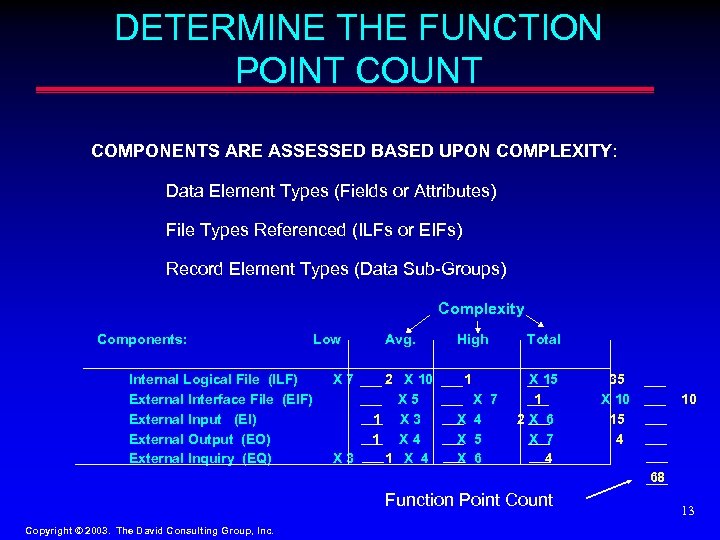 DETERMINE THE FUNCTION POINT COUNT COMPONENTS ARE ASSESSED BASED UPON COMPLEXITY: Data Element Types (Fields or Attributes) File Types Referenced (ILFs or EIFs) Record Element Types (Data Sub-Groups) Complexity Components: Internal Logical File (ILF) External Interface File (EIF) External Input (EI) External Output (EO) External Inquiry (EQ) Low X 7 X 3 Avg. 2 X 10 X 5 1 X 3 1 X 4 High 1 X 7 X 4 X 5 X 6 Total X 15 1 2 X 6 X 7 4 35 X 10 15 4 10 68 Function Point Count Copyright © 2003. The David Consulting Group, Inc. 13
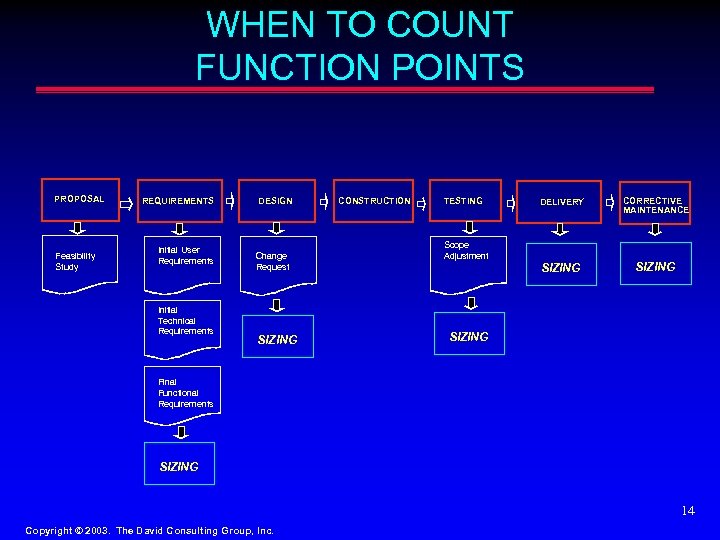 WHEN TO COUNT FUNCTION POINTS PROPOSAL Feasibility Study REQUIREMENTS Initial User Requirements Initial Technical Requirements DESIGN Change Request SIZING CONSTRUCTION TESTING Scope Adjustment DELIVERY CORRECTIVE MAINTENANCE SIZING Final Functional Requirements SIZING 14 Copyright © 2003. The David Consulting Group, Inc.
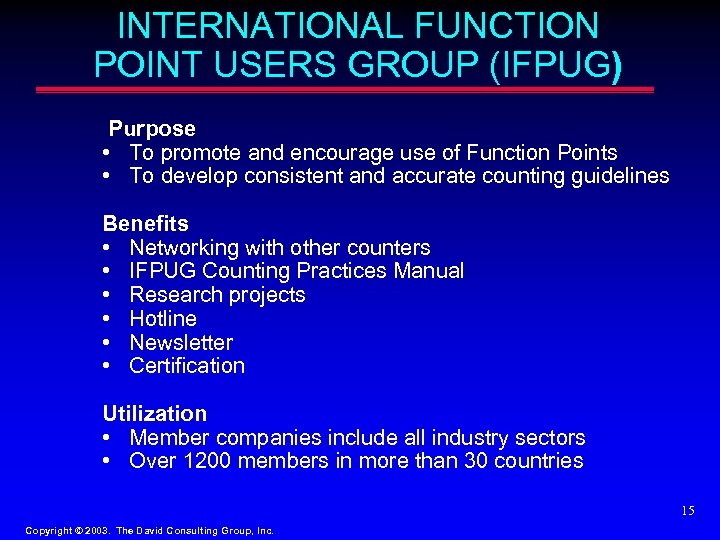 INTERNATIONAL FUNCTION POINT USERS GROUP (IFPUG) Purpose • To promote and encourage use of Function Points • To develop consistent and accurate counting guidelines Benefits • Networking with other counters • IFPUG Counting Practices Manual • Research projects • Hotline • Newsletter • Certification Utilization • Member companies include all industry sectors • Over 1200 members in more than 30 countries 15 Copyright © 2003. The David Consulting Group, Inc.
 EFFECTIVE USE OF FUNCTION POINTS ä Requirements Management ä Estimating ä Benchmark Comparisons ä Managing Change 16 Copyright © 2003. The David Consulting Group, Inc.
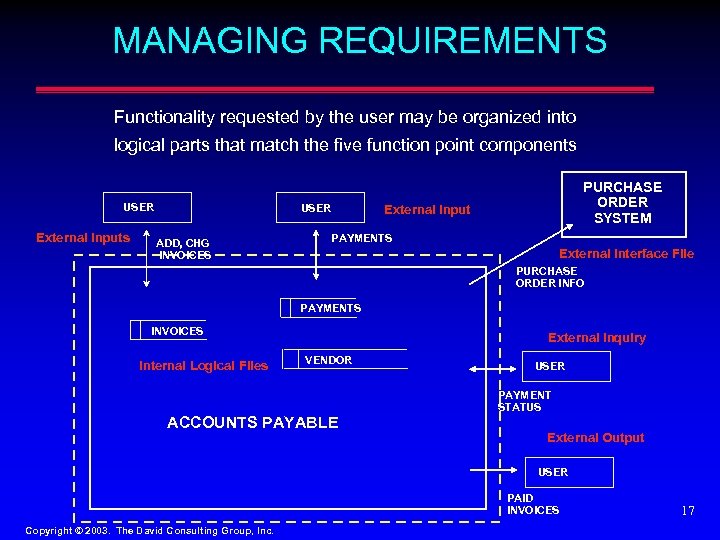 MANAGING REQUIREMENTS Functionality requested by the user may be organized into logical parts that match the five function point components USER External Inputs External Input USER ADD, CHG INVOICES PURCHASE ORDER SYSTEM PAYMENTS External Interface File PURCHASE ORDER INFO PAYMENTS INVOICES Internal Logical Files External Inquiry VENDOR USER PAYMENT STATUS ACCOUNTS PAYABLE External Output USER PAID INVOICES Copyright © 2003. The David Consulting Group, Inc. 17
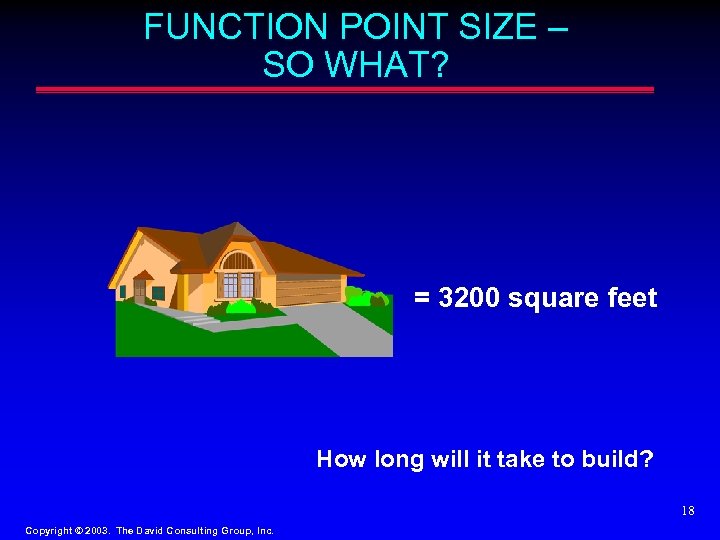 FUNCTION POINT SIZE – SO WHAT? = 3200 square feet How long will it take to build? 18 Copyright © 2003. The David Consulting Group, Inc.
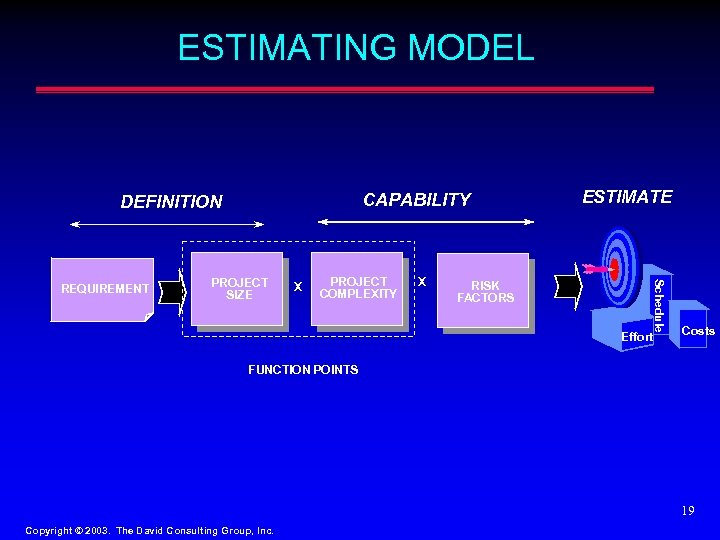 ESTIMATING MODEL CAPABILITY DEFINITION PROJECT SIZE X PROJECT COMPLEXITY X RISK FACTORS Schedule REQUIREMENT ESTIMATE Effort Costs FUNCTION POINTS 19 Copyright © 2003. The David Consulting Group, Inc.
 RISK FACTORS Estimates will also vary based upon a variety of risk factors: u u u Technology Applied such as tools, languages, reuse, platforms Process/Methodology including tasks performed, reviews, testing, object oriented Customer/User and Developer skills, knowledge, experience Environment including locations, office space System Type such as information systems; control systems, telecom, real-time, client server, scientific, knowledge-based, web Industry such as automotive, banking, financial, insurance, retail, telecommunications 20 Copyright © 2003. The David Consulting Group, Inc.
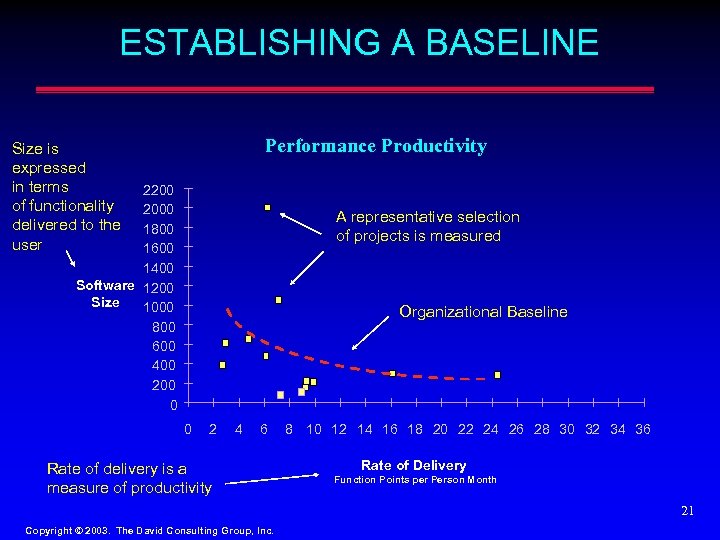 ESTABLISHING A BASELINE Performance Productivity Size is expressed in terms of functionality delivered to the user 2200 2000 1800 1600 1400 Software 1200 Size 1000 800 600 400 200 0 A representative selection of projects is measured Organizational Baseline 0 2 4 6 Rate of delivery is a measure of productivity 8 10 12 14 16 18 20 22 24 26 28 30 32 34 36 Rate of Delivery Function Points per Person Month 21 Copyright © 2003. The David Consulting Group, Inc.
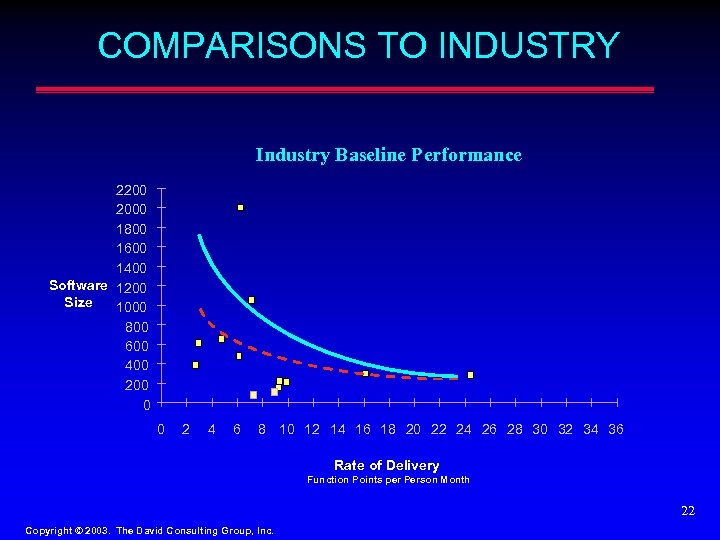 COMPARISONS TO INDUSTRY Industry Baseline Performance 2200 2000 1800 1600 1400 Software 1200 Size 1000 800 600 400 200 0 0 2 4 6 8 10 12 14 16 18 20 22 24 26 28 30 32 34 36 Rate of Delivery Function Points per Person Month 22 Copyright © 2003. The David Consulting Group, Inc.
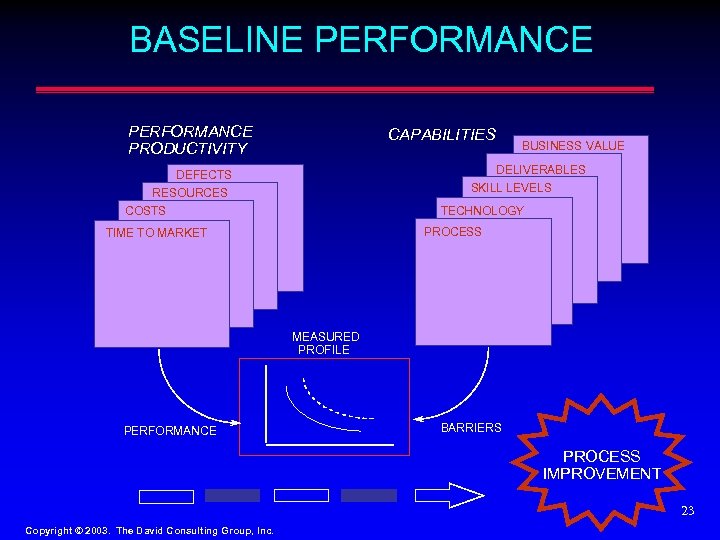 BASELINE PERFORMANCE PRODUCTIVITY CAPABILITIES BUSINESS VALUE DELIVERABLES SKILL LEVELS DEFECTS RESOURCES COSTS TECHNOLOGY PROCESS TIME TO MARKET MEASURED PROFILE PERFORMANCE BARRIERS PROCESS IMPROVEMENT 23 Copyright © 2003. The David Consulting Group, Inc.
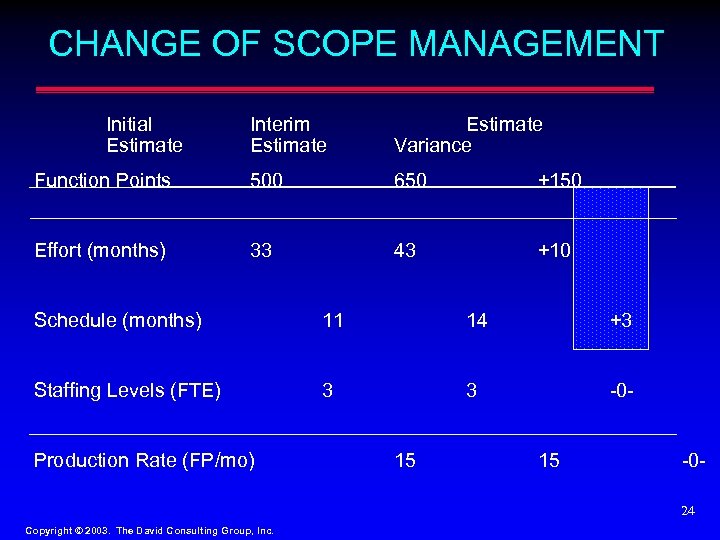 CHANGE OF SCOPE MANAGEMENT Initial Estimate Interim Estimate Variance Function Points 500 650 +150 Effort (months) 33 43 +10 Schedule (months) 11 14 +3 Staffing Levels (FTE) 3 3 -0 - Production Rate (FP/mo) 15 15 -024 Copyright © 2003. The David Consulting Group, Inc.
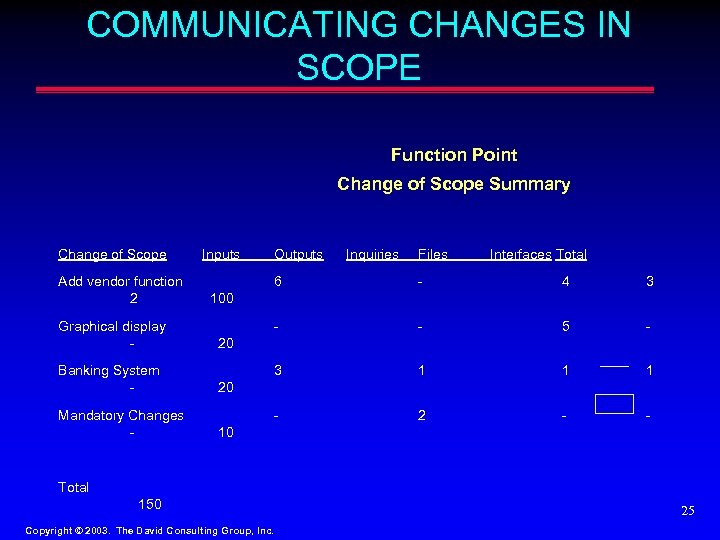 COMMUNICATING CHANGES IN SCOPE Function Point Change of Scope Summary Change of Scope Add vendor function 2 Graphical display Banking System Mandatory Changes - Inputs Outputs Inquiries Files Interfaces Total 6 - 4 3 - - 5 - 3 1 1 1 - 2 - - 100 20 20 10 Total 150 Copyright © 2003. The David Consulting Group, Inc. 25
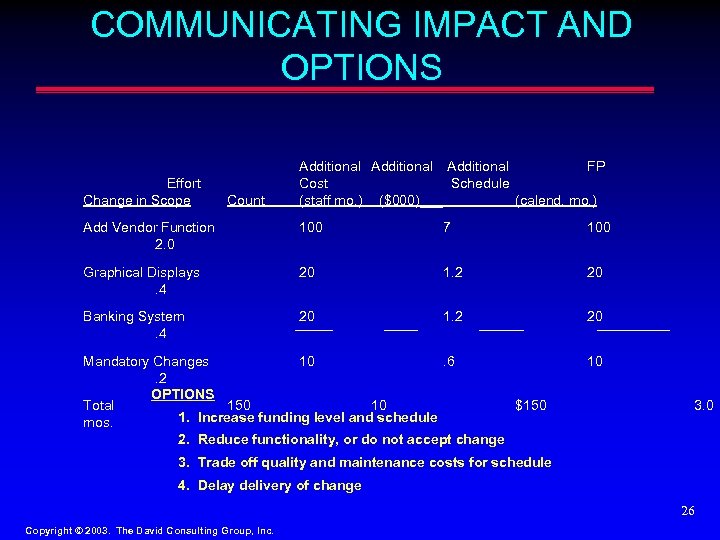 COMMUNICATING IMPACT AND OPTIONS Effort Change in Scope Count Additional FP Cost Schedule (staff mo. ) ($000)___ (calend. mo. ) Add Vendor Function 2. 0 100 7 100 Graphical Displays. 4 20 1. 2 20 Banking System. 4 20 1. 2 20 Mandatory Changes 10. 6. 2 OPTIONS Total 150 10 $150 1. Increase funding level and schedule mos. 2. Reduce functionality, or do not accept change 10 3. Trade off quality and maintenance costs for schedule 4. Delay delivery of change 26 Copyright © 2003. The David Consulting Group, Inc.
 GENERAL INFORMATION ä International Function Point Users Group www. ifpug. org ä International Software Benchmarking Standards Group www. isbsg. org. au ä Measuring The Software Process: A Practical Guide To Functional Measurements, Prentice Hall, 1996 ä Function Point Analysis; Measurement Practices for Successful Software Projects, Addison-Wesley, 2001 27 Copyright © 2003. The David Consulting Group, Inc.