


 Скачать презентацию NYC School Health Automated Student Health Record Oxiris
ebee1d4fea448976868115063d493d6a.ppt
- Количество слайдов: 29
 NYC School Health Automated Student Health Record Oxiris Barbot, M. D. Medical Director December 6, 2006
 Mission Promote the physical, emotional, social and environmental health of the 1. 2 million public school children of New York City.
 Office of School Health Structure • Department of Health and Mental Hygiene – – HPDP Division ~800 nurses 54 doctors ~ 150 public health advisers • Department of Education – Office of Youth Development and School. Community Services – ~300 nurses – 5 Health Content Experts
 Program Responsibilities Health Services • Physician of Last Resort • Students with IEP and Section 504 Needs – Nursing, OT, PT • • New Entrant and Other Exams Vision and Hearing Screening Coordinate response to communicable diseases Immunization and other mandates compliance
 ASHR Goals • Computerize student health-related data • Easily accessible, yet secure • Improve the way health related information is maintained, tracked and retrieved • For the purpose of providing medical services, tracking mandated activities and providing follow up on identified health needs (case management). • Supply real-time data to Syndromic Surveillance
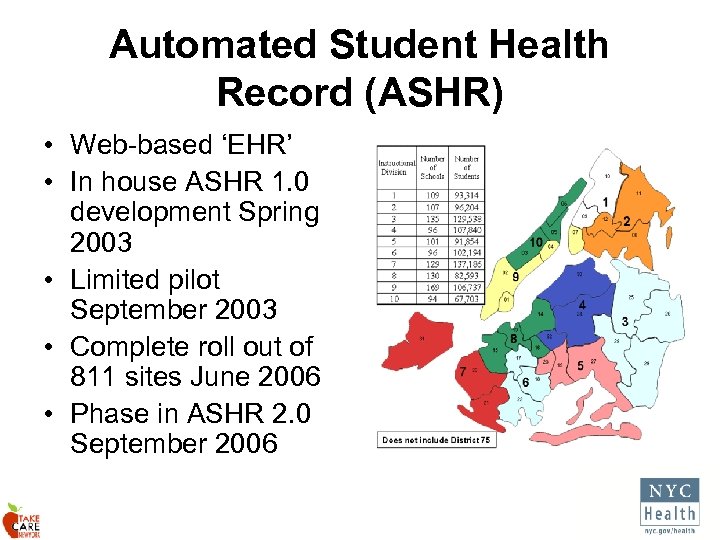 Automated Student Health Record (ASHR) • Web-based ‘EHR’ • In house ASHR 1. 0 development Spring 2003 • Limited pilot September 2003 • Complete roll out of 811 sites June 2006 • Phase in ASHR 2. 0 September 2006
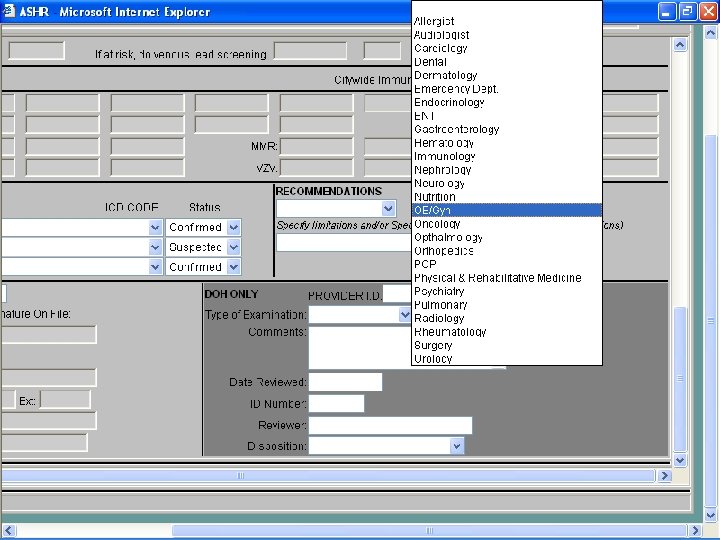
 ASHR Content • Student demographics (imported from DOE) • PMD & specialist contact info • Immunizations (imported from DOE) • Chronic Diagnoses • Allergies • Activities Restrictions • Vision and Hearing • Medication orders • Individual health plans • New Admission Exam • Asthma profile • Walk-in (exports to Syndromic Surveillance) • Diabetes module (under construction)
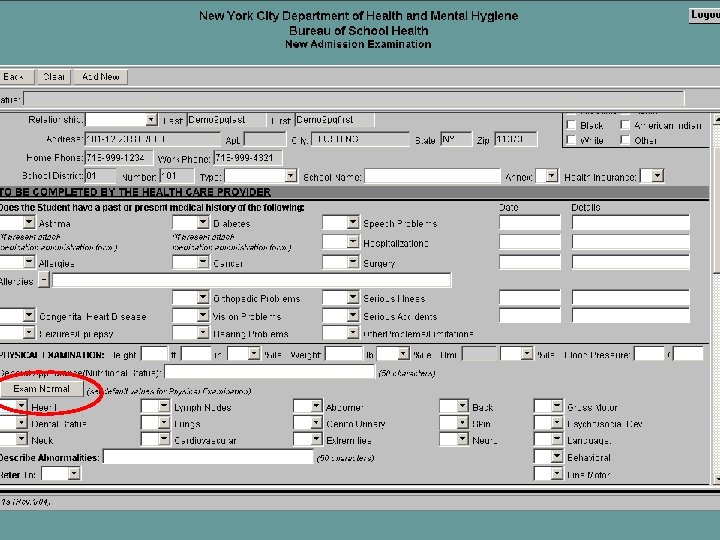
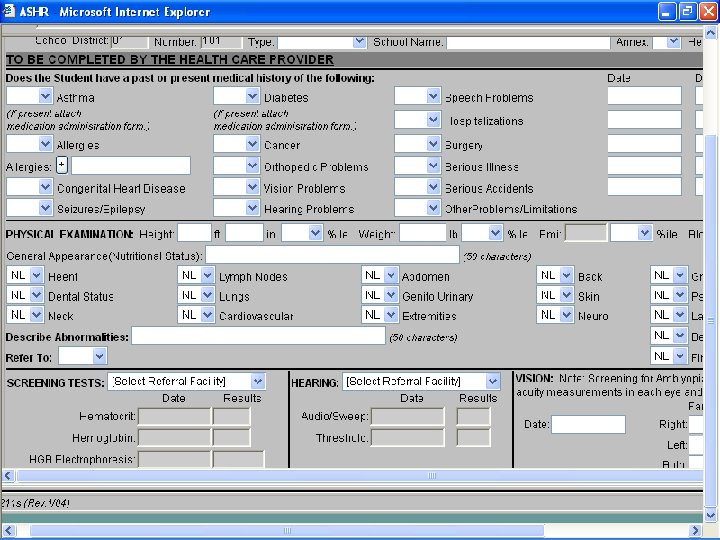
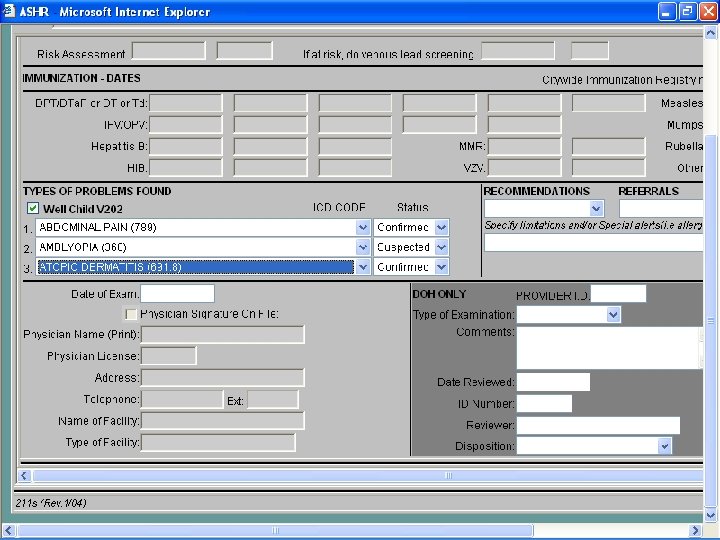
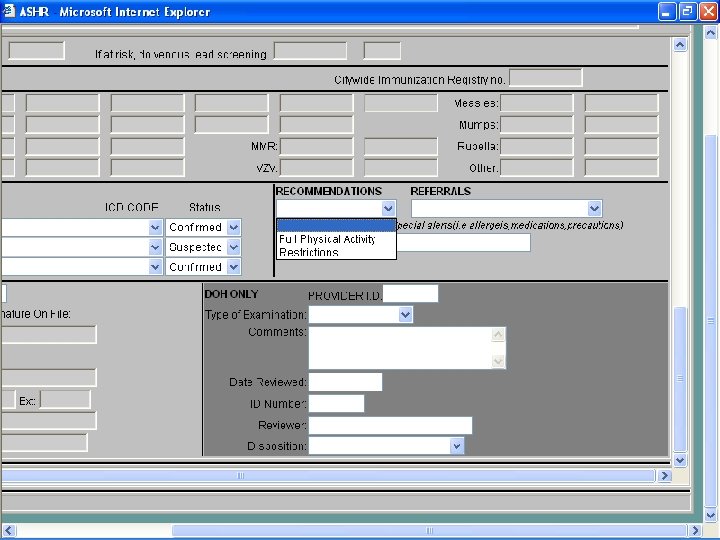
 Use Case • State and City mandate that every newly entering student is required to submit a new admission examination (NAE aka 211 S)
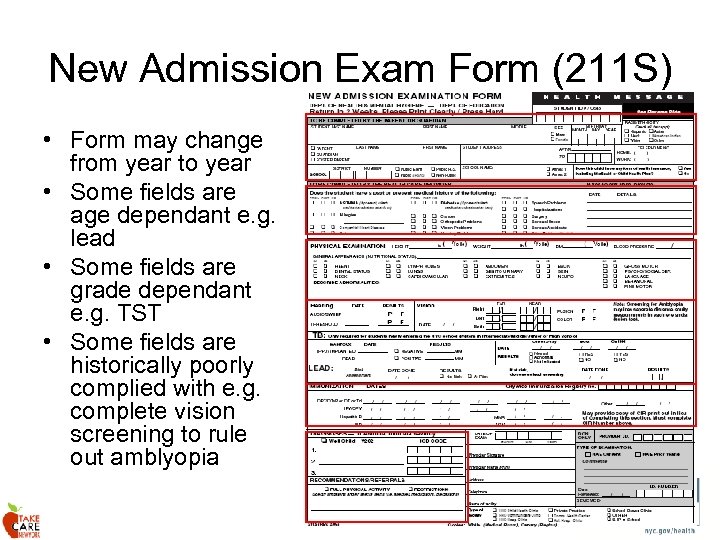 New Admission Exam Form (211 S) • Form may change from year to year • Some fields are age dependant e. g. lead • Some fields are grade dependant e. g. TST • Some fields are historically poorly complied with e. g. complete vision screening to rule out amblyopia
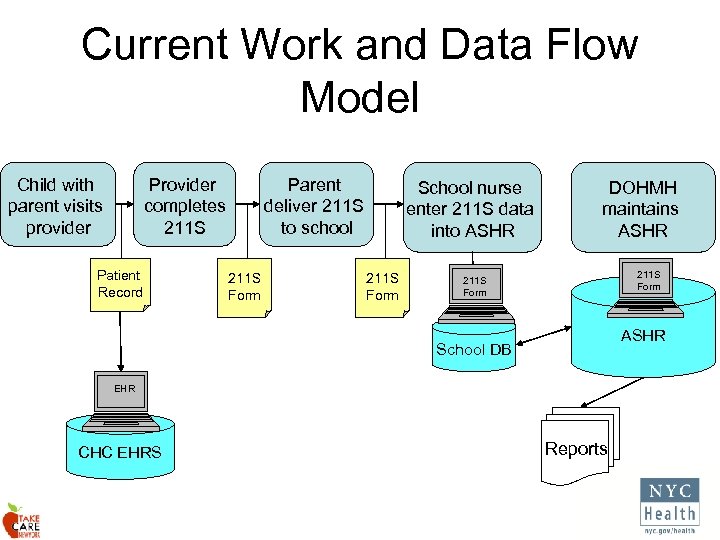 Current Work and Data Flow Model Child with parent visits provider Provider completes 211 S Patient Record Parent deliver 211 S to school 211 S Form School nurse enter 211 S data into ASHR 211 S Form Reports DOHMH maintains ASHR 211 S Form ASHR School DB EHR CHC EHRS Reports
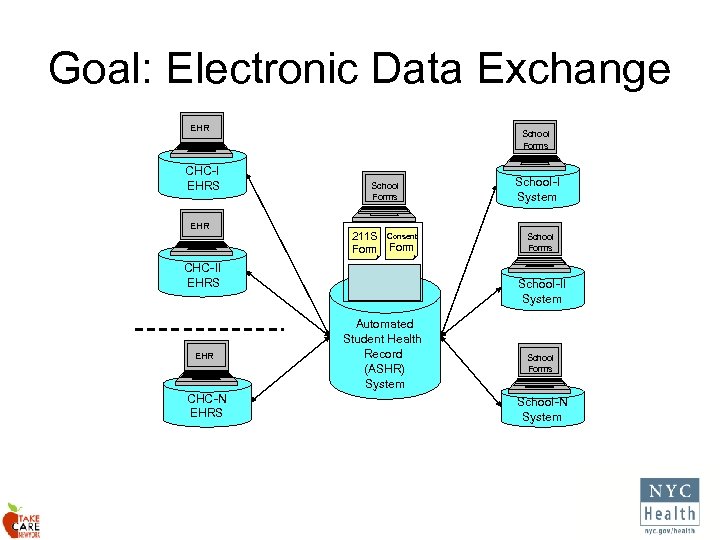 Goal: Electronic Data Exchange EHR CHC-I EHRS EHR CHC-II EHRS EHR CHC-N EHRS School Forms 211 S Form Consent Form RES MUM Form Automated Student Health Record (ASHR) System School-I System School Forms School-II System School Forms School-N System
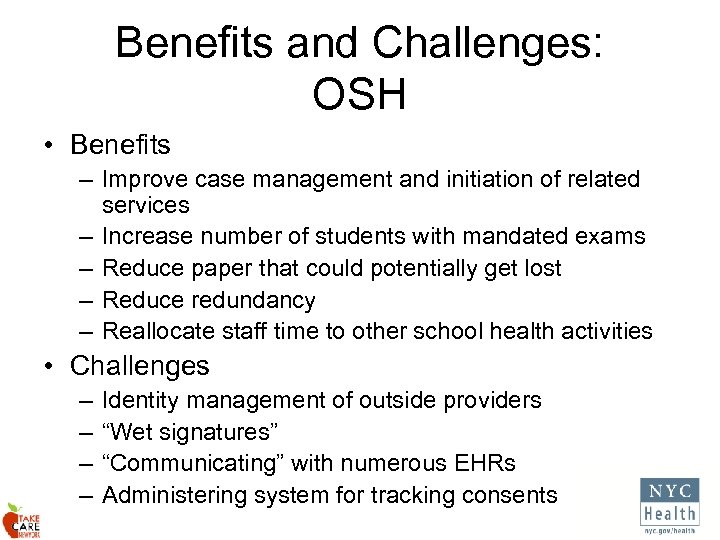 Benefits and Challenges: OSH • Benefits – Improve case management and initiation of related services – Increase number of students with mandated exams – Reduce paper that could potentially get lost – Reduce redundancy – Reallocate staff time to other school health activities • Challenges – – Identity management of outside providers “Wet signatures” “Communicating” with numerous EHRs Administering system for tracking consents
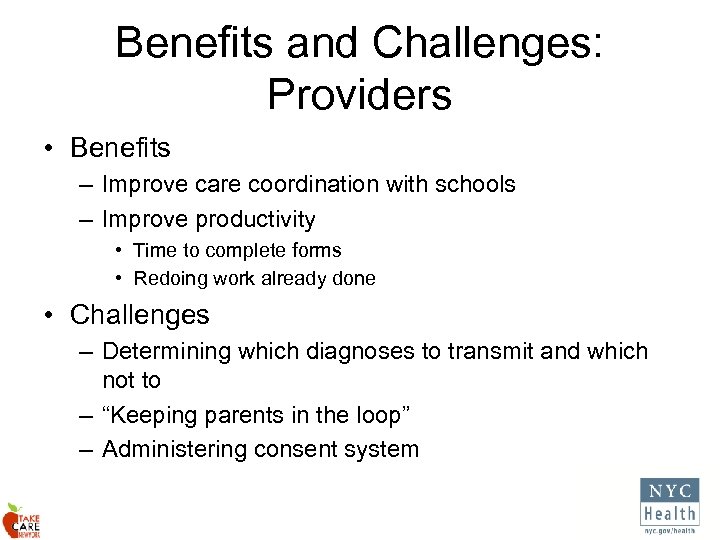 Benefits and Challenges: Providers • Benefits – Improve care coordination with schools – Improve productivity • Time to complete forms • Redoing work already done • Challenges – Determining which diagnoses to transmit and which not to – “Keeping parents in the loop” – Administering consent system
 Benefits and Challenges: Parents • Benefits – Compliance with school requirements – Less missed school and work days – Improved care coordination between PCP and school system • Challenges – Knowing what is being transmitted to schools
 Overall Goals for NAE Electronic Transmission • Traditional school health – ensure full participation in school activities – Students are free of communicable diseases – Students’ academic needs accommodated – Delivery of direct services • Public Health Oriented School Health – Population-based chronic disease management (chronic disease reporting) – Resource allocation – PH equivalent of clinical decision support
 Benefits of Bi-directionality: Parents • Minimize unnecessary go-between activities • Updates on child’s status – e. g. # of visits to medical room • Reports on when and what type of information was transmitted
 Benefits of Bi-directionality: Provider • List of patients and schools they attend with nurse contact info – Medication services – Related services – e. g. PT/OT/ST – Accommodations – e. g. barrier-free schools • Updates on patient status – e. g. # of visits to medical room • Profile as compared to other providers
 Benefits of Bi-directionality: OSH • Improve communications with providers • Expand from NAE to “doctor’s notes”
 Data transfer to Syndromic Surveillance • Began March 1, 2005 • Data fields transferred – – – Student Age ATS School DBN Official Class Complaint Description Record Last Update - Walk-In Time In - Grade Level - Zip - Comments • Process – Nightly Data transfer Service (DTS) of de-identified student walk-in data by school
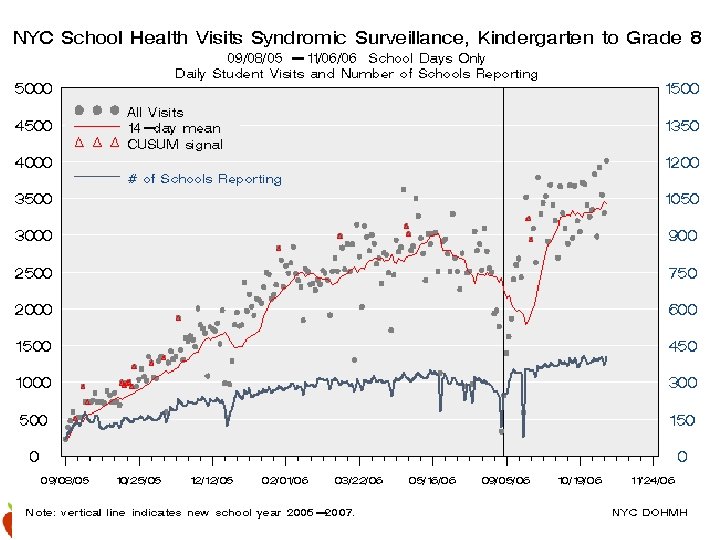
 Syndromic Surveillance Potential • Syndromes tracked – Allergy – Diarrhea – Injury – Rash - Asthma. Resp - Fever. Flu - Neuro - Vomiting • Once a week email now; daily once system fully functional • Potential for tracking to citywide, but too early to determine overall utility
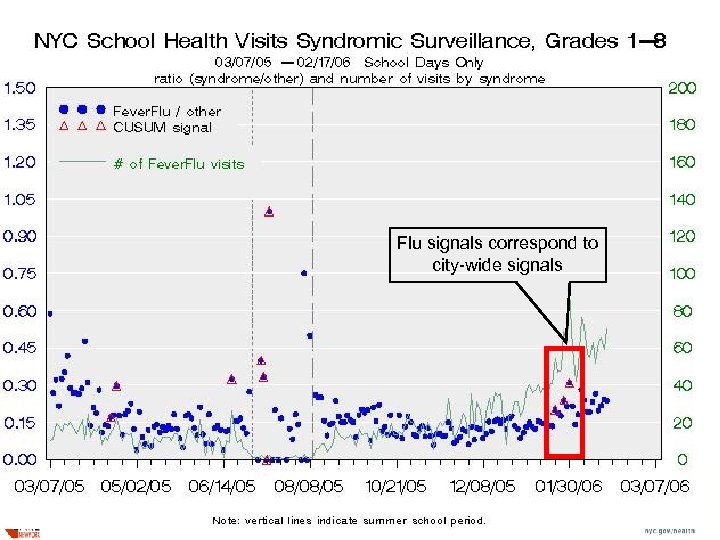 Flu signals correspond to city-wide signals