


 Скачать презентацию NWP in the Met Office Crown copyright
a3ac2ba10e08210a5aa39e62a4a9f9e8.ppt
- Количество слайдов: 45
 NWP in the Met Office © Crown copyright 2006 Page 1
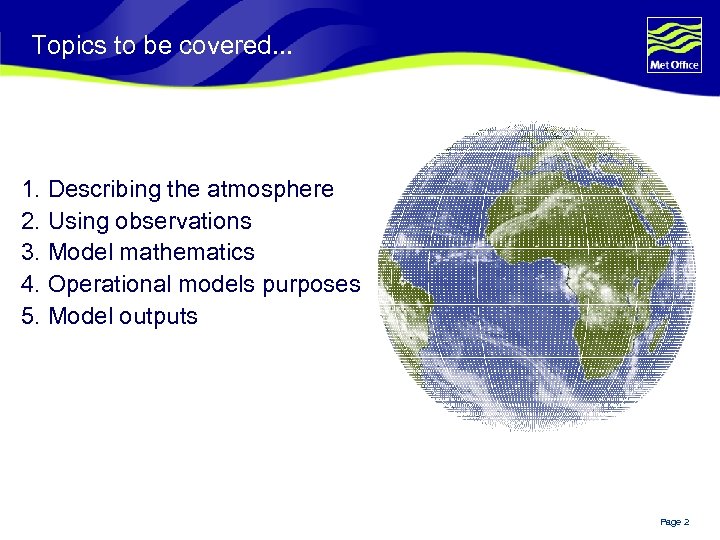 Topics to be covered. . . 1. Describing the atmosphere 2. Using observations 3. Model mathematics 4. Operational models purposes 5. Model outputs Page 2
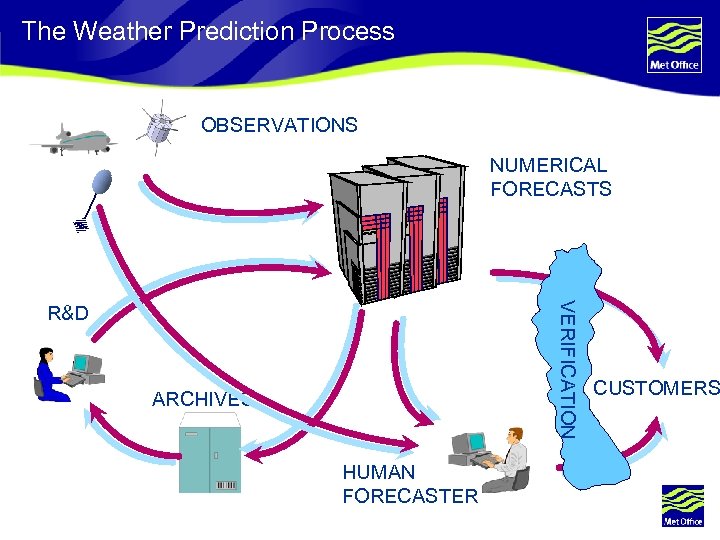 The Weather Prediction Process OBSERVATIONS NUMERICAL FORECASTS VERIFICATION R&D ARCHIVES CUSTOMERS HUMAN FORECASTER Page 3
 Unified Model • Met. Office has several requirements: • local forecasting • global forecasting • climate modelling • ocean and wave modelling • a common model: • shares code and operating structure • is modular where differences are necessary • gives considerable savings in maintenance cost © Crown copyright 2006 Page 4
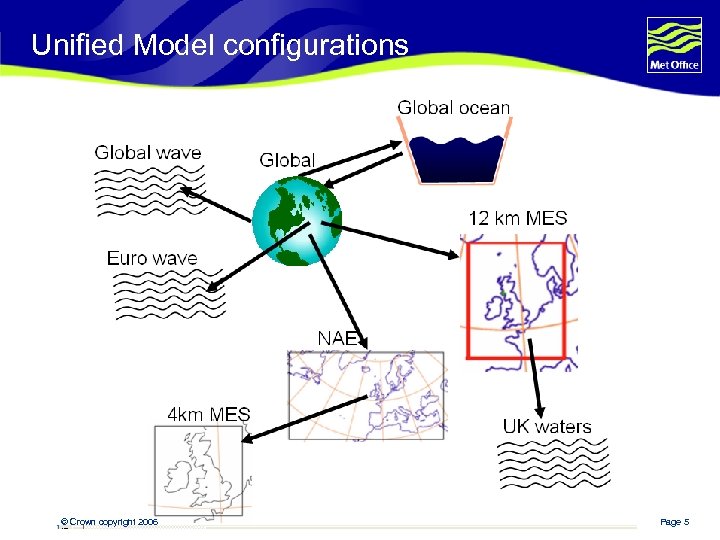 Unified Model configurations © Crown copyright 2006 Page 5
 Met Office models Based on Unified Model • Global • North Atlantic and European model • 4 km and 12 km Mesoscales • Crisis Area Mesoscale Models • Stratospheric • FOAM ocean forecasting models © Crown copyright 2006 Page 6
 Met Office models Other models including • Wave (Global, European, UK Waters) • Surge • NAME • SSFM © Crown copyright 2006 Page 7
 Fundamentals of NWP 1. Specify atmospheric initial conditions in a numerical form 2. Use equations describing atmospheric physical processes to predict how the initial state will evolve 3. Output the forecast in a useful form for the user © Crown copyright 2006 Page 8
 1. Describing the atmosphere
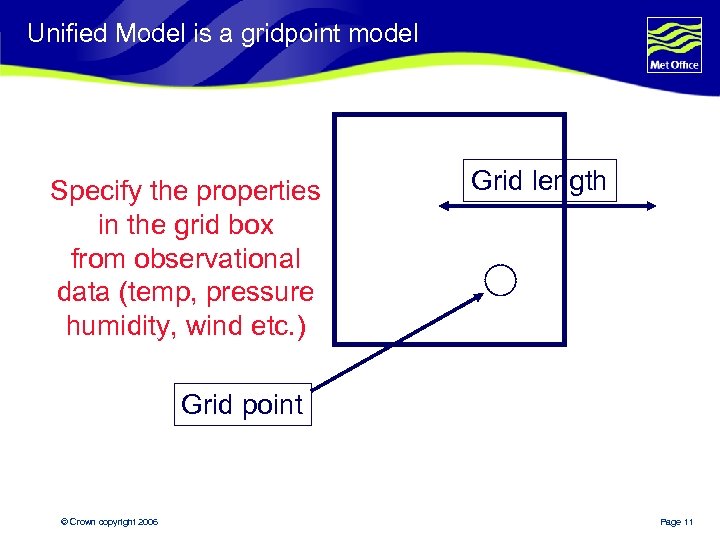 Unified Model is a gridpoint model Specify the properties in the grid box from observational data (temp, pressure humidity, wind etc. ) Grid length Grid point © Crown copyright 2006 Page 11
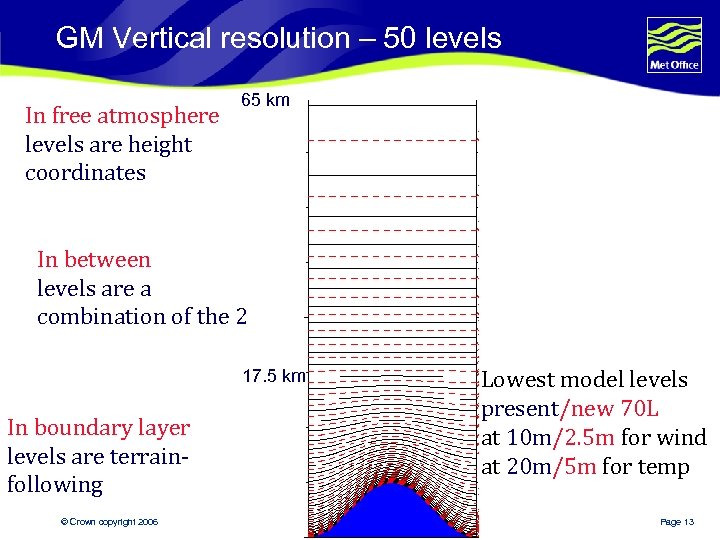 GM Vertical resolution – 50 levels In free atmosphere levels are height coordinates 65 km In between levels are a combination of the 2 17. 5 km In boundary layer levels are terrainfollowing © Crown copyright 2006 Lowest model levels present/new 70 L at 10 m/2. 5 m for wind at 20 m/5 m for temp Page 13
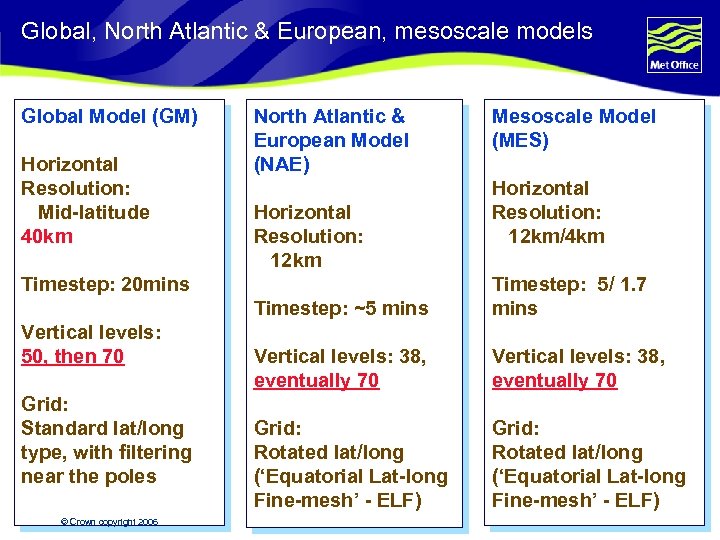 Global, North Atlantic & European, mesoscale models Global Model (GM) Horizontal Resolution: Mid-latitude 40 km North Atlantic & European Model (NAE) Horizontal Resolution: 12 km Timestep: 20 mins Mesoscale Model (MES) Horizontal Resolution: 12 km/4 km Timestep: ~5 mins Vertical levels: 50, then 70 Grid: Standard lat/long type, with filtering near the poles © Crown copyright 2006 Timestep: 5/ 1. 7 mins Vertical levels: 38, eventually 70 Grid: Rotated lat/long (‘Equatorial Lat-long Fine-mesh’ - ELF) Page 14
 2. Using observations
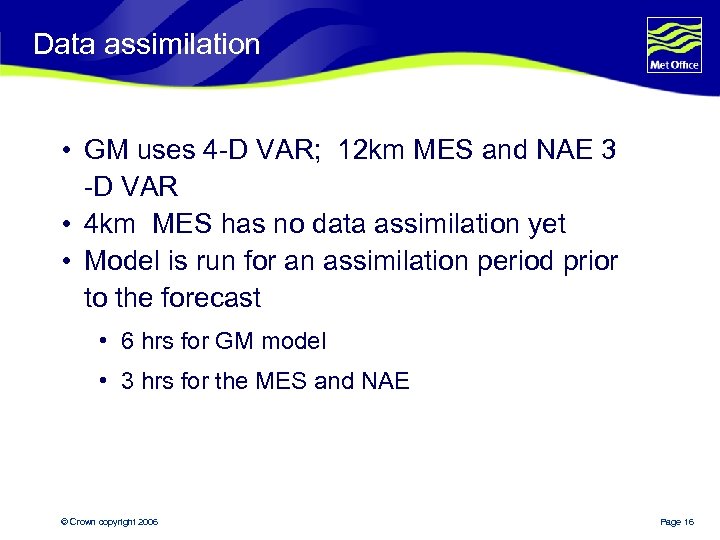 Data assimilation • GM uses 4 -D VAR; 12 km MES and NAE 3 -D VAR • 4 km MES has no data assimilation yet • Model is run for an assimilation period prior to the forecast • 6 hrs for GM model • 3 hrs for the MES and NAE © Crown copyright 2006 Page 16
 Data assimilation • Observations firstly quality controlled against • climate data • model background field • nearby obs. • Then inserted into the run at or near their validity time to nudge the model towards reality © Crown copyright 2006 Page 17
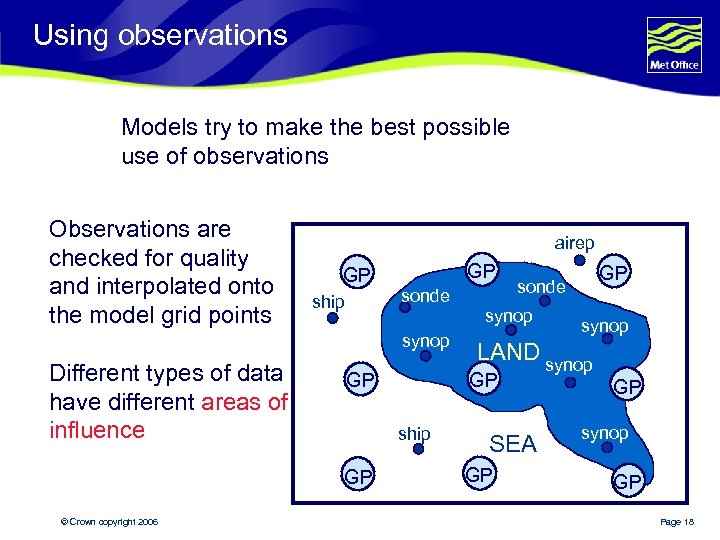 Using observations Models try to make the best possible use of observations Observations are checked for quality and interpolated onto the model grid points airep GP ship GP sonde synop Different types of data have different areas of influence GP GP © Crown copyright 2006 sonde synop LAND synop GP ship GP SEA GP GP synop GP Page 18
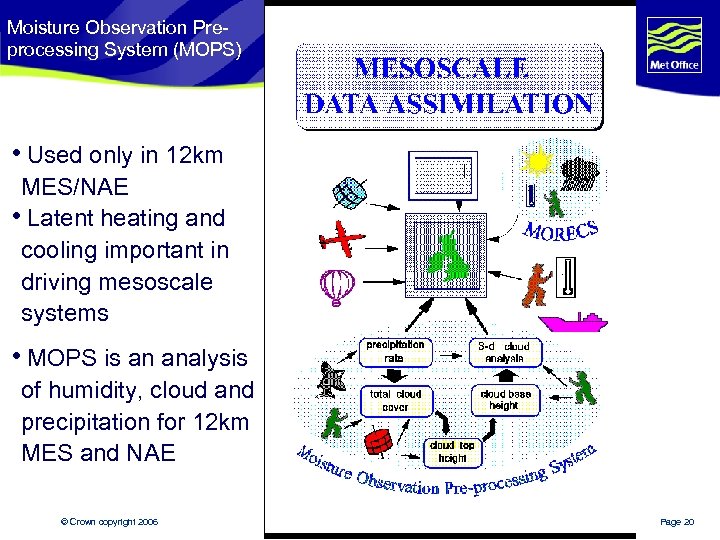 Moisture Observation Preprocessing System (MOPS) i. Used only in 12 km MES/NAE i. Latent heating and cooling important in driving mesoscale systems i. MOPS is an analysis of humidity, cloud and precipitation for 12 km MES and NAE © Crown copyright 2006 Page 20
 Soil moisture in the GM i. No longer reset weekly to climatology i. New soil moisture nudging scheme i. Not as complex as MOPS i. Produced verifiable improvement, especially surface temperatures © Crown copyright 2006 Page 21
 3. Model Mathematics
 Model variables • PRIMARY PROGNOSTIC variables are explicitly calculated using the primitive equations • ANCILLARY FIELDS are fixed lower boundary conditions • SECONDARY PROGNOSTIC variables are calculated at each timestep from the prognostic variables. © Crown copyright 2006 Page 23
 Primary prognostic variables • • • Horizontal and vertical wind components potential temperature specific humidity cloud water and ice surface pressure surface temperature soil temperature canopy water content snow depth © Crown copyright 2006 Page 24
 Ancillary fields • • land/sea mask soil type vegetation type grid-box mean and variance of orography • sea surface temperature • proportion of sea-ice cover • sea-ice thickness • sea surface currents © Crown copyright 2006 Prognostic variables in coupled atmosphere/ ocean models Page 25
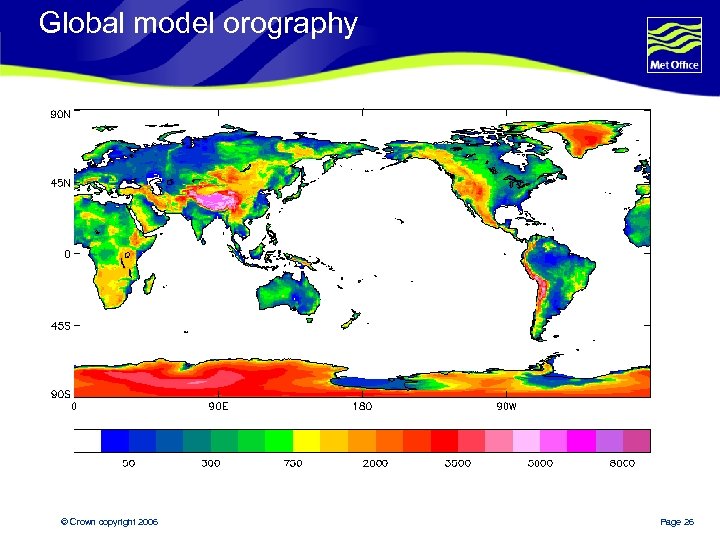 Global model orography © Crown copyright 2006 Page 26
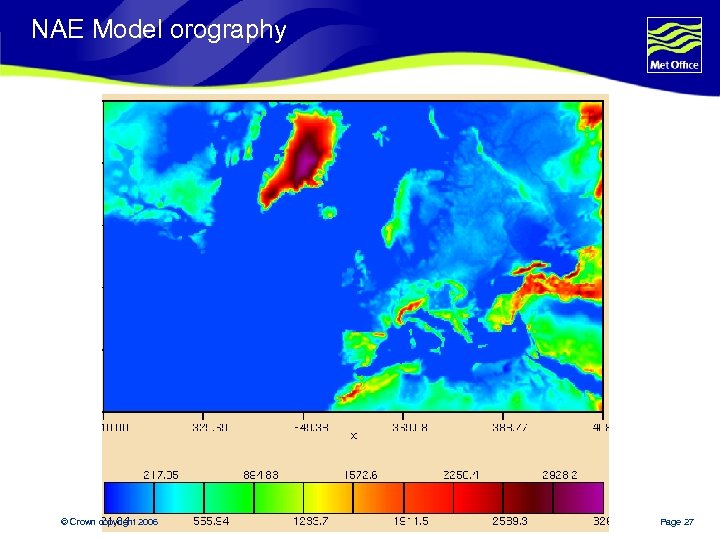 NAE Model orography © Crown copyright 2006 Page 27
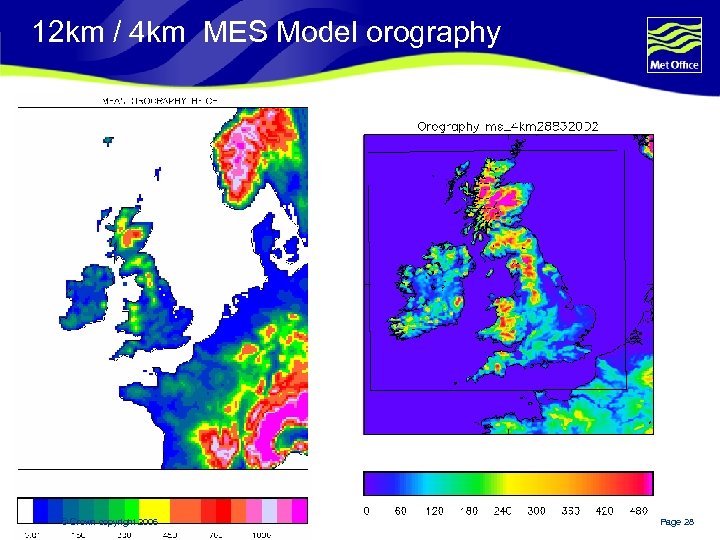 12 km / 4 km MES Model orography © Crown copyright 2006 Page 28
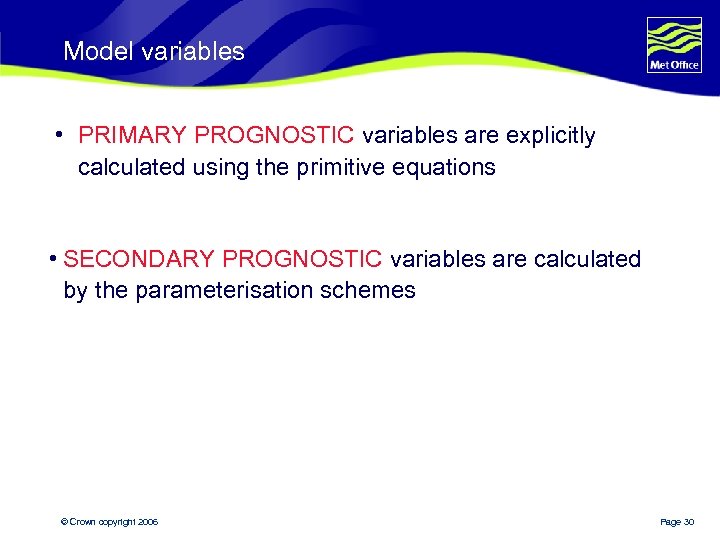 Model variables • PRIMARY PROGNOSTIC variables are explicitly calculated using the primitive equations • SECONDARY PROGNOSTIC variables are calculated by the parameterisation schemes © Crown copyright 2006 Page 30
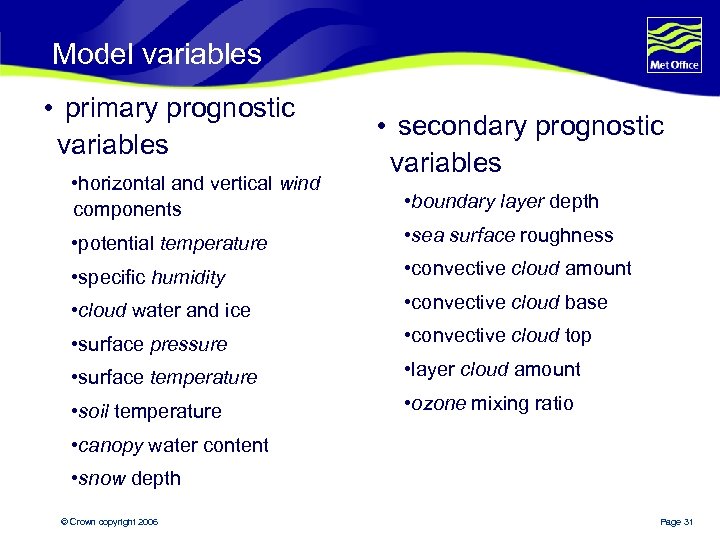 Model variables • primary prognostic variables • horizontal and vertical wind components • secondary prognostic variables • boundary layer depth • potential temperature • sea surface roughness • specific humidity • convective cloud amount • cloud water and ice • convective cloud base • surface pressure • convective cloud top • surface temperature • layer cloud amount • soil temperature • ozone mixing ratio • canopy water content • snow depth © Crown copyright 2006 Page 31
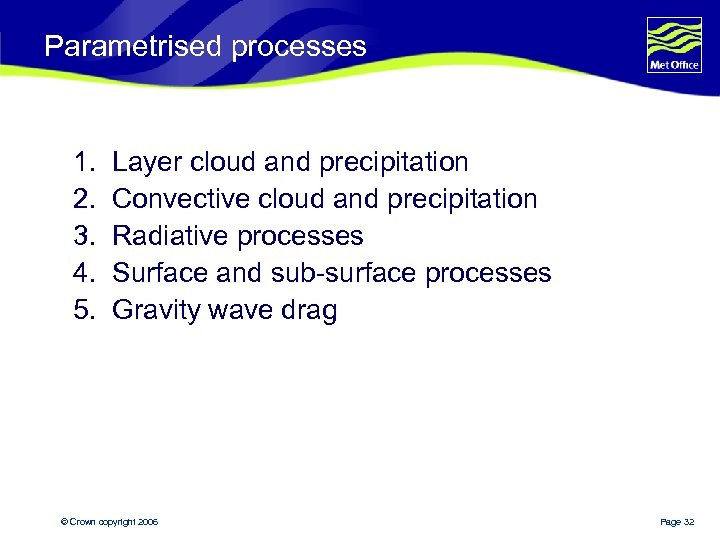 Parametrised processes 1. 2. 3. 4. 5. Layer cloud and precipitation Convective cloud and precipitation Radiative processes Surface and sub-surface processes Gravity wave drag © Crown copyright 2006 Page 32
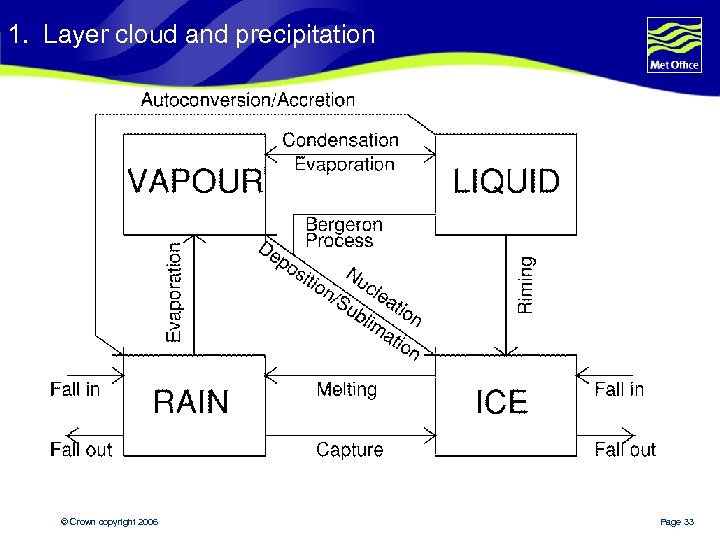 1. Layer cloud and precipitation * * * © Crown copyright 2006 * * * * * Page 33
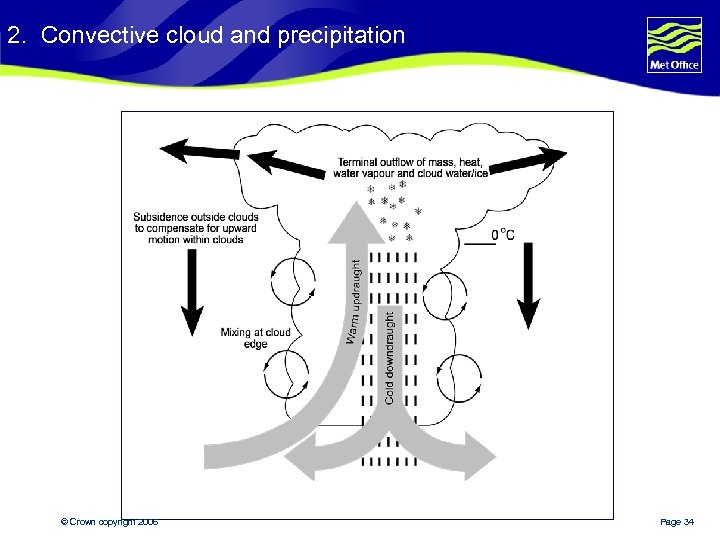 2. Convective cloud and precipitation Convective cloud model © Crown copyright 2006 Page 34
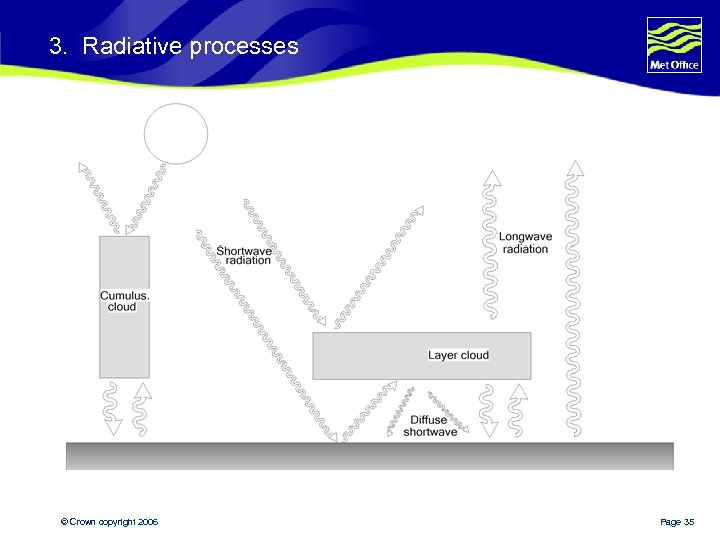 3. Radiative processes © Crown copyright 2006 Page 35
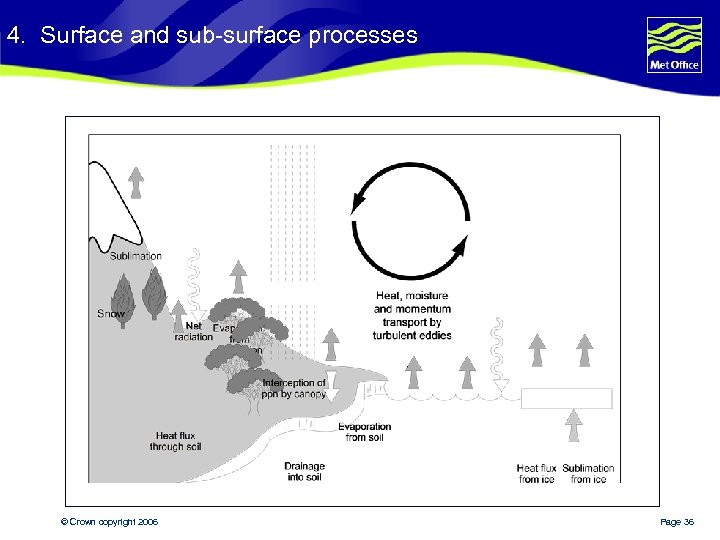 4. Surface and sub-surface processes © Crown copyright 2006 Page 36
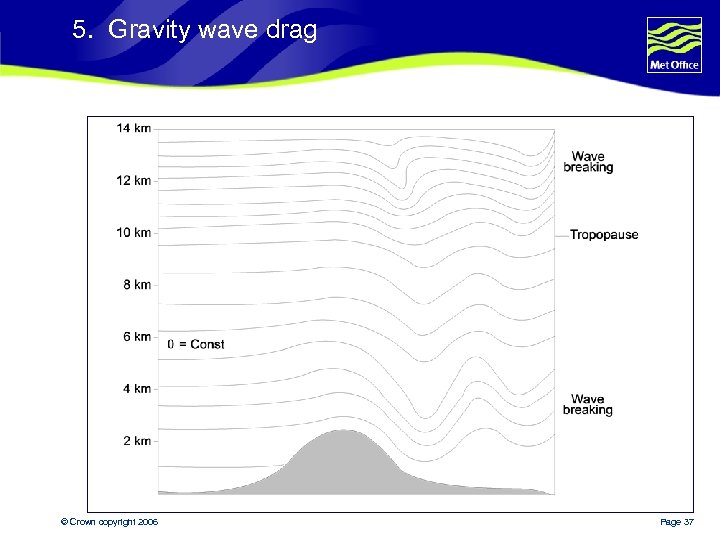 5. Gravity wave drag © Crown copyright 2006 Page 37
 Boundary conditions • Lower and upper boundaries • Land & sea: ancillary fields • Stratosphere: ‘lid’ to model • Lateral boundaries • required in MES and NAE models • primary prognostic variables required at each grid point • NAE and 12 km MES supplied from global model • 4 km MES supplied from NAE • possible source of error © Crown copyright 2006 Page 38
 4. Purposes of Operational Models
 Global model • • 4 times daily Run times … 00 Z, 06 Z, 12 Z, 18 Z Data accepted up to T+1 hour 45 min Out to T+144 (6 days) at 00 Z and 12 Z, T+48 at 06 Z and 18 Z • Takes 2 hr 15 mins to run out to T+144, 1 hr 15 min for T+48 © Crown copyright 2006 Page 40
 Global model • Used for: • regional synoptic guidance • medium range guidance • civil aviation products • mesoscale model boundary conditions © Crown copyright 2006 Page 41
 North Atlantic & European model • Run times … 00, 06, 12 and 18 Z • Takes boundary conditions from Global Model (previous GM run) • Run partly overlaps with the GM • Out to T+48 © Crown copyright 2006 Page 42
 North Atlantic & European model • Used for: • wider range of products to international customers • Improved Synoptic development guidance • Better for rapid developments and extremes • Boundary conditions for 4 km MES © Crown copyright 2006 Page 43
 Advantages of NAE Model • Large domain • Captures developing systems over North Atlantic • Covers all of Europe and European Nimrod area • includes some other model areas • Higher resolution than GM (12 km-v-40 km) • Better for rapid developments and extremes © Crown copyright 2006 Page 44
 12 km Mesoscale model • Run times … 00 Z, 06 Z, 12 Z and 18 Z • Takes boundary conditions from Global Model • Runs in parallel with the GM (starts 10 mins later) • Out to T+48 (2 days) © Crown copyright 2006 Page 45
 12 km Mesoscale model • Used for: • UK local detail (ppn, cloud, temp, wind) • Input to other systems (SSFM, and Nowcasting systems etc. ) © Crown copyright 2006 Page 46
 4 km MES model • Run times … 03 Z, 09 Z, 15 Z, 21 Z • Takes boundary conditions from NAE Model • Out to T+36 • No data assimilation © Crown copyright 2006 Page 47
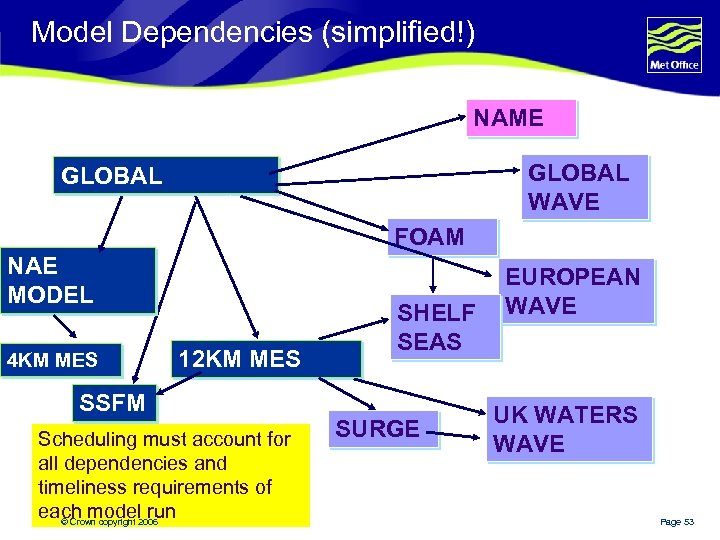 Model Dependencies (simplified!) NAME GLOBAL WAVE GLOBAL FOAM NAE MODEL 4 KM MES 12 KM MES SSFM Scheduling must account for all dependencies and timeliness requirements of each model 2006 run © Crown copyright SHELF SEAS SURGE EUROPEAN WAVE UK WATERS WAVE Page 53
 Any questions? GM, NAE and MES output. http: //www-nwp/~meso/current_mesglob_charts. html NWP Gazette http: //www. metoffice. gov. uk/research/nwp/publications /nwp_gazette/index. html NWP technical reports http: //www. metoffice. gov. uk/research/nwp/publicati ons/papers/technical_reports/index. html 4 km mesoscale runs: http: //www-