


 Скачать презентацию NV Series Transmitters Product Overview Installation Considerations 1
cb9d4ad5f61d7a60365c1f70dd717a8d.ppt
- Количество слайдов: 36
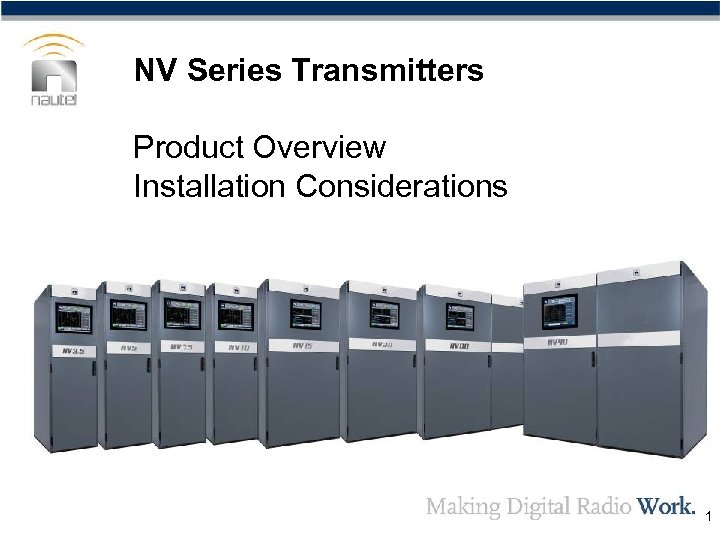 NV Series Transmitters Product Overview Installation Considerations 1
 Product Overview The following presentation uses the NV 30/NV 40 as a reference; refer to the next slide for an NV Series Transmitter Comparison table for key differences between the NV 30/NV 40 and other NV transmitters. • Broadband, capable of operation from 87. 5 MHz to 108 MHz. • Frequency change is a single local or remote command (no tuning). • Dynamic bias controlled RF amplifiers allow seamless mode changing. • Plug-in upgrade to HD by adding Exgine (plus applicable license fees). • Operation at rated power up to VSWR of 1. 5: 1. 2
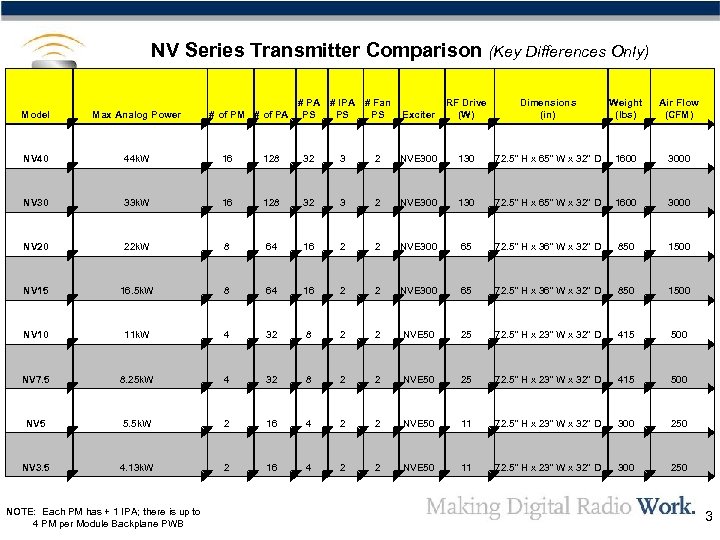 NV Series Transmitter Comparison (Key Differences Only) Exciter RF Drive (W) Dimensions (in) Weight (lbs) Air Flow (CFM) 2 NVE 300 130 72. 5" H x 65" W x 32" D 1600 3000 3 2 NVE 300 130 72. 5" H x 65" W x 32" D 1600 3000 16 2 2 NVE 300 65 72. 5" H x 36" W x 32" D 850 1500 64 16 2 2 NVE 300 65 72. 5" H x 36" W x 32" D 850 1500 4 32 8 2 2 NVE 50 25 72. 5" H x 23" W x 32" D 415 500 8. 25 k. W 4 32 8 2 2 NVE 50 25 72. 5" H x 23" W x 32" D 415 500 NV 5 5. 5 k. W 2 16 4 2 2 NVE 50 11 72. 5" H x 23" W x 32" D 300 250 NV 3. 5 4. 13 k. W 2 16 4 2 2 NVE 50 11 72. 5" H x 23" W x 32" D 300 250 # IPA # Fan PS PS Max Analog Power NV 40 44 k. W 16 128 32 3 NV 30 33 k. W 16 128 32 NV 20 22 k. W 8 64 NV 15 16. 5 k. W 8 NV 10 11 k. W NV 7. 5 NOTE: Each PM has + 1 IPA; there is up to 4 PM per Module Backplane PWB # of PM # of PA # PA PS Model 3
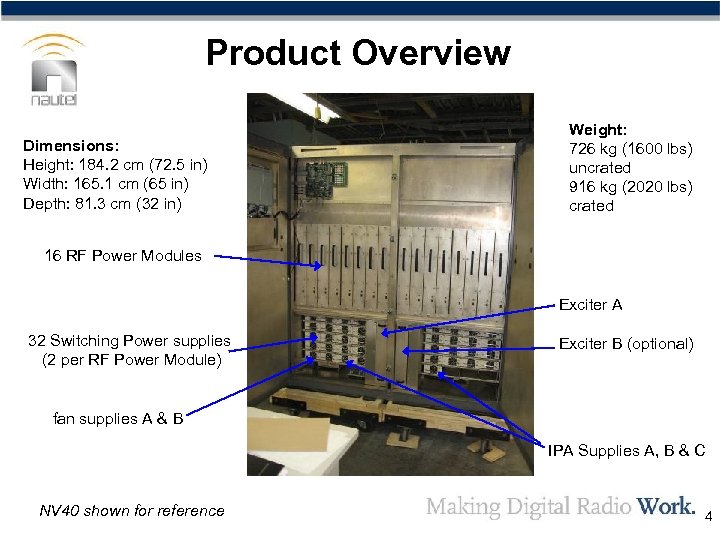 Product Overview Dimensions: Height: 184. 2 cm (72. 5 in) Width: 165. 1 cm (65 in) Depth: 81. 3 cm (32 in) Weight: 726 kg (1600 lbs) uncrated 916 kg (2020 lbs) crated 16 RF Power Modules Exciter A 32 Switching Power supplies (2 per RF Power Module) Exciter B (optional) fan supplies A & B IPA Supplies A, B & C NV 40 shown for reference 4
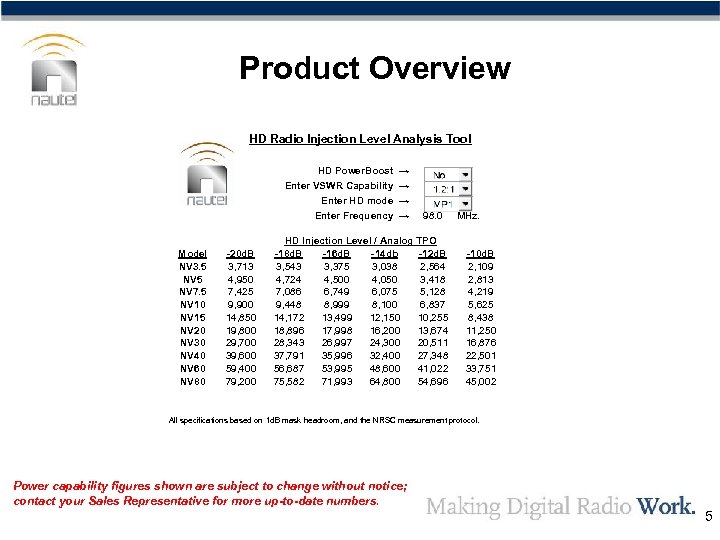 Product Overview HD Radio Injection Level Analysis Tool HD Power. Boost Enter VSWR Capability Enter HD mode Enter Frequency Model NV 3. 5 NV 7. 5 NV 10 NV 15 NV 20 NV 30 NV 40 NV 60 NV 80 -20 d. B 3, 713 4, 950 7, 425 9, 900 14, 850 19, 800 29, 700 39, 600 59, 400 79, 200 → → 98. 0 HD Injection Level / Analog TPO -18 d. B -16 d. B -14 db -12 d. B 3, 543 3, 375 3, 038 2, 564 4, 724 4, 500 4, 050 3, 418 7, 086 6, 749 6, 075 5, 128 9, 448 8, 999 8, 100 6, 837 14, 172 13, 499 12, 150 10, 255 18, 896 17, 998 16, 200 13, 674 28, 343 26, 997 24, 300 20, 511 37, 791 35, 996 32, 400 27, 348 56, 687 53, 995 48, 600 41, 022 75, 582 71, 993 64, 800 54, 696 MHz. -10 d. B 2, 109 2, 813 4, 219 5, 625 8, 438 11, 250 16, 876 22, 501 33, 751 45, 002 All specifications based on 1 d. B mask headroom, and the NRSC measurement protocol. Power capability figures shown are subject to change without notice; contact your Sales Representative for more up-to-date numbers. 5
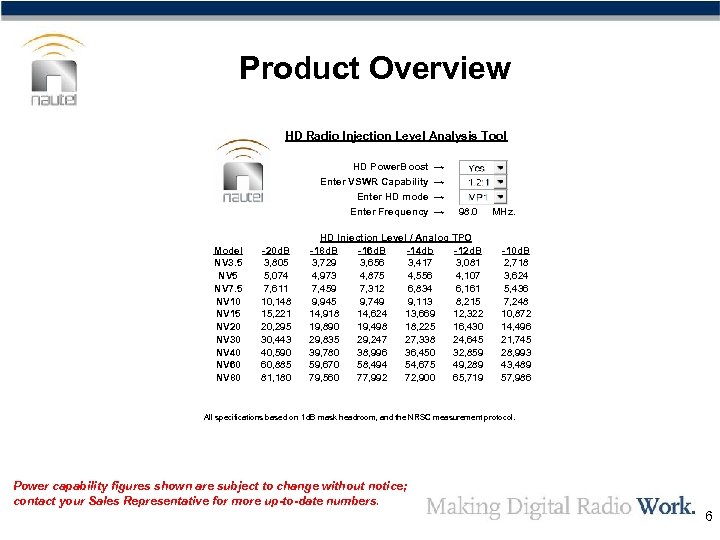 Product Overview HD Radio Injection Level Analysis Tool HD Power. Boost Enter VSWR Capability Enter HD mode Enter Frequency Model NV 3. 5 NV 7. 5 NV 10 NV 15 NV 20 NV 30 NV 40 NV 60 NV 80 -20 d. B 3, 805 5, 074 7, 611 10, 148 15, 221 20, 295 30, 443 40, 590 60, 885 81, 180 → → 98. 0 HD Injection Level / Analog TPO -18 d. B -16 d. B -14 db -12 d. B 3, 729 3, 656 3, 417 3, 081 4, 973 4, 875 4, 556 4, 107 7, 459 7, 312 6, 834 6, 161 9, 945 9, 749 9, 113 8, 215 14, 918 14, 624 13, 669 12, 322 19, 890 19, 498 18, 225 16, 430 29, 835 29, 247 27, 338 24, 645 39, 780 38, 996 36, 450 32, 859 59, 670 58, 494 54, 675 49, 289 79, 560 77, 992 72, 900 65, 719 MHz. -10 d. B 2, 718 3, 624 5, 436 7, 248 10, 872 14, 496 21, 745 28, 993 43, 489 57, 986 All specifications based on 1 d. B mask headroom, and the NRSC measurement protocol. Power capability figures shown are subject to change without notice; contact your Sales Representative for more up-to-date numbers. 6
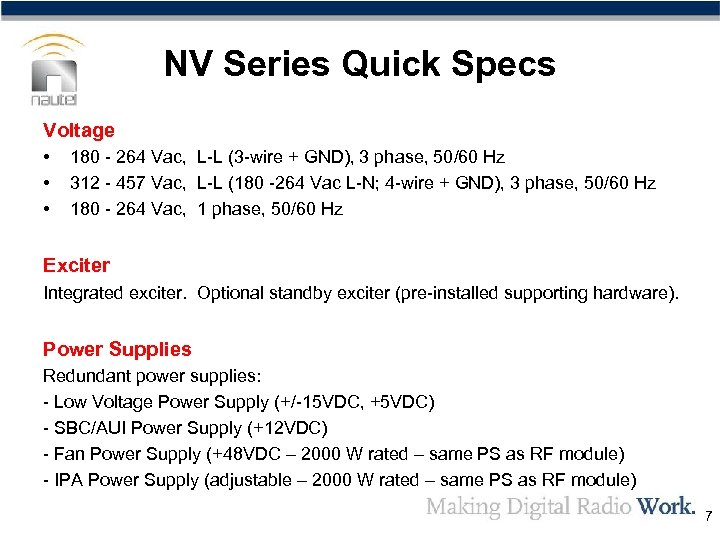 NV Series Quick Specs Voltage • • • 180 - 264 Vac, L-L (3 -wire + GND), 3 phase, 50/60 Hz 312 - 457 Vac, L-L (180 -264 Vac L-N; 4 -wire + GND), 3 phase, 50/60 Hz 180 - 264 Vac, 1 phase, 50/60 Hz Exciter Integrated exciter. Optional standby exciter (pre-installed supporting hardware). Power Supplies Redundant power supplies: - Low Voltage Power Supply (+/-15 VDC, +5 VDC) - SBC/AUI Power Supply (+12 VDC) - Fan Power Supply (+48 VDC – 2000 W rated – same PS as RF module) - IPA Power Supply (adjustable – 2000 W rated – same PS as RF module) 7
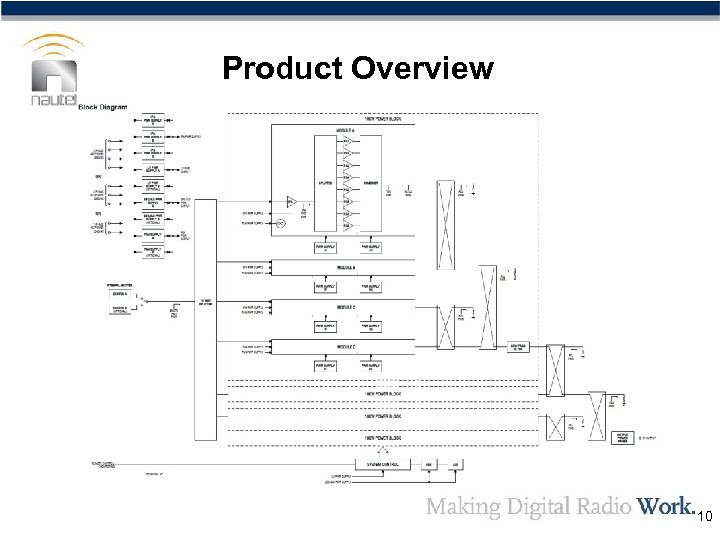
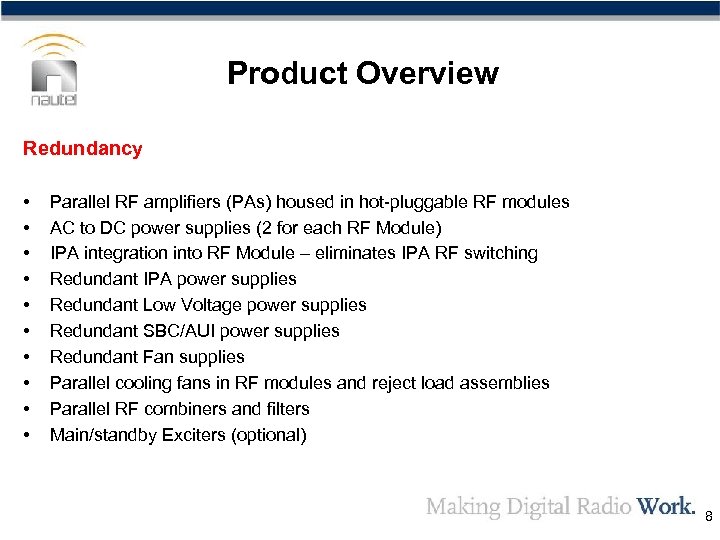 Product Overview Redundancy • • • Parallel RF amplifiers (PAs) housed in hot-pluggable RF modules AC to DC power supplies (2 for each RF Module) IPA integration into RF Module – eliminates IPA RF switching Redundant IPA power supplies Redundant Low Voltage power supplies Redundant SBC/AUI power supplies Redundant Fan supplies Parallel cooling fans in RF modules and reject load assemblies Parallel RF combiners and filters Main/standby Exciters (optional) 8
 Product Overview Transmitter Control Redundancy • Local/Remote AUI, local rudimentary controls, remote parallel inputs. • Control/Interface PWB has: – Push button switches for RF On, RF Off, Local/Remote, Reset, Power Increase and Decrease (backup control) – Summary alarm status LEDs for the various transmitter stages – Forward Power LED bar meter with 10% steps up to maximum power 9
 Product Overview 10
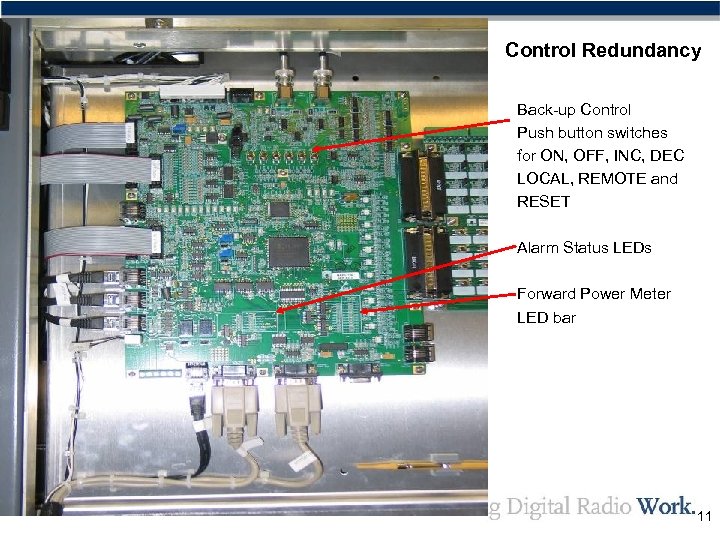 Control Redundancy Back-up Control Push button switches for ON, OFF, INC, DEC LOCAL, REMOTE and RESET Alarm Status LEDs Forward Power Meter LED bar 11
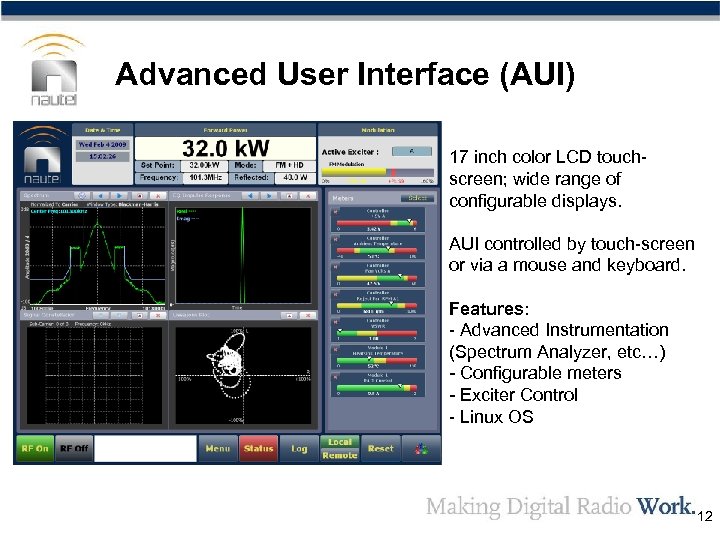 Advanced User Interface (AUI) 17 inch color LCD touchscreen; wide range of configurable displays. AUI controlled by touch-screen or via a mouse and keyboard. Features: - Advanced Instrumentation (Spectrum Analyzer, etc…) - Configurable meters - Exciter Control - Linux OS 12
 RF Drive Requirements Exciter Configuration: NVE 300 (300 watts FM) NVE 50 (50 watts FM) Integrated exciter. RF drive level is set automatically based on transmitter model, mode of operation, and power level. Typical Exciter level for full power analog mode: NV 30/NV 40 - 130 W NV 15/NV 20 - 65 W NV 7. 5/NV 10 - 25 W NV 3. 5/NV 5 - 11 W 13
 Advanced Integral Exciter Features: • Adaptive Pre-correction • Pre-Equalization • GPS 10 MHz input • Single PWB for audio and RF generation • Exciter control through TX AUI • Dynamic PA bias control for on the fly analog-IBOC mode switching • Built in SCA, RDS/RBDS, Stereo generator 14
 Analog Inputs Exciter accepts the following Analog & Digital Inputs: Analog Inputs • Left and right inputs – see page 7 -1 (pre-installation manual) • Composite input – see page 7 -3 • SCA inputs – see page 7 -3 Digital inputs • IBOC - see page 7 -3 • AES/EBU - see page 7 -4 • SCA generator input - see page 7 -4 • RBDS/RDS input - see page 7 -4 • Pilot phase control - see page 7 -4 • Pilot/MPX sample output - see page 7 -4 15
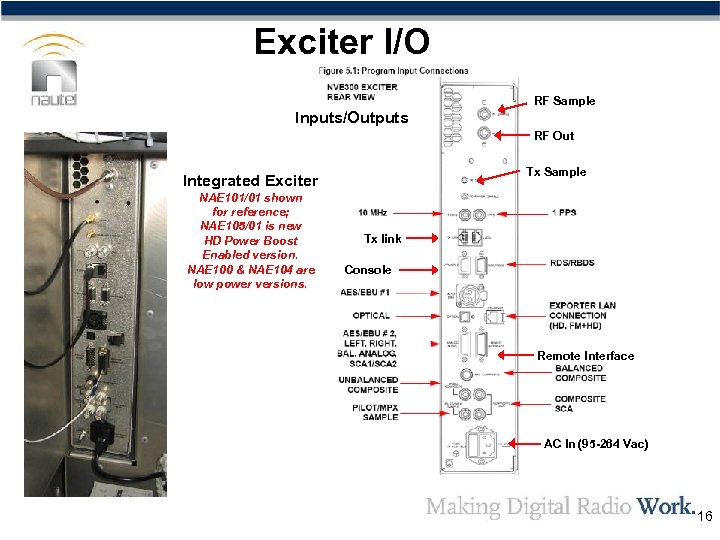 Exciter I/O RF Sample Inputs/Outputs RF Out Tx Sample Integrated Exciter NAE 101/01 shown for reference; NAE 105/01 is new HD Power Boost Enabled version. NAE 100 & NAE 104 are low power versions. Tx link Console Remote Interface AC In (95 -264 Vac) 16
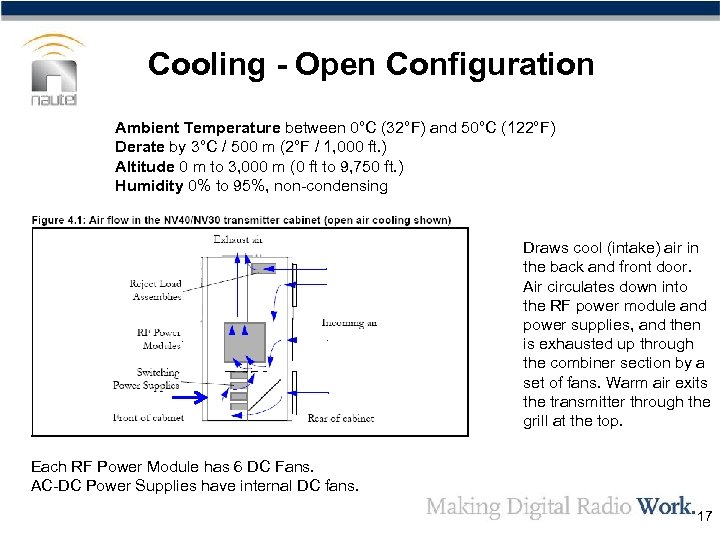 Cooling - Open Configuration Ambient Temperature between 0°C (32°F) and 50°C (122°F) Derate by 3°C / 500 m (2°F / 1, 000 ft. ) Altitude 0 m to 3, 000 m (0 ft to 9, 750 ft. ) Humidity 0% to 95%, non-condensing Draws cool (intake) air in the back and front door. Air circulates down into the RF power module and power supplies, and then is exhausted up through the combiner section by a set of fans. Warm air exits the transmitter through the grill at the top. Each RF Power Module has 6 DC Fans. AC-DC Power Supplies have internal DC fans. 17
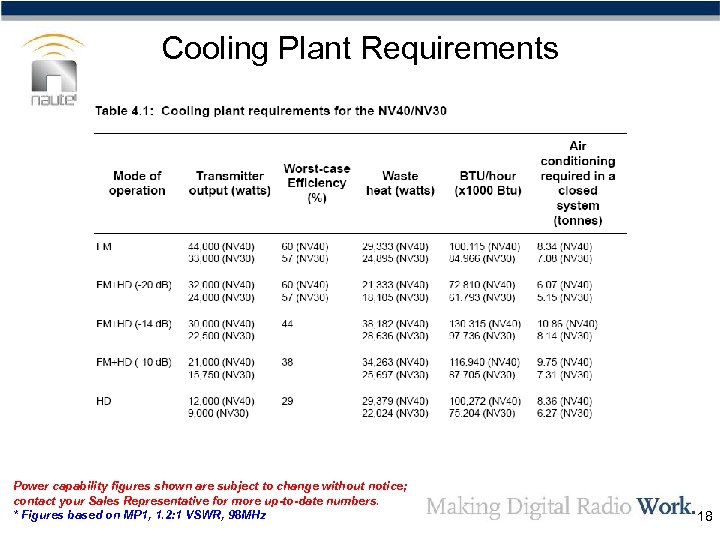 Cooling Plant Requirements Power capability figures shown are subject to change without notice; contact your Sales Representative for more up-to-date numbers. * Figures based on MP 1, 1. 2: 1 VSWR, 98 MHz 18 18
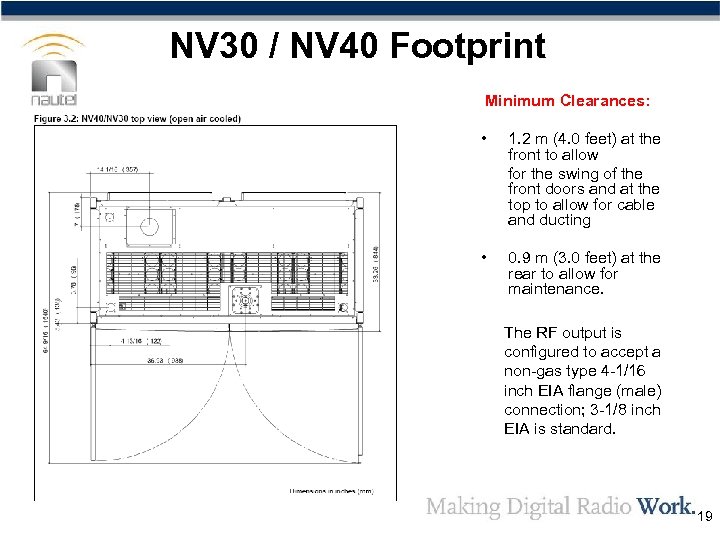 NV 30 / NV 40 Footprint Minimum Clearances: • 1. 2 m (4. 0 feet) at the front to allow for the swing of the front doors and at the top to allow for cable and ducting • 0. 9 m (3. 0 feet) at the rear to allow for maintenance. The RF output is configured to accept a non-gas type 4 -1/16 inch EIA flange (male) connection; 3 -1/8 inch EIA is standard. 19
 Ac Source Requirements • Option: 3 -phase, 4 wire (L, L, L, G) or 5 wire (L, L, L, N, G) • Option: 1 -phase, 3 wire (L, L, G) • 180 and 264 V ac under load (3 -phase or 1 -phase, 50 / 60 Hz). No transformer tapping. • 312 and 457 V ac under load (3 -phase, 50 / 60 Hz). No transformer tapping. • LVPS and SBC/AUI PS have universal input (85 -264 VAC) 20
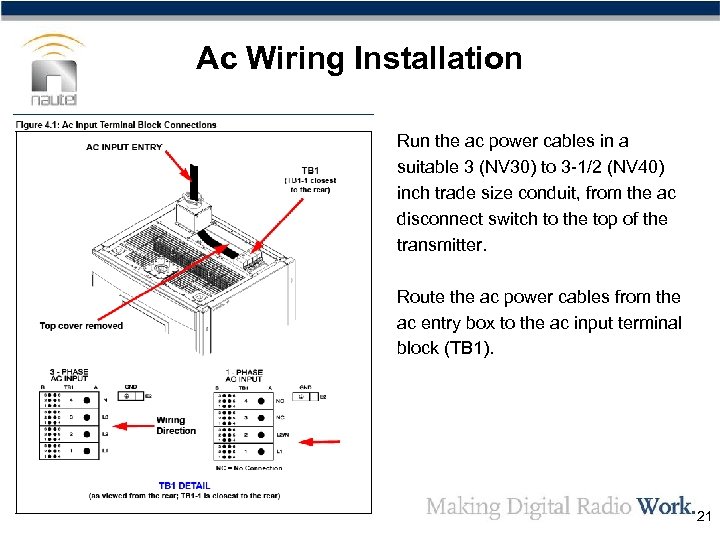 Ac Wiring Installation Run the ac power cables in a suitable 3 (NV 30) to 3 -1/2 (NV 40) inch trade size conduit, from the ac disconnect switch to the top of the transmitter. Route the ac power cables from the ac entry box to the ac input terminal block (TB 1). 21
 AC Installation • Run the ac power cables in a suitable 3 -1/2 (NV 40) inch conduit, from the ac disconnect switch to the top of the transmitter. Pass all ac power source wires, including the ground wire, through the ferrite toroids. • Install the AC power cables to the ac entry box. • Route the ac power cables from the ac entry box to the ac input terminal block (TB 1). • For three-phase ac power sources connect the three ac line inputs to terminals 1 A (L 1), 2 A (L 2) and 3 A (L 3) of terminal block TB 1. Connect the ac neutral (as required) to terminal 4 A (N). Secure all wires in their respective terminals. • Install the RF Feed cable to the RF output connector on the top of the cabinet. Install a ferrite around the feed cable near the transmitter RF output. • Reinstall the ac distribution assembly cover. 22
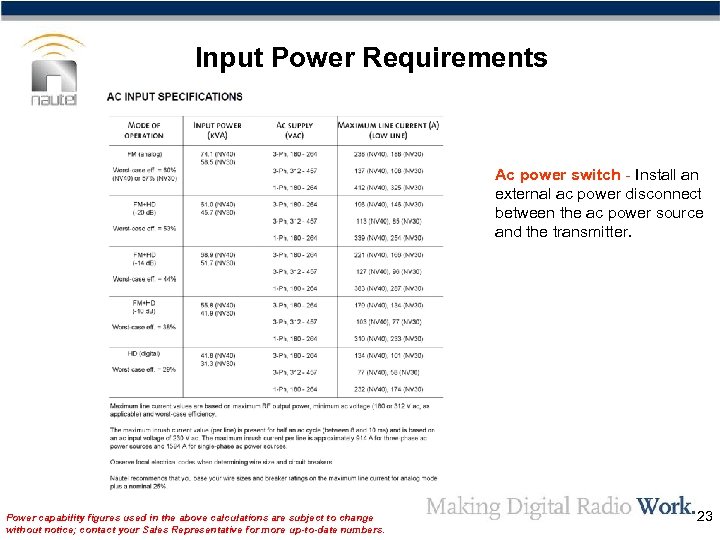 Input Power Requirements Ac power switch - Install an external ac power disconnect between the ac power source and the transmitter. Power capability figures used in the above calculations are subject to change without notice; contact your Sales Representative for more up-to-date numbers. 23
 Antenna • 50 ± j 0 ohms • VSWR - Rated Power achievable up to 1. 5: 1 - Automatic power reduction above 1. 5: 1 - Shutback above 2: 1 - Shutdown above 3: 1 • RF Feed – The antenna feed cable should be a suitably rated coaxial cable. – Output connector: NV 30/NV 40: Non-gas type 4 -1/16 inch EIA flange (male) connection available; 3 -1/8 inch EIA standard. 24
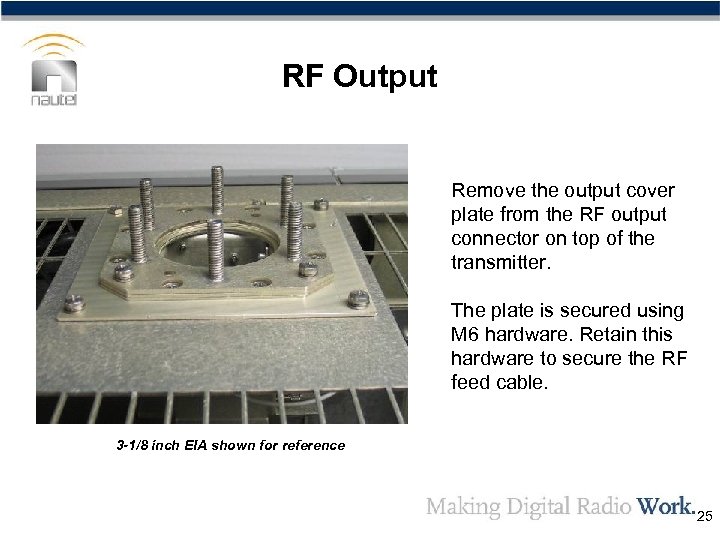 RF Output Remove the output cover plate from the RF output connector on top of the transmitter. The plate is secured using M 6 hardware. Retain this hardware to secure the RF feed cable. 3 -1/8 inch EIA shown for reference 25
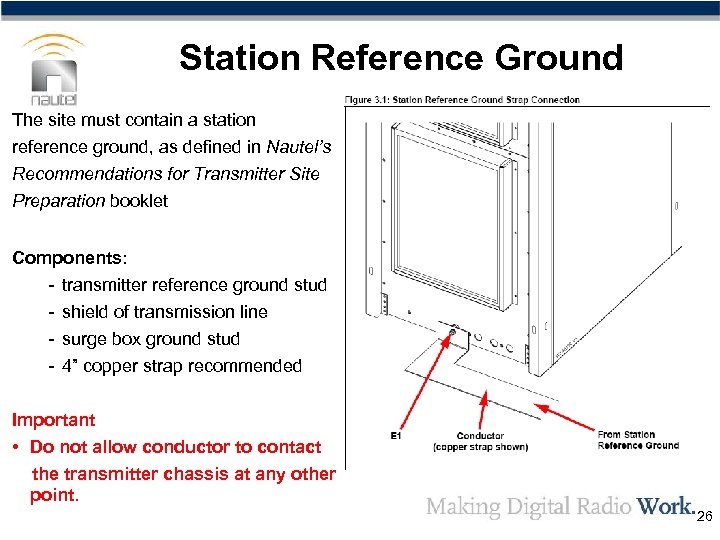 Station Reference Ground The site must contain a station reference ground, as defined in Nautel’s Recommendations for Transmitter Site Preparation booklet Components: - transmitter reference ground stud - shield of transmission line - surge box ground stud - 4” copper strap recommended Important • Do not allow conductor to contact the transmitter chassis at any other point. 26
 Control and Monitoring Remote control is available via two different methods: Web Based Control: • • From a web browser you can access 100% of the transmitter’s local functionality. An Ethernet port is provided for remote connection to remotely monitor and/or control an NV series transmitter. Discrete Logic Control: • All important status, telemetry and control of the NV transmitter’s operation is available such as on/off control and status, RF power level, power level adjustment, and system reset. • Includes 24 digital inputs, 24 digital outputs, and 8 analog outputs. Each input is preset by Nautel but can be mapped by the user to any available digital control/status within the transmitter. • All digital inputs and outputs are defined using the AUI. 27 27
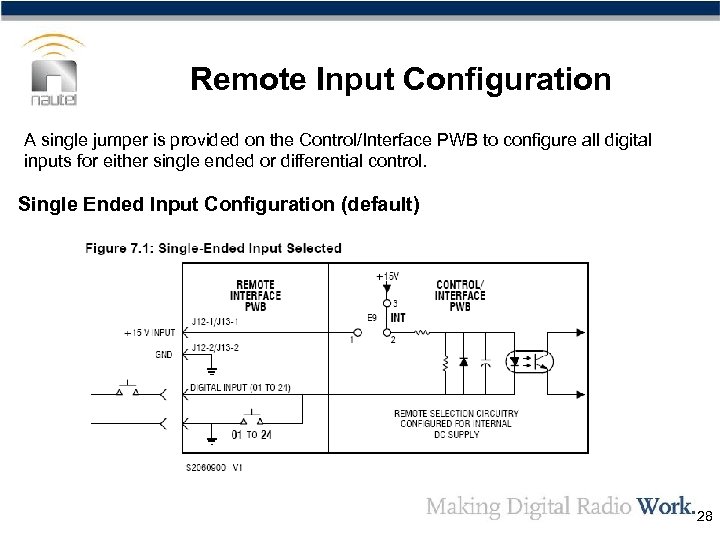 Remote Input Configuration A single jumper is provided on the Control/Interface PWB to configure all digital inputs for either single ended or differential control. Single Ended Input Configuration (default) 28
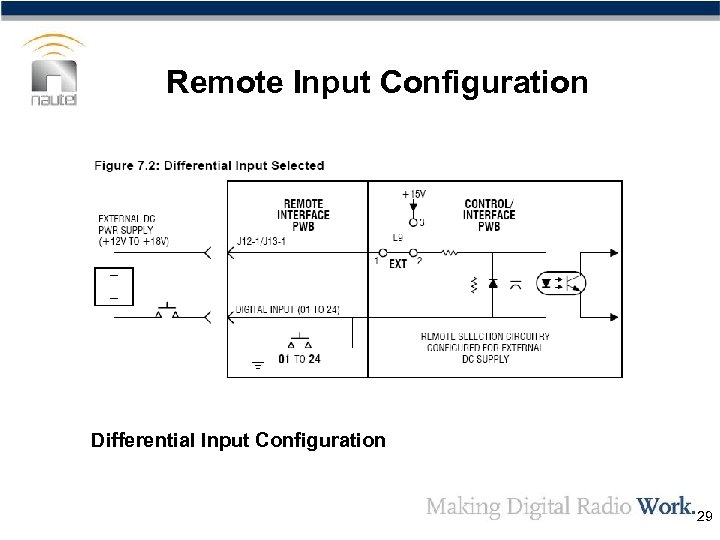 Remote Input Configuration Differential Input Configuration 29
 Digital Inputs • The 24 digital inputs are connected to terminal blocks J 7, J 8, J 9 and J 10. • Momentary switches S 1 (01) through S 24 (24), which can be labeled according to their function, provide a means to locally activate the digital inputs. • See Table 7. 1 on page 7 -2 (Pre-installation Manual) to determine the input terminal associated with each digital input and to determine the switch associated with each of the digital inputs. 30
 Digital Outputs • The 24 digital outputs are connected to terminal blocks J 3, J 4, J 5 and J 6. • Outputs are defaulted to negative logic (current-sink-to-ground) output when a ‘true’ (alarm condition or active status) exists. See note ** below. • Outputs provide an open collector during logic 'false' conditions (non-alarm or non-active status condition). See note ** below. ** Some status outputs are reverse logic; e. g. Summary Alarm, Low and Very Low Forward Power Alarms, and AC Low Alarm – are all active high to prevent a false indication when the transmitter has a low ac condition (open-collector is ‘true’ condition). • Each monitoring circuit must present impedance between the switching device and a positive dc voltage source that results in a current flow of not more than 25 m. A. 31
 Digital Outputs continued • A +15 V supply is available for use by the remote monitoring circuits on J 1 -34 or J 1 -35 (ground on J 1 -36 or J 1 -37). • Outputs can be connected to a STATUS (green) or ALARM (red) LED using Bi-position shorting jumpers E 1 through E 24. • The outputs can be labeled according to their function. • See Table 7. 2 on page 7 -7 for a list of the factory preset outputs, their descriptions and their associated output terminals and status LEDs (see “LED configuration”) on the remote interface PWB. 32
 Analog Outputs • The dc voltage of each output is between 0 to 6 V, and varies within the real limits of the parameter being monitored. • Analog outputs 1 through 8 connect to terminals of connector J 11 on the remote interface PWB (A 2). • See Table 7. 3 on page 7 -9 to determine the terminal associated with each analog output. • Ground/shield connections are available on various terminals of connectors J 3 through J 10. 33
 Installation Parts Nautel will supply - Standard: An ancillary kit (hardware, zip ties, ferrite toroids) is provided with the transmitter - Optional (purchased by customer): Surge protector units • Nautel does NOT supply* - 50 ohm RF transmission line - inner connectors (bullets) - ground strap - external control / monitor wiring - electrical power cables - test equipment / tools * Unless specifically quoted by customer request 34
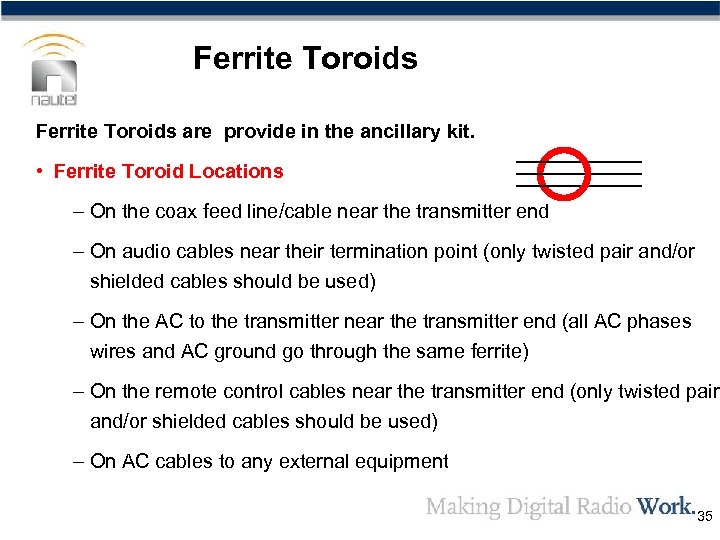 Ferrite Toroids are provide in the ancillary kit. • Ferrite Toroid Locations – On the coax feed line/cable near the transmitter end – On audio cables near their termination point (only twisted pair and/or shielded cables should be used) – On the AC to the transmitter near the transmitter end (all AC phases wires and AC ground go through the same ferrite) – On the remote control cables near the transmitter end (only twisted pair and/or shielded cables should be used) – On AC cables to any external equipment 35
 Helpful Information Sources NV Series Technical Instruction Manual: • Schematics • Mechanical drawings • Parts list • Wiring list NUG (Nautel User’s Group) website: • OEM list Accessed via www. nautel. com • FAQs • Pre-installation data sheets • Online manuals • Field modification documents Customer Service Dept: Sales: Service: Fax: +1. 902. 823. 3900 / 1 -877 -628 -8353 info@nautel. com support@nautel. com +1. 902. 823. 3183 Live Chat via www. nautel. com 36 36