Скачать презентацию NURSING CARE PLAN PATIENT WITH GYNECOLOGY CHEMOTHERAPY Ni
4402929878621834a7597731f8049f67.ppt
- Количество слайдов: 25
 NURSING CARE PLAN PATIENT WITH GYNECOLOGY CHEMOTHERAPY Ni Ketut Alit A Nursing Faculty Airlangga University Surabaya East Java
 REFERENCES Bobak LM & Jensen MD (1993) Maternity & Gynecologyc Care, The Nurse and The Family 5 th ed , St Luis : CV Mosby Company. Black, J. M. & Matassarin E, (1997). Medical Surgical Nursing: Clinical Management for continuity of care. J. B. Lippincott. co. Smeltzer, S. C. , & Bare, B. (2003). Brunner and Suddarth's Textbook of Medical-Surgical Nursing (10 th ed. ). Philadelphia: Lippincott Williams & Wilkins. Ignativicius & Bayne. (2001). Medical and Surgical Nursing. Philadelphia: W. B. Saunders Company. Luckman & Sorensen. (2000). Medical Surgical Nursing. Philadelphia: W. B. Saunders Company. Journals and article related to. .
 TERMINOLOGY Neoplasm “new plasma”…abnormal tissue growth with rapid growth Benign no metastasis Malignant local invasion and destructive growth…”wicked” Metastasis spread form primary via lymphatic and/or circulatory system
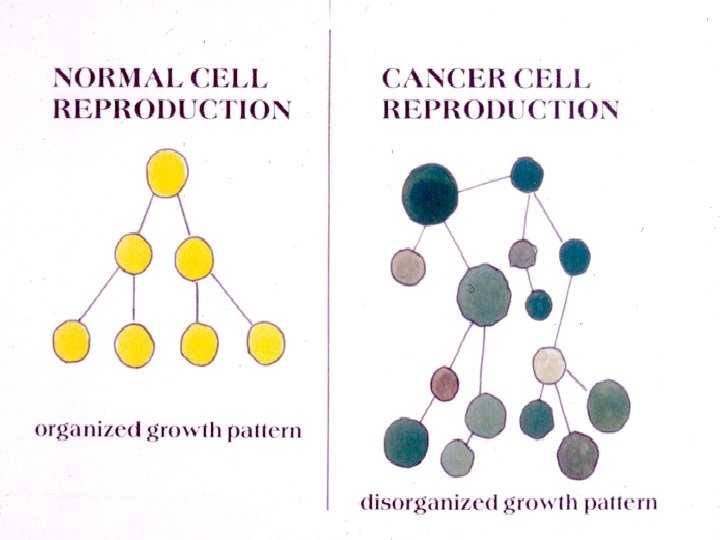
 DEFINITIONS 1. Cancer is a disease of the cell 2. Large group of diseases characterized by: a. Abnormal cell structure (no differentiation) b. Uncontrolled growth (proliferation) c. Ability to spread (metastasis) d. Ability to invade normal tissue (lack contact inhibition)
 SURGERY Curative Prophylactic Diagnostic Staging Palliative Adjuvant or Supportive Reconstructive/Rehabilitative
 RADIATION Highest energy rays that can kill any cell or tissue May be external source (brachytherapy) Curative Palliative 60% will receive XRT Divided into doses or fractions (Preserve normal cellular growth)
 CHEMOTHERAPY Cytotoxic drugs that destroy cancer cells or prevent cellular replication by interfering with DNA and RNA and vital cellular proteins Goal is to reduce the number of cells to a small number that can be (theoretically) handled by the immune system
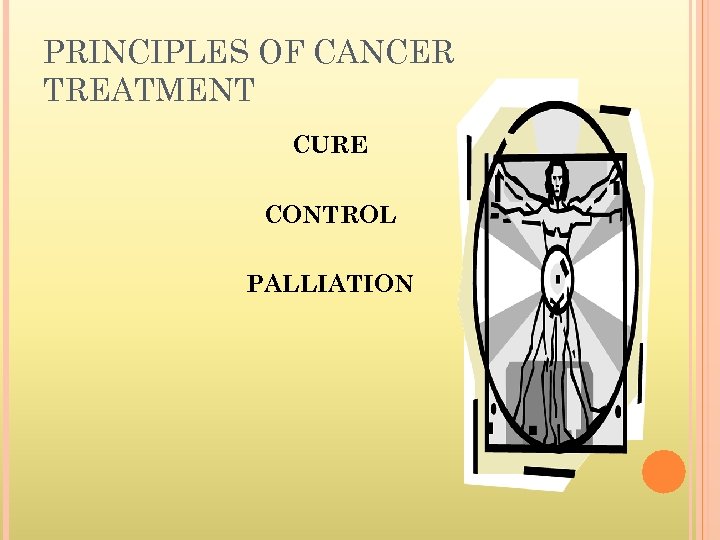 PRINCIPLES OF CANCER TREATMENT CURE CONTROL PALLIATION
 GENITAL CANCER • • • Cervical Endometrial Ovarian Testicular Breast
 CANCER BACKGROUND 1. 2. 3. 4. 5. 6. Family of complex diseases Affect different organs and organ systems Normal cells mutate into abnormal cells Eventually harm and destroy host Historically, cancer is a dreaded disease Cancer accounts for about 25% of death.
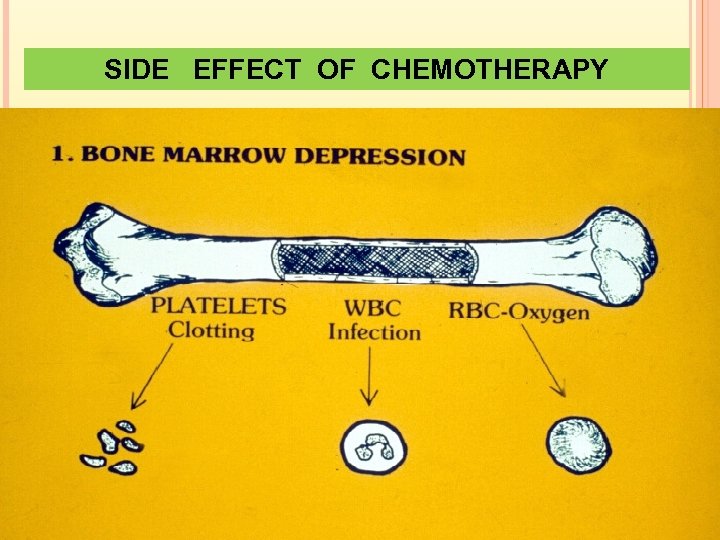 SIDE EFFECT OF CHEMOTHERAPY
 MYELOSUPPRESSION NEUTROPENIA THROMBOCYTOPENIA ANEMIA
 NEUTROPENIA/LEUKOPENIA Assess risk factors (Age, renal and liver function, nutrition, bone marrow, other medications, prior chemotherapy and/or radiation) Manifestations include fever >38 C or 100. 4 F (no classic signs) cough, SOB skin redness or tenderness, (mouth, perianal, rectal) urinary symptoms (dysuria frequency, hematuria, hesitancy) indwelling devices (VAD’s, pain, edema, swelling, induration at site) sepsis (hypotension, agitation, decreased urine)
 PREVENTION No fresh fruits or vegetables, no pepper, live plants or potting soil No exposure to live vaccines or pet excreta Avoid others with colds Strict hand washing and personal hygiene Mouth care at least 4 times daily No trauma or invasive procedures Prevent constipation and pressure sores
 Management: BC lines and peripheral, urine, sputum Good physical assessment Antibiotics immediately (broad spectrum coverage) Patient education Vital signs at least every 4 hours or more Assess for chills, cough, pain
 THROMBOCYTOPENIA Assess risk factors chemotherapy / radiation DIC disease infiltration NSAID's petechaie hemorrhage (skin, GI, GU) headaches, confusion, somnolence
 Management Institute bleeding precautions <50, 000/mm 3 Decrease activity and no lifting or straining/Valsalva High fiber, increase fluids, stool softeners No razors, nail clippers, douching, tampons, watersoluble lubricants, no flossing, guiac/hemocult, pad counts Maintain SBP <140 mm/Hg No IM injections, apply pressure to all sites, no NSAIDS, administer platelets per protocol Educate patients signs and symptoms
 ANEMIA=DECREASED RED BLOOD CELLS Assess for chemotherapy kidney damage tumor infiltration bleeding, hemorrhage age, appetite
 Management: Rest, slow position changes Oxygen Iron Transfusion Patient education on signs and symptoms
 GI SYMPTOM 60% patients experience nausea and vomiting, etc. . Patterns Anticipatory (starts and may last several hours to days) Acute (0 -24 hours) Delayed (1 -4 days) medications, stress management Assess for weight loss, albumin, hydration
 OTHER NOTABLE SIDE EFFECTS Up to 80% develop mouth sores Skin reaction : hypersensitivity, hyper pigmentation, photo sensitivity, Ulceration Hair loss : damage is to shaft (thinning and breakage), damage to roots (complete alopecia), loss begins about 2 weeks after treatment, regrowth may take up to 3 -5 months after treatment
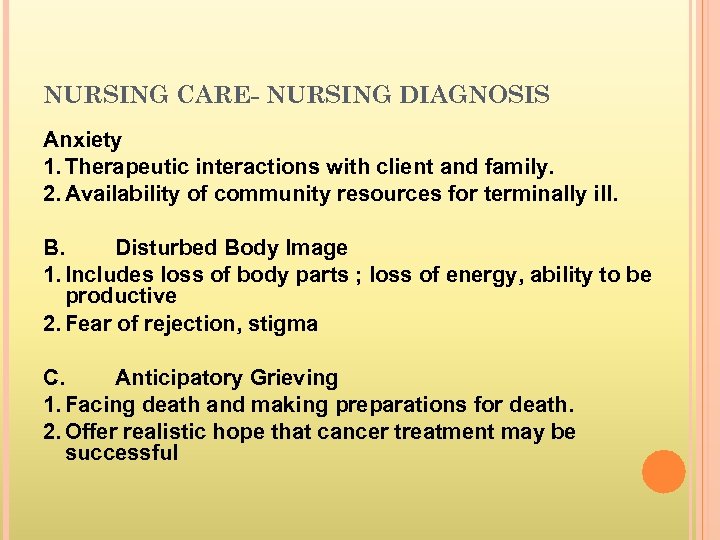 NURSING CARE- NURSING DIAGNOSIS Anxiety 1. Therapeutic interactions with client and family. 2. Availability of community resources for terminally ill. B. Disturbed Body Image 1. Includes loss of body parts ; loss of energy, ability to be productive 2. Fear of rejection, stigma C. Anticipatory Grieving 1. Facing death and making preparations for death. 2. Offer realistic hope that cancer treatment may be successful
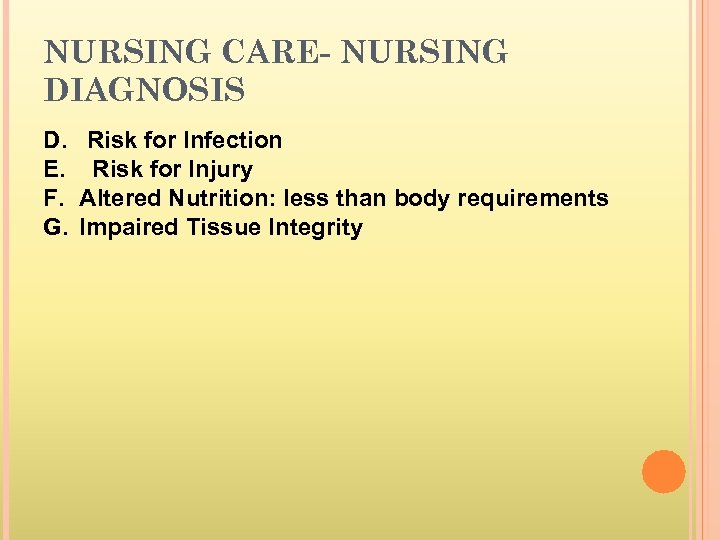 NURSING CARE- NURSING DIAGNOSIS D. E. F. G. Risk for Infection Risk for Injury Altered Nutrition: less than body requirements Impaired Tissue Integrity