


 Скачать презентацию Numerical Simulation of the Confined Motion of Drops
ad610f18588a3f21915991e5a6a4b99e.ppt
- Количество слайдов: 1
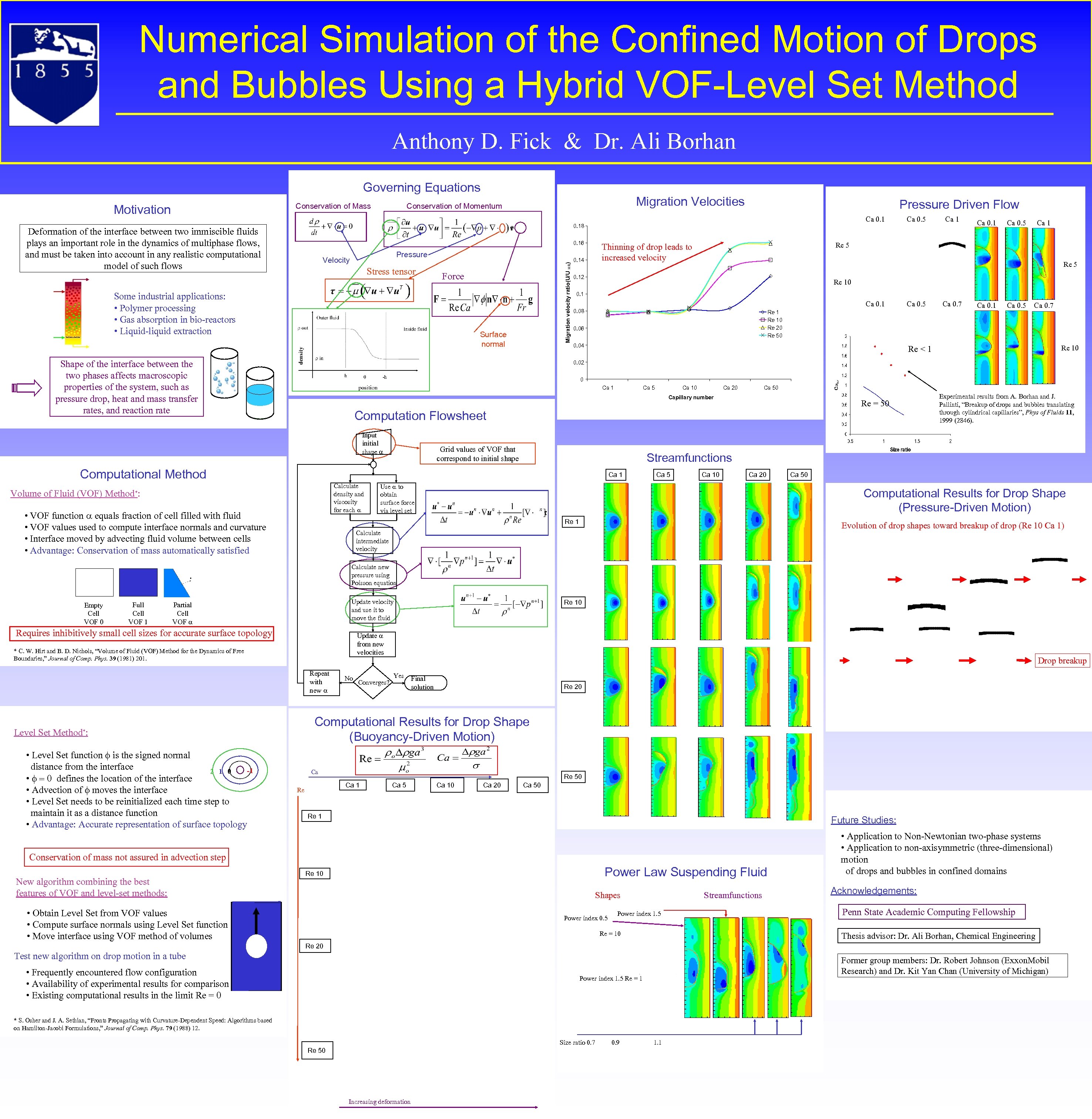 Numerical Simulation of the Confined Motion of Drops and Bubbles Using a Hybrid VOF-Level Set Method Anthony D. Fick & Dr. Ali Borhan Governing Equations Conservation of Mass Pressure Driven Flow Ca 0. 18 Deformation of the interface between two immiscible fluids plays an important role in the dynamics of multiphase flows, and must be taken into account in any realistic computational model of such flows 0. 16 Velocity Stress tensor HR ) Pressure Force Some industrial applications: • Polymer processing • Gas absorption in bio-reactors • Liquid-liquid extraction Migration velocity ratio(U/U Motivation Migration Velocities Conservation of Momentum Surface normal Shape of the interface between the two phases affects macroscopic properties of the system, such as pressure drop, heat and mass transfer rates, and reaction rate 0. 14 Ca 0. 5 Ca 1 Re 5 Thinning of drop leads to increased velocity Re 5 0. 12 Re 10 0. 1 Ca 0. 1 0. 08 Ca 0. 5 Re 10 Re 20 Re 50 0. 06 0. 04 Ca 0. 7 Ca 0. 1 Ca 0. 5 Ca 0. 7 Re 10 Re < 1 0. 02 0 Ca 1 Ca 5 Ca 10 Ca 20 Ca 50 Capillary number Re = 50 Computation Flowsheet Input initial Grid values of VOF that correspond to initial shape Streamfunctions Computational Method Ca 1 Calculate density and viscosity for each Volume of Fluid (VOF) Method*: • VOF function equals fraction of cell filled with fluid • VOF values used to compute interface normals and curvature • Interface moved by advecting fluid volume between cells • Advantage: Conservation of mass automatically satisfied Experimental results from A. Borhan and J. Pallinti, “Breakup of drops and bubbles translating through cylindrical capillaries”, Phys of Fluids 11, 1999 (2846). Ca 5 Ca 10 Ca 20 Use to obtain surface force via level set Ca 50 Computational Results for Drop Shape (Pressure-Driven Motion) Re 1 Evolution of drop shapes toward breakup of drop (Re 10 Ca 1) Calculate intermediate velocity Calculate new pressure using Poisson equation Empty Cell VOF 0 Full Cell VOF 1 Update velocity and use it to move the fluid Partial Cell VOF Requires inhibitively small cell sizes for accurate surface topology Update from new velocities * C. W. Hirt and B. D. Nichols, “Volume of Fluid (VOF) Method for the Dynamics of Free Boundaries, ” Journal of Comp. Phys. 39 (1981) 201. Repeat with new No Converges? Drop breakup Yes Final solution Re 20 Computational Results for Drop Shape (Buoyancy-Driven Motion) Level Set Method*: • Level Set function f is the signed normal distance from the interface -1 2 1 0 • f = 0 defines the location of the interface • Advection of f moves the interface • Level Set needs to be reinitialized each time step to maintain it as a distance function • Advantage: Accurate representation of surface topology Re 10 Ca Re 50 Ca 1 Re Ca 5 Ca 10 Ca 20 Ca 50 Re 1 Future Studies: Conservation of mass not assured in advection step New algorithm combining the best features of VOF and level-set methods: Power Law Suspending Fluid Re 10 Shapes • Obtain Level Set from VOF values • Compute surface normals using Level Set function • Move interface using VOF method of volumes Power index 0. 5 Streamfunctions Power index 1. 5 Re = 10 • Application to Non-Newtonian two-phase systems • Application to non-axisymmetric (three-dimensional) motion of drops and bubbles in confined domains Acknowledgements: Penn State Academic Computing Fellowship Thesis advisor: Dr. Ali Borhan, Chemical Engineering Re 20 Test new algorithm on drop motion in a tube • Frequently encountered flow configuration • Availability of experimental results for comparison • Existing computational results in the limit Re = 0 Former group members: Dr. Robert Johnson (Exxon. Mobil Research) and Dr. Kit Yan Chan (University of Michigan) Power index 1. 5 Re = 1 * S. Osher and J. A. Sethian, “Fronts Propagating with Curvature-Dependent Speed: Algorithms based on Hamilton-Jacobi Formulations, ” Journal of Comp. Phys. 79 (1988) 12. Size ratio 0. 7 Re 50 Increasing deformation 0. 9 1. 1