


 Скачать презентацию Nucleus D K The Professional Development Service for
807f162f8dc2bc7533199a6e110188ad.ppt
- Количество слайдов: 19
 Nucleus D. K. The Professional Development Service for Teachers is funded by the Department of Education and Skills under the National Development Plan
 Leaving Certificate Physics: Topics § § § § § Mechanics Temperature Heat Waves Vibrations and Sound Light Electricity Modern Physics Option 1: Particle Physics Option 2: Applied Electricity PDST Resources for Leaving Certificate Physics 2
 Learning outcomes (1) § Discovery of radioactivity and that three kinds of radiation exist. Know the nature and properties of each type of radiation – Applications: of alpha, beta and gamma rays § Rutherford’s alpha scattering experiment …the significance of the nuclear structure of atoms. – Application: enhanced understanding of chemical bonding § The principle of operation of an ionization chamber and other radiation detectors as well as appreciation of units like the Curie and Becquerel – Application: monitoring levels to ensure safety PDST Resources for Leaving Certificate Physics 3
 Learning outcomes (2) § Concept of half-life, decay constant as measurable quantities as well as the random and uncontrolled nature of radioactivity – Application: Radiocarbon dating § Understand how energy may be obtained from nuclear reactions like fission and fusion – Application: Nuclear reactors PDST Resources for Leaving Certificate Physics 4
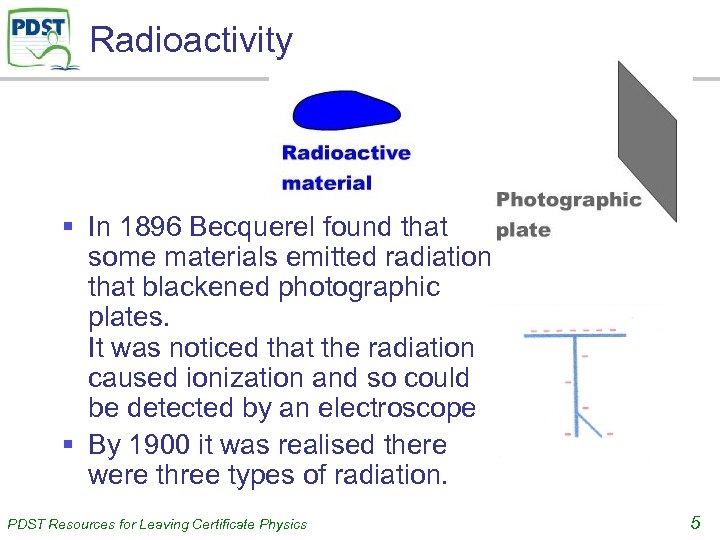 Radioactivity § In 1896 Becquerel found that some materials emitted radiation that blackened photographic plates. It was noticed that the radiation caused ionization and so could be detected by an electroscope § By 1900 it was realised there were three types of radiation. PDST Resources for Leaving Certificate Physics 5
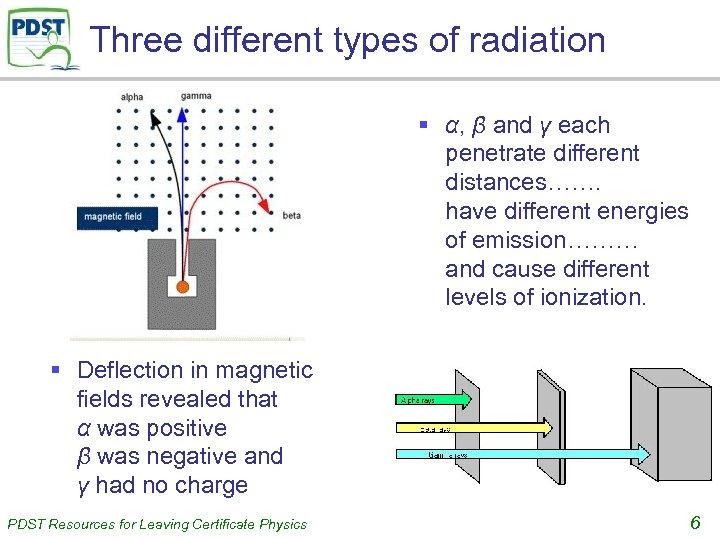 Three different types of radiation § α, β and γ each penetrate different distances……. have different energies of emission……… and cause different levels of ionization. § Deflection in magnetic fields revealed that α was positive β was negative and γ had no charge PDST Resources for Leaving Certificate Physics 6
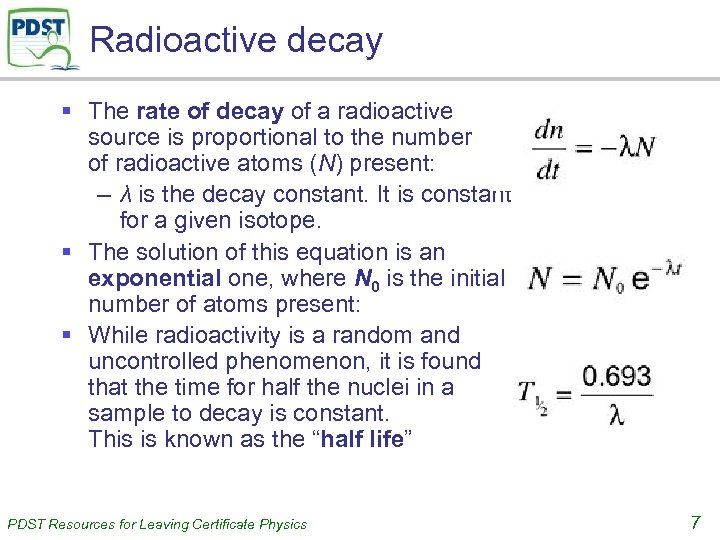 Radioactive decay § The rate of decay of a radioactive source is proportional to the number of radioactive atoms (N) present: – λ is the decay constant. It is constant for a given isotope. § The solution of this equation is an exponential one, where N 0 is the initial number of atoms present: § While radioactivity is a random and uncontrolled phenomenon, it is found that the time for half the nuclei in a sample to decay is constant. This is known as the “half life” PDST Resources for Leaving Certificate Physics 7
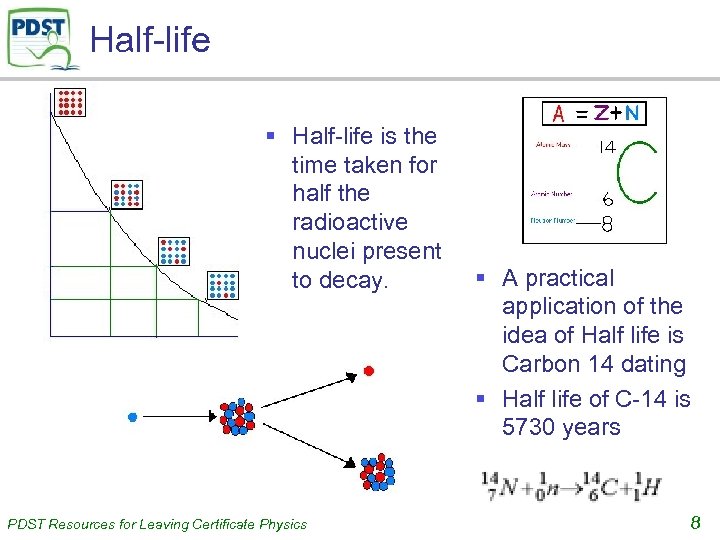 Half-life § Half-life is the time taken for half the radioactive nuclei present to decay. PDST Resources for Leaving Certificate Physics § A practical application of the idea of Half life is Carbon 14 dating § Half life of C-14 is 5730 years 8
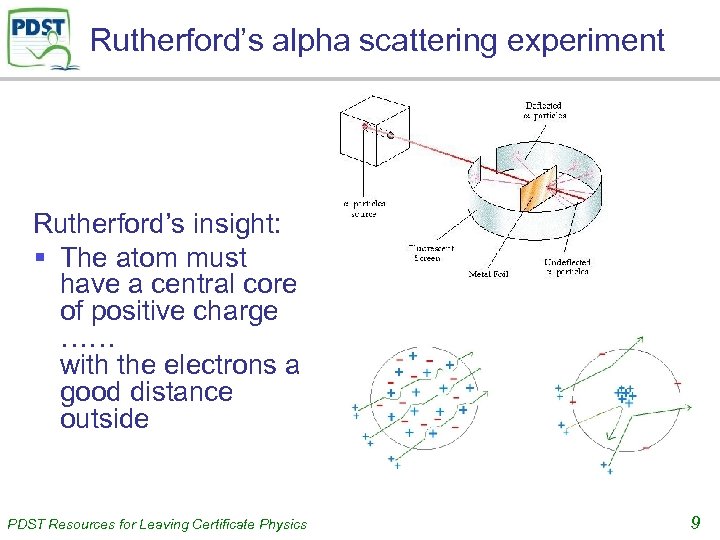 Rutherford’s alpha scattering experiment Rutherford’s insight: § The atom must have a central core of positive charge …… with the electrons a good distance outside PDST Resources for Leaving Certificate Physics 9
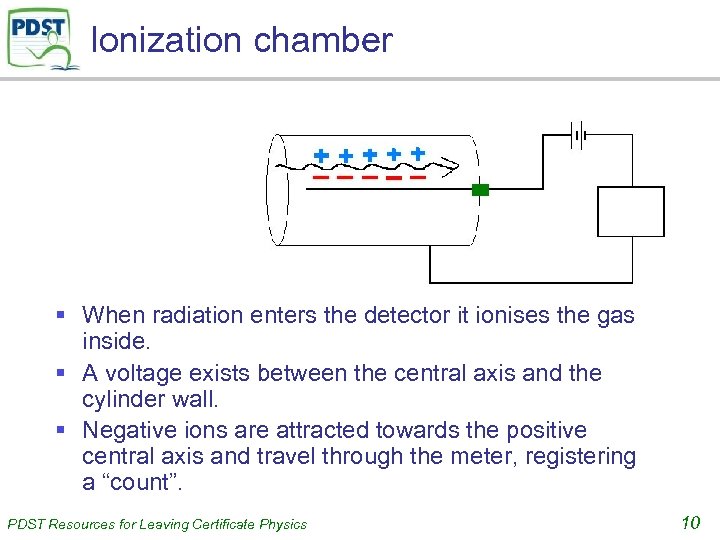 Ionization chamber § When radiation enters the detector it ionises the gas inside. § A voltage exists between the central axis and the cylinder wall. § Negative ions are attracted towards the positive central axis and travel through the meter, registering a “count”. PDST Resources for Leaving Certificate Physics 10
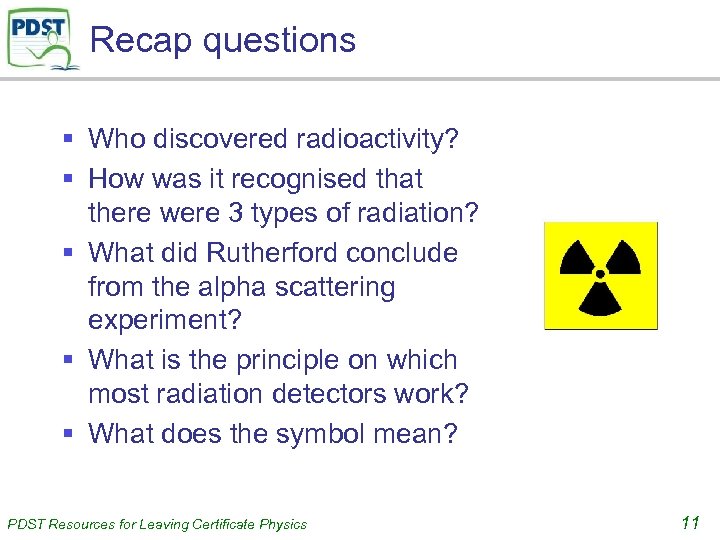 Recap questions § Who discovered radioactivity? § How was it recognised that there were 3 types of radiation? § What did Rutherford conclude from the alpha scattering experiment? § What is the principle on which most radiation detectors work? § What does the symbol mean? PDST Resources for Leaving Certificate Physics 11
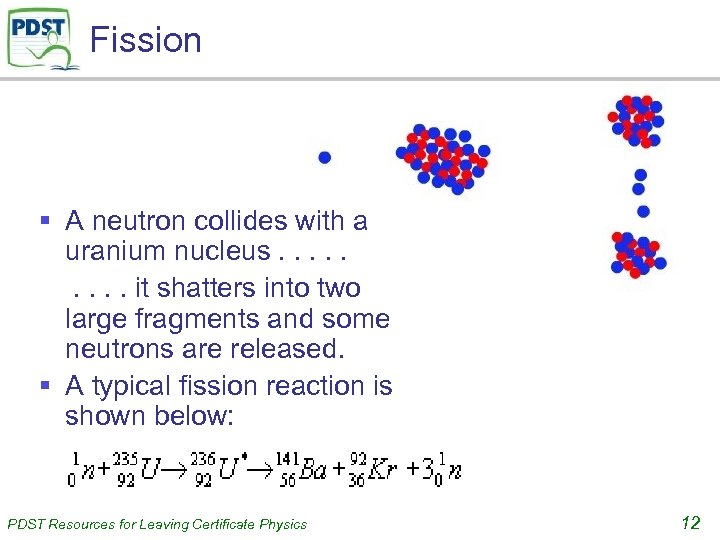 Fission § A neutron collides with a uranium nucleus. . it shatters into two large fragments and some neutrons are released. § A typical fission reaction is shown below: PDST Resources for Leaving Certificate Physics 12
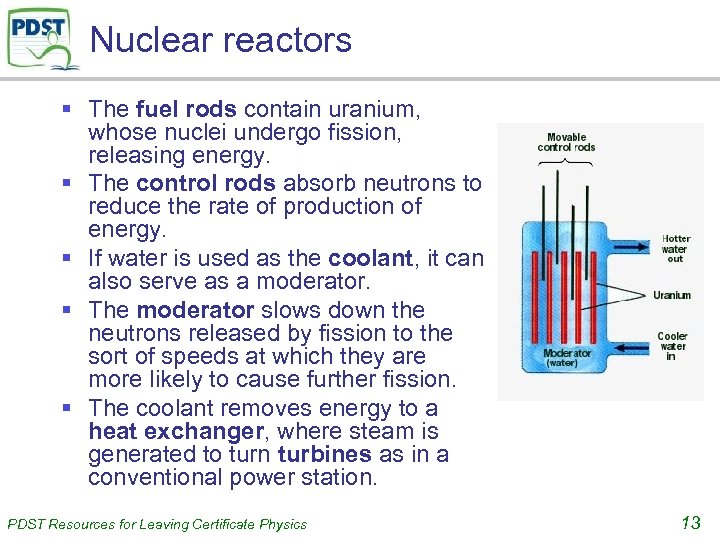 Nuclear reactors § The fuel rods contain uranium, whose nuclei undergo fission, releasing energy. § The control rods absorb neutrons to reduce the rate of production of energy. § If water is used as the coolant, it can also serve as a moderator. § The moderator slows down the neutrons released by fission to the sort of speeds at which they are more likely to cause further fission. § The coolant removes energy to a heat exchanger, where steam is generated to turn turbines as in a conventional power station. PDST Resources for Leaving Certificate Physics 13
 ADVANTAGES of FISSION § It releases a huge amount of energy per kilogram of fuel. It causes less pollution of the environment than fossil fuels PDST Resources for Leaving Certificate Physics 14
 DISADVANTAGES of FISSION § Reactors produce waste which emit dangerous radiation, that is difficult to dispose of, store, or recycle, safely. If nuclear radiation escaped it could cause serious illness or even death. § A reactor meltdown could occur. § In a meltdown, the fission chain reaction goes out of control, leading to an explosion, releasing great amounts of radiation. – Three Mile Island (USA) 1979. – Chernobyl (Russia) 1986. PDST Resources for Leaving Certificate Physics 15
 Chain reaction § A chain reaction is not possible in natural uranium where 99% is U-238 and 1% is U-235. PDST Resources for Leaving Certificate Physics § Most of the neutrons released in fission reactions are not fast enough to cause fission in U -238 and are too fast to cause fission in U 235. § Slowing down the neutrons and increasing the percentage of U-235 improve the chances of a chain reaction. 16
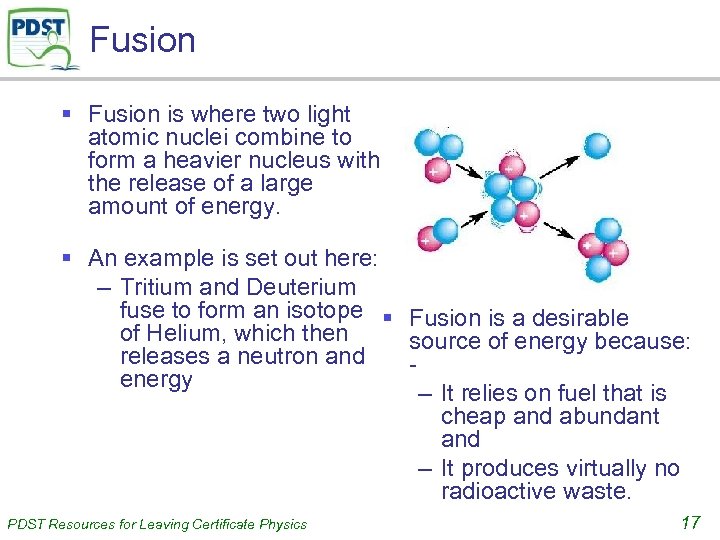 Fusion § Fusion is where two light atomic nuclei combine to form a heavier nucleus with the release of a large amount of energy. § An example is set out here: – Tritium and Deuterium fuse to form an isotope § Fusion is a desirable of Helium, which then source of energy because: releases a neutron and energy – It relies on fuel that is cheap and abundant and – It produces virtually no radioactive waste. PDST Resources for Leaving Certificate Physics 17
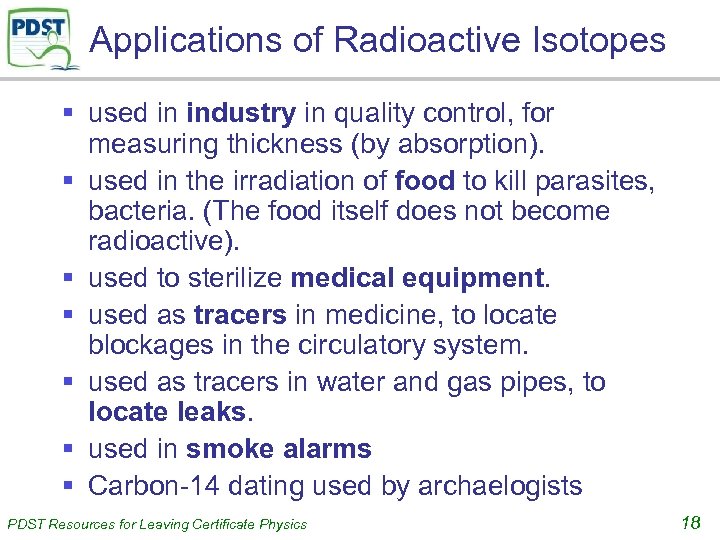 Applications of Radioactive Isotopes § used in industry in quality control, for measuring thickness (by absorption). § used in the irradiation of food to kill parasites, bacteria. (The food itself does not become radioactive). § used to sterilize medical equipment. § used as tracers in medicine, to locate blockages in the circulatory system. § used as tracers in water and gas pipes, to locate leaks. § used in smoke alarms § Carbon-14 dating used by archaelogists PDST Resources for Leaving Certificate Physics 18
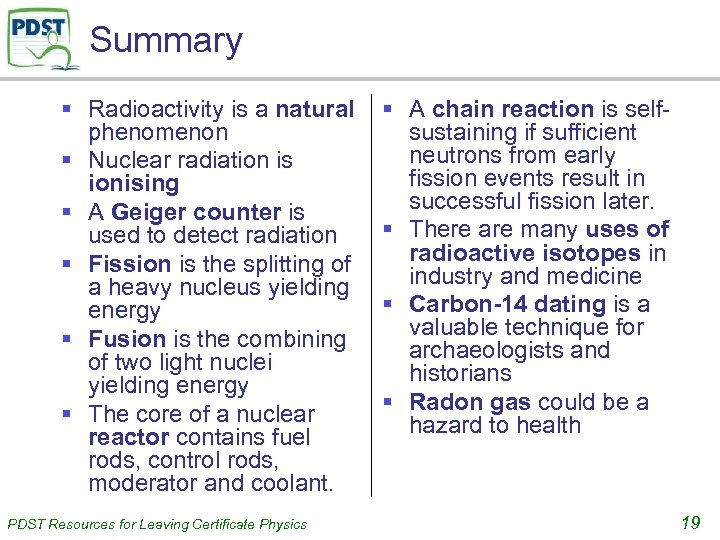 Summary § Radioactivity is a natural phenomenon § Nuclear radiation is ionising § A Geiger counter is used to detect radiation § Fission is the splitting of a heavy nucleus yielding energy § Fusion is the combining of two light nuclei yielding energy § The core of a nuclear reactor contains fuel rods, control rods, moderator and coolant. PDST Resources for Leaving Certificate Physics § A chain reaction is selfsustaining if sufficient neutrons from early fission events result in successful fission later. § There are many uses of radioactive isotopes in industry and medicine § Carbon-14 dating is a valuable technique for archaeologists and historians § Radon gas could be a hazard to health 19