 Скачать презентацию Nuclear Weapons Today A presentation prepared by the
1586d72348f7dbeeef66510b3d544f58.ppt
- Количество слайдов: 91



Nuclear Weapons Today A presentation prepared by the Medical Association for Prevention of War MAPW (Australia) Nuclear Weapons 2006
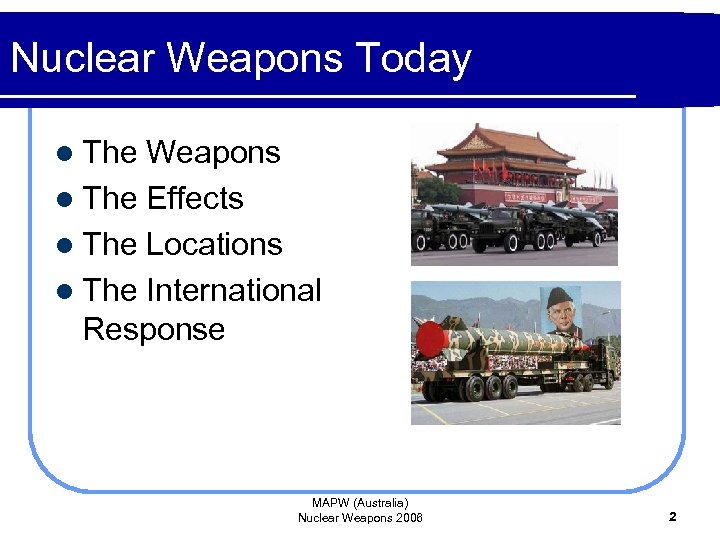
Nuclear Weapons Today l The Weapons l The Effects l The Locations l The International Response MAPW (Australia) Nuclear Weapons 2006 2
The Basics MAPW (Australia) Nuclear Weapons 2006
Nuclear Weapon Cores l Fission weapons require “fissile isotopes” l Most important - plutonium-239 (Pu-239) and uranium-235 (U-235) l Some weapons are made from both isotopes l Basic nuclear weapons rely on nuclear fission chain reaction to produce large amount of energy in a very short time MAPW (Australia) Nuclear Weapons 2006 4
Nuclear Explosions l Explosive power measured by the mass equivalent of TNT: A 1 kiloton bomb has an explosive yield equivalent to 1000 tons of TNT l A 1 megaton bomb has an explosive yield equivalent to 1, 000 tons of TNT l MAPW (Australia) Nuclear Weapons 2006 5
Plutonium l Weapons grade - produced in military plutonium-production reactors specifically for nuclear weapons use l Reactor grade - produced in all nuclearpower reactors l For electricity production, but can be used to make weapons MAPW (Australia) Nuclear Weapons 2006 6
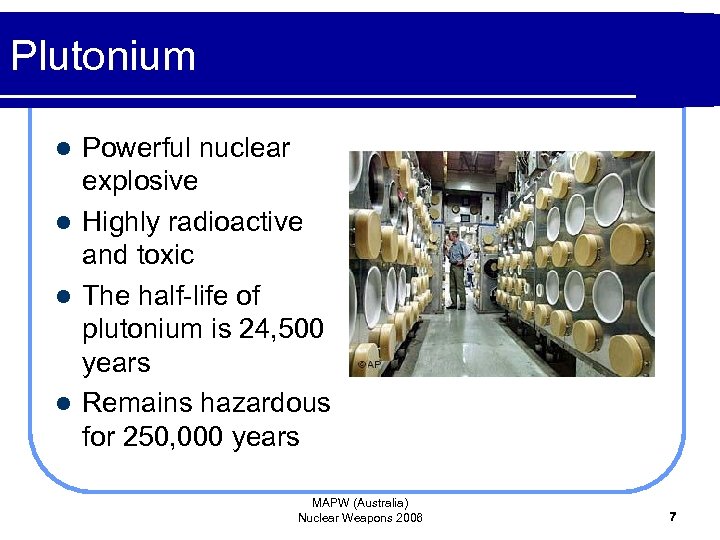
Plutonium Powerful nuclear explosive l Highly radioactive and toxic l The half-life of plutonium is 24, 500 years l Remains hazardous for 250, 000 years l MAPW (Australia) Nuclear Weapons 2006 7
Uranium l Naturally occurring uranium contains 0. 7% U-235 l Weapons use highly-enriched uranium (HEU) - proportion of U-235 increased l Weapons grade - usually enriched to greater than 90%, but lower percentages still useable MAPW (Australia) Nuclear Weapons 2006 8
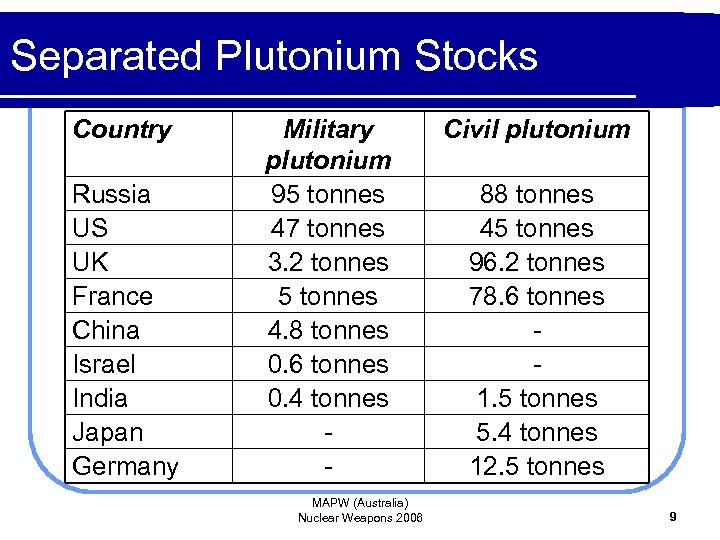
Separated Plutonium Stocks Country Russia US UK France China Israel India Japan Germany Military plutonium 95 tonnes 47 tonnes 3. 2 tonnes 5 tonnes 4. 8 tonnes 0. 6 tonnes 0. 4 tonnes MAPW (Australia) Nuclear Weapons 2006 Civil plutonium 88 tonnes 45 tonnes 96. 2 tonnes 78. 6 tonnes 1. 5 tonnes 5. 4 tonnes 12. 5 tonnes 9
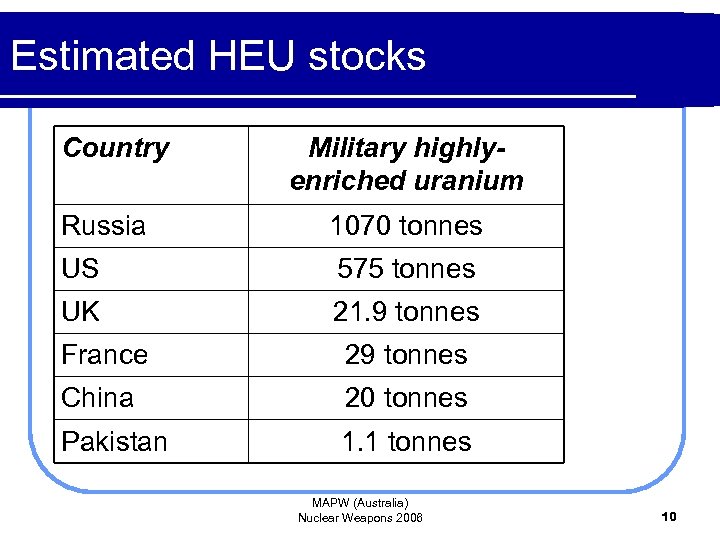
Estimated HEU stocks Country Military highlyenriched uranium Russia 1070 tonnes US 575 tonnes UK 21. 9 tonnes France 29 tonnes China 20 tonnes Pakistan 1. 1 tonnes MAPW (Australia) Nuclear Weapons 2006 10
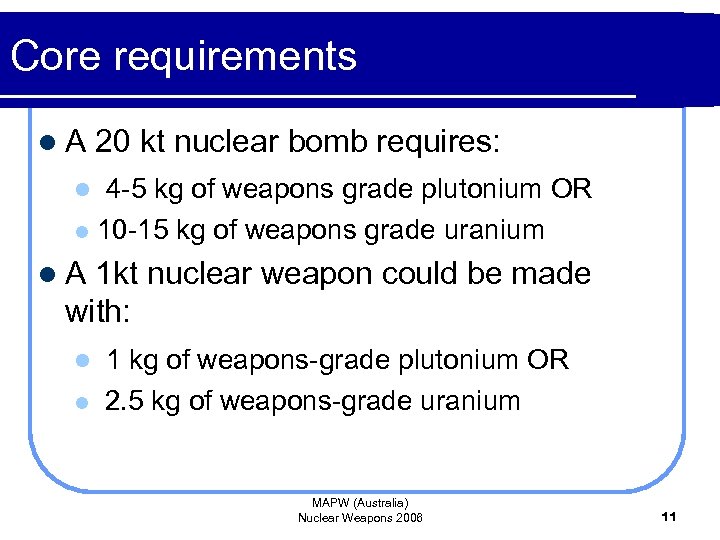
Core requirements l. A 20 kt nuclear bomb requires: 4 -5 kg of weapons grade plutonium OR l 10 -15 kg of weapons grade uranium l l. A 1 kt nuclear weapon could be made with: l l 1 kg of weapons-grade plutonium OR 2. 5 kg of weapons-grade uranium MAPW (Australia) Nuclear Weapons 2006 11
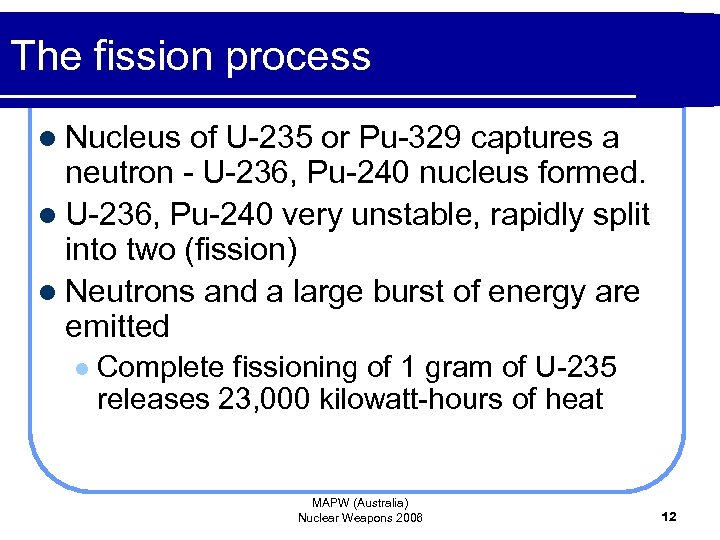
The fission process l Nucleus of U-235 or Pu-329 captures a neutron - U-236, Pu-240 nucleus formed. l U-236, Pu-240 very unstable, rapidly split into two (fission) l Neutrons and a large burst of energy are emitted l Complete fissioning of 1 gram of U-235 releases 23, 000 kilowatt-hours of heat MAPW (Australia) Nuclear Weapons 2006 12
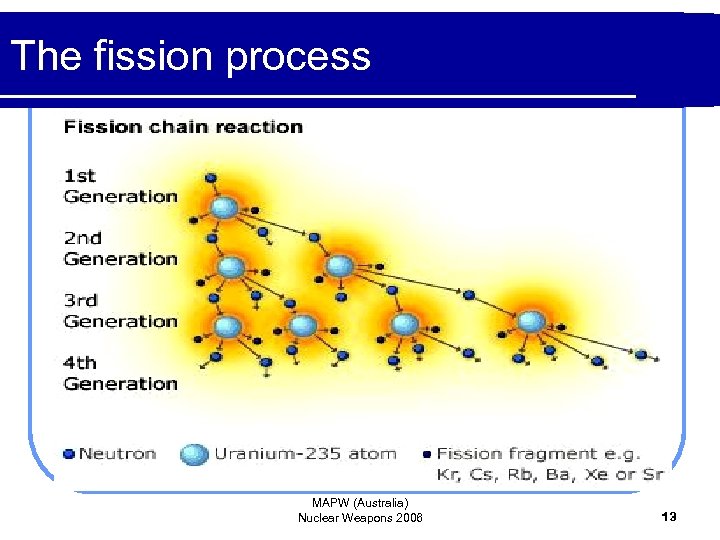
The fission process MAPW (Australia) Nuclear Weapons 2006 13
Critical mass l Each nucleus undergoing fission must produce a neutron that splits another nucleus l Critical mass - the minimum mass of fissile material that can sustain a nuclear fission chain reaction l Sphere is optimum shape MAPW (Australia) Nuclear Weapons 2006 14
Nuclear explosions occur at super-critical masses l Basic weapons contain fissile material less than critical mass. l Within half a millionth of a second: l Temperatures - hundreds of millions degrees centigrade, and pressures - millions of atmospheres, build up l MAPW (Australia) Nuclear Weapons 2006 15
Fusion Isotopes of hydrogen - deuterium and tritium l Extremely high temperatures required for reaction to occur l Require a fission bomb to provide energy to initiate reaction l Used mainly to ‘boost’ fission bombs - increase fission rate by providing more high energy neutrons l MAPW (Australia) Nuclear Weapons 2006 16
Main Components Of Nuclear Weapons l High quality, high purity conventional high explosives and reliable detonators l Electronic circuits l A tamper and neutron reflector l A core of fissile material l A neutron source MAPW (Australia) Nuclear Weapons 2006 17
Detonation techniques Gun technique Only used with HEU l Mass of sub-critical HEU fired at another sum of two masses supercritical l Simple technique l Long assembly time l Hiroshima bomb l MAPW (Australia) Nuclear Weapons 2006 18
Detonation techniques l Implosion technique 1/10 the assembly time of the gun technique l HEU or plutonium can be used l Fissile core surrounded by conventional high explosives l MAPW (Australia) Nuclear Weapons 2006 19
Detonation techniques l Implosion technique Explosives detonate and uniformly compress the core and increase its density, making it super-critical l Neutrons also fired into fissile material to encourage fission chain reaction l MAPW (Australia) Nuclear Weapons 2006 20
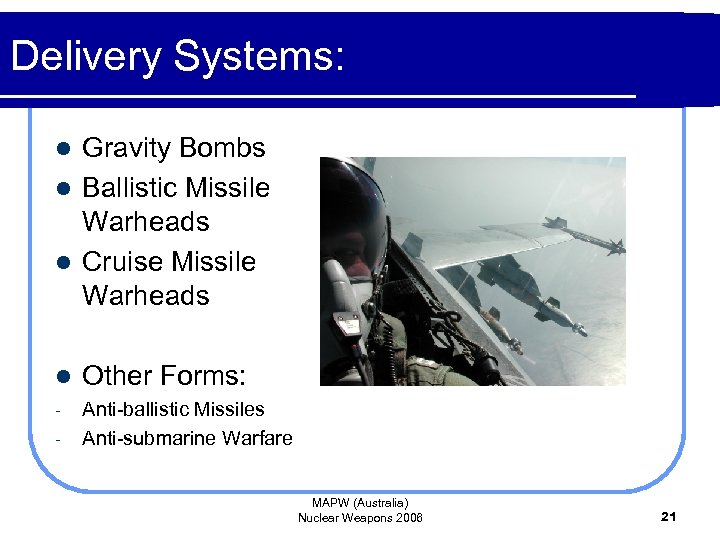
Delivery Systems: Gravity Bombs l Ballistic Missile Warheads l Cruise Missile Warheads l l Other Forms: - Anti-ballistic Missiles Anti-submarine Warfare - MAPW (Australia) Nuclear Weapons 2006 21
Tactical vs. Strategic Nuclear Weapons l Tactical: l US and Russian definition - less than 500 km range l Strategic: l Intended to be detonated in other countries, i. e. intercontinental delivery MAPW (Australia) Nuclear Weapons 2006 22
Launch on Warning (Lo. W) l Retaliation with nuclear weapons to a perceived nuclear attack by another state l Response to a warning (by radar or satellite sensors) of attacking missiles l Decision must be made in minutes MAPW (Australia) Nuclear Weapons 2006 23
The Effects of Nuclear Weapons MAPW (Australia) Nuclear Weapons 2006
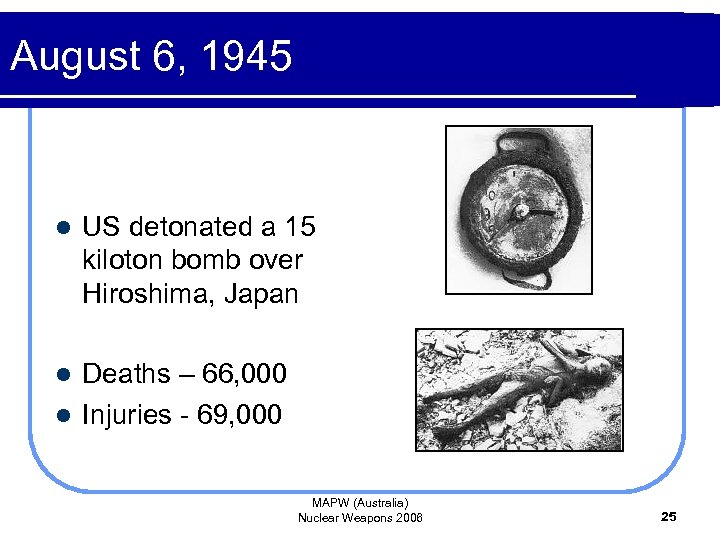
August 6, 1945 l US detonated a 15 kiloton bomb over Hiroshima, Japan Deaths – 66, 000 l Injuries - 69, 000 l MAPW (Australia) Nuclear Weapons 2006 25
August 9, 1945 l US detonated a 21 kiloton bomb over Nagasaki, Japan Deaths - 73, 884 l Injuries - 74, 909 l 6. 7 million square metres leveled l MAPW (Australia) Nuclear Weapons 2006 26
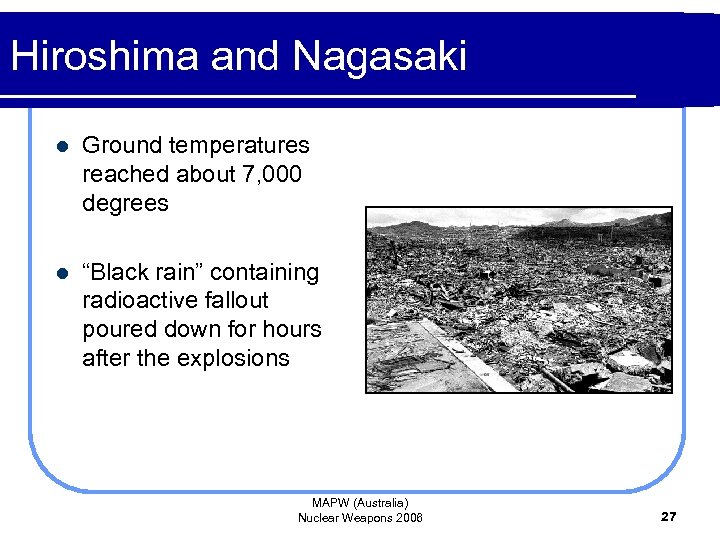
Hiroshima and Nagasaki l Ground temperatures reached about 7, 000 degrees l “Black rain” containing radioactive fallout poured down for hours after the explosions MAPW (Australia) Nuclear Weapons 2006 27
One-Megaton Bomb Detonated In The Air l Flash Intense flash of light, a thousand times brighter than lightning l Pulse of heat radiation - sets fire to combustible material 14 km away l Pulse of X-rays, lethal within 3 km l MAPW (Australia) Nuclear Weapons 2006 28
One-Megaton Bomb Detonated In The Air l Fireball Forms after the ‘flash’ and rises in the air l Can permanently blind people up to 80 km away l All exposed body parts burned deeply within 10 km l Superficial burns within fifteen km l MAPW (Australia) Nuclear Weapons 2006 29
One-Megaton Bomb Detonated In The Air l Blast Powerful blast wave - starts immediately, but travels slower than the flash and fireball l Destroys everything within 2 km l 100% fatalities within 3 km l 50% of people killed within 8 km l Major damage to buildings within 14 km, windows broken out to 20 -30 km l MAPW (Australia) Nuclear Weapons 2006 30
One-Megaton Bomb Detonated In The Air l Blast Hurricane force winds, first outwards, then inwards l Tornado force winds (six hundred km/hr), within four km - can drive glass splinters into people l People picked up and hurled into any object strong enough to be still standing l MAPW (Australia) Nuclear Weapons 2006 31
One-Megaton Bomb Detonated In The Air l Firestorm Fires started by the first flash coalesce l Cause sufficient updraft to form their own wind, which blows inwards from all sides - increasing the intensity of the fire l Fire uses all available oxygen l “People caught in the open would melt, those in shelters would probably be baked” l MAPW (Australia) Nuclear Weapons 2006 32
One-Megaton Bomb Detonated In The Air l Acute Radiation Exposure Central nervous system dysfunction l Gastrointestinal damage l Uncontrolled internal bleeding l Bleeding from gums or within the skin l Massive infections l Death l MAPW (Australia) Nuclear Weapons 2006 33
One-Megaton Bomb Detonated In The Air l Delayed Radiation Everything in vicinity of explosion radioactive l Hiroshima - radioactive rainstorms l 1/3 of original fissile material not destroyed l Widespread contamination l Increased risk of developing cancer for survivors l MAPW (Australia) Nuclear Weapons 2006 34
One-Megaton Bomb Detonated In The Air l In case of a nuclear bomb - don’t bother to call your doctor No significant medical response possible l Hospitals destroyed, most health care providers killed l MAPW (Australia) Nuclear Weapons 2006 35
One-Megaton Bomb Detonated In The Air l Medical response barriers No electricity, water or telephone service l No drugs, sterile IV solutions, bandages l Impassable roads, inaccessible areas l Overloading of emergency/ hospital services in surrounding areas l Rescuers risk radiation exposure l MAPW (Australia) Nuclear Weapons 2006 36
One-Megaton Bomb Detonated In The Air l Medical problems: one city of 1 -2 million Fifty times more severe burns than burn beds in North America l A year’s supply of blood for transfusions needed immediately l Bottlenecks and delays due to the need for radioactivity assays l Most of injured die, even from easily treated injuries l MAPW (Australia) Nuclear Weapons 2006 37
One-Megaton Bomb Detonated At Ground-Level Enormous crater - 400 metres wide and 70 metres deep l Major fallout of radioactive particulates, potentially lethal hundreds of kilometres downwind l Area of blast damage and immediate deaths about one half of air detonation scenario l More deaths days to weeks after bomb due to radiation sickness from fallout l MAPW (Australia) Nuclear Weapons 2006 38
Effect Of Nuclear War l Many nuclear bombs exploded l Radioactive contamination of whole continents l Permanent large scale damage to environment l Nuclear winter MAPW (Australia) Nuclear Weapons 2006 39
Nuclear Winter l Airborne contaminants absorb and reflect the sun’s rays l Results in an extended period of semidarkness and freezing temperatures l Potentially generated from less than 100 detonations MAPW (Australia) Nuclear Weapons 2006 40
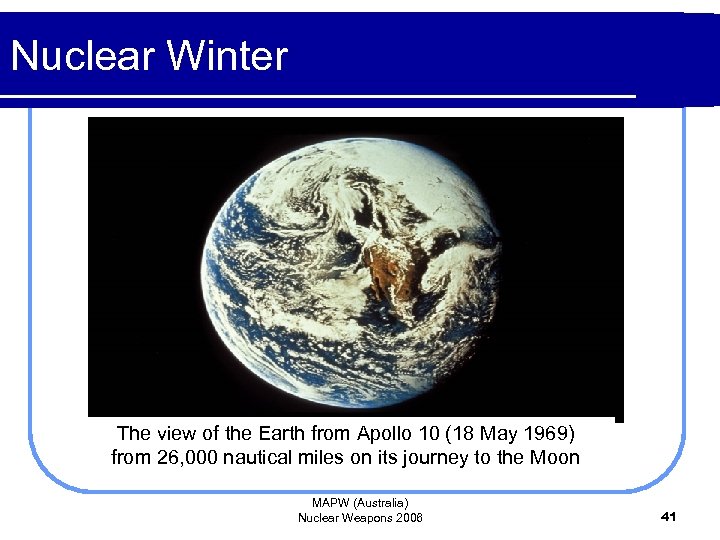
Nuclear Winter The view of the Earth from Apollo 10 (18 May 1969) from 26, 000 nautical miles on its journey to the Moon MAPW (Australia) Nuclear Weapons 2006 41
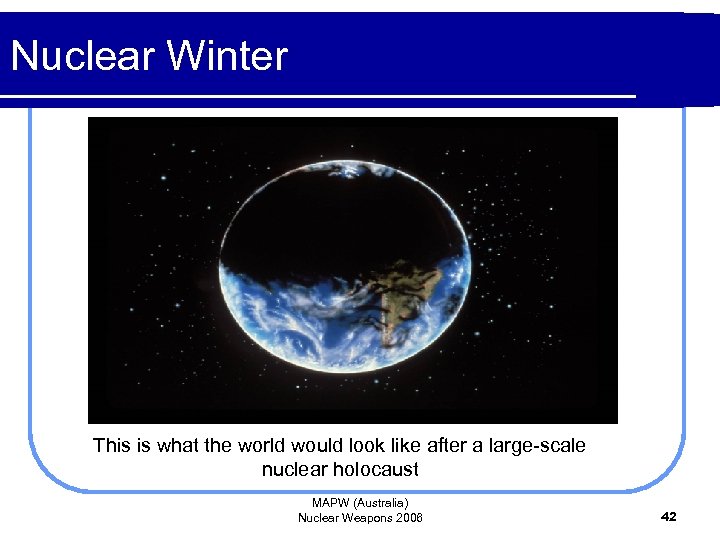
Nuclear Winter This is what the world would look like after a large-scale nuclear holocaust MAPW (Australia) Nuclear Weapons 2006 42
Nuclear Winter l Nuclear winter could occur with detonation of 100 nuclear warheads over major cities l 30, 000 weapons currently, deployed – 90% reduction of deployed weapons could still cause nuclear winter l This puts nuclear weapons are in a league of their own MAPW (Australia) Nuclear Weapons 2006 43
Nuclear Weapons Testing MAPW (Australia) Nuclear Weapons 2006
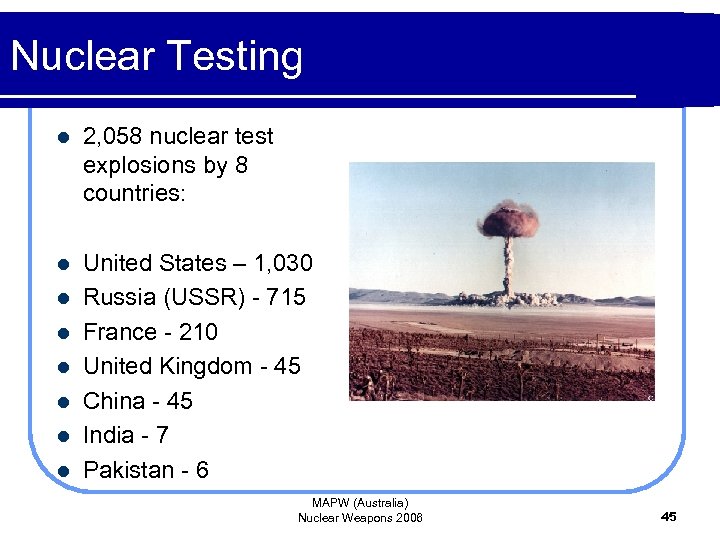
Nuclear Testing l 2, 058 nuclear test explosions by 8 countries: l United States – 1, 030 Russia (USSR) - 715 France - 210 United Kingdom - 45 China - 45 India - 7 Pakistan - 6 l l l MAPW (Australia) Nuclear Weapons 2006 45
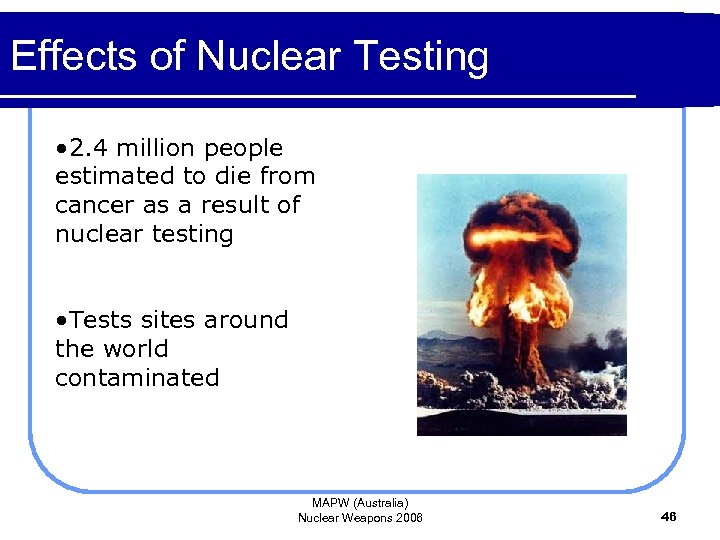
Effects of Nuclear Testing • 2. 4 million people estimated to die from cancer as a result of nuclear testing • Tests sites around the world contaminated MAPW (Australia) Nuclear Weapons 2006 46
Nuclear Terrorism MAPW (Australia) Nuclear Weapons 2006
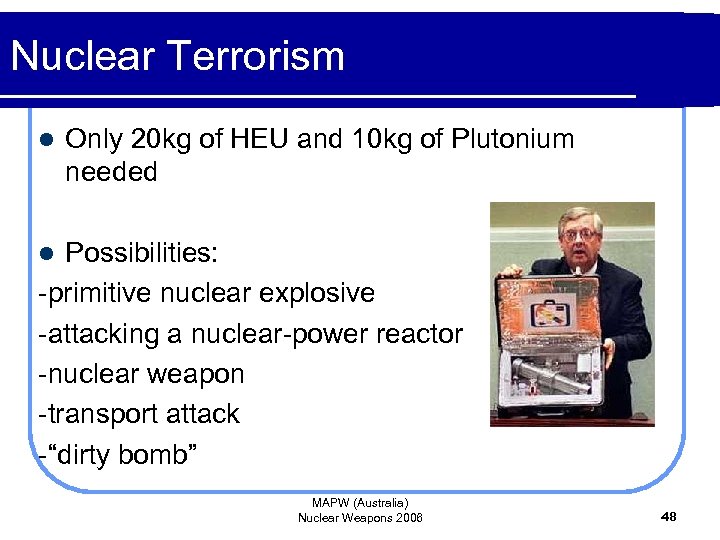
Nuclear Terrorism l Only 20 kg of HEU and 10 kg of Plutonium needed Possibilities: -primitive nuclear explosive -attacking a nuclear-power reactor -nuclear weapon -transport attack -“dirty bomb” l MAPW (Australia) Nuclear Weapons 2006 48
Nuclear Material Availability Fissile materials are not controlled or accounted for effectively l At least 40 kg of weapons-usable uranium and plutonium has been stolen l Only 1/3 of an estimated 600 tonnes of weapons -usable material in the former USSR has been secured l MAPW (Australia) Nuclear Weapons 2006 49
Terrorism And Nuclear Energy The International Atomic Energy Agency has confirmed that current nuclear power plants are structurally vulnerable against the Sept. 11 attack scenario l Over 120 documented cases of nuclear sabotage l Credible threats reported by security agencies l MAPW (Australia) Nuclear Weapons 2006 50
States Possessing Nuclear Weapons MAPW (Australia) Nuclear Weapons 2006
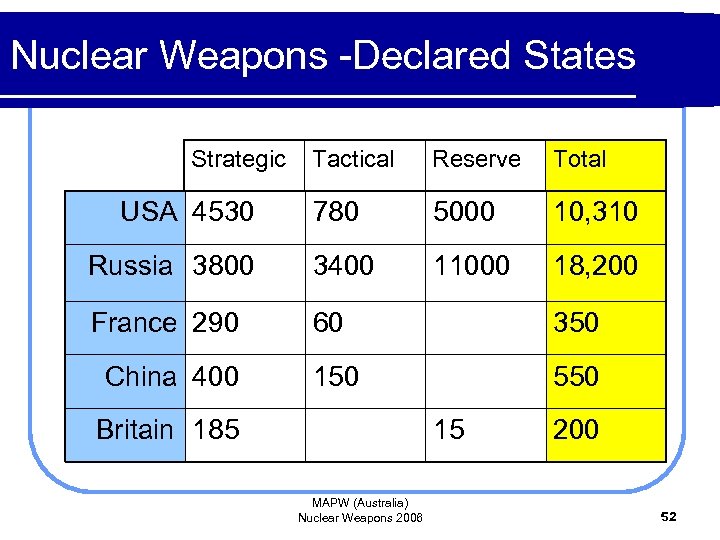
Nuclear Weapons -Declared States Strategic Tactical Reserve Total 780 5000 10, 310 Russia 3800 3400 11000 18, 200 France 290 60 350 China 400 150 550 USA 4530 Britain 185 15 MAPW (Australia) Nuclear Weapons 2006 200 52
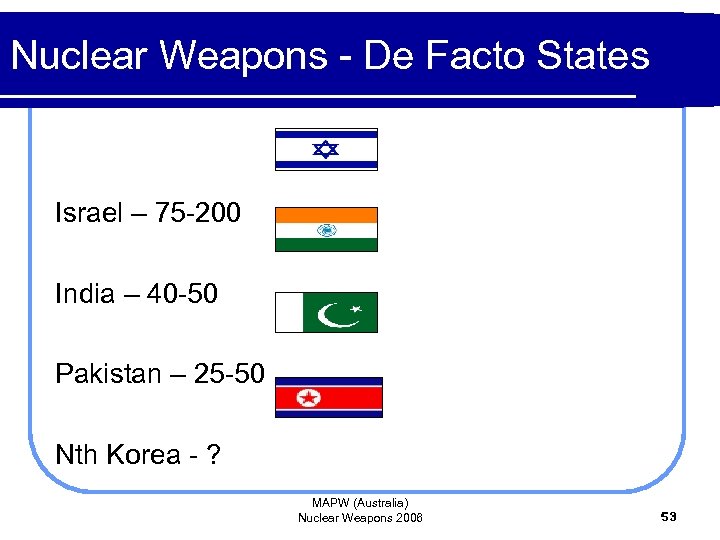
Nuclear Weapons - De Facto States Israel – 75 -200 India – 40 -50 Pakistan – 25 -50 Nth Korea - ? MAPW (Australia) Nuclear Weapons 2006 53
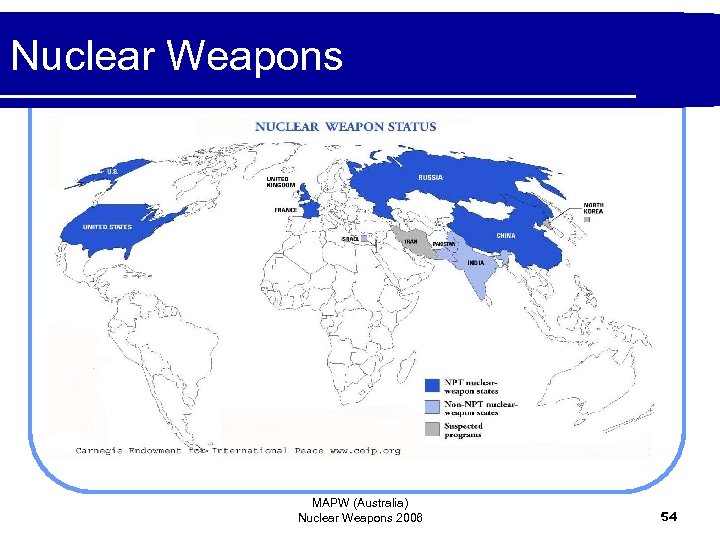
Nuclear Weapons MAPW (Australia) Nuclear Weapons 2006 54
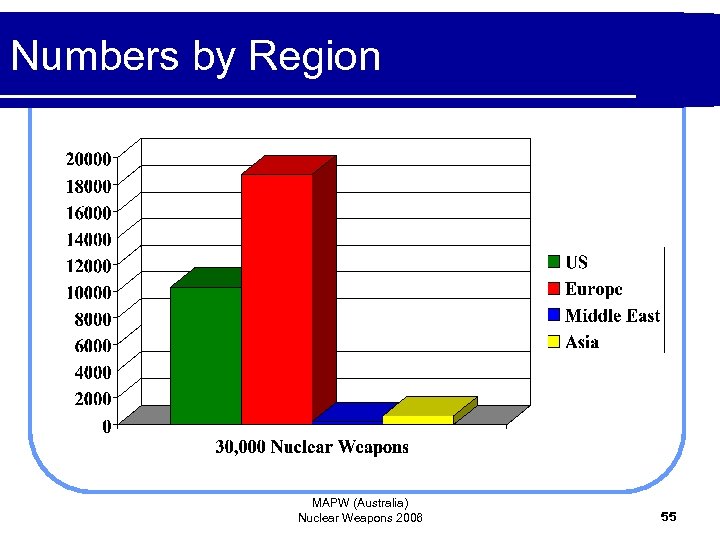
Numbers by Region MAPW (Australia) Nuclear Weapons 2006 55
Arms Control and Disarmament MAPW (Australia) Nuclear Weapons 2006
International Law and Nuclear Weapons l Multilateral (3 or more states) l Bilateral (2 states) l Unilateral (1 state) l In existence: proliferation, testing, geographic limitations l Not in existence: complete disarmament, fissile material control MAPW (Australia) Nuclear Weapons 2006 57
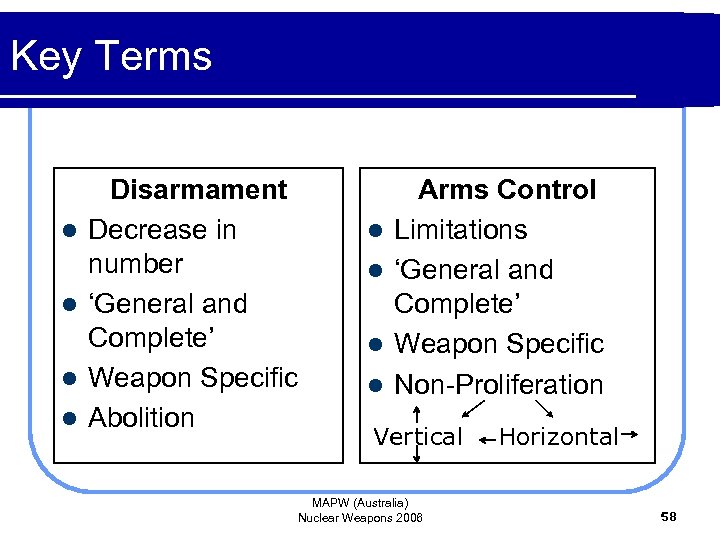
Key Terms l l Disarmament Decrease in number ‘General and Complete’ Weapon Specific Abolition l l Arms Control Limitations ‘General and Complete’ Weapon Specific Non-Proliferation Vertical MAPW (Australia) Nuclear Weapons 2006 Horizontal 58
United Nations Main roles: l Forum l Facilitating l Verification & Enforcement l Education UN Treaties: l Antarctica Treaty, PTBT, Outer Space Treaty, NPT, Sea-Bed Treaty, NWFZs, CTBT MAPW (Australia) Nuclear Weapons 2006 59
IAEA Established by UN in 1957 l Nuclear non-proliferation l Nuclear Science and Technology in Sustainable Development l Nuclear Safety and Security l MAPW (Australia) Nuclear Weapons 2006 60
Conference on Disarmament l UN Body l Established in 1979 l 66 countries are members l Agreement by Consensus l Based in Geneva, Switzerland MAPW (Australia) Nuclear Weapons 2006 61
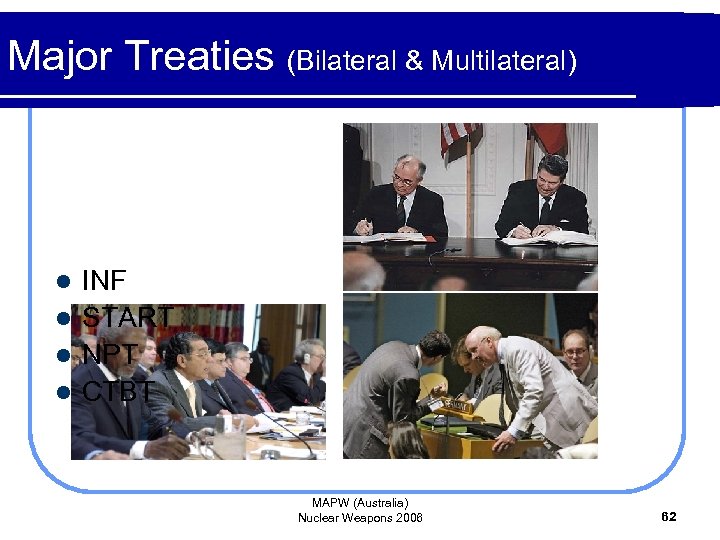
Major Treaties (Bilateral & Multilateral) INF l START l NPT l CTBT l MAPW (Australia) Nuclear Weapons 2006 62
Intermediate-Range Forces (INF) Treaty Missiles with ranges of 500 -5, 500 km l World-first in disarmament talks: l a) b) c) l Nuclear arsenal reduction Category of weapon eliminated Extensive on-site verification Signed 8 December 1987 MAPW (Australia) Nuclear Weapons 2006 63
Strategic Arms Reduction Treaties (START) • START I - signed in 1991 – US and Russia agreed to reduce ICBMs, SLBMs and warheads • START II - signed in 1993 – Reduction of strategic nuclear arsenals to 3, 000 -3, 500 by 2007 • START III – superceded by SORT • SORT – not verified or reversible MAPW (Australia) Nuclear Weapons 2006 64
Non-Proliferation Treaty (NPT) l Opened for signature in 1968 l More signatures than any other arms control treaty l Two-part bargain between nuclear weapon states (NWS) and non-nuclear weapon states (NNWS) MAPW (Australia) Nuclear Weapons 2006 65
(NPT) Article VI “Each of the Parties to the Treaty undertakes to pursue negotiations in good faith on effective measures relating to cessation of the nuclear arms race at an early date and to nuclear disarmament, and on a treaty on general and complete disarmament under strict and effective international control. ” MAPW (Australia) Nuclear Weapons 2006 66
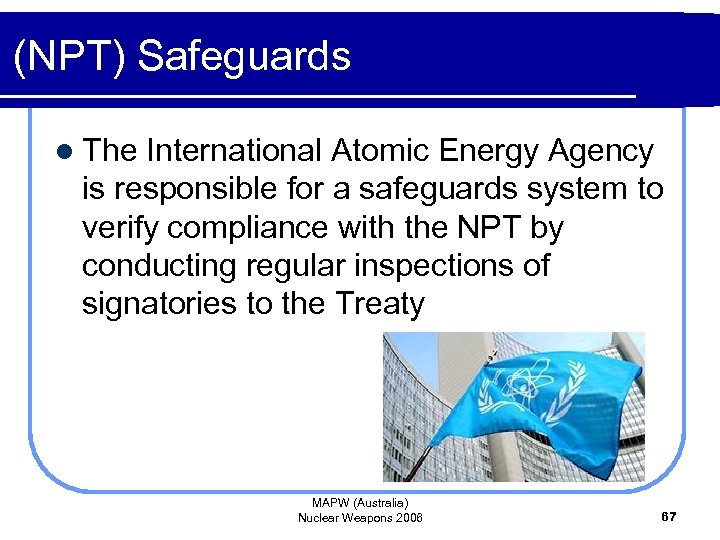
(NPT) Safeguards l The International Atomic Energy Agency is responsible for a safeguards system to verify compliance with the NPT by conducting regular inspections of signatories to the Treaty MAPW (Australia) Nuclear Weapons 2006 67
(NPT) The Review Cycle Review Conference – (Rev. Con) l every 5 years over 4 weeks l meetings held at United Nations in New York l 1995 – NPT indefinite extension l 2000 – 13 Point Action Plan MAPW (Australia) Nuclear Weapons 2006 68
NPT 2005 Review l 2 -27 May 2005 l Disagreement over conference agenda: -Nth Korea, Iran, CTBT, disarmament, non-NPT states, past decisions/agreements l No substantive text produced MAPW (Australia) Nuclear Weapons 2006 69
Comprehensive Test Ban Treaty l Opened for signature 24 September 1996 l Bans all nuclear tests l All 44 “Annex II” must sign and ratify l 3 “Annex II” states still to sign l 11 “Annex II” states still to ratify l CTBTO working from Vienna MAPW (Australia) Nuclear Weapons 2006 70
Fissile Materials Cut-Off Treaty (FMCT or “fissban”) First suggested at the UN over 50 years ago l Enthusiasm for a FMCT from early 1990 s onwards l Talks at Conference on Disarmament deadlocked l Disagreement over: -Existing stocks -Scope of the treaty l MAPW (Australia) Nuclear Weapons 2006 71
Security Council Res 1540 l 28 April 2004 l Threat from Non-state actors l Calls on states to enact national legislation l Member states must report to the 1540 Committee MAPW (Australia) Nuclear Weapons 2006 72
International Court of Justice Advisory Opinion, July 8, 1996: “. . . the threat or use of nuclear weapons would generally be contrary to the rules of international law applicable in armed conflict, and in particular the principles and rules of humanitarian law. ” MAPW (Australia) Nuclear Weapons 2006 73
International Court of Justice Implications l Supplements and reinforces the role of international laws (UN Charter, humanitarian law NPT etc) l Nuclear weapons are now in effect illegal under international law MAPW (Australia) Nuclear Weapons 2006 74
Nuclear Free Zones (NWFZs) l Treaties completely banning nuclear explosive devices in territories: Latin America (Treaty of Tlatelolco) l South Pacific (Treaty of Rarotonga) l South East Asia (Treaty of Bangkok) l Africa (Treaty of Pelindaba) l l Proposed zones for Central Asia, Central Europe and the Middle East MAPW (Australia) Nuclear Weapons 2006 75
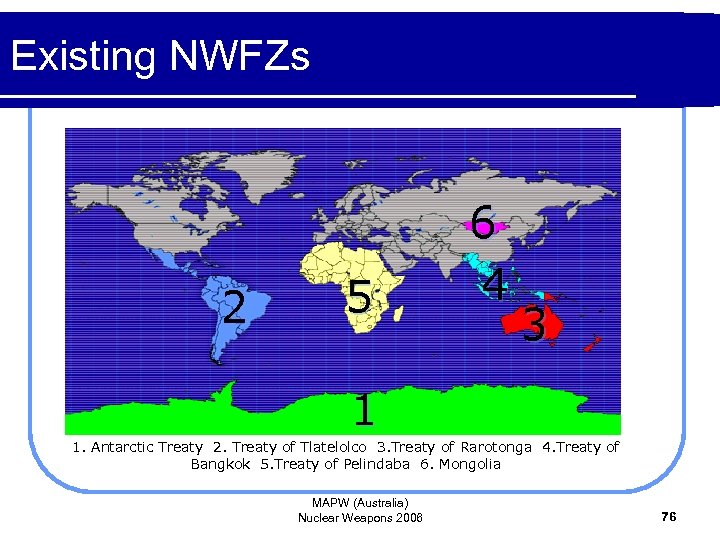
Existing NWFZs 2 5 6 4 3 1 1. Antarctic Treaty 2. Treaty of Tlatelolco 3. Treaty of Rarotonga 4. Treaty of Bangkok 5. Treaty of Pelindaba 6. Mongolia MAPW (Australia) Nuclear Weapons 2006 76
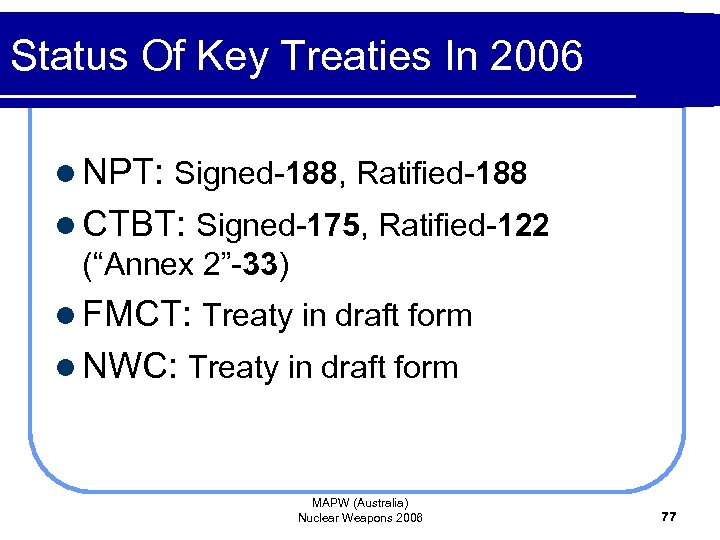
Status Of Key Treaties In 2006 l NPT: Signed-188, Ratified-188 l CTBT: Signed-175, Ratified-122 (“Annex 2”-33) l FMCT: Treaty in draft form l NWC: Treaty in draft form MAPW (Australia) Nuclear Weapons 2006 77
Status Of The Non-proliferation & Disarmament Regimes l The risk of nuclear war has not gone away and is in fact increasing l The opportunity presented by the end of the cold war was squandered l Multilateral disarmament deadlocked MAPW (Australia) Nuclear Weapons 2006 78
The ICAN Campaign ICAN stands for International Campaign to Abolish Nuclear weapons MAPW (Australia) Nuclear Weapons 2006
ICAN l ICAN to address the erosion of the global nuclear disarmament regime l Nuclear Weapons Convention – Review, update, progress l MAPW to take a leading role within IPPNW and the global peace movement in the ICAN Campaign MAPW (Australia) Nuclear Weapons 2006 80
Model Nuclear Weapons Convention (NWC) Draft text produced by NGOs l Submitted to the UN by Costa Rica in 1997 l NWC would prohibit: l l l l development testing production stockpiling transfer use and threat of use MAPW (Australia) Nuclear Weapons 2006 81
What ICAN Would Aim For IPPNW members feel that a coordinated effort across states and institutions, in the framework of voluntary governmental and nongovernmental participation, is necessary if there is to be a reversal of the nuclear threat. l One element of such coordination will be a multilateral agreement to prohibit and eliminate nuclear weapons ~ a Nuclear Weapons Convention. l MAPW (Australia) Nuclear Weapons 2006 82
How To Work Towards A NWC l It is strongly felt that the campaign for a NWC would need to be based on an Ottawa style process that lead to the Landmines Treaty – a strong and effectively coordinated global coalition of NGO's and international organisations that drew in governments, starting with Canada, and achieved a treaty in the space of five years. MAPW (Australia) Nuclear Weapons 2006 83
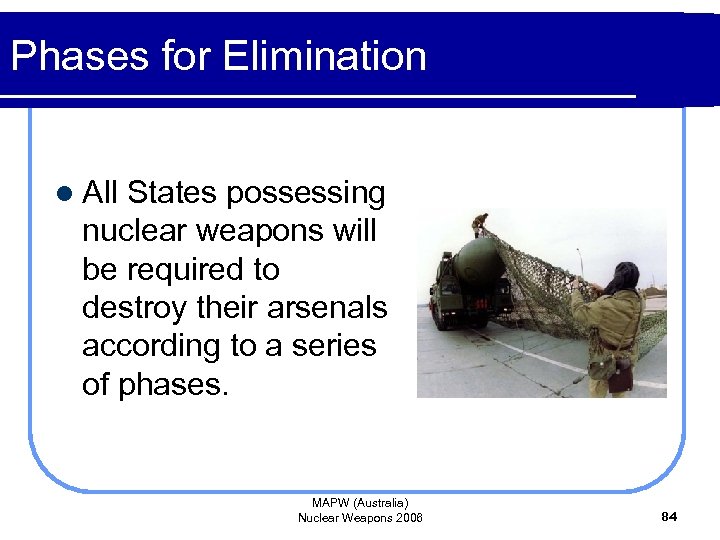
Phases for Elimination l All States possessing nuclear weapons will be required to destroy their arsenals according to a series of phases. MAPW (Australia) Nuclear Weapons 2006 84
Step by Step… l The Convention outlines a series of five phases for the elimination of nuclear weapons beginning with: l l l taking nuclear weapons off alert removing weapons from deployment removing nuclear warheads from their delivery vehicles disabling the warheads removing and disfiguring the "pits" and placing the fissile material under inter-national control. MAPW (Australia) Nuclear Weapons 2006 85
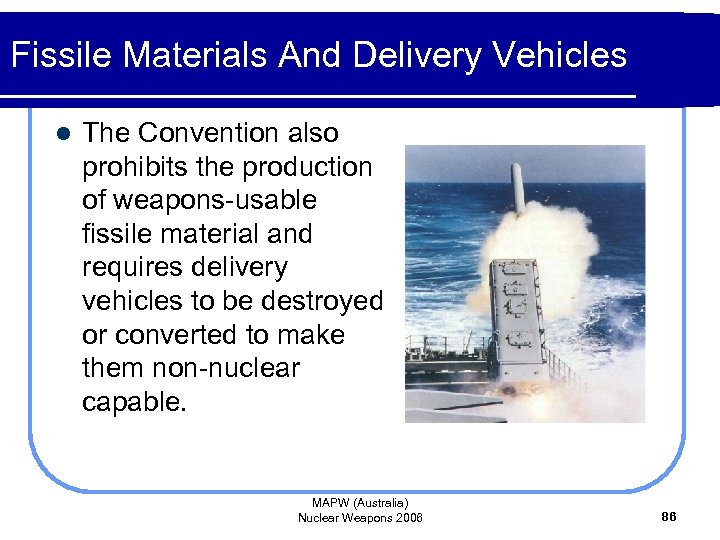
Fissile Materials And Delivery Vehicles l The Convention also prohibits the production of weapons-usable fissile material and requires delivery vehicles to be destroyed or converted to make them non-nuclear capable. MAPW (Australia) Nuclear Weapons 2006 86
Working Towards A Nuclear Weapons Free World l Today some of these issues may appear intractable, and there is no guarantee that they are soluble. l However, a robust and open debate is the most likely - if not the only - way to generate creative solutions and engage the broad transnational and crossindustrial involvement necessary for a nuclear weapons free world. MAPW (Australia) Nuclear Weapons 2006 87
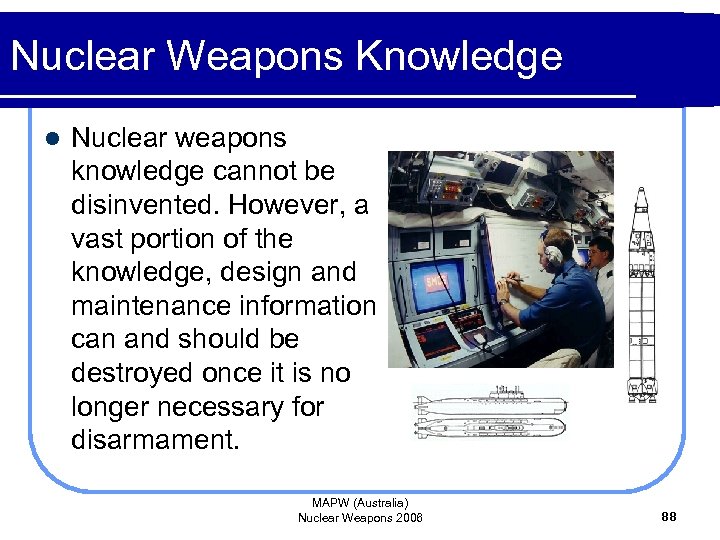
Nuclear Weapons Knowledge l Nuclear weapons knowledge cannot be disinvented. However, a vast portion of the knowledge, design and maintenance information can and should be destroyed once it is no longer necessary for disarmament. MAPW (Australia) Nuclear Weapons 2006 88
Our Responsibility l Moreover, and precisely because we cannot return to a world innocent of nuclear weapons knowledge, the answer to the "genie out of the bottle" is to increase scientific responsibility and awareness of potential proliferation risks. MAPW (Australia) Nuclear Weapons 2006 89
Get Involved l For further information about the NCW, please see: http: //www. ippnw. org/NWC. html l or contact the Medical Association for Prevention of War (Australia) phone: (03) 8344 1637 email: mapw@mapw. org. au MAPW (Australia) Nuclear Weapons 2006 90
Medical Association for Prevention of War Australia (MAPW) National Office: P. O. Box 1379, Carlton VIC 3053, Australia Ph: 03 8344 1637 Fax: 03 8344 1638 www. mapw. org. au mapw@mapw. org. au Australian affiliate of International Physicians for Prevention of Nuclear War (IPPNW) MAPW (Australia) Nuclear Weapons 2006 91
Скачать презентацию Nuclear Weapons Today A presentation prepared by the
1586d72348f7dbeeef66510b3d544f58.ppt