 Скачать презентацию Nuclear Structure studies using fast radioactive beams
95e9af971aa21b40afcb5da215603726.ppt
- Количество слайдов: 27



Nuclear Structure studies using fast radioactive beams – The RISING experiment – Relativistic Coulomb excitation – Spin degree of freedom in fragmentation reactions – Open questions and future experimental possibilities J. Gerl SNP 2008 July 8 -11 2008 Ohio University, Athens Ohio USA 23
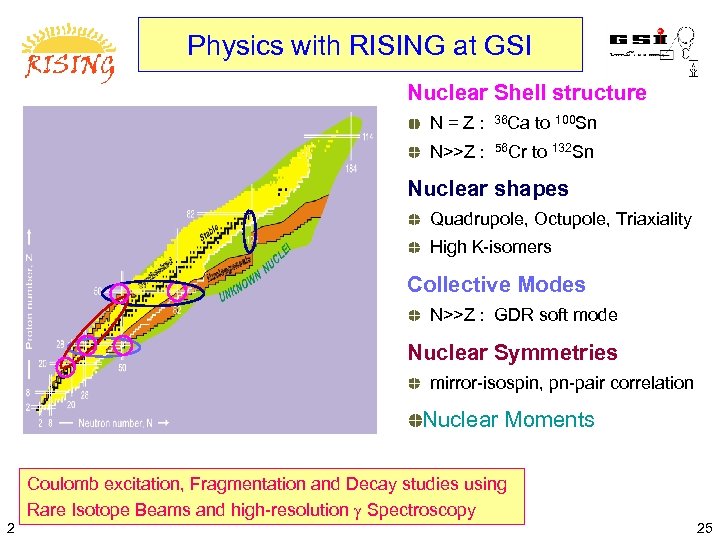
Physics with RISING at GSI Nuclear Shell structure N=Z: 36 Ca to 100 Sn N>>Z : 56 Cr to 132 Sn Nuclear shapes Quadrupole, Octupole, Triaxiality High K-isomers Collective Modes N>>Z : GDR soft mode Nuclear Symmetries mirror-isospin, pn-pair correlation Nuclear Moments Coulomb excitation, Fragmentation and Decay studies using Rare Isotope Beams and high-resolution Spectroscopy 2 25
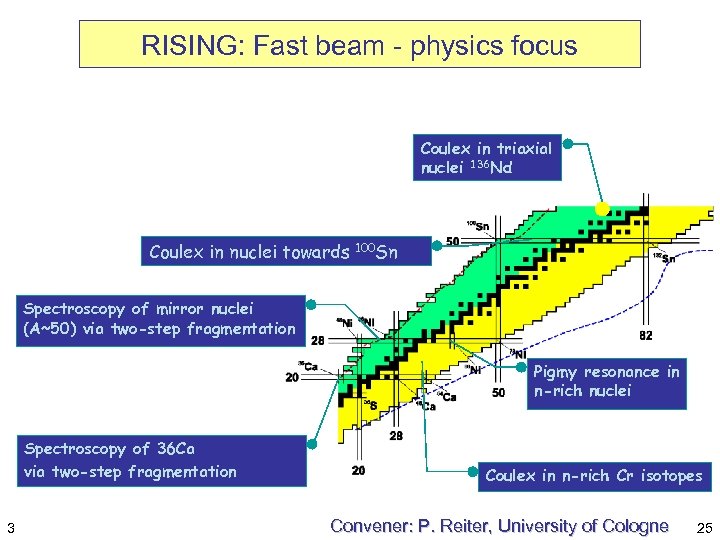
RISING: Fast beam - physics focus Coulex in triaxial nuclei 136 Nd Coulex in nuclei towards 100 Sn Spectroscopy of mirror nuclei (A~50) via two-step fragmentation Pigmy resonance in n-rich nuclei Spectroscopy of 36 Ca via two-step fragmentation 3 Coulex in n-rich Cr isotopes Convener: P. Reiter, University of Cologne 25
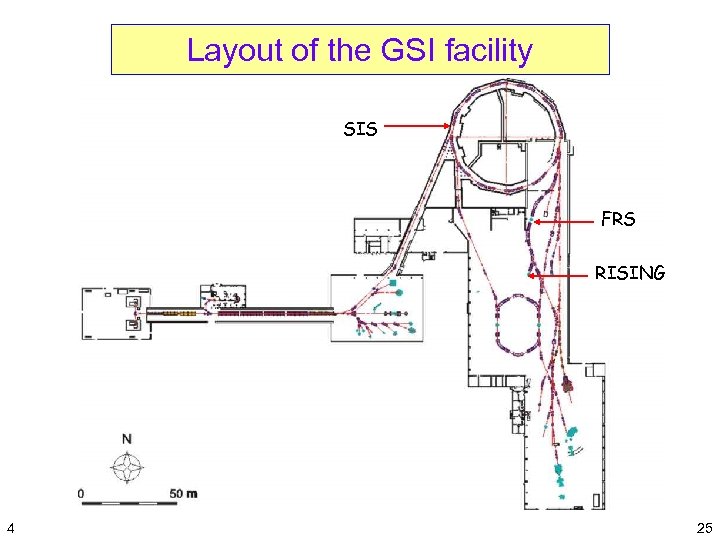
Layout of the GSI facility SIS FRS RISING 4 25
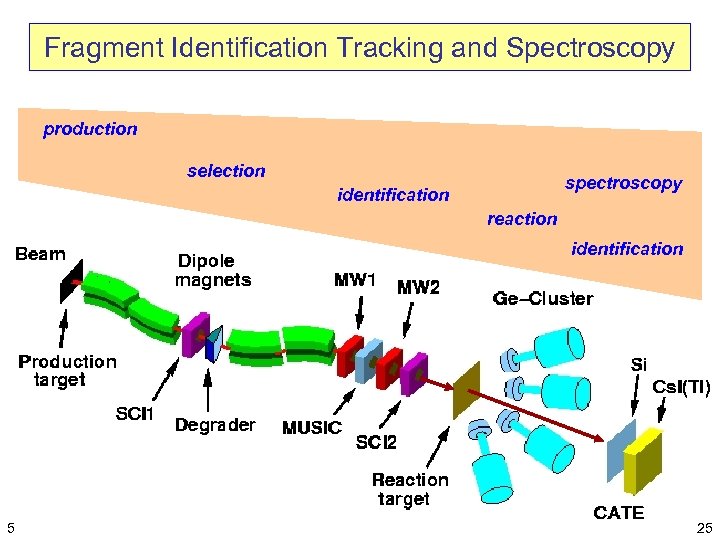
Fragment Identification Tracking and Spectroscopy production selection spectroscopy identification reaction identification 5 25
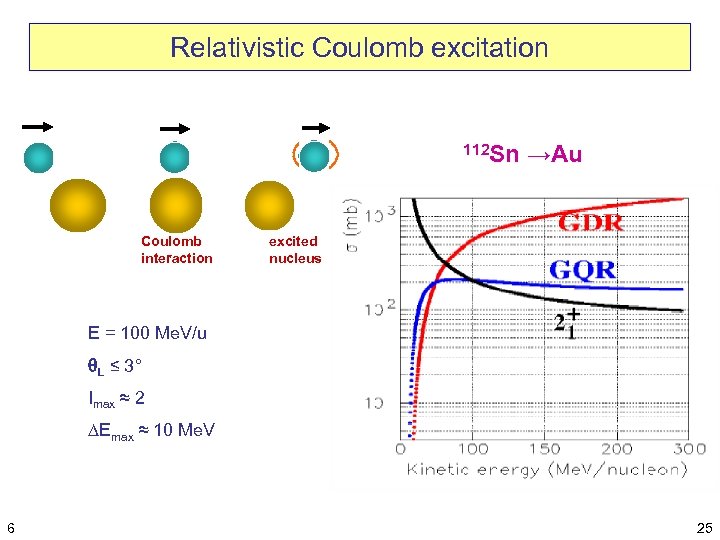
Relativistic Coulomb excitation 112 Sn Coulomb interaction →Au excited nucleus E = 100 Me. V/u L ≤ 3° Imax ≈ 2 Emax ≈ 10 Me. V 6 25
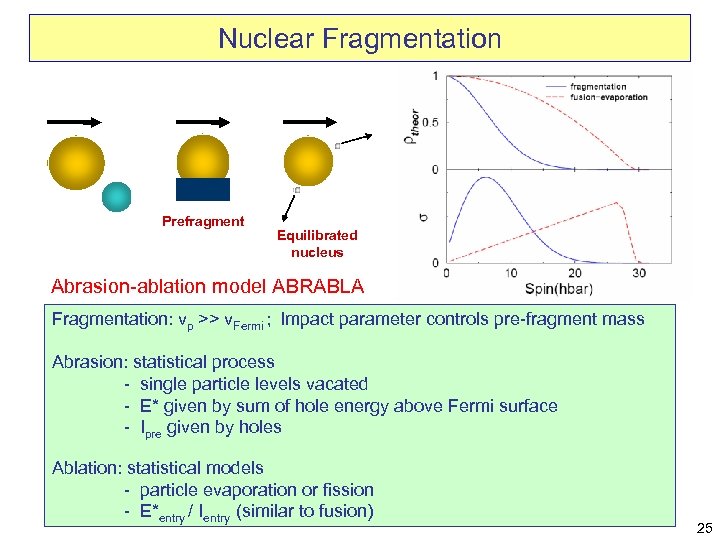
Nuclear Fragmentation Prefragment Equilibrated nucleus Abrasion-ablation model ABRABLA Fragmentation: vp >> v. Fermi ; Impact parameter controls pre-fragment mass Abrasion: statistical process - single particle levels vacated - E* given by sum of hole energy above Fermi surface - Ipre given by holes Ablation: statistical models - particle evaporation or fission - E*entry / Ientry (similar to fusion) 25
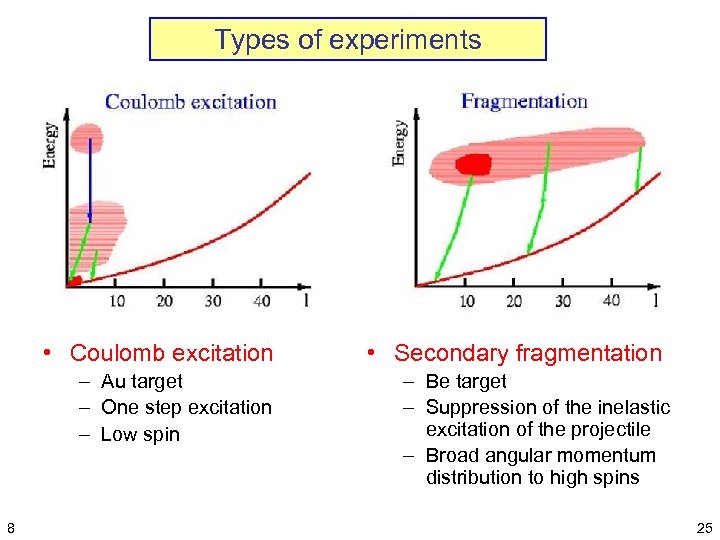
Types of experiments • Coulomb excitation – Au target – One step excitation – Low spin 8 • Secondary fragmentation – Be target – Suppression of the inelastic excitation of the projectile – Broad angular momentum distribution to high spins 25
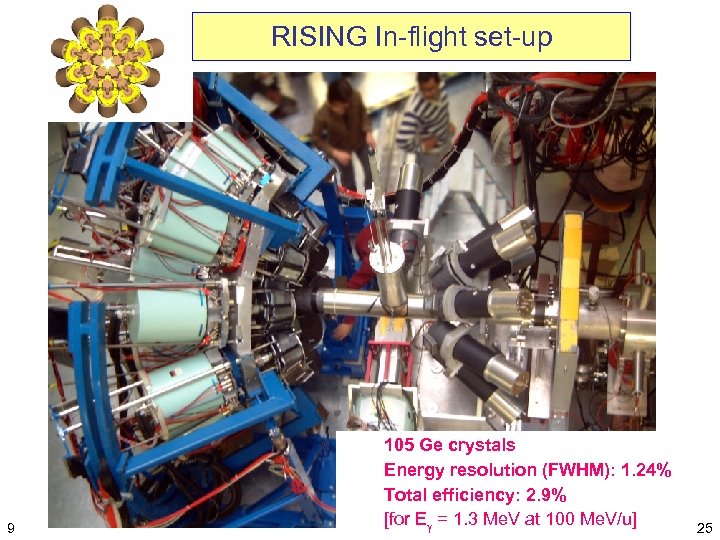
RISING In-flight set-up 9 105 Ge crystals Energy resolution (FWHM): 1. 24% Total efficiency: 2. 9% [for E = 1. 3 Me. V at 100 Me. V/u] 25
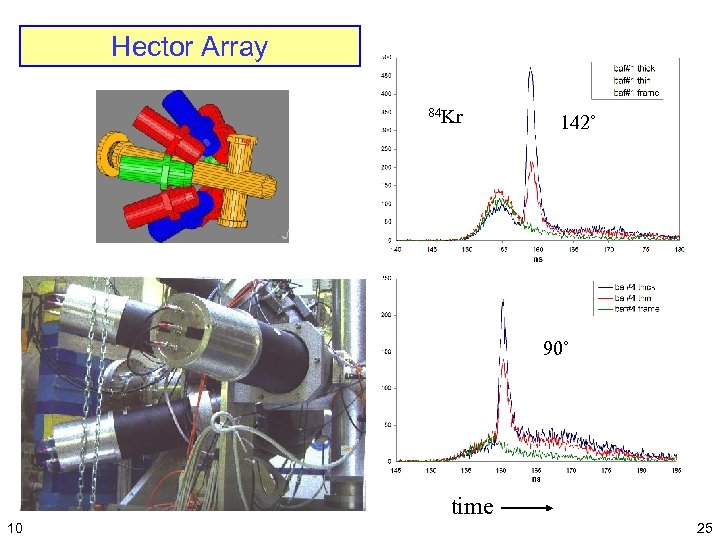
Hector Array 84 Kr 142˚ 90˚ time 10 25
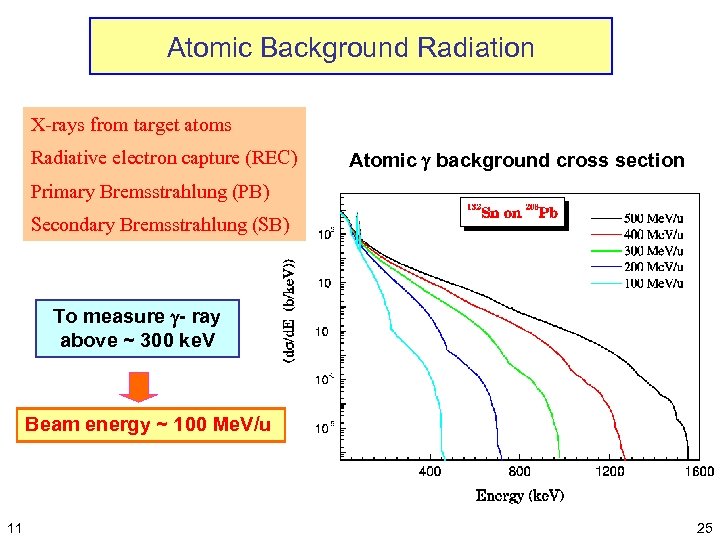
Atomic Background Radiation X-rays from target atoms Radiative electron capture (REC) Atomic background cross section Primary Bremsstrahlung (PB) Secondary Bremsstrahlung (SB) To measure - ray above ~ 300 ke. V Beam energy ~ 100 Me. V/u 11 25
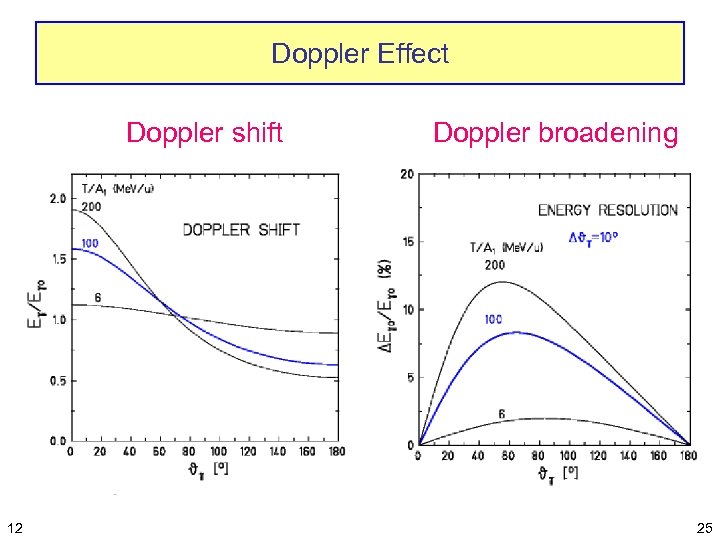
Doppler Effect Doppler shift 12 Doppler broadening 25
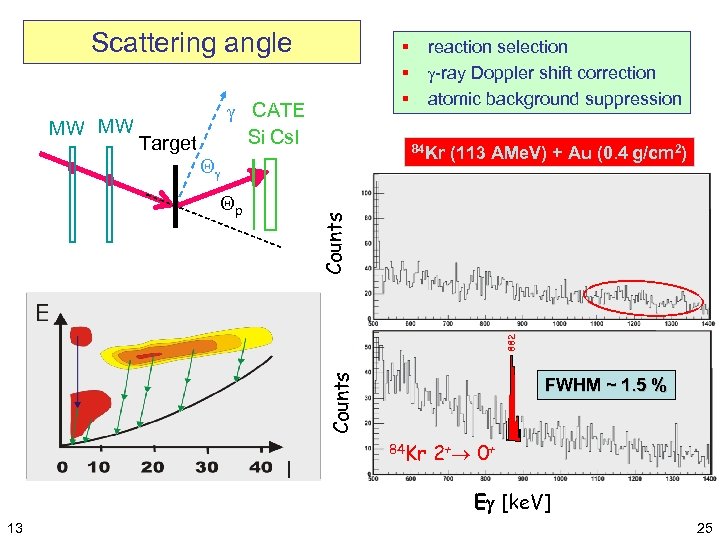
Scattering angle Target CATE Si Cs. I 84 Kr Q Qp reaction selection -ray Doppler shift correction atomic background suppression (113 AMe. V) + Au (0. 4 g/cm 2) Counts MW MW § § § Counts 882 E [ke. V] FWHM ~ 1. 5 % 84 Kr 2 + ® 0+ E [ke. V] 13 25
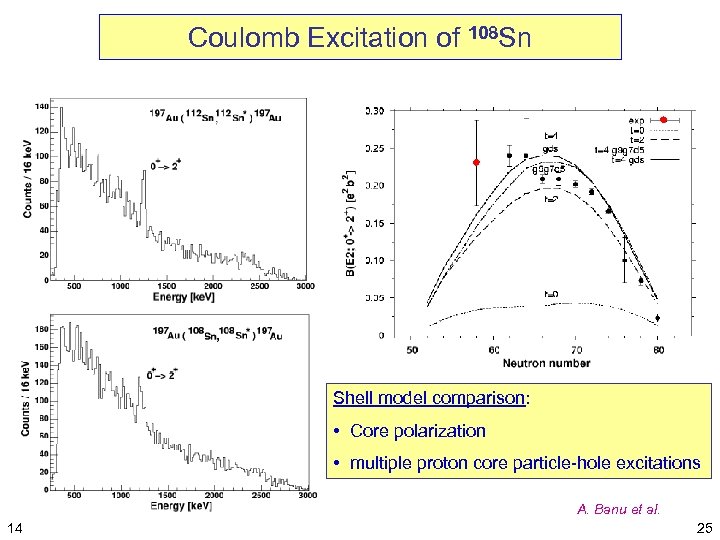
Coulomb Excitation of 108 Sn Shell model comparison: • Core polarization • multiple proton core particle-hole excitations A. Banu et al. 14 25
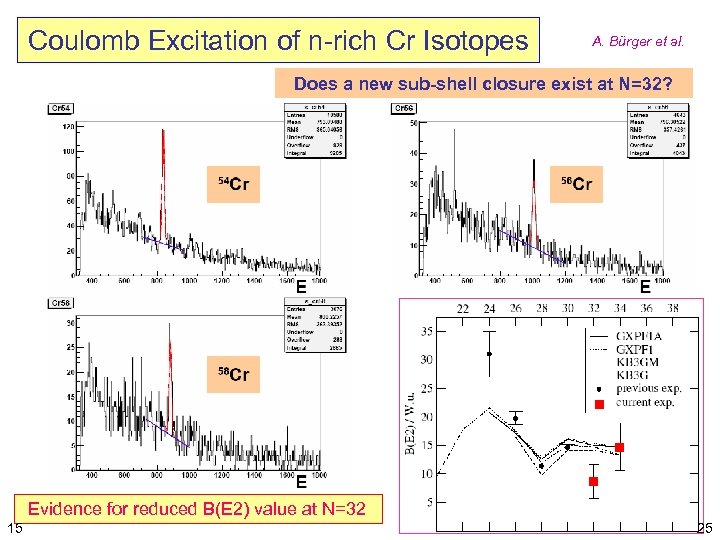
Coulomb Excitation of n-rich Cr Isotopes A. Bürger et al. Does a new sub-shell closure exist at N=32? Evidence for reduced B(E 2) value at N=32 15 25
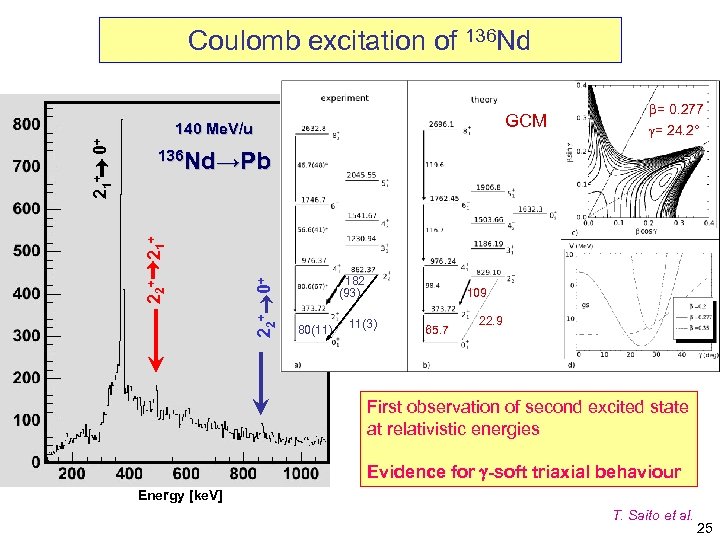
Coulomb excitation of 136 Nd GCM 136 Nd→Pb 182 (93) 0+ 22 + 2 1+ 21 + 0+ 140 Me. V/u = 0. 277 = 24. 2° 80(11) 109 11(3) 65. 7 22. 9 First observation of second excited state at relativistic energies Evidence for -soft triaxial behaviour Energy [ke. V] T. Saito et al. 25
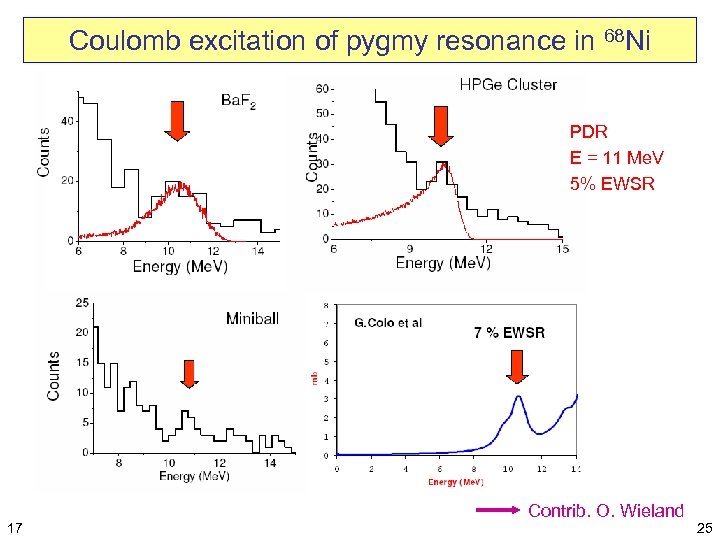
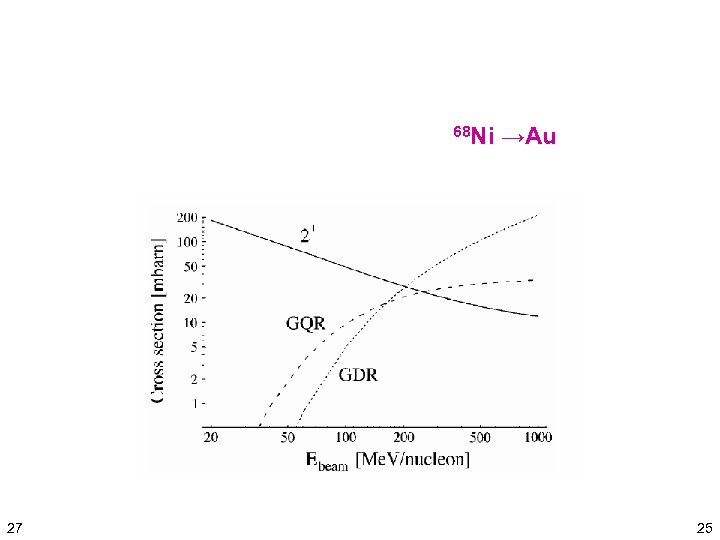
Coulomb excitation of pygmy resonance in 68 Ni PDR E = 11 Me. V 5% EWSR 17 Contrib. O. Wieland 25
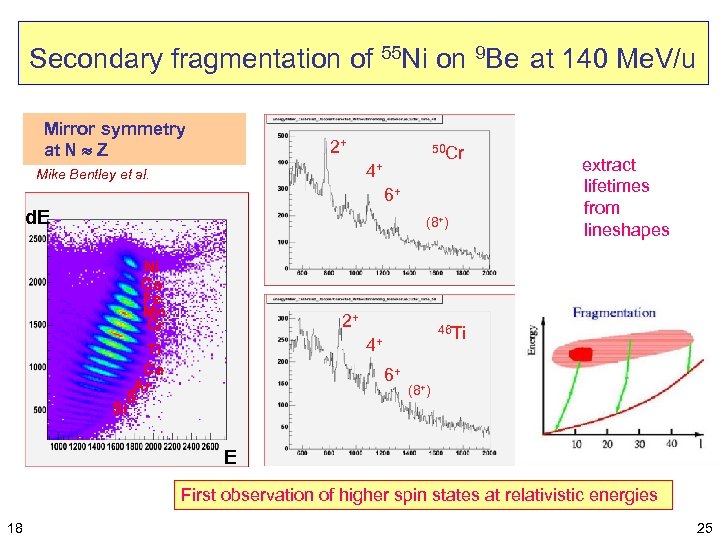
Secondary fragmentation of 55 Ni on 9 Be at 140 Me. V/u Mirror symmetry at N Z 2+ 50 Cr 4+ Mike Bentley et al. 6+ d. E (8+) Ni Co Fe Mn Cr 2+ 46 Ti 4+ Ti Ca Ar S Si extract lifetimes from lineshapes 6+ (8+) E First observation of higher spin states at relativistic energies 18 25
![Isomeric ratios Fragmentation of 238 U Isomeric ratios I 211 Fr R [%] 29/2+](https://present5.com/presentation/95e9af971aa21b40afcb5da215603726/image-19.jpg "Isomeric ratios Fragmentation of 238 U Isomeric ratios I 211 Fr R [%] 29/2+")
Isomeric ratios Fragmentation of 238 U Isomeric ratios I 211 Fr R [%] 29/2+ 5. 7 (2) 1529/2+ 17 - 6. 8 (2) 215 Ra 43/2 - I = 27+ R = 3. 2 (3) % 12. 0 (8) 214 Ra 148 Tb 7. 5 (2) 213 Fr Fragmentation of 208 Pb 3. 1 (6) 212 Fr Fragmentation populates high spin states 19 Zs. Podolyak et al. 25
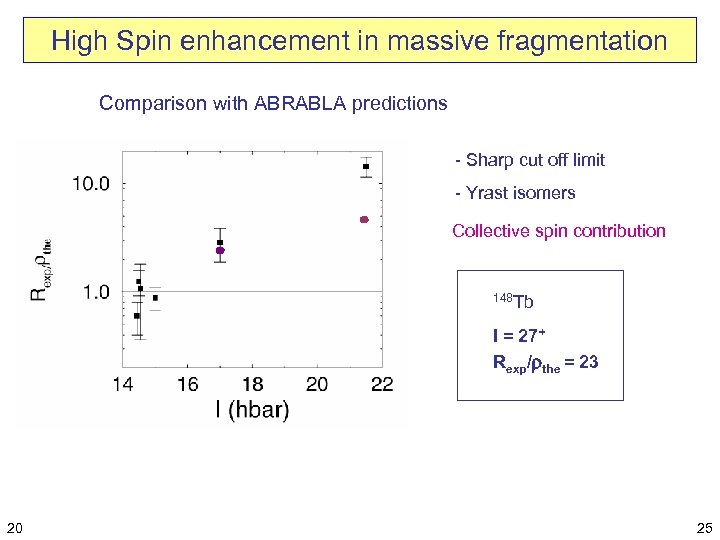
High Spin enhancement in massive fragmentation Comparison with ABRABLA predictions - Sharp cut off limit - Yrast isomers Collective spin contribution 148 Tb I = 27+ Rexp/ the = 23 20 25
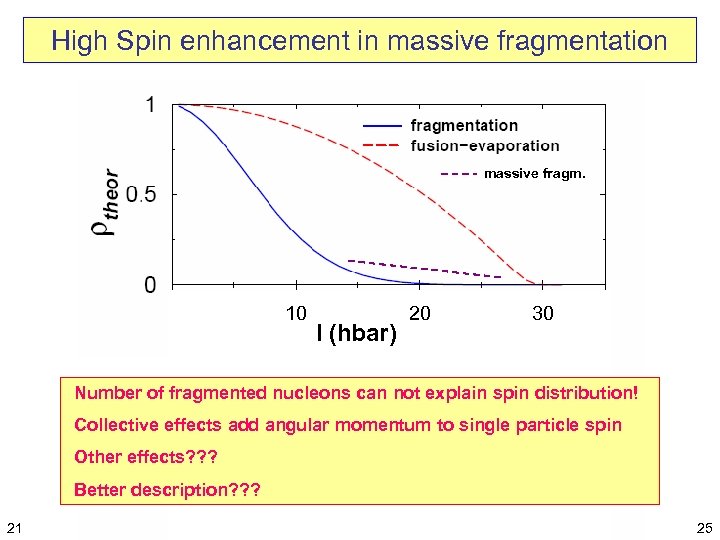
High Spin enhancement in massive fragmentation massive fragm. 10 I (hbar) 20 30 Number of fragmented nucleons can not explain spin distribution! Collective effects add angular momentum to single particle spin Other effects? ? ? Better description? ? ? 21 25
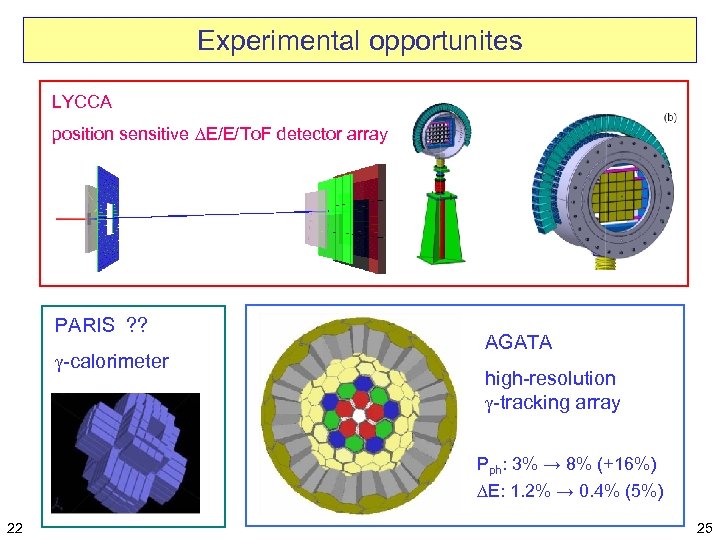
Experimental opportunites LYCCA position sensitive E/E/To. F detector array PARIS ? ? -calorimeter AGATA high-resolution -tracking array Pph: 3% → 8% (+16%) E: 1. 2% → 0. 4% (5%) 22 25
Spectroscopy program at GSI / FAIR RISING 2007 – 2008 Decay with active stopper PRESPEC 2009 – 2010 In-beam employing LYCCA including To. F 2010 – 2011 Decay and g-factors 2011 – 2012 In-beam AGATA demonstrator together with Euroball detectors HISPEC/DESPEC 2013 – … 23 In-beam and decay spectroscopy with Super-FRS at FAIR/NUSTAR 25
Conclusions Coulomb and nuclear interactions at relativistic beam energies provide a universal method to populate excited states in nuclei Coulomb excitation populates low spin states from the first excited state up to giant resonances with a population pattern governed by B(E ) values Fragmentation reactions seem to populate low spin states unspecifically up to particle thresholds High spin states are populated in massive fragmentation reactions The underlying reaction mechanism is only qualitatively understood and more detailed investigations are required for a quantitative understanding Improved instrumentation is coming up soon… PRESPEC In-Beam Physics workshop, Daresbury 8. -9. October 2008 24 25
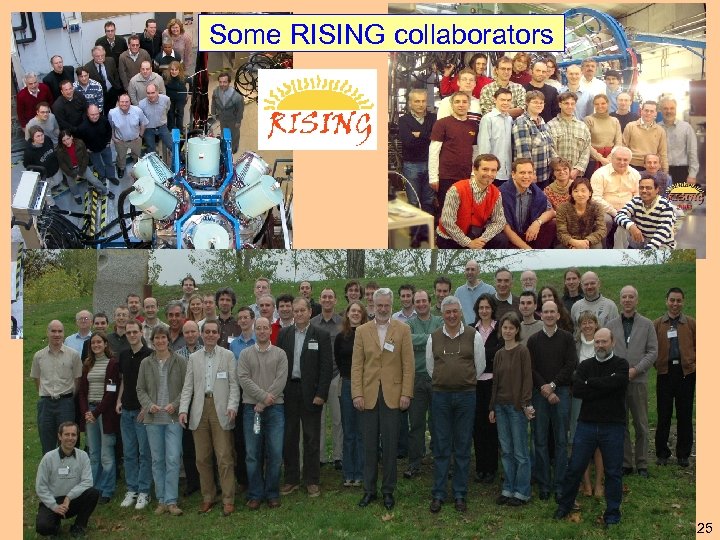
Some RISING collaborators 25
… thank you 26 25
68 Ni 27 →Au 25
Скачать презентацию Nuclear Structure studies using fast radioactive beams
95e9af971aa21b40afcb5da215603726.ppt