


 Скачать презентацию Nuclear Power in Washington State Kathleen M Saul
a9cce443fbb3ae9e7dc0f536aed13e60.ppt
- Количество слайдов: 28
 Nuclear Power in Washington State Kathleen M. Saul November 4, 2010 g. CORE
 Electrical Generation vs. Bomb Production n The energy from the atom has been used for two different purposes: ¨ In atomic bombs/nuclear weapons, ¨ To generate electricity. n The focus today: Electrical Generation “Commercial Nuclear Power”
 What is commercial nuclear power? n A fancy way to heat water and generate steam to drive a turbine and create electricity. ¨ Neutrons bombard the nucleus of a uranium 235 atom, causing the release of other neutrons and a lot of heat. Those new neutrons go on to hit other uranium-235 nuclei in a self-sustaining reaction.
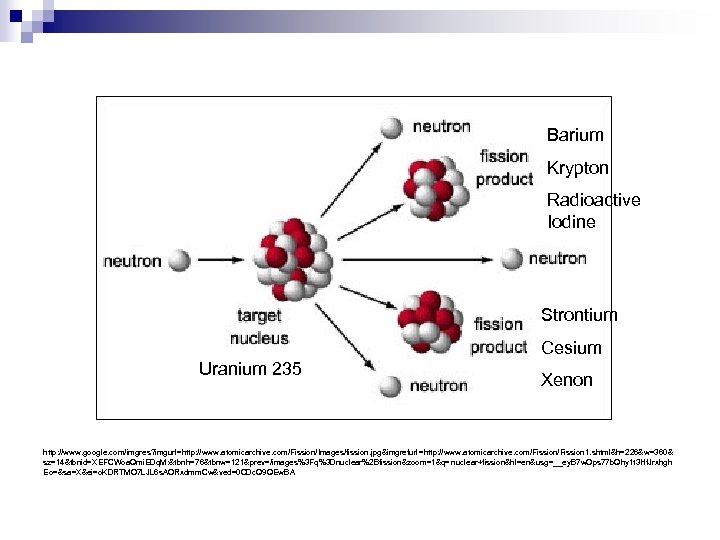 Barium Krypton Radioactive Iodine Strontium Cesium Uranium 235 Xenon http: //www. google. com/imgres? imgurl=http: //www. atomicarchive. com/Fission/Images/fission. jpg&imgrefurl =http: //www. atomicarchive. com/Fission 1. shtml&h=226&w=360& sz=14&tbnid=XEFCWoa. Qmi. EDq. M: &tbnh=76&tbnw=121&prev=/images%3 Fq%3 Dnuclear%2 Bfission&zoom=1&q= nuclear+fission&hl=en&usg=__ey. B 7 w. Ops 77 b. Qhy 1 t 3 Hf. Jrxhgh Eo=&sa=X&ei=o. KDRTMO 7 LJL 6 s. AORxdmm. Cw&ved=0 CDc. Q 9 QEw. BA
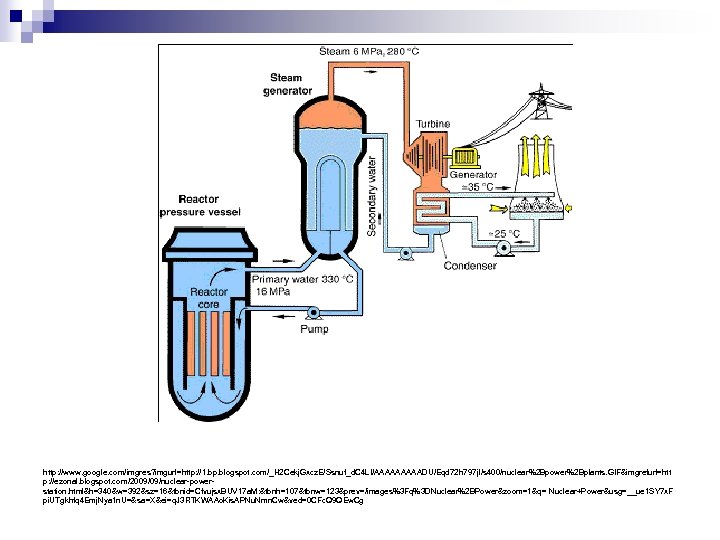 http: //www. google. com/imgres? imgurl=http: //1. bp. blogspot. com/_H 2 Cekj. Gxcz. E/Ssnuf_d. C 4 LI/AAAAADU/Eqd 72 h 797 j. I/s 400/nuclear%2 Bpower%2 Bplants. GIF&imgrefurl=htt p: //ezonal. blogspot. com/2009/09/nuclear-powerstation. html&h=340&w=392&sz=16&tbnid=Cfvujsx. BUV 17 a. M: &tbnh=107&tbnw=123&prev=/images%3 Fq%3 DNuclear%2 BPower&zoom=1&q= Nuclear+Power&usg=__ue 1 SY 7 x. F pi. UTgkhfq 4 Emj. Nya 1 n. U=&sa=X&ei=q. J 3 RTKWAAo. Kis. APNu. Nmn. Cw&ved=0 CFc. Q 9 QEw. Cg
 Key Dates in the History of the U. S. Commercial Nuclear Industry
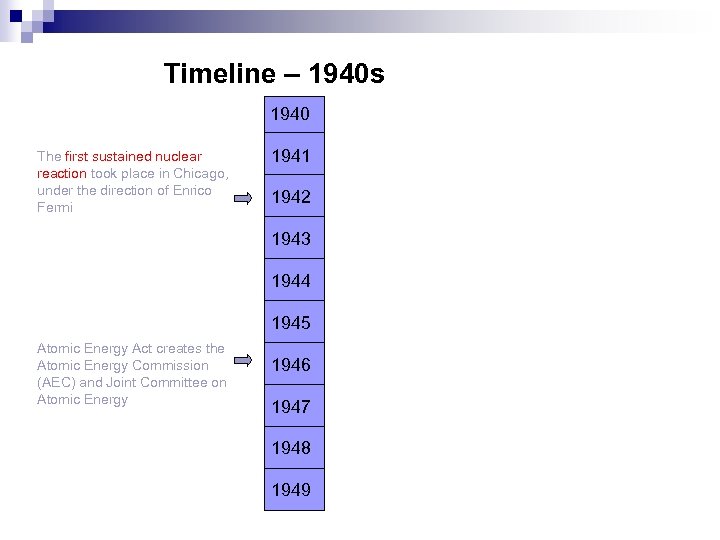 Timeline – 1940 s 1940 The first sustained nuclear reaction took place in Chicago, under the direction of Enrico Fermi 1941 1942 1943 1944 1945 Atomic Energy Act creates the Atomic Energy Commission (AEC) and Joint Committee on Atomic Energy 1946 1947 1948 1949
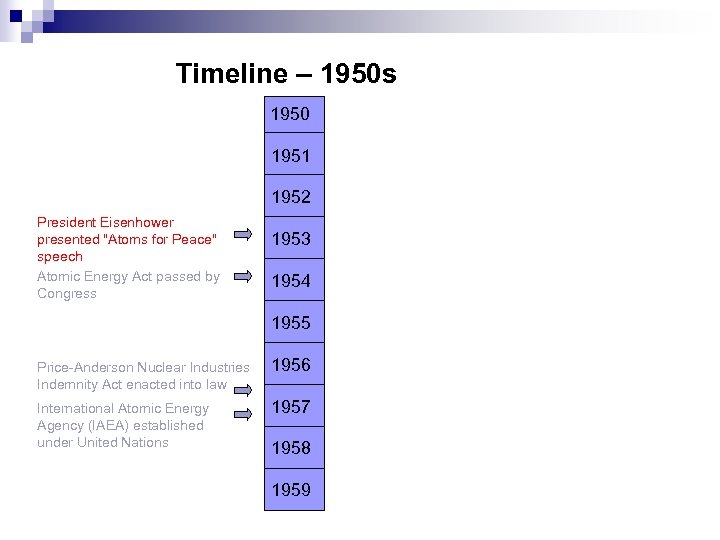 Timeline – 1950 s 1950 1951 1952 President Eisenhower presented "Atoms for Peace" speech Atomic Energy Act passed by Congress 1953 1954 1955 Price-Anderson Nuclear Industries Indemnity Act enacted into law 1956 International Atomic Energy Agency (IAEA) established under United Nations 1957 1958 1959
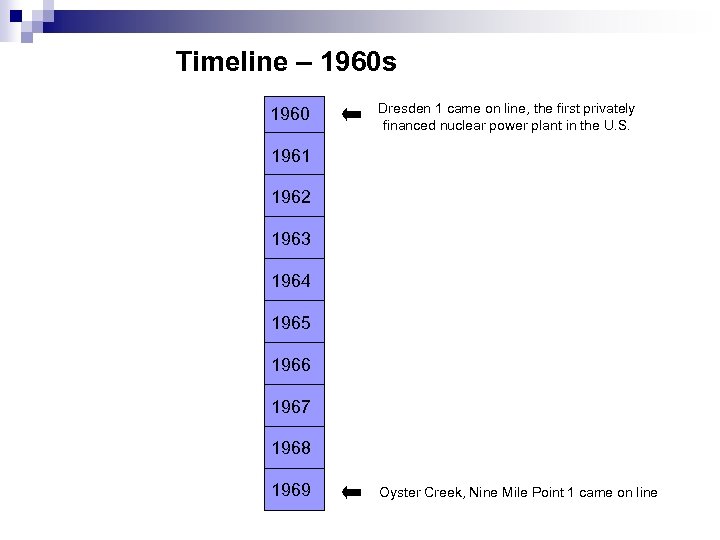 Timeline – 1960 s 1960 Dresden 1 came on line, the first privately financed nuclear power plant in the U. S. 1961 1962 1963 1964 1965 1966 1967 1968 1969 Oyster Creek, Nine Mile Point 1 came on line
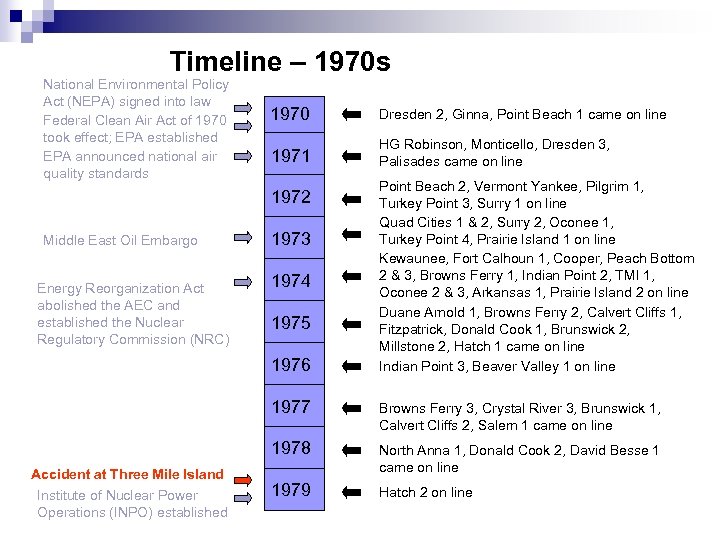 Timeline – 1970 s National Environmental Policy Act (NEPA) signed into law Federal Clean Air Act of 1970 took effect; EPA established EPA announced national air quality standards 1970 Dresden 2, Ginna, Point Beach 1 came on line 1971 HG Robinson, Monticello, Dresden 3, Palisades came on line 1972 Middle East Oil Embargo Energy Reorganization Act abolished the AEC and established the Nuclear Regulatory Commission (NRC) 1973 1974 1975 1976 Point Beach 2, Vermont Yankee, Pilgrim 1, Turkey Point 3, Surry 1 on line Quad Cities 1 & 2, Surry 2, Oconee 1, Turkey Point 4, Prairie Island 1 on line Kewaunee, Fort Calhoun 1, Cooper, Peach Bottom 2 & 3, Browns Ferry 1, Indian Point 2, TMI 1, Oconee 2 & 3, Arkansas 1, Prairie Island 2 on line Duane Arnold 1, Browns Ferry 2, Calvert Cliffs 1, Fitzpatrick, Donald Cook 1, Brunswick 2, Millstone 2, Hatch 1 came on line Indian Point 3, Beaver Valley 1 on line 1977 1978 Accident at Three Mile Island Institute of Nuclear Power Operations (INPO) established Browns Ferry 3, Crystal River 3, Brunswick 1, Calvert Cliffs 2, Salem 1 came on line North Anna 1, Donald Cook 2, David Besse 1 came on line 1979 Hatch 2 on line
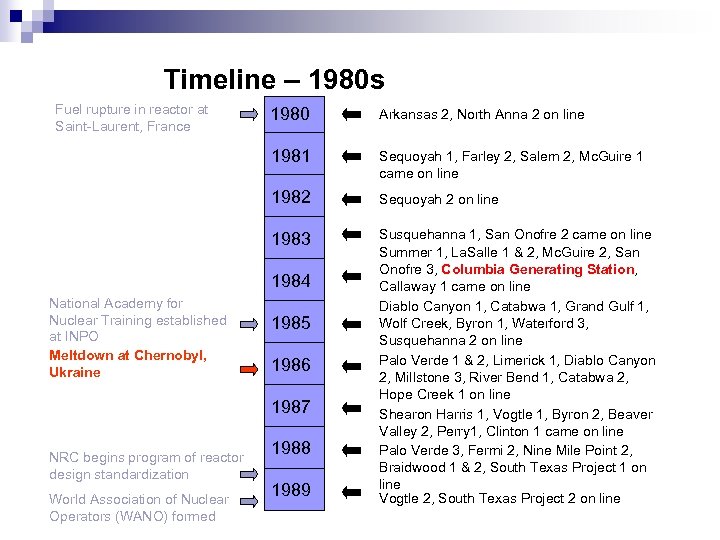 Timeline – 1980 s Fuel rupture in reactor at Saint-Laurent, France 1980 Arkansas 2, North Anna 2 on line 1981 Sequoyah 1, Farley 2, Salem 2, Mc. Guire 1 came on line 1982 Sequoyah 2 on line 1983 Susquehanna 1, San Onofre 2 came on line Summer 1, La. Salle 1 & 2, Mc. Guire 2, San Onofre 3, Columbia Generating Station, Callaway 1 came on line Diablo Canyon 1, Catabwa 1, Grand Gulf 1, Wolf Creek, Byron 1, Waterford 3, Susquehanna 2 on line Palo Verde 1 & 2, Limerick 1, Diablo Canyon 2, Millstone 3, River Bend 1, Catabwa 2, Hope Creek 1 on line Shearon Harris 1, Vogtle 1, Byron 2, Beaver Valley 2, Perry 1, Clinton 1 came on line Palo Verde 3, Fermi 2, Nine Mile Point 2, Braidwood 1 & 2, South Texas Project 1 on line Vogtle 2, South Texas Project 2 on line 1984 National Academy for Nuclear Training established at INPO Meltdown at Chernobyl, Ukraine 1985 1986 1987 NRC begins program of reactor design standardization World Association of Nuclear Operators (WANO) formed 1988 1989
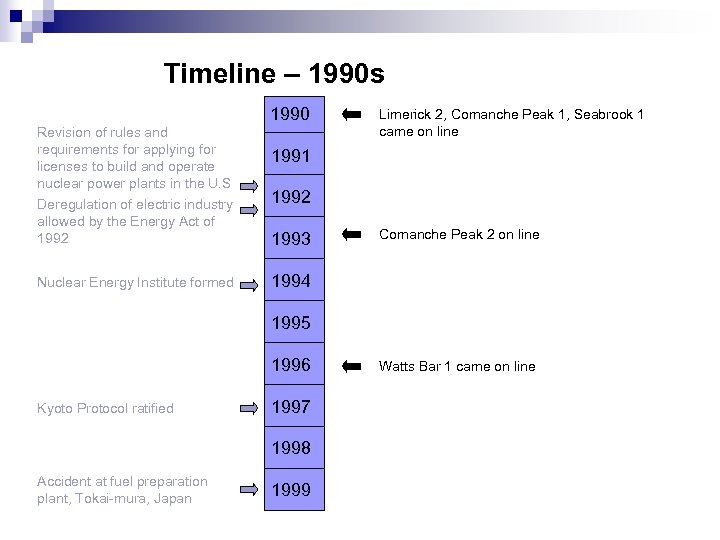 Timeline – 1990 s 1990 Revision of rules and requirements for applying for licenses to build and operate nuclear power plants in the U. S Deregulation of electric industry allowed by the Energy Act of 1992 Nuclear Energy Institute formed Limerick 2, Comanche Peak 1, Seabrook 1 came on line 1991 1992 1993 Comanche Peak 2 on line 1994 1995 1996 Kyoto Protocol ratified 1997 1998 Accident at fuel preparation plant, Tokai-mura, Japan 1999 Watts Bar 1 came on line
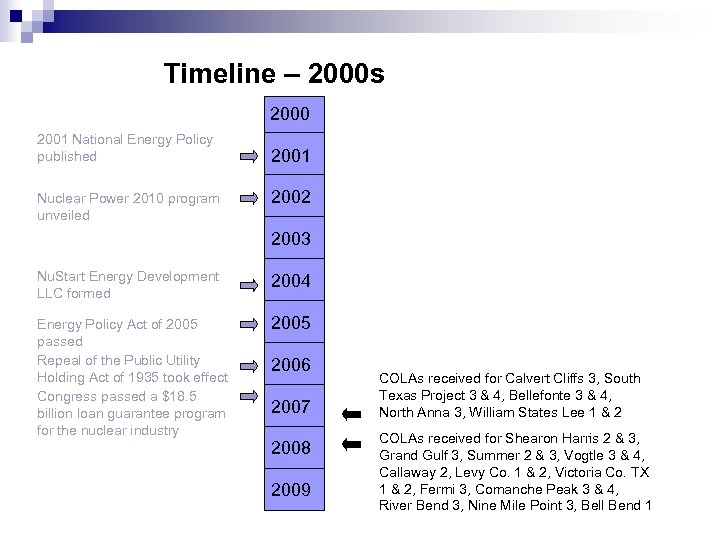 Timeline – 2000 s 2000 2001 National Energy Policy published Nuclear Power 2010 program unveiled 2001 2002 2003 Nu. Start Energy Development LLC formed 2004 Energy Policy Act of 2005 passed Repeal of the Public Utility Holding Act of 1935 took effect Congress passed a $18. 5 billion loan guarantee program for the nuclear industry 2005 2006 2007 2008 2009 COLAs received for Calvert Cliffs 3, South Texas Project 3 & 4, Bellefonte 3 & 4, North Anna 3, William States Lee 1 & 2 COLAs received for Shearon Harris 2 & 3, Grand Gulf 3, Summer 2 & 3, Vogtle 3 & 4, Callaway 2, Levy Co. 1 & 2, Victoria Co. TX 1 & 2, Fermi 3, Comanche Peak 3 & 4, River Bend 3, Nine Mile Point 3, Bell Bend 1
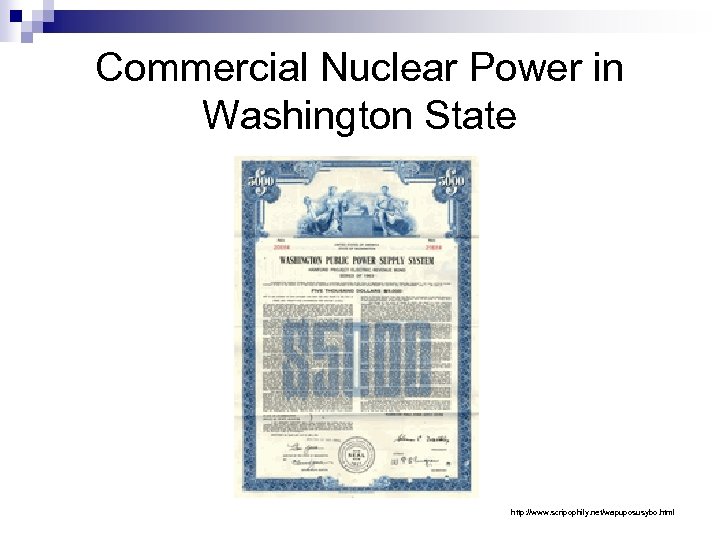 Commercial Nuclear Power in Washington State http: //www. scripophily. net/wapuposusybo. html
 The History of The Washington Public Power Supply System (WPPSS) 1957: WPPSS organized to allow publicly owned utilities to combine resources and build power generation facilities. n 1968: The Joint Power Planning Council set forth its outline for the Thermal-Hydro Power Program, including 20 new thermal plants by 1980. n
 n 1971: WPPSS made plans to construct and operate a commercial nuclear plant on the Hanford site (Plant 2). ¨ Utilities n would share the costs and benefits. 1972: WPPSS proposed a second plant near Hanford (Plant 1) and one at Satsop (Plant 3). ¨ Costs to be covered through the sale of the power generated. n 1973: The IRS decreed the type of financing used for Plants 1, 2, and 3 would no longer be tax exempt.
 n 1973: WPPSS announced plans for Plant 4 near Hanford and Plant 5 at Satsop. ¨ Based on forecasts of continuing growth in electrical demand, WPPSS enticed utilities to buy shares of the projects.
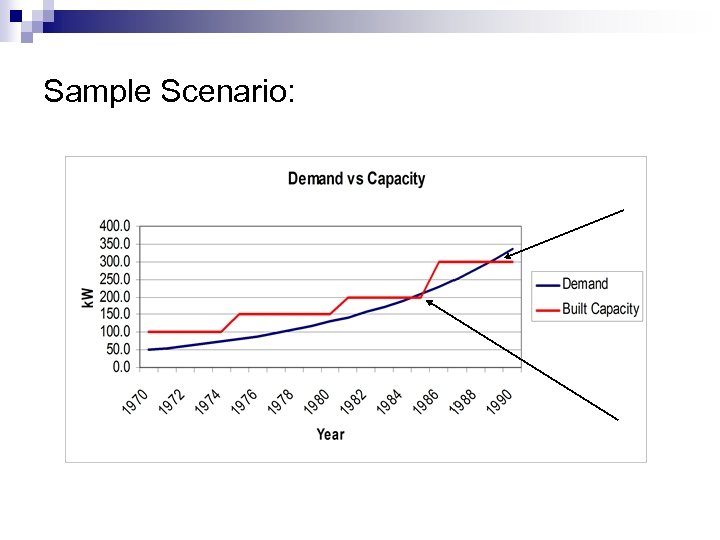 Sample Scenario:
 1981: Revised demand forecasts call into question the need for Plants 4 and 5. n 1982: WPPSS terminated work on 4 and 5. n ¨ Partner utilities were still on the hook for the costs. Ratepayers sued, saying the agreements utilities had entered into were not legal. Courts sided with the ratepayers.
 1983: WPPSS defaulted on the bonds it had issued to cover the costs of plants 4 and 5: $2. 25 billion. n 1983: WPPSS mothballed Plants 1 and 3. n 1984: Plant 2, Columbia Generating Station, began producing power. n
 Challenges Faced by WPPSS Overambitious forecasts, primarily based on Bonneville numbers. n Inexperience with nuclear management and construction. n ¨ Quality control issues. Design changes as construction progressed. n Changes in safety standards. n Increased costs and interest rates. n Environmental backlash against nuclear power. n
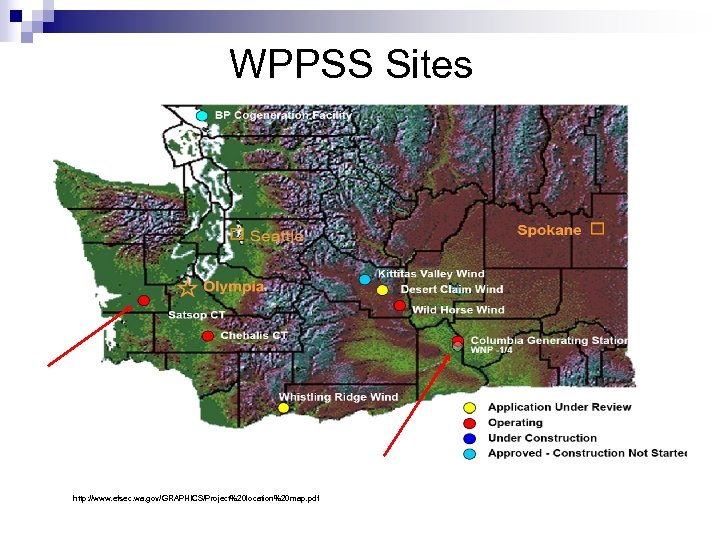 WPPSS Sites http: //www. efsec. wa. gov/GRAPHICS/Project%20 location%20 map. pdf
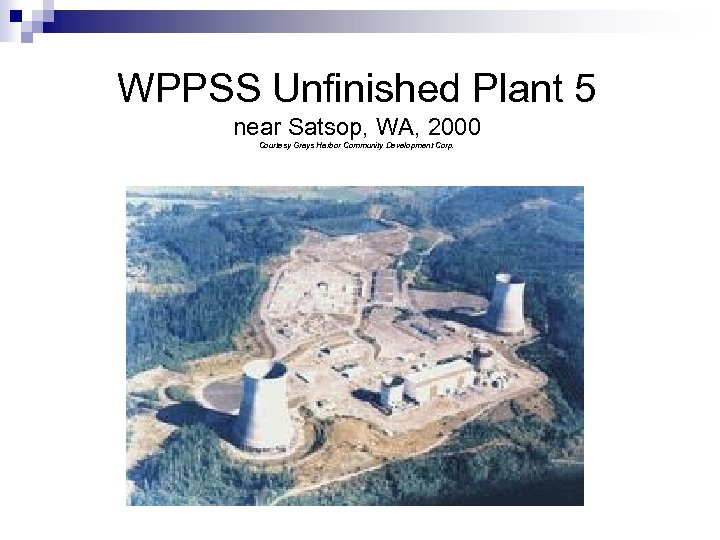 WPPSS Unfinished Plant 5 near Satsop, WA, 2000 Courtesy Grays Harbor Community Development Corp.
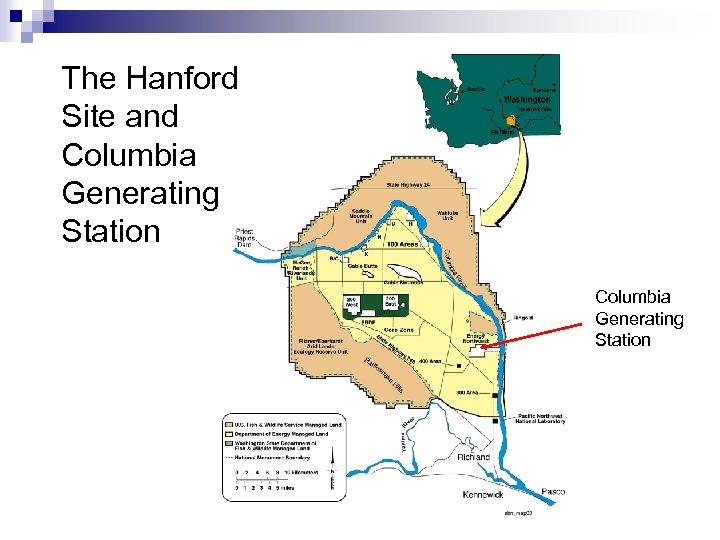 The Hanford Site and Columbia Generating Station
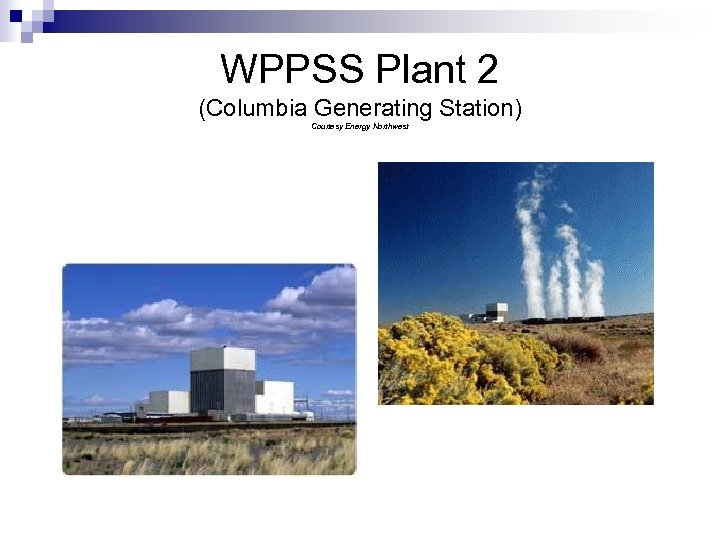 WPPSS Plant 2 (Columbia Generating Station) Courtesy Energy Northwest
 Columbia Generating Station Today Capacity: 1150 MW of electricity. n Emissions avoided (vs fossil fuel plants): n ¨ 9, 750 tons of sulfur dioxide. ¨ 11, 900 tons of nitrogen oxide. ¨ 7, 960, 000 metric tons of carbon dioxide. n 27 casks of spent fuel/by-products stored on site. http: //www. energy-northwest. com/generation/cgs /
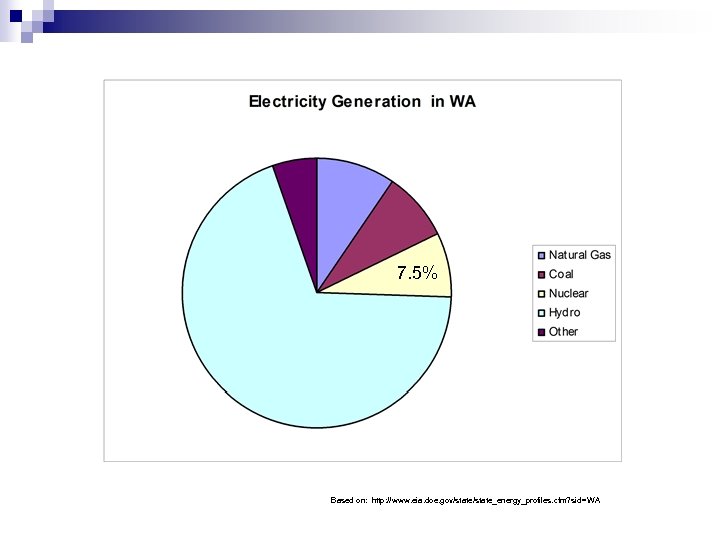 7. 5% Based on: http: //www. eia. doe. gov/state_energy_profiles. cfm? sid =WA
 References n Too many to list. ¨ See me.