 Скачать презентацию Nuclear post Fukushima the position of WEC Members
a553e9d1772ea030f515a4f621feddd7.ppt
- Количество слайдов: 47



Nuclear post Fukushima: the position of WEC Members VI Kazenergy Eurasian Forum “Nuclear post Fukushima” Astana – October, 4 -5 2011 Alessandro Clerici WEC Chair of Study Group “Survey of Energy Resources and Technologies” & Senior Advisor to The President of ABB Italy 1
VI Kazenergy Eurasian Forum “Nuclear post Fukushima” Astana – October, 4 -5 2011 Index 1) What is WEC 2) Global Energy Situation 3) WEC Nuclear Task Force 2
VI Kazenergy Eurasian Forum “Nuclear post Fukushima” Astana – October, 4 -5 2011 1) What is WEC 3
VI Kazenergy Eurasian Forum “Nuclear post Fukushima” Astana – October, 4 -5 2011 4
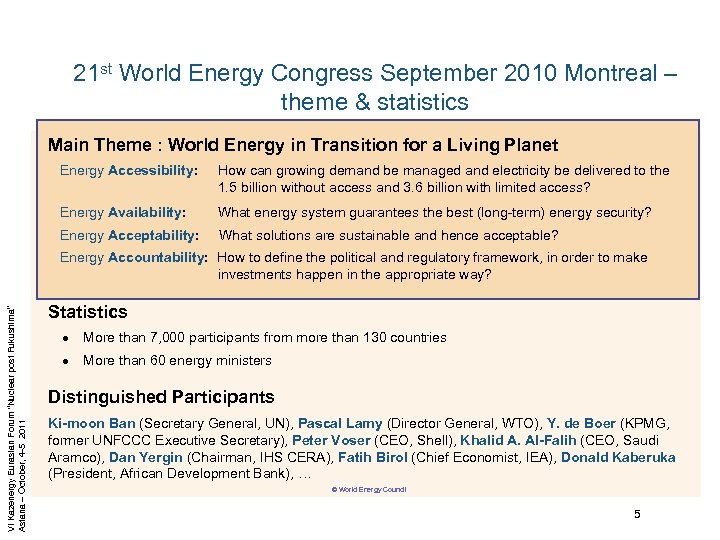
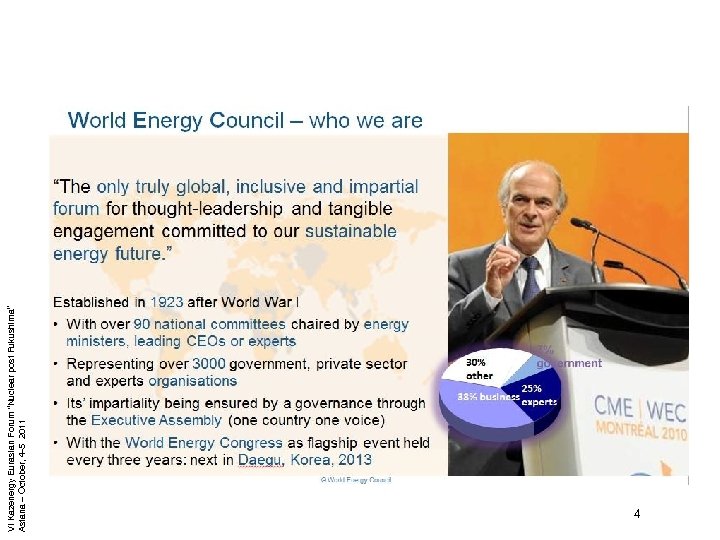
21 st World Energy Congress September 2010 Montreal – theme & statistics Main Theme : World Energy in Transition for a Living Planet Energy Accessibility: How can growing demand be managed and electricity be delivered to the 1. 5 billion without access and 3. 6 billion with limited access? Energy Availability: What energy system guarantees the best (long-term) energy security? Energy Acceptability: What solutions are sustainable and hence acceptable? VI Kazenergy Eurasian Forum “Nuclear post Fukushima” Astana – October, 4 -5 2011 Energy Accountability: How to define the political and regulatory framework, in order to make investments happen in the appropriate way? Statistics ● More than 7, 000 participants from more than 130 countries ● More than 60 energy ministers Distinguished Participants Ki-moon Ban (Secretary General, UN), Pascal Lamy (Director General, WTO), Y. de Boer (KPMG, former UNFCCC Executive Secretary), Peter Voser (CEO, Shell), Khalid A. Al-Falih (CEO, Saudi Aramco), Dan Yergin (Chairman, IHS CERA), Fatih Birol (Chief Economist, IEA), Donald Kaberuka (President, African Development Bank), … © World Energy Council 5
VI Kazenergy Eurasian Forum “Nuclear post Fukushima” Astana – October, 4 -5 2011 © World Energy Council 6
VI Kazenergy Eurasian Forum “Nuclear post Fukushima” Astana – October, 4 -5 2011 2) Global Energy Situation 7
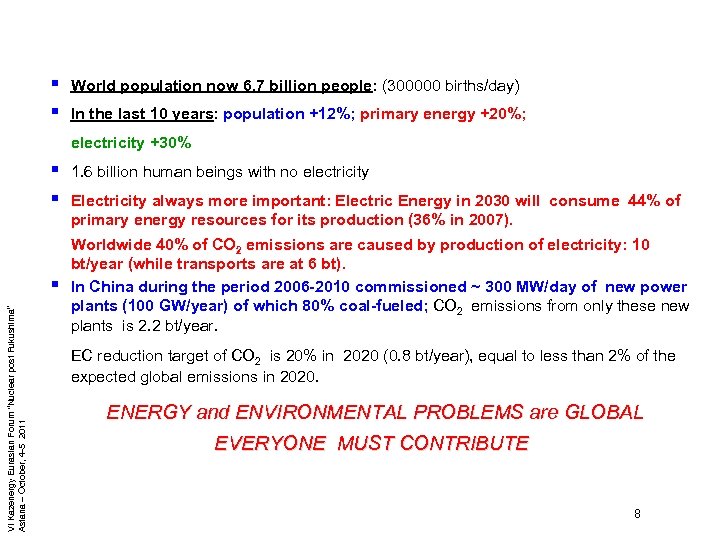
§ § World population now 6. 7 billion people: (300000 births/day) In the last 10 years: population +12%; primary energy +20%; electricity +30% § § VI Kazenergy Eurasian Forum “Nuclear post Fukushima” Astana – October, 4 -5 2011 § 1. 6 billion human beings with no electricity Electricity always more important: Electric Energy in 2030 will consume 44% of primary energy resources for its production (36% in 2007). Worldwide 40% of CO 2 emissions are caused by production of electricity: 10 bt/year (while transports are at 6 bt). In China during the period 2006 -2010 commissioned ~ 300 MW/day of new power plants (100 GW/year) of which 80% coal-fueled; CO 2 emissions from only these new plants is 2. 2 bt/year. EC reduction target of CO 2 is 20% in 2020 (0. 8 bt/year), equal to less than 2% of the expected global emissions in 2020. ENERGY and ENVIRONMENTAL PROBLEMS are GLOBAL EVERYONE MUST CONTRIBUTE 8
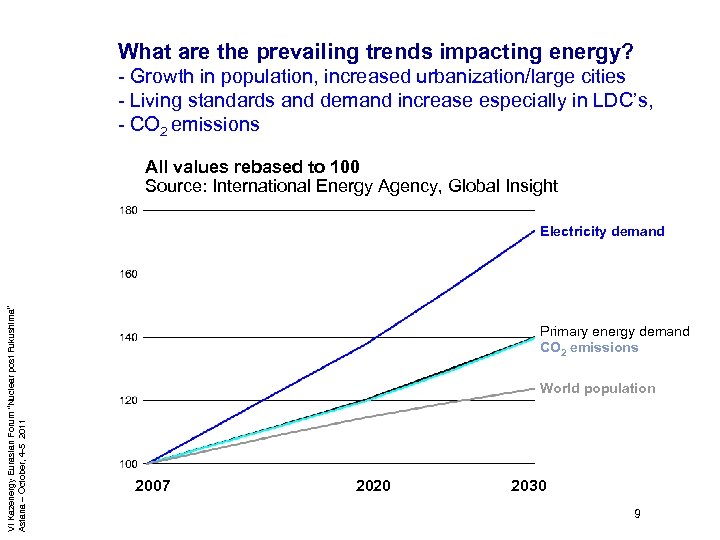
What are the prevailing trends impacting energy? - Growth in population, increased urbanization/large cities - Living standards and demand increase especially in LDC’s, - CO 2 emissions All values rebased to 100 Source: International Energy Agency, Global Insight VI Kazenergy Eurasian Forum “Nuclear post Fukushima” Astana – October, 4 -5 2011 Electricity demand Primary energy demand CO 2 emissions World population 2007 2020 2030 9
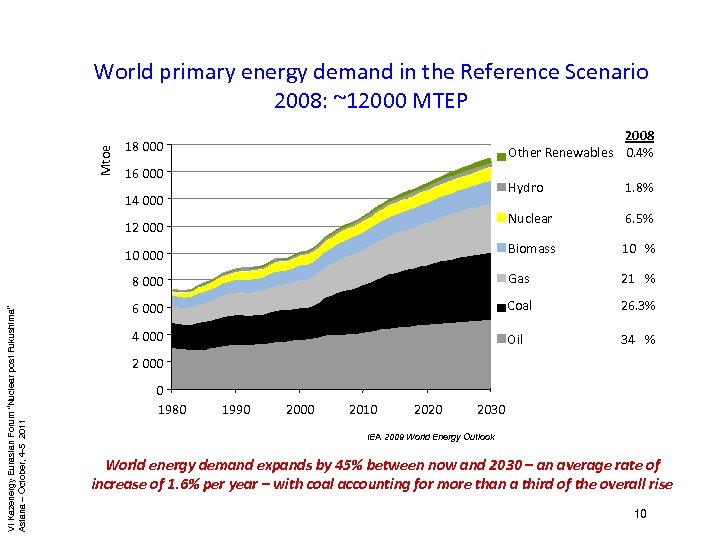
Mtoe World primary energy demand in the Reference Scenario 2008: ~12000 MTEP 2008 Other Renewables 0. 4% 18 000 16 000 Hydro 1. 8% Nuclear 6. 5% Biomass 10 % 8 000 Gas 21 % 6 000 Coal 26. 3% 4 000 Oil 34 % 14 000 12 000 VI Kazenergy Eurasian Forum “Nuclear post Fukushima” Astana – October, 4 -5 2011 10 000 2 000 0 1980 1990 2000 2010 2020 2030 IEA 2009 World Energy Outlook World energy demand expands by 45% between now and 2030 – an average rate of increase of 1. 6% per year – with coal accounting for more than a third of the overall rise 10
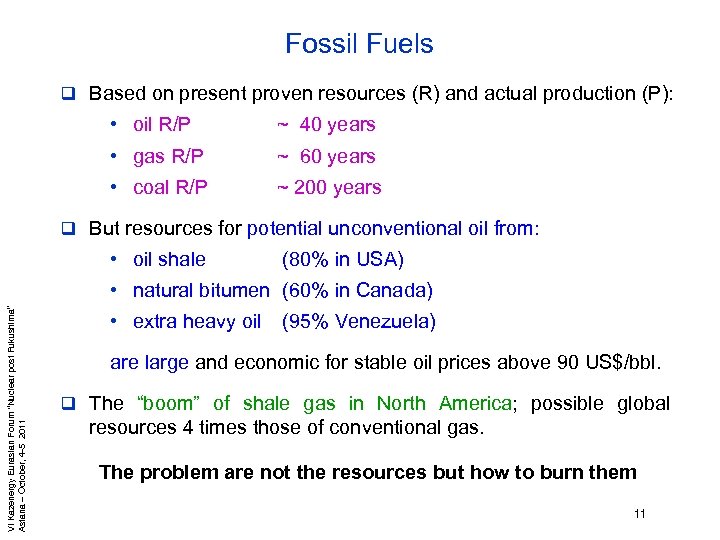
Fossil Fuels q Based on present proven resources (R) and actual production (P): • oil R/P ~ 40 years • gas R/P ~ 60 years • coal R/P ~ 200 years q But resources for potential unconventional oil from: • oil shale (80% in USA) VI Kazenergy Eurasian Forum “Nuclear post Fukushima” Astana – October, 4 -5 2011 • natural bitumen (60% in Canada) • extra heavy oil (95% Venezuela) are large and economic for stable oil prices above 90 US$/bbl. q The “boom” of shale gas in North America; possible global resources 4 times those of conventional gas. The problem are not the resources but how to burn them 11
VI Kazenergy Eurasian Forum “Nuclear post Fukushima” Astana – October, 4 -5 2011 12
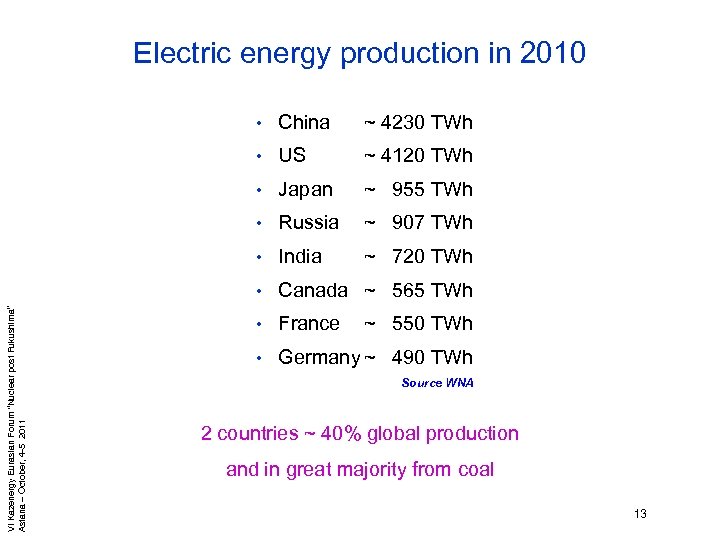
Electric energy production in 2010 China ~ 4230 TWh • US ~ 4120 TWh • Japan ~ 955 TWh • Russia ~ 907 TWh • India ~ 720 TWh • VI Kazenergy Eurasian Forum “Nuclear post Fukushima” Astana – October, 4 -5 2011 • Canada ~ 565 TWh • France • Germany ~ 490 TWh ~ 550 TWh Source WNA 2 countries ~ 40% global production and in great majority from coal 13
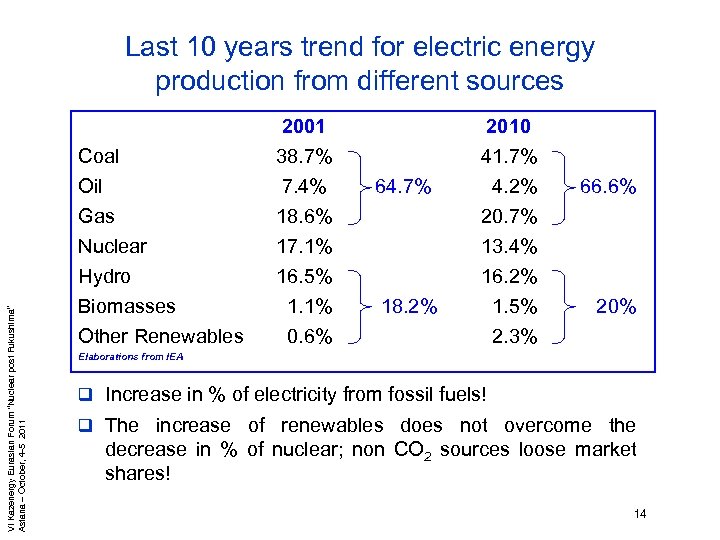
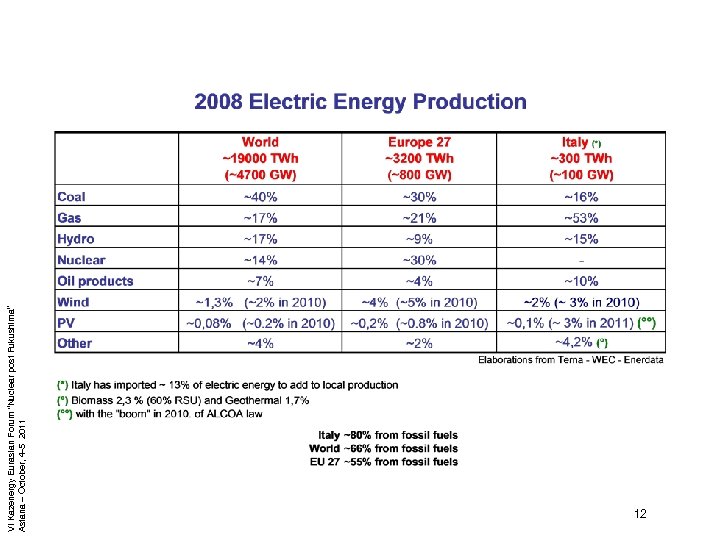
VI Kazenergy Eurasian Forum “Nuclear post Fukushima” Astana – October, 4 -5 2011 Last 10 years trend for electric energy production from different sources Coal Oil Gas Nuclear Hydro Biomasses Other Renewables 2001 38. 7% 7. 4% 18. 6% 17. 1% 16. 5% 1. 1% 0. 6% 64. 7% 18. 2% 2010 41. 7% 4. 2% 20. 7% 13. 4% 16. 2% 1. 5% 2. 3% 66. 6% 20% Elaborations from IEA q Increase in % of electricity from fossil fuels! q The increase of renewables does not overcome the decrease in % of nuclear; non CO 2 sources loose market shares! 14
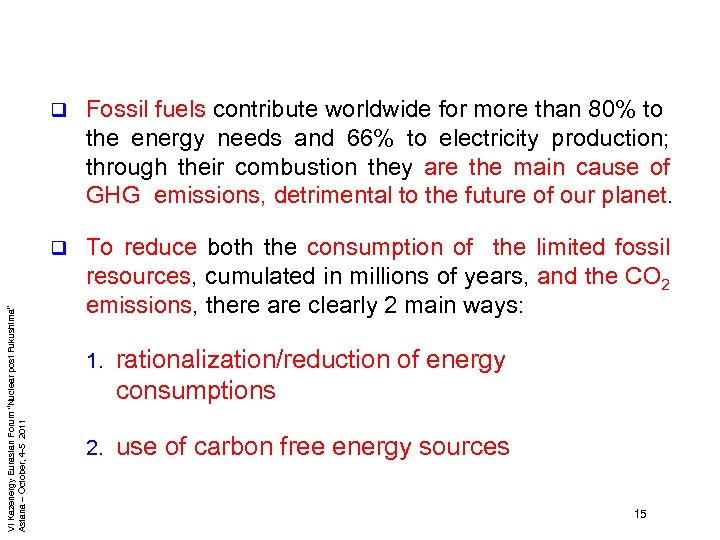
Fossil fuels contribute worldwide for more than 80% to the energy needs and 66% to electricity production; through their combustion they are the main cause of GHG emissions, detrimental to the future of our planet. q VI Kazenergy Eurasian Forum “Nuclear post Fukushima” Astana – October, 4 -5 2011 q To reduce both the consumption of the limited fossil resources, cumulated in millions of years, and the CO 2 emissions, there are clearly 2 main ways: 1. rationalization/reduction of energy consumptions 2. use of carbon free energy sources 15
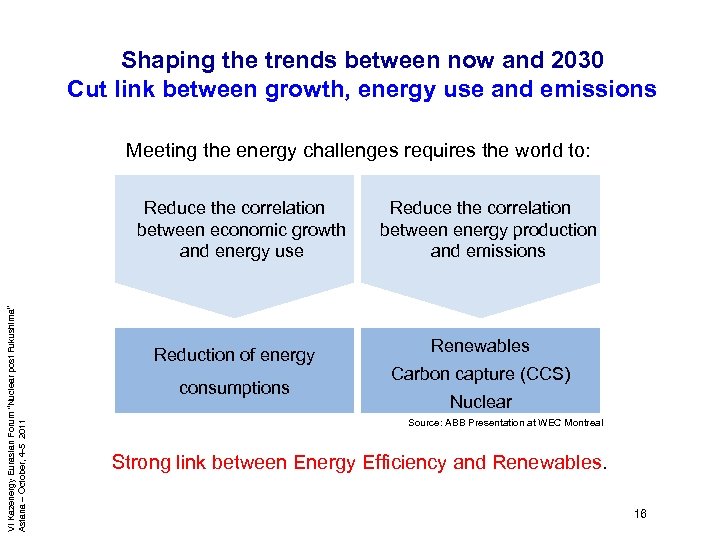
Shaping the trends between now and 2030 Cut link between growth, energy use and emissions Meeting the energy challenges requires the world to: VI Kazenergy Eurasian Forum “Nuclear post Fukushima” Astana – October, 4 -5 2011 Reduce the correlation between economic growth and energy use Reduction of energy consumptions Reduce the correlation between energy production and emissions Renewables Carbon capture (CCS) Nuclear Source: ABB Presentation at WEC Montreal Strong link between Energy Efficiency and Renewables. 16
q For reduction of energy consumptions, 2 main parallel ways: VI Kazenergy Eurasian Forum “Nuclear post Fukushima” Astana – October, 4 -5 2011 ● energy efficiency, doing the same with less: same products and services but using less energy, with no impact on the standards of living. technology driven but affected also by legislations, standards, “life cycle culture”. ● energy conservation: changes in standards of leaving, doing / having less with less. socio/politically driven. 17
Global situation for nuclear q Over the last 10 years the world nuclear energy production VI Kazenergy Eurasian Forum “Nuclear post Fukushima” Astana – October, 4 -5 2011 has been practically constant at about 2600 TWh but loosing market shares, with the so called “nuclear renaissance” happening at the public perception front, where the major concerns after Chernobyl changed little by little from large accident to questions around final waste disposal / costs / Nimby. q The impact of the incident at the Fukushima Daiichi nuclear power plant, which resulted from the devastating earthquake and subsequent tsunami on March 11 th, 2011 will have wide ranging consequences on the global energy mix , following emotional reactions of governments and companies consequential to public opinion 18
q Clearly we must recognize that a nuclear accident VI Kazenergy Eurasian Forum “Nuclear post Fukushima” Astana – October, 4 -5 2011 has a great impact on people due a radiation you do not see, you do not know if it has hit you, you do not know if or when it will effect your health. q The Fukushima impact has been larger than that of the Chernobyl disaster; Japan is in fact considered a high-tech country and a very well organized one. 19
VI Kazenergy Eurasian Forum “Nuclear post Fukushima” Astana – October, 4 -5 2011 3) WEC Nuclear Task Force 20
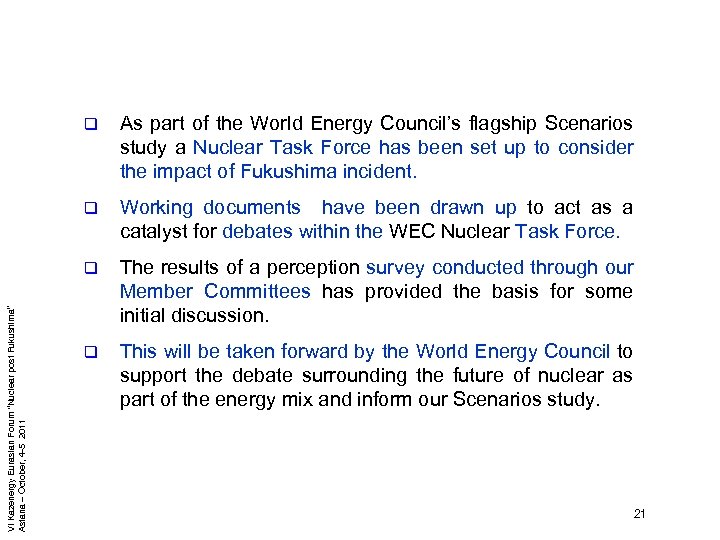
As part of the World Energy Council’s flagship Scenarios study a Nuclear Task Force has been set up to consider the impact of Fukushima incident. q Working documents have been drawn up to act as a catalyst for debates within the WEC Nuclear Task Force. q VI Kazenergy Eurasian Forum “Nuclear post Fukushima” Astana – October, 4 -5 2011 q The results of a perception survey conducted through our Member Committees has provided the basis for some initial discussion. q This will be taken forward by the World Energy Council to support the debate surrounding the future of nuclear as part of the energy mix and inform our Scenarios study. 21
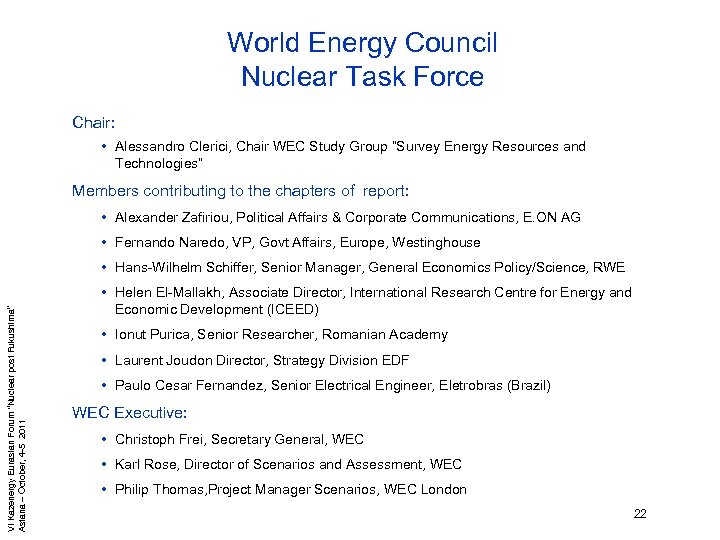
World Energy Council Nuclear Task Force Chair: • Alessandro Clerici, Chair WEC Study Group “Survey Energy Resources and Technologies” Members contributing to the chapters of report: • Alexander Zafiriou, Political Affairs & Corporate Communications, E. ON AG • Fernando Naredo, VP, Govt Affairs, Europe, Westinghouse VI Kazenergy Eurasian Forum “Nuclear post Fukushima” Astana – October, 4 -5 2011 • Hans-Wilhelm Schiffer, Senior Manager, General Economics Policy/Science, RWE • Helen El-Mallakh, Associate Director, International Research Centre for Energy and Economic Development (ICEED) • Ionut Purica, Senior Researcher, Romanian Academy • Laurent Joudon Director, Strategy Division EDF • Paulo Cesar Fernandez, Senior Electrical Engineer, Eletrobras (Brazil) WEC Executive: • Christoph Frei, Secretary General, WEC • Karl Rose, Director of Scenarios and Assessment, WEC • Philip Thomas, Project Manager Scenarios, WEC London 22
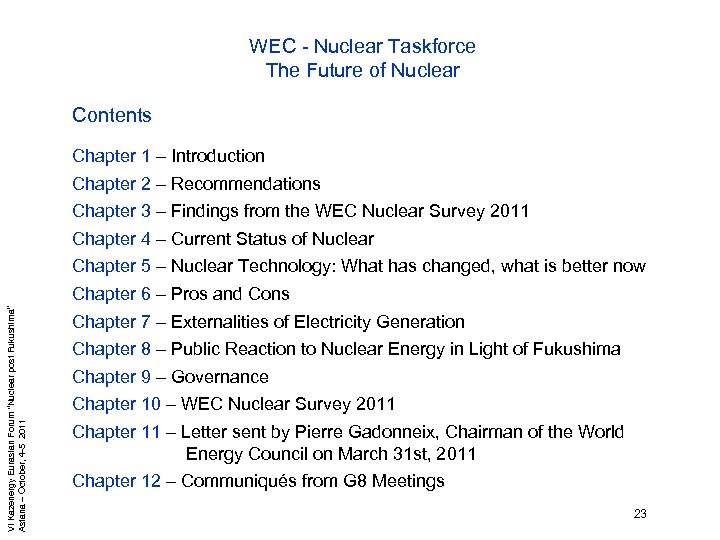
WEC - Nuclear Taskforce The Future of Nuclear Contents Chapter 1 – Introduction Chapter 2 – Recommendations Chapter 3 – Findings from the WEC Nuclear Survey 2011 Chapter 4 – Current Status of Nuclear Chapter 5 – Nuclear Technology: What has changed, what is better now VI Kazenergy Eurasian Forum “Nuclear post Fukushima” Astana – October, 4 -5 2011 Chapter 6 – Pros and Cons Chapter 7 – Externalities of Electricity Generation Chapter 8 – Public Reaction to Nuclear Energy in Light of Fukushima Chapter 9 – Governance Chapter 10 – WEC Nuclear Survey 2011 Chapter 11 – Letter sent by Pierre Gadonneix, Chairman of the World Energy Council on March 31 st, 2011 Chapter 12 – Communiqués from G 8 Meetings 23
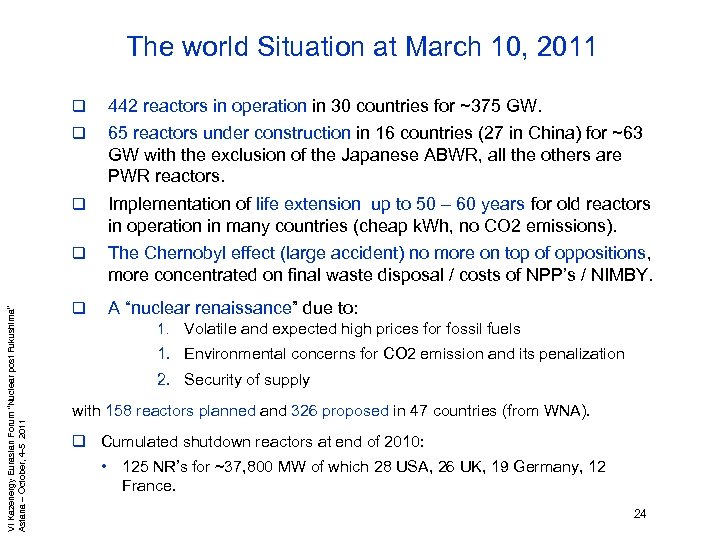
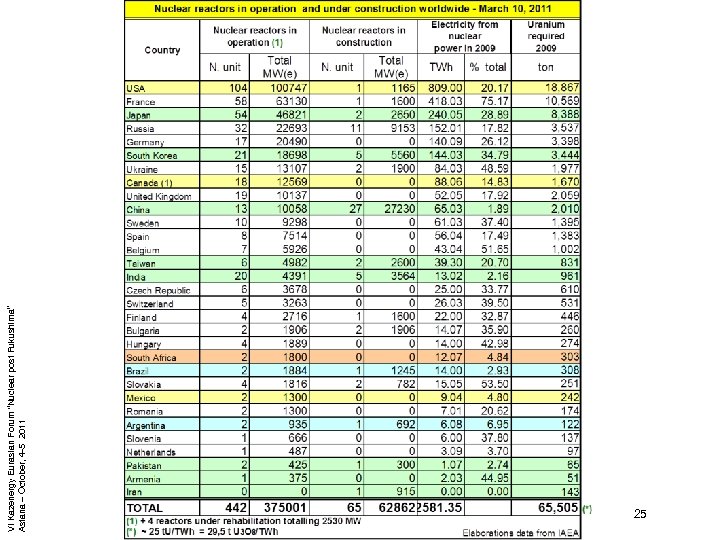
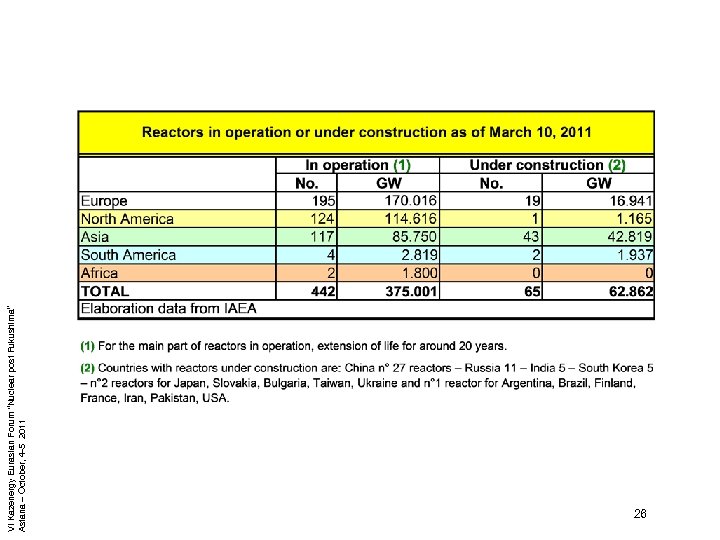
The world Situation at March 10, 2011 442 reactors in operation in 30 countries for ~375 GW. q 65 reactors under construction in 16 countries (27 in China) for ~63 GW with the exclusion of the Japanese ABWR, all the others are PWR reactors. q Implementation of life extension up to 50 – 60 years for old reactors in operation in many countries (cheap k. Wh, no CO 2 emissions). q VI Kazenergy Eurasian Forum “Nuclear post Fukushima” Astana – October, 4 -5 2011 q The Chernobyl effect (large accident) no more on top of oppositions, more concentrated on final waste disposal / costs of NPP’s / NIMBY. q A “nuclear renaissance” due to: 1. Volatile and expected high prices for fossil fuels 1. Environmental concerns for CO 2 emission and its penalization 2. Security of supply with 158 reactors planned and 326 proposed in 47 countries (from WNA). q Cumulated shutdown reactors at end of 2010: • 125 NR’s for ~37, 800 MW of which 28 USA, 26 UK, 19 Germany, 12 France. 24
VI Kazenergy Eurasian Forum “Nuclear post Fukushima” Astana – October, 4 -5 2011 25
VI Kazenergy Eurasian Forum “Nuclear post Fukushima” Astana – October, 4 -5 2011 26
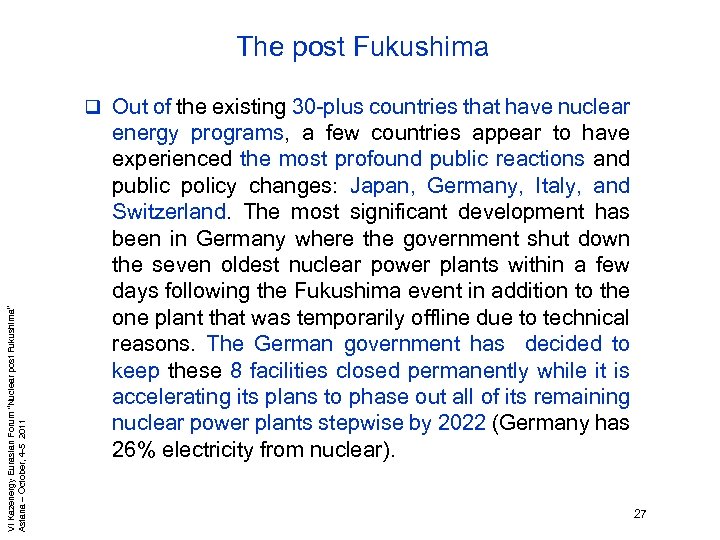
The post Fukushima VI Kazenergy Eurasian Forum “Nuclear post Fukushima” Astana – October, 4 -5 2011 q Out of the existing 30 -plus countries that have nuclear energy programs, a few countries appear to have experienced the most profound public reactions and public policy changes: Japan, Germany, Italy, and Switzerland. The most significant development has been in Germany where the government shut down the seven oldest nuclear power plants within a few days following the Fukushima event in addition to the one plant that was temporarily offline due to technical reasons. The German government has decided to keep these 8 facilities closed permanently while it is accelerating its plans to phase out all of its remaining nuclear power plants stepwise by 2022 (Germany has 26% electricity from nuclear). 27
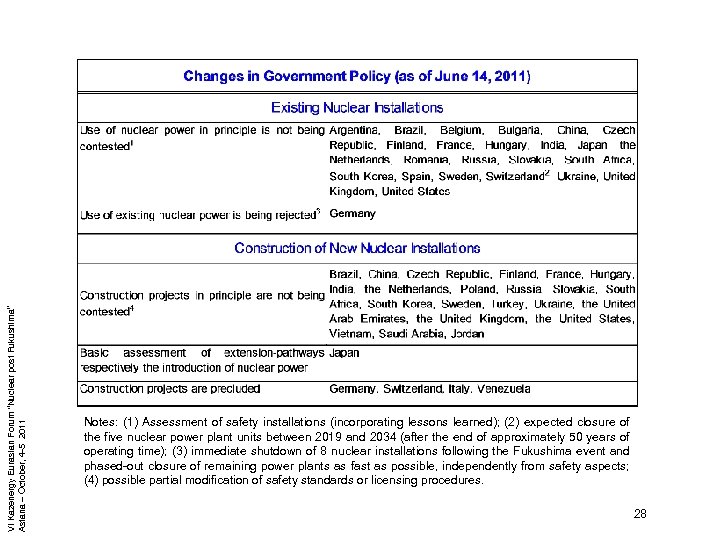
VI Kazenergy Eurasian Forum “Nuclear post Fukushima” Astana – October, 4 -5 2011 Notes: (1) Assessment of safety installations (incorporating lessons learned); (2) expected closure of the five nuclear power plant units between 2019 and 2034 (after the end of approximately 50 years of operating time); (3) immediate shutdown of 8 nuclear installations following the Fukushima event and phased-out closure of remaining power plants as fast as possible, independently from safety aspects; (4) possible partial modification of safety standards or licensing procedures. 28
q In regions and countries that have long held ambivalent to negative opinions on nuclear energy and its safety, the Fukushima accident will serve as an additional example of why to oppose it and local, national, and regional politics will prevail over the longer-time frame. VI Kazenergy Eurasian Forum “Nuclear post Fukushima” Astana – October, 4 -5 2011 q There will also be an increase of “not in my backyard” mentality, with facilities/plants neighbourhood. issue for those disasters. the general public not wanting in their immediate vicinity or In particular, these will be a larger living in areas vulnerable to natural q Possible increased cost of NPP’s for increased security / safety rules, longer permission times and increased costs of risks insurances. 29
q Those in favour of nuclear energy will call for improved safety procedures and plans and point out that the global community can learn from Fukushima; this according to the history of nuclear power of constant improvement and technological development based on lessons learned both by vendors and owners that operate reactors. VI Kazenergy Eurasian Forum “Nuclear post Fukushima” Astana – October, 4 -5 2011 q This has been the inspiration to vendors for the so- called Generation III reactors, currently being built in several countries. These new reactors have typically a 60 year design life, a higher than 90% availability, a 12 -24 month fuel cycle, a 10 -7 probability of radiation releases with no external effect, a very low occupational radiation exposure , capability to withstand impact of large airplanes. 30
VI Kazenergy Eurasian Forum “Nuclear post Fukushima” Astana – October, 4 -5 2011 31
VI Kazenergy Eurasian Forum “Nuclear post Fukushima” Astana – October, 4 -5 2011 32
VI Kazenergy Eurasian Forum “Nuclear post Fukushima” Astana – October, 4 -5 2011 33
VI Kazenergy Eurasian Forum “Nuclear post Fukushima” Astana – October, 4 -5 2011 34
VI Kazenergy Eurasian Forum “Nuclear post Fukushima” Astana – October, 4 -5 2011 35
VI Kazenergy Eurasian Forum “Nuclear post Fukushima” Astana – October, 4 -5 2011 36
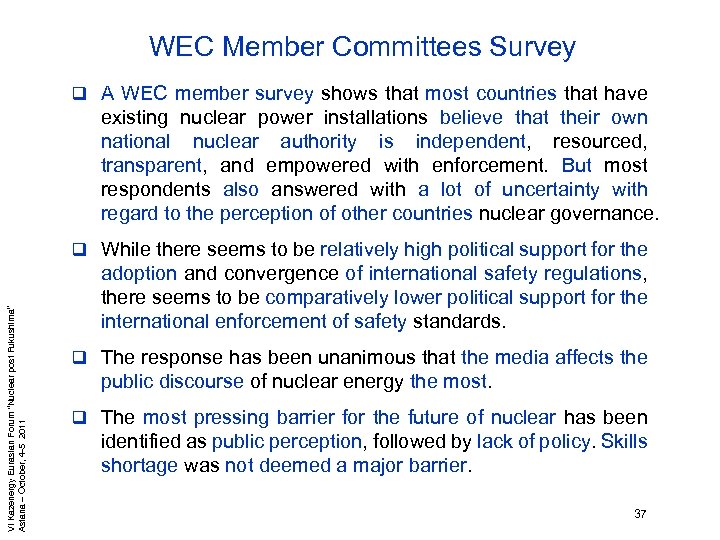
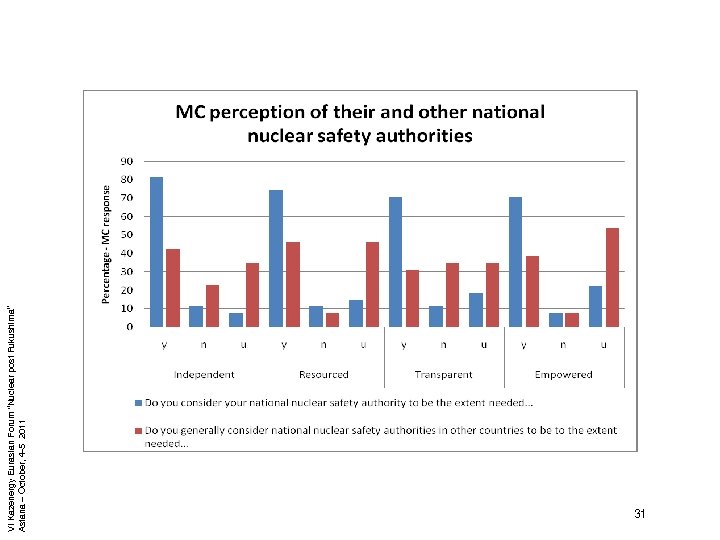
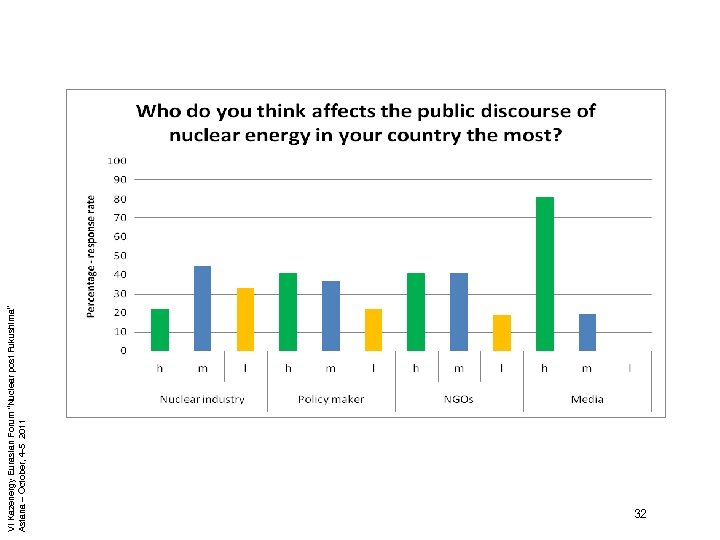
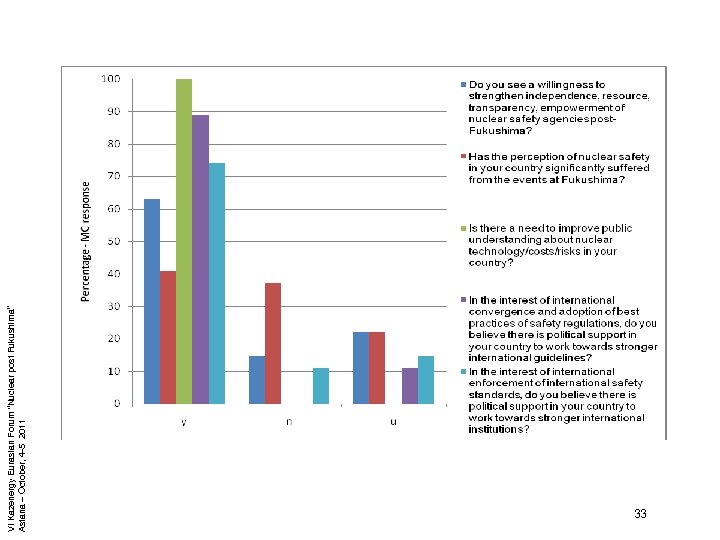
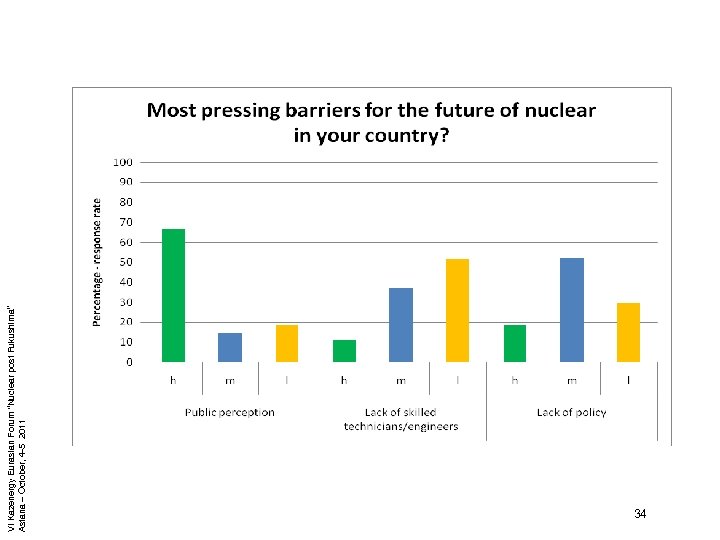
WEC Member Committees Survey q A WEC member survey shows that most countries that have existing nuclear power installations believe that their own national nuclear authority is independent, resourced, transparent, and empowered with enforcement. But most respondents also answered with a lot of uncertainty with regard to the perception of other countries nuclear governance. VI Kazenergy Eurasian Forum “Nuclear post Fukushima” Astana – October, 4 -5 2011 q While there seems to be relatively high political support for the adoption and convergence of international safety regulations, there seems to be comparatively lower political support for the international enforcement of safety standards. q The response has been unanimous that the media affects the public discourse of nuclear energy the most. q The most pressing barrier for the future of nuclear has been identified as public perception, followed by lack of policy. Skills shortage was not deemed a major barrier. 37
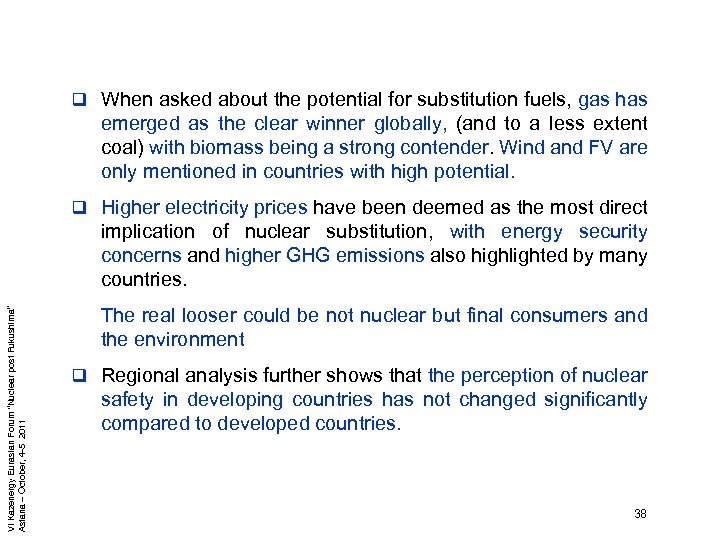
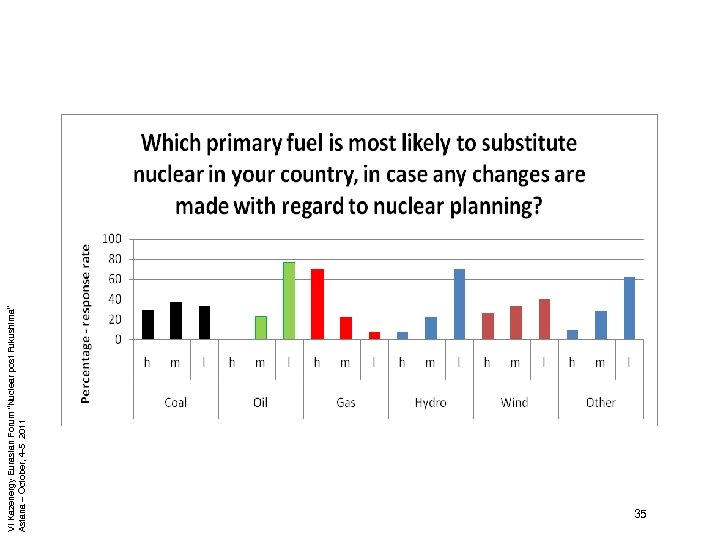
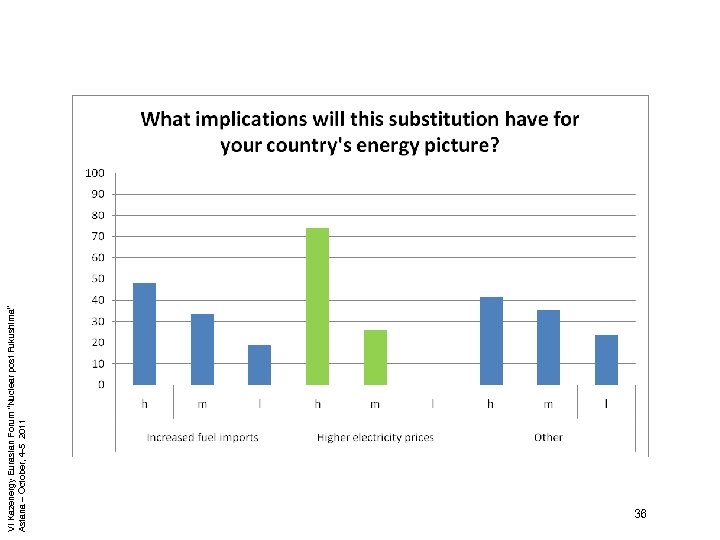
q When asked about the potential for substitution fuels, gas has emerged as the clear winner globally, (and to a less extent coal) with biomass being a strong contender. Wind and FV are only mentioned in countries with high potential. q Higher electricity prices have been deemed as the most direct VI Kazenergy Eurasian Forum “Nuclear post Fukushima” Astana – October, 4 -5 2011 implication of nuclear substitution, with energy security concerns and higher GHG emissions also highlighted by many countries. The real looser could be not nuclear but final consumers and the environment q Regional analysis further shows that the perception of nuclear safety in developing countries has not changed significantly compared to developed countries. 38
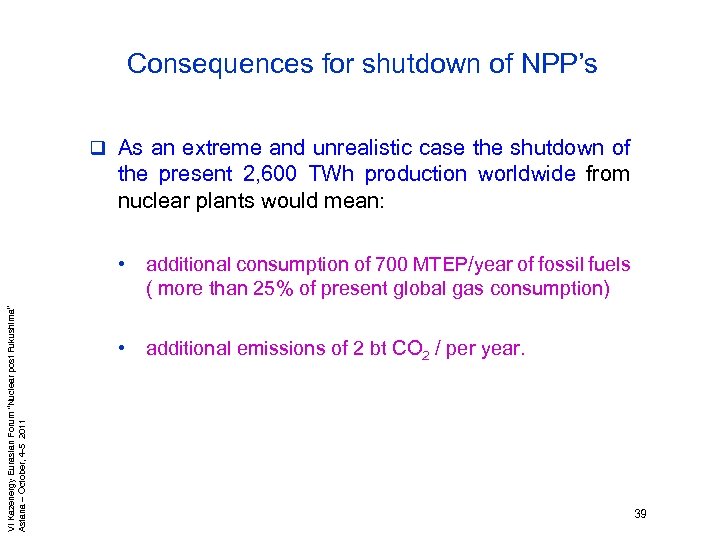
Consequences for shutdown of NPP’s q As an extreme and unrealistic case the shutdown of the present 2, 600 TWh production worldwide from nuclear plants would mean: VI Kazenergy Eurasian Forum “Nuclear post Fukushima” Astana – October, 4 -5 2011 • additional consumption of 700 MTEP/year of fossil fuels ( more than 25% of present global gas consumption) • additional emissions of 2 bt CO 2 / per year. 39
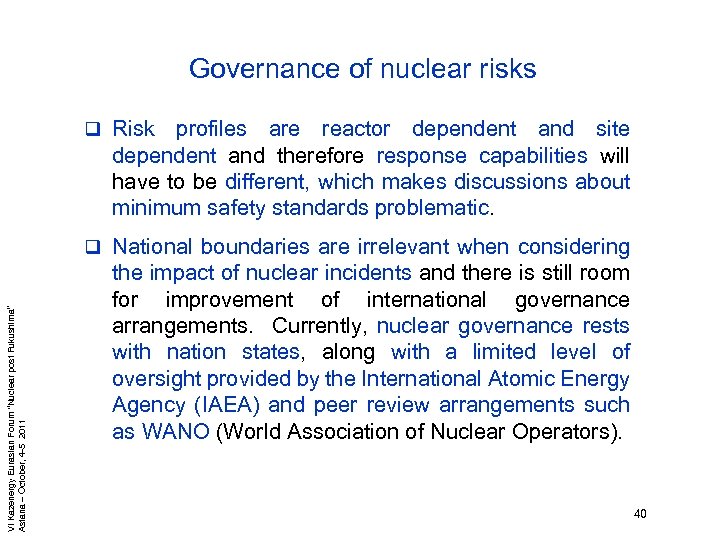
Governance of nuclear risks q Risk profiles are reactor dependent and site dependent and therefore response capabilities will have to be different, which makes discussions about minimum safety standards problematic. VI Kazenergy Eurasian Forum “Nuclear post Fukushima” Astana – October, 4 -5 2011 q National boundaries are irrelevant when considering the impact of nuclear incidents and there is still room for improvement of international governance arrangements. Currently, nuclear governance rests with nation states, along with a limited level of oversight provided by the International Atomic Energy Agency (IAEA) and peer review arrangements such as WANO (World Association of Nuclear Operators). 40
q In all cases the sovereignty of the state supersedes VI Kazenergy Eurasian Forum “Nuclear post Fukushima” Astana – October, 4 -5 2011 that of IAEA who with WANO can operate only through peer reviews/ consensus and technical support and access to a global library of operating experience. q Under the existing system of nuclear governance there is clear need to strengthen global regulation of nuclear energy. q In line with this train of thoughts, the following points were highlighted by the WEC nuclear task force. 41
Recommendations from WEC Standards - National Nuclear Safety Agencies must adopt the IAEA’s minimum safety operation, maintenance, and transparency standards, including site location parameters, and training certification. 2. Verification - The IAEA should be empowered to work with each enhanced National Nuclear Safety Agency to verify adherence to the IAEA’s minimum safety standards. Such verification should be publicly available to enhance transparency. 3. VI Kazenergy Eurasian Forum “Nuclear post Fukushima” Astana – October, 4 -5 2011 1. Design - The IAEA should produce an international accreditation standard for reactor design. 4. Finance - Funding mechanisms should be revised to ensure compliance. 5. Structure – At national and international level there should be unbundle of responsibilities for promotion and safety to reduce the potential for conflicts of interest. Given their accountability, under the United Nations, the International Atomic Energy Agency (IAEA) is the most practical organisation to achieve the required improvements in global governance for the nuclear energy sector. Governments, working through the United Nations, must therefore empower the IAEA. 42
The Pros and Cons still remain PROS q No CO 2 emissions q No volatile cost of k. Wh and very interesting value in medium/long time perspective due to expected high costs of fossil fuels and CO 2 Independency from foreign fuels and security of supply Possible contribution to elimination of nuclear weapons Wave of innovation; fall-out on local industry during construction and technological qualification of companies Volatile renewables need back up capacity and programmable production and nuclear is the only CO 2 free source (nuclear and RES are not in competition but complementary) q VI Kazenergy Eurasian Forum “Nuclear post Fukushima” Astana – October, 4 -5 2011 q q q 43
The Pros and Cons still remain CONS q Fear of large accidents, with global consequences; due to human errors, natural events, terrorism q Acceptability and times for authorizations VI Kazenergy Eurasian Forum “Nuclear post Fukushima” Astana – October, 4 -5 2011 q Financing of merchant plants without government subsidies. q Deposits of nuclear waste and plant decommissioning q The future is of RES q Doubts on Uranium actual reserves 44
VI Kazenergy Eurasian Forum “Nuclear post Fukushima” Astana – October, 4 -5 2011 45
Key variables that will affect global public perception of nuclear energy going forward VI Kazenergy Eurasian Forum “Nuclear post Fukushima” Astana – October, 4 -5 2011 1. The ability of the Japanese government, the nuclear industry, and the Fukushima facility to deal with the aftermath. 2. The short- and long-term effects on the local community. 3. Another disaster. 46
VI Kazenergy Eurasian Forum “Nuclear post Fukushima” Astana – October, 4 -5 2011 Thank you for listening! 47
Скачать презентацию Nuclear post Fukushima the position of WEC Members
a553e9d1772ea030f515a4f621feddd7.ppt