


 Скачать презентацию Nuclear moments of excited states Recent results developments
111836fea1ce41f23fb42ff4db879e57.ppt
- Количество слайдов: 18
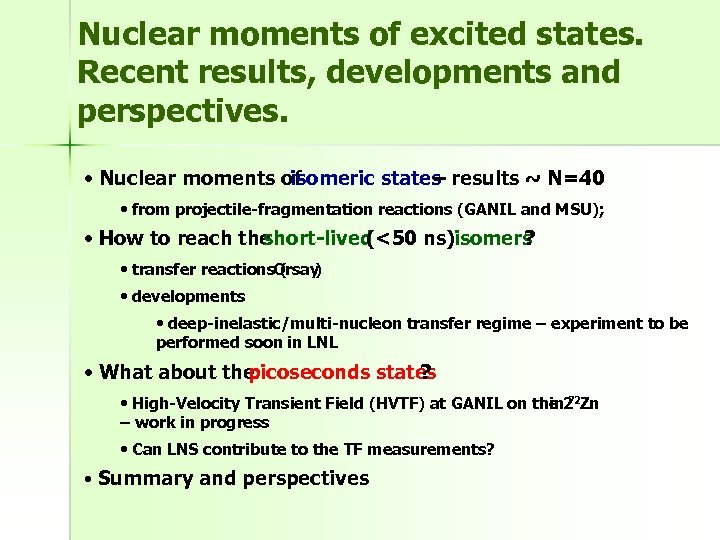 Nuclear moments of excited states. Recent results, developments and perspectives. • Nuclear moments of isomeric states results ~ N=40 – • from projectile-fragmentation reactions (GANIL and MSU); • How to reach the short-lived (<50 ns)isomers ? • transfer reactions. Orsay ( ) • developments • deep-inelastic/multi-nucleon transfer regime – experiment to be performed soon in LNL • What about the picoseconds states ? + in 72 • High-Velocity Transient Field (HVTF) at GANIL on the 2 Zn – work in progress • Can LNS contribute to the TF measurements? • Summary and perspectives
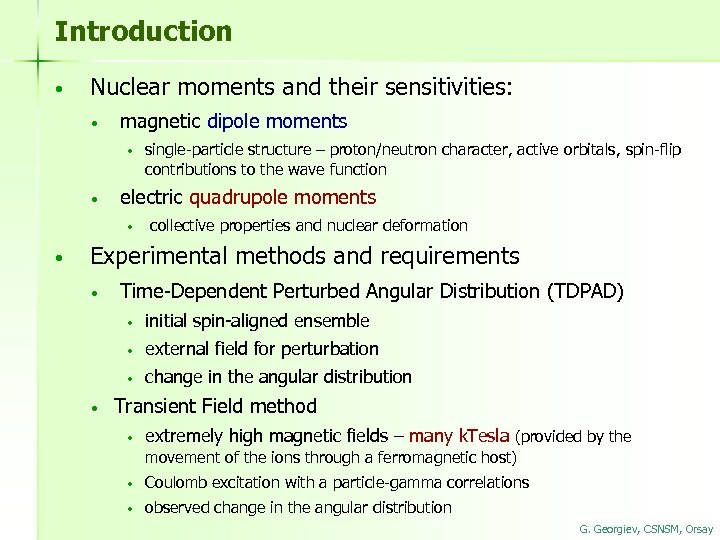 Introduction • Nuclear moments and their sensitivities: • magnetic dipole moments • • electric quadrupole moments • • single-particle structure – proton/neutron character, active orbitals, spin-flip contributions to the wave function collective properties and nuclear deformation Experimental methods and requirements • Time-Dependent Perturbed Angular Distribution (TDPAD) • • external field for perturbation • • initial spin-aligned ensemble change in the angular distribution Transient Field method • extremely high magnetic fields – many k. Tesla (provided by the movement of the ions through a ferromagnetic host) • Coulomb excitation with a particle-gamma correlations • observed change in the angular distribution G. Georgiev, CSNSM, Orsay
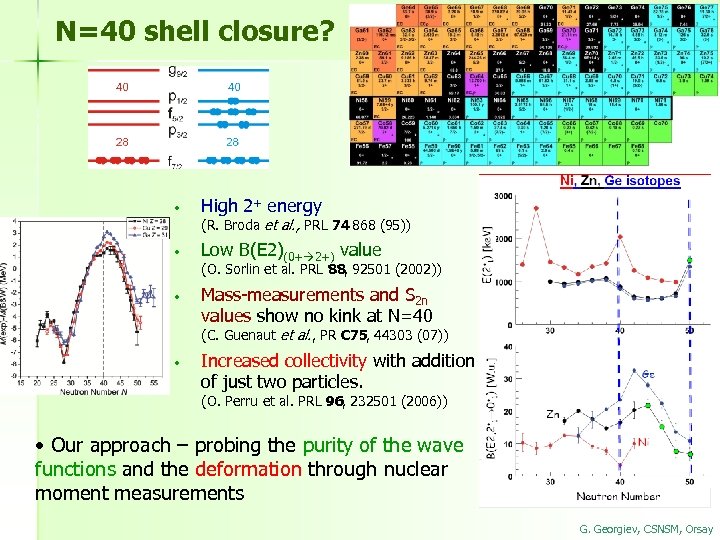 N=40 shell closure? • High 2+ energy (R. Broda et al. , PRL 74 868 (95)) • Low B(E 2)(0+ 2+) value (O. Sorlin et al. PRL 88, 92501 (2002)) • Mass-measurements and S 2 n values show no kink at N=40 (C. Guenaut et al. , PR C 75, 44303 (07)) • Increased collectivity with addition of just two particles. (O. Perru et al. PRL 96, 232501 (2006)) • Our approach – probing the purity of the wave functions and the deformation through nuclear moment measurements G. Georgiev, CSNSM, Orsay
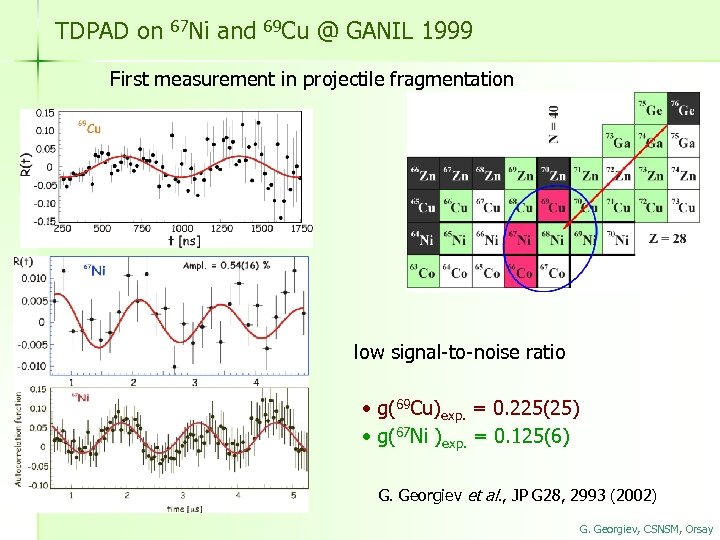 TDPAD on 67 Ni and 69 Cu @ GANIL 1999 First measurement in projectile fragmentation low signal-to-noise ratio • g(69 Cu)exp. = 0. 225(25) • g(67 Ni )exp. = 0. 125(6) G. Georgiev et al. , JP G 28, 2993 (2002) G. Georgiev, CSNSM, Orsay
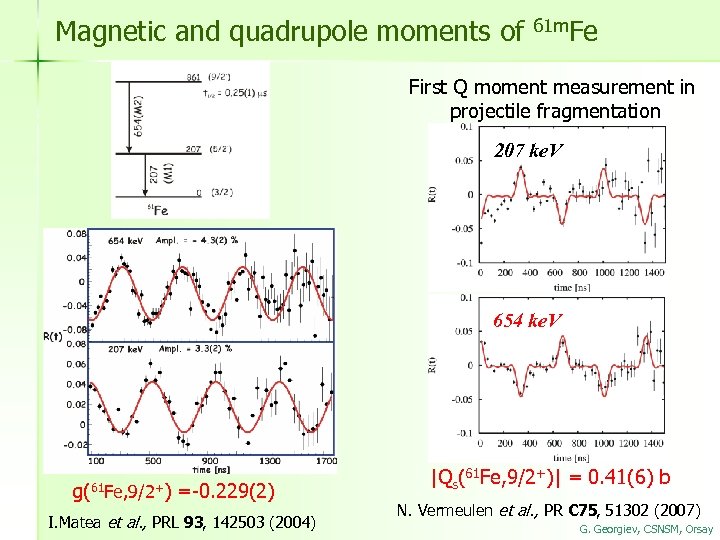 Magnetic and quadrupole moments of 61 m. Fe First Q moment measurement in projectile fragmentation 207 ke. V 654 ke. V g(61 Fe, 9/2+) =-0. 229(2) I. Matea et al. , PRL 93, 142503 (2004) |Qs(61 Fe, 9/2+)| = 0. 41(6) b N. Vermeulen et al. , PR C 75, 51302 (2007) G. Georgiev, CSNSM, Orsay
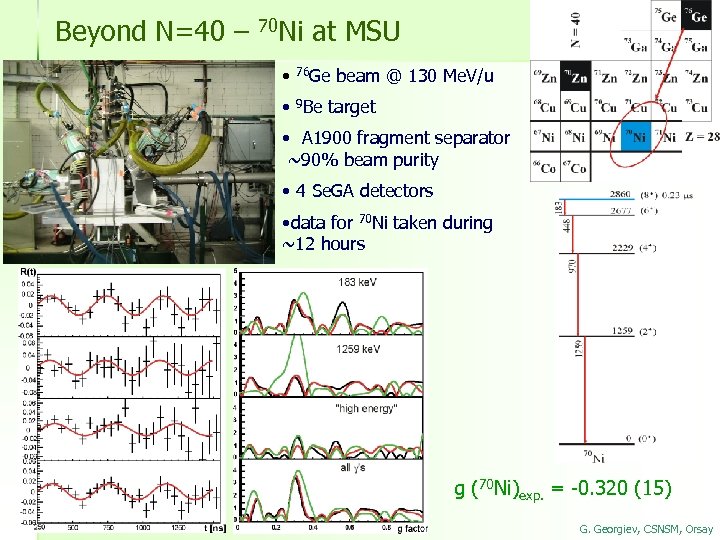 Beyond N=40 – 70 Ni • at MSU 76 Ge beam @ 130 Me. V/u • 9 Be target • A 1900 fragment separator ~90% beam purity • 4 Se. GA detectors • data for 70 Ni taken during ~12 hours g (70 Ni)exp. = -0. 320 (15) G. Georgiev, CSNSM, Orsay
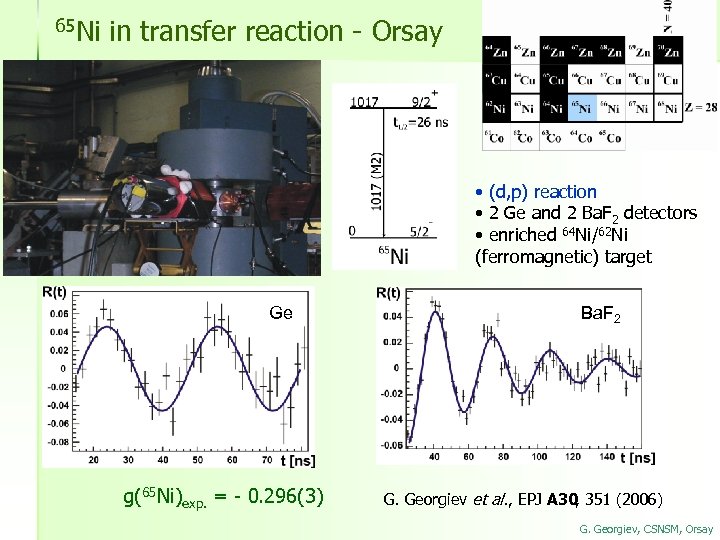 65 Ni in transfer reaction - Orsay • (d, p) reaction • 2 Ge and 2 Ba. F 2 detectors • enriched 64 Ni/62 Ni (ferromagnetic) target Ge g(65 Ni)exp. = - 0. 296(3) Ba. F 2 G. Georgiev et al. , EPJ A 30 351 (2006) , G. Georgiev, CSNSM, Orsay
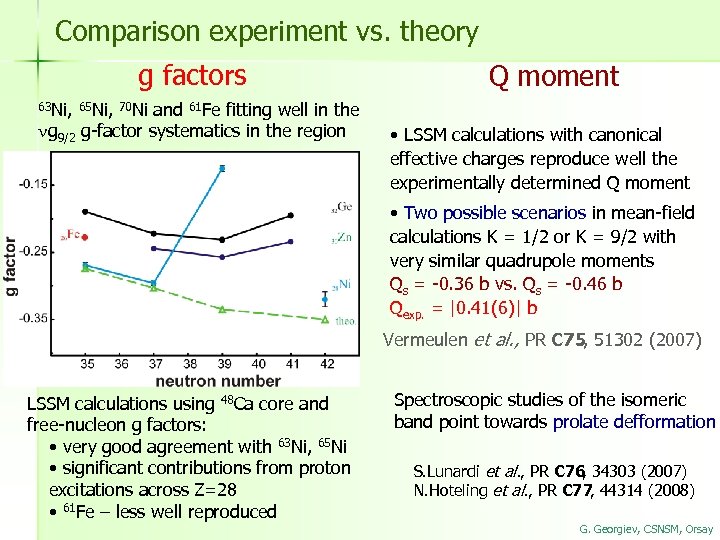 Comparison experiment vs. theory g factors 63 Ni, 65 Ni, 70 Ni ng 9/2 and 61 Fe fitting well in the g-factor systematics in the region Q moment • LSSM calculations with canonical effective charges reproduce well the experimentally determined Q moment • Two possible scenarios in mean-field calculations K = 1/2 or K = 9/2 with very similar quadrupole moments Qs = -0. 36 b vs. Qs = -0. 46 b Qexp. = |0. 41(6)| b Vermeulen et al. , PR C 75, 51302 (2007) LSSM calculations using 48 Ca core and free-nucleon g factors: • very good agreement with 63 Ni, 65 Ni • significant contributions from proton excitations across Z=28 • 61 Fe – less well reproduced Spectroscopic studies of the isomeric band point towards prolate defformation S. Lunardi et al. , PR C 76, 34303 (2007) N. Hoteling et al. , PR C 77, 44314 (2008) G. Georgiev, CSNSM, Orsay
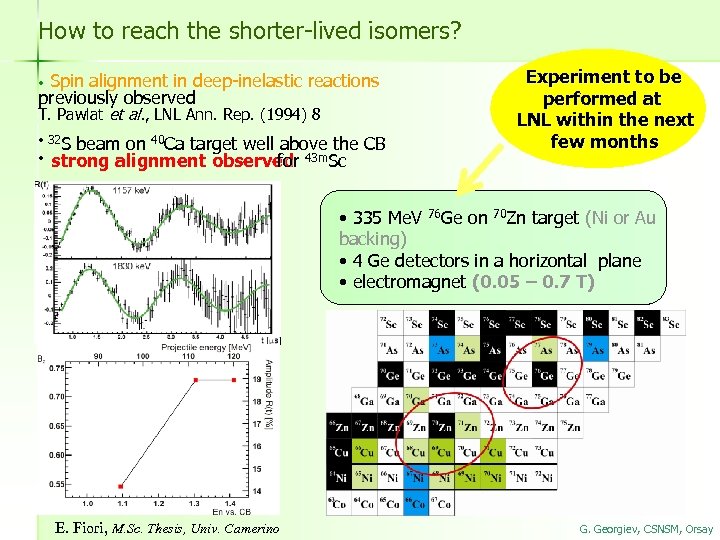 How to reach the shorter-lived isomers? Spin alignment in deep-inelastic reactions previously observed • T. Pawlat et al. , LNL Ann. Rep. (1994) 8 • 32 S beam on 40 Ca target well above the • strong alignment observed 43 m. Sc for CB Experiment to be performed at LNL within the next few months • 335 Me. V 76 Ge on 70 Zn target (Ni or Au backing) • 4 Ge detectors in a horizontal plane • electromagnet (0. 05 – 0. 7 T) E. Fiori, M. Sc. Thesis, Univ. Camerino G. Georgiev, CSNSM, Orsay
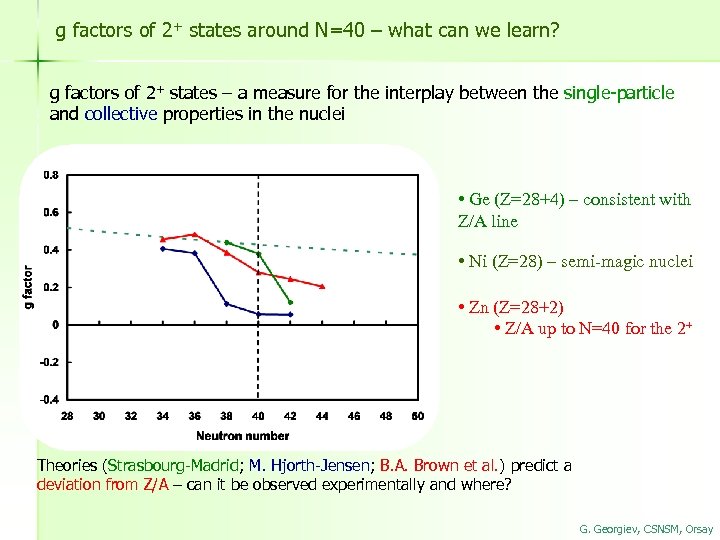 g factors of 2+ states around N=40 – what can we learn? g factors of 2+ states – a measure for the interplay between the single-particle and collective properties in the nuclei • Ge (Z=28+4) – consistent with Z/A line • Ni (Z=28) – semi-magic nuclei • Zn (Z=28+2) • Z/A up to N=40 for the 2+ Theories (Strasbourg-Madrid; M. Hjorth-Jensen; B. A. Brown et al. ) predict a deviation from Z/A – can it be observed experimentally and where? G. Georgiev, CSNSM, Orsay
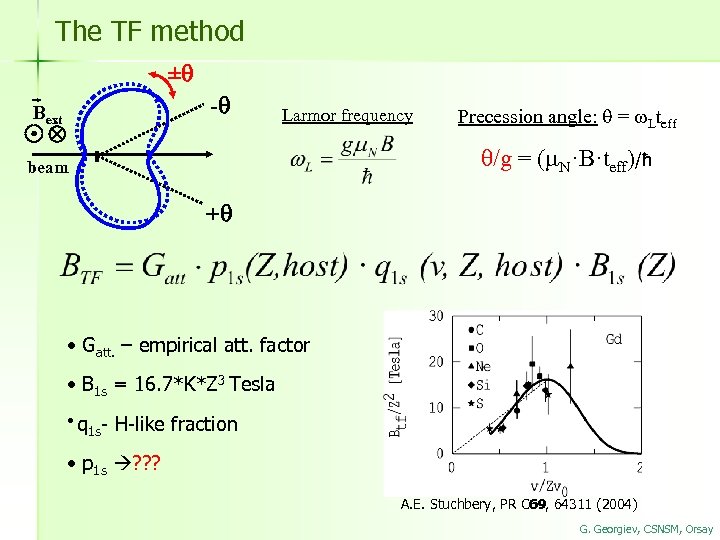 The TF method ± - Bext Larmor frequency Precession angle: q = Lteff q/g = ( N·B·teff)/ħ beam + • Gatt. – empirical att. factor • B 1 s = 16. 7*K*Z 3 Tesla • q 1 s- H-like fraction • p 1 s ? ? ? A. E. Stuchbery, PR C 69, 64311 (2004) G. Georgiev, CSNSM, Orsay
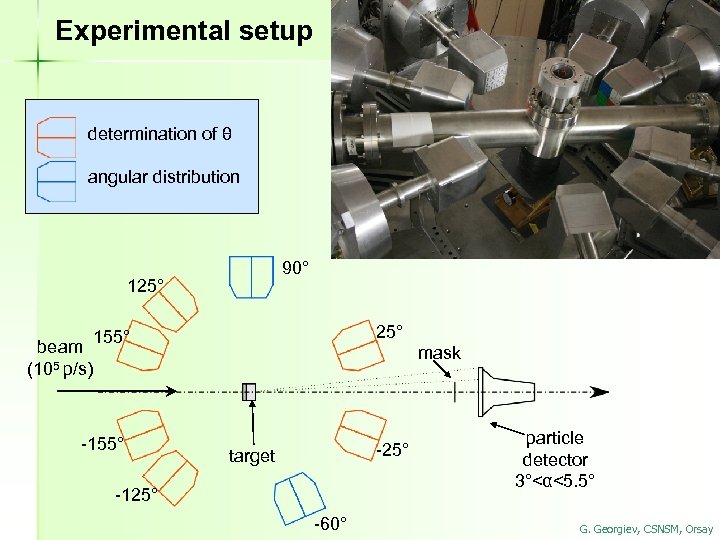 Experimental setup determination of θ angular distribution 90° 125° 155° beam (105 p/s) -155° mask -25° target -125° -60° particle detector 3°<α<5. 5° G. Georgiev, CSNSM, Orsay
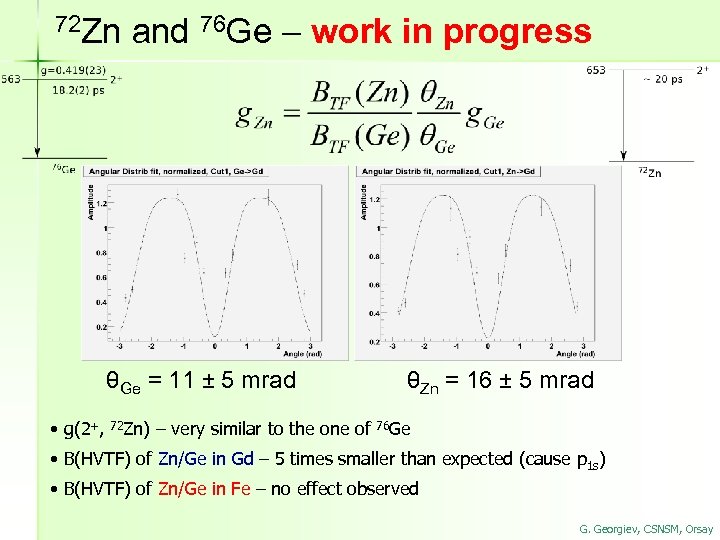 72 Zn and 76 Ge – work in progress θGe = 11 ± 5 mrad • g(2+, 72 Zn) – very similar to the one of θZn = 16 ± 5 mrad 76 Ge • B(HVTF) of Zn/Ge in Gd – 5 times smaller than expected (cause p 1 s) • B(HVTF) of Zn/Ge in Fe – no effect observed G. Georgiev, CSNSM, Orsay
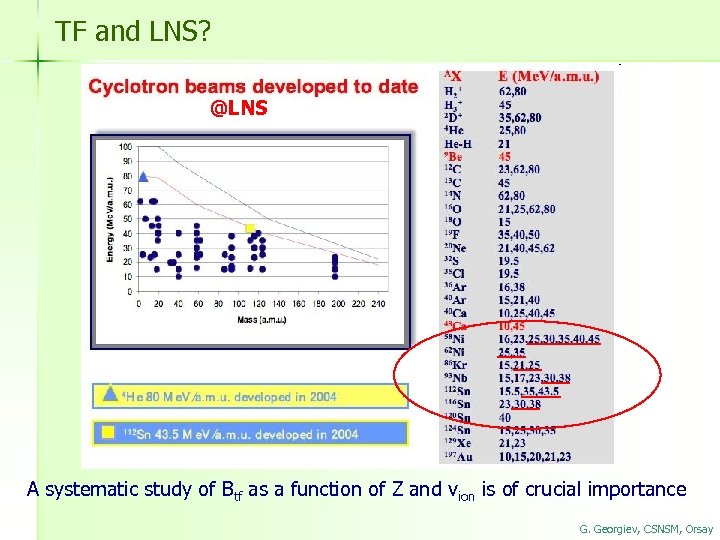 TF and LNS? @LNS A systematic study of Btf as a function of Z and vion is of crucial importance G. Georgiev, CSNSM, Orsay
 Summary and perspectives • g factors - very sensitive probes for small admixtures in the nuclear wave functions • g(2+) fingerprint of the interplay between collective and single-particle properties • Q moments – direct information on the deformation • Developments are on the way and still more need to be done in order to reach more and more exotic nuclei G. Georgiev, CSNSM, Orsay
 Collaborations • • • • CSNSM, Orsay France , E. Fiori, R. Lozeva, S. Cabaret University of Camerino Italy and INRNE, BAS, Bulgaria* , , D. L. Balabanski*, G. Lo Bianco, A. Saltarelli CE Bruyères le Châtel, France J. M. Daugas, G. Belier, V. Meot, O. Roig The Weizmann Institute of Science, Israel M. Hass, G. Goldring, N. S. Bondilli, V. Kumar GANIL, Caen, France E. Clement, G. De France, F. De Oliveira Santos, S. Grevy, M. Lewitowicz, C. Stodel Department of Nuclear Physics, ANU, Canberra, Australia A. Stuchbery Dep. Física. Teórica Univ. Autónoma Madrid, Spain , de A. Jungclaus, V. Modamio, J. Walker CENBG, Bordeaux. Gradignant. France , I. Matea, M. Tarisien IKS, KU Leuven G. Neyens, N. Vermeulen, D. Yordanov IPN, Orsay France , S. Franchoo, F. Ibrahim, F. Le Blanc, B. Mouginot, L. Perrot, O. Sorlin, I. Stefan, M. Stanoiu, D. Verney NSCL, MSU, USA P. Mantica, W. Mueller, T. Ginter, M. Hausman, A. Stolz FLNR, JINR, Dubna Russia , S. Lukyanov, Yu. Penionzhkevich, Yu. Sobolev ISK, Universitaet Bonn, Germany K. H. Speidel, J. Leske IKS, Univ. Cologne, Germany A. Blazhev University of Sofia, Bulgaria M. Danchev Univ. Ioannina Greece , T. Mertzimekis G. Georgiev, CSNSM, Orsay
 G. Georgiev, CSNSM, Orsay
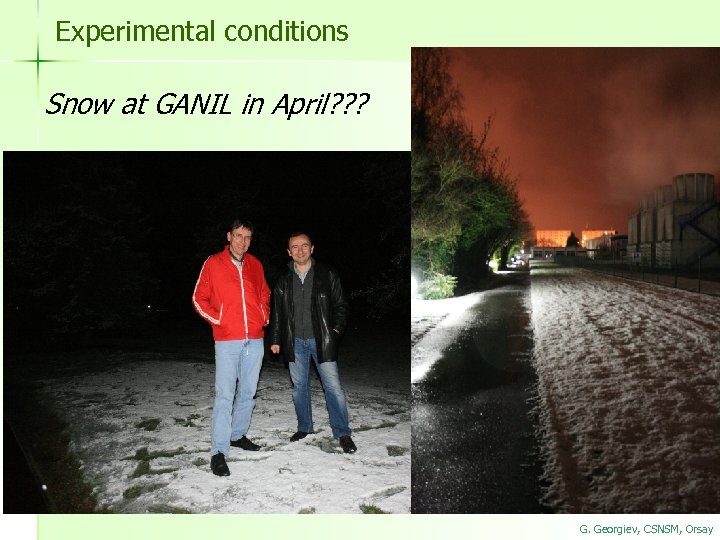 Experimental conditions Snow at GANIL in April? ? ? G. Georgiev, CSNSM, Orsay