 Скачать презентацию Nuclear dynamics in the dissociative recombination of H
de1005f8946860ff2c27662dbf33ef34.ppt
- Количество слайдов: 29



Nuclear dynamics in the dissociative recombination of H 3+ and its isotopologues Daniel Zajfman Max-Planck-Institut für Kernphysik and Weizmann Institute of Science
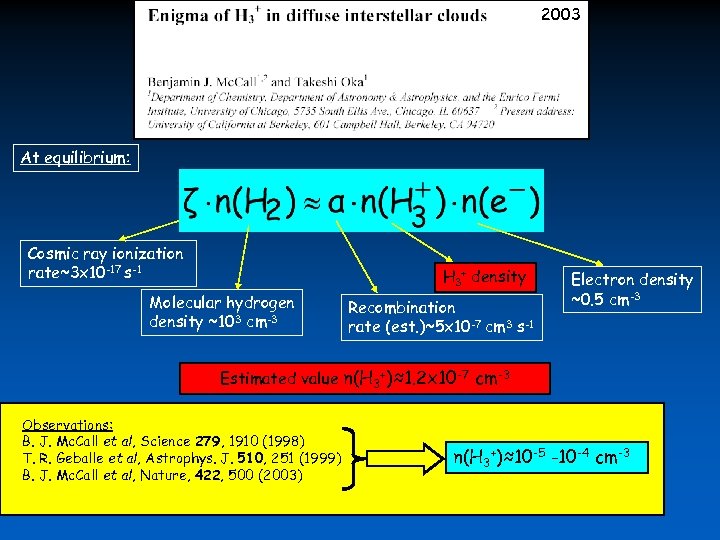
2003 At equilibrium: Cosmic ray ionization rate~3 x 10 -17 s-1 H 3+ density Molecular hydrogen density ~103 cm-3 Recombination rate (est. )~5 x 10 -7 cm 3 s-1 Electron density ~0. 5 cm-3 Estimated value n(H 3+)≈1. 2 x 10 -7 cm-3 Observations: B. J. Mc. Call et al, Science 279, 1910 (1998) T. R. Geballe et al, Astrophys. J. 510, 251 (1999) B. J. Mc. Call et al, Nature, 422, 500 (2003) n(H 3+)≈10 -5 -10 -4 cm-3
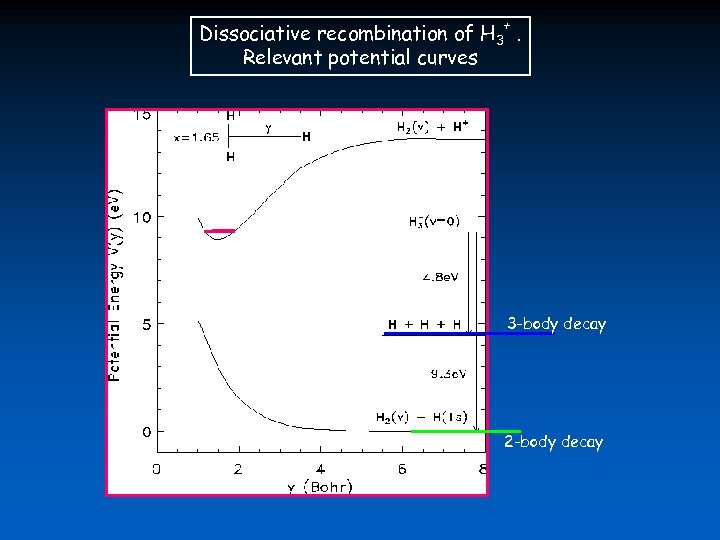
Dissociative recombination of H 3+. Relevant potential curves 3 -body decay 2 -body decay
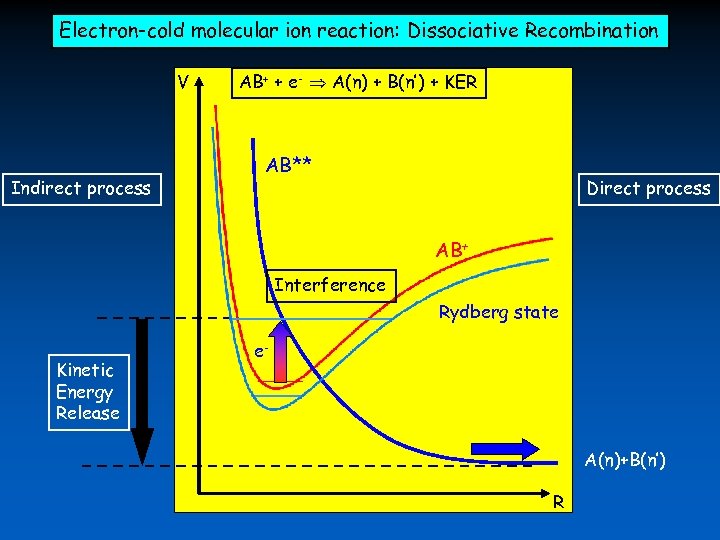
Electron-cold molecular ion reaction: Dissociative Recombination V Indirect process AB+ + e- A(n) + B(n’) + KER AB** Direct process AB+ Interference Rydberg state Kinetic Energy Release e- A(n)+B(n’) R
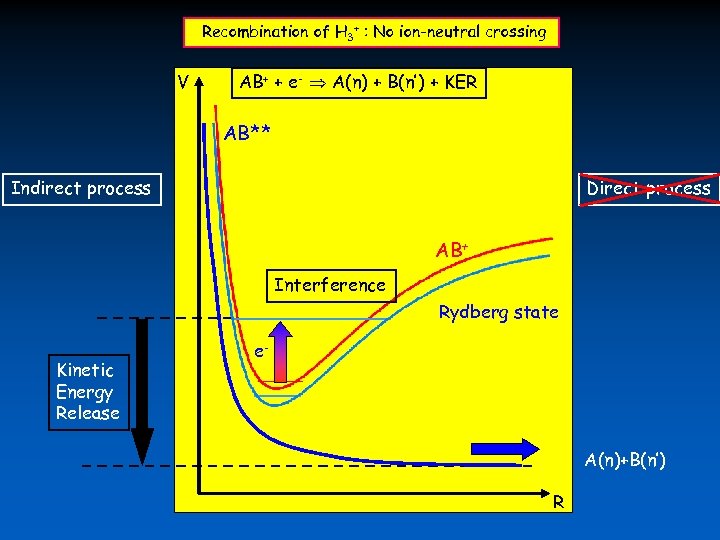
Recombination of H 3+ : No ion-neutral crossing V AB+ + e- A(n) + B(n’) + KER AB** Indirect process Direct process AB+ Interference Rydberg state Kinetic Energy Release e- A(n)+B(n’) R
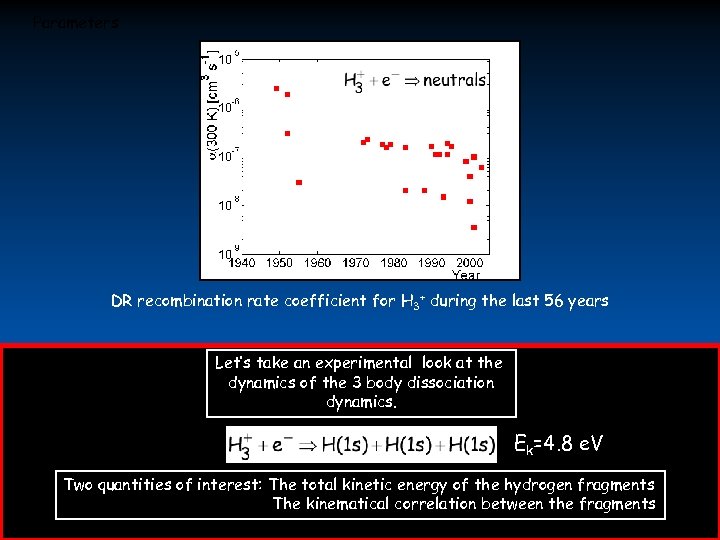
Parameters DR recombination rate coefficient for H 3+ during the last 56 years Let’s take an experimental look at the dynamics of the 3 body dissociation dynamics. Ek=4. 8 e. V Two quantities of interest: The total kinetic energy of the hydrogen fragments The kinematical correlation between the fragments
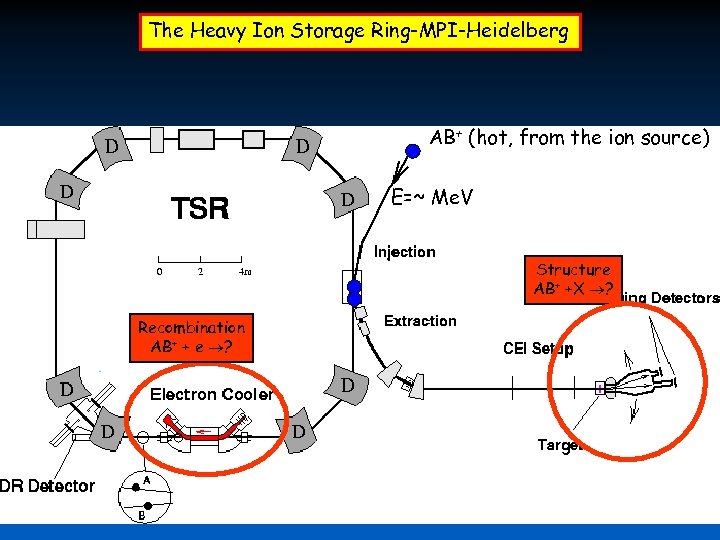
The Heavy Ion Storage Ring-MPI-Heidelberg AB+ (hot, from the ion source) E=~ Me. V Structure AB+ +X ? Recombination AB+ + e ?
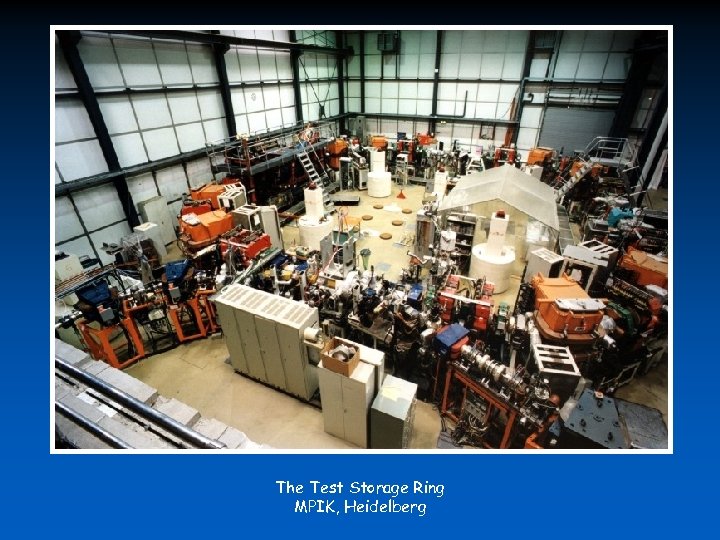
The Test Storage Ring MPIK, Heidelberg
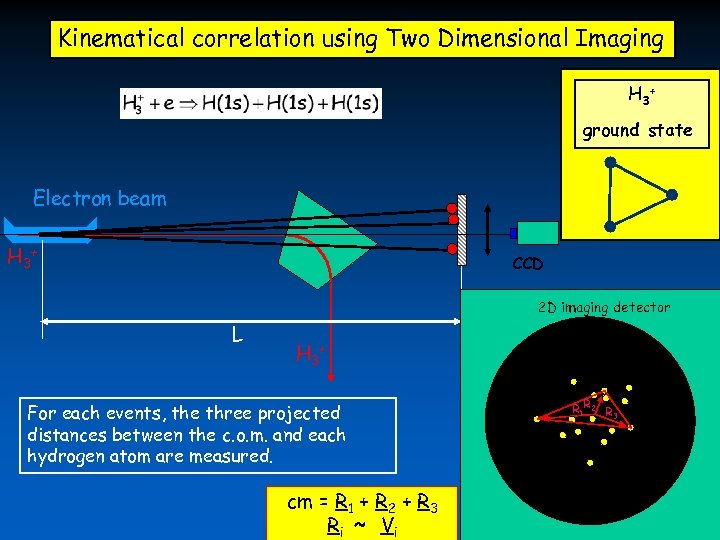
Kinematical correlation using Two Dimensional Imaging H 3 + ground state Electron beam H 3+ CCD 2 D imaging detector L H 3+ For each events, the three projected distances between the c. o. m. and each hydrogen atom are measured. cm = R 1 + R 2 + R 3 Ri ~ V i R 1 R 2 R 3
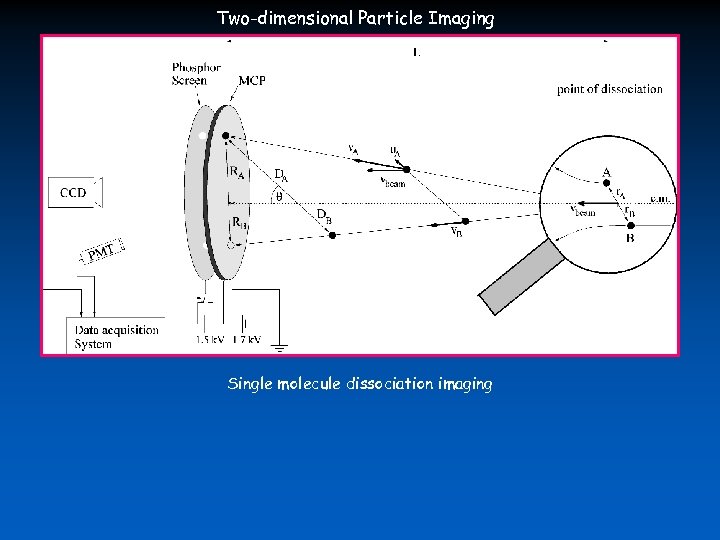
Two-dimensional Particle Imaging Single molecule dissociation imaging
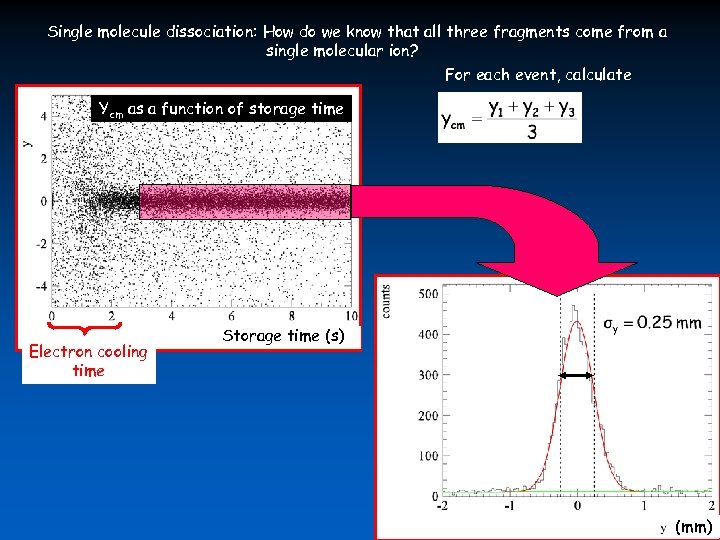
Single molecule dissociation: How do we know that all three fragments come from a single molecular ion? For each event, calculate Ycm as a function of storage time Electron cooling time Storage time (s) (mm)
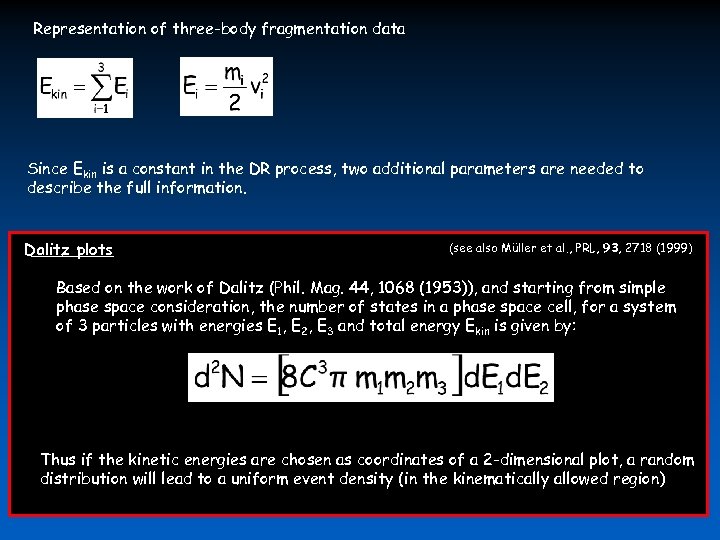
Representation of three-body fragmentation data Since Ekin is a constant in the DR process, two additional parameters are needed to describe the full information. Dalitz plots (see also Müller et al. , PRL, 93, 2718 (1999) Based on the work of Dalitz (Phil. Mag. 44, 1068 (1953)), and starting from simple phase space consideration, the number of states in a phase space cell, for a system of 3 particles with energies E 1, E 2, E 3 and total energy Ekin is given by: Thus if the kinetic energies are chosen as coordinates of a 2 -dimensional plot, a random distribution will lead to a uniform event density (in the kinematically allowed region)
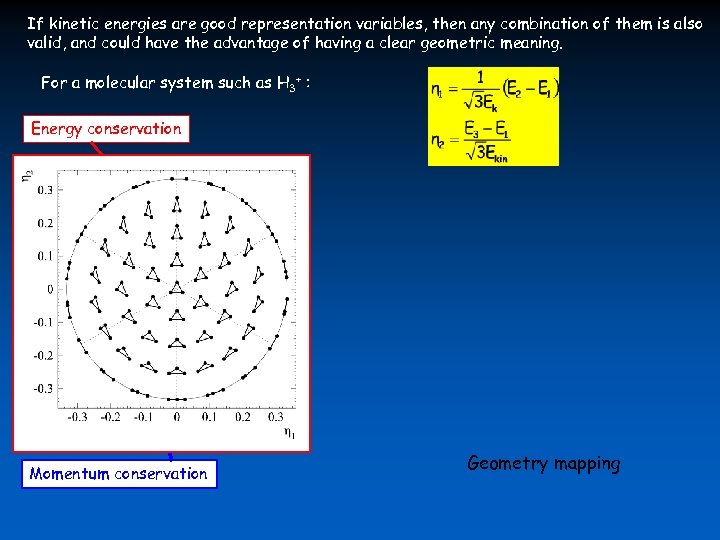
If kinetic energies are good representation variables, then any combination of them is also valid, and could have the advantage of having a clear geometric meaning. For a molecular system such as H 3+ : Energy conservation Momentum conservation Geometry mapping
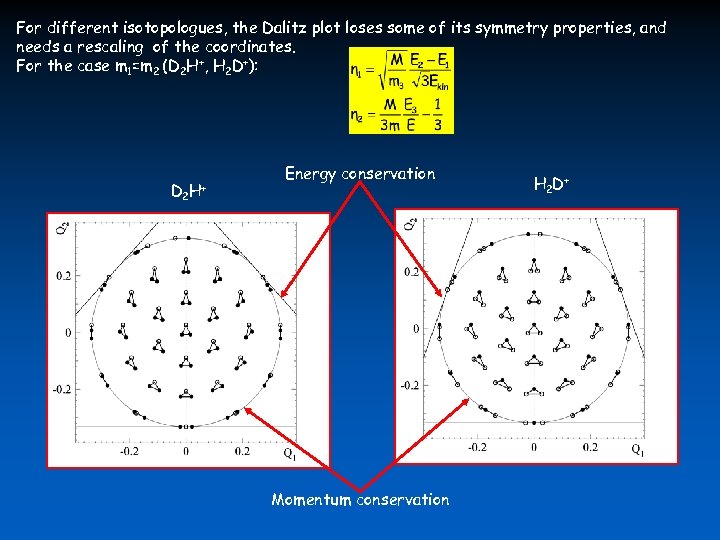
For different isotopologues, the Dalitz plot loses some of its symmetry properties, and needs a rescaling of the coordinates. For the case m 1=m 2 (D 2 H+, H 2 D+): D 2 H+ Energy conservation Momentum conservation H 2 D +
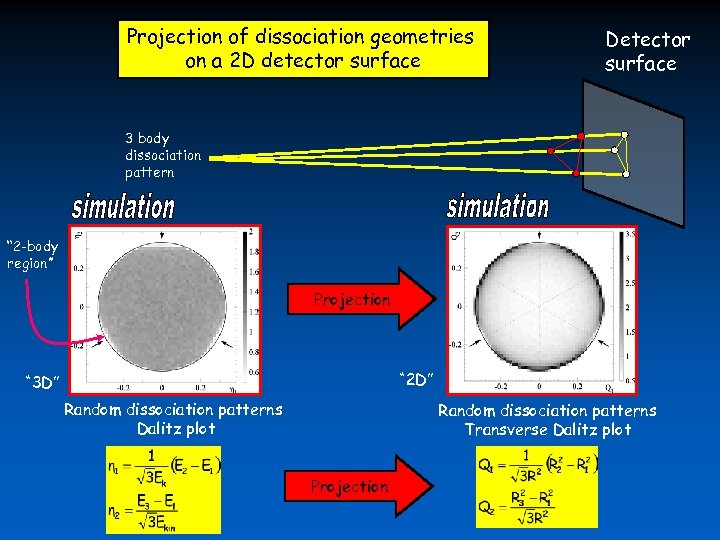
Projection of dissociation geometries on a 2 D detector surface Detector surface 3 body dissociation pattern “ 2 -body region” Projection “ 2 D” “ 3 D” Random dissociation patterns Dalitz plot Random dissociation patterns Transverse Dalitz plot Projection
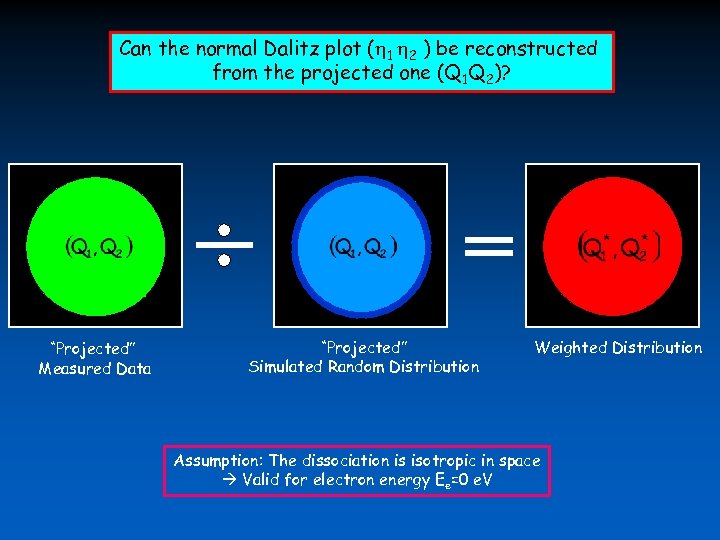
Can the normal Dalitz plot ( 1 2 ) be reconstructed from the projected one (Q 1 Q 2)? “Projected” Measured Data “Projected” Simulated Random Distribution Weighted Distribution Assumption: The dissociation is isotropic in space Valid for electron energy Ee=0 e. V
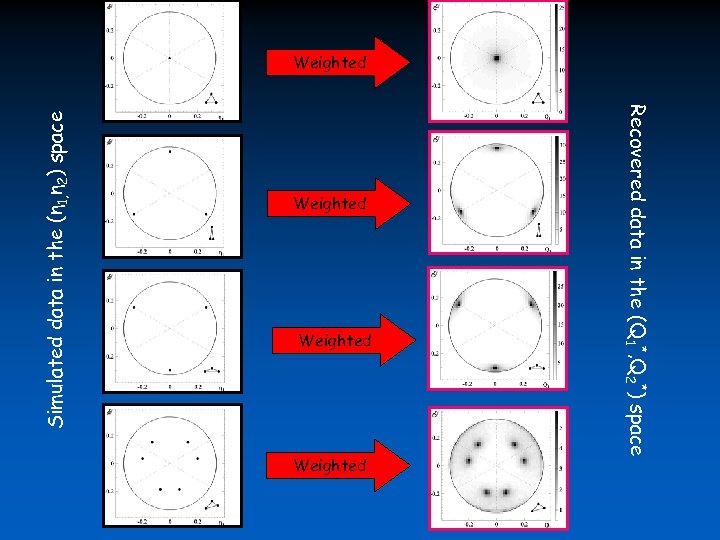
Weighted Recovered data in the (Q 1*, Q 2*) space Weighted Simulated data in the (η 1, η 2) space Weighted
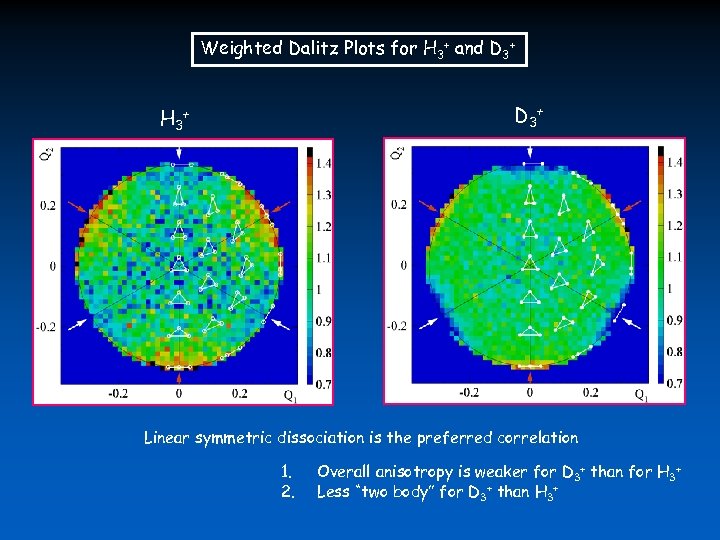
Weighted Dalitz Plots for H 3+ and D 3+ H 3+ Linear symmetric dissociation is the preferred correlation 1. 2. Overall anisotropy is weaker for D 3+ than for H 3+ Less “two body” for D 3+ than H 3+
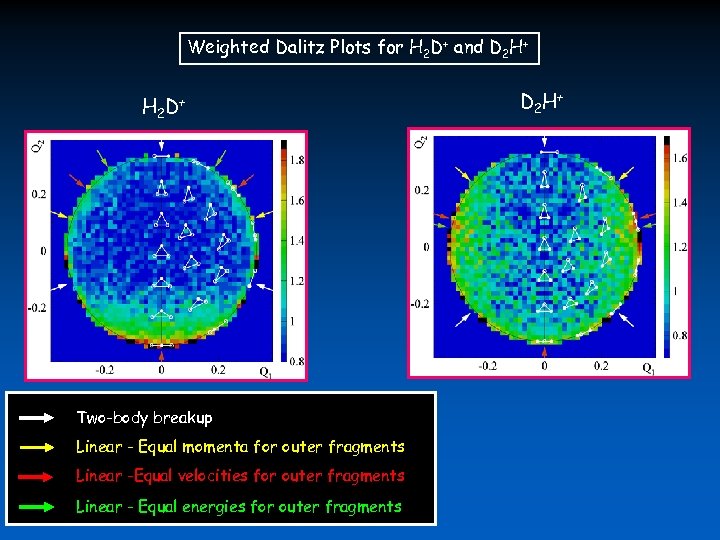
Weighted Dalitz Plots for H 2 D+ and D 2 H+ H 2 D+ Two-body breakup Linear - Equal momenta for outer fragments Linear -Equal velocities for outer fragments Linear - Equal energies for outer fragments D 2 H+
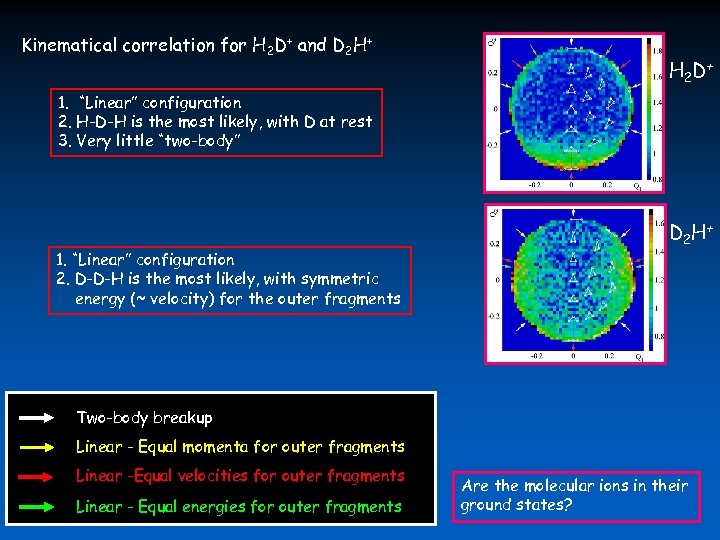
Kinematical correlation for H 2 D+ and D 2 H+ H 2 D+ 1. “Linear” configuration 2. H-D-H is the most likely, with D at rest 3. Very little “two-body” D 2 H+ 1. “Linear” configuration 2. D-D-H is the most likely, with symmetric energy (~ velocity) for the outer fragments Two-body breakup Linear - Equal momenta for outer fragments Linear -Equal velocities for outer fragments Linear - Equal energies for outer fragments Are the molecular ions in their ground states?
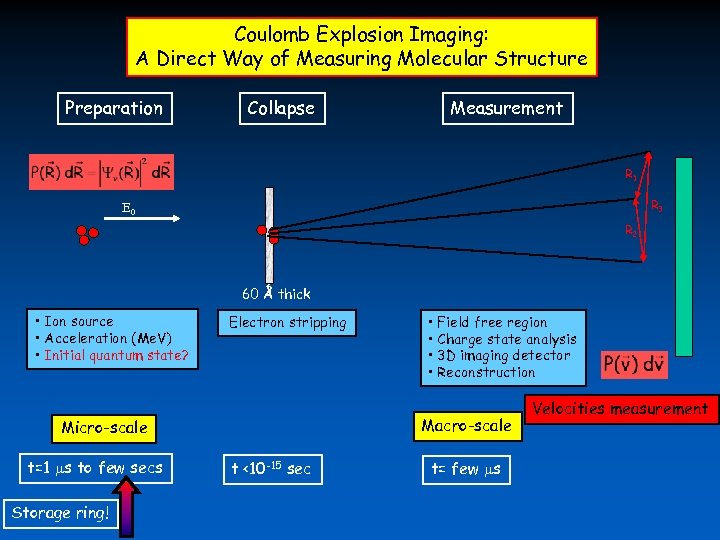
Coulomb Explosion Imaging: A Direct Way of Measuring Molecular Structure Preparation Collapse Measurement R 1 R 3 E 0 R 2 60 Ǻ thick • Ion source • Acceleration (Me. V) • Initial quantum state? Electron stripping Macro-scale Micro-scale t=1 s to few secs Storage ring! • Field free region • Charge state analysis • 3 D imaging detector • Reconstruction t <10 -15 sec t= few s Velocities measurement
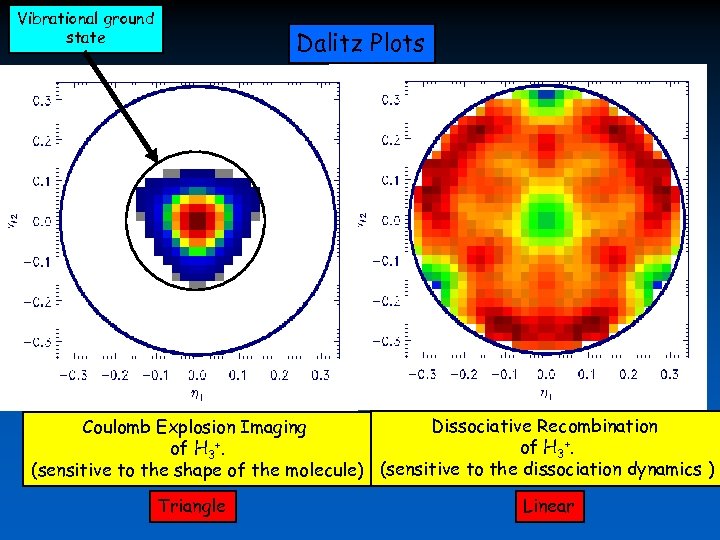
Vibrational ground state Dalitz Plots Dissociative Recombination Coulomb Explosion Imaging of H 3+. (sensitive to the shape of the molecule) (sensitive to the dissociation dynamics ) Triangle Linear
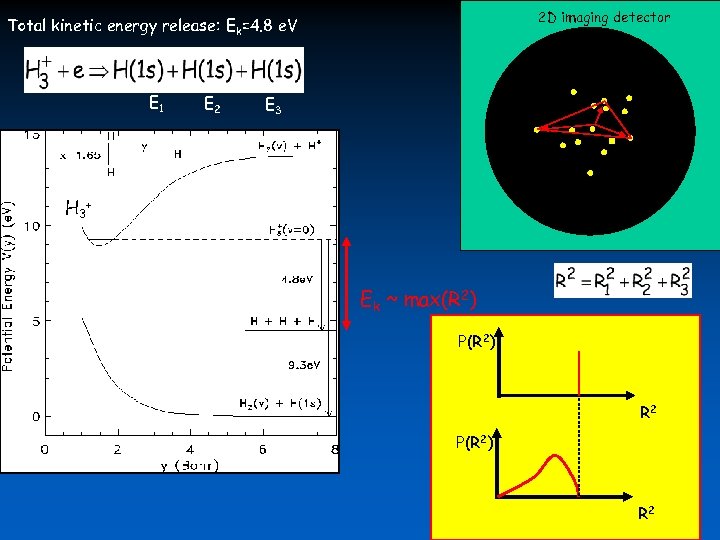
2 D imaging detector Total kinetic energy release: Ek=4. 8 e. V E 1 E 2 E 3 H 3 + Ek ~ max(R 2) P(R 2) R 2
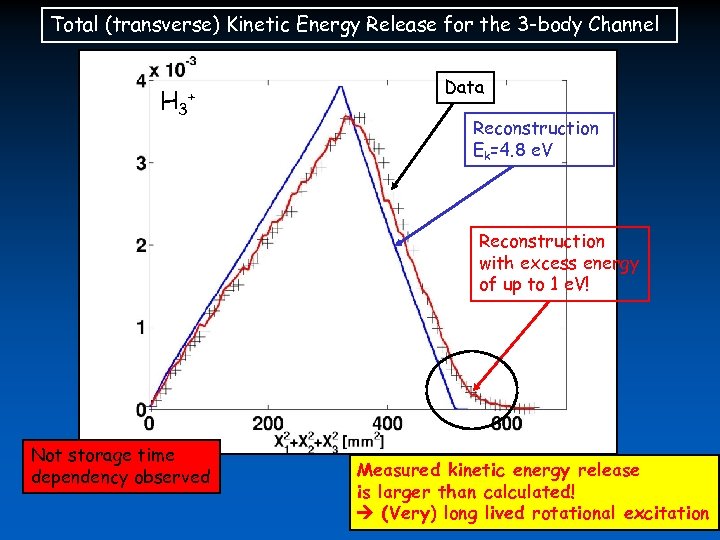
Total (transverse) Kinetic Energy Release for the 3 -body Channel H 3 + Data Reconstruction Ek=4. 8 e. V Reconstruction with excess energy of up to 1 e. V! Not storage time dependency observed Measured kinetic energy release is larger than calculated! (Very) long lived rotational excitation
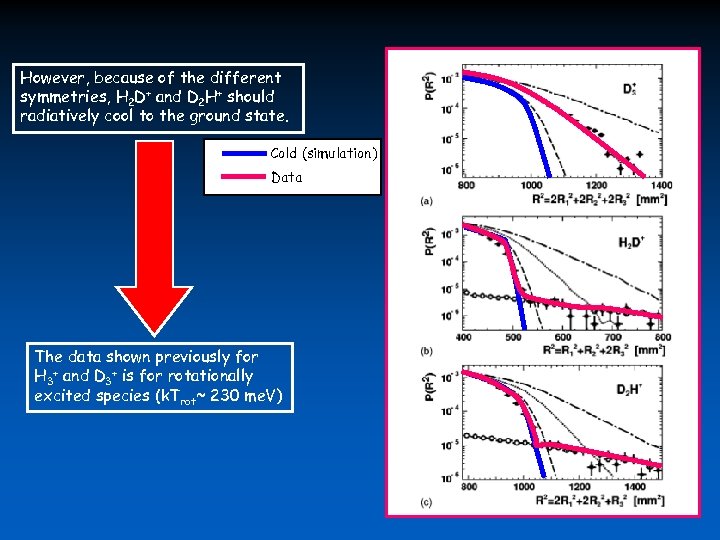
However, because of the different symmetries, H 2 D+ and D 2 H+ should radiatively cool to the ground state. Cold (simulation) Data The data shown previously for H 3+ and D 3+ is for rotationally excited species (k. Trot~ 230 me. V)
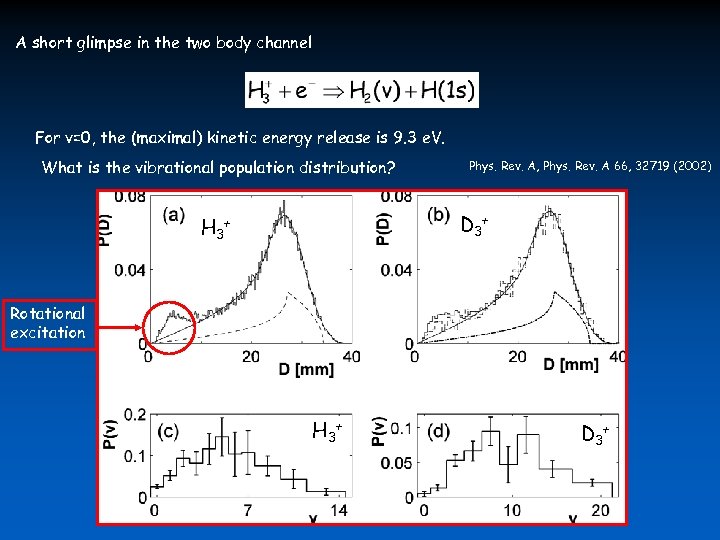
A short glimpse in the two body channel For v=0, the (maximal) kinetic energy release is 9. 3 e. V. What is the vibrational population distribution? Phys. Rev. A, Phys. Rev. A 66, 32719 (2002) D 3+ H 3+ Rotational excitation H 3+ D 3+
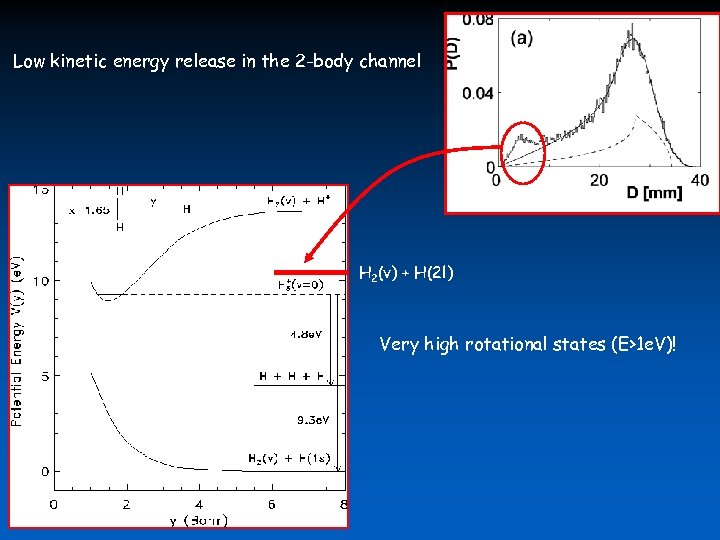
Low kinetic energy release in the 2 -body channel H 2(v) + H(2 l) Very high rotational states (E>1 e. V)!
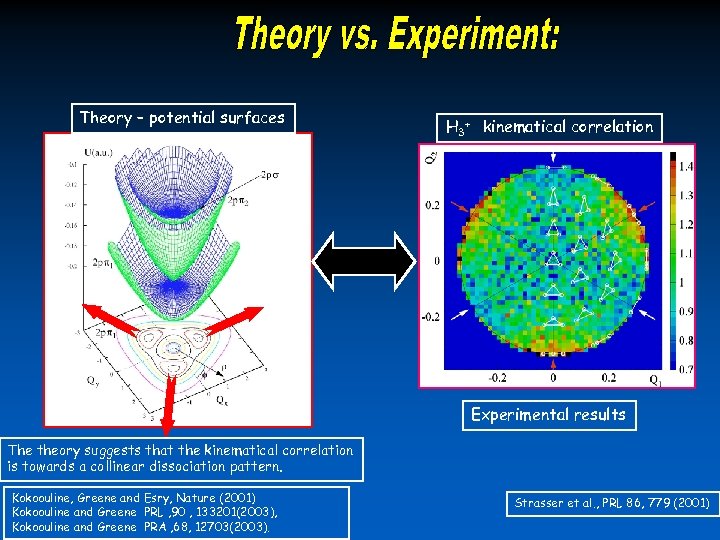
Theory – potential surfaces H 3+ kinematical correlation Experimental results The theory suggests that the kinematical correlation is towards a collinear dissociation pattern. Kokoouline, Greene and Esry, Nature (2001) Kokoouline and Greene PRL , 90 , 133201(2003), Kokoouline and Greene PRA , 68, 12703(2003). Strasser et al. , PRL 86, 779 (2001)
Ion Storage and Molecular Quantum Dynamics Max-Planck-Institut für Kernphysik Heidelberg, Germany A. Wolf D. Schwalm H. Kreckel L. Lammich (Aarhus) R. Wester (Freiburg) S. Krohn (BASF) M. Lange (Canberra) J. Levin (Applied Mat. ) M. Grieser R. von Hahn R. Repnow D. Zajfman Weizmann Institute of Science Rehovot, Israel D. Strasser (Berkeley) 1. A. Diner 2. D. Zajfman
Скачать презентацию Nuclear dynamics in the dissociative recombination of H
de1005f8946860ff2c27662dbf33ef34.ppt