 Скачать презентацию NUCESO COMMENTS ON SENATE BILL 3215 ENTITLED Career
952c9d8ca51e0bfd05d4619d17f30567.ppt
- Количество слайдов: 76



NUCESO COMMENTS ON SENATE BILL 3215 ENTITLED “Career Executive Service Act of 2012” Presented by: ALBERTO A. BERNARDO, CPA, Esq. , CESO I Deputy Executive Secretary, Office of the President and NUCESO Board Member
1. THIRD LEVEL POSITIONS A. SENATE BILL NO. 3215 “SEC. 4. Definition of Terms. - As used in this Act, the following terms shall be construed as follows: (a) ‘Third Level’ refers to the highest level in the career service of the Civil Service System which includes positions in the executive and managerial class covering all positions higher than chief of division based on the position classification system of the Department of Budget and Management and the Civil Service Commission. ” (underscoring supplied) 2
1. THIRD LEVEL POSITIONS B. NUCESO PROPOSAL “SEC. 4. Definition of Terms. - As used in this Act, the following terms shall be construed as follows: (a) ‘Third Level Position’ refers to the highest level among the classes of positions in the career service which includes the Closed Career positions; positions in the Career Executive Service (CES); career officers, other than those in the CES; commissioned officers of the Armed Forces; and career personnel of government-owned or con 3 trolled corporations. .
1. THIRD LEVEL POSITIONS B. NUCESO PROPOSAL (continuation). . . It shall cover all positions higher than chief of division, classified as either: a) positions in the executive and managerial class, and b) positions in the highly technical and specialized class, based on the position classification system of the Department of Budget and Management (DBM) and with the qualifications standards established by the departments or agencies, to be approved by the Civil Service Commission. ” (underscoring supplied) 4
1. THIRD LEVEL POSITIONS 1. 1. Career Positions “SECTION 7. Career Service. – x x x The Career Service shall include: (1) Open Career positions for appointment to which prior qualification in an appropriate examination is required; (2) Closed Career positions which are scientific, or highly technical in nature; these include the faculty and academic staff of state colleges and universities, and scientific and technical positions in scientific or research institutions which shall establish and maintain their own merit system; . . . 5
1. THIRD LEVEL POSITIONS 1. 1. Career Positions (Continuation). . . (3) Positions in the Career Executive Service; namely, Undersecretary, Assistant Secretary, Bureau Director, Assistant Bureau Director, Regional Director, Assistant Regional Director, Chief of Department Service and other officers of equivalent rank as may be identified by the Career Executive Service Board, all of whom are appointed by the President; (4) Career officers, other than those in the Career Executive Service, who are appointed by the President, such as the Foreign Service Officers in the Department 6 of Foreign Affairs; . . .
1. THIRD LEVEL POSITIONS 1. 1. Career Positions (Continuation) government-owned (6) Personnel of or controlled corporations, whether performing governmental or proprietary functions, who do not fall under the non-career service; and (7) Permanent laborers, whether skilled, semiskilled, or unskilled. ” (underscoring supplied) [Section 7, Chapter 2, Sub-title A, Title I, Book V, Executive Order [EO] No. 292, s. 1987, the “Administrative Code of 1987, ” 25 July 1987] 7
1. THIRD LEVEL POSITIONS 1. 2. Constitutional Fiscal Autonomy Group (CFAG) “NOW, THEREFORE, the CFAG jointly resolves: 1. That all third level positions under each member agency are career positions; 2. x x x 3. That all career third level positions identified and classified by each of the member agency are not embraced within the Career Executive Service (CES) and as such shall not require Career Service Executive Eligibility (CSEE) or Career Executive Service (CES) Eligibility for purposes of permanent appointment; ” (emphasis and underscoring in the original) [Office of the Ombudsman vs. Civil Service Commission, G. R. No. 159940, 16 February 2005] 8
1. THIRD LEVEL POSITIONS 1. 3. Department of Budget and Management to Classify Positions “SEC 3. Powers and Functions. The Department of Budget and Management shall assist the President in the x x x administration of compensation and position classification system, x x x. ” (Section 3, Chapter 1, Title XVII, Book IV of the Administrative Code of 1987) 9
1. THIRD LEVEL POSITIONS 1. 4. Classes of Positions a. “KEY positions refer to executive, managerial, and chief of division or equivalent positions; b. “TECHNICAL positions refer to those directly performing the mandated substantive and/or frontline services or functions of the agency; c. “SUPPORT TO TECHNICAL positions refer to those which provide staff or technical support functions to key and technical positions but do not perform frontline services/functions; and d. “ADMINISTRATIVE positions refer to those performing general services, clerical, human resource management, procurement, custodial and other related house-keeping functions. ” (underscoring supplied) [Item 3. 2 bullet no. 4, DBM National Budget 10 Circular No. 533, 5 December 2011]
1. THIRD LEVEL POSITIONS 1. 5. Departments or Agencies on Qualification Standards 1. 5. 1. “SEC. 22 Qualification Standards. – (1) A A qualification standard expresses the minimum requirements for a class of positions in terms of education, training and experience, civil service eligibility, physical fitness, and other qualities required for successful performance. x x x. ” (underscoring supplied) [Section 22 (2), Chapter 5, Subtitle A, Title I, Book V, Executive Order No. 292, or the Administrative Code of 1987, 25 July 1987, as amended] 11

1. THIRD LEVEL POSITIONS 1. 6. Departments or Agencies on Qualification Standards 1. 6. 2. “SEC. 22. Qualification Standards – (1) x x x (2) The establishment, administration and maintenance of qualification standards shall be the responsibility of the department or agency, with the assistance and approval of the Civil Service Commission and in consultation with the Wage and Position Classification Office. ” [underscoring supplied] (Chapter 5, Subtitle A [Civil Service Commission], Title I, Book V, Executive Order No. 292, or the “Administrative Code of 1987, ” as amended, 25 July 1987) 12
1. THIRD LEVEL POSITIONS 1. 6. Departments or Agencies on Qualification Standards 1. 6. 3. “The CSC cannot substitute its own standards for those of the department or agency, specially in a case like this in which an independent constitutional body is involved. ” (Office of the Ombudsman vs. Civil Service Commission, G. R. No. 162215, 30 July 2007) 13
1. THIRD LEVEL POSITIONS 1. 6. Departments or Agencies on Qualification Standards order to in 1. 6. 4. “First, as permanent, the appointee must possess the rank appropriate to the position. Failure in this respect will render the appointment merely temporary. In Atty. Bacal’s case, it was ruled that she did not acquire tenure since she had only a CESO III rank; and that she was not appointed CESO I which was the requisite eligibility for the position of Chief Public Attorney. ” (underscoring supplied) (Cuevas vs. Bacal, GR No. 39382, 6 December 2000; and Dimayuga vs. Benedicto II, II G. R. No. 44153, 16 January 2002) 14
1. THIRD LEVEL POSITIONS 1. 6. Departments or Agencies on Qualification Standards 1. 6. 5. constantly held that whether or not a position is a policy-determining, primarily confidential or highly technical, it is determined not by the title but by the nature of trust entrusted to it. x x x [T]he Supreme court has said before that a position which requires mere membership in the Bar is not a highly technical position. Since the term ‘highly technical’ means something beyond the ordinary requirement of the profession, it is always a question of 15 fact. ” (CSC vs. Salas, G. R. No. 123708, 19 June 1997, citing the Record of the Constitutional Commission, Vol. I, 571 -572) 571 -572
2. CAREER EXECUTIVE SERVICE BOARD (CES BOARD) A-1. SENATE BILL NO. 3215 “SEC. 4. Definition of Terms. x x x (d) Career Executive Service Board (CESB) refers to the policy making body responsible for the development, maintenance and administration of the System under the supervision of the Civil Service Commission as provided herein. ” (underscoring supplied) 16
2. CAREER EXECUTIVE SERVICE BOARD (CES BOARD) B-1. NUCESO PROPOSAL SEC. 4. Definition of Terms. x x x (d) “Career Executive Service Board (CESB)” refers to the policy making body, attached to the Civil Service Commission, responsible for the development, maintenance and administration of the Career Executive Service. (underscoring supplied) 17
2. CAREER EXECUTIVE SERVICE BOARD (CES BOARD) A-2. SENATE BILL NO. 3215 “SEC. 6. Career Executive Service Board (CESB). – A Career Executive Service Board, hereinafter referred to as the Board, under the supervision of the Civil Service Commission is hereby created. It shall be composed of the most senior commissioner of the Commission who shall serve as the Board’s ex-officio Chairperson and four (4) ex officio members namely: . . . 18

2. CAREER EXECUTIVE SERVICE BOARD (CES BOARD) A-2. SENATE BILL NO. 3215 (continuation). . . the Secretary of the Department of Budget and Management (DBM) or his/her permanent representative holding a position not lower than an undersecretary; the President of the Development Academy of the Philippines (DAP); the Dean of the National College of Public Administration and Governance (NCPAG) of the University of the Philippines; the President or representative of a duly accredited national federation or union of Career Executive Service Officers. . 19
2. CAREER EXECUTIVE SERVICE BOARD (CES BOARD) A-2. SENATE BILL NO. 3215 (continuation). . . The Board shall also include three (3) members to be appointed by the President for a term of three (3) years, namely: the President or representative of a nationwide association of personnel and/or human resource practitioners in the private sector, the President or representative of the Philippine Association of Professional Regulatory Board Members (PAPRBM) and a representative of the Office of the President. ” (underscoring supplied) 20
2. CAREER EXECUTIVE SERVICE BOARD (CES BOARD) B-2. NUCESO PROPOSAL SEC. 6. Career Executive Service Board (CES Board). - A Career Executive Service Board, hereinafter referred to as the Board, is hereby created and shall be attached to the Civil Service Commission for policy and program coordination. It shall be a collegial body composed of six (6) ex-officio Members namely: the most senior commissioner of the Civil Service Commission; the Executive Secretary or his/her permanent representative, who must be a CESO with the rank equivalent to a Deputy Executive Secretary; . . . 21

2. CAREER EXECUTIVE SERVICE BOARD (CES BOARD) B-2. NUCESO PROPOSAL (continuation). . . the Secretary of the Department of Budget and Management (DBM) or his/her permanent representative who must be a CESO with the rank equivalent to an Undersecretary; the President of the National Union of Career Executive Service Officers (NUCESO) or his/her permanent representative; the President of the Development Academy of the Philippines (DAP); and the Dean of the National College of Public Administration and Governance (NCPAG) of the University of the Philippines. . 22

2. CAREER EXECUTIVE SERVICE BOARD (CES BOARD) B-2. NUCESO PROPOSAL (continuation). . . The Board shall also include three (3) regular members to be appointed by the President, who are familiar with human resource management and organizational development. Of those first appointed one shall hold office for term of two (2) years, one for four (4) years and the other for six (6) years, and the succeeding appointments thereafter all for a term of six (6) years. The Board members shall elect among themselves a Chairman and Vice-Chairman. The members of the Board may be provided with per diems and allowances as may be determined by the Board. (underscoring supplied) 23
2. CAREER EXECUTIVE SERVICE BOARD (CES BOARD) 2. 1. Constitutionality of the CES Board “From its inception, the CESB was intended to be an autonomous entity, albeit administratively attached to respondent Commission. As conceptualized by the Reorganization Committee ‘the CESB shall be autonomous. x x x The essential autonomous character of the CESB is not negated by its attachment to respondent Commission. By said attachment, CESB was not made to fall within the control of respondent Commission. x x x. ’” (Eugenio vs. CSC, G. R. No. 115863, 31 March 1995) 24
2. CAREER EXECUTIVE SERVICE BOARD (CES BOARD) 2. 2. Limits the Appointing Power of the President “Hence, when Congress clothes the President with the power to appoint an officer, it (Congress) cannot at the same time limit the choice of the President to only one candidate. x x x Consequently, when the qualifications prescribed by Congress can only be met by one individual, such enactment effectively eliminates the discretion of the appointing power to choose and constitutes an irregular restriction on the power of appointment. ” (Flores vs. Drilon, G. R. No. 104732, 22 June 1993) 25
3. POWERS AND FUNCTIONS OF CES BOARD A. SENATE BILL NO. 3215 “SEC. 7. Powers and Functions of the Board. The Board shall be the policy-making body for the Career Executive System. It shall promulgate rules, standards and procedures in the recruitment, selection, assignment to positions, attestation of appointment to CES positions, conferment of ranks, classification, compensation, mobility, performance management, tour of duty, rewards and incentives, and training and career development of CESOs and CESEs: . . . 26
3. POWERS AND FUNCTIONS OF CES BOARD A. SENATE BILL NO. 3215 (continuation). . . Provided, That in the exercise of its power of supervision, the Commission may motu propio review, revise, reverse or modify any policy, ruling and/or action of the Board within a period of thirty (30) days from receipt of written notice thereof: Provided further, That if the Commission does not act within the said period, the subject policy, ruling and/or action of the Board shall be deemed as presumptively approved by the Commission. ” (underscoring supplied) 27

3. POWERS AND FUNCTIONS OF CES BOARD B. NUCESO PROPOSAL SEC. 7. Powers and Functions of CES Board. The CES Board shall be the policy-making body of the CES. It shall promulgate rules, standards and procedures in the recruitment, selection, classification, compensation, mobility, performance management, tour of duty, rewards and incentives, training and career development of CESOs and CESEs. 28
3. POWERS AND FUNCTIONS OF CES BOARD 3. 1. “In this case, when Aurillo motu proprio took over the preliminary investigation of I. S. No. 95043 after the same had already been dismissed by the city prosecutor and ordered the assistant regional state prosecutor to conduct a preliminary investigation of the case, he exercised not only administrative supervision but control over the city prosecutor in the performance of the latter’s quasi-judicial functions. “ (Aurillo vs. Rabi, G. R. No. 120014, 26 November 2002) 29
3. POWERS AND FUNCTIONS OF CES BOARD 3. 2. “There being no requirement in EO 292 that appointment should be submitted to the CSC for attestation within 30 days from issuance, it is doubtful by what authority the CSC imposed such condition under Section 11, Rule V of the Omnibus Rules. It certainly cannot restore what EO 292 itself already and deliberately removed. At the very least, that requirement cannot be used as basis to unjustly prejudiced respondent. ” (Obiasca vs. Basallote, G. R. No. 176707, 17 February 2010) 30
4. DISCIPLINE A. SENATE BILL NO. 3215 Disciplineand Investigation 17. – SEC. . adjudication of administrative complaints against occupants of positions in the CES appointed by the President, shall be vested with the Office of the President (O. P. ). In the case of non-presidential appointees, the same shall be vested concurrently in the head of the agency and the Civil Service Commission. B. NUCESO PROPOSAL 31
4. DISCIPLINE 4. 1. “Thus the petitioner is a presidential appointee who belongs to career service. Being a presidential appointee, he comes under direct disciplining authority of the President. This is in line with the settled principle that “power to remove is inherent in the power to appoint” conferred to the President by Section 16 Article VII of the Constitution. ” (underscoring supplied) [Larin vs. Executive Secretary, G. R. No. 112745, 16 October 1997 and DOH VS. Camposano, G. R. No. 157684, 27 April 2005] 32
4. DISCIPLINE 4. 2. “Section 16. The President shall nominate and, with the consent of the Commission on Appointments, appoint the heads of the executive departments, ambassadors, other public ministers and consuls, or officers of the armed forces from the rank of colonel or naval captain, and other officers whose appointments are vested in him in this Constitution. He shall also appoint all other officers of the Government whose appointments are not otherwise provided for by law, and those whom he may be authorized by law to appoint. x x x. ” (Article VII Executive Department, 1987 Philippine Constitution) 33
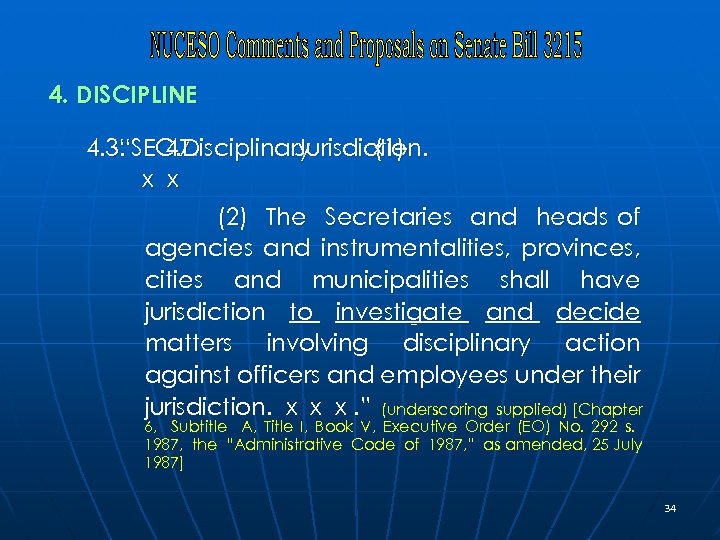
4. DISCIPLINE 4. 3. “SEC. Disciplinary 47. Jurisdiction. x – (1) x x (2) The Secretaries and heads of agencies and instrumentalities, provinces, cities and municipalities shall have jurisdiction to investigate and decide matters involving disciplinary action against officers and employees under their jurisdiction. x x x. ” (underscoring supplied) [Chapter 6, Subtitle A, Title I, Book V, Executive Order (EO) No. 292 s. 1987, the “Administrative Code of 1987, ” as amended, 25 July 1987] 34
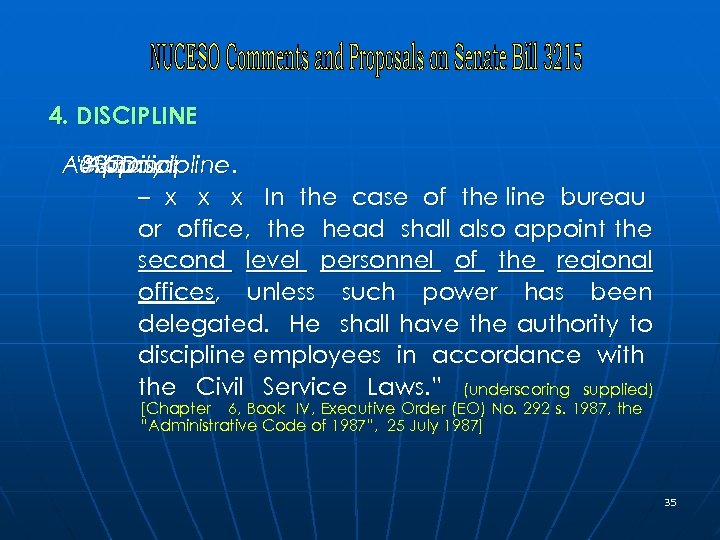
4. DISCIPLINE Authority “SEC. 4. 4. Discipline. 30. to Appoint and – x x x In the case of the line bureau or office, the head shall also appoint the second level personnel of the regional offices, unless such power has been delegated. He shall have the authority to discipline employees in accordance with the Civil Service Laws. ” (underscoring supplied) [Chapter 6, Book IV, Executive Order (EO) No. 292 s. 1987, the “Administrative Code of 1987”, 25 July 1987] 35
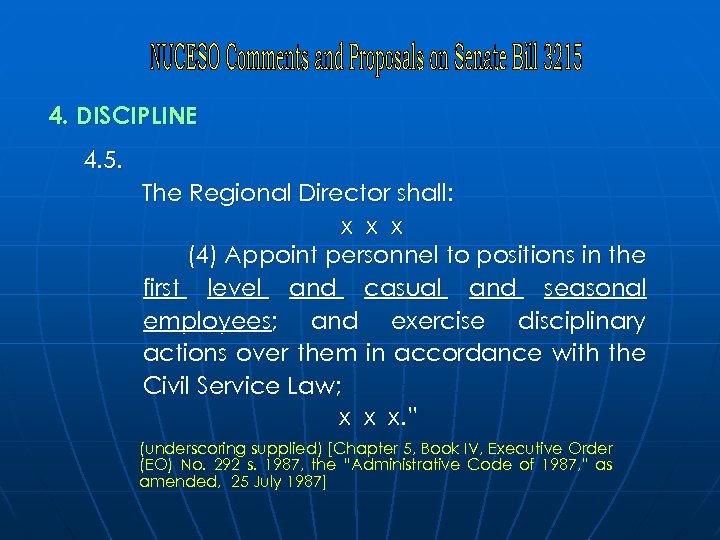
4. DISCIPLINE 4. 5. The Regional Director shall: x x x (4) Appoint personnel to positions in the first level and casual and seasonal employees; and exercise disciplinary actions over them in accordance with the Civil Service Law; x x x. ” (underscoring supplied) [Chapter 5, Book IV, Executive Order (EO) No. 292 s. 1987, the “Administrative Code of 1987, ” as amended, 25 July 1987]
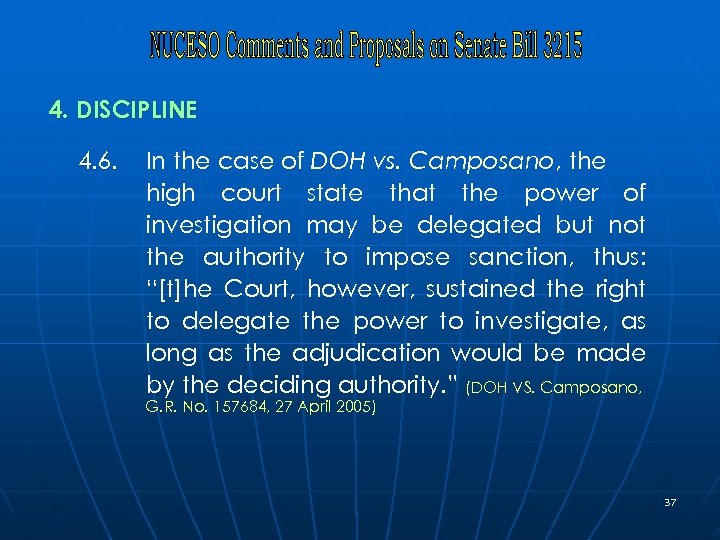
4. DISCIPLINE 4. 6. In the case of DOH vs. Camposano, the high court state that the power of investigation may be delegated but not the authority to impose sanction, thus: “[t]he Court, however, sustained the right to delegate the power to investigate, as long as the adjudication would be made by the deciding authority. ” (DOH VS. Camposano, G. R. No. 157684, 27 April 2005) 37
![4. DISCIPLINE 4. 7. “[W]hile the term ‘adjudicatory’ appears part of its appellation, the](https://present5.com/presentation/952c9d8ca51e0bfd05d4619d17f30567/image-38.jpg "4. DISCIPLINE 4. 7. “[W]hile the term ‘adjudicatory’ appears part of its appellation, the")
4. DISCIPLINE 4. 7. “[W]hile the term ‘adjudicatory’ appears part of its appellation, the IAD-ODESLA cannot try and resolve cases, its authority being limited to the conduct of investigations, preparation of reports and submission of recommendations. x x x The IAD-ODESLA is a fact-finding and recommendatory body to the President, not having the power to settle controversies and adjudicate cases. ”(underscoring supplied) [Pichay vs. Office of the Deputy Executive Secretary for Legal Affairs, G. R. No. 196425, July 24, 2012] 38
5. MOBILITY IN THE CAREER EXECUTIVE SERVICE A. SENATE BILL NO. 3215 “SEC. 15. Mobility in the Career Executive System. –A CESO may be assigned to any position in the Career Executive System without diminution in rank and salary. The tour of duty of each CESO shall be for a period of three (3) years during which period he/she shall not be transferred to another office without his/her consent. . 39
5. MOBILITY IN THE CAREER EXECUTIVE SERVICE A. SENATE BILL NO. 3215 (continuation). . . In filling vacancy, the head of the agency shall give preference and priority to those who have been appointed to rank or conferred CES eligibility. The Board shall provide information on vacancies, an updated list of available qualified persons who may be assigned, and such other mechanisms to assist the head of agency in the selection. (underscoring supplied) 40
5. MOBILITY IN THE CAREER EXECUTIVE SERVICE B. NUCESO PROPOSAL SEC. 19. Mobility in the Career Executive Service. – The personnel movement of a CESO may be to any position in the Career Executive Service based on functional expertise without diminution in rank and salary and shall only be for a period of one year. The tour of duty of a CESO appointed to a not station-specific CES position shall be for a period of three (3) years during which period he/she shall not be transferred to another CES position/office without his/her consent. (underscoring supplied) 41
5. MOBILITY IN THE CAREER EXECUTIVE SERVICE 5. 1. Based on Subject Matter of Specialization 5. 1. 1. “e. Assignments, Reassignmentsand Transfers. Depending upon their ranks, members of the Service shall be assigned to occupy positions of Undersecretary, Assistant Secretary, Bureau Director, Assistant Bureau Director, Regional Director, Chief of Department Service and other officers of equivalent rank as may be identified by the Board on the basis of the members’ functional expertise…. . ” (underscoring original in the case; emphasis supplied) [Cuevas vs. Bacal, G. R No. 139382, 6 December 2000; Item No. 5, Article IV, Part III, Volume I, PD No. 1, otherwise known as the “Integrated Reorganization Plan”, as 42 amended, 24 September 1972]
5. MOBILITY IN THE CAREER EXECUTIVE SERVICE 5. 1. Based on Subject Matter of Specialization 5. 1. 2. “f. Functional Groupings. Members of the Career Executive Service shall be divided into a number of broad functional groupings based on the subject matter of specialization, not on the particular department in which the work is done. ” (underscoring original in the law; emphasis supplied) [Item No. 5, Article IV (Career Executive Service), Part III (Civil Service), Volume I, Presidential Decree No. 1, otherwise known as the “Integrated Reorganization Plan”, 24 September 1972, as amended] 43
5. MOBILITY IN THE CAREER EXECUTIVE SERVICE 5. 2. Based on Functional Expertise of Departments 5. 2. 1. “SECTION 1. Purpose and Number of Departments. - The Executive Branch shall have such Departments as are necessary for the functional distribution of the work of the President and for the performance of their functions. ” (underscoring supplied) [Chapter I, Book IV of Executive Order No. 292 , s. 1987 or the “Administrative Code of 1987”, 25 July 1987, as amended] 44
5. MOBILITY IN THE CAREER EXECUTIVE SERVICE 5. 2. Based on Functional Expertise of Departments 5. 2. 2. “SEC. 39. Secretary’s Authority. – (1) The Secretary shall have supervision and control over the bureaus, offices, and agencies under him, subject to the following guidelines: x x x (b) With respect to functions involving discretion, experienced judgment or expertise vested by law upon a subordinate agency, control shall be exercised in accordance with said law; and x x x. ” [underscoring supplied] (Chapter 8, Book IV, Executive Order (EO) No. 292 s. 1987, the “Administrative Code of 1987, ” as amended, 25 July 1987) 45
5. MOBILITY IN THE CAREER EXECUTIVE SERVICE 5. 2. Based on Functional Expertise of Departments 5. 2. 3. “Factual findings of administrative agencies are generally respected and even accorded finality because of the special knowledge and expertise gained by these agencies from handling matters falling under their specialized jurisdiction. ” (Modesto vs. Urbina, G. R. No. 189859, 18 October 2010) 46
5. MOBILITY IN THE CAREER EXECUTIVE SERVICE 5. 2. Based on Functional Expertise of Departments 5. 2. 4. “SEC. 10. Powers and Duties of the Undersecretary. – The Undersecretary shall: xxx (2) Oversee all the operational activities of the department for which he shall be responsible to the Secretary; x x x. ” (underscoring supplied) [Chapter 2, Book IV of Executive Order No. 292 or the “Administrative Code of 1987”, 25 July 1987, as amended] 47
5. MOBILITY IN THE CAREER EXECUTIVE SERVICE 5. 2. Based on Functional Expertise of Departments 5. 2. 5. “SEC. 16. Technical Service. – Whenever necessary, one or more technical services shall be established to take charge of technical staff activities essential to a department and which cannot be allocated to the three other services or to the bureaus. ” (underscoring supplied) [Chapter 3, Book IV, E. O. No. 292, s. 1987 or the “Administrative Code of 1987”, 25 July 1987, as amended] 48
5. MOBILITY IN THE CAREER EXECUTIVE SERVICE 5. 2. Based on Functional Expertise of Departments 5. 2. 6. “SEC. 16. Legal Service. – A Legal Service shall be provided where the operations of the department involve substantial legal work, in which case the Administrative Service shall not have a Legal Division. The Legal Service shall provide legal advice to the department; interpret laws and rules affecting the operation of the department; x x x. ” (underscoring supplied) [Chapter 3, Book IV, E. O. No. 292, s. 1987 or the “Administrative Code of 1987”, 25 July 1987, as amended] 49
5. MOBILITY IN THE CAREER EXECUTIVE SERVICE 5. 2. Based on Functional Expertise of Departments 5. 2. 7. “x x x failed to uphold the law and provide a sound legal assistance and support to the mayor in carrying out the delivery of basic services and provisions of adequate facilities when he advised [the mayor] to proceed with the construction of the subject projects without prior competitive bidding. ” [underscoring supplied, words in parenthesis in the original] (Salumbides vs. Ombudsman, G. R. No. 180917, 23 April 2010) 50
5. MOBILITY IN THE CAREER EXECUTIVE SERVICE 5. 2. Based on Functional Expertise of Departments 5. 2. 8. “SEC. 19. Staff Bureau. – (1) x x x (2) The Director of a staff bureau shall: (a) Advise and assist the Office of the Secretary on matters pertaining to the Bureau’s area of specialization; xxx (c) Develop plans, programs, operating standards, and administrative techniques for the attainment of the objectives and functions of the bureau; x x x. ” (underscoring supplied) [Chapter 4, Book IV of Executive Order No. 292 or the “Administrative Code of 1987”, 25 July 1987, as amended] 51
5. MOBILITY IN THE CAREER EXECUTIVE SERVICE 5. 2. Based on Functional Expertise of Departments 5. 2. 9. “SEC. 20. Line Bureau. – (1) A line bureau shall directly implement programs adopted pursuant to department policies and plans. (2) The Director of a line bureau shall: xxx (b) Establish policies and standards for the operations of the bureau pursuant to the plans and program of the department; x x x. ” (underscoring supplied) [Chapter 4, Book IV of Executive Order No. 292, s. 1987, or the “Administrative Code of 1987”, 25 July 1987, as amended] 52
5. MOBILITY IN THE CAREER EXECUTIVE SERVICE 5. 2. Based on Functional Expertise of Departments 5. 2. 10. 26. “SEC. Functions Regional of Office. A regional office shall: Executive Order No. 292, s. 1987, or the “Administrative Code of 1987”, 25 July 1987, as amended) 53
5. MOBILITY IN THE CAREER EXECUTIVE SERVICE 5. 2. Based on Functional Expertise of Departments 5. 2. 11. “SEC. 27. Duties of a Regional Director. – The Regional Director shall: (underscoring supplied) [Chapter 5, Book IV of Executive Order No. 292, s. 1987, or the “Administrative Code of 1987”, 25 July 1987, as amended] 54
5. MOBILITY IN THE CAREER EXECUTIVE SERVICE 5. 2. Based on Functional Expertise of Departments 5. 2. 12. “The process of approval is not a ministerial duty of approving authorities to sign every document that comes across their desks, and then point to their subordinates as the parties responsible if something goes awry. ” (underscoring supplied) [Nava vs. Palattao, et. al, G. R. No. 160211, 28 August 2006] 55
5. MOBILITY IN THE CAREER EXECUTIVE SERVICE 5. 2. Based on Functional Expertise of Departments y of neglect “Respondent’s of guilt 5. 2. 13. becomes more pronounced as note is taken of her admitted inaction upon learning of the irregularity. Her justification for such inaction – that to do so would subject her to a charge of falsification – reflects her indifference, to say the least, to her duties and functions. ” (underscoring in the original) [Office of the Ombudsman (Mindanao) vs. Cruzabra, G. R. No. 183507, 24 February 2010] 56
5. MOBILITY IN THE CAREER EXECUTIVE SERVICE 5. 2. Based on Functional Expertise of Departments 5. 2. 14. “That it is the duty and responsibility of respondent, as register of deeds, to direct and supervise the activities of her office can never be overemphasized. Whether respondent exercised prudence and vigilance in discharging her duties, she has not shown. ” (underscoring and emphasis in the original) [Office of the Ombudsman (Mindanao) vs. Cruzabra, G. R. No. 183507, 24 February 2010] 57
5. MOBILITY IN THE CAREER EXECUTIVE SERVICE 5. 3. Department-Specific Career Service Positions 5. 3. 1. DOJ-National Prosecution Service (DOJNPS) “Section 16. Qualifications, Ranks, and Appointments of Prosecutors, and other Prosecution Officers. - Prosecutor with the hall Prosecutorrank V of qualification for appointment, rank, category, prerogatives, salary grade and salaries, allowances, emoluments and other privileges, shall be subject to the same inhibitions and disqualifications, and shall enjoy the same retirement and other benefits as those of an Associate Justice of the Court of Appeals. 58 xxx. . .
5. MOBILITY IN THE CAREER EXECUTIVE SERVICE 5. 3. Department-Specific Career Service Positions 5. 3. 1. DOJ-NPS (continuation). . . Prosecutor with the rank of Prosecutor I shall have the same qualifications for appointment, rank, category, prerogatives, salary grade and salaries, allowances, emoluments and other privileges, shall be subject to the same inhibitions and disqualifications, and shall enjoy the same retirement and other benefit as those of a Judge of the Metropolitan Trial Court in municipalities. x x x. ” (Republic Act No. 10071 “An Act Strengthening and Rationalized the National Prosecution Service”, 8 April 2010) 2010 59
5. MOBILITY IN THE CAREER EXECUTIVE SERVICE 5. 3. Department-Specific Career Service Positions 5. 3. 2. DOJ- Office of the Solicitor General (OSG) “SEC. 3. Standards. - The Solicitor General shall have cabinet rank and the same qualifications for appointment, rank, prerogatives, salaries, allowances, benefits and privileges as the Presiding Justice of the Court of Appeals; an Associate Solicitor General, those of an Associate Justice of the Court of Appeals. . 60
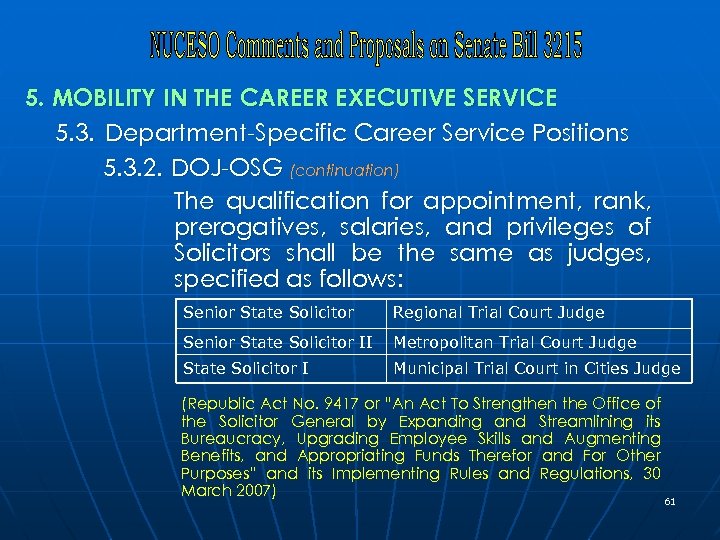
5. MOBILITY IN THE CAREER EXECUTIVE SERVICE 5. 3. Department-Specific Career Service Positions 5. 3. 2. DOJ-OSG (continuation) The qualification for appointment, rank, prerogatives, salaries, and privileges of Solicitors shall be the same as judges, specified as follows: Senior State Solicitor Regional Trial Court Judge Senior State Solicitor II Metropolitan Trial Court Judge State Solicitor I Municipal Trial Court in Cities Judge (Republic Act No. 9417 or “An Act To Strengthen the Office of the Solicitor General by Expanding and Streamlining its Bureaucracy, Upgrading Employee Skills and Augmenting Benefits, and Appropriating Funds Therefor and For Other Purposes” and its Implementing Rules and Regulations, 30 March 2007) 61
5. MOBILITY IN THE CAREER EXECUTIVE SERVICE 5. 3. Department-Specific Career Service Positions 5. 3. 3. Department of Science and Technology “Section 4. Science and Technology Career System. - A career system for science and technology personnel in the service of the government which is patterned after the Scientific Career System (SCS) shall be formulated by the DOST in coordination with the Civil Service Commission. ” (Republic Act No. 8439 or “An Act Providing A Magna Carta For Scientists, Engineers, Researchers and Other Science and Technology Personnel in Government”, 22 December 1997) 62
5. MOBILITY IN THE CAREER EXECUTIVE SERVICE 5. 3. Department-Specific Career Service Positions 5. 3. 4. Department of Foreign Affairs “Sec. 47. Functions. — The Board shall conduct examinations and nominate to the President, through the Secretary, successful candidates for appointments as foreign service officers, class VI. It shall receive and screen applications for the foreign service officer (FSO) examinations. ” [Republic Act No. 7157 or the “Philippine Foreign Service Act of 1991”, 19 September 1991] 63
5. MOBILITY IN THE CAREER EXECUTIVE SERVICE 5. 4. Departmentation/Divisionalization “The extent and size of departmentation/divisionalization shall take into account the functional distribution, workload, span of control, type and variety of skills/expertise required, the number of personnel for each type of expertise, and the geographical location of the work station in order to ensure clear and effective performance accountability. ” (underscoring supplied) [Item III ORGANIZATIONAL GUIDELINES, (A), CSC-DBM Joint Resolution No. 1, s. 2006, the “Rationalization Program’s Organizational and Staffing Standards Guidelines”, 12 May 2006] 64
5. MOBILITY IN THE CAREER EXECUTIVE SERVICE 5. 5. “SEC. 6. Other Personnel Movements. The following personnel movements, which will not require issuance of an appointment shall nevertheless require an office order by duly authorized official. a. Reassignment – movement of an employee from one organizational unit to another of the same department or agency x x x. b. Detail – temporary movement of an employee from one department or agency to another x x x. c. Secondment – movement of an employee from one department or agency to another x x x. ” (emphasis in the original) [CSC MC. No. 40 s. 1998 “Revised Omnibus Rules on Appointments and Other 65 Personnel Actions”, 14 December 1998]
5. MOBILITY IN THE CAREER EXECUTIVE SERVICE 5. 6. Period of one (1) year for personnel movement 5. 6. 1. “Reassignment of employees with station-specific place of work indicated in their respective appointments shall be allowed only for a maximum period of one (1) year. x x x. ” (emphasis in the original) [CSC MC No. 02, s. 2005 “Revised Rules on Reassignment”, 4 January 2005] 66
5. MOBILITY IN THE CAREER EXECUTIVE SERVICE 5. 6. Period of one (1) year for personnel movement 5. 6. 2. “b. x x x Detail shall be allowed only for a maximum period of one year in the case of employees occupying professional, technical and scientific position. x x x. ”; (Section 6(b), Rule III, CSC MC. No. 40, s. 1998 “Revised Omnibus Rules on Appointments and Other Personnel Actions”, 14 December 1998) 67
5. MOBILITY IN THE CAREER EXECUTIVE SERVICE 5. 7. Tour of Duty Applies to CESO appointed to Not -station Specific Positions 5. 7. 1. In the case of the Career Executive Service, CESO’s that are not appointed to a particular post are considered to be occupying a not station-specific CES positions. Thus, applying the same principle for career foreign service officers, they are the specific class of CESO covered by the tour of duty. 68
5. MOBILITY IN THE CAREER EXECUTIVE SERVICE 5. 7. Tour Duty CESO of. Applies appointed to Not to -station Specific Positions 5. 7. 2. “Thus when, the Foreign Service Act (both old [R. A. No. 708] and [R. A. No. 7157]) speaks of the ‘tour of duty’ it envisions the Secretary’s power and prerogative to assign and reassign service personnel to posts abroad and in Home Office, which is discretionary act ‘guided chiefly by his perception of what is necessary for the good of the service. ” [Department of Justice Opinion No. 75 dated 26 May 1994 citing Manglapus vs. Matias (192 SCRA 496)] 69
5. MOBILITY IN THE CAREER EXECUTIVE SERVICE 5. 7. Tour of Duty Applies to CESO appointed to Not -Station Specific Positions 5. 7. 3. “Sec. 37. Tour of Duty. - Subject to the exigencies of the service; (a) The tour of duty of a foreign service officer at any post shall be six (6) years commencing on the date of his arrival at the post, after which he shall serve in the home office; x x x. ” [RA 7157 “Philippine Foreign Service Act of 1991”, 19 September 1991] 70
6. POLICY DIRECTIVES AFFECTING CES PERFORMANCE 6. 1. Results-Based Performance Management System 6. 1. 1. “SECTION 3. Harmonized RBPMS. The Organizational Performance Indicators Framework (OPIF) and the Results Matrix (RM) shall be the underlying frameworks for the proposed RBPMS, which will be used by all government agencies mandated to exercise broad oversight over the performance of all agencies in the government. x x x. ” (Administrative Order No. 25, s. 2011, “Creating an Inter-agency Task Force on the Harmonization of National Government Performance Monitoring, Information and Reporting Systems”, 21 December 2011) 71
6. POLICY DIRECTIVES AFFECTING CES PERFORMANCE 6. 1. Results-Based Performance Management System 6. 1. 2. “SECTION 4. Involvement of Other Government Oversight Office. The Task Force shall involve the Civil Service Commission (CSC) and the Career Executive Service Board (CESB) in order to align the Strategic Performance Management [System] (SPMS) of CSC and the Career Executive Service Performance Evaluation System (CESPES) of CESB to the proposed RBPMS. x x x. ” (underscoring and bracketed word supplied) [Administrative Order No. 25, s. 2011, Creating an Inter-agency Task Force on the Harmonization of National Government Performance Monitoring, Information and Reporting Systems”, 21 December 2011] 72
6. POLICY DIRECTIVES AFFECTING CES PERFORMANCE 6. 2. Performance-Based Incentive System 6. 2. 1. “Major Final Output (MFO) – a good or service that a department is mandated to deliver to external clients through the implementation of programs, activities and projects. It may be a single output or group outputs that are similar in nature, targeted at the same organizational / sector outcome and capable of being summarized by a common performance indicator. ” (underscoring supplied) [Item 4. 1, Inter-agency Task Force (IATF) on the Harmonization of National Government Performance Monitoring, Information and Reporting Systems, MC No. 2012 -1 “Guidelines on the Cascading of Department Performance Targets in Line with Executive Order No. 80”, 13 August 2012] 73
6. POLICY DIRECTIVES AFFECTING CES PERFORMANCE 6. 2. Performance-Based Incentive System 6. 2. 2. “The Department shall select, prioritize or name the 3 most significant performance indicators of output and outcome under each MFO to capture the dimension of quantity, quality, and timeliness. x x x. All agencies shall feature outputs and outcomes among their MFO targets and not internal / intermediate outputs or ‘throughputs’. ” (underscoring supplied) [Item 7. 2, IATF MC No. 2012 -1 “Guidelines on the Cascading of Department Performance Targets in Line with Executive Order No. 80”, 13 August 2012] 74
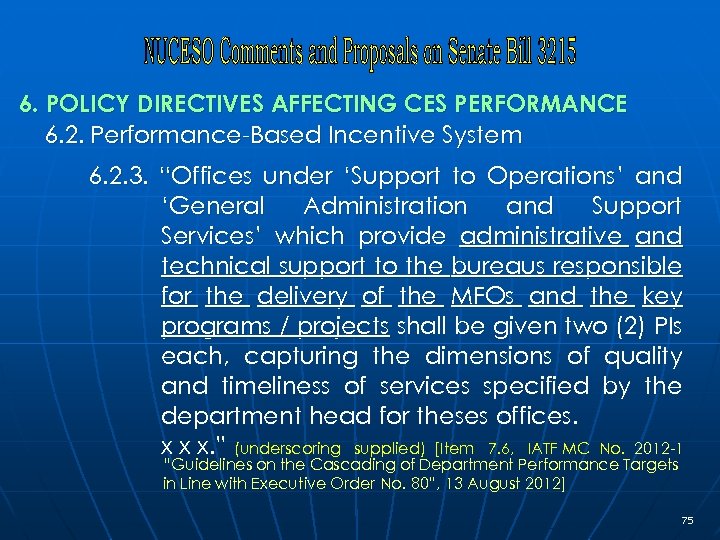
6. POLICY DIRECTIVES AFFECTING CES PERFORMANCE 6. 2. Performance-Based Incentive System 6. 2. 3. “Offices under ‘Support to Operations’ and ‘General Administration and Support Services’ which provide administrative and technical support to the bureaus responsible for the delivery of the MFOs and the key programs / projects shall be given two (2) PIs each, capturing the dimensions of quality and timeliness of services specified by the department head for theses offices. x x x. ” (underscoring supplied) [Item 7. 6, IATF MC No. 2012 -1 “Guidelines on the Cascading of Department Performance Targets in Line with Executive Order No. 80”, 13 August 2012] 75

Thank you! 76
Скачать презентацию NUCESO COMMENTS ON SENATE BILL 3215 ENTITLED Career
952c9d8ca51e0bfd05d4619d17f30567.ppt