


 Скачать презентацию NT Survey II Romans Paul s Third Journey
ab4871c328d998a2030cde6fea0831dd.ppt
- Количество слайдов: 14
 NT Survey II Romans
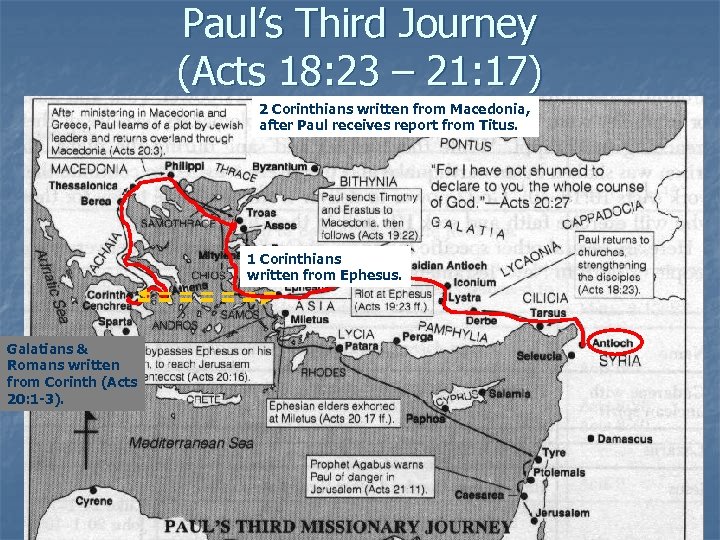 Paul’s Third Journey (Acts 18: 23 – 21: 17) 2 Corinthians written from Macedonia, after Paul receives report from Titus. 1 Corinthians written from Ephesus. Galatians & Romans written from Corinth (Acts 20: 1 -3).
 Occasion for the Epistle to the Romans n n Different from Paul’s other letters. “Paul had long desired to see Rome, as he declares twice in the epistle (1: 13; 15: 23) and once in Acts (19: 21). He was now at their very doors, but still could not make the intended visit; other work must be done first (15: 25), and only “after that” could he see Rome (Acts 19: 21). An explanation is also due the Romans for his longcontinued delay in coming to them (1: 9, 10; 15: 22). The next best thing can be done. Phebe is about to make a journey to Rome, and Paul will take this opportunity to write to the Roman church (James Stifler, Epistle to the Romans, pp. 15 -16).
 Introductory Matters for Romans n n Author: The Apostle Paul; his magnum opus! Audience: The church at Rome, a church not founded by Paul himself. It was made up of both Jews and Gentiles, but predominantly Gentile. Date: Paul writes this letter from Corinth, where he was staying with Gaius (Rom 16: 23; 1 Cor 1: 14) on his third missionary journey, as he is headed toward Jerusalem with a collection for the saints (Rom 15: 25 -27). The date was about 56 AD. Character of the book: A clear and tightly reasoned explanation of the gospel of God’s grace towards mankind in Jesus Christ.
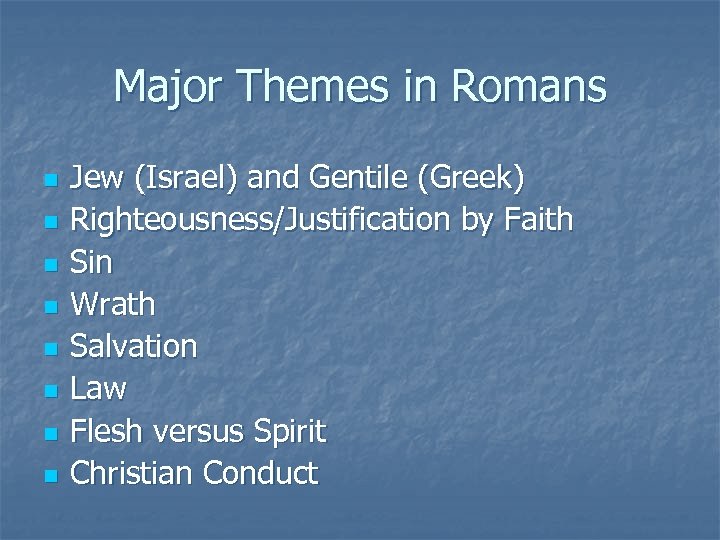 Major Themes in Romans n n n n Jew (Israel) and Gentile (Greek) Righteousness/Justification by Faith Sin Wrath Salvation Law Flesh versus Spirit Christian Conduct
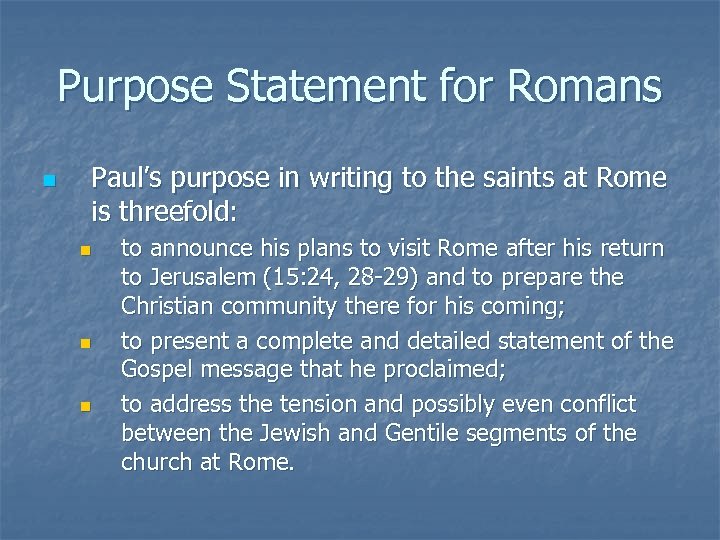 Purpose Statement for Romans n Paul’s purpose in writing to the saints at Rome is threefold: n n n to announce his plans to visit Rome after his return to Jerusalem (15: 24, 28 -29) and to prepare the Christian community there for his coming; to present a complete and detailed statement of the Gospel message that he proclaimed; to address the tension and possibly even conflict between the Jewish and Gentile segments of the church at Rome.
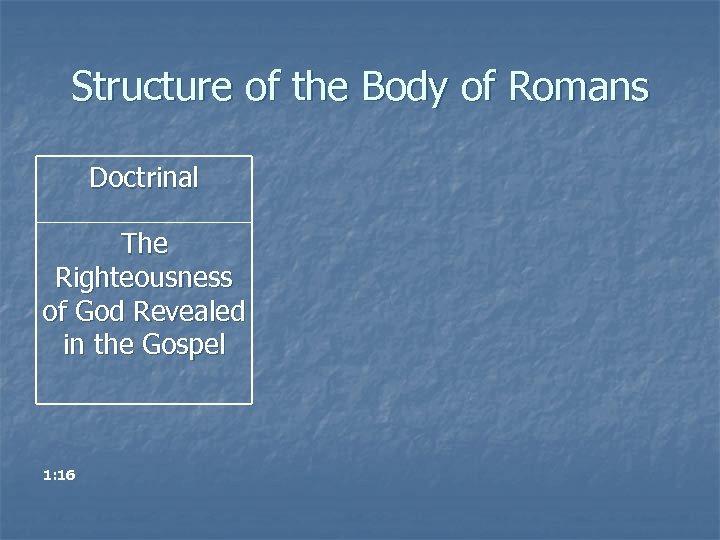 Structure of the Body of Romans Doctrinal The Righteousness of God Revealed in the Gospel 1: 16
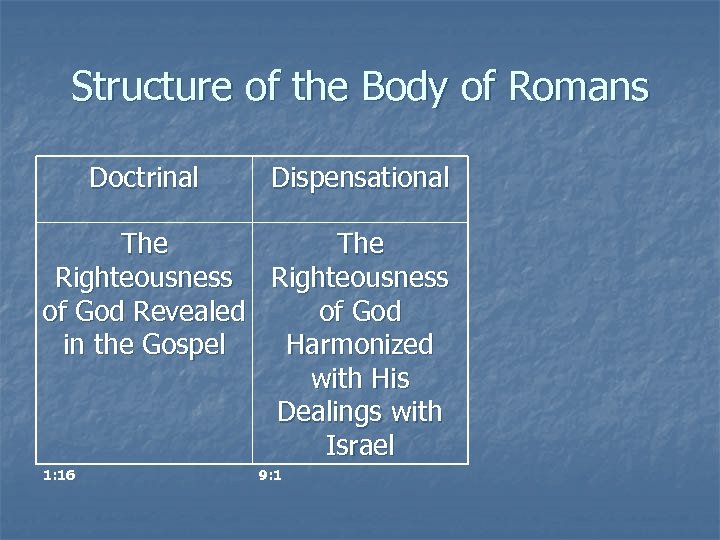 Structure of the Body of Romans Doctrinal Dispensational The Righteousness of God Revealed of God in the Gospel Harmonized with His Dealings with Israel 1: 16 9: 1
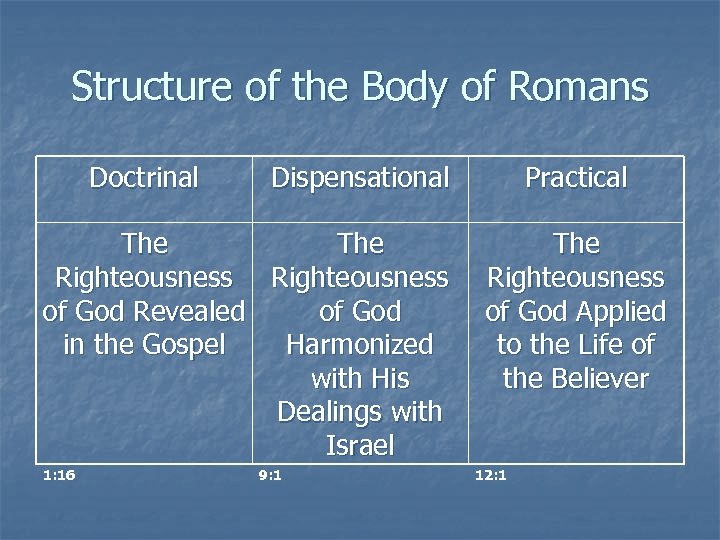 Structure of the Body of Romans Doctrinal Dispensational The Righteousness of God Revealed of God in the Gospel Harmonized with His Dealings with Israel 1: 16 9: 1 Practical The Righteousness of God Applied to the Life of the Believer 12: 1
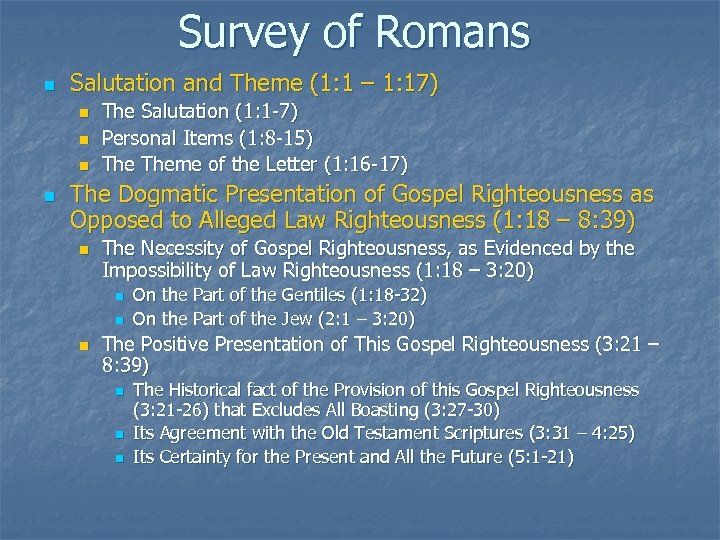 Survey of Romans n Salutation and Theme (1: 1 – 1: 17) n n The Salutation (1: 1 -7) Personal Items (1: 8 -15) Theme of the Letter (1: 16 -17) The Dogmatic Presentation of Gospel Righteousness as Opposed to Alleged Law Righteousness (1: 18 – 8: 39) n The Necessity of Gospel Righteousness, as Evidenced by the Impossibility of Law Righteousness (1: 18 – 3: 20) n n n On the Part of the Gentiles (1: 18 -32) On the Part of the Jew (2: 1 – 3: 20) The Positive Presentation of This Gospel Righteousness (3: 21 – 8: 39) n n n The Historical fact of the Provision of this Gospel Righteousness (3: 21 -26) that Excludes All Boasting (3: 27 -30) Its Agreement with the Old Testament Scriptures (3: 31 – 4: 25) Its Certainty for the Present and All the Future (5: 1 -21)
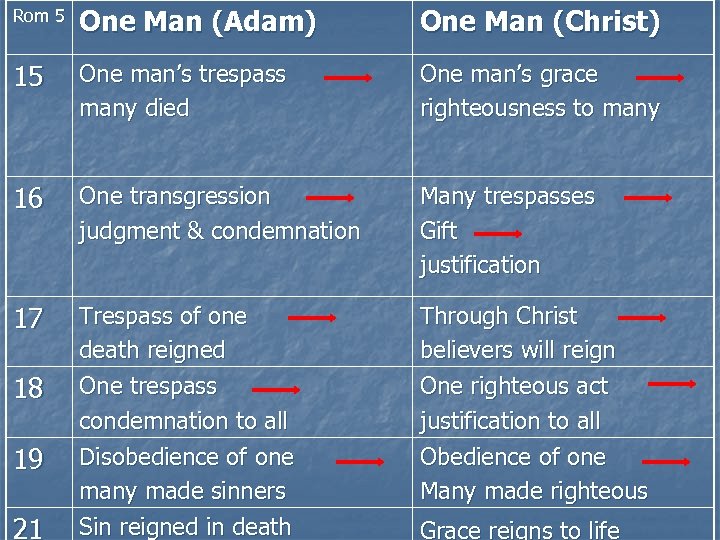 Rom 5 One Man (Adam) One Man (Christ) 15 One man’s trespass many died One man’s grace righteousness to many 16 One transgression judgment & condemnation Many trespasses Gift justification 17 Trespass of one death reigned One trespass condemnation to all Disobedience of one many made sinners Sin reigned in death Through Christ believers will reign One righteous act justification to all Obedience of one Many made righteous 18 19 21 Grace reigns to life
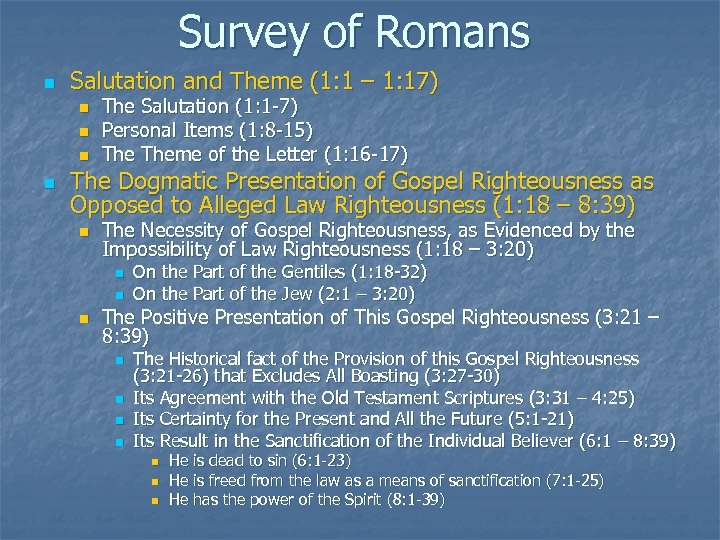 Survey of Romans n Salutation and Theme (1: 1 – 1: 17) n n The Salutation (1: 1 -7) Personal Items (1: 8 -15) Theme of the Letter (1: 16 -17) The Dogmatic Presentation of Gospel Righteousness as Opposed to Alleged Law Righteousness (1: 18 – 8: 39) n The Necessity of Gospel Righteousness, as Evidenced by the Impossibility of Law Righteousness (1: 18 – 3: 20) n n n On the Part of the Gentiles (1: 18 -32) On the Part of the Jew (2: 1 – 3: 20) The Positive Presentation of This Gospel Righteousness (3: 21 – 8: 39) n n The Historical fact of the Provision of this Gospel Righteousness (3: 21 -26) that Excludes All Boasting (3: 27 -30) Its Agreement with the Old Testament Scriptures (3: 31 – 4: 25) Its Certainty for the Present and All the Future (5: 1 -21) Its Result in the Sanctification of the Individual Believer (6: 1 – 8: 39) n n n He is dead to sin (6: 1 -23) He is freed from the law as a means of sanctification (7: 1 -25) He has the power of the Spirit (8: 1 -39)
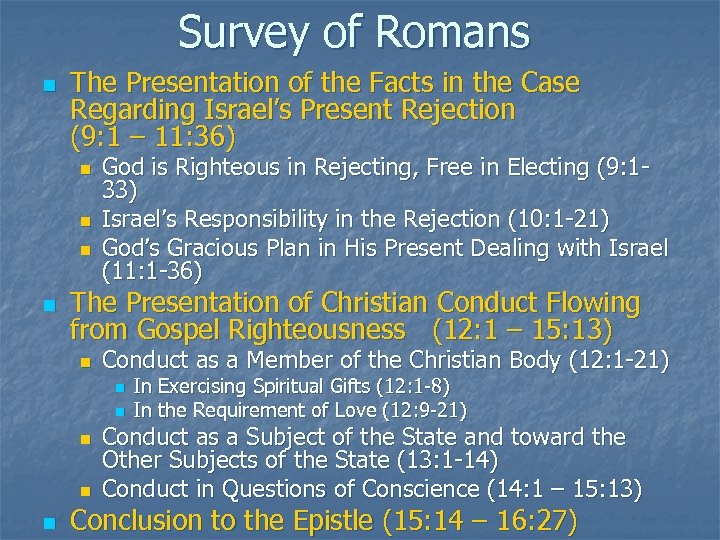 Survey of Romans n The Presentation of the Facts in the Case Regarding Israel’s Present Rejection (9: 1 – 11: 36) n n God is Righteous in Rejecting, Free in Electing (9: 133) Israel’s Responsibility in the Rejection (10: 1 -21) God’s Gracious Plan in His Present Dealing with Israel (11: 1 -36) The Presentation of Christian Conduct Flowing from Gospel Righteousness (12: 1 – 15: 13) n Conduct as a Member of the Christian Body (12: 1 -21) n n n In Exercising Spiritual Gifts (12: 1 -8) In the Requirement of Love (12: 9 -21) Conduct as a Subject of the State and toward the Other Subjects of the State (13: 1 -14) Conduct in Questions of Conscience (14: 1 – 15: 13) Conclusion to the Epistle (15: 14 – 16: 27)
 Next Week: Ephesians