



 NT E TY FE M YS S EM T EM AG AN SA CSSE-114 K BEISEN SULTANMAKHMUT
 SAFETY MANAGEMENT SYSTEM A safety management system (SMS) is a systematic approach to managing safety, including the necessary organisational structures, accountabilities, policies and procedures. Safety Management System (SMS) - A systematic and explicit approach defining the activities by which safety management is undertaken by an organisation in order to achieve acceptable or tolerable safety. The objective of a Safety Management System is to provide a structured management approach to control safety risks in operations. Effective safety management must take into account the organisation’s specific structures and processes related to safety of operations. A safety management system can be created to fit any business type and/or industry sector.
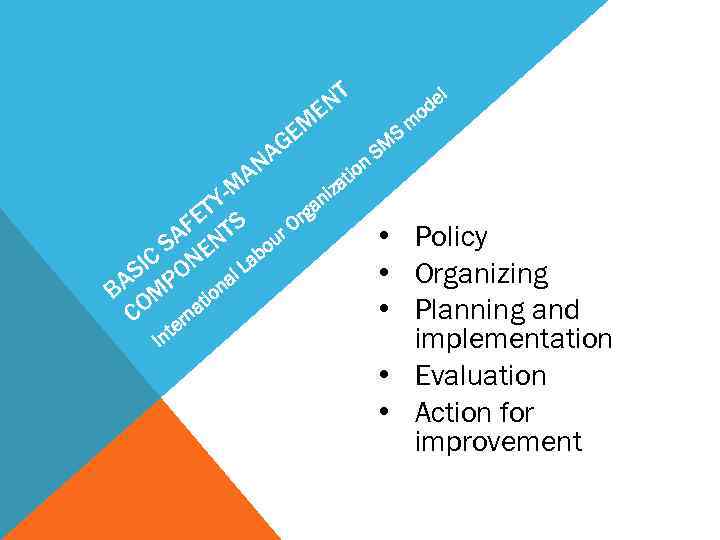 NT E EM AG AN iza -M an TY g FE TS r Or SA EN bou IC ON l La AS P ona B M ti CO erna ion t t In S M S o m el d • Policy • Organizing • Planning and implementation • Evaluation • Action for improvement
 INTERNATIONAL LABOUR ORGANIZATION SMS MODE Policy – Establish within policy statements what the requirements are for the organization in terms of resources, defining management commitment and defining OSH targets Organizing - How is the organization structured, where are responsibilities and accountabilities defined, who reports to who and who is responsible for what Planning and Implementation – What legislation and standards apply to our organization, what OSH objectives are defined and how are these reviews, hazard prevention and the assessment and management of risk. Evaluation – How is OSH performance measured and assessed, what are the processes for the reporting of accidents and incidents and for the investigation of accidents and what internal and external audit processes are in place to review the system. Action for Improvement – How are preventative and corrective actions managed and what processes are in place to ensure the continual improvement process. There is a significant amount of detail within each of these sections and these should be examined in detail from the ILO-OSH Guidelines document.
 SMS IMPLICATIONS A SMS is intended to act as a framework to allow an organisation, as a minimum, to meet its legal obligations under occupational health and safety law. The structure of a SMS is generally speaking, not of itself a legal requirement but it is an extremely effective tool to organise the myriad aspects of occupational safety and health (OSH) that can exist within an organisation, often to meet standards which exceed the minimum legal requirement. A SMS is only as good as its implementation – effective safety management means that organisations need to ensure they are looking at all the risks within the organization as a single system, rather than having multiple, competing, ‘Safety Management Silos. ’[3] If safety is not seen holistically, it can interfere with the prioritization of improvements or even result in safety issues being missed. For example, after an explosion in March 2005 at BP's Texas City Refinery (BP) the investigation concluded that the company had put too much emphasis on personal safety thus ignoring the safety of their processes. [4] The antidote to such silo thinking is the proper evaluation of all risks, a key aspect of an effective SMS.
 ADOPTION OF SMSS FOR INDUSTRY SECTORS Civil Aviation The International Civil Aviation Organization has recommended that all aviation authorities implement SMS regulatory structures. ICAO has provided resources to assist with implementation, including the ICAO Safety Management Manual. Unlike the traditional occupational safety focus of SMS, the ICAO focus is to use SMS for managing aviation safety. Maritime Industry The International Maritime Organization (IMO) is another organization that has adopted SMS. All international passenger ships and oil tankers, chemical tankers, gas carriers, bulk carriers and cargo ships of 500 gross tons or more are required to have a Safety Management System. Railway Industry Transport Canada’s Rail Safety Directorate incorporated SMS into the rail industry in 2001. The Rail Safety Management System requirements are set out in the Railway Safety Management System Regulations. The objectives of the Rail Safety Management System Regulations are to ensure that safety is given management time and corporate resources and that it is subject to performance measurement and monitoring on par with corporate financial and production goals
 ON TI EN T TH NK A OU Y R FO Y UR O AT