 Скачать презентацию NSTX-U Supported by NSTX-U Research Program Overview FY
06ba97b52385d1ba70972e66636dd054.ppt
- Количество слайдов: 58



NSTX-U Supported by NSTX-U Research Program Overview FY 2012 -14 research, collaboration, and 5 year planning Coll of Wm & Mary Columbia U Comp. X General Atomics FIU INL Johns Hopkins U LANL LLNL Lodestar MIT Lehigh U Nova Photonics ORNL PPPL Princeton U Purdue U SNL Think Tank, Inc. UC Davis UC Irvine UCLA UCSD U Colorado U Illinois U Maryland U Rochester U Tennessee U Tulsa U Washington U Wisconsin X Science LLC Jonathan Menard, PPPL For the NSTX Research Team NSTX PAC-31 Meeting PPPL – B 318 April 17 -19, 2012 Culham Sci Ctr York U Chubu U Fukui U Hiroshima U Hyogo U Kyoto U Kyushu Tokai U NIFS Niigata U U Tokyo JAEA Inst for Nucl Res, Kiev Ioffe Inst TRINITI Chonbuk Natl U NFRI KAIST POSTECH Seoul Natl U ASIPP CIEMAT FOM Inst DIFFER ENEA, Frascati CEA, Cadarache IPP, Jülich IPP, Garching ASCR, Czech Rep
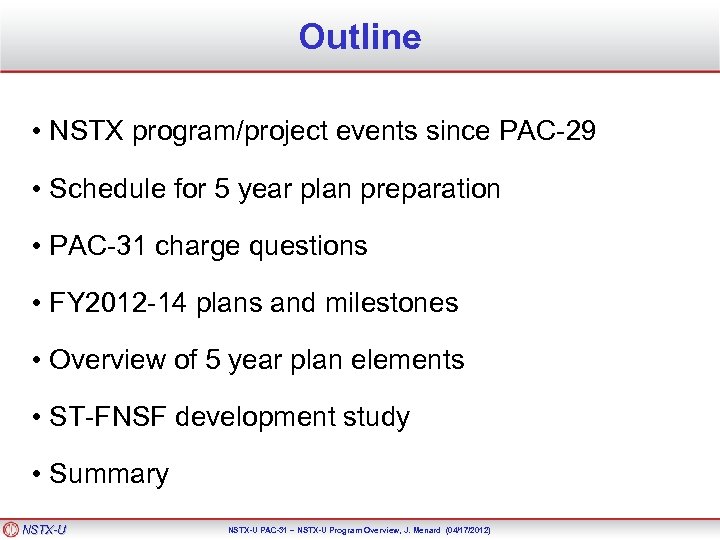
Outline • NSTX program/project events since PAC-29 • Schedule for 5 year plan preparation • PAC-31 charge questions • FY 2012 -14 plans and milestones • Overview of 5 year plan elements • ST-FNSF development study • Summary NSTX-U PAC-31 – NSTX-U Program Overview, J. Menard (04/17/2012)
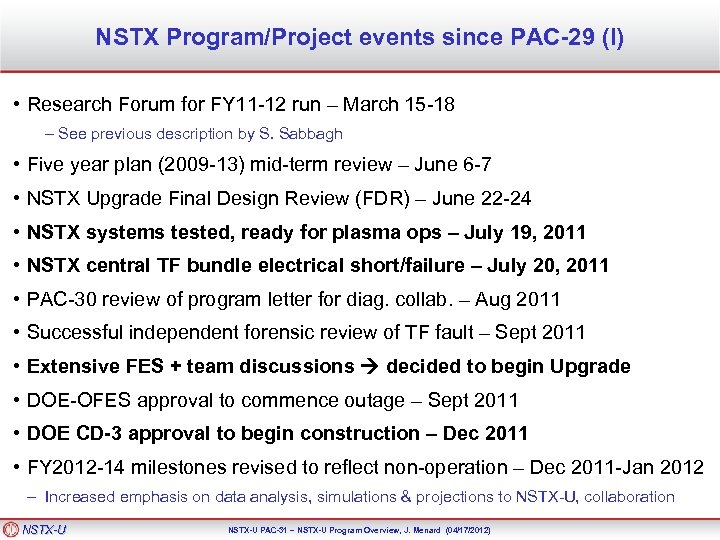
NSTX Program/Project events since PAC-29 (I) • Research Forum for FY 11 -12 run – March 15 -18 – See previous description by S. Sabbagh • Five year plan (2009 -13) mid-term review – June 6 -7 • NSTX Upgrade Final Design Review (FDR) – June 22 -24 • NSTX systems tested, ready for plasma ops – July 19, 2011 • NSTX central TF bundle electrical short/failure – July 20, 2011 • PAC-30 review of program letter for diag. collab. – Aug 2011 • Successful independent forensic review of TF fault – Sept 2011 • Extensive FES + team discussions decided to begin Upgrade • DOE-OFES approval to commence outage – Sept 2011 • DOE CD-3 approval to begin construction – Dec 2011 • FY 2012 -14 milestones revised to reflect non-operation – Dec 2011 -Jan 2012 – Increased emphasis on data analysis, simulations & projections to NSTX-U, collaboration NSTX-U PAC-31 – NSTX-U Program Overview, J. Menard (04/17/2012)
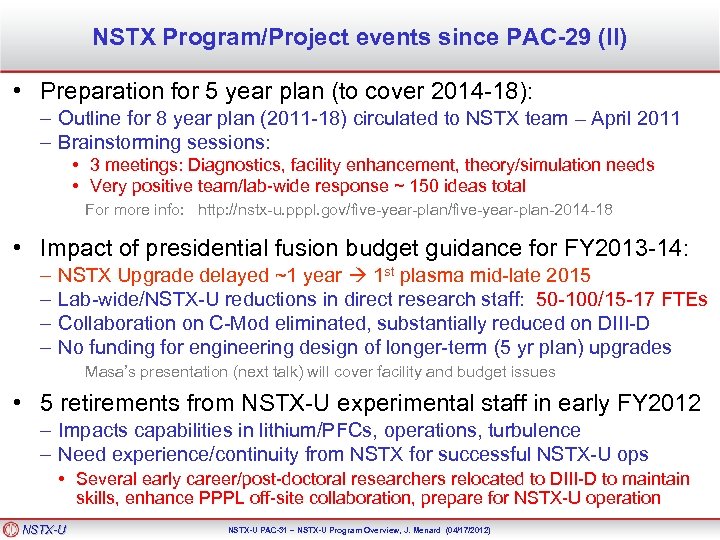
NSTX Program/Project events since PAC-29 (II) • Preparation for 5 year plan (to cover 2014 -18): – Outline for 8 year plan (2011 -18) circulated to NSTX team – April 2011 – Brainstorming sessions: • 3 meetings: Diagnostics, facility enhancement, theory/simulation needs • Very positive team/lab-wide response ~ 150 ideas total For more info: http: //nstx-u. pppl. gov/five-year-plan-2014 -18 • Impact of presidential fusion budget guidance for FY 2013 -14: – – NSTX Upgrade delayed ~1 year 1 st plasma mid-late 2015 Lab-wide/NSTX-U reductions in direct research staff: 50 -100/15 -17 FTEs Collaboration on C-Mod eliminated, substantially reduced on DIII-D No funding for engineering design of longer-term (5 yr plan) upgrades Masa’s presentation (next talk) will cover facility and budget issues • 5 retirements from NSTX-U experimental staff in early FY 2012 – Impacts capabilities in lithium/PFCs, operations, turbulence – Need experience/continuity from NSTX for successful NSTX-U ops • Several early career/post-doctoral researchers relocated to DIII-D to maintain skills, enhance PPPL off-site collaboration, prepare for NSTX-U operation NSTX-U PAC-31 – NSTX-U Program Overview, J. Menard (04/17/2012)
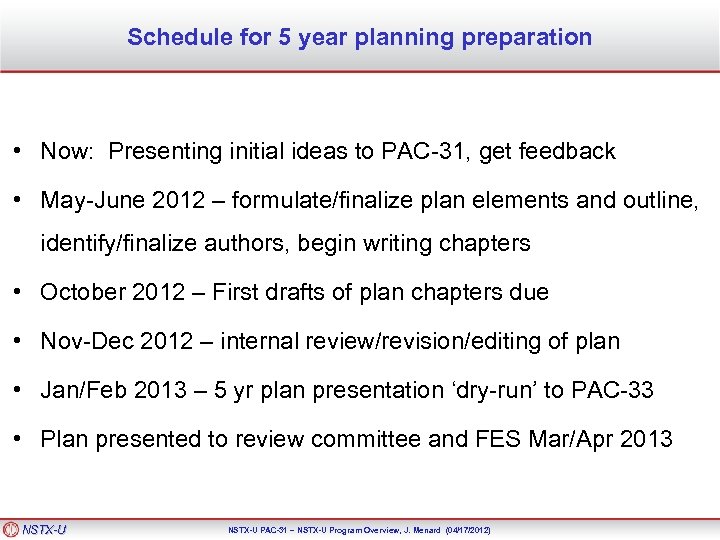
Schedule for 5 year planning preparation • Now: Presenting initial ideas to PAC-31, get feedback • May-June 2012 – formulate/finalize plan elements and outline, identify/finalize authors, begin writing chapters • October 2012 – First drafts of plan chapters due • Nov-Dec 2012 – internal review/revision/editing of plan • Jan/Feb 2013 – 5 yr plan presentation ‘dry-run’ to PAC-33 • Plan presented to review committee and FES Mar/Apr 2013 NSTX-U PAC-31 – NSTX-U Program Overview, J. Menard (04/17/2012)
Response to NSTX PAC-29 recommendations • Excel table of responses to PAC-29 recommendations in backup of this presentation, and on PAC-31 website • Detailed responses to PAC-29 provided (and enumerated) in presentations over next 2 days • Presentation by J. Canik responsive to recommendations to: – Perform more device-realistic design study for divertor cryo-pumping – More quantitatively project D particle control w/ Li-coatings for NSTX-U PAC-31 – NSTX-U Program Overview, J. Menard (04/17/2012)
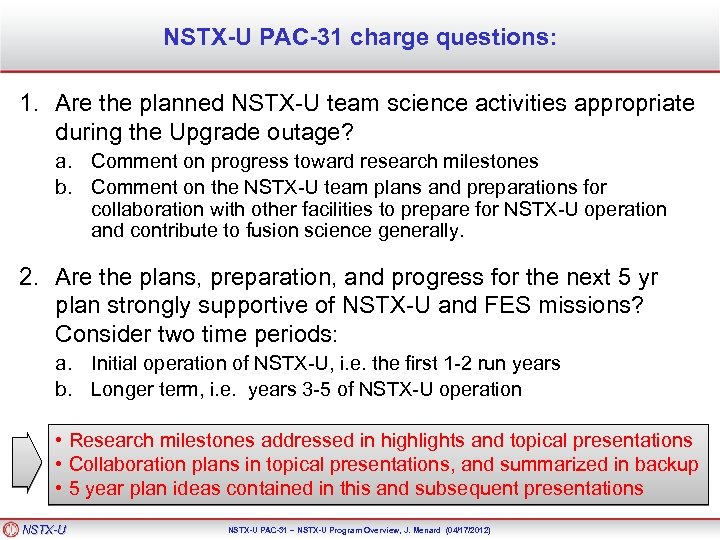
NSTX-U PAC-31 charge questions: 1. Are the planned NSTX-U team science activities appropriate during the Upgrade outage? a. Comment on progress toward research milestones b. Comment on the NSTX-U team plans and preparations for collaboration with other facilities to prepare for NSTX-U operation and contribute to fusion science generally. 2. Are the plans, preparation, and progress for the next 5 yr plan strongly supportive of NSTX-U and FES missions? Consider two time periods: a. Initial operation of NSTX-U, i. e. the first 1 -2 run years b. Longer term, i. e. years 3 -5 of NSTX-U operation • Research milestones addressed in highlights and topical presentations • Collaboration plans in topical presentations, and summarized in backup • 5 year plan ideas contained in this and subsequent presentations NSTX-U PAC-31 – NSTX-U Program Overview, J. Menard (04/17/2012)
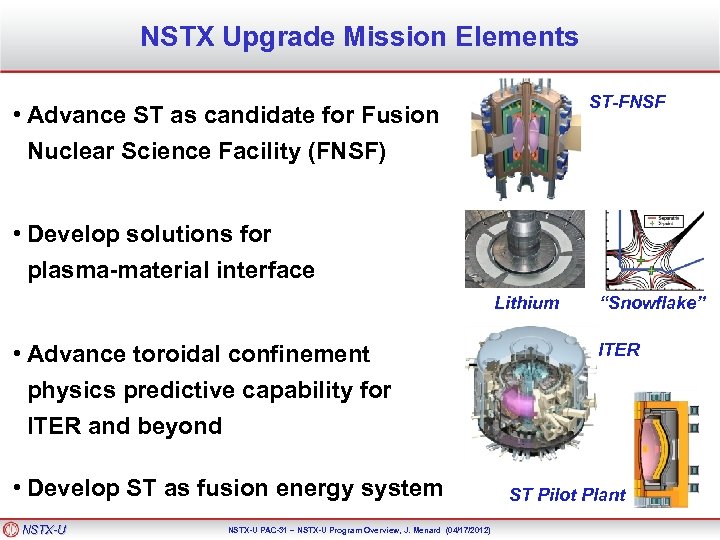
NSTX Upgrade Mission Elements ST-FNSF • Advance ST as candidate for Fusion Nuclear Science Facility (FNSF) • Develop solutions for plasma-material interface Lithium • Advance toroidal confinement physics predictive capability for ITER and beyond • Develop ST as fusion energy system NSTX-U PAC-31 – NSTX-U Program Overview, J. Menard (04/17/2012) “Snowflake” ITER ST Pilot Plant
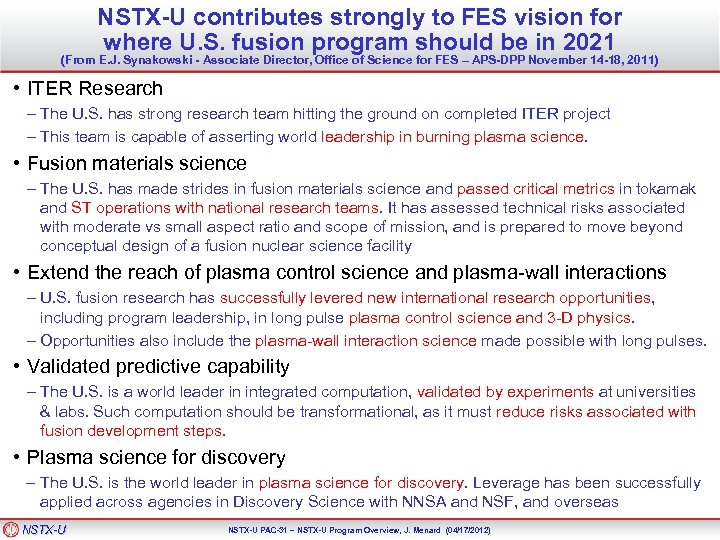
NSTX-U contributes strongly to FES vision for where U. S. fusion program should be in 2021 (From E. J. Synakowski - Associate Director, Office of Science for FES – APS-DPP November 14 -18, 2011) • ITER Research – The U. S. has strong research team hitting the ground on completed ITER project – This team is capable of asserting world leadership in burning plasma science. • Fusion materials science – The U. S. has made strides in fusion materials science and passed critical metrics in tokamak and ST operations with national research teams. It has assessed technical risks associated with moderate vs small aspect ratio and scope of mission, and is prepared to move beyond conceptual design of a fusion nuclear science facility • Extend the reach of plasma control science and plasma-wall interactions – U. S. fusion research has successfully levered new international research opportunities, including program leadership, in long pulse plasma control science and 3 -D physics. – Opportunities also include the plasma-wall interaction science made possible with long pulses. • Validated predictive capability – The U. S. is a world leader in integrated computation, validated by experiments at universities & labs. Such computation should be transformational, as it must reduce risks associated with fusion development steps. • Plasma science for discovery – The U. S. is the world leader in plasma science for discovery. Leverage has been successfully applied across agencies in Discovery Science with NNSA and NSF, and overseas NSTX-U PAC-31 – NSTX-U Program Overview, J. Menard (04/17/2012)
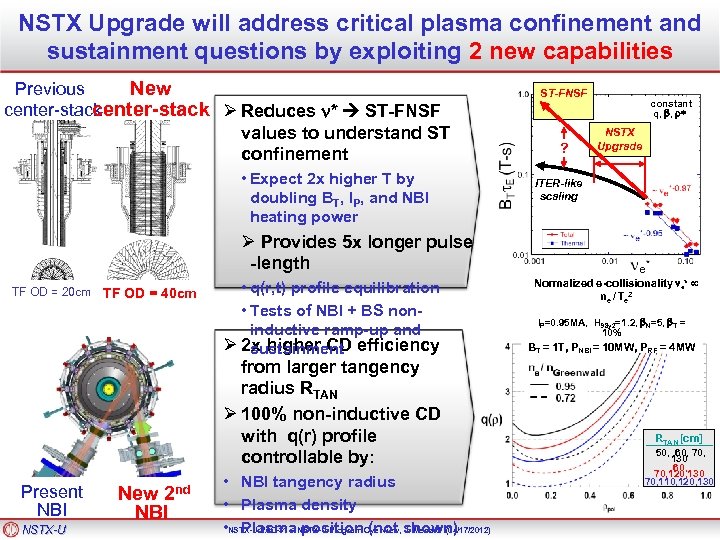
NSTX Upgrade will address critical plasma confinement and sustainment questions by exploiting 2 new capabilities New Previous center-stack Ø Reduces n* ST-FNSF center-stack values to understand ST confinement • Expect 2 x higher T by doubling BT, IP, and NBI heating power ST-FNSF ? constant q, b, r* NSTX Upgrade ITER-like scaling Ø Provides 5 x longer pulse -length TF OD = 20 cm TF OD = 40 cm • q(r, t) profile equilibration • Tests of NBI + BS noninductive ramp-up and Ø 2 x higher CD efficiency sustainment from larger tangency radius RTAN Ø 100% non-inductive CD with q(r) profile controllable by: Present NBI NSTX-U New 2 nd NBI • NBI tangency radius • Plasma density • NSTX-U PAC-31 – NSTX-U Program Overview, shown) Plasma position (not J. Menard (04/17/2012) Normalized e-collisionality ne* ne / Te 2 IP=0. 95 MA, H 98 y 2=1. 2, b. N=5, b. T = 10% BT = 1 T, PNBI = 10 MW, PRF = 4 MW R [cm] TAN _________ 50, 60, 70, 130 60, 70, 120, 130 70, 110, 120, 130
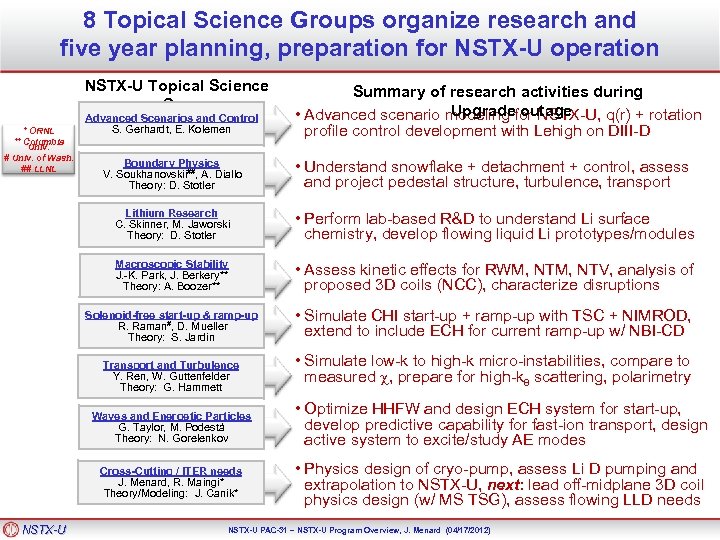
8 Topical Science Groups organize research and five year planning, preparation for NSTX-U operation NSTX-U Topical Science Groups * ORNL ** Columbia Univ. # Univ. of Wash. ## LLNL Advanced Scenarios and Control S. Gerhardt, E. Kolemen Summary of research activities during Upgrade outage • Advanced scenario modeling for NSTX-U, q(r) + rotation profile control development with Lehigh on DIII-D Boundary Physics V. Soukhanovskii##, A. Diallo Theory: D. Stotler • Understand snowflake + detachment + control, assess and project pedestal structure, turbulence, transport Lithium Research C. Skinner, M. Jaworski Theory: D. Stotler • Perform lab-based R&D to understand Li surface chemistry, develop flowing liquid Li prototypes/modules Macroscopic Stability J. -K. Park, J. Berkery** Theory: A. Boozer** • Assess kinetic effects for RWM, NTV, analysis of proposed 3 D coils (NCC), characterize disruptions Solenoid-free start-up & ramp-up R. Raman#, D. Mueller Theory: S. Jardin • Simulate CHI start-up + ramp-up with TSC + NIMROD, extend to include ECH for current ramp-up w/ NBI-CD Transport and Turbulence Y. Ren, W. Guttenfelder Theory: G. Hammett • Simulate low-k to high-k micro-instabilities, compare to measured c, prepare for high-kq scattering, polarimetry Waves and Energetic Particles G. Taylor, M. Podestá Theory: N. Gorelenkov Cross-Cutting / ITER needs J. Menard, R. Maingi* Theory/Modeling: J. Canik* NSTX-U • Optimize HHFW and design ECH system for start-up, develop predictive capability for fast-ion transport, design active system to excite/study AE modes • Physics design of cryo-pump, assess Li D pumping and extrapolation to NSTX-U, next: lead off-midplane 3 D coil physics design (w/ MS TSG), assess flowing LLD needs NSTX-U PAC-31 – NSTX-U Program Overview, J. Menard (04/17/2012)
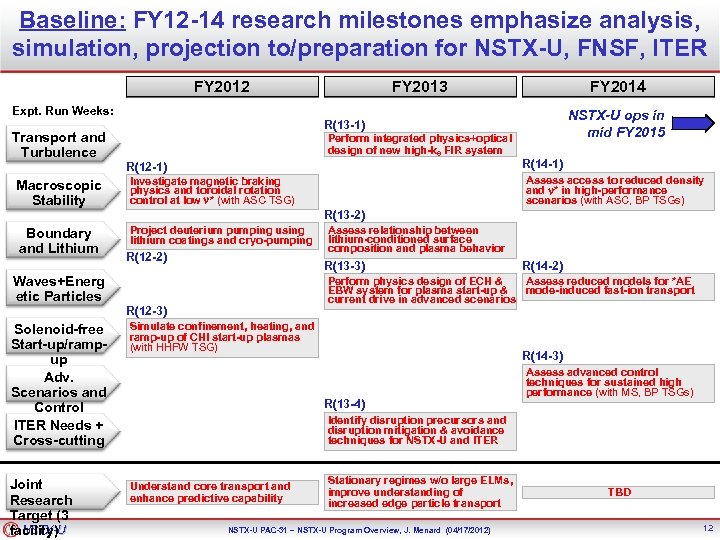
Baseline: FY 12 -14 research milestones emphasize analysis, simulation, projection to/preparation for NSTX-U, FNSF, ITER FY 2012 FY 2013 FY 2014 Expt. Run Weeks: Transport and Turbulence Perform integrated physics+optical design of new high-kθ FIR system R(12 -1) Macroscopic Stability NSTX-U ops in mid FY 2015 R(13 -1) R(14 -1) Assess access to reduced density and n* in high-performance scenarios (with ASC, BP TSGs) Investigate magnetic braking physics and toroidal rotation control at low n* (with ASC TSG) R(13 -2) Boundary and Lithium Project deuterium pumping using lithium coatings and cryo-pumping R(12 -2) Assess relationship between lithium-conditioned surface composition and plasma behavior R(13 -3) Waves+Energ etic Particles R(14 -2) Perform physics design of ECH & Assess reduced models for *AE EBW system for plasma start-up & mode-induced fast-ion transport current drive in advanced scenarios R(12 -3) Solenoid-free Start-up/rampup Adv. Scenarios and Control ITER Needs + Cross-cutting Simulate confinement, heating, and ramp-up of CHI start-up plasmas (with HHFW TSG) Joint Research Target (3 NSTX-U facility) Understand core transport and enhance predictive capability R(14 -3) R(13 -4) Assess advanced control techniques for sustained high performance (with MS, BP TSGs) Identify disruption precursors and disruption mitigation & avoidance techniques for NSTX-U and ITER Stationary regimes w/o large ELMs, improve understanding of increased edge particle transport NSTX-U PAC-31 – NSTX-U Program Overview, J. Menard (04/17/2012) TBD 12
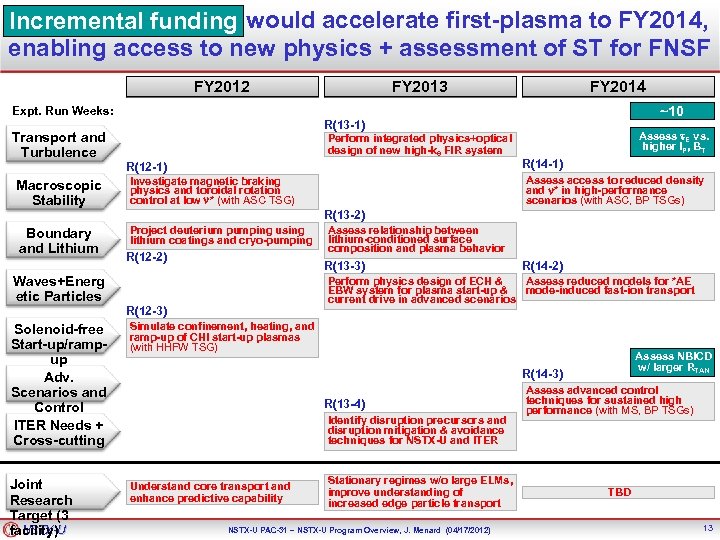
Incremental funding would accelerate first-plasma to FY 2014, enabling access to new physics + assessment of ST for FNSF FY 2012 FY 2013 FY 2014 ~10 Expt. Run Weeks: R(13 -1) Transport and Turbulence Perform integrated physics+optical design of new high-kθ FIR system R(12 -1) Macroscopic Stability Assess t. E vs. higher IP, BT R(14 -1) Assess access to reduced density and n* in high-performance scenarios (with ASC, BP TSGs) Investigate magnetic braking physics and toroidal rotation control at low n* (with ASC TSG) R(13 -2) Boundary and Lithium Project deuterium pumping using lithium coatings and cryo-pumping R(12 -2) Assess relationship between lithium-conditioned surface composition and plasma behavior R(13 -3) Waves+Energ etic Particles R(14 -2) Perform physics design of ECH & Assess reduced models for *AE EBW system for plasma start-up & mode-induced fast-ion transport current drive in advanced scenarios R(12 -3) Solenoid-free Start-up/rampup Adv. Scenarios and Control ITER Needs + Cross-cutting Simulate confinement, heating, and ramp-up of CHI start-up plasmas (with HHFW TSG) Joint Research Target (3 NSTX-U facility) Understand core transport and enhance predictive capability Assess NBICD w/ larger RTAN R(14 -3) R(13 -4) Identify disruption precursors and disruption mitigation & avoidance techniques for NSTX-U and ITER Stationary regimes w/o large ELMs, improve understanding of increased edge particle transport NSTX-U PAC-31 – NSTX-U Program Overview, J. Menard (04/17/2012) Assess advanced control techniques for sustained high performance (with MS, BP TSGs) TBD 13
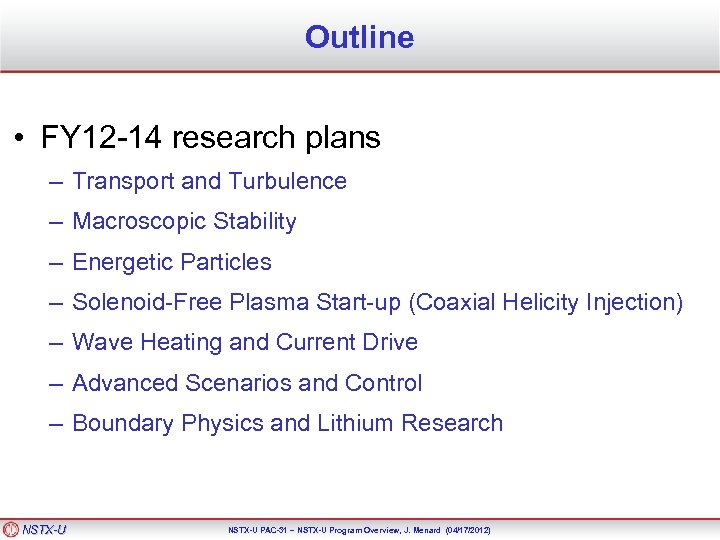
Outline • FY 12 -14 research plans – Transport and Turbulence – Macroscopic Stability – Energetic Particles – Solenoid-Free Plasma Start-up (Coaxial Helicity Injection) – Wave Heating and Current Drive – Advanced Scenarios and Control – Boundary Physics and Lithium Research NSTX-U PAC-31 – NSTX-U Program Overview, J. Menard (04/17/2012)
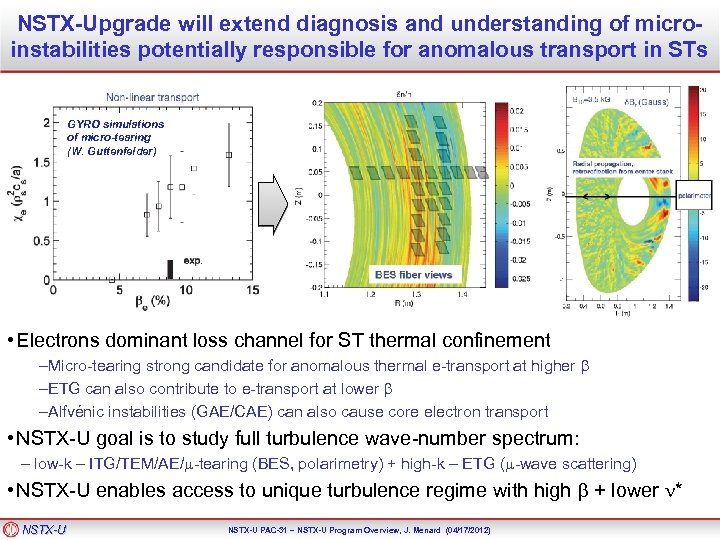
NSTX-Upgrade will extend diagnosis and understanding of microinstabilities potentially responsible for anomalous transport in STs GYRO simulations of micro-tearing (W. Guttenfelder) • Electrons dominant loss channel for ST thermal confinement –Micro-tearing strong candidate for anomalous thermal e-transport at higher b –ETG can also contribute to e-transport at lower b –Alfvénic instabilities (GAE/CAE) can also cause core electron transport • NSTX-U goal is to study full turbulence wave-number spectrum: – low-k – ITG/TEM/AE/m-tearing (BES, polarimetry) + high-k – ETG (m-wave scattering) • NSTX-U enables access to unique turbulence regime with high b + lower n* NSTX-U PAC-31 – NSTX-U Program Overview, J. Menard (04/17/2012)
Transport and Turbulence Research Plans for FY 2012 -14: Develop advanced turbulence diagnostics, reduced transport models • FY 12/JRT: Simultaneous comparison of electron thermal and particle/impurities transport channels in NSTX, coupled with turbulence measurements and gyro-kinetic simulations – Test TGLF profile predictions for NSTX discharges (with GA) • FY 12 -13: Identify diagnostics for micro-tearing, intermediate kq rs ~ 1 -4 turbulence as possible drive for e-transport – Work/collaborate with DIII-D (polarimetry), C-Mod (PCI, polarimetry) • FY 13: Develop integrated physics and optical design of the new high-kθ FIR scattering system – Investigate micro-tearing mode by varying relevant parameters (b, n, Zeff) and using BES diagnostics on MAST • FY 14: Work toward development of reduced transport models and validation of existing models using ST data and linear and non-linear gyro-kinetic simulations NSTX-U PAC-31 – NSTX-U Program Overview, J. Menard (04/17/2012)
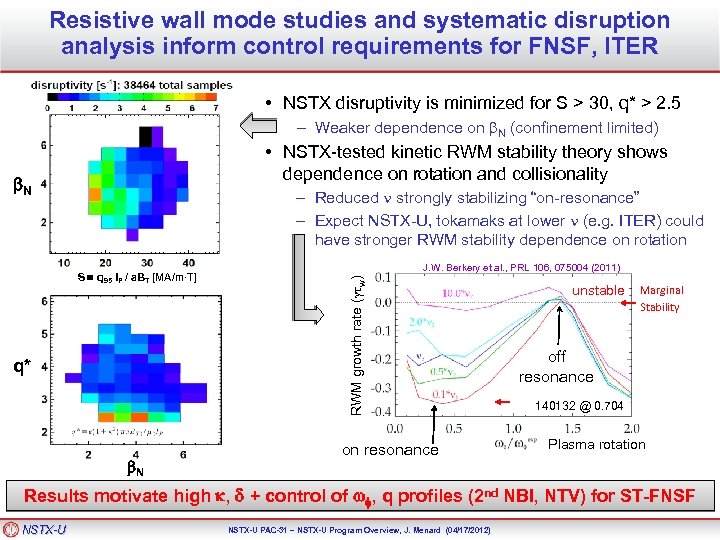
Resistive wall mode studies and systematic disruption analysis inform control requirements for FNSF, ITER • NSTX disruptivity is minimized for S > 30, q* > 2. 5 – Weaker dependence on b. N (confinement limited) • NSTX-tested kinetic RWM stability theory shows dependence on rotation and collisionality b. N – Reduced n strongly stabilizing “on-resonance” – Expect NSTX-U, tokamaks at lower n (e. g. ITER) could have stronger RWM stability dependence on rotation q* b. N J. W. Berkery et al. , PRL 106, 075004 (2011) RWM growth rate (gtw) S q 95 IP / a. BT [MA/m·T] on resonance unstable Marginal Stability off resonance 140132 @ 0. 704 Plasma rotation Results motivate high k, d + control of wf, q profiles (2 nd NBI, NTV) for ST-FNSF NSTX-U PAC-31 – NSTX-U Program Overview, J. Menard (04/17/2012)
Macroscopic Stability Research Plans for FY 2012 -14: Investigate kinetic RWM and disruption physics, assess new 3 D coils • FY 12 -13: Investigate RWM kinetic stability w/ MISK for NSTX & NSTX-U + experimental (DIII-D and KSTAR) and computational (MARS-K, HAGIS) RWM collaborations • FY 12 -13: Compile NSTX disruption database, study NSTX disruptions, combine various precursors/signals for disruption characterization and prediction – Develop disruption mitigation + avoidance strategies for NSTX-U, ITER • FY 13 -14: Assess access to reduced density and collisionality by investigating RWM, tearing mode physics, and 3 D physics including error field + magnetic braking in NSTX-U scenarios – Collaborate with DIII-D, KSTAR, and MAST • FY 13 -14: Assess utility of new Non-axisymmetric Control Coils (NCC) for RWM, TM, RMP, EFC, NTV/vf control for NSTX-U – Collaborate with DIII-D, KSTAR, MAST to identify optimal coil set NSTX-U PAC-31 – NSTX-U Program Overview, J. Menard (04/17/2012)
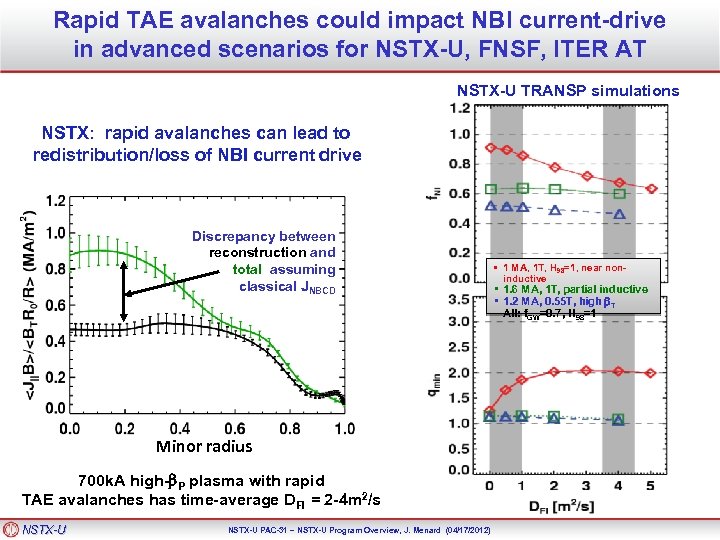
Rapid TAE avalanches could impact NBI current-drive in advanced scenarios for NSTX-U, FNSF, ITER AT NSTX-U TRANSP simulations NSTX: rapid avalanches can lead to redistribution/loss of NBI current drive Discrepancy between reconstruction and total assuming classical JNBCD Minor radius 700 k. A high-b. P plasma with rapid TAE avalanches has time-average DFI = 2 -4 m 2/s NSTX-U PAC-31 – NSTX-U Program Overview, J. Menard (04/17/2012) • 1 MA, 1 T, H 98=1, near noninductive • 1. 6 MA, 1 T, partial inductive • 1. 2 MA, 0. 55 T, high b. T All: f. GW=0. 7, H 98=1
Energetic Particle Physics Research Plans for FY 2012 -14: Develop full and reduced models of fast-ion transport, f(v) diagnostics • FY 12: Model TAE stability for NSTX, project to NSTX-U Hmode plasmas w/ NOVA & M 3 D-K codes • FY 12 -13: Improve model of fast ion response to highfrequency GAE/CAE (Develop interface between SPIRAL and HYM codes) • FY 12 -13: Collaborate with MAST and DIII-D on AE experiments, ID optimal FI diagnostics for NSTX-U • FY 13 -14: Develop reduced model for AE-induced fast ion losses – needed for NBICD in STs/ATs/ITER – Collaboration with MAST, DIII-D, Irvine • FY 13 -14: Finalize design of prototype AE antenna and of upgraded solid-state NPA diagnostic NSTX-U PAC-31 – NSTX-U Program Overview, J. Menard (04/17/2012)
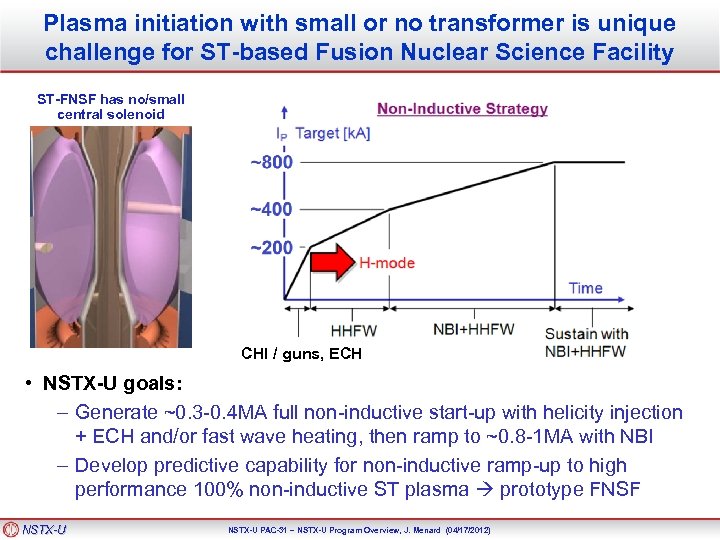
Plasma initiation with small or no transformer is unique challenge for ST-based Fusion Nuclear Science Facility ST-FNSF has no/small central solenoid CHI / guns, ECH • NSTX-U goals: – Generate ~0. 3 -0. 4 MA full non-inductive start-up with helicity injection + ECH and/or fast wave heating, then ramp to ~0. 8 -1 MA with NBI – Develop predictive capability for non-inductive ramp-up to high performance 100% non-inductive ST plasma prototype FNSF NSTX-U PAC-31 – NSTX-U Program Overview, J. Menard (04/17/2012)
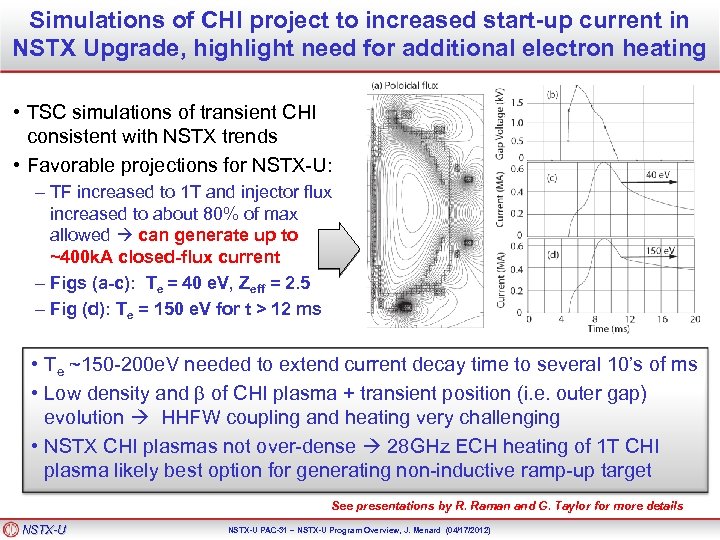
Simulations of CHI project to increased start-up current in NSTX Upgrade, highlight need for additional electron heating • TSC simulations of transient CHI consistent with NSTX trends • Favorable projections for NSTX-U: – TF increased to 1 T and injector flux increased to about 80% of max allowed can generate up to ~400 k. A closed-flux current – Figs (a-c): Te = 40 e. V, Zeff = 2. 5 – Fig (d): Te = 150 e. V for t > 12 ms • Te ~150 -200 e. V needed to extend current decay time to several 10’s of ms • Low density and b of CHI plasma + transient position (i. e. outer gap) evolution HHFW coupling and heating very challenging • NSTX CHI plasmas not over-dense 28 GHz ECH heating of 1 T CHI plasma likely best option for generating non-inductive ramp-up target See presentations by R. Raman and G. Taylor for more details NSTX-U PAC-31 – NSTX-U Program Overview, J. Menard (04/17/2012)
Solenoid-Free Start-up and Ramp-up Research Plans for FY 2012 -14: Simulate CHI start-up/ramp-up, prepare CHI/guns for NSTX-U • FY 12 -13: Model CHI start-up HHFW+NBI ramp-up scenarios using the NSTX-U vessel + coil geometry – Use TSC simulations w/ free-boundary capabilities, identify and develop CHI experiments using FY 14 reduced coil set – Use TRANSP to vary IP, Te, ne and study how NBI couples to these plasmas with low and zero loop voltage • Design (FY 12) and implement (FY 13) upgrades to CHI capacitor bank and diagnostics for NSTX-U • FY 12 -13: Participate in PEGASUS plasma gun startup experiments to identify hardware requirements for implementation on NSTX-U • FY 13 -14: Finish CHI design study for QUEST, work with QUEST group for possible CHI usage on QUEST NSTX-U PAC-31 – NSTX-U Program Overview, J. Menard (04/17/2012)
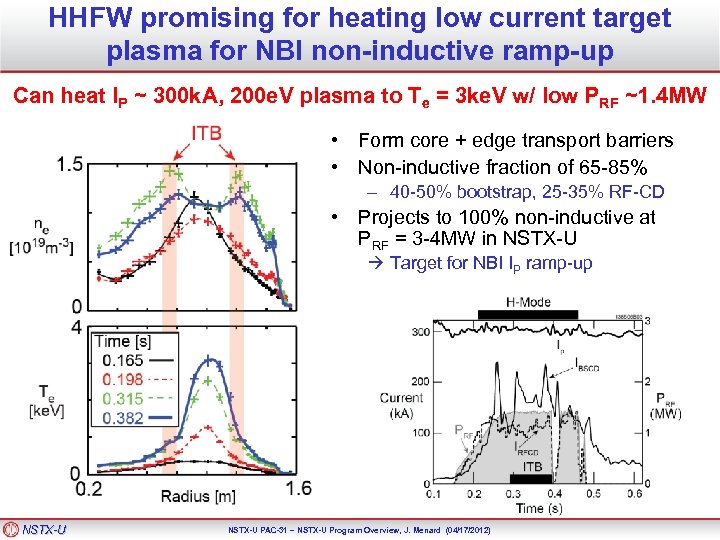
HHFW promising for heating low current target plasma for NBI non-inductive ramp-up Can heat IP ~ 300 k. A, 200 e. V plasma to Te = 3 ke. V w/ low PRF ~1. 4 MW • Form core + edge transport barriers • Non-inductive fraction of 65 -85% – 40 -50% bootstrap, 25 -35% RF-CD • Projects to 100% non-inductive at PRF = 3 -4 MW in NSTX-U Target for NBI IP ramp-up NSTX-U PAC-31 – NSTX-U Program Overview, J. Menard (04/17/2012)
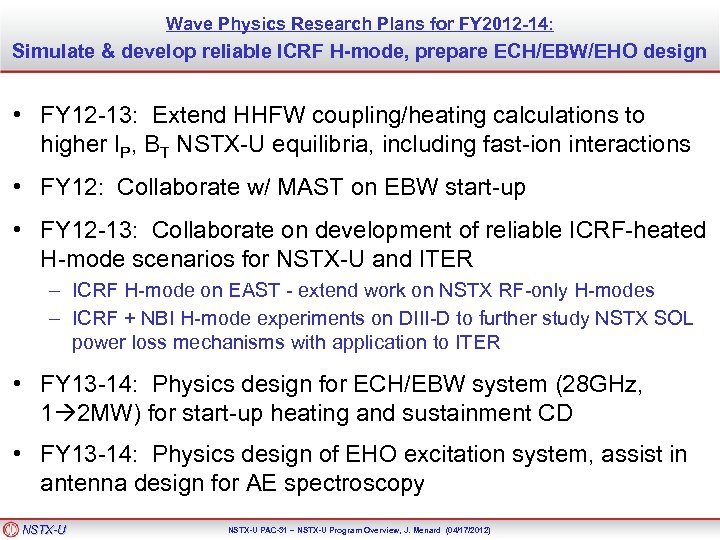
Wave Physics Research Plans for FY 2012 -14: Simulate & develop reliable ICRF H-mode, prepare ECH/EBW/EHO design • FY 12 -13: Extend HHFW coupling/heating calculations to higher IP, BT NSTX-U equilibria, including fast-ion interactions • FY 12: Collaborate w/ MAST on EBW start-up • FY 12 -13: Collaborate on development of reliable ICRF-heated H-mode scenarios for NSTX-U and ITER – ICRF H-mode on EAST - extend work on NSTX RF-only H-modes – ICRF + NBI H-mode experiments on DIII-D to further study NSTX SOL power loss mechanisms with application to ITER • FY 13 -14: Physics design for ECH/EBW system (28 GHz, 1 2 MW) for start-up heating and sustainment CD • FY 13 -14: Physics design of EHO excitation system, assist in antenna design for AE spectroscopy NSTX-U PAC-31 – NSTX-U Program Overview, J. Menard (04/17/2012)
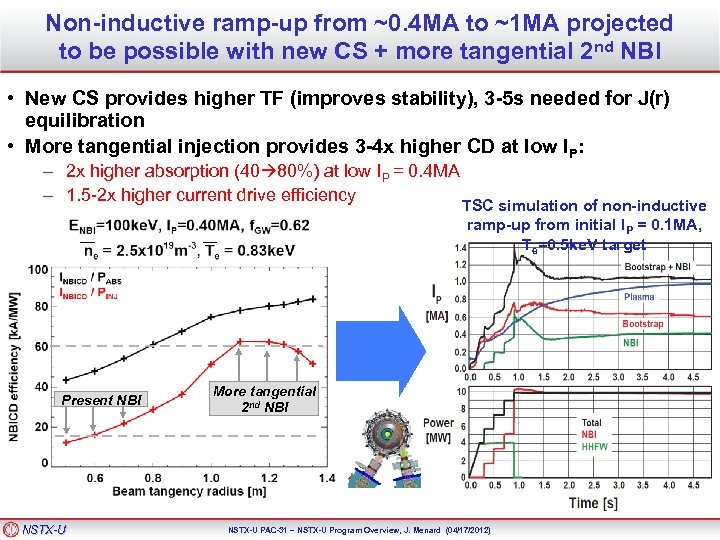
Non-inductive ramp-up from ~0. 4 MA to ~1 MA projected to be possible with new CS + more tangential 2 nd NBI • New CS provides higher TF (improves stability), 3 -5 s needed for J(r) equilibration • More tangential injection provides 3 -4 x higher CD at low IP: – 2 x higher absorption (40 80%) at low IP = 0. 4 MA – 1. 5 -2 x higher current drive efficiency Present NBI NSTX-U TSC simulation of non-inductive ramp-up from initial IP = 0. 1 MA, Te=0. 5 ke. V target More tangential 2 nd NBI NSTX-U PAC-31 – NSTX-U Program Overview, J. Menard (04/17/2012)
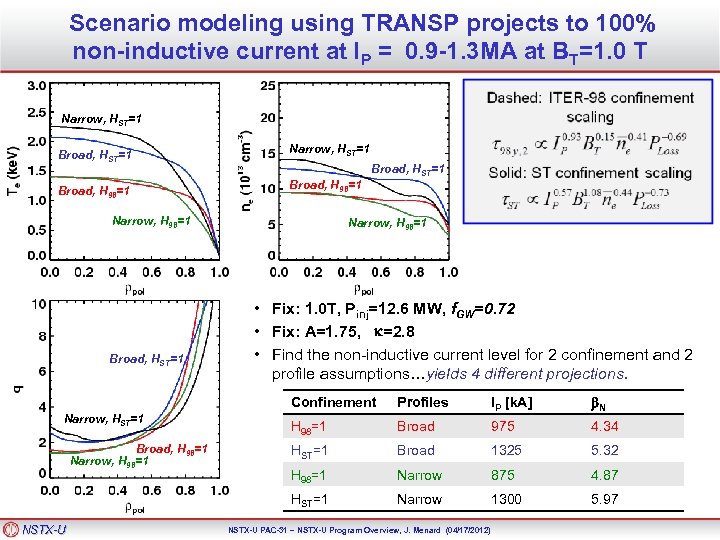
Scenario modeling using TRANSP projects to 100% non-inductive current at IP = 0. 9 -1. 3 MA at BT=1. 0 T Dashed: ITER-98 confinement scaling Narrow, HST=1 Broad, HST=1 Narrow, HST=1 Broad, H 98=1 Broad, HST=1 Narrow, H 98=1 Broad, HST=1 Solid: ST confinement scaling Narrow, H 98=1 • Fix: 1. 0 T, Pinj=12. 6 MW, f. GW=0. 72 • Fix: A=1. 75, k=2. 8 • Find the non-inductive current level for 2 confinement and 2 profile assumptions…yields 4 different projections. Confinement Broad, H 98=1 Narrow, H 98=1 NSTX-U IP [k. A] b. N H 98=1 Broad 975 4. 34 HST=1 Broad 1325 5. 32 H 98=1 Narrow 875 4. 87 HST=1 Narrow, HST=1 Profiles Narrow 1300 5. 97 NSTX-U PAC-31 – NSTX-U Program Overview, J. Menard (04/17/2012)
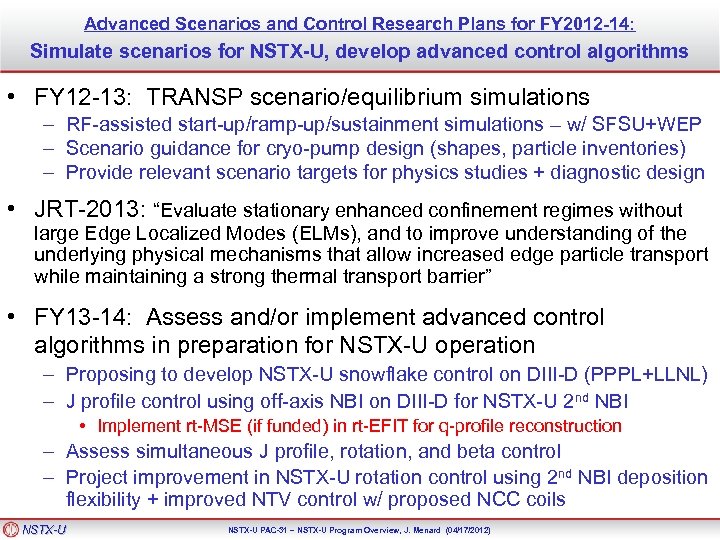
Advanced Scenarios and Control Research Plans for FY 2012 -14: Simulate scenarios for NSTX-U, develop advanced control algorithms • FY 12 -13: TRANSP scenario/equilibrium simulations – RF-assisted start-up/ramp-up/sustainment simulations – w/ SFSU+WEP – Scenario guidance for cryo-pump design (shapes, particle inventories) – Provide relevant scenario targets for physics studies + diagnostic design • JRT-2013: “Evaluate stationary enhanced confinement regimes without large Edge Localized Modes (ELMs), and to improve understanding of the underlying physical mechanisms that allow increased edge particle transport while maintaining a strong thermal transport barrier” • FY 13 -14: Assess and/or implement advanced control algorithms in preparation for NSTX-U operation – Proposing to develop NSTX-U snowflake control on DIII-D (PPPL+LLNL) – J profile control using off-axis NBI on DIII-D for NSTX-U 2 nd NBI • Implement rt-MSE (if funded) in rt-EFIT for q-profile reconstruction – Assess simultaneous J profile, rotation, and beta control – Project improvement in NSTX-U rotation control using 2 nd NBI deposition flexibility + improved NTV control w/ proposed NCC coils NSTX-U PAC-31 – NSTX-U Program Overview, J. Menard (04/17/2012)
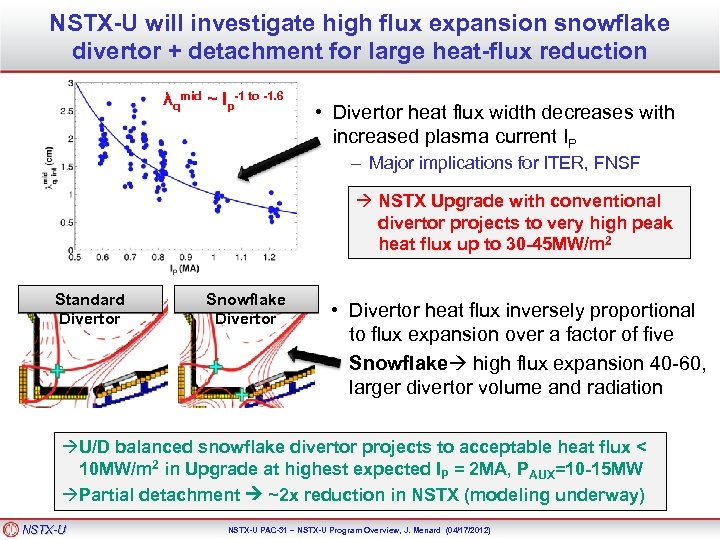
NSTX-U will investigate high flux expansion snowflake divertor + detachment for large heat-flux reduction λqmid ~ Ip-1 to -1. 6 • Divertor heat flux width decreases with increased plasma current IP – Major implications for ITER, FNSF NSTX Upgrade with conventional divertor projects to very high peak heat flux up to 30 -45 MW/m 2 Standard Divertor Snowflake Divertor • Divertor heat flux inversely proportional to flux expansion over a factor of five • Snowflake high flux expansion 40 -60, larger divertor volume and radiation U/D balanced snowflake divertor projects to acceptable heat flux < 10 MW/m 2 in Upgrade at highest expected IP = 2 MA, PAUX=10 -15 MW Partial detachment ~2 x reduction in NSTX (modeling underway) NSTX-U PAC-31 – NSTX-U Program Overview, J. Menard (04/17/2012)
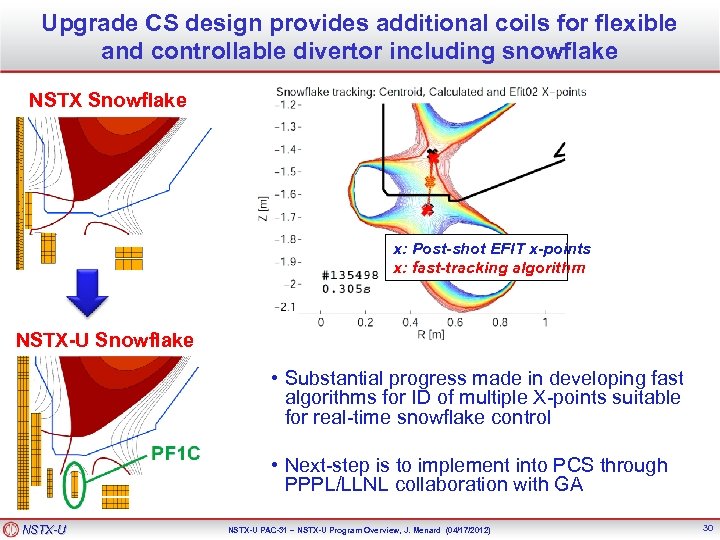
Upgrade CS design provides additional coils for flexible and controllable divertor including snowflake NSTX Snowflake x: Post-shot EFIT x-points x: fast-tracking algorithm NSTX-U Snowflake • Substantial progress made in developing fast algorithms for ID of multiple X-points suitable for real-time snowflake control • Next-step is to implement into PCS through PPPL/LLNL collaboration with GA NSTX-U PAC-31 – NSTX-U Program Overview, J. Menard (04/17/2012) 30
Boundary Physics Research Plans for FY 2012 -14: Advance snowflake & edge turbulence understanding, plan cryo & PFCs • FY 12 -13: Perform modeling of synergy of snowflake with radiative divertor in NSTX, project to NSTX-U and beyond • FY 12 -13: Perform cryo-pumping physics design for NSTX-U compatible with vessel geometry and snowflake shapes – Use SOLPS to interpret/reproduce heat and particle flux profiles from high IP and PNBI discharges from NSTX, project to NSTX Upgrade (Initial results indicate snowflake compatible with cryo-pumping) • FY 12 -14: Study divertor power exhaust with high-Z Mo PFCs on C-Mod & EAST, assess for NSTX-U – Assess Mo with low-Z (B & Li) coatings, study cryo-pumping for density control with moly PFC (particle balance, supersonic gas jet fueling), possibly radiative divertor control development (C-Mod) • FY 12 -14: Investigate pedestal transport & turbulence: – Utilize correlation reflectometer on C-Mod, EPH/VH expts + XGC 0 simulations on DIII-D, SOL turbulence with GPI on EAST and C-Mod NSTX-U PAC-31 – NSTX-U Program Overview, J. Menard (04/17/2012)
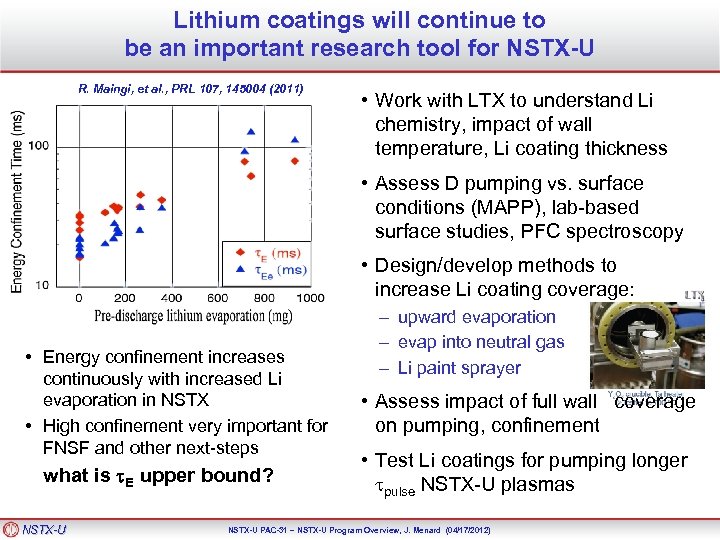
Lithium coatings will continue to be an important research tool for NSTX-U R. Maingi, et al. , PRL 107, 145004 (2011) • Work with LTX to understand Li chemistry, impact of wall temperature, Li coating thickness • Assess D pumping vs. surface conditions (MAPP), lab-based surface studies, PFC spectroscopy • Design/develop methods to increase Li coating coverage: • Energy confinement increases continuously with increased Li evaporation in NSTX • High confinement very important for FNSF and other next-steps what is t. E upper bound? NSTX-U – upward evaporation – evap into neutral gas – Li paint sprayer • Assess impact of full wall coverage on pumping, confinement • Test Li coatings for pumping longer tpulse NSTX-U plasmas NSTX-U PAC-31 – NSTX-U Program Overview, J. Menard (04/17/2012)
Lithium Research Plans for FY 2012 -14: Advance-Li PFC understanding and technology, R&D for flowing Li • FY 12: Model D pumping from Li coatings in NSTX, project to NSTX-U conditions, compare to cryo-pumping projections • FY 12 -13: Collaborate with EAST/HT-7 on lithium research – Assess interplay between cryo-pumping and lithiumization, and high-Z PFC interactions/synergies with lithium – Study effects of Li on thermal and particle transport, further develop sustained/long-pulse lithium delivery systems (Li slapper, dropper) • FY 12 -14: Measure Li coating lifetime on ATJ, TZM, W for NSTX-U like divertor conditions: Magnum-PSI collaboration • FY 13: Study lithium-conditioned surface composition using MAPP (Purdue) between-shot surface analysis on LTX • FY 13 -14: Develop Li-coating tool for upper PFCs of NSTX-U, + – Perform lab-based R&D to develop circulation of Li in/out of divertor – Physics/pre-conceptual design of next-generation LLD with flowing Li and/or capillary porous system (CPS) NSTX-U PAC-31 – NSTX-U Program Overview, J. Menard (04/17/2012)
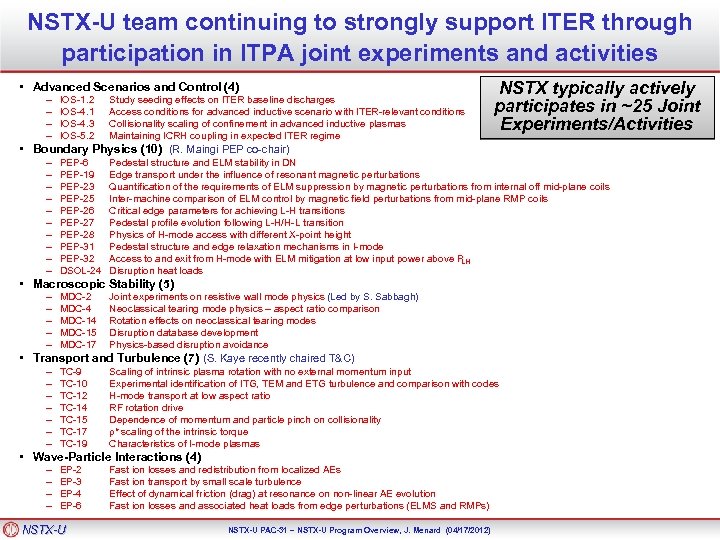
NSTX-U team continuing to strongly support ITER through participation in ITPA joint experiments and activities • Advanced Scenarios and Control (4) – – IOS-1. 2 IOS-4. 1 IOS-4. 3 IOS-5. 2 Study seeding effects on ITER baseline discharges Access conditions for advanced inductive scenario with ITER-relevant conditions Collisionality scaling of confinement in advanced inductive plasmas Maintaining ICRH coupling in expected ITER regime NSTX typically actively participates in ~25 Joint Experiments/Activities • Boundary Physics (10) (R. Maingi PEP co-chair) – – – – – PEP-6 PEP-19 PEP-23 PEP-25 PEP-26 PEP-27 PEP-28 PEP-31 PEP-32 DSOL-24 Pedestal structure and ELM stability in DN Edge transport under the influence of resonant magnetic perturbations Quantification of the requirements of ELM suppression by magnetic perturbations from internal off mid-plane coils Inter-machine comparison of ELM control by magnetic field perturbations from mid-plane RMP coils Critical edge parameters for achieving L-H transitions Pedestal profile evolution following L-H/H-L transition Physics of H-mode access with different X-point height Pedestal structure and edge relaxation mechanisms in I-mode Access to and exit from H-mode with ELM mitigation at low input power above PLH Disruption heat loads • Macroscopic Stability (5) – – – MDC-2 MDC-4 MDC-15 MDC-17 Joint experiments on resistive wall mode physics (Led by S. Sabbagh) Neoclassical tearing mode physics – aspect ratio comparison Rotation effects on neoclassical tearing modes Disruption database development Physics-based disruption avoidance • Transport and Turbulence (7) (S. Kaye recently chaired T&C) – – – – TC-9 TC-10 TC-12 TC-14 TC-15 TC-17 TC-19 Scaling of intrinsic plasma rotation with no external momentum input Experimental identification of ITG, TEM and ETG turbulence and comparison with codes H-mode transport at low aspect ratio RF rotation drive Dependence of momentum and particle pinch on collisionality r* scaling of the intrinsic torque Characteristics of I-mode plasmas • Wave-Particle Interactions (4) – – EP-2 EP-3 EP-4 EP-6 NSTX-U Fast ion losses and redistribution from localized AEs Fast ion transport by small scale turbulence Effect of dynamical friction (drag) at resonance on non-linear AE evolution Fast ion losses and associated heat loads from edge perturbations (ELMS and RMPs) NSTX-U PAC-31 – NSTX-U Program Overview, J. Menard (04/17/2012)
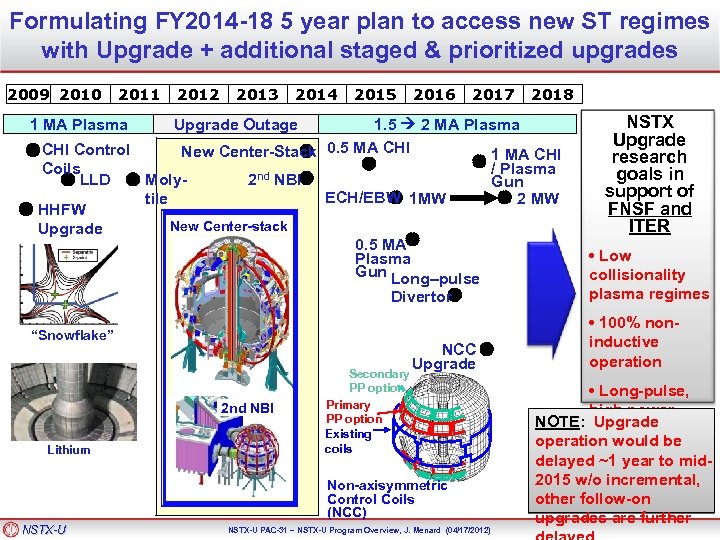
Formulating FY 2014 -18 5 year plan to access new ST regimes with Upgrade + additional staged & prioritized upgrades 2009 2010 2011 2012 2013 2014 2015 2016 2017 2018 1. 5 2 MA Plasma CHI Control New Center-Stack 0. 5 MA CHI 1 MA CHI / Plasma Coils LLD Moly 2 nd NBI Gun ECH/EBW 1 MW 2 MW tile HHFW New Center-stack Upgrade 0. 5 MA Plasma Gun Long–pulse Divertor 1 MA Plasma Upgrade Outage “Snowflake” 2 nd NBI Lithium Secondary PP option Primary PP option Existing coils NCC Upgrade Non-axisymmetric Control Coils (NCC) NSTX-U PAC-31 – NSTX-U Program Overview, J. Menard (04/17/2012) NSTX Upgrade research goals in support of FNSF and ITER • Low collisionality plasma regimes • 100% noninductive operation • Long-pulse, high power NOTE: divertor Upgrade operation would be • Advanced delayed ~1 year to midhigh-b 2015 w/o incremental, scenarios other follow-on upgrades are further
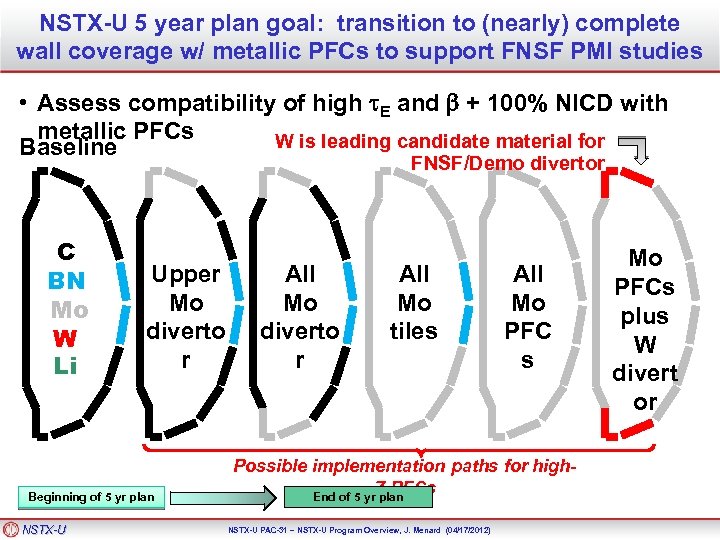
NSTX-U 5 year plan goal: transition to (nearly) complete wall coverage w/ metallic PFCs to support FNSF PMI studies • Assess compatibility of high t. E and b + 100% NICD with metallic PFCs W is leading candidate material for Baseline FNSF/Demo divertor C BN Mo W Li Upper Mo diverto r Beginning of 5 yr plan NSTX-U All Mo diverto r All Mo tiles All Mo PFC s Possible implementation paths for high. Z PFCs End of 5 yr plan NSTX-U PAC-31 – NSTX-U Program Overview, J. Menard (04/17/2012) Mo PFCs plus W divert or
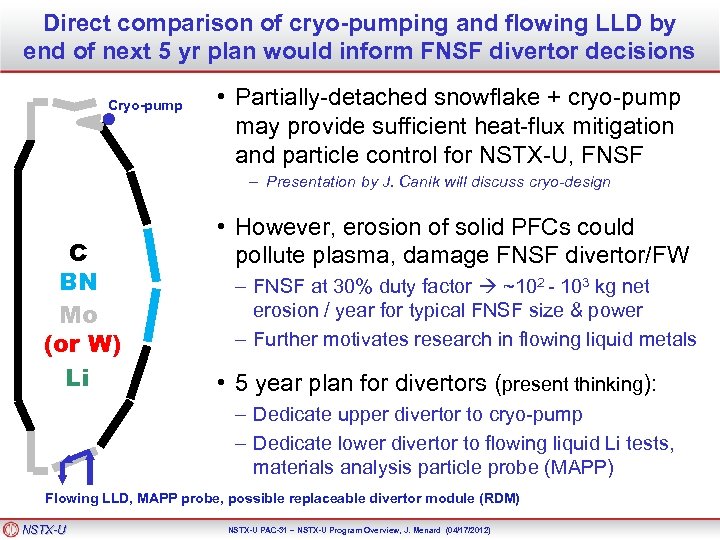
Direct comparison of cryo-pumping and flowing LLD by end of next 5 yr plan would inform FNSF divertor decisions Cryo-pump • Partially-detached snowflake + cryo-pump may provide sufficient heat-flux mitigation and particle control for NSTX-U, FNSF – Presentation by J. Canik will discuss cryo-design C BN Mo (or W) Li • However, erosion of solid PFCs could pollute plasma, damage FNSF divertor/FW – FNSF at 30% duty factor ~102 - 103 kg net erosion / year for typical FNSF size & power – Further motivates research in flowing liquid metals • 5 year plan for divertors (present thinking): – Dedicate upper divertor to cryo-pump – Dedicate lower divertor to flowing liquid Li tests, materials analysis particle probe (MAPP) Flowing LLD, MAPP probe, possible replaceable divertor module (RDM) NSTX-U PAC-31 – NSTX-U Program Overview, J. Menard (04/17/2012)
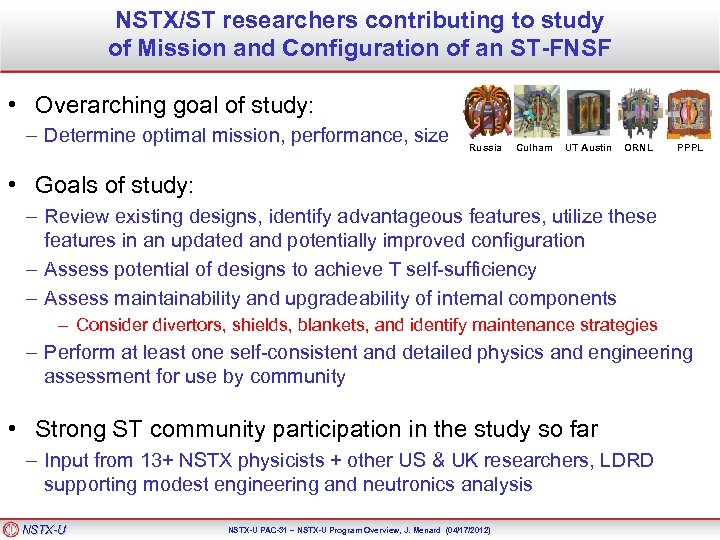
NSTX/ST researchers contributing to study of Mission and Configuration of an ST-FNSF • Overarching goal of study: – Determine optimal mission, performance, size Russia Culham UT Austin ORNL PPPL • Goals of study: – Review existing designs, identify advantageous features, utilize these features in an updated and potentially improved configuration – Assess potential of designs to achieve T self-sufficiency – Assess maintainability and upgradeability of internal components – Consider divertors, shields, blankets, and identify maintenance strategies – Perform at least one self-consistent and detailed physics and engineering assessment for use by community • Strong ST community participation in the study so far – Input from 13+ NSTX physicists + other US & UK researchers, LDRD supporting modest engineering and neutronics analysis NSTX-U PAC-31 – NSTX-U Program Overview, J. Menard (04/17/2012)
Summary: NSTX-U plan strongly supports OFES vision for fusion for next decade emphasizing ITER, PMI, FNSF • Plasma dynamics and control – NSTX performed detailed measurements of turbulence, transport, core/edge stability, and integrating this knowledge to develop advanced high-b ST scenarios – NSTX Upgrade will extend these scenarios to full non-inductive operation with current profile control + advanced stability control w/ application to FNSF, ITER-AT • Plasma material science and technology, support FNSF – NSTX has provided critical data on SOL-width scaling and SOL turbulence, novel high-flux-expansion divertors for heat-flux mitigation, and lithium-based PFCs – NSTX Upgrade will extend these studies to substantially higher heat flux, tpulse – NSTX + Upgrade providing critical data for assessing the ST as potential FNSF • Validated predictive capability, discovery science – Performing leading validation efforts for turbulent transport, RWM stability and 3 D MHD effects, edge turbulence, fast-ion transport from AE - important to ITER, ST – Upgrade will substantially extend range of collisionality, rotation, fast-ion drive, enabling access to a unique parameter regime of order-unity b and low n* NSTX-U PAC-31 – NSTX-U Program Overview, J. Menard (04/17/2012)
Backup material – PAC-29 recommendations NSTX-U PAC-31 – NSTX-U Program Overview, J. Menard (04/17/2012)
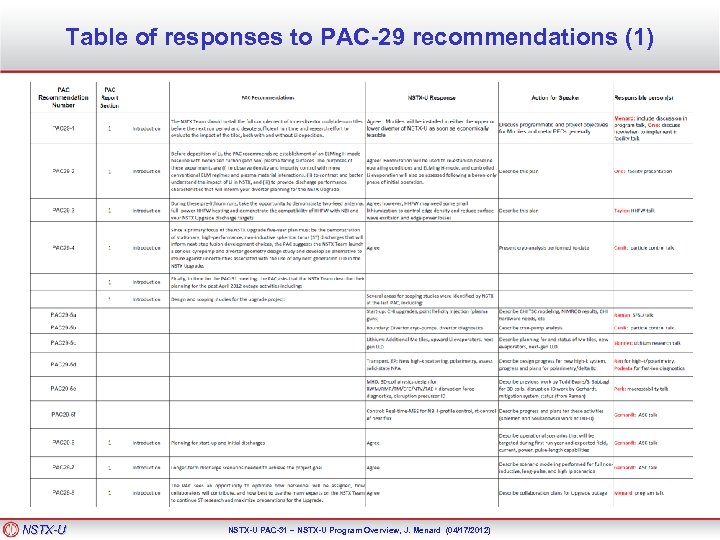
Table of responses to PAC-29 recommendations (1) NSTX-U PAC-31 – NSTX-U Program Overview, J. Menard (04/17/2012)
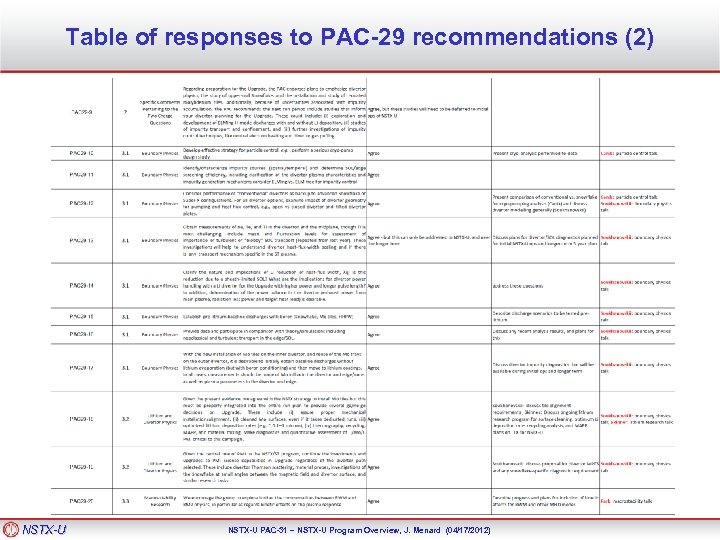
Table of responses to PAC-29 recommendations (2) NSTX-U PAC-31 – NSTX-U Program Overview, J. Menard (04/17/2012)
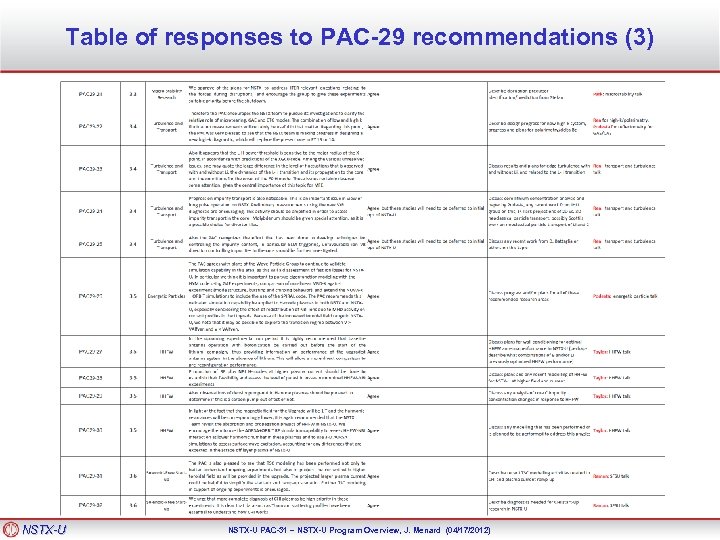
Table of responses to PAC-29 recommendations (3) NSTX-U PAC-31 – NSTX-U Program Overview, J. Menard (04/17/2012)
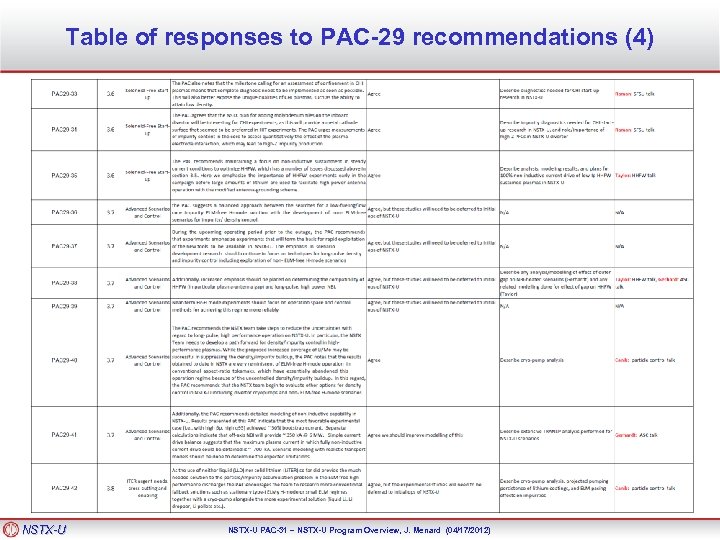
Table of responses to PAC-29 recommendations (4) NSTX-U PAC-31 – NSTX-U Program Overview, J. Menard (04/17/2012)
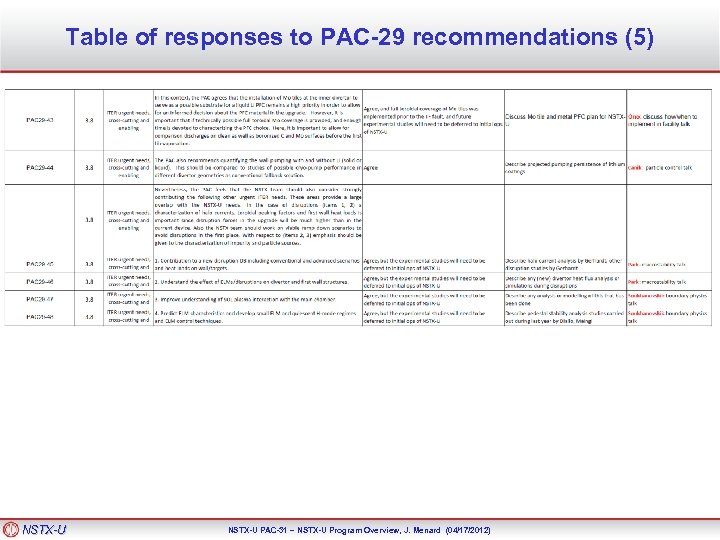
Table of responses to PAC-29 recommendations (5) NSTX-U PAC-31 – NSTX-U Program Overview, J. Menard (04/17/2012)
Backup: LLD results and needs for flowing LLD NSTX-U PAC-31 – NSTX-U Program Overview, J. Menard (04/17/2012)
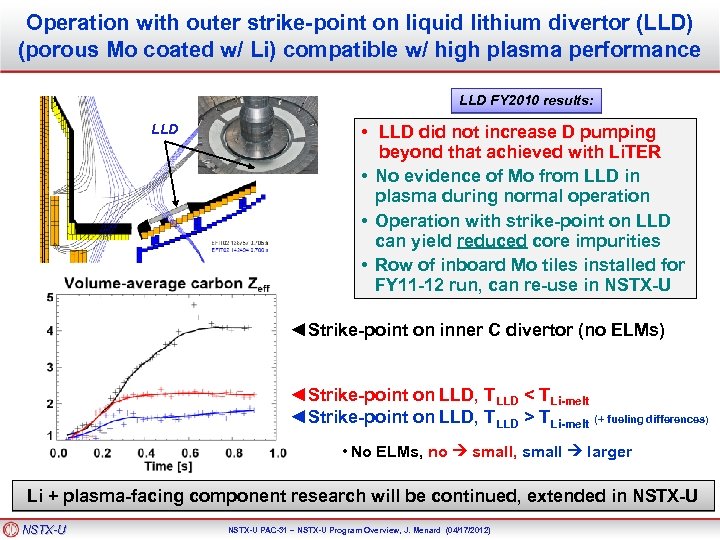
Operation with outer strike-point on liquid lithium divertor (LLD) (porous Mo coated w/ Li) compatible w/ high plasma performance LLD FY 2010 results: LLD • LLD did not increase D pumping beyond that achieved with Li. TER • No evidence of Mo from LLD in plasma during normal operation • Operation with strike-point on LLD can yield reduced core impurities • Row of inboard Mo tiles installed for FY 11 -12 run, can re-use in NSTX-U ◄Strike-point on inner C divertor (no ELMs) ◄Strike-point on LLD, TLLD < TLi-melt ◄Strike-point on LLD, TLLD > TLi-melt (+ fueling differences) • No ELMs, no small, small larger Li + plasma-facing component research will be continued, extended in NSTX-U PAC-31 – NSTX-U Program Overview, J. Menard (04/17/2012)
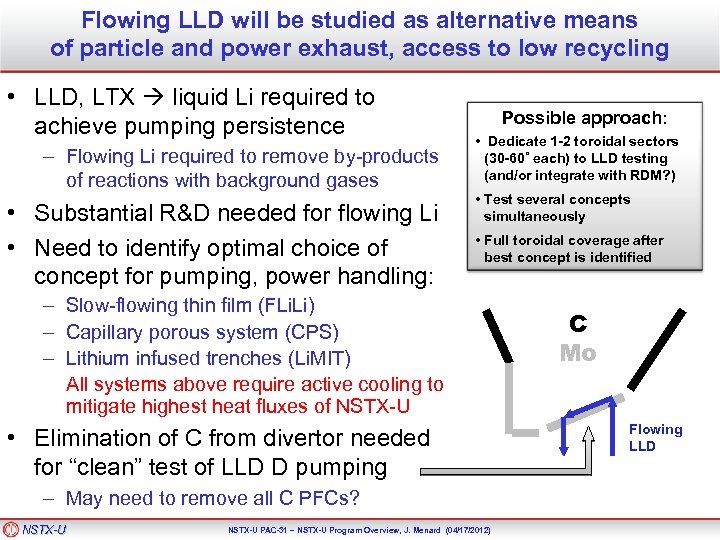
Flowing LLD will be studied as alternative means of particle and power exhaust, access to low recycling • LLD, LTX liquid Li required to achieve pumping persistence – Flowing Li required to remove by-products of reactions with background gases • Substantial R&D needed for flowing Li • Need to identify optimal choice of concept for pumping, power handling: Possible approach: • Dedicate 1 -2 toroidal sectors (30 -60˚ each) to LLD testing (and/or integrate with RDM? ) • Test several concepts simultaneously • Full toroidal coverage after best concept is identified – Slow-flowing thin film (FLi. Li) – Capillary porous system (CPS) – Lithium infused trenches (Li. MIT) All systems above require active cooling to mitigate highest heat fluxes of NSTX-U • Elimination of C from divertor needed for “clean” test of LLD D pumping – May need to remove all C PFCs? NSTX-U PAC-31 – NSTX-U Program Overview, J. Menard (04/17/2012) C Mo Flowing LLD
Backup: summary of collaboration activities NSTX-U PAC-31 – NSTX-U Program Overview, J. Menard (04/17/2012)
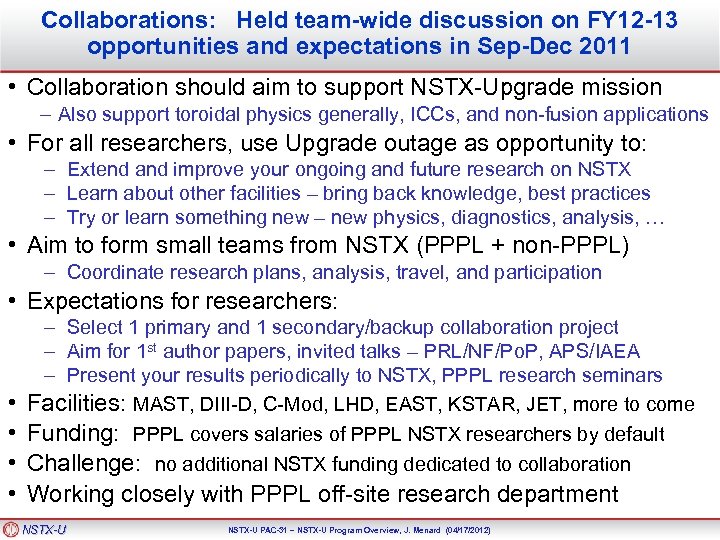
Collaborations: Held team-wide discussion on FY 12 -13 opportunities and expectations in Sep-Dec 2011 • Collaboration should aim to support NSTX-Upgrade mission – Also support toroidal physics generally, ICCs, and non-fusion applications • For all researchers, use Upgrade outage as opportunity to: – Extend and improve your ongoing and future research on NSTX – Learn about other facilities – bring back knowledge, best practices – Try or learn something new – new physics, diagnostics, analysis, … • Aim to form small teams from NSTX (PPPL + non-PPPL) – Coordinate research plans, analysis, travel, and participation • Expectations for researchers: – Select 1 primary and 1 secondary/backup collaboration project – Aim for 1 st author papers, invited talks – PRL/NF/Po. P, APS/IAEA – Present your results periodically to NSTX, PPPL research seminars • Facilities: MAST, DIII-D, C-Mod, LHD, EAST, KSTAR, JET, more to come • Funding: PPPL covers salaries of PPPL NSTX researchers by default • Challenge: no additional NSTX funding dedicated to collaboration • Working closely with PPPL off-site research department NSTX-U PAC-31 – NSTX-U Program Overview, J. Menard (04/17/2012)
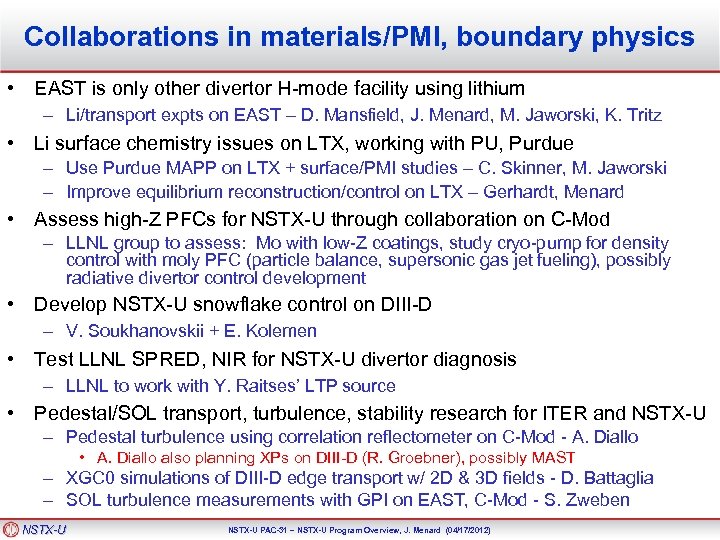
Collaborations in materials/PMI, boundary physics • EAST is only other divertor H-mode facility using lithium – Li/transport expts on EAST – D. Mansfield, J. Menard, M. Jaworski, K. Tritz • Li surface chemistry issues on LTX, working with PU, Purdue – Use Purdue MAPP on LTX + surface/PMI studies – C. Skinner, M. Jaworski – Improve equilibrium reconstruction/control on LTX – Gerhardt, Menard • Assess high-Z PFCs for NSTX-U through collaboration on C-Mod – LLNL group to assess: Mo with low-Z coatings, study cryo-pump for density control with moly PFC (particle balance, supersonic gas jet fueling), possibly radiative divertor control development • Develop NSTX-U snowflake control on DIII-D – V. Soukhanovskii + E. Kolemen • Test LLNL SPRED, NIR for NSTX-U divertor diagnosis – LLNL to work with Y. Raitses’ LTP source • Pedestal/SOL transport, turbulence, stability research for ITER and NSTX-U – Pedestal turbulence using correlation reflectometer on C-Mod - A. Diallo • A. Diallo also planning XPs on DIII-D (R. Groebner), possibly MAST – XGC 0 simulations of DIII-D edge transport w/ 2 D & 3 D fields - D. Battaglia – SOL turbulence measurements with GPI on EAST, C-Mod - S. Zweben NSTX-U PAC-31 – NSTX-U Program Overview, J. Menard (04/17/2012)
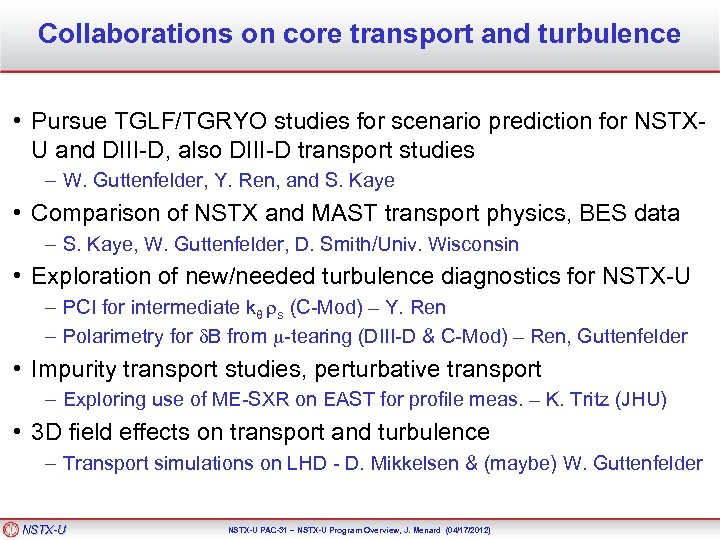
Collaborations on core transport and turbulence • Pursue TGLF/TGRYO studies for scenario prediction for NSTXU and DIII-D, also DIII-D transport studies – W. Guttenfelder, Y. Ren, and S. Kaye • Comparison of NSTX and MAST transport physics, BES data – S. Kaye, W. Guttenfelder, D. Smith/Univ. Wisconsin • Exploration of new/needed turbulence diagnostics for NSTX-U – PCI for intermediate kq rs (C-Mod) – Y. Ren – Polarimetry for d. B from m-tearing (DIII-D & C-Mod) – Ren, Guttenfelder • Impurity transport studies, perturbative transport – Exploring use of ME-SXR on EAST for profile meas. – K. Tritz (JHU) • 3 D field effects on transport and turbulence – Transport simulations on LHD - D. Mikkelsen & (maybe) W. Guttenfelder NSTX-U PAC-31 – NSTX-U Program Overview, J. Menard (04/17/2012)
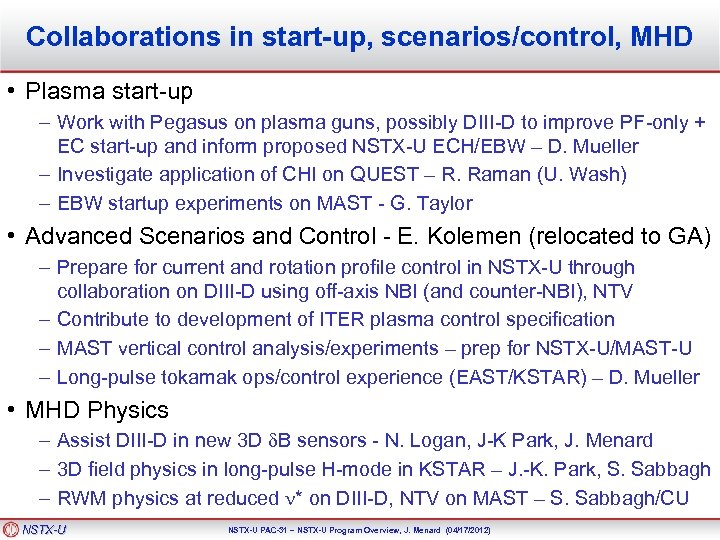
Collaborations in start-up, scenarios/control, MHD • Plasma start-up – Work with Pegasus on plasma guns, possibly DIII-D to improve PF-only + EC start-up and inform proposed NSTX-U ECH/EBW – D. Mueller – Investigate application of CHI on QUEST – R. Raman (U. Wash) – EBW startup experiments on MAST - G. Taylor • Advanced Scenarios and Control - E. Kolemen (relocated to GA) – Prepare for current and rotation profile control in NSTX-U through collaboration on DIII-D using off-axis NBI (and counter-NBI), NTV – Contribute to development of ITER plasma control specification – MAST vertical control analysis/experiments – prep for NSTX-U/MAST-U – Long-pulse tokamak ops/control experience (EAST/KSTAR) – D. Mueller • MHD Physics – Assist DIII-D in new 3 D d. B sensors - N. Logan, J-K Park, J. Menard – 3 D field physics in long-pulse H-mode in KSTAR – J. -K. Park, S. Sabbagh – RWM physics at reduced n* on DIII-D, NTV on MAST – S. Sabbagh/CU NSTX-U PAC-31 – NSTX-U Program Overview, J. Menard (04/17/2012)
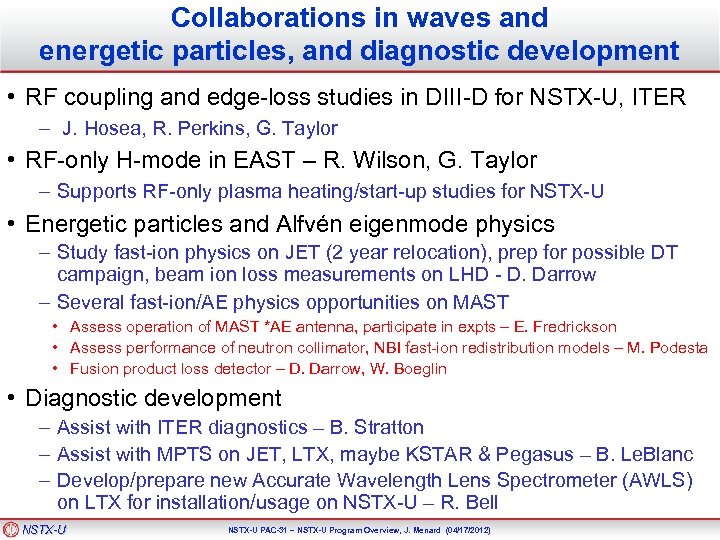
Collaborations in waves and energetic particles, and diagnostic development • RF coupling and edge-loss studies in DIII-D for NSTX-U, ITER – J. Hosea, R. Perkins, G. Taylor • RF-only H-mode in EAST – R. Wilson, G. Taylor – Supports RF-only plasma heating/start-up studies for NSTX-U • Energetic particles and Alfvén eigenmode physics – Study fast-ion physics on JET (2 year relocation), prep for possible DT campaign, beam ion loss measurements on LHD - D. Darrow – Several fast-ion/AE physics opportunities on MAST • Assess operation of MAST *AE antenna, participate in expts – E. Fredrickson • Assess performance of neutron collimator, NBI fast-ion redistribution models – M. Podesta • Fusion product loss detector – D. Darrow, W. Boeglin • Diagnostic development – Assist with ITER diagnostics – B. Stratton – Assist with MPTS on JET, LTX, maybe KSTAR & Pegasus – B. Le. Blanc – Develop/prepare new Accurate Wavelength Lens Spectrometer (AWLS) on LTX for installation/usage on NSTX-U – R. Bell NSTX-U PAC-31 – NSTX-U Program Overview, J. Menard (04/17/2012)
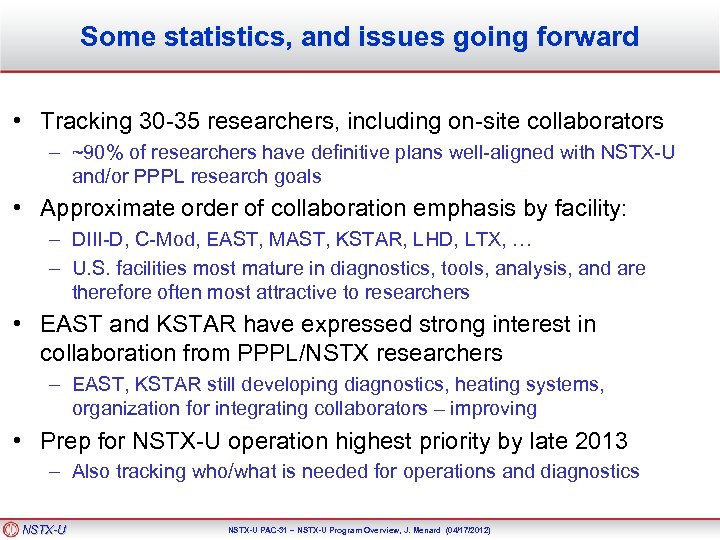
Some statistics, and issues going forward • Tracking 30 -35 researchers, including on-site collaborators – ~90% of researchers have definitive plans well-aligned with NSTX-U and/or PPPL research goals • Approximate order of collaboration emphasis by facility: – DIII-D, C-Mod, EAST, MAST, KSTAR, LHD, LTX, … – U. S. facilities most mature in diagnostics, tools, analysis, and are therefore often most attractive to researchers • EAST and KSTAR have expressed strong interest in collaboration from PPPL/NSTX researchers – EAST, KSTAR still developing diagnostics, heating systems, organization for integrating collaborators – improving • Prep for NSTX-U operation highest priority by late 2013 – Also tracking who/what is needed for operations and diagnostics NSTX-U PAC-31 – NSTX-U Program Overview, J. Menard (04/17/2012)
Additional backup NSTX-U PAC-31 – NSTX-U Program Overview, J. Menard (04/17/2012)
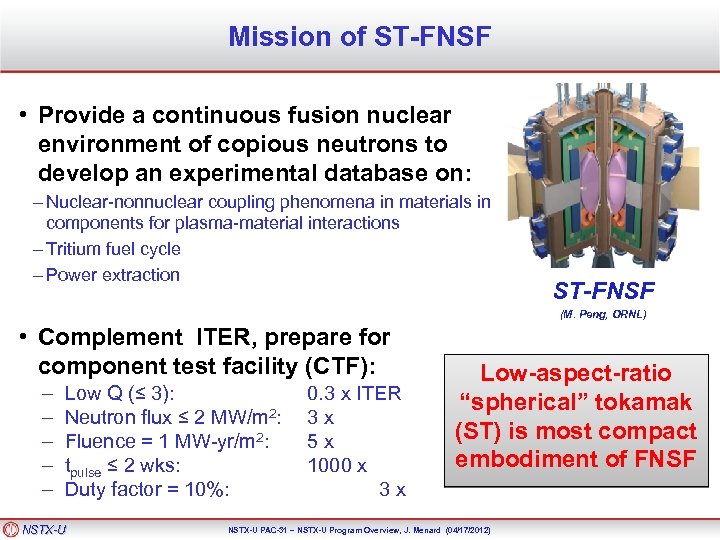
Mission of ST-FNSF • Provide a continuous fusion nuclear environment of copious neutrons to develop an experimental database on: – Nuclear-nonnuclear coupling phenomena in materials in components for plasma-material interactions – Tritium fuel cycle – Power extraction ST-FNSF (M. Peng, ORNL) • Complement ITER, prepare for component test facility (CTF): – – – Low Q (≤ 3): Neutron flux ≤ 2 MW/m 2: Fluence = 1 MW-yr/m 2: tpulse ≤ 2 wks: Duty factor = 10%: NSTX-U 0. 3 x ITER 3 x 5 x 1000 x 3 x Low-aspect-ratio “spherical” tokamak (ST) is most compact embodiment of FNSF NSTX-U PAC-31 – NSTX-U Program Overview, J. Menard (04/17/2012)
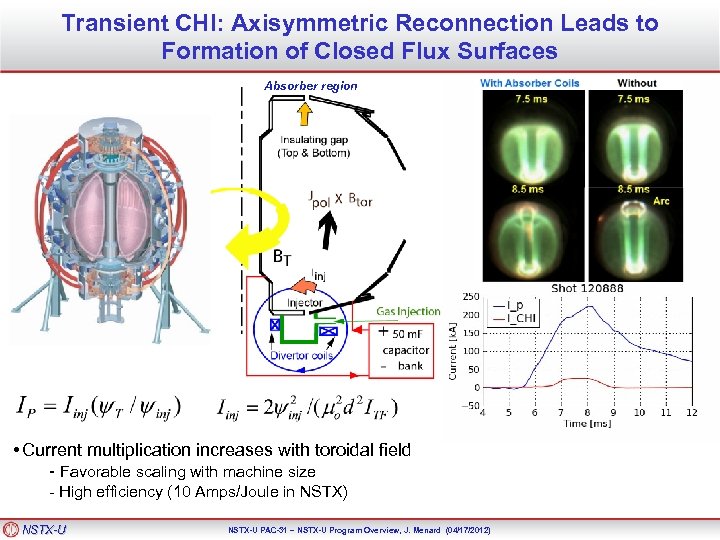
Transient CHI: Axisymmetric Reconnection Leads to Formation of Closed Flux Surfaces Absorber region • Current multiplication increases with toroidal field - Favorable scaling with machine size - High efficiency (10 Amps/Joule in NSTX) NSTX-U PAC-31 – NSTX-U Program Overview, J. Menard (04/17/2012)
Скачать презентацию NSTX-U Supported by NSTX-U Research Program Overview FY
06ba97b52385d1ba70972e66636dd054.ppt