 Скачать презентацию NSTX-U Supported by Ideas For and Comments on
17e7ffa9449c71ed8ad9cc955497943f.ppt
- Количество слайдов: 17



NSTX-U Supported by Ideas For, and Comments on, Disruption Theory/Modeling Coll of Wm & Mary Columbia U Comp. X General Atomics FIU INL Johns Hopkins U LANL LLNL Lodestar MIT Lehigh U Nova Photonics ORNL PPPL Princeton U Purdue U SNL Think Tank, Inc. UC Davis UC Irvine UCLA UCSD U Colorado U Illinois U Maryland U Rochester U Tennessee U Tulsa U Washington U Wisconsin X Science LLC Stefan Gerhardt Meeting name Location Date Culham Sci Ctr York U Chubu U Fukui U Hiroshima U Hyogo U Kyoto U Kyushu Tokai U NIFS Niigata U U Tokyo JAEA Inst for Nucl Res, Kiev Ioffe Inst TRINITI Chonbuk Natl U NFRI KAIST POSTECH Seoul Natl U ASIPP CIEMAT FOM Inst DIFFER ENEA, Frascati CEA, Cadarache IPP, Jülich IPP, Garching ASCR, Czech Rep
To. C • About the NSTX 5 -Year plan for disruptions. • A cautionary note on NSTX disruptions • A major disruption example that might be amenable to modeling. • Comments on NSTX halo current measurements and “experimentalist driven” ideas for further research. • Trying to follow Amitava’s admonition to look for short term projects. • Not including RWMs, NTM, LMs, and other “initiating events” typically studied by CU group, J. -K. Park, JEM, GA, . . . NSTX-U Meeting name – abbreviated presentation title, abbreviated author name (? ? /20? ? )
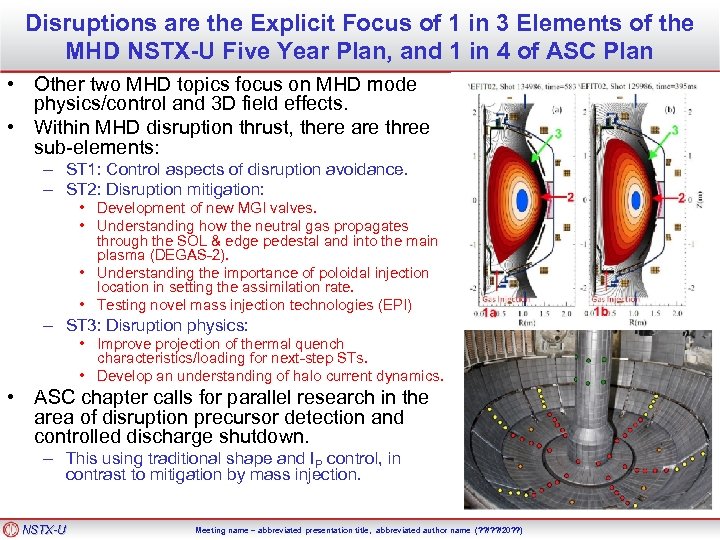
Disruptions are the Explicit Focus of 1 in 3 Elements of the MHD NSTX-U Five Year Plan, and 1 in 4 of ASC Plan • Other two MHD topics focus on MHD mode physics/control and 3 D field effects. • Within MHD disruption thrust, there are three sub-elements: – ST 1: Control aspects of disruption avoidance. – ST 2: Disruption mitigation: • Development of new MGI valves. • Understanding how the neutral gas propagates through the SOL & edge pedestal and into the main plasma (DEGAS-2). • Understanding the importance of poloidal injection location in setting the assimilation rate. • Testing novel mass injection technologies (EPI) – ST 3: Disruption physics: • Improve projection of thermal quench characteristics/loading for next-step STs. • Develop an understanding of halo current dynamics. • ASC chapter calls for parallel research in the area of disruption precursor detection and controlled discharge shutdown. – This using traditional shape and IP control, in contrast to mitigation by mass injection. NSTX-U Meeting name – abbreviated presentation title, abbreviated author name (? ? /20? ? )
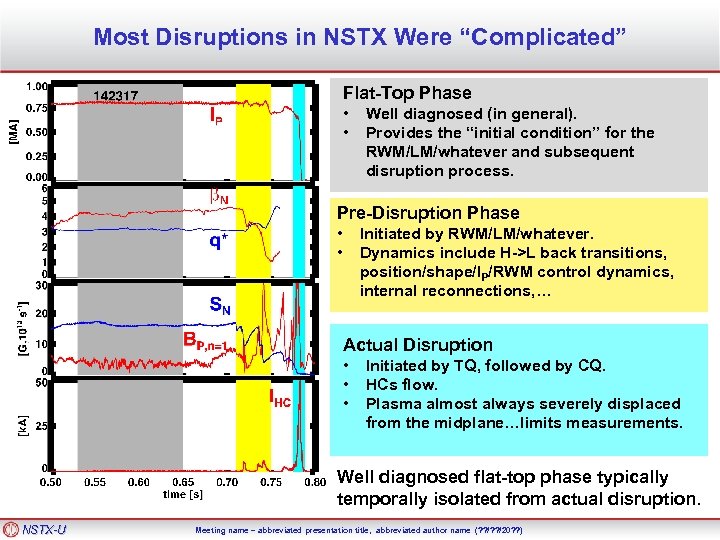
Most Disruptions in NSTX Were “Complicated” Flat-Top Phase • • Well diagnosed (in general). Provides the “initial condition” for the RWM/LM/whatever and subsequent disruption process. Pre-Disruption Phase • • Initiated by RWM/LM/whatever. Dynamics include H->L back transitions, position/shape/IP/RWM control dynamics, internal reconnections, … Actual Disruption • • • Initiated by TQ, followed by CQ. HCs flow. Plasma almost always severely displaced from the midplane…limits measurements. Well diagnosed flat-top phase typically temporally isolated from actual disruption. NSTX-U Meeting name – abbreviated presentation title, abbreviated author name (? ? /20? ? )
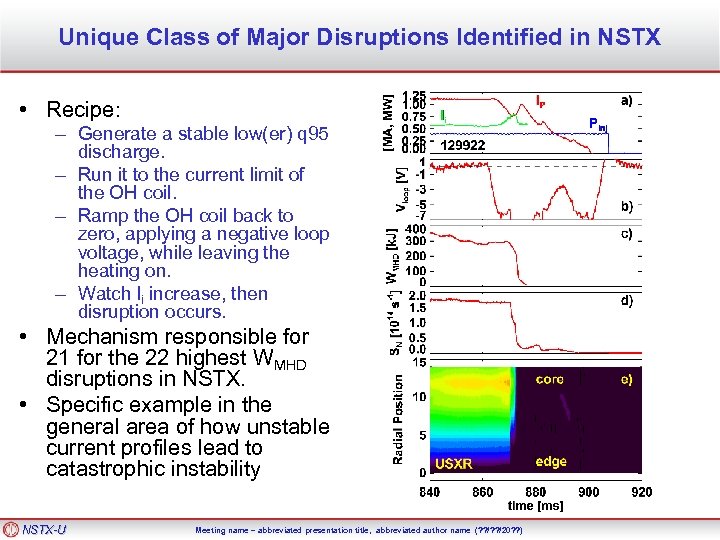
Unique Class of Major Disruptions Identified in NSTX • Recipe: – Generate a stable low(er) q 95 discharge. – Run it to the current limit of the OH coil. – Ramp the OH coil back to zero, applying a negative loop voltage, while leaving the heating on. – Watch li increase, then disruption occurs. • Mechanism responsible for 21 for the 22 highest WMHD disruptions in NSTX. • Specific example in the general area of how unstable current profiles lead to catastrophic instability NSTX-U Meeting name – abbreviated presentation title, abbreviated author name (? ? /20? ? )
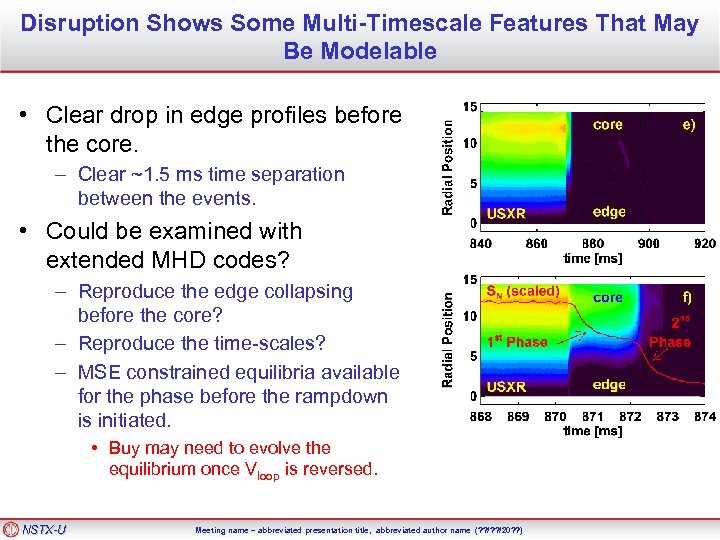
Disruption Shows Some Multi-Timescale Features That May Be Modelable • Clear drop in edge profiles before the core. – Clear ~1. 5 ms time separation between the events. • Could be examined with extended MHD codes? – Reproduce the edge collapsing before the core? – Reproduce the time-scales? – MSE constrained equilibria available for the phase before the rampdown is initiated. • Buy may need to evolve the equilibrium once Vloop is reversed. NSTX-U Meeting name – abbreviated presentation title, abbreviated author name (? ? /20? ? )
On To Halo Currents NSTX-U Meeting name – abbreviated presentation title, abbreviated author name (? ? /20? ? )
![Toroidal Angle f [degrees] Strongly Non-Axisymmetric Halo Currents Detected in the NSTX Lower Divertor](https://present5.com/presentation/17e7ffa9449c71ed8ad9cc955497943f/image-8.jpg "Toroidal Angle f [degrees] Strongly Non-Axisymmetric Halo Currents Detected in the NSTX Lower Divertor")
Toroidal Angle f [degrees] Strongly Non-Axisymmetric Halo Currents Detected in the NSTX Lower Divertor 300 141687 Row 3 200 100 0 0. 408 0. 410 Time [s] 0. 412 0. 414 • Measurements from an array of instrumented tiles – Same poloidal angle – Distributed toroidally • Infer strong toroidal asymmetry, often with significant rotation, at locations where currents enter the divertor floor. Tiles NSTX-U Meeting name – abbreviated presentation title, abbreviated author name (? ? /20? ? ) 10
Li I Camera Images Confirm Rotation of Structure Four Times • Neutral lithium light most indicative of surface interactions NSTX-U Meeting name – abbreviated presentation title, abbreviated author name (? ? /20? ? )
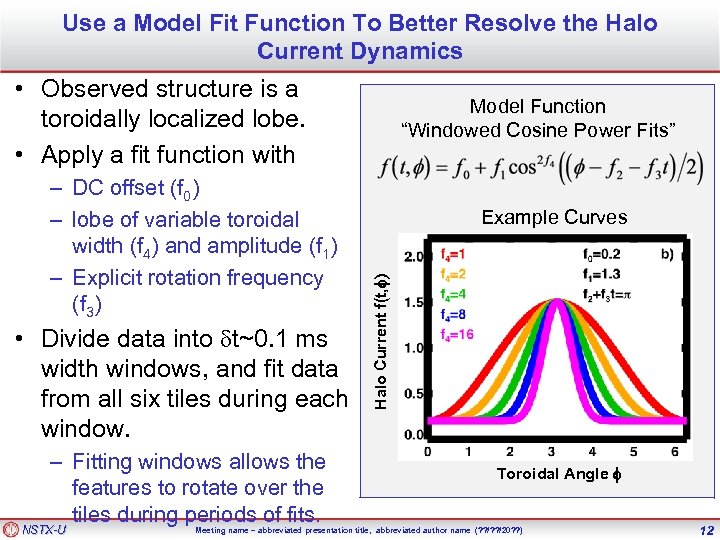
Use a Model Fit Function To Better Resolve the Halo Current Dynamics • Observed structure is a toroidally localized lobe. • Apply a fit function with • Divide data into dt~0. 1 ms width windows, and fit data from all six tiles during each window. – Fitting windows allows the features to rotate over the tiles during periods of fits. NSTX-U Example Curves Halo Current f(t, f) – DC offset (f 0) – lobe of variable toroidal width (f 4) and amplitude (f 1) – Explicit rotation frequency (f 3) Model Function “Windowed Cosine Power Fits” Toroidal Angle f Meeting name – abbreviated presentation title, abbreviated author name (? ? /20? ? ) 12
![Toroidal Angle f [degrees] Dominant Structure of the Halo Current is a Rotating Toroidally](https://present5.com/presentation/17e7ffa9449c71ed8ad9cc955497943f/image-11.jpg "Toroidal Angle f [degrees] Dominant Structure of the Halo Current is a Rotating Toroidally")
Toroidal Angle f [degrees] Dominant Structure of the Halo Current is a Rotating Toroidally Localized Lobe of Current 300 141687 Row 3 200 100 0 0. 408 0. 410 Time [s] 0. 412 0. 414 max(JHC) min(JHC) f 0 f 1 NSTX-U Meeting name – abbreviated presentation title, abbreviated author name (? ? /20? ? ) 13
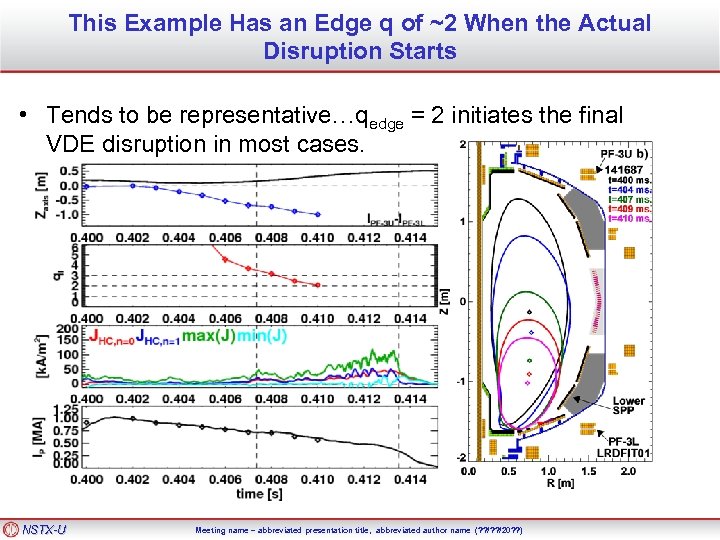
This Example Has an Edge q of ~2 When the Actual Disruption Starts • Tends to be representative…qedge = 2 initiates the final VDE disruption in most cases. NSTX-U Meeting name – abbreviated presentation title, abbreviated author name (? ? /20? ? )
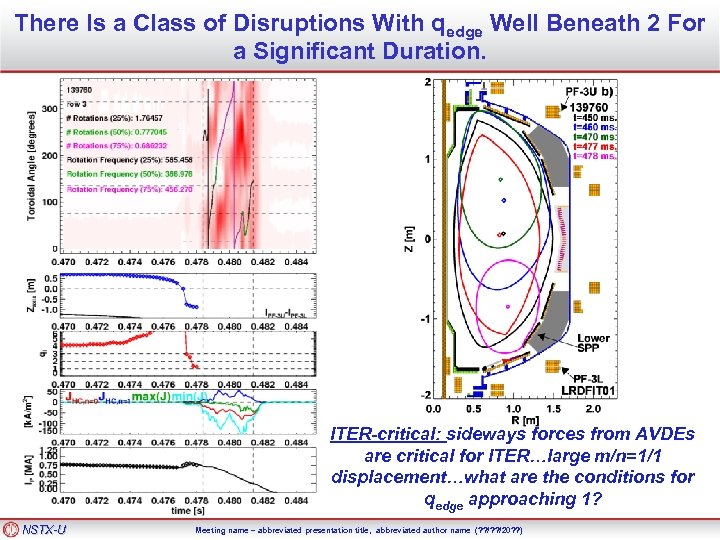
There Is a Class of Disruptions With qedge Well Beneath 2 For a Significant Duration. ITER-critical: sideways forces from AVDEs are critical for ITER…large m/n=1/1 displacement…what are the conditions for qedge approaching 1? NSTX-U Meeting name – abbreviated presentation title, abbreviated author name (? ? /20? ? )
Videos Confirm that the Plasma Resides on the Upper Divertor Before Slamming Downward Onto the Lower SPPs NSTX-U Meeting name – abbreviated presentation title, abbreviated author name (? ? /20? ? )
Key Messages • The halo current pattern is 3 D (strongly non-axisymmetric), and can represent a substantial fraction of the plasma current. • There are tantalizing hints about the equilibria of these VDEs before/during the halo current phase, but these reconstructions are not complete in their physics. • Desirable tools: – Routine axisymmetric equivalent reconstructions, allowing for currents outside the separatrix. • Believe it is in EFIT, but not LRDFIT. • Must account for large, potentially 3 D, vacuum chamber currents. • How do you treat the halo width? – Fully 3 D equilibria. • Though candidly unclear how we would constrain them. • Potential topic: Define a limited, semi-realistic set of halo current sensors or other measurements that are most appropriate for these constraints. – Otherwise, likely to just add more shunt tiles in the fairly obvious pattern discussed before. – For instance, what measurements in the structures would be most important? NSTX-U Meeting name – abbreviated presentation title, abbreviated author name (? ? /20? ? )
NSTX-U Meeting name – abbreviated presentation title, abbreviated author name (? ? /20? ? )
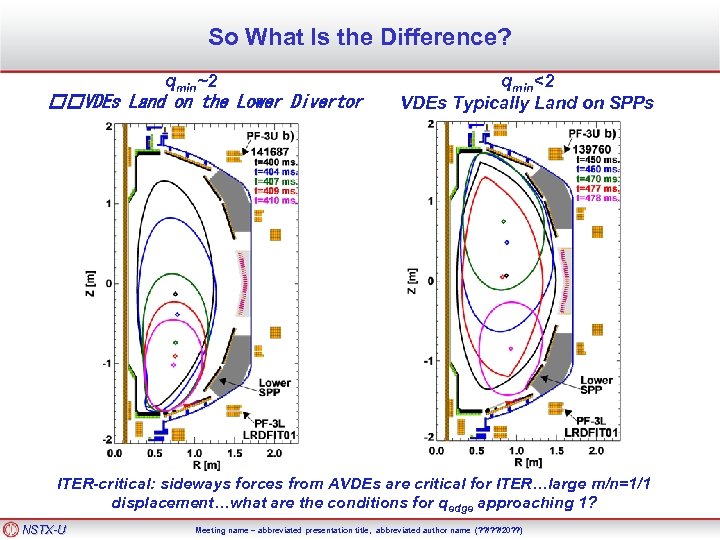
So What Is the Difference? qmin~2 VDEs Land on the Lower Divertor qmin<2 VDEs Typically Land on SPPs ITER-critical: sideways forces from AVDEs are critical for ITER…large m/n=1/1 displacement…what are the conditions for qedge approaching 1? NSTX-U Meeting name – abbreviated presentation title, abbreviated author name (? ? /20? ? )
Скачать презентацию NSTX-U Supported by Ideas For and Comments on
17e7ffa9449c71ed8ad9cc955497943f.ppt