 Скачать презентацию NSTX-U Supported by Automatic Rampdowns Coll of Wm
e13cc028a267ff13f9de0e4e9e24d6f7.ppt
- Количество слайдов: 7



NSTX-U Supported by Automatic Rampdowns Coll of Wm & Mary Columbia U Comp. X General Atomics FIU INL Johns Hopkins U LANL LLNL Lodestar MIT Lehigh U Nova Photonics ORNL PPPL Princeton U Purdue U SNL Think Tank, Inc. UC Davis UC Irvine UCLA UCSD U Colorado U Illinois U Maryland U Rochester U Tennessee U Tulsa U Washington U Wisconsin X Science LLC S. Gerhardt, et al. and the NSTX Research Team Meeting name Location Date Culham Sci Ctr York U Chubu U Fukui U Hiroshima U Hyogo U Kyoto U Kyushu Tokai U NIFS Niigata U U Tokyo JAEA Inst for Nucl Res, Kiev Ioffe Inst TRINITI Chonbuk Natl U NFRI KAIST POSTECH Seoul Natl U ASIPP CIEMAT FOM Inst DIFFER ENEA, Frascati CEA, Cadarache IPP, Jülich IPP, Garching ASCR, Czech Rep
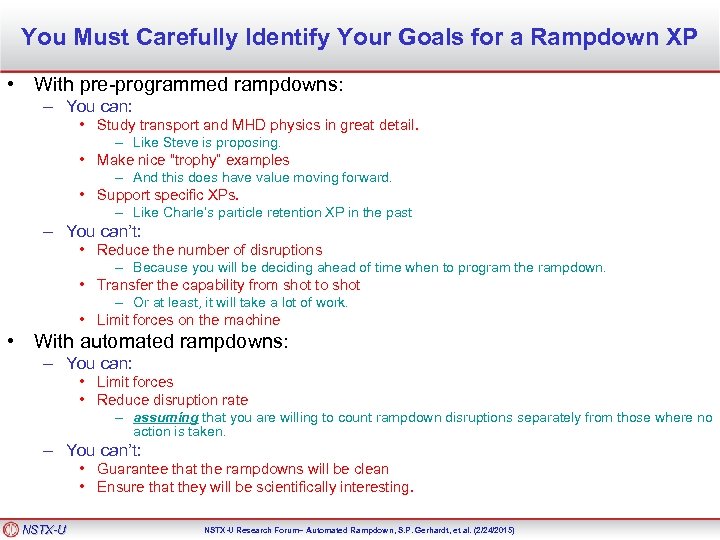
You Must Carefully Identify Your Goals for a Rampdown XP • With pre-programmed rampdowns: – You can: • Study transport and MHD physics in great detail. – Like Steve is proposing. • Make nice “trophy” examples – And this does have value moving forward. • Support specific XPs. – Like Charle’s particle retention XP in the past – You can’t: • Reduce the number of disruptions – Because you will be deciding ahead of time when to program the rampdown. • Transfer the capability from shot to shot – Or at least, it will take a lot of work. • Limit forces on the machine • With automated rampdowns: – You can: • Limit forces • Reduce disruption rate – assuming that you are willing to count rampdown disruptions separately from those where no action is taken. – You can’t: • Guarantee that the rampdowns will be clean • Ensure that they will be scientifically interesting. NSTX-U Research Forum– Automated Rampdown, S. P. Gerhardt, et al. (2/24/2015)
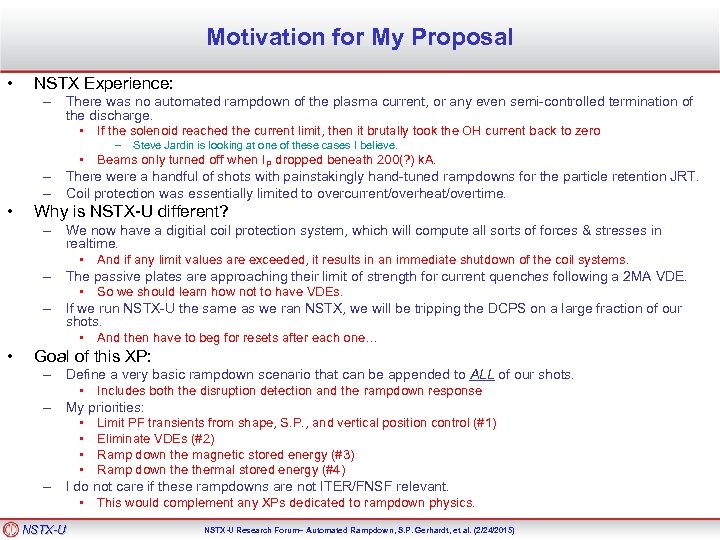
Motivation for My Proposal • NSTX Experience: – There was no automated rampdown of the plasma current, or any even semi-controlled termination of the discharge. • If the solenoid reached the current limit, then it brutally took the OH current back to zero – – – • Steve Jardin is looking at one of these cases I believe. • Beams only turned off when I P dropped beneath 200(? ) k. A. There were a handful of shots with painstakingly hand-tuned rampdowns for the particle retention JRT. Coil protection was essentially limited to overcurrent/overheat/overtime. Why is NSTX-U different? – We now have a digitial coil protection system, which will compute all sorts of forces & stresses in realtime. – – • • And if any limit values are exceeded, it results in an immediate shutdown of the coil systems. The passive plates are approaching their limit of strength for current quenches following a 2 MA VDE. • So we should learn how not to have VDEs. If we run NSTX-U the same as we ran NSTX, we will be tripping the DCPS on a large fraction of our shots. • And then have to beg for resets after each one… Goal of this XP: – Define a very basic rampdown scenario that can be appended to ALL of our shots. – – • Includes both the disruption detection and the rampdown response My priorities: • Limit PF transients from shape, S. P. , and vertical position control (#1) • Eliminate VDEs (#2) • Ramp down the magnetic stored energy (#3) • Ramp down thermal stored energy (#4) I do not care if these rampdowns are not ITER/FNSF relevant. • This would complement any XPs dedicated to rampdown physics. NSTX-U Research Forum– Automated Rampdown, S. P. Gerhardt, et al. (2/24/2015)
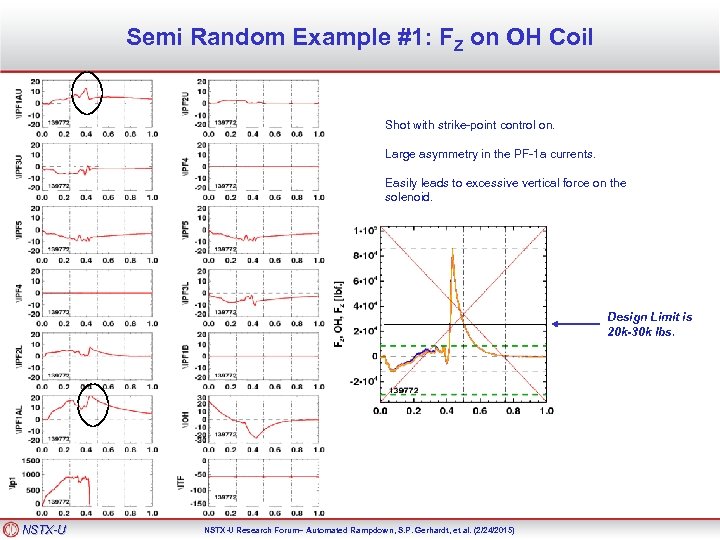
Semi Random Example #1: FZ on OH Coil Shot with strike-point control on. Large asymmetry in the PF-1 a currents. Easily leads to excessive vertical force on the solenoid. Design Limit is 20 k-30 k lbs. NSTX-U Research Forum– Automated Rampdown, S. P. Gerhardt, et al. (2/24/2015)
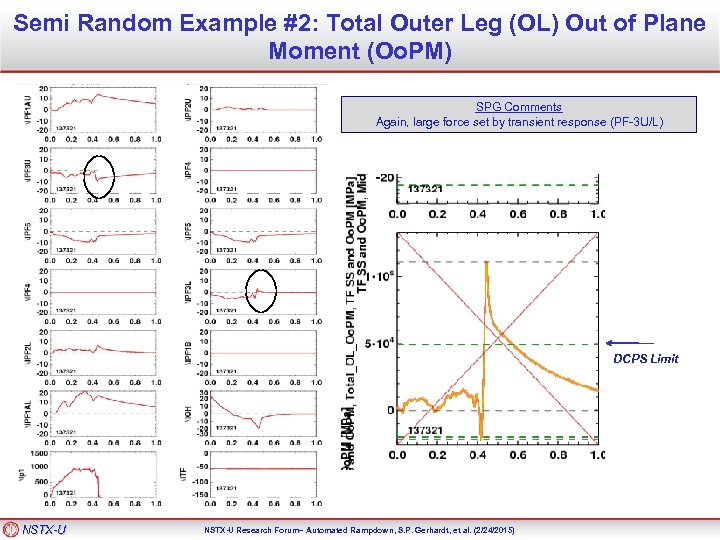
Semi Random Example #2: Total Outer Leg (OL) Out of Plane Moment (Oo. PM) SPG Comments Again, large force set by transient response (PF-3 U/L) DCPS Limit NSTX-U Research Forum– Automated Rampdown, S. P. Gerhardt, et al. (2/24/2015)
Software Spec. has been Drafted • Bring a subset of highly reliable realtime signals into the system category, and use these to assess if a shutdown should be initiated. – IP error, BP, n=1 amplitude, vertical motion detector, operator trigger, … – This is all perfectly well defined at this point…read the spec. • When it is initiated, make specific changes in a number of other categories (this part is less well specified at present): – – – IP-OH: ramp down the plasma current over a predefined duration. System: transition to shape category control of the PF voltage requests Shape: Limit on the inner wall. NBI: turn the beams off (probably just immediately off at first). RWMEF: Turn the SPAs off GIS: less sure… • Note: this is NOT a general exception handling mechanism. – We should look into that, but I don’t want to bog this down. NSTX-U Research Forum– Automated Rampdown, S. P. Gerhardt, et al. (2/24/2015)
General Plan Towards an XP • Need to finalize the software requirements, especially for the phase transitions. – I could use some practical help in assessing how the system and shape category phase transitions should be handled from a PCS specific perspective. • • Finish code. Run in the background: check it is alive Run the XMP: just to check that the most basic functions work. Optimization within this XP: – Pick an H-mode scenario of interest (probably the fiducial, whatever that ends up being). – Using the operator trigger, spend ~10 shots optimizing the rampdown for the allowed parameters (IP ramp-rate, shape change timing, …). – Deliberately trigger disruptions ( n=1 fields, turning off vertical control), and see system respond (5 shots). – Then append rampdown scenario to a second scenario of interest (5 shots). NSTX-U Research Forum– Automated Rampdown, S. P. Gerhardt, et al. (2/24/2015)
Скачать презентацию NSTX-U Supported by Automatic Rampdowns Coll of Wm
e13cc028a267ff13f9de0e4e9e24d6f7.ppt