 Скачать презентацию NSTX-U Coll of Wm Mary Columbia U
df399e04e002bfb391918b753efd34f3.ppt
- Количество слайдов: 18



NSTX-U Coll of Wm & Mary Columbia U Comp. X General Atomics FIU INL Johns Hopkins U LANL LLNL Lodestar MIT Lehigh U Nova Photonics Old Dominion ORNL PPPL Princeton U Purdue U SNL Think Tank, Inc. UC Davis UC Irvine UCLA UCSD U Colorado U Illinois U Maryland U Rochester U Tennessee U Tulsa U Washington U Wisconsin X Science LLC NSTX-U Supported by NSTX-U Engineering Operations Al von. Halle January 28, 2015 Culham Sci Ctr York U Chubu U Fukui U Hiroshima U Hyogo U Kyoto U Kyushu Tokai U NIFS Niigata U U Tokyo JAEA Inst for Nucl Res, Kiev Ioffe Inst TRINITI Chonbuk Natl U NFRI KAIST POSTECH Seoul Natl U ASIPP CIEMAT FOM Inst DIFFER ENEA, Frascati CEA, Cadarache IPP, Jülich IPP, Garching ASCR, Czech Rep Engineering Operations January 28, 2015
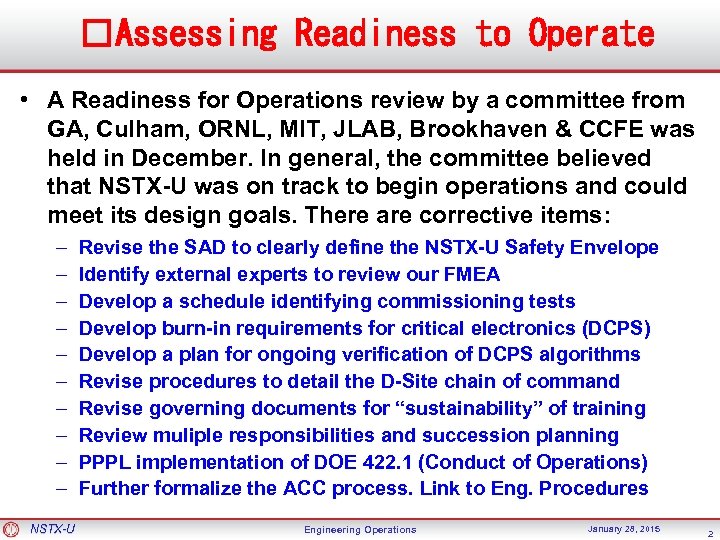
Assessing Readiness to Operate • A Readiness for Operations review by a committee from GA, Culham, ORNL, MIT, JLAB, Brookhaven & CCFE was held in December. In general, the committee believed that NSTX-U was on track to begin operations and could meet its design goals. There are corrective items: – – – – – NSTX-U Revise the SAD to clearly define the NSTX-U Safety Envelope Identify external experts to review our FMEA Develop a schedule identifying commissioning tests Develop burn-in requirements for critical electronics (DCPS) Develop a plan for ongoing verification of DCPS algorithms Revise procedures to detail the D-Site chain of command Revise governing documents for “sustainability” of training Review muliple responsibilities and succession planning PPPL implementation of DOE 422. 1 (Conduct of Operations) Further formalize the ACC process. Link to Eng. Procedures Engineering Operations January 28, 2015 2
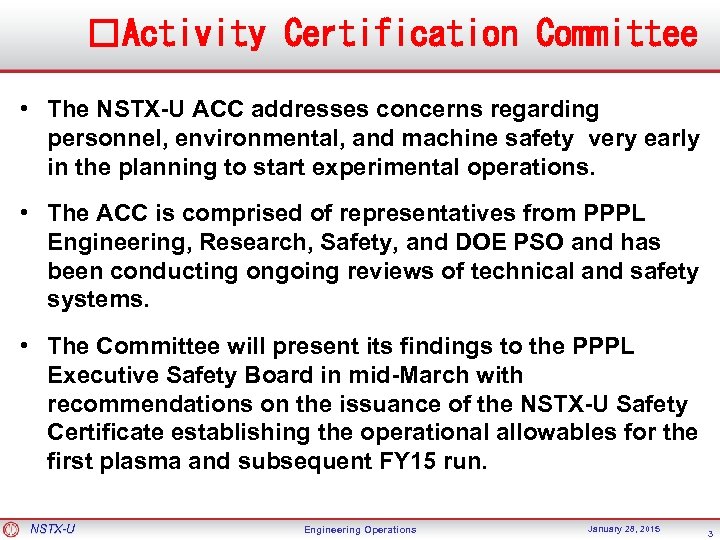
Activity Certification Committee • The NSTX-U ACC addresses concerns regarding personnel, environmental, and machine safety very early in the planning to start experimental operations. • The ACC is comprised of representatives from PPPL Engineering, Research, Safety, and DOE PSO and has been conducting ongoing reviews of technical and safety systems. • The Committee will present its findings to the PPPL Executive Safety Board in mid-March with recommendations on the issuance of the NSTX-U Safety Certificate establishing the operational allowables for the first plasma and subsequent FY 15 run. NSTX-U Engineering Operations January 28, 2015 3
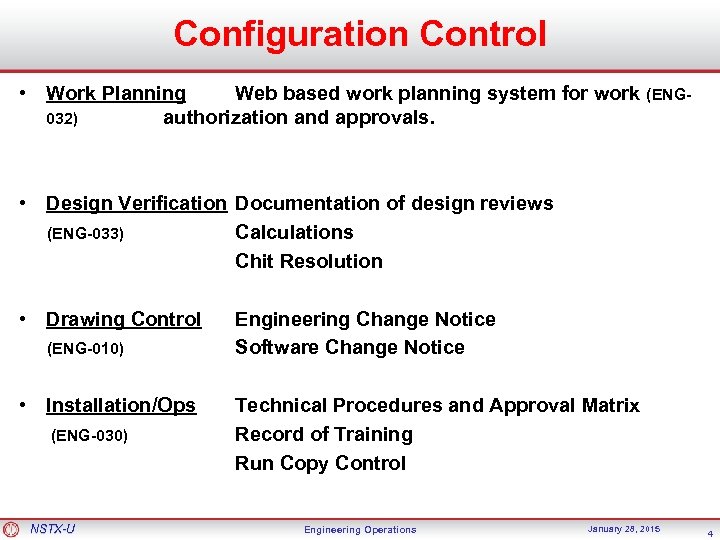
Configuration Control • Work Planning Web based work planning system for work (ENG 032) authorization and approvals. • Design Verification Documentation of design reviews (ENG-033) Calculations Chit Resolution • Drawing Control (ENG-010) Engineering Change Notice Software Change Notice • Installation/Ops Technical Procedures and Approval Matrix Record of Training Run Copy Control (ENG-030) NSTX-U Engineering Operations January 28, 2015 4
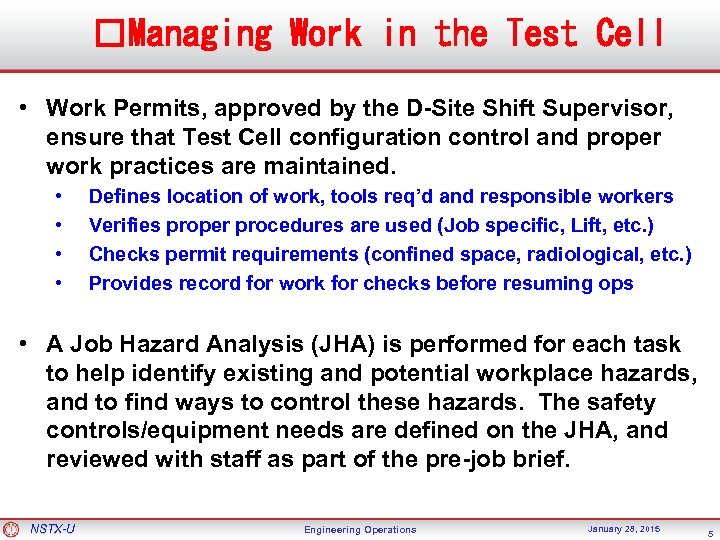
Managing Work in the Test Cell • Work Permits, approved by the D-Site Shift Supervisor, ensure that Test Cell configuration control and proper work practices are maintained. • • Defines location of work, tools req’d and responsible workers Verifies proper procedures are used (Job specific, Lift, etc. ) Checks permit requirements (confined space, radiological, etc. ) Provides record for work for checks before resuming ops • A Job Hazard Analysis (JHA) is performed for each task to help identify existing and potential workplace hazards, and to find ways to control these hazards. The safety controls/equipment needs are defined on the JHA, and reviewed with staff as part of the pre-job brief. NSTX-U Engineering Operations January 28, 2015 5
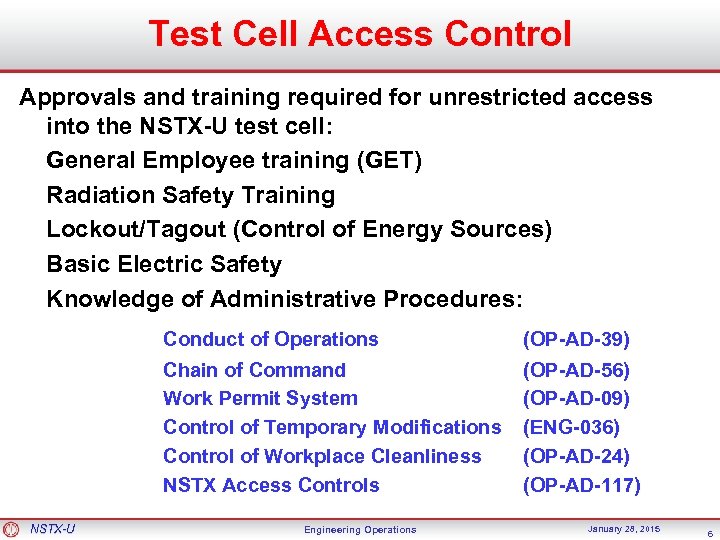
Test Cell Access Control Approvals and training required for unrestricted access into the NSTX-U test cell: General Employee training (GET) Radiation Safety Training Lockout/Tagout (Control of Energy Sources) Basic Electric Safety Knowledge of Administrative Procedures: Conduct of Operations Chain of Command Work Permit System Control of Temporary Modifications Control of Workplace Cleanliness NSTX Access Controls NSTX-U (OP-AD-39) (OP-AD-56) (OP-AD-09) (ENG-036) (OP-AD-24) (OP-AD-117) Engineering Operations January 28, 2015 6
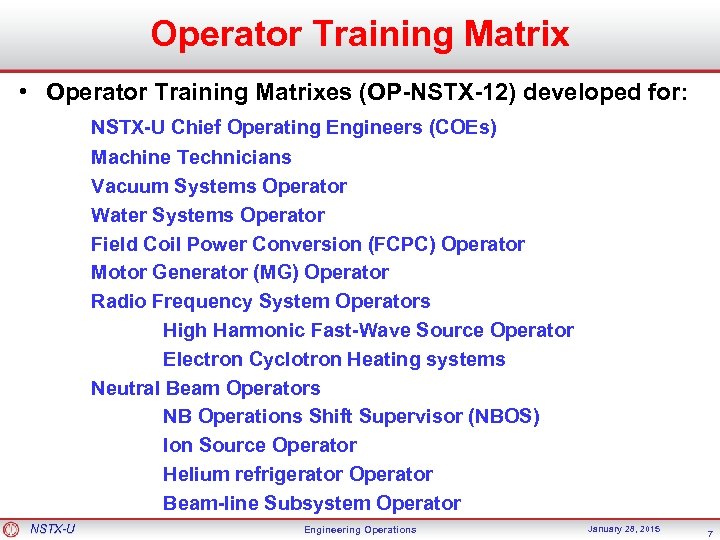
Operator Training Matrix • Operator Training Matrixes (OP-NSTX-12) developed for: NSTX-U Chief Operating Engineers (COEs) Machine Technicians Vacuum Systems Operator Water Systems Operator Field Coil Power Conversion (FCPC) Operator Motor Generator (MG) Operator Radio Frequency System Operators High Harmonic Fast-Wave Source Operator Electron Cyclotron Heating systems Neutral Beam Operators NB Operations Shift Supervisor (NBOS) Ion Source Operator Helium refrigerator Operator Beam-line Subsystem Operator NSTX-U Engineering Operations January 28, 2015 7
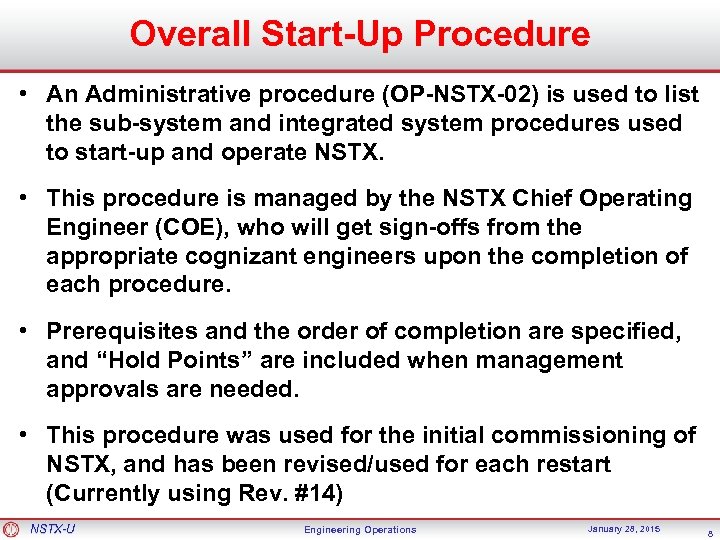
Overall Start-Up Procedure • An Administrative procedure (OP-NSTX-02) is used to list the sub-system and integrated system procedures used to start-up and operate NSTX. • This procedure is managed by the NSTX Chief Operating Engineer (COE), who will get sign-offs from the appropriate cognizant engineers upon the completion of each procedure. • Prerequisites and the order of completion are specified, and “Hold Points” are included when management approvals are needed. • This procedure was used for the initial commissioning of NSTX, and has been revised/used for each restart (Currently using Rev. #14) NSTX-U Engineering Operations January 28, 2015 8
Overall Start-Up Procedure The OP-NSTX-02 procedure is separated into five sections: 1. Pump down, Test Cell Prep, and Initial Bake out. 2. Preparation and authorization for ISTP-001. 3. Preparation and authorization for NSTX-U CD-4 milestone. 4. Preparation and authorization for the Neutral Beam CD-4 milestone 5. Preparations/Approvals for subsystems used for NSTX-U plasma operations. NSTX-U Engineering Operations January 28, 2015 9
Allowable Magnet Parameters • The electromagnetic ISTP (ISTP-001) defines protection system settings and necessary test shots for any changes to the NSTX electromagnetic configuration and/or operating envelope. • Intended to be repeated as the operating envelope is adjusted to support the experimental program. • Verifies that planned polarities, power levels and pulse lengths are consistent with design allowables. • Documents, exercises and tests protection circuits, and prescribes test shot levels. • Each iteration approved by Engineering, Research, and Project Management. NSTX-U Engineering Operations January 28, 2015 10
Coil Protection • AC System Protective Relaying • Rectifier Fault Detector Overcurrent – Set to produce a Level 1 Fault if current exceeds 10% of the PSRTC setting • Digital Coil Protection System (Redundant) – Junction Area DCPS. Set to produce a Level 1 Fault if current exceeds 5% of the PSRTC setting, or 1% over the I 2 T level of the FCC DCPS – FCC DCPS. Set to suppress & bypass rectifiers if current exceeds 2% of the PSRTC setting, or reaches the I 2 T level • Pulse Duration & Period (PDP) trip protection NSTX-U Engineering Operations January 28, 2015 11
ISTP-001 Test Shots • ISTP-001 prescribes individual magnet coil set test shots to test and set coil protection features. • Important prerequisites for this procedure include: – that the DCPS be tested and configured per OP-DCPS-779 to verify, exercise, and set protection algorithms. – that the Power Supply Fault Detectors and AC Protective Relaying be configured/tested per OP-PC-734 (Reactivation of individual rectifiers) and PTP-ECS-39 (individual Rectifier Dummy Load Tests). NSTX-U Engineering Operations January 28, 2015 12
ISTP-001 Test Shots • A “portfolio” of test shots will be generated and archived (under a test data sheet #) for each coil set to be qualified for use: –Test Shots performed at the 10%, 50% & 100% of the planned operating level, and induced Voltage & Magnetic Diagnostic calibration measurements taken as prescribed. –Exercise the overcurrent and I 2 T trips of the redundant DCPS’s at nominal 10% and 90% of the desired operating level, and the Rectifier Fault Detector Overcurrent and Overtime trips at the 90% level. –Set and document the DCPS and Rectifier Fault Detector protection settings at prescribed “headrooms” as defined in ISTP 001 for coil operation at 100% of the planned operating level. –Record that coil set’s allowable operating level and protection settings on the summary Test Plan Data Sheet. NSTX-U Engineering Operations January 28, 2015 13
ISTP-001 Test Shots • Select appropriate levels for the daily 50% and 100% test shots, and record on the summary Test Plan Data Sheet. • Obtain approvals of the Test Plan Data Sheet results and the daily test shot level selections as shown on the following test plan template. NSTX-U Engineering Operations January 28, 2015 14
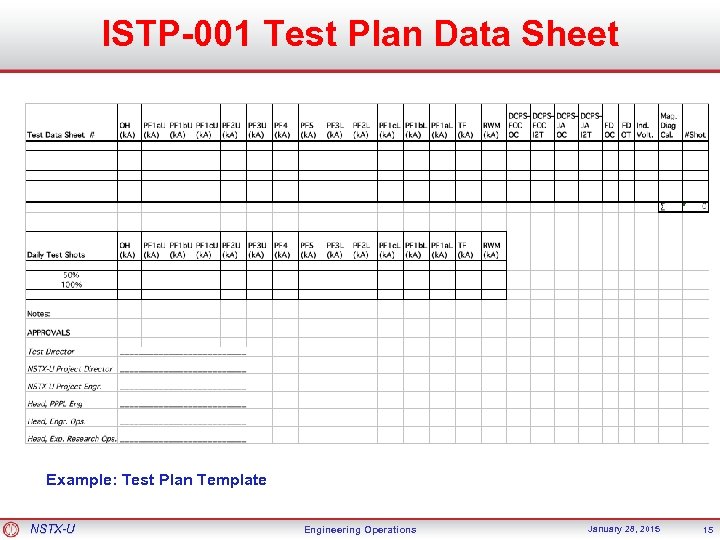
ISTP-001 Test Plan Data Sheet Example: Test Plan Template NSTX-U Engineering Operations January 28, 2015 15
Status of Power Systems • D-MG#1 has been fully restored to operation • Rectifier reactivation (open circuit testing) is complete • Rectifier Dummy Load testing is ready to start – Will concentrate on systems needed for the CD 4 plasma (TF, OH, PF 3 U/L, PF 5) • Expect to be ready to start ISTP-001 on March 23 rd • SPA’s, HF power supply (SPA primary power) will be recommissioned following CD 4 • CHI Cap Bank is being restored to previous ops levels – Control System will have to be re-evaluated – CHI Handiscope is being recommissioned. MOV’s re-installed NSTX-U Engineering Operations January 28, 2015 16
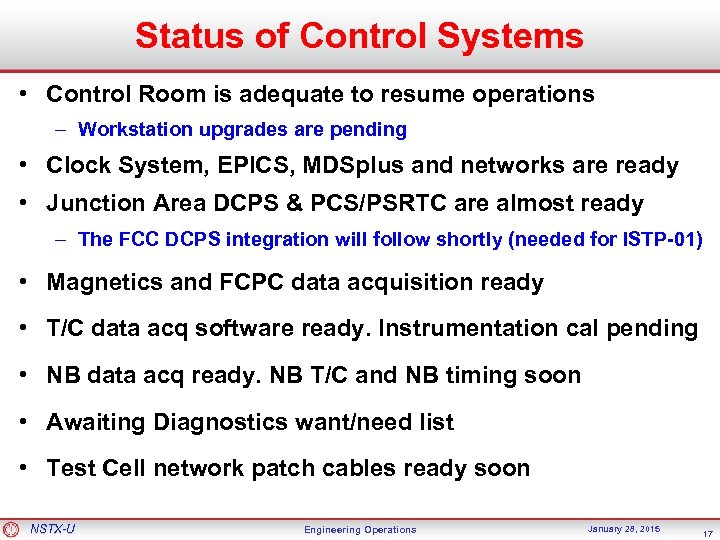
Status of Control Systems • Control Room is adequate to resume operations – Workstation upgrades are pending • Clock System, EPICS, MDSplus and networks are ready • Junction Area DCPS & PCS/PSRTC are almost ready – The FCC DCPS integration will follow shortly (needed for ISTP-01) • Magnetics and FCPC data acquisition ready • T/C data acq software ready. Instrumentation cal pending • NB data acq ready. NB T/C and NB timing soon • Awaiting Diagnostics want/need list • Test Cell network patch cables ready soon NSTX-U Engineering Operations January 28, 2015 17
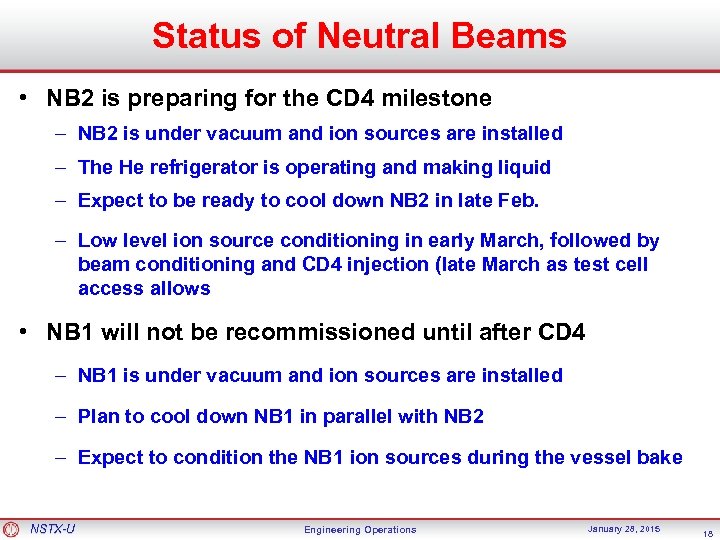
Status of Neutral Beams • NB 2 is preparing for the CD 4 milestone – NB 2 is under vacuum and ion sources are installed – The He refrigerator is operating and making liquid – Expect to be ready to cool down NB 2 in late Feb. – Low level ion source conditioning in early March, followed by beam conditioning and CD 4 injection (late March as test cell access allows • NB 1 will not be recommissioned until after CD 4 – NB 1 is under vacuum and ion sources are installed – Plan to cool down NB 1 in parallel with NB 2 – Expect to condition the NB 1 ion sources during the vessel bake NSTX-U Engineering Operations January 28, 2015 18
Скачать презентацию NSTX-U Coll of Wm Mary Columbia U
df399e04e002bfb391918b753efd34f3.ppt