 Скачать презентацию NSLS-II Hard X-ray Nanoprobe Beamline Yong Chu Experimental
88065be9c3d9950823415b3cb7fba9d5.ppt
- Количество слайдов: 20



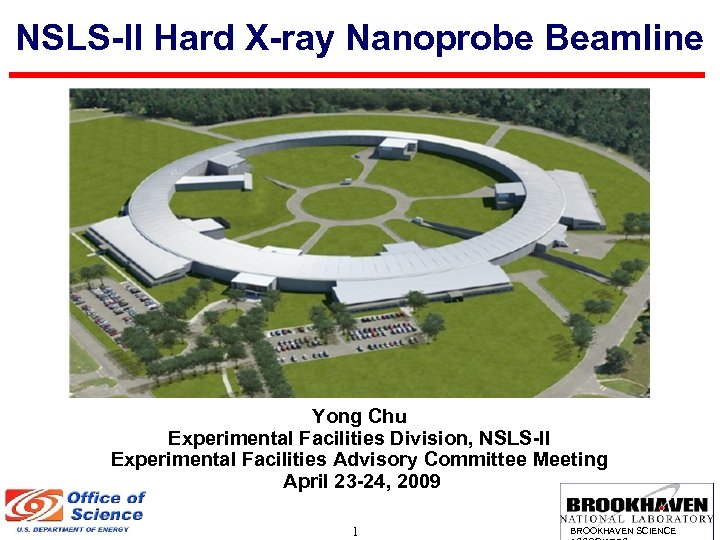
NSLS-II Hard X-ray Nanoprobe Beamline Yong Chu Experimental Facilities Division, NSLS-II Experimental Facilities Advisory Committee Meeting April 23 -24, 2009 1 BROOKHAVEN SCIENCE
HXN Team HXN beamline Group Leader: Yong Chu (Joined Jan, 2009). Beamline Scientist: finalizing the interview process Ken Evans-Lutterodt (MOU Staff, Kinoform, lead initial HXN effort ) Nanopositioning R&D Engineer & Postdoc Interviewing 1 nm R&D Hanfei Yan (MLL theory, optics testing) Enju Lima (coherent phase retrieval, optics testing) Ray Conley (MLL fabrication, metrology) Nathalie Bouet (postdoc, MLL processing) James Biancarosa (technician, MLL fabrication) 2 BROOKHAVEN SCIENCE
Scientific Mission for HXN Beamline To enable hard x–ray microscopy experiments with spatial resolution down to 1 nm. expected scientific impact areas: • Materials science • Environmental science • Biology • Nano-catalysis energy range being considered: 5~30 ke. V 3 BROOKHAVEN SCIENCE
Techniques Considered for the HXN • • • X-ray Fluorescence Nanodiffraction/Scattering Coherent Diffraction Imaging (small angle & Bragg) Transmission Imaging (absorption/phase contrast) Spectroscopy (XAS) Import Considerations: • Mutual compatibility among the supported techniques • Radiation damage • Retaining substantial scientific advantage over other technique (i. e EM, SPM, atom probe) 4 BROOKHAVEN SCIENCE
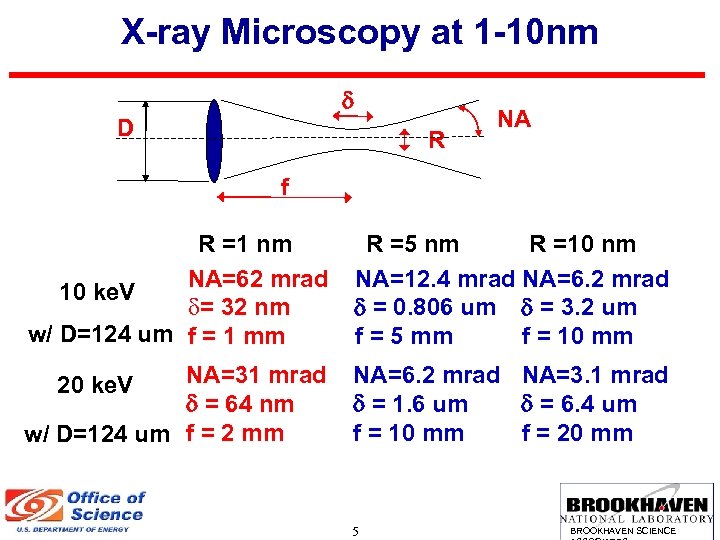
X-ray Microscopy at 1 -10 nm d D R NA f R =1 nm NA=62 mrad 10 ke. V d= 32 nm w/ D=124 um f = 1 mm R =5 nm R =10 nm NA=12. 4 mrad NA=6. 2 mrad d = 0. 806 um d = 3. 2 um f = 5 mm f = 10 mm NA=31 mrad d = 64 nm w/ D=124 um f = 2 mm NA=6. 2 mrad NA=3. 1 mrad d = 1. 6 um d = 6. 4 um f = 10 mm f = 20 mm 20 ke. V 5 BROOKHAVEN SCIENCE
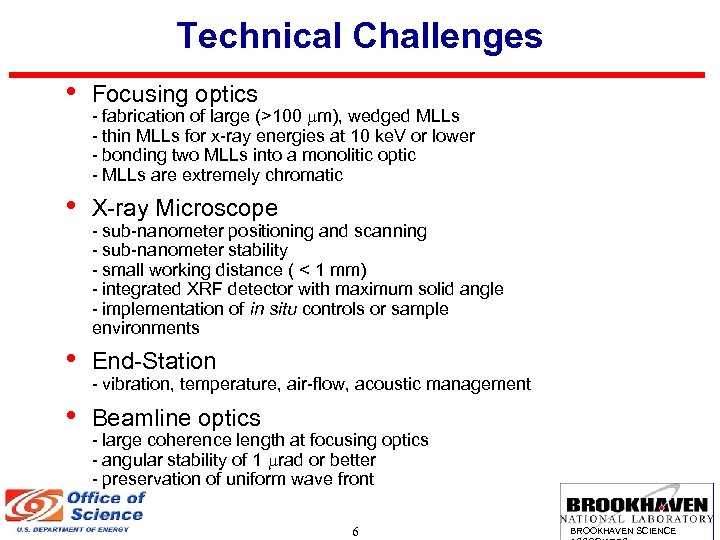
Technical Challenges • Focusing optics • X-ray Microscope • End-Station • Beamline optics - fabrication of large (>100 mm), wedged MLLs - thin MLLs for x-ray energies at 10 ke. V or lower - bonding two MLLs into a monolitic optic - MLLs are extremely chromatic - sub-nanometer positioning and scanning - sub-nanometer stability - small working distance ( < 1 mm) - integrated XRF detector with maximum solid angle - implementation of in situ controls or sample environments - vibration, temperature, air-flow, acoustic management - large coherence length at focusing optics - angular stability of 1 mrad or better - preservation of uniform wave front 6 BROOKHAVEN SCIENCE
Key Considerations for the HXN Beamline Effective Vibration Control 7 BROOKHAVEN SCIENCE
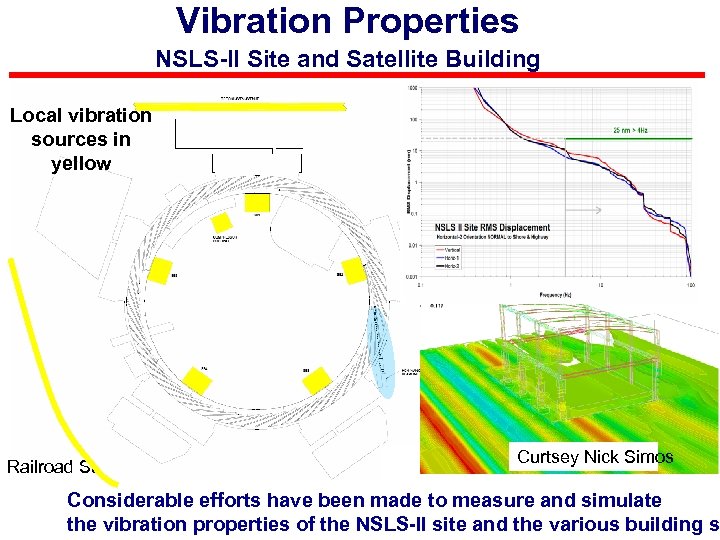
Vibration Properties NSLS-II Site and Satellite Building Brookhaven Ave. Local vibration sources in yellow Railroad St. Curtsey Nick Simos Considerable efforts have been made to measure and simulate the vibration properties of the 8 NSLS-II site and the various building st BROOKHAVEN SCIENCE
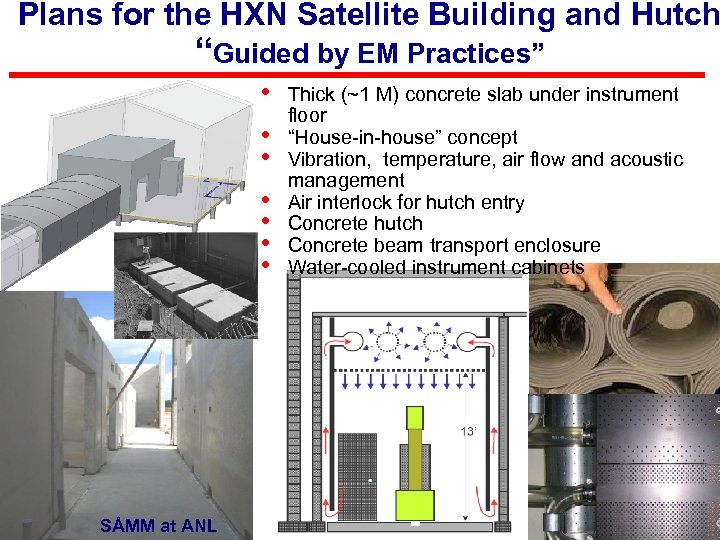
Plans for the HXN Satellite Building and Hutch “Guided by EM Practices” • • SÅMM at ANL Thick (~1 M) concrete slab under instrument floor “House-in-house” concept Vibration, temperature, air flow and acoustic management Air interlock for hutch entry Concrete hutch Concrete beam transport enclosure Water-cooled instrument cabinets 9 BROOKHAVEN SCIENCE
Key Considerations for the HXN Beamline Phase-Space Management and Beam Stability 10 BROOKHAVEN SCIENCE
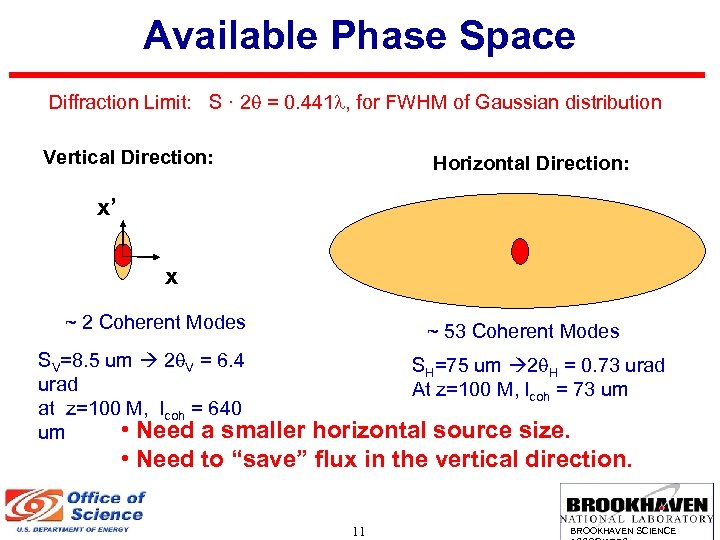
Available Phase Space Diffraction Limit: S · 2 q = 0. 441 l, for FWHM of Gaussian distribution Vertical Direction: Horizontal Direction: x’ x ~ 2 Coherent Modes ~ 53 Coherent Modes SV=8. 5 um 2 q. V = 6. 4 urad at z=100 M, lcoh = 640 • Need a smaller um SH=75 um 2 q. H = 0. 73 urad At z=100 M, lcoh = 73 um horizontal source size. • Need to “save” flux in the vertical direction. 11 BROOKHAVEN SCIENCE
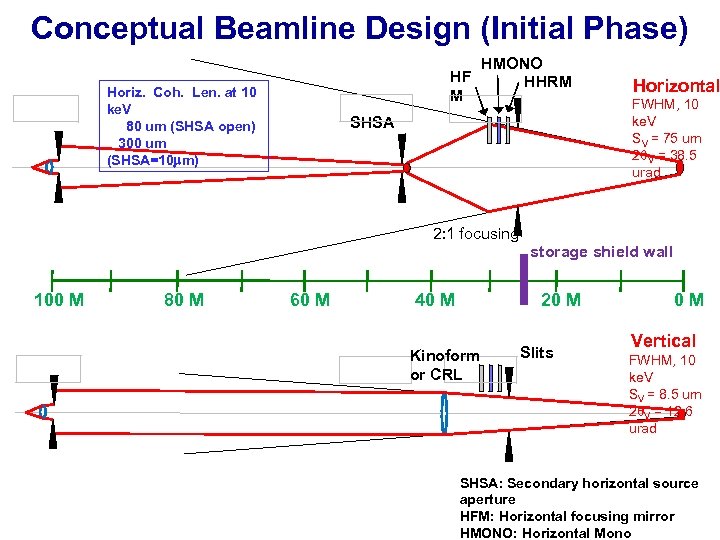
Conceptual Beamline Design (Initial Phase) HF M Horiz. Coh. Len. at 10 ke. V 80 um (SHSA open) 300 um (SHSA=10 mm) HMONO HHRM Horizontal FWHM, 10 ke. V SV = 75 um 2 q. V = 38. 5 urad SHSA 2: 1 focusing storage shield wall 100 M 80 M 60 M 40 M 20 M Kinoform or CRL 12 Slits 0 M Vertical FWHM, 10 ke. V SV = 8. 5 um 2 q. V = 12. 6 urad SHSA: Secondary horizontal source aperture HFM: Horizontal focusing mirror BROOKHAVEN HMONO: Horizontal Mono SCIENCE
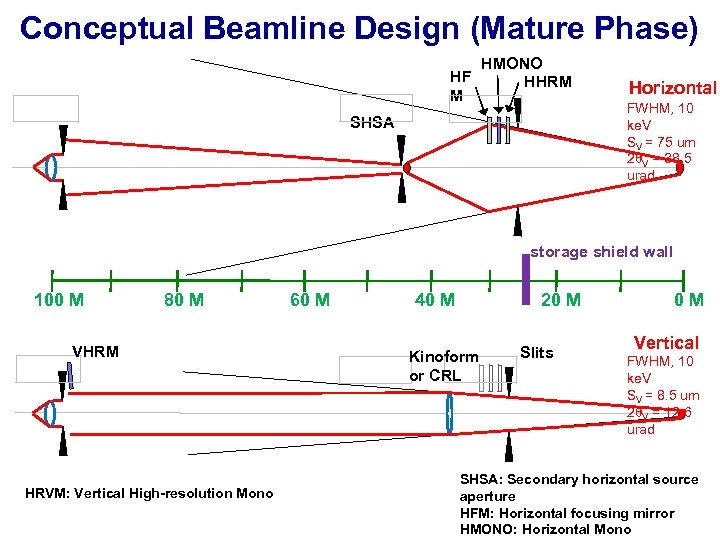
Conceptual Beamline Design (Mature Phase) HF M HMONO HHRM Horizontal FWHM, 10 ke. V SV = 75 um 2 q. V = 38. 5 urad SHSA storage shield wall 100 M 80 M 60 M 40 M VHRM 20 M Kinoform or CRL HRVM: Vertical High-resolution Mono 13 Slits 0 M Vertical FWHM, 10 ke. V SV = 8. 5 um 2 q. V = 12. 6 urad SHSA: Secondary horizontal source aperture HFM: Horizontal focusing mirror BROOKHAVEN HMONO: Horizontal Mono SCIENCE
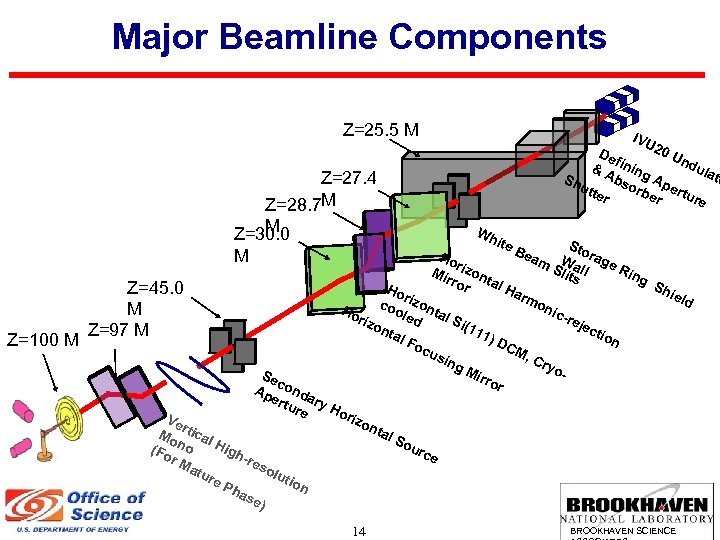
Major Beamline Components Z=25. 5 M Z=27. 4 Z=28. 7 M M Z=30. 0 M Z=100 M Z=45. 0 M Z=97 M 20 De Un f du & A ining lat bs o Ap Sh orb utt er ure er Wh ite Sto Be Ho am W rage Sli all Rin Mir rizon ts g tal ror Sh Ha Ho ield rm riz co on on Ho ole t icriz rej d al Si( on ect 111 tal ion )D Fo CM cu , C sin ryo g. M irro r Se c Ap ond ert ary ure Ho ri Ve r Mo tical Hig (Fo no h-r r. M es atu olu re tio Ph n as e) IVU zon tal 14 So urc e BROOKHAVEN SCIENCE
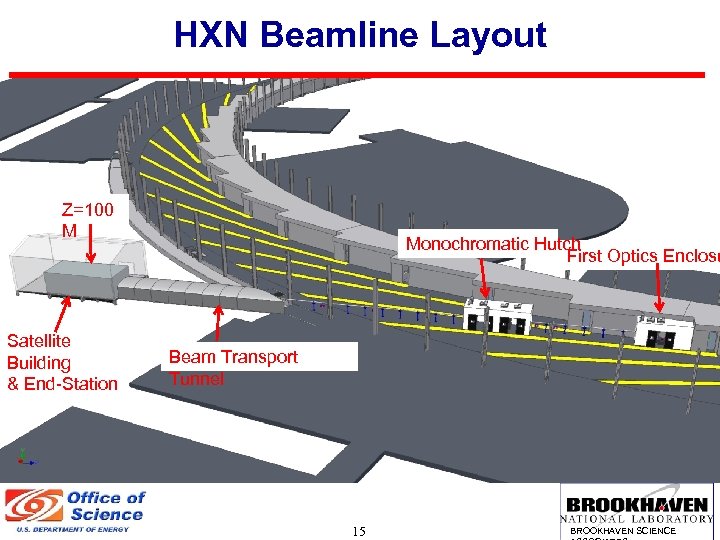
HXN Beamline Layout Z=100 M Satellite Building & End-Station Monochromatic Hutch First Optics Enclosu Beam Transport Tunnel 15 BROOKHAVEN SCIENCE
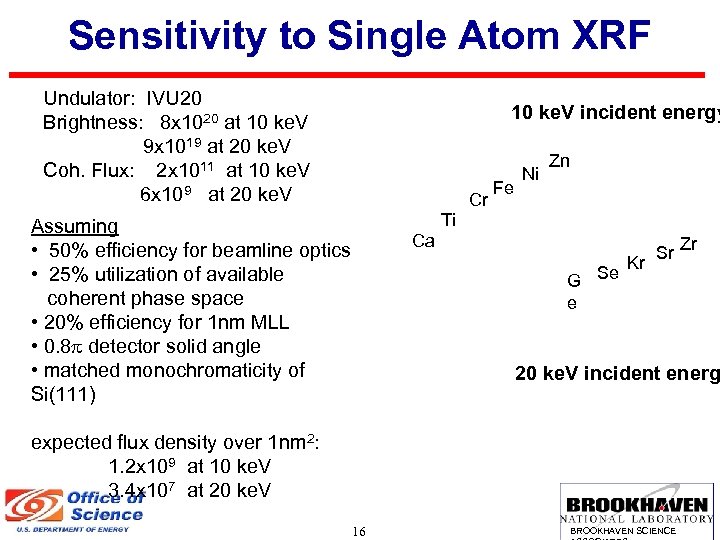
Sensitivity to Single Atom XRF Undulator: IVU 20 Brightness: 8 x 10²⁰ at 10 ke. V 9 x 10¹⁹ at 20 ke. V Coh. Flux: 2 x 10¹¹ at 10 ke. V 6 x 10⁹ at 20 ke. V 10 ke. V incident energy Ti Assuming • 50% efficiency for beamline optics • 25% utilization of available coherent phase space • 20% efficiency for 1 nm MLL • 0. 8 p detector solid angle • matched monochromaticity of Si(111) Cr Fe Ni Zn Ca G Se e Kr Sr Zr 20 ke. V incident energ expected flux density over 1 nm 2: 1. 2 x 10⁹ at 10 ke. V 3. 4 x 10⁷ at 20 ke. V 16 BROOKHAVEN SCIENCE
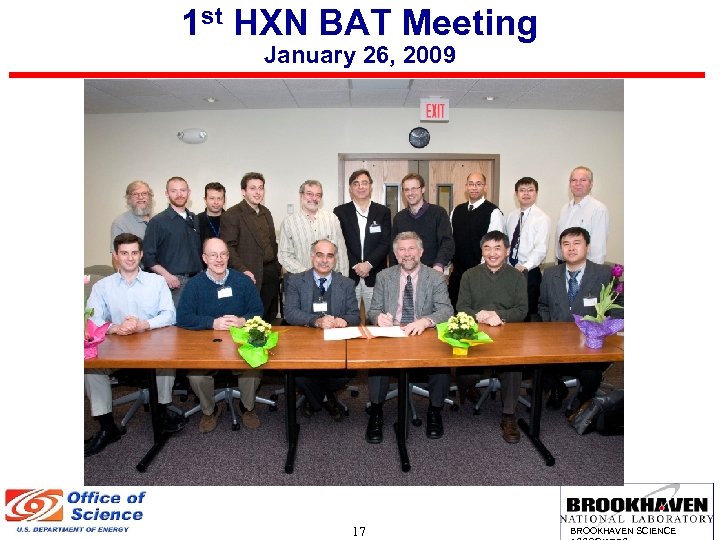
1 st HXN BAT Meeting January 26, 2009 17 BROOKHAVEN SCIENCE
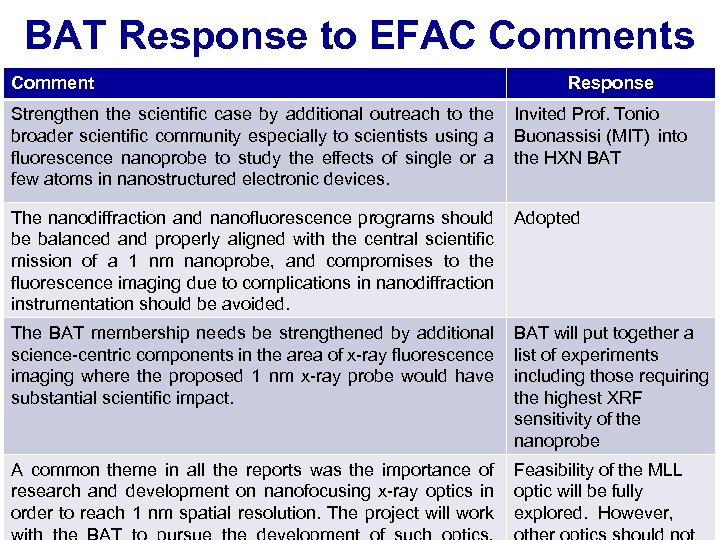
BAT Response to EFAC Comments Comment Response Strengthen the scientific case by additional outreach to the broader scientific community especially to scientists using a fluorescence nanoprobe to study the effects of single or a few atoms in nanostructured electronic devices. Invited Prof. Tonio Buonassisi (MIT) into the HXN BAT The nanodiffraction and nanofluorescence programs should be balanced and properly aligned with the central scientific mission of a 1 nm nanoprobe, and compromises to the fluorescence imaging due to complications in nanodiffraction instrumentation should be avoided. Adopted The BAT membership needs be strengthened by additional science-centric components in the area of x-ray fluorescence imaging where the proposed 1 nm x-ray probe would have substantial scientific impact. BAT will put together a list of experiments including those requiring the highest XRF sensitivity of the nanoprobe A common theme in all the reports was the importance of research and development on nanofocusing x-ray optics in order to reach 1 nm spatial resolution. The project will work Feasibility of the MLL optic will be fully explored. However, 18 BROOKHAVEN SCIENCE
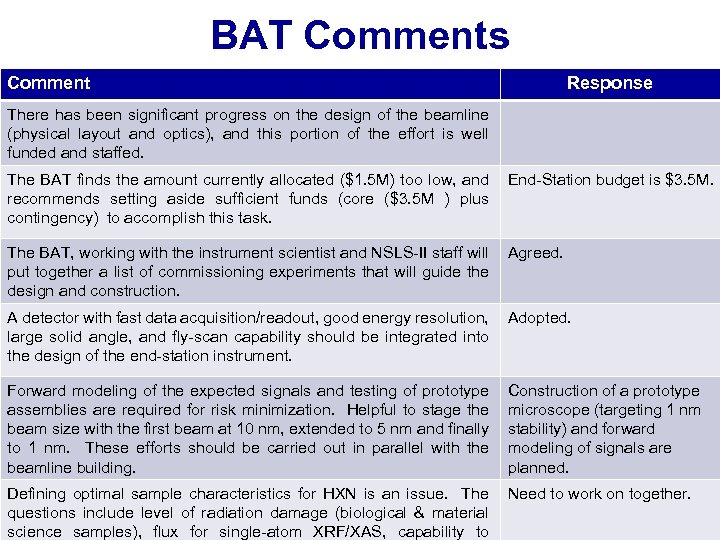
BAT Comments Comment Response There has been significant progress on the design of the beamline (physical layout and optics), and this portion of the effort is well funded and staffed. The BAT finds the amount currently allocated ($1. 5 M) too low, and recommends setting aside sufficient funds (core ($3. 5 M ) plus contingency) to accomplish this task. End-Station budget is $3. 5 M. The BAT, working with the instrument scientist and NSLS-II staff will put together a list of commissioning experiments that will guide the design and construction. Agreed. A detector with fast data acquisition/readout, good energy resolution, large solid angle, and fly-scan capability should be integrated into the design of the end-station instrument. Adopted. Forward modeling of the expected signals and testing of prototype assemblies are required for risk minimization. Helpful to stage the beam size with the first beam at 10 nm, extended to 5 nm and finally to 1 nm. These efforts should be carried out in parallel with the beamline building. Construction of a prototype microscope (targeting 1 nm stability) and forward modeling of signals are planned. Defining optimal sample characteristics for HXN is an issue. The questions include level of radiation damage (biological & material 19 science samples), flux for single-atom XRF/XAS, capability to Need to work on together. BROOKHAVEN SCIENCE
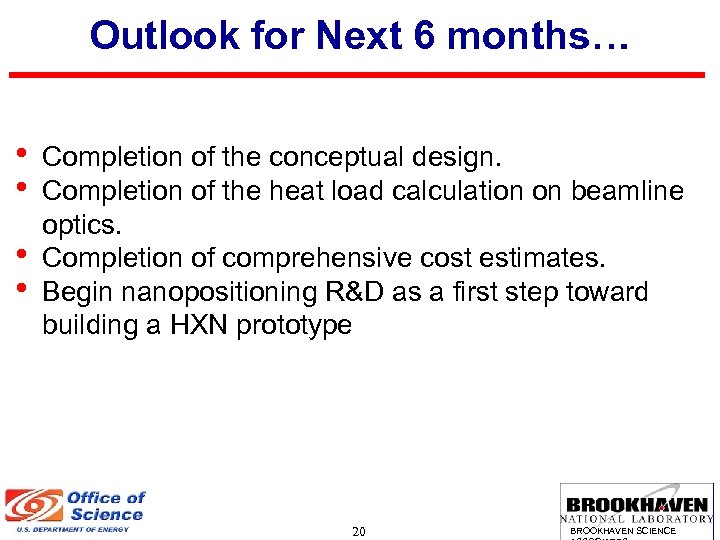
Outlook for Next 6 months… • • Completion of the conceptual design. Completion of the heat load calculation on beamline optics. Completion of comprehensive cost estimates. Begin nanopositioning R&D as a first step toward building a HXN prototype 20 BROOKHAVEN SCIENCE
Скачать презентацию NSLS-II Hard X-ray Nanoprobe Beamline Yong Chu Experimental
88065be9c3d9950823415b3cb7fba9d5.ppt