 Скачать презентацию NSIDC Technical Infrastructure Bipolar is the primary web
736c21b8f466606db6dbef9c4922bf4f.ppt
- Количество слайдов: 1



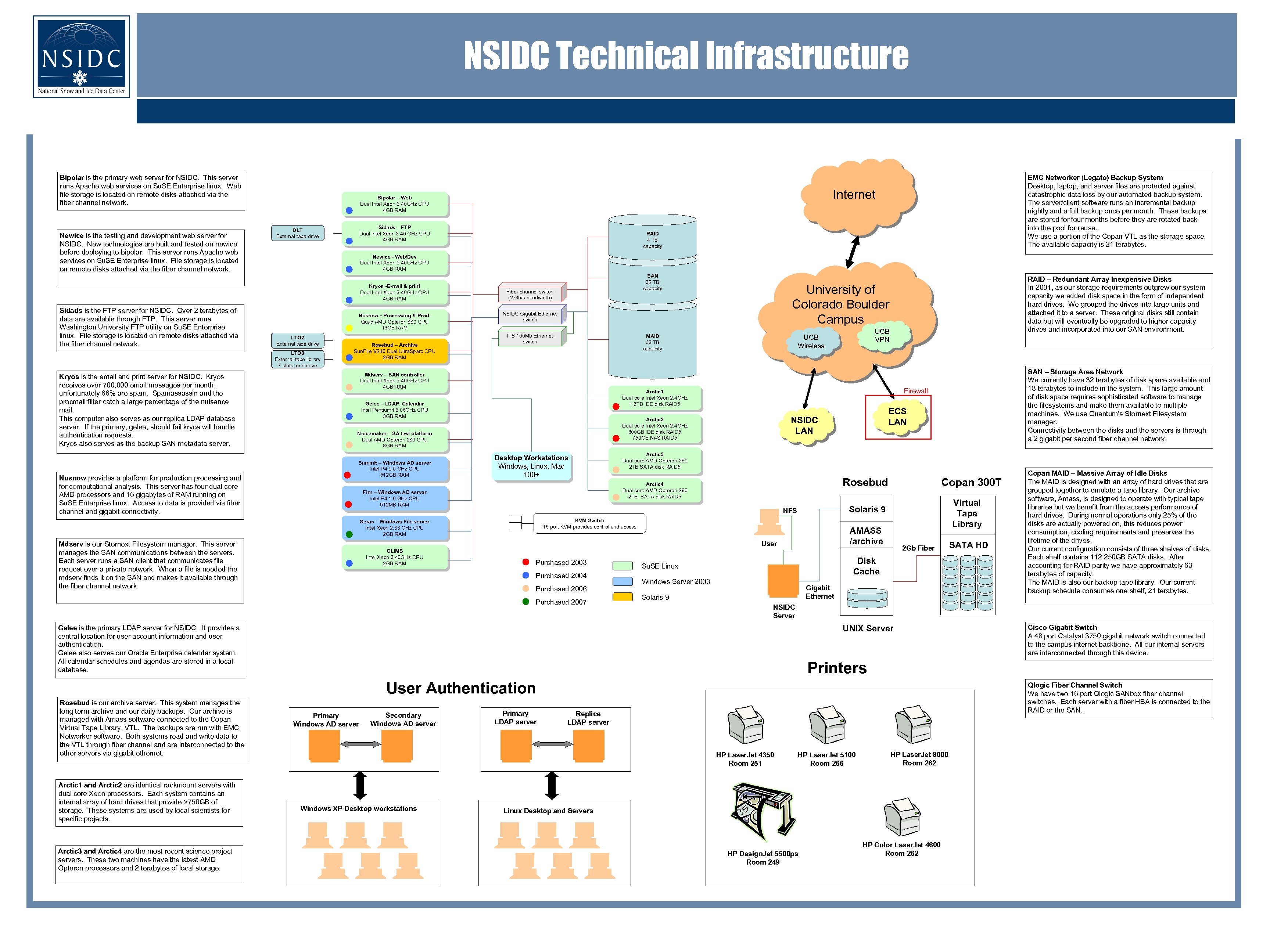
NSIDC Technical Infrastructure Bipolar is the primary web server for NSIDC. This server runs Apache web services on Su. SE Enterprise linux. Web file storage is located on remote disks attached via the fiber channel network. Newice is the testing and development web server for NSIDC. New technologies are built and tested on newice before deploying to bipolar. This server runs Apache web services on Su. SE Enterprise linux. File storage is located on remote disks attached via the fiber channel network. Sidads – FTP Dual Intel Xeon 3. 40 GHz CPU 4 GB RAM Nusnow - Processing & Prod. Quad AMD Opteron 880 CPU 16 GB RAM LTO 2 External tape drive LTO 3 External tape library 7 slots, one drive Kryos is the email and print server for NSIDC. Kryos receives over 700, 000 email messages per month, unfortunately 66% are spam. Spamassassin and the procmail filter catch a large percentage of the nuisance mail. This computer also serves as our replica LDAP database server. If the primary, gelee, should fail kryos will handle authentication requests. Kryos also serves as the backup SAN metadata server. Nusnow provides a platform for production processing and for computational analysis. This server has four dual core AMD processors and 16 gigabytes of RAM running on Su. SE Enterprise linux. Access to data is provided via fiber channel and gigabit connectivity. RAID 4 TB capacity Newice - Web/Dev Dual Intel Xeon 3. 40 GHz CPU 4 GB RAM Kryos -E-mail & print Dual Intel Xeon 3. 40 GHz CPU 4 GB RAM Sidads is the FTP server for NSIDC. Over 2 terabytes of data are available through FTP. This server runs Washington University FTP utility on Su. SE Enterprise linux. File storage is located on remote disks attached via the fiber channel network. Internet Bipolar – Web Dual Intel Xeon 3. 40 GHz CPU 4 GB RAM DLT External tape drive EMC Networker (Legato) Backup System Desktop, laptop, and server files are protected against catastrophic data loss by our automated backup system. The server/client software runs an incremental backup nightly and a full backup once per month. These backups are stored for four months before they are rotated back into the pool for reuse. We use a portion of the Copan VTL as the storage space. The available capacity is 21 terabytes. Rosebud – Archive Sun. Fire V 240 Dual Ultra. Sparc CPU 2 GB RAM SAN 32 TB capacity Fiber channel switch (2 Gb/s bandwidth) MAID 63 TB capacity Mdserv – SAN controller Dual Intel Xeon 3. 40 GHz CPU 4 GB RAM UCB Wireless Desktop Workstations Windows, Linux, Mac 100+ Arctic 3 Dual core AMD Opteron 280 2 TB SATA disk RAID 5 Rosebud KVM Switch 16 port KVM provides control and access Purchased 2003 Purchased 2004 Purchased 2006 Purchased 2007 Virtual Tape Library AMASS /archive User GLIMS Intel Xeon 3. 40 GHz CPU 2 GB RAM Copan 300 T Solaris 9 NFS Serac – Windows File server Intel Xeon 2. 33 GHz CPU 2 GB RAM ECS LAN NSIDC LAN Arctic 4 Dual core AMD Opteron 280 2 TB, SATA disk RAID 5 Firn – Windows AD server Intel P 4 1. 9 GHz CPU 512 MB RAM SAN – Storage Area Network We currently have 32 terabytes of disk space available and 18 terabytes to include in the system. This large amount of disk space requires sophisticated software to manage the filesystems and make them available to multiple machines. We use Quantum’s Stornext Filesystem manager. Connectivity between the disks and the servers is through a 2 gigabit per second fiber channel network. Firewall Arctic 2 Dual core Intel Xeon 2. 4 GHz 600 GB IDE disk RAID 5 750 GB NAS RAID 5 Nuicemaker – SA test platform Dual AMD Opteron 280 CPU 8 GB RAM Mdserv is our Stornext Filesystem manager. This server manages the SAN communications between the servers. Each server runs a SAN client that communicates file request over a private network. When a file is needed the mdserv finds it on the SAN and makes it available through the fiber channel network. UCB VPN Arctic 1 Dual core Intel Xeon 2. 4 GHz 1. 5 TB IDE disk RAID 5 Gelee – LDAP, Calendar Intel Pentium 4 3. 06 GHz CPU 3 GB RAM Summit – Windows AD server Intel P 4 3. 0 GHz CPU 512 GB RAM University of Colorado Boulder Campus NSIDC Gigabit Ethernet switch ITS 100 Mb Ethernet switch RAID – Redundant Array Inexpensive Disks In 2001, as our storage requirements outgrew our system capacity we added disk space in the form of independent hard drives. We grouped the drives into large units and attached it to a server. These original disks still contain data but will eventually be upgraded to higher capacity drives and incorporated into our SAN environment. 2 Gb Fiber Disk Cache Su. SE Linux Windows Server 2003 Gigabit Ethernet Solaris 9 NSIDC Server UNIX Server Gelee is the primary LDAP server for NSIDC. It provides a central location for user account information and user authentication. Gelee also serves our Oracle Enterprise calendar system. All calendar schedules and agendas are stored in a local database. Arctic 1 and Arctic 2 are identical rackmount servers with dual core Xeon processors. Each system contains an internal array of hard drives that provide >750 GB of storage. These systems are used by local scientists for specific projects. Arctic 3 and Arctic 4 are the most recent science project servers. These two machines have the latest AMD Opteron processors and 2 terabytes of local storage. Cisco Gigabit Switch A 48 port Catalyst 3750 gigabit network switch connected to the campus internet backbone. All our internal servers are interconnected through this device. Printers User Authentication Rosebud is our archive server. This system manages the long term archive and our daily backups. Our archive is managed with Amass software connected to the Copan Virtual Tape Library, VTL. The backups are run with EMC Networker software. Both systems read and write data to the VTL through fiber channel and are interconnected to the other servers via gigabit ethernet. SATA HD Copan MAID – Massive Array of Idle Disks The MAID is designed with an array of hard drives that are grouped together to emulate a tape library. Our archive software, Amass, is designed to operate with typical tape libraries but we benefit from the access performance of hard drives. During normal operations only 25% of the disks are actually powered on, this reduces power consumption, cooling requirements and preserves the lifetime of the drives. Our current configuration consists of three shelves of disks. Each shelf contains 112 250 GB SATA disks. After accounting for RAID parity we have approximately 63 terabytes of capacity. The MAID is also our backup tape library. Our current backup schedule consumes one shelf, 21 terabytes. Primary Windows AD server Secondary Windows AD server Primary LDAP server Qlogic Fiber Channel Switch We have two 16 port Qlogic SANbox fiber channel switches. Each server with a fiber HBA is connected to the RAID or the SAN. Replica LDAP server HP Laser. Jet 4350 Room 251 Windows XP Desktop workstations HP Laser. Jet 5100 Room 266 HP Laser. Jet 8000 Room 262 Linux Desktop and Servers HP Design. Jet 5500 ps Room 249 HP Color Laser. Jet 4600 Room 262
Скачать презентацию NSIDC Technical Infrastructure Bipolar is the primary web
736c21b8f466606db6dbef9c4922bf4f.ppt