


 Скачать презентацию NSF-DMR ITR Workshop Review 17 -20 June 2004 University of
fa9ef7ac84c11e075db06e90a99ec3ff.ppt
- Количество слайдов: 29
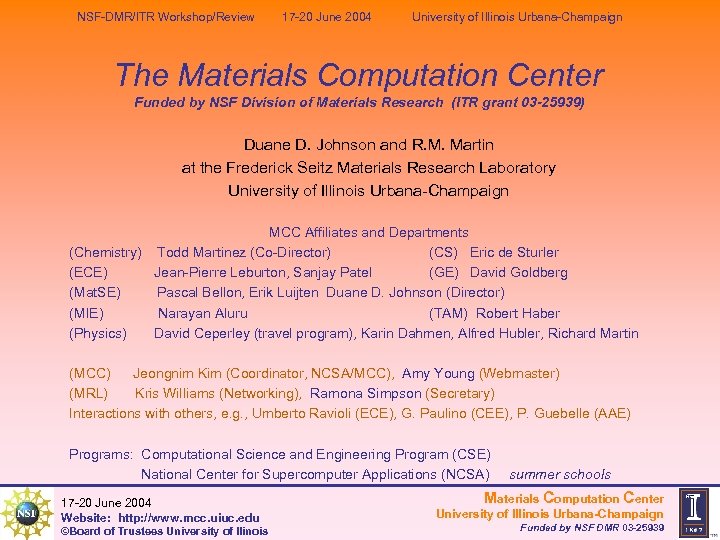 NSF-DMR/ITR Workshop/Review 17 -20 June 2004 University of Illinois Urbana-Champaign The Materials Computation Center Funded by NSF Division of Materials Research (ITR grant 03 -25939) Duane D. Johnson and R. M. Martin at the Frederick Seitz Materials Research Laboratory University of Illinois Urbana-Champaign MCC Affiliates and Departments (Chemistry) Todd Martinez (Co-Director) (CS) Eric de Sturler (ECE) Jean-Pierre Leburton, Sanjay Patel (GE) David Goldberg (Mat. SE) Pascal Bellon, Erik Luijten Duane D. Johnson (Director) (MIE) Narayan Aluru (TAM) Robert Haber (Physics) David Ceperley (travel program), Karin Dahmen, Alfred Hubler, Richard Martin (MCC) Jeongnim Kim (Coordinator, NCSA/MCC), Amy Young (Webmaster) (MRL) Kris Williams (Networking), Ramona Simpson (Secretary) Interactions with others, e. g. , Umberto Ravioli (ECE), G. Paulino (CEE), P. Guebelle (AAE) Programs: Computational Science and Engineering Program (CSE) National Center for Supercomputer Applications (NCSA) summer schools 17 -20 June 2004 Website: http: //www. mcc. uiuc. edu ©Board of Trustees University of Ilinois Materials Computation Center University of Illinois Urbana-Champaign Funded by NSF DMR 03 -25939
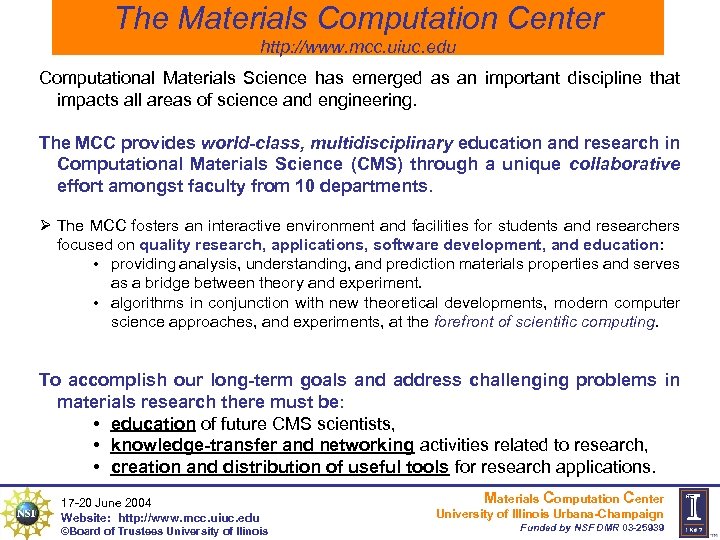 The Materials Computation Center http: //www. mcc. uiuc. edu Computational Materials Science has emerged as an important discipline that impacts all areas of science and engineering. The MCC provides world-class, multidisciplinary education and research in Computational Materials Science (CMS) through a unique collaborative effort amongst faculty from 10 departments. Ø The MCC fosters an interactive environment and facilities for students and researchers focused on quality research, applications, software development, and education: • providing analysis, understanding, and prediction materials properties and serves as a bridge between theory and experiment. • algorithms in conjunction with new theoretical developments, modern computer science approaches, and experiments, at the forefront of scientific computing. To accomplish our long-term goals and address challenging problems in materials research there must be: • education of future CMS scientists, • knowledge-transfer and networking activities related to research, • creation and distribution of useful tools for research applications. 17 -20 June 2004 Website: http: //www. mcc. uiuc. edu ©Board of Trustees University of Ilinois Materials Computation Center University of Illinois Urbana-Champaign Funded by NSF DMR 03 -25939
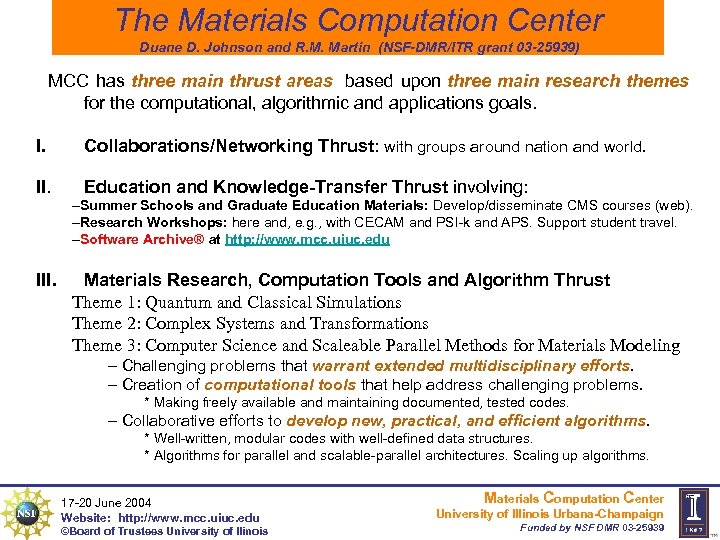 The Materials Computation Center Duane D. Johnson and R. M. Martin (NSF-DMR/ITR grant 03 -25939) MCC has three main thrust areas based upon three main research themes for the computational, algorithmic and applications goals. I. Collaborations/Networking Thrust: with groups around nation and world. II. Education and Knowledge-Transfer Thrust involving: –Summer Schools and Graduate Education Materials: Develop/disseminate CMS courses (web). –Research Workshops: here and, e. g. , with CECAM and PSI-k and APS. Support student travel. –Software Archive® at http: //www. mcc. uiuc. edu III. Materials Research, Computation Tools and Algorithm Thrust Theme 1: Quantum and Classical Simulations Theme 2: Complex Systems and Transformations Theme 3: Computer Science and Scaleable Parallel Methods for Materials Modeling – Challenging problems that warrant extended multidisciplinary efforts. – Creation of computational tools that help address challenging problems. * Making freely available and maintaining documented, tested codes. – Collaborative efforts to develop new, practical, and efficient algorithms. * Well-written, modular codes with well-defined data structures. * Algorithms for parallel and scalable-parallel architectures. Scaling up algorithms. 17 -20 June 2004 Website: http: //www. mcc. uiuc. edu ©Board of Trustees University of Ilinois Materials Computation Center University of Illinois Urbana-Champaign Funded by NSF DMR 03 -25939
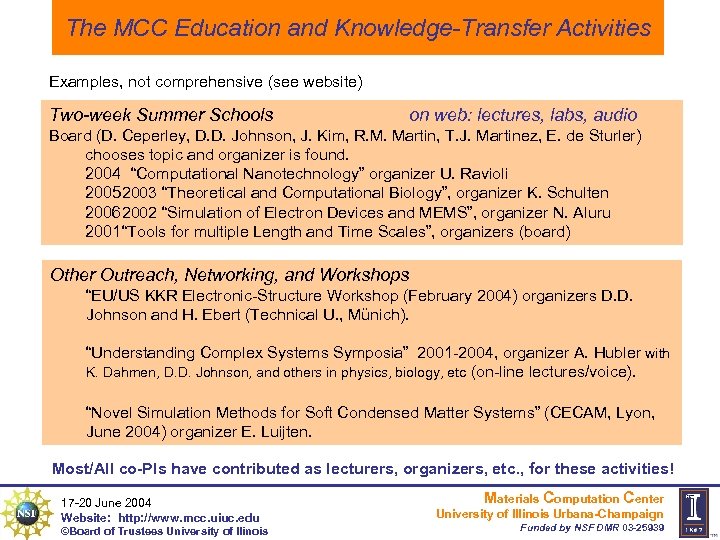 The MCC Education and Knowledge-Transfer Activities Examples, not comprehensive (see website) Two-week Summer Schools on web: lectures, labs, audio Board (D. Ceperley, D. D. Johnson, J. Kim, R. M. Martin, T. J. Martinez, E. de Sturler) chooses topic and organizer is found. 2004 “Computational Nanotechnology” organizer U. Ravioli 20052003 “Theoretical and Computational Biology”, organizer K. Schulten 20062002 “Simulation of Electron Devices and MEMS”, organizer N. Aluru 2001“Tools for multiple Length and Time Scales”, organizers (board) Other Outreach, Networking, and Workshops “EU/US KKR Electronic-Structure Workshop (February 2004) organizers D. D. Johnson and H. Ebert (Technical U. , Münich). “Understanding Complex Systems Symposia” 2001 -2004, organizer A. Hubler with K. Dahmen, D. D. Johnson, and others in physics, biology, etc (on-line lectures/voice). “Novel Simulation Methods for Soft Condensed Matter Systems” (CECAM, Lyon, June 2004) organizer E. Luijten. Most/All co-PIs have contributed as lecturers, organizers, etc. , for these activities! 17 -20 June 2004 Website: http: //www. mcc. uiuc. edu ©Board of Trustees University of Ilinois Materials Computation Center University of Illinois Urbana-Champaign Funded by NSF DMR 03 -25939
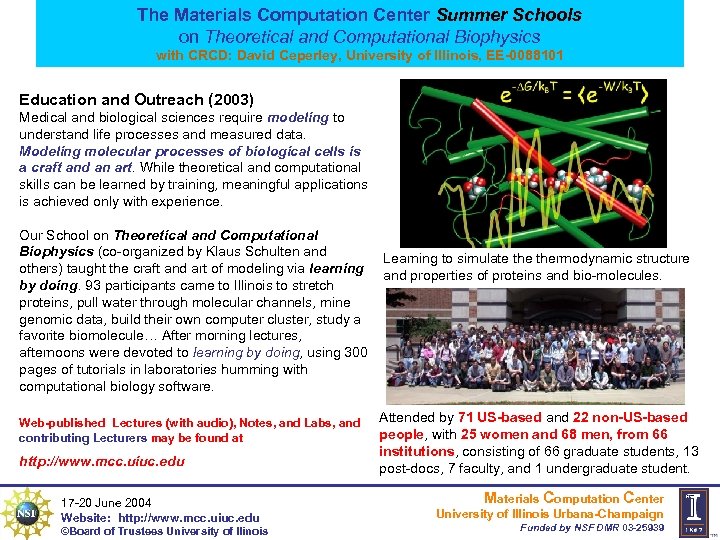 The Materials Computation Center Summer Schools on Theoretical and Computational Biophysics with CRCD: David Ceperley, University of Illinois, EE-0088101 Education and Outreach (2003) Medical and biological sciences require modeling to understand life processes and measured data. Modeling molecular processes of biological cells is a craft and an art. While theoretical and computational skills can be learned by training, meaningful applications is achieved only with experience. Our School on Theoretical and Computational Biophysics (co-organized by Klaus Schulten and Learning to simulate thermodynamic structure others) taught the craft and art of modeling via learning and properties of proteins and bio-molecules. by doing. 93 participants came to Illinois to stretch proteins, pull water through molecular channels, mine genomic data, build their own computer cluster, study a favorite biomolecule… After morning lectures, afternoons were devoted to learning by doing, using 300 pages of tutorials in laboratories humming with computational biology software. Web-published Lectures (with audio), Notes, and Labs, and contributing Lecturers may be found at http: //www. mcc. uiuc. edu 17 -20 June 2004 Website: http: //www. mcc. uiuc. edu ©Board of Trustees University of Ilinois Attended by 71 US-based and 22 non-US-based people, with 25 women and 68 men, from 66 institutions, consisting of 66 graduate students, 13 post-docs, 7 faculty, and 1 undergraduate student. Materials Computation Center University of Illinois Urbana-Champaign Funded by NSF DMR 03 -25939
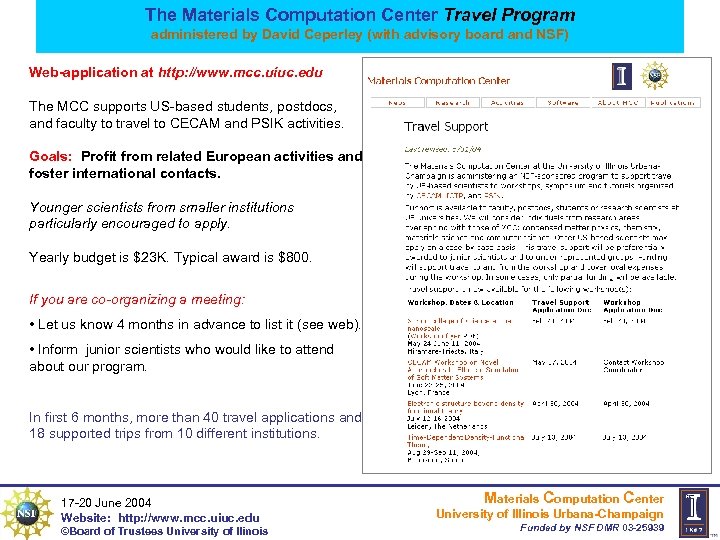 The Materials Computation Center Travel Program administered by David Ceperley (with advisory board and NSF) Web-application at http: //www. mcc. uiuc. edu The MCC supports US-based students, postdocs, and faculty to travel to CECAM and PSIK activities. Goals: Profit from related European activities and foster international contacts. Younger scientists from smaller institutions particularly encouraged to apply. Yearly budget is $23 K. Typical award is $800. If you are co-organizing a meeting: • Let us know 4 months in advance to list it (see web). • Inform junior scientists who would like to attend about our program. In first 6 months, more than 40 travel applications and 18 supported trips from 10 different institutions. 17 -20 June 2004 Website: http: //www. mcc. uiuc. edu ©Board of Trustees University of Ilinois Materials Computation Center University of Illinois Urbana-Champaign Funded by NSF DMR 03 -25939
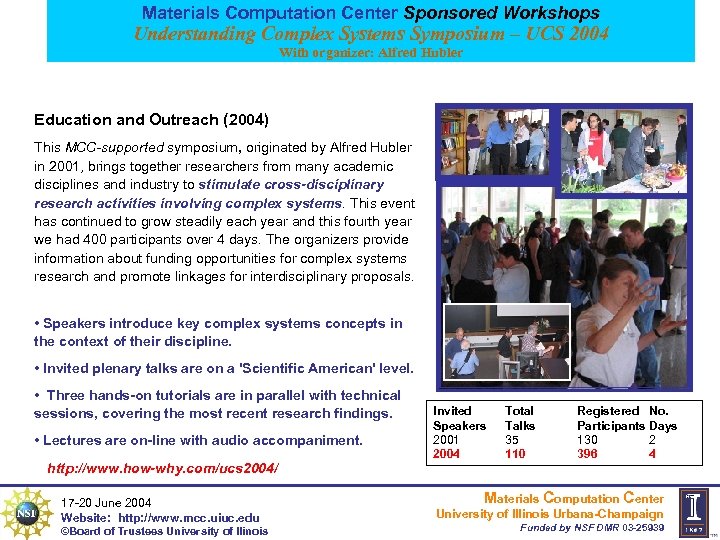 Materials Computation Center Sponsored Workshops Understanding Complex Systems Symposium – UCS 2004 With organizer: Alfred Hubler Education and Outreach (2004) This MCC-supported symposium, originated by Alfred Hubler in 2001, brings together researchers from many academic disciplines and industry to stimulate cross-disciplinary research activities involving complex systems. This event has continued to grow steadily each year and this fourth year we had 400 participants over 4 days. The organizers provide information about funding opportunities for complex systems research and promote linkages for interdisciplinary proposals. • Speakers introduce key complex systems concepts in the context of their discipline. • Invited plenary talks are on a 'Scientific American' level. • Three hands-on tutorials are in parallel with technical sessions, covering the most recent research findings. • Lectures are on-line with audio accompaniment. http: //www. how-why. com/ucs 2004/ 17 -20 June 2004 Website: http: //www. mcc. uiuc. edu ©Board of Trustees University of Ilinois Invited Speakers 2001 2004 Total Talks 35 110 Registered No. Participants Days 130 2 396 4 Materials Computation Center University of Illinois Urbana-Champaign Funded by NSF DMR 03 -25939
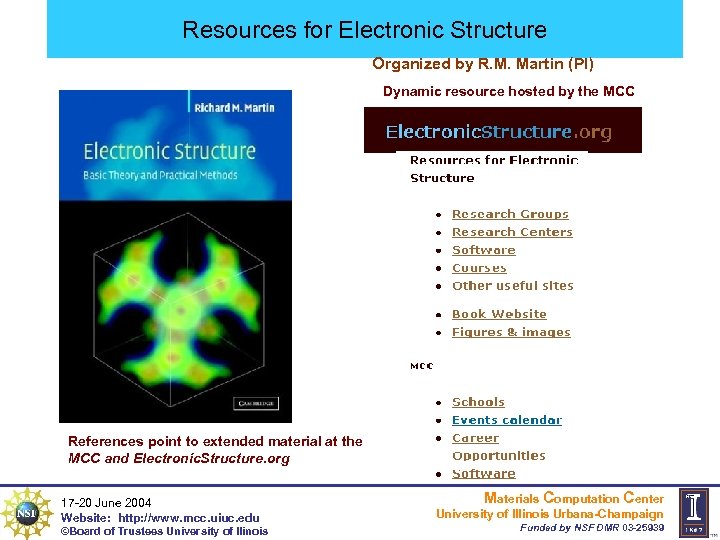 Resources for Electronic Structure Organized by R. M. Martin (PI) Dynamic resource hosted by the MCC References point to extended material at the MCC and Electronic. Structure. org 17 -20 June 2004 Website: http: //www. mcc. uiuc. edu ©Board of Trustees University of Ilinois Materials Computation Center University of Illinois Urbana-Champaign Funded by NSF DMR 03 -25939
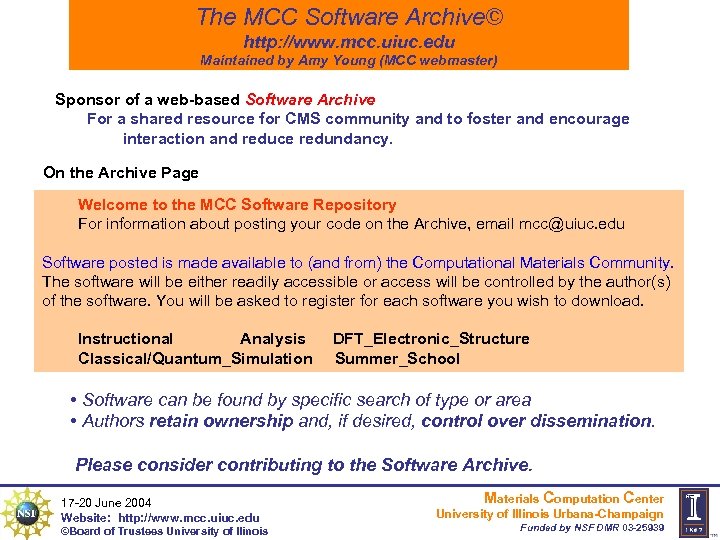 The MCC Software Archive© http: //www. mcc. uiuc. edu Maintained by Amy Young (MCC webmaster) Sponsor of a web-based Software Archive For a shared resource for CMS community and to foster and encourage interaction and reduce redundancy. On the Archive Page Welcome to the MCC Software Repository For information about posting your code on the Archive, email mcc@uiuc. edu Software posted is made available to (and from) the Computational Materials Community. The software will be either readily accessible or access will be controlled by the author(s) of the software. You will be asked to register for each software you wish to download. Instructional Analysis Classical/Quantum_Simulation DFT_Electronic_Structure Summer_School • Software can be found by specific search of type or area • Authors retain ownership and, if desired, control over dissemination. Please consider contributing to the Software Archive. 17 -20 June 2004 Website: http: //www. mcc. uiuc. edu ©Board of Trustees University of Ilinois Materials Computation Center University of Illinois Urbana-Champaign Funded by NSF DMR 03 -25939
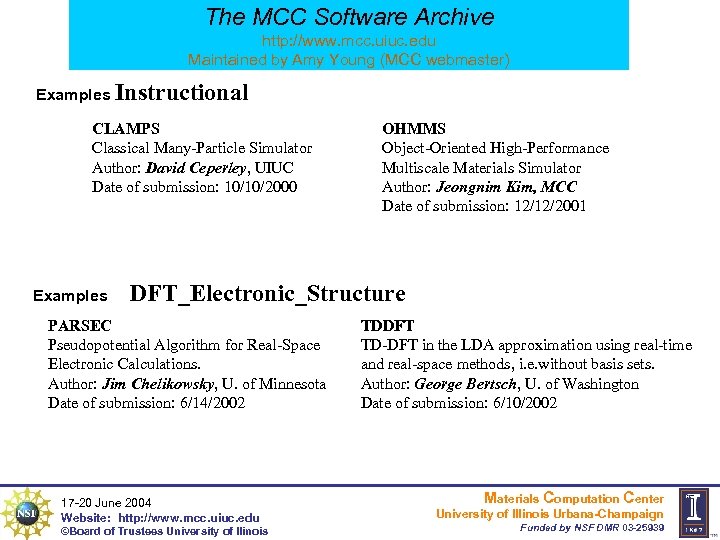 The MCC Software Archive http: //www. mcc. uiuc. edu Maintained by Amy Young (MCC webmaster) Examples Instructional CLAMPS Classical Many-Particle Simulator Author: David Ceperley, UIUC Date of submission: 10/10/2000 Examples OHMMS Object-Oriented High-Performance Multiscale Materials Simulator Author: Jeongnim Kim, MCC Date of submission: 12/12/2001 DFT_Electronic_Structure PARSEC Pseudopotential Algorithm for Real-Space Electronic Calculations. Author: Jim Chelikowsky, U. of Minnesota Date of submission: 6/14/2002 17 -20 June 2004 Website: http: //www. mcc. uiuc. edu ©Board of Trustees University of Ilinois TDDFT TD-DFT in the LDA approximation using real-time and real-space methods, i. e. without basis sets. Author: George Bertsch, U. of Washington Date of submission: 6/10/2002 Materials Computation Center University of Illinois Urbana-Champaign Funded by NSF DMR 03 -25939
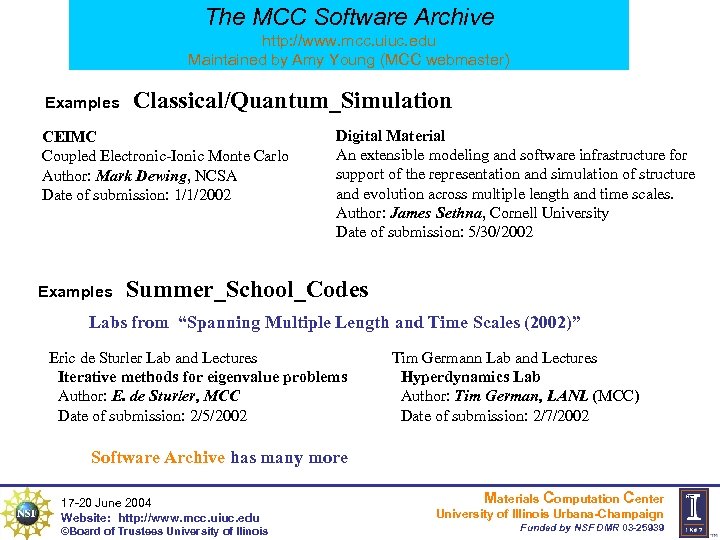 The MCC Software Archive http: //www. mcc. uiuc. edu Maintained by Amy Young (MCC webmaster) Examples Classical/Quantum_Simulation CEIMC Coupled Electronic-Ionic Monte Carlo Author: Mark Dewing, NCSA Date of submission: 1/1/2002 Examples Digital Material An extensible modeling and software infrastructure for support of the representation and simulation of structure and evolution across multiple length and time scales. Author: James Sethna, Cornell University Date of submission: 5/30/2002 Summer_School_Codes Labs from “Spanning Multiple Length and Time Scales (2002)” Eric de Sturler Lab and Lectures Iterative methods for eigenvalue problems Author: E. de Sturler, MCC Date of submission: 2/5/2002 Tim Germann Lab and Lectures Hyperdynamics Lab Author: Tim German, LANL (MCC) Date of submission: 2/7/2002 Software Archive has many more 17 -20 June 2004 Website: http: //www. mcc. uiuc. edu ©Board of Trustees University of Ilinois Materials Computation Center University of Illinois Urbana-Champaign Funded by NSF DMR 03 -25939
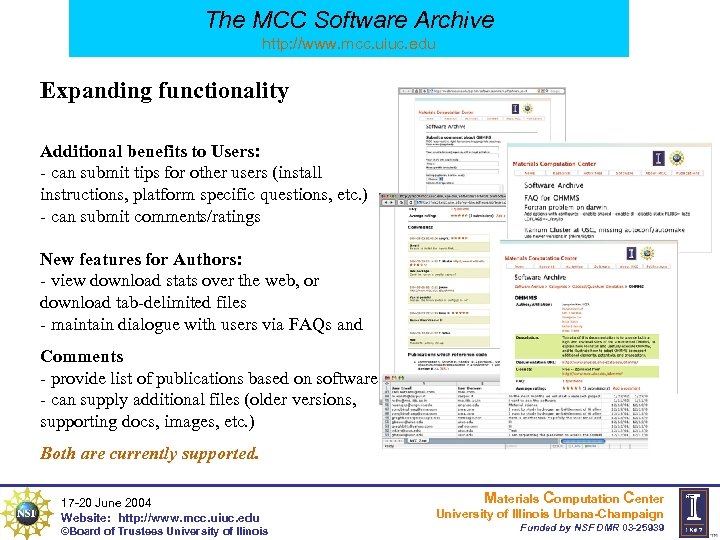 The MCC Software Archive http: //www. mcc. uiuc. edu Expanding functionality Additional benefits to Users: - can submit tips for other users (install instructions, platform specific questions, etc. ) - can submit comments/ratings New features for Authors: - view download stats over the web, or download tab-delimited files - maintain dialogue with users via FAQs and Comments - provide list of publications based on software - can supply additional files (older versions, supporting docs, images, etc. ) Both are currently supported. 17 -20 June 2004 Website: http: //www. mcc. uiuc. edu ©Board of Trustees University of Ilinois Materials Computation Center University of Illinois Urbana-Champaign Funded by NSF DMR 03 -25939
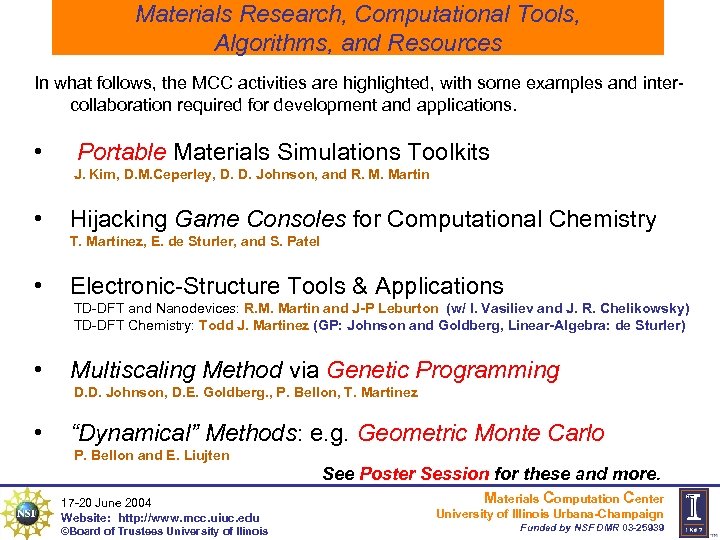 Materials Research, Computational Tools, Algorithms, and Resources In what follows, the MCC activities are highlighted, with some examples and intercollaboration required for development and applications. • Portable Materials Simulations Toolkits J. Kim, D. M. Ceperley, D. D. Johnson, and R. M. Martin • Hijacking Game Consoles for Computational Chemistry T. Martínez, E. de Sturler, and S. Patel • Electronic-Structure Tools & Applications TD-DFT and Nanodevices: R. M. Martin and J-P Leburton (w/ I. Vasiliev and J. R. Chelikowsky) TD-DFT Chemistry: Todd J. Martinez (GP: Johnson and Goldberg, Linear-Algebra: de Sturler) • Multiscaling Method via Genetic Programming D. D. Johnson, D. E. Goldberg. , P. Bellon, T. Martinez • “Dynamical” Methods: e. g. Geometric Monte Carlo P. Bellon and E. Liujten See Poster Session for these and more. 17 -20 June 2004 Website: http: //www. mcc. uiuc. edu ©Board of Trustees University of Ilinois Materials Computation Center University of Illinois Urbana-Champaign Funded by NSF DMR 03 -25939
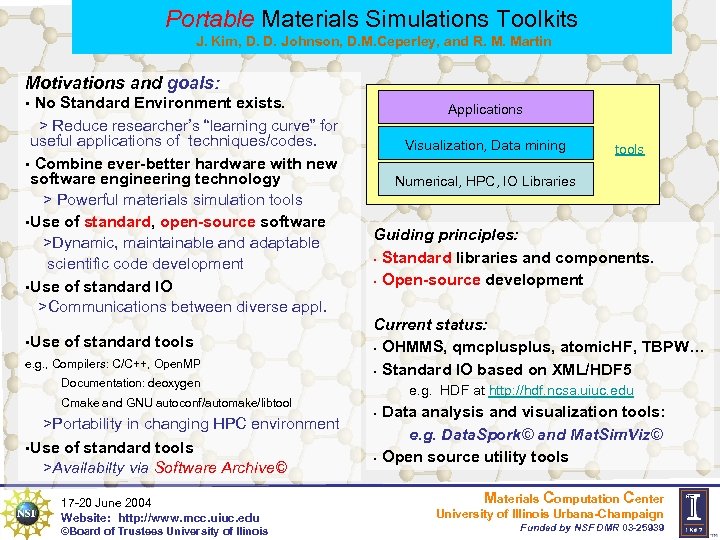 Portable Materials Simulations Toolkits J. Kim, D. D. Johnson, D. M. Ceperley, and R. M. Martin Motivations and goals: No Standard Environment exists. > Reduce researcher’s “learning curve” for useful applications of techniques/codes. • Combine ever-better hardware with new software engineering technology > Powerful materials simulation tools • Use of standard, open-source software >Dynamic, maintainable and adaptable scientific code development • Use of standard IO >Communications between diverse appl. • • Use of standard tools e. g. , Compilers: C/C++, Open. MP Documentation: deoxygen Cmake and GNU autoconf/automake/libtool >Portability in changing HPC environment • Use of standard tools >Availabilty via Software Archive© 17 -20 June 2004 Website: http: //www. mcc. uiuc. edu ©Board of Trustees University of Ilinois Applications Visualization, Data mining tools Numerical, HPC, IO Libraries Guiding principles: • Standard libraries and components. • Open-source development Current status: • OHMMS, qmcplus, atomic. HF, TBPW… • Standard IO based on XML/HDF 5 e. g. HDF at http: //hdf. ncsa. uiuc. edu • • Data analysis and visualization tools: e. g. Data. Spork© and Mat. Sim. Viz© Open source utility tools Materials Computation Center University of Illinois Urbana-Champaign Funded by NSF DMR 03 -25939
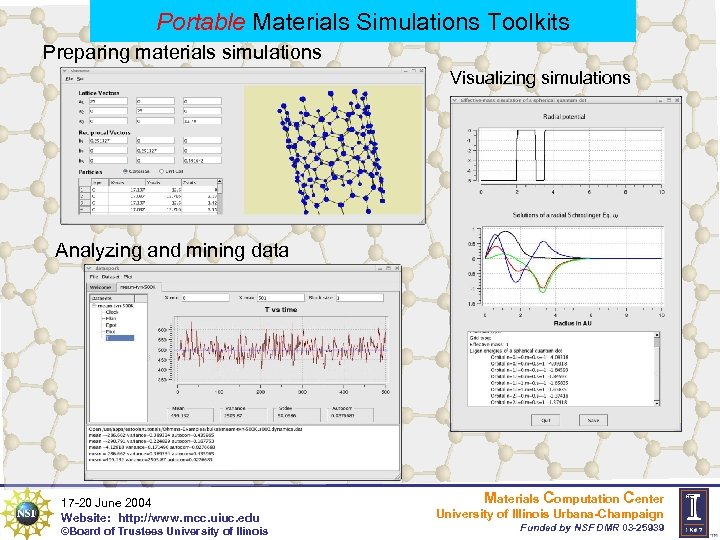 Portable Materials Simulations Toolkits Preparing materials simulations Visualizing simulations Analyzing and mining data 17 -20 June 2004 Website: http: //www. mcc. uiuc. edu ©Board of Trustees University of Ilinois Materials Computation Center University of Illinois Urbana-Champaign Funded by NSF DMR 03 -25939
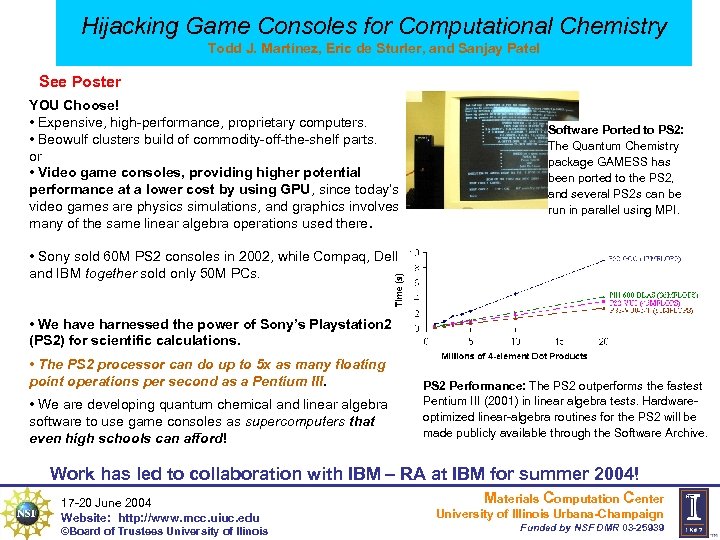 Hijacking Game Consoles for Computational Chemistry Todd J. Martínez, Eric de Sturler, and Sanjay Patel See Poster YOU Choose! • Expensive, high-performance, proprietary computers. • Beowulf clusters build of commodity-off-the-shelf parts. or • Video game consoles, providing higher potential performance at a lower cost by using GPU, since today’s video games are physics simulations, and graphics involves many of the same linear algebra operations used there. Software Ported to PS 2: The Quantum Chemistry package GAMESS has been ported to the PS 2, and several PS 2 s can be run in parallel using MPI. • Sony sold 60 M PS 2 consoles in 2002, while Compaq, Dell and IBM together sold only 50 M PCs. • We have harnessed the power of Sony’s Playstation 2 (PS 2) for scientific calculations. • The PS 2 processor can do up to 5 x as many floating point operations per second as a Pentium III. • We are developing quantum chemical and linear algebra software to use game consoles as supercomputers that even high schools can afford! PS 2 Performance: The PS 2 outperforms the fastest Pentium III (2001) in linear algebra tests. Hardwareoptimized linear-algebra routines for the PS 2 will be made publicly available through the Software Archive. Work has led to collaboration with IBM – RA at IBM for summer 2004! 17 -20 June 2004 Website: http: //www. mcc. uiuc. edu ©Board of Trustees University of Ilinois Materials Computation Center University of Illinois Urbana-Champaign Funded by NSF DMR 03 -25939
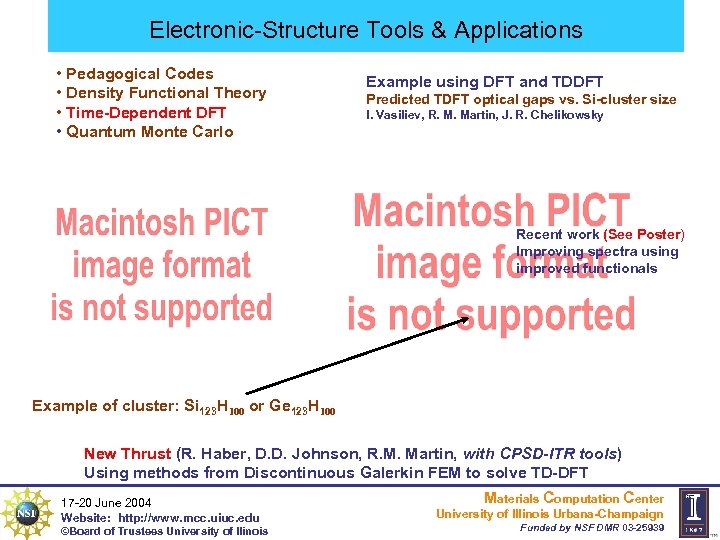 Electronic-Structure Tools & Applications • Pedagogical Codes • Density Functional Theory • Time-Dependent DFT • Quantum Monte Carlo Example using DFT and TDDFT Predicted TDFT optical gaps vs. Si-cluster size I. Vasiliev, R. M. Martin, J. R. Chelikowsky Recent work (See Poster) Improving spectra using improved functionals Example of cluster: Si 123 H 100 or Ge 123 H 100 New Thrust (R. Haber, D. D. Johnson, R. M. Martin, with CPSD-ITR tools) Using methods from Discontinuous Galerkin FEM to solve TD-DFT 17 -20 June 2004 Website: http: //www. mcc. uiuc. edu ©Board of Trustees University of Ilinois Materials Computation Center University of Illinois Urbana-Champaign Funded by NSF DMR 03 -25939
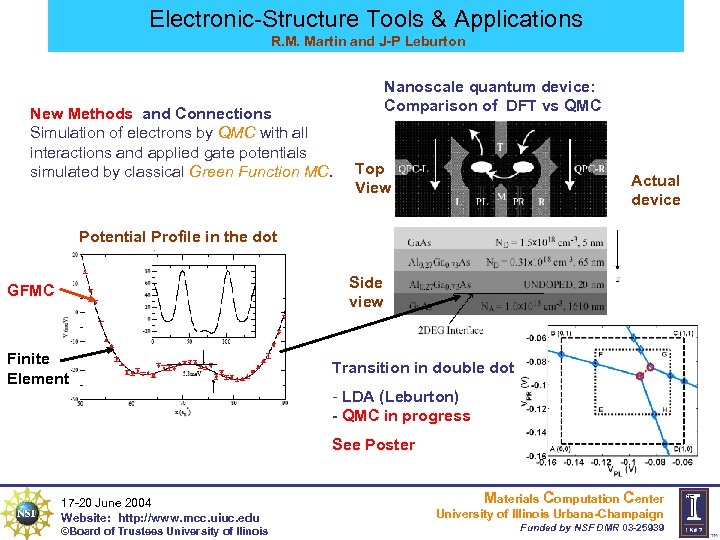 Electronic-Structure Tools & Applications R. M. Martin and J-P Leburton New Methods and Connections Simulation of electrons by QMC with all interactions and applied gate potentials simulated by classical Green Function MC. Nanoscale quantum device: Comparison of DFT vs QMC Top View Actual device Potential Profile in the dot Side view GFMC Finite Element Transition in double dot - LDA (Leburton) - QMC in progress See Poster 17 -20 June 2004 Website: http: //www. mcc. uiuc. edu ©Board of Trustees University of Ilinois Materials Computation Center University of Illinois Urbana-Champaign Funded by NSF DMR 03 -25939
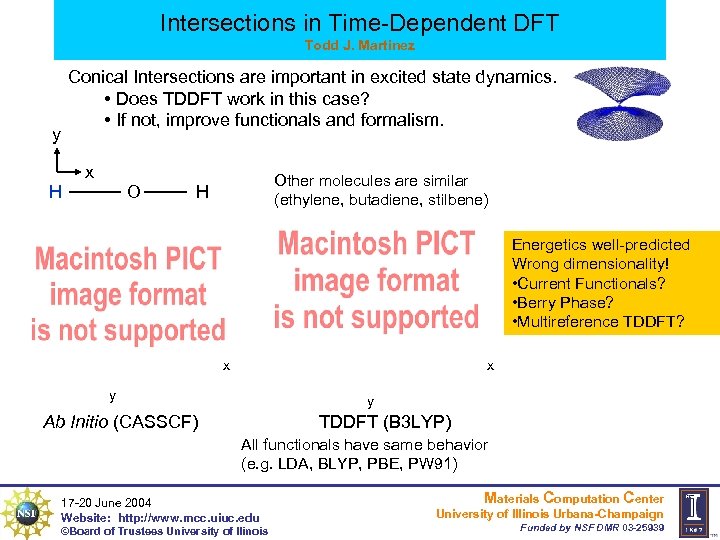 Intersections in Time-Dependent DFT Todd J. Martinez y Conical Intersections are important in excited state dynamics. • Does TDDFT work in this case? • If not, improve functionals and formalism. x H O H Other molecules are similar (ethylene, butadiene, stilbene) Energetics well-predicted Wrong dimensionality! • Current Functionals? • Berry Phase? • Multireference TDDFT? x x y y Ab Initio (CASSCF) TDDFT (B 3 LYP) All functionals have same behavior (e. g. LDA, BLYP, PBE, PW 91) 17 -20 June 2004 Website: http: //www. mcc. uiuc. edu ©Board of Trustees University of Ilinois Materials Computation Center University of Illinois Urbana-Champaign Funded by NSF DMR 03 -25939
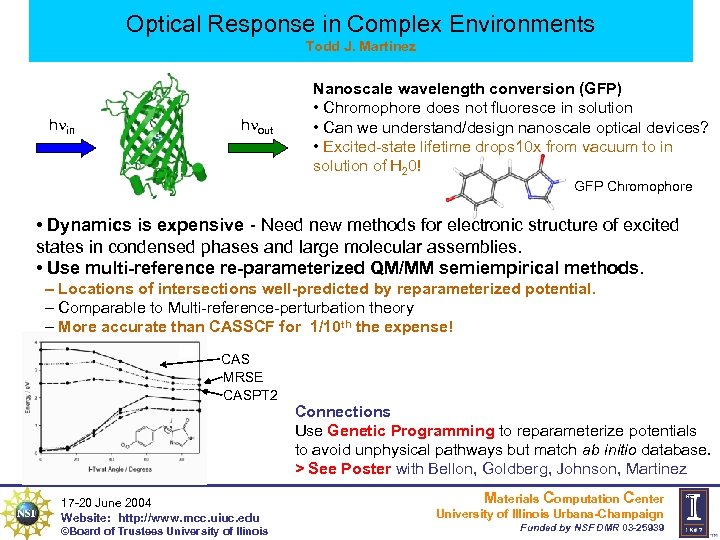 Optical Response in Complex Environments Todd J. Martinez h in h out Nanoscale wavelength conversion (GFP) • Chromophore does not fluoresce in solution • Can we understand/design nanoscale optical devices? • Excited-state lifetime drops 10 x from vacuum to in solution of H 20! GFP Chromophore • Dynamics is expensive - Need new methods for electronic structure of excited states in condensed phases and large molecular assemblies. • Use multi-reference re-parameterized QM/MM semiempirical methods. – Locations of intersections well-predicted by reparameterized potential. – Comparable to Multi-reference-perturbation theory – More accurate than CASSCF for 1/10 th the expense! CAS MRSE CASPT 2 17 -20 June 2004 Website: http: //www. mcc. uiuc. edu ©Board of Trustees University of Ilinois Connections Use Genetic Programming to reparameterize potentials to avoid unphysical pathways but match ab initio database. > See Poster with Bellon, Goldberg, Johnson, Martinez Materials Computation Center University of Illinois Urbana-Champaign Funded by NSF DMR 03 -25939
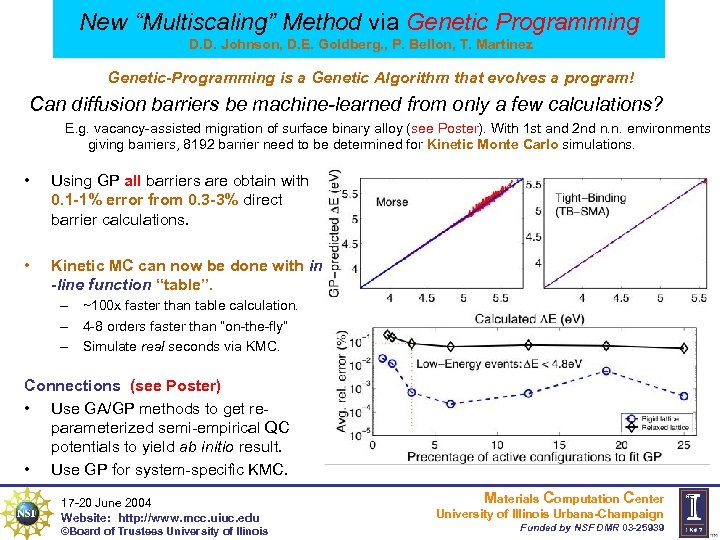 New “Multiscaling” Method via Genetic Programming D. D. Johnson, D. E. Goldberg. , P. Bellon, T. Martinez Genetic-Programming is a Genetic Algorithm that evolves a program! Can diffusion barriers be machine-learned from only a few calculations? E. g. vacancy-assisted migration of surface binary alloy (see Poster). With 1 st and 2 nd n. n. environments giving barriers, 8192 barrier need to be determined for Kinetic Monte Carlo simulations. • Using GP all barriers are obtain with 0. 1 -1% error from 0. 3 -3% direct barrier calculations. • Kinetic MC can now be done with in -line function “table”. – ~100 x faster than table calculation. – 4 -8 orders faster than “on-the-fly” – Simulate real seconds via KMC. Connections (see Poster) • Use GA/GP methods to get reparameterized semi-empirical QC potentials to yield ab initio result. • Use GP for system-specific KMC. 17 -20 June 2004 Website: http: //www. mcc. uiuc. edu ©Board of Trustees University of Ilinois Materials Computation Center University of Illinois Urbana-Champaign Funded by NSF DMR 03 -25939
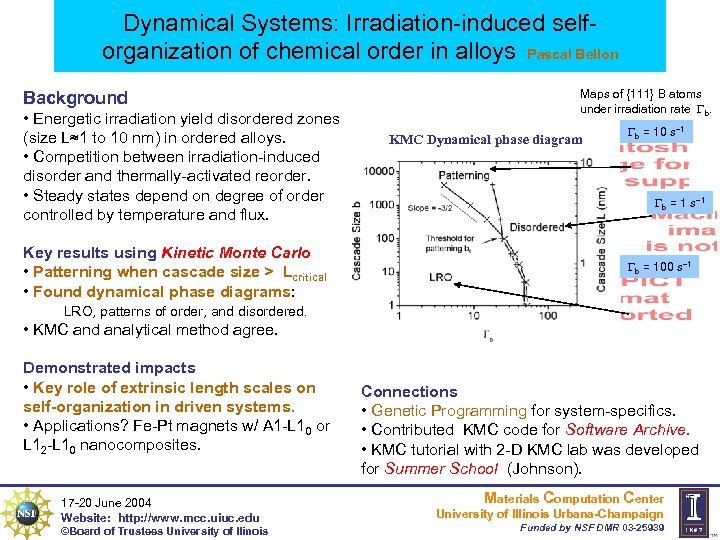 Dynamical Systems: Irradiation-induced selforganization of chemical order in alloys Pascal Bellon Background • Energetic irradiation yield disordered zones (size L≈1 to 10 nm) in ordered alloys. • Competition between irradiation-induced disorder and thermally-activated reorder. • Steady states depend on degree of order controlled by temperature and flux. Key results using Kinetic Monte Carlo • Patterning when cascade size > Lcritical • Found dynamical phase diagrams: LRO, patterns of order, and disordered. • KMC and analytical method agree. Demonstrated impacts • Key role of extrinsic length scales on self-organization in driven systems. • Applications? Fe-Pt magnets w/ A 1 -L 10 or L 12 -L 10 nanocomposites. 17 -20 June 2004 Website: http: //www. mcc. uiuc. edu ©Board of Trustees University of Ilinois Maps of {111} B atoms under irradiation rate b. KMC Dynamical phase diagram b = 10 s– 1 b = 100 s– 1 Connections • Genetic Programming for system-specifics. • Contributed KMC code for Software Archive. • KMC tutorial with 2 -D KMC lab was developed for Summer School (Johnson). Materials Computation Center University of Illinois Urbana-Champaign Funded by NSF DMR 03 -25939
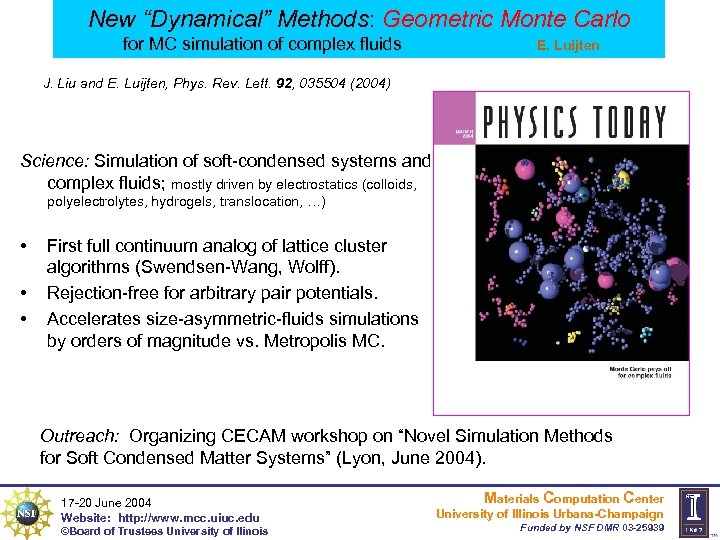 New “Dynamical” Methods: Geometric Monte Carlo for MC simulation of complex fluids E. Luijten J. Liu and E. Luijten, Phys. Rev. Lett. 92, 035504 (2004) Science: Simulation of soft-condensed systems and complex fluids; mostly driven by electrostatics (colloids, polyelectrolytes, hydrogels, translocation, …) • • • First full continuum analog of lattice cluster algorithms (Swendsen-Wang, Wolff). Rejection-free for arbitrary pair potentials. Accelerates size-asymmetric-fluids simulations by orders of magnitude vs. Metropolis MC. Outreach: Organizing CECAM workshop on “Novel Simulation Methods for Soft Condensed Matter Systems” (Lyon, June 2004). 17 -20 June 2004 Website: http: //www. mcc. uiuc. edu ©Board of Trustees University of Ilinois Materials Computation Center University of Illinois Urbana-Champaign Funded by NSF DMR 03 -25939
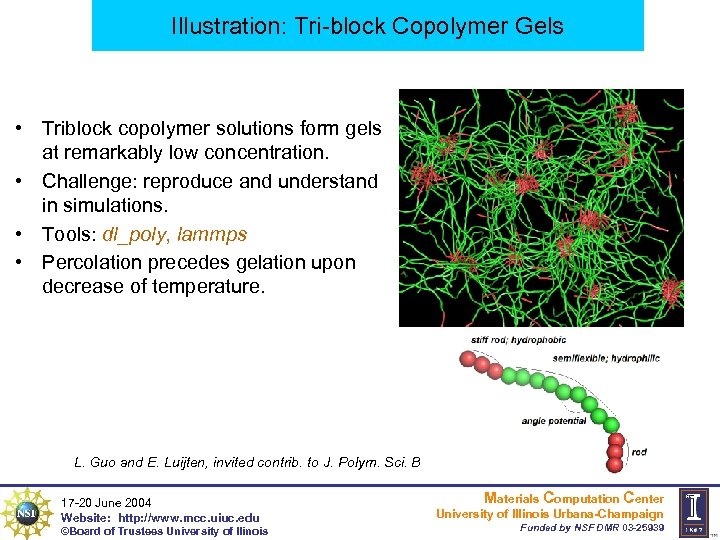 Illustration: Tri-block Copolymer Gels • Triblock copolymer solutions form gels at remarkably low concentration. • Challenge: reproduce and understand in simulations. • Tools: dl_poly, lammps • Percolation precedes gelation upon decrease of temperature. L. Guo and E. Luijten, invited contrib. to J. Polym. Sci. B 17 -20 June 2004 Website: http: //www. mcc. uiuc. edu ©Board of Trustees University of Ilinois Materials Computation Center University of Illinois Urbana-Champaign Funded by NSF DMR 03 -25939
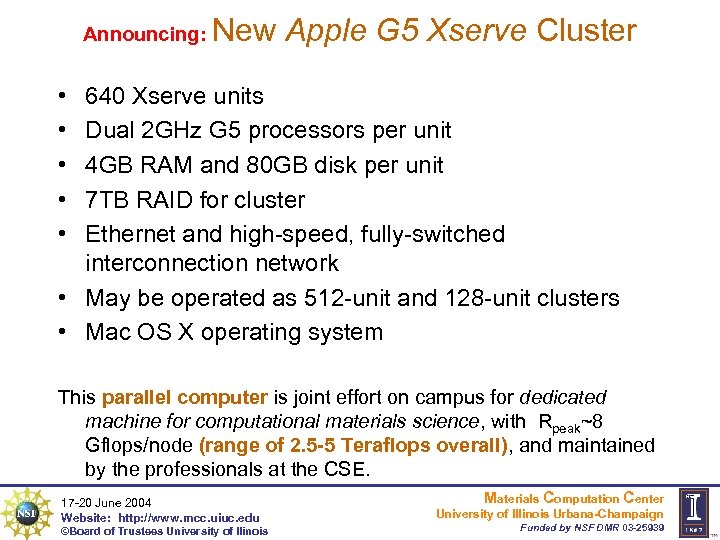 Announcing: New Apple G 5 Xserve Cluster • • • 640 Xserve units Dual 2 GHz G 5 processors per unit 4 GB RAM and 80 GB disk per unit 7 TB RAID for cluster Ethernet and high-speed, fully-switched interconnection network • May be operated as 512 -unit and 128 -unit clusters • Mac OS X operating system This parallel computer is joint effort on campus for dedicated machine for computational materials science, with Rpeak~8 Gflops/node (range of 2. 5 -5 Teraflops overall), and maintained by the professionals at the CSE. 17 -20 June 2004 Website: http: //www. mcc. uiuc. edu ©Board of Trustees University of Ilinois Materials Computation Center University of Illinois Urbana-Champaign Funded by NSF DMR 03 -25939
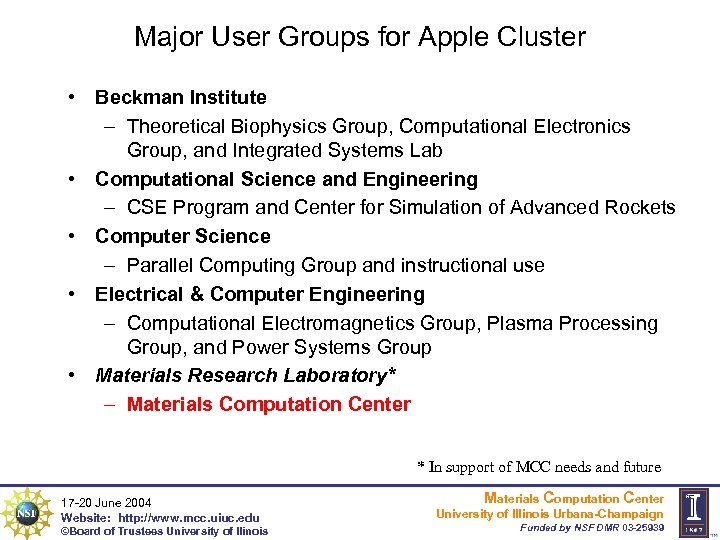 Major User Groups for Apple Cluster • Beckman Institute – Theoretical Biophysics Group, Computational Electronics Group, and Integrated Systems Lab • Computational Science and Engineering – CSE Program and Center for Simulation of Advanced Rockets • Computer Science – Parallel Computing Group and instructional use • Electrical & Computer Engineering – Computational Electromagnetics Group, Plasma Processing Group, and Power Systems Group • Materials Research Laboratory* – Materials Computation Center * In support of MCC needs and future 17 -20 June 2004 Website: http: //www. mcc. uiuc. edu ©Board of Trustees University of Ilinois Materials Computation Center University of Illinois Urbana-Champaign Funded by NSF DMR 03 -25939
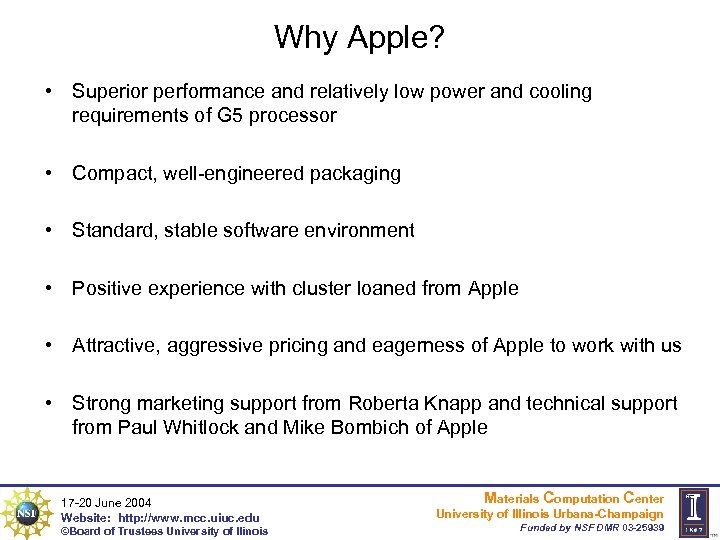 Why Apple? • Superior performance and relatively low power and cooling requirements of G 5 processor • Compact, well-engineered packaging • Standard, stable software environment • Positive experience with cluster loaned from Apple • Attractive, aggressive pricing and eagerness of Apple to work with us • Strong marketing support from Roberta Knapp and technical support from Paul Whitlock and Mike Bombich of Apple 17 -20 June 2004 Website: http: //www. mcc. uiuc. edu ©Board of Trustees University of Ilinois Materials Computation Center University of Illinois Urbana-Champaign Funded by NSF DMR 03 -25939
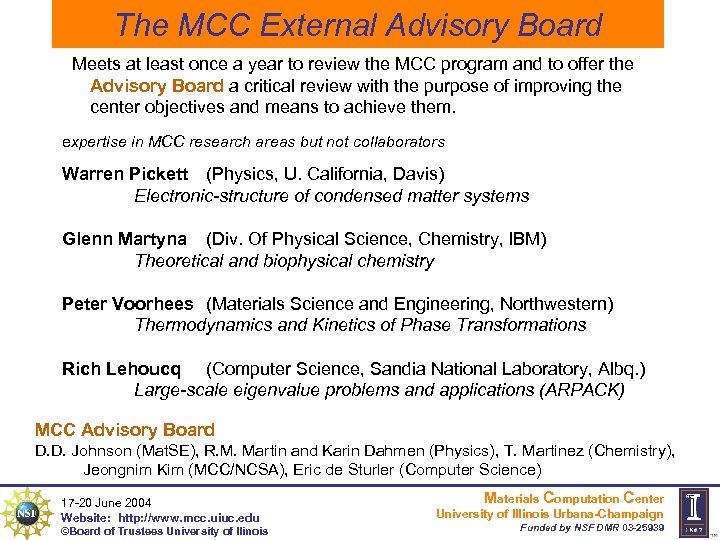 The MCC External Advisory Board Meets at least once a year to review the MCC program and to offer the Advisory Board a critical review with the purpose of improving the center objectives and means to achieve them. expertise in MCC research areas but not collaborators Warren Pickett (Physics, U. California, Davis) Electronic-structure of condensed matter systems Glenn Martyna (Div. Of Physical Science, Chemistry, IBM) Theoretical and biophysical chemistry Peter Voorhees (Materials Science and Engineering, Northwestern) Thermodynamics and Kinetics of Phase Transformations Rich Lehoucq (Computer Science, Sandia National Laboratory, Albq. ) Large-scale eigenvalue problems and applications (ARPACK) MCC Advisory Board D. D. Johnson (Mat. SE), R. M. Martin and Karin Dahmen (Physics), T. Martinez (Chemistry), Jeongnim Kim (MCC/NCSA), Eric de Sturler (Computer Science) 17 -20 June 2004 Website: http: //www. mcc. uiuc. edu ©Board of Trustees University of Ilinois Materials Computation Center University of Illinois Urbana-Champaign Funded by NSF DMR 03 -25939
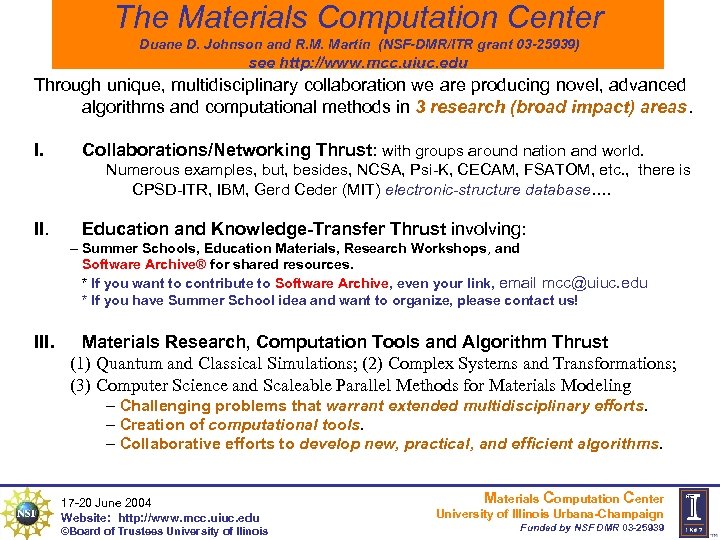 The Materials Computation Center Duane D. Johnson and R. M. Martin (NSF-DMR/ITR grant 03 -25939) see http: //www. mcc. uiuc. edu Through unique, multidisciplinary collaboration we are producing novel, advanced algorithms and computational methods in 3 research (broad impact) areas. I. Collaborations/Networking Thrust: with groups around nation and world. Numerous examples, but, besides, NCSA, Psi-K, CECAM, FSATOM, etc. , there is CPSD-ITR, IBM, Gerd Ceder (MIT) electronic-structure database…. II. Education and Knowledge-Transfer Thrust involving: – Summer Schools, Education Materials, Research Workshops, and Software Archive® for shared resources. * If you want to contribute to Software Archive, even your link, email mcc@uiuc. edu * If you have Summer School idea and want to organize, please contact us! III. Materials Research, Computation Tools and Algorithm Thrust (1) Quantum and Classical Simulations; (2) Complex Systems and Transformations; (3) Computer Science and Scaleable Parallel Methods for Materials Modeling – Challenging problems that warrant extended multidisciplinary efforts. – Creation of computational tools. – Collaborative efforts to develop new, practical, and efficient algorithms. 17 -20 June 2004 Website: http: //www. mcc. uiuc. edu ©Board of Trustees University of Ilinois Materials Computation Center University of Illinois Urbana-Champaign Funded by NSF DMR 03 -25939