 Скачать презентацию NS 3 Wifi By Salah Amean Ahmmed Saeed
NS3_implementation_wifi_Seminar (1).pptx
- Количество слайдов: 33



NS 3 Wifi By Salah Amean Ahmmed Saeed
Wifi Net. Device • ns-3 nodes can contain a collection of Net. Device objects • Similar to real computer containing interface card, Ethernet, wifi, etc. • By adding Wifi. Net. Device objects to ns-3 nodes, • one can create models of 802. 11 -based infrastructure and ad hoc networks.
Wifi. Net. Device Model overview • Models a wireless network interface controller based on the IEEE 802. 11 standard. • basic 802. 11 DCF with infrastructure and modes • 802. 11 a and 802. 11 b physical layers • Qo. S-based EDCA and queueing extensions of 802. 11 e • various propagation loss models including Nakagami, Rayleigh, Friis, Log. Distance, Fixed. Rss, Random • various rate control algorithms including Aarf, Arf, Cara, Onoe, Rraa, Constant. Rate, and Minstrel
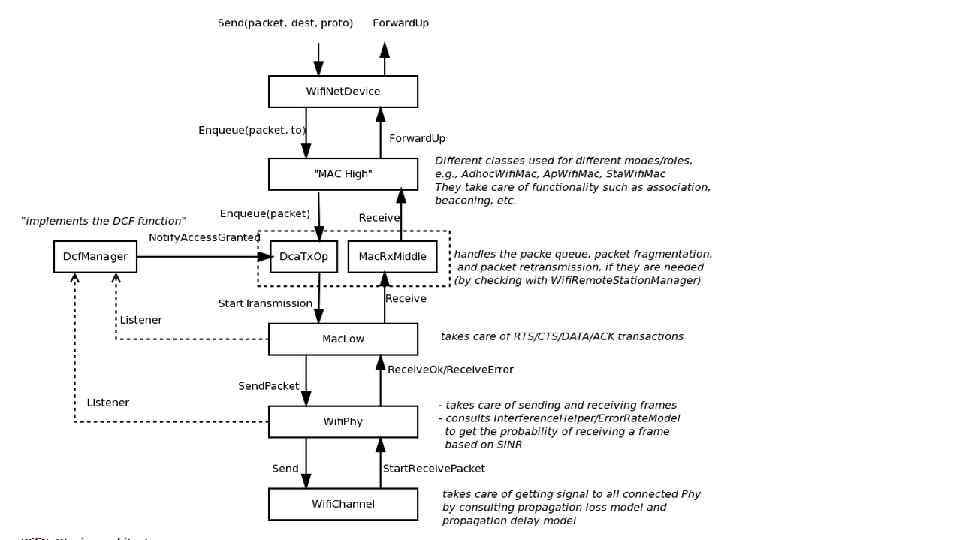
Modular implementation • Ns 3 implementation is modular and contains: • PHY layer models • MAC low models: • they implement DCF and EDCAF • MAC high models: • they implement the MAC-level beacon generation, probing, and association state machines, and • Rate control algorithms used by the MAC low models
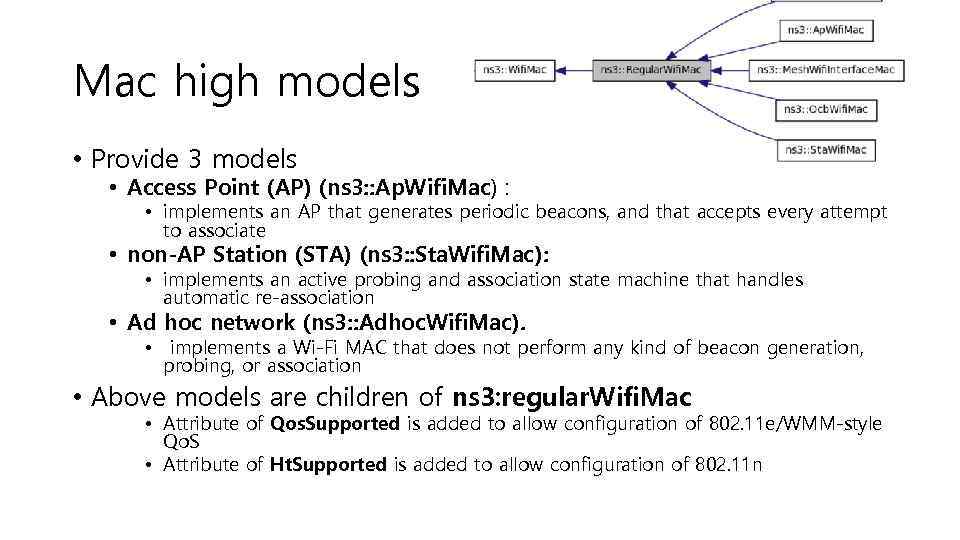
Mac high models • Provide 3 models • Access Point (AP) (ns 3: : Ap. Wifi. Mac) : • implements an AP that generates periodic beacons, and that accepts every attempt to associate • non-AP Station (STA) (ns 3: : Sta. Wifi. Mac): • implements an active probing and association state machine that handles automatic re-association • Ad hoc network (ns 3: : Adhoc. Wifi. Mac). • implements a Wi-Fi MAC that does not perform any kind of beacon generation, probing, or association • Above models are children of ns 3: regular. Wifi. Mac • Attribute of Qos. Supported is added to allow configuration of 802. 11 e/WMM-style Qo. S • Attribute of Ht. Supported is added to allow configuration of 802. 11 n
Mac low layer • Three components: • ns 3: : Mac. Low: • Takes care of RTS/CTS/DATA/ACK transactions. • ns 3: : Dcf. Manager and ns 3: : Dcf. State • Implements the DCF and EDCAF functions. • ns 3: : Dca. Txop and ns 3: : Edca. Txop. N • • handle the packet queue, packet fragmentation, and packet retransmissions if they are needed. The ns 3: : Dca. Txop object is used high MACs that are not Qo. S-enabled, and for transmission of frames (e. g. , of type Management) that the standard says should access the medium using the DCF. ns 3: : Edca. Txop. N is is used by Qo. S-enabled high MACs and also performs Qo. S operations like 802. 11 n-style MSDU aggregation.
The Wifi. Channel and Wifi. Phy models • ns 3: : Wifi. Phy class implement it, • Based on YANS simulator • Validation of ns-3 802. 11 b PHY model • Yans PHY layer states: • TX: the physical layer is transmitting on behalf of its associated MAC • SYNC: PHY is synchronized on a signal and it is waiting till it receives the last bit to forward it to MAC. • CCA_BUSY: PHY is not in TX or SYNC state but the measured energy higher than the energy detection threshold. • IDLE: PHY is not in TX or SYNC state • When in TX or SYNC state, • Any new packet arriving will be droped
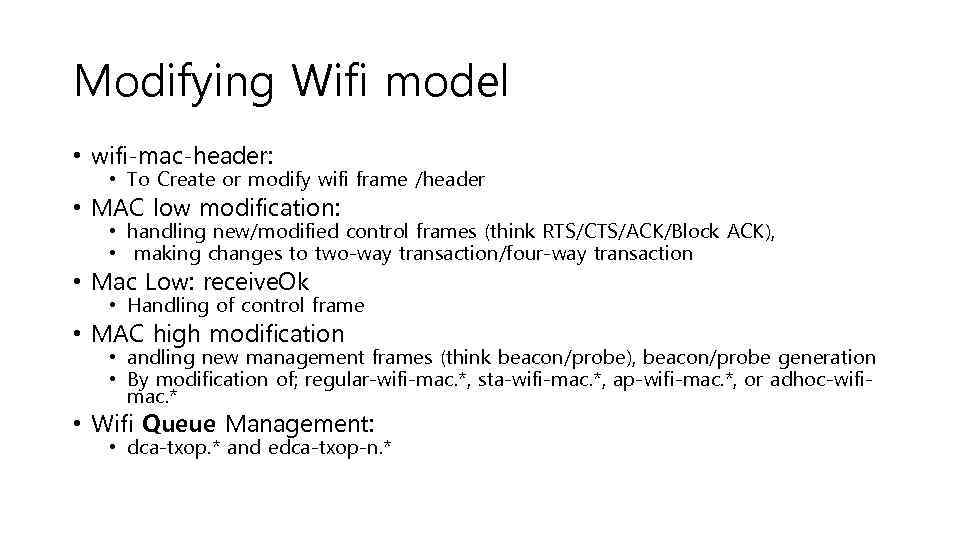
Modifying Wifi model • wifi-mac-header: • To Create or modify wifi frame /header • MAC low modification: • handling new/modified control frames (think RTS/CTS/ACK/Block ACK), • making changes to two-way transaction/four-way transaction • Mac Low: receive. Ok • Handling of control frame • MAC high modification • andling new management frames (think beacon/probe), beacon/probe generation • By modification of; regular-wifi-mac. *, sta-wifi-mac. *, ap-wifi-mac. *, or adhoc-wifimac. * • Wifi Queue Management: • dca-txop. * and edca-txop-n. *
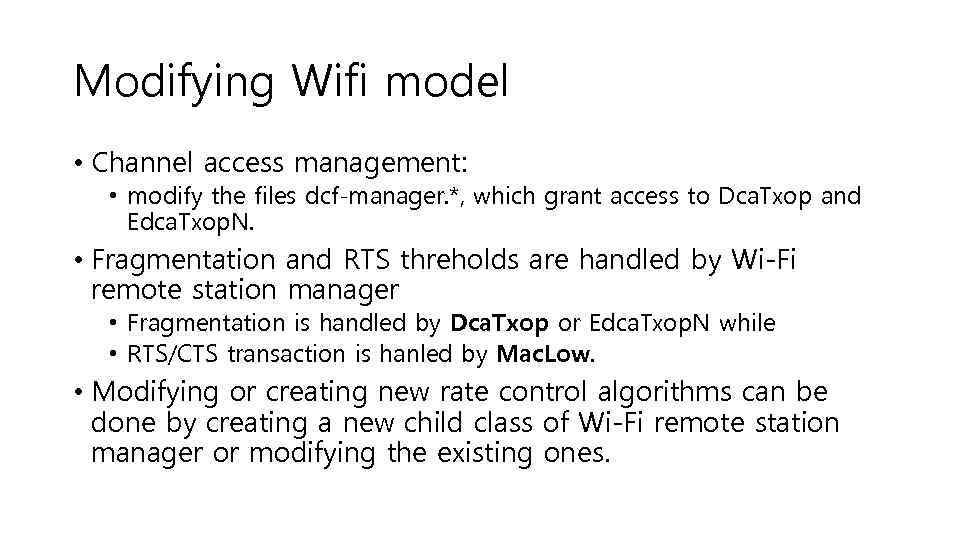
Modifying Wifi model • Channel access management: • modify the files dcf-manager. *, which grant access to Dca. Txop and Edca. Txop. N. • Fragmentation and RTS threholds are handled by Wi-Fi remote station manager • Fragmentation is handled by Dca. Txop or Edca. Txop. N while • RTS/CTS transaction is hanled by Mac. Low. • Modifying or creating new rate control algorithms can be done by creating a new child class of Wi-Fi remote station manager or modifying the existing ones.
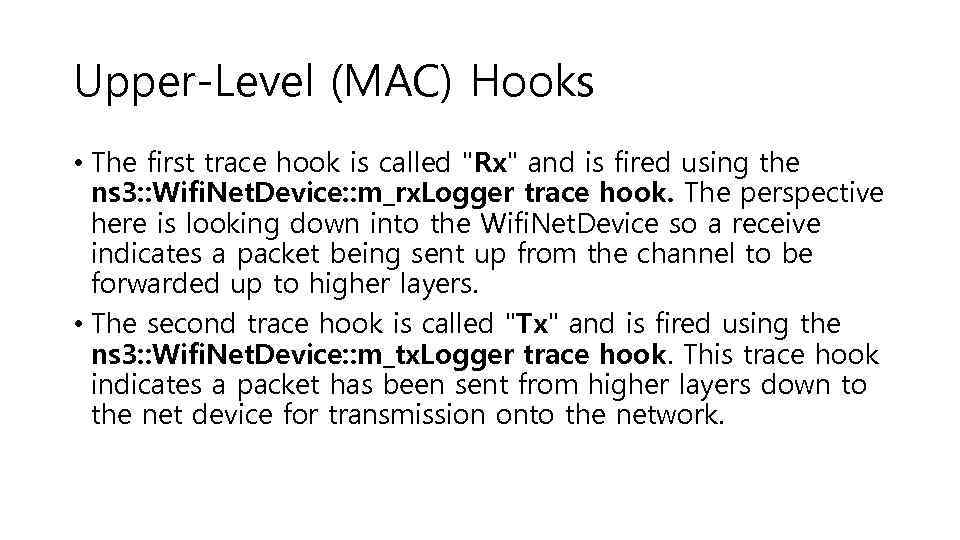
Upper-Level (MAC) Hooks • The first trace hook is called "Rx" and is fired using the ns 3: : Wifi. Net. Device: : m_rx. Logger trace hook. The perspective here is looking down into the Wifi. Net. Device so a receive indicates a packet being sent up from the channel to be forwarded up to higher layers. • The second trace hook is called "Tx" and is fired using the ns 3: : Wifi. Net. Device: : m_tx. Logger trace hook. This trace hook indicates a packet has been sent from higher layers down to the net device for transmission onto the network.
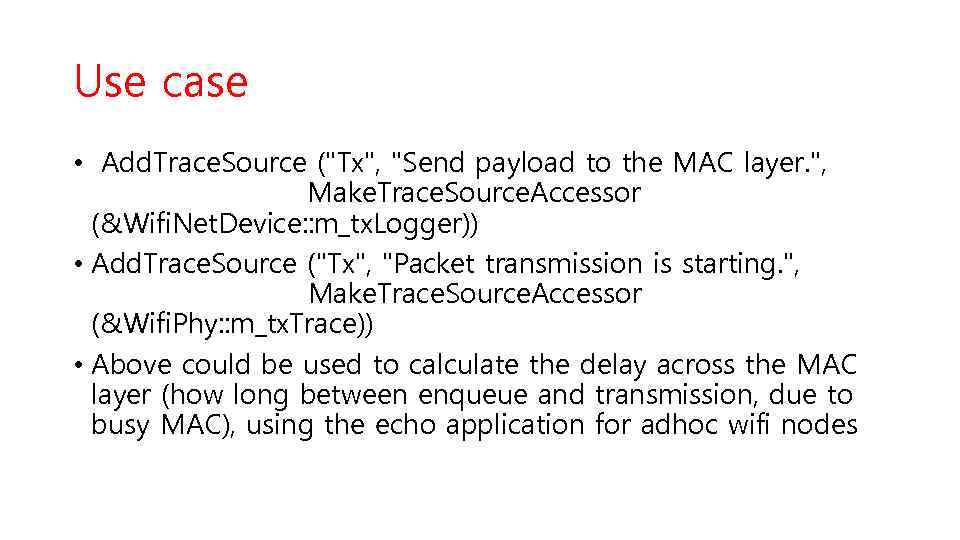
Use case • Add. Trace. Source ("Tx", "Send payload to the MAC layer. ", Make. Trace. Source. Accessor (&Wifi. Net. Device: : m_tx. Logger)) • Add. Trace. Source ("Tx", "Packet transmission is starting. ", Make. Trace. Source. Accessor (&Wifi. Phy: : m_tx. Trace)) • Above could be used to calculate the delay across the MAC layer (how long between enqueue and transmission, due to busy MAC), using the echo application for adhoc wifi nodes
Low-Level (PHY) Hooks • First, we provide a trace hook to indicate state changes. This trace source is called "State" and is fired using the ns 3: : Wifi. Phy. State. Helper: : m_state. Logger trace source. • We also provide a trace hook to indicate the successful reception of a packet from the channel. This trace source is called "Rx. Ok" and is accessed using the ns 3: : Wifi. Phy. State. Helper: : m_rx. Ok. Trace trace source. • There also exists a trace hook to indicate an unsuccessful reception of a packet from the channel. This trace source is called "Rx. Error" and is accessed using the ns 3: : Wifi. Phy. State. Helper: : m_rx. Error. Trace trace source. • There is a trace hook to indicate that transmission of a packet is starting onto the channel. This trace source is called "Tx" (don't confuse it with the higher layer "Tx" hook) and is fired using the ns 3: : Wifi. Phy. State. Helper: : m_tx. Trace trace source.
Remote Station Hooks • We provide access to changes in the per-remote-station RTS counter through the "Ssrc" trace source which is fired using the ns 3: : Wifi. Remote. Station: : m_ssrc(station short retry count) trace hook. • Finally, we provide access to the per-remote-station SLRC counter that indications the number of retransmissions of data. Changes to this counter are traced using the ns 3: : Wifi. Remote. Station: : m_slrc source.
Rate control algorithms • Ns 3 implements rate adaptation algorithms • Ideal. Wifi. Manager • ns 3: : Arf. Mac. Stations • ns 3: : AArf. Mac. Stations • ns 3: : Ideal. Mac. Stations • ns 3: : Cr. Mac. Stations • ns 3: : Onoe. Mac. Stations • ns 3: : Amrr. Mac. Station
DCF manager • keep track of the state needed for a single DCF function. • Multiple instances of a Dcf. State can be registered in a single Dcf. Manager. • The first Dc. Fstate added gets the higher priority and second gets the second and so on.
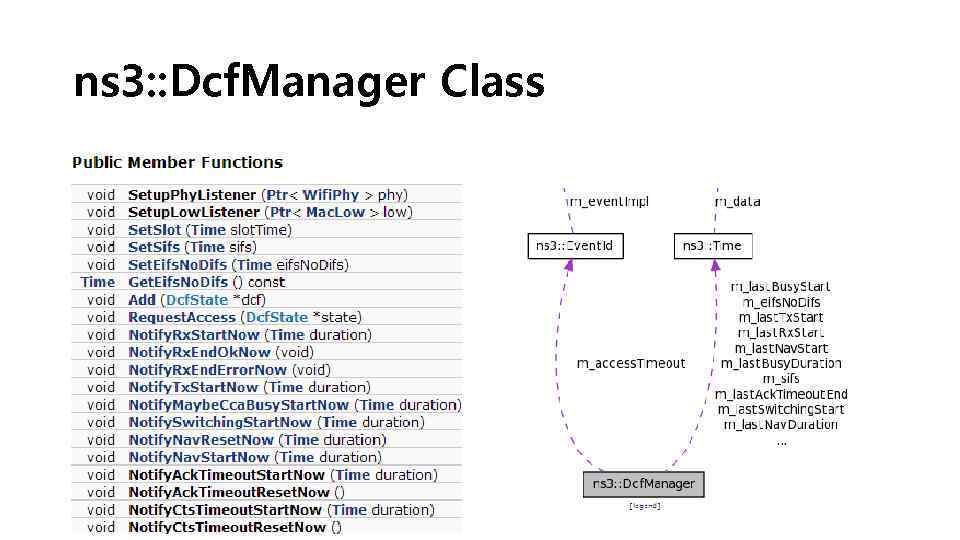
ns 3: : Dcf. Manager Class
Dcf. State • keep track of the state needed for a single DCF function. • Multiple instances of a Dcf. State can be registered in a single Dcf. Manager to implement 802. 11 e-style relative Qo. S. • Dcf. State: : Set. Aifsn and Dcf. State: : Set. Cw. Bounds allow the user to control the relative Qo. S differentiation.
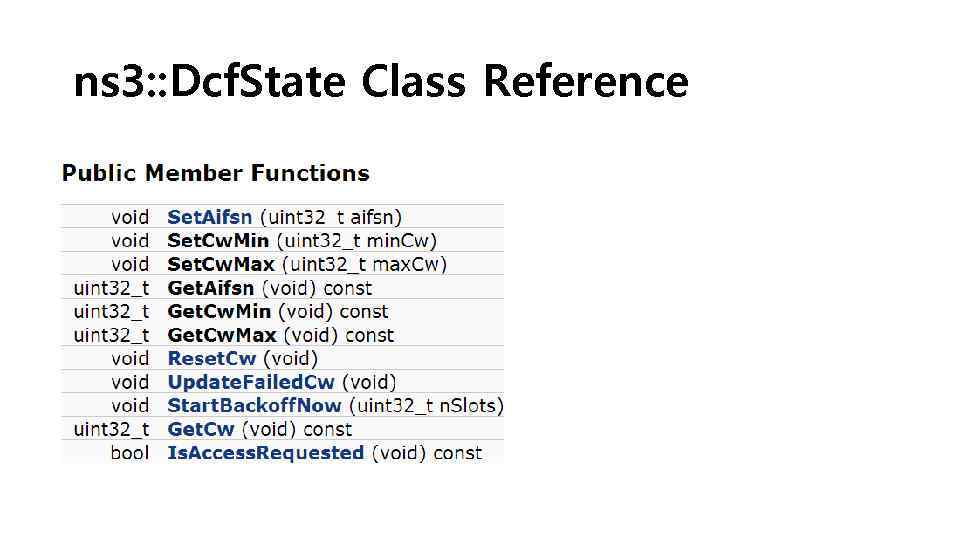
ns 3: : Dcf. State Class Reference
Dca_txop(1) • handle packet fragmentation and retransmissions. This class implements the packet fragmentation and retransmission policy. • It uses the ns 3: : Mac. Low and ns 3: : Dcf. Manager helper classes to respectively send packets and decide when to send them. Packets are stored in a ns 3: : Wifi. Mac. Queue until they can be sent.
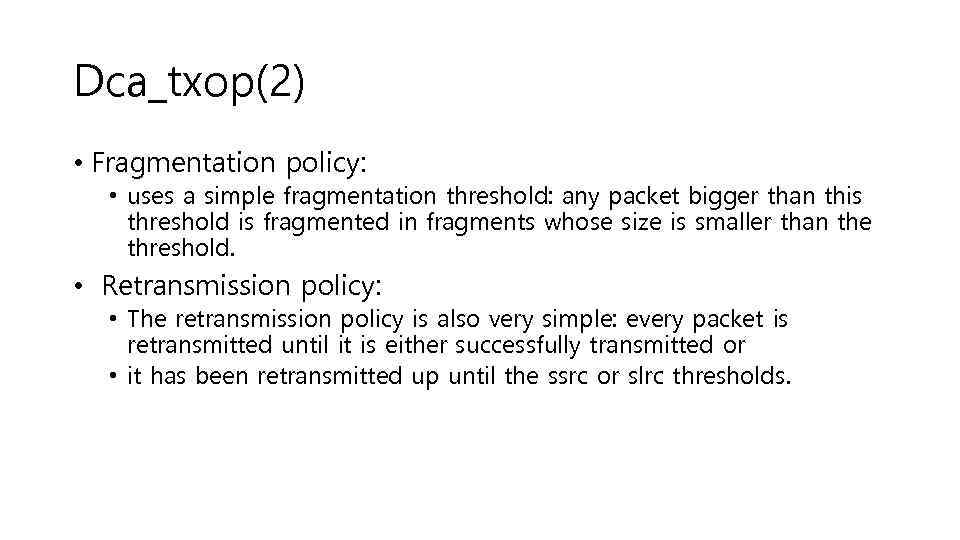
Dca_txop(2) • Fragmentation policy: • uses a simple fragmentation threshold: any packet bigger than this threshold is fragmented in fragments whose size is smaller than the threshold. • Retransmission policy: • The retransmission policy is also very simple: every packet is retransmitted until it is either successfully transmitted or • it has been retransmitted up until the ssrc or slrc thresholds.
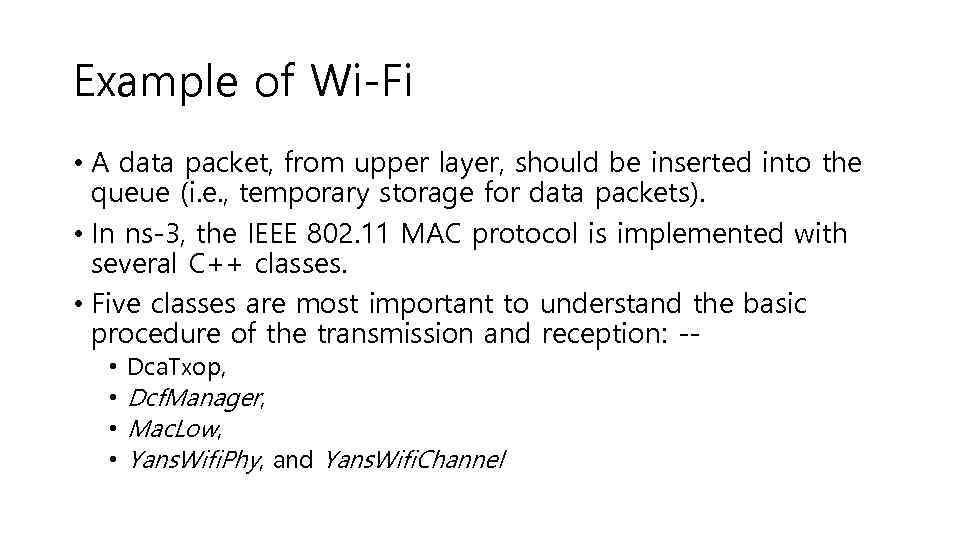
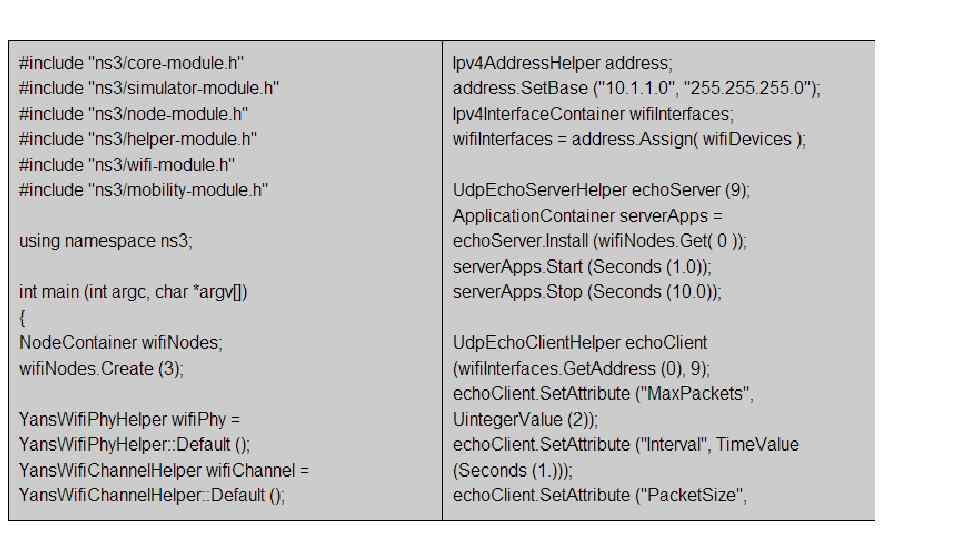
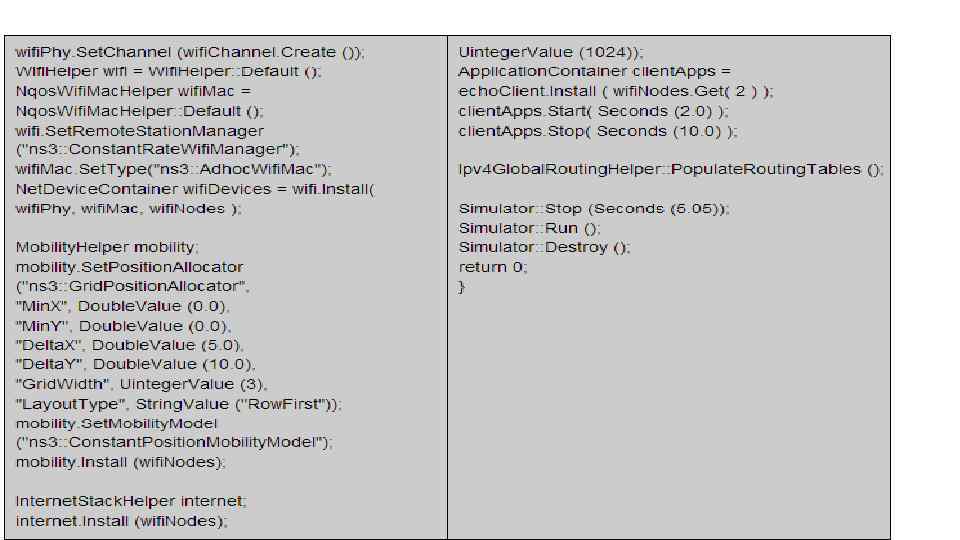
Example of Wi-Fi • A data packet, from upper layer, should be inserted into the queue (i. e. , temporary storage for data packets). • In ns-3, the IEEE 802. 11 MAC protocol is implemented with several C++ classes. • Five classes are most important to understand the basic procedure of the transmission and reception: - • • Dca. Txop, Dcf. Manager, Mac. Low, Yans. Wifi. Phy, and Yans. Wifi. Channel
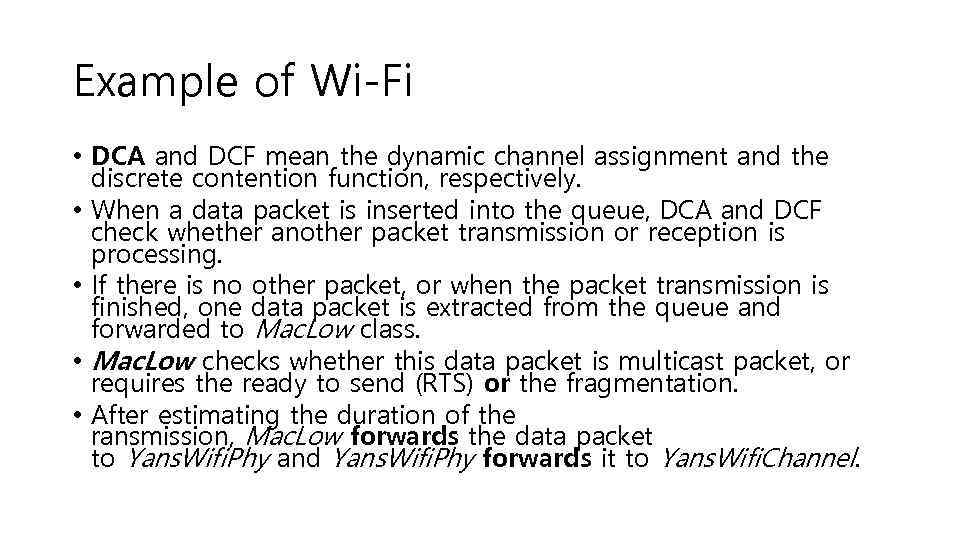
Example of Wi-Fi • DCA and DCF mean the dynamic channel assignment and the discrete contention function, respectively. • When a data packet is inserted into the queue, DCA and DCF check whether another packet transmission or reception is processing. • If there is no other packet, or when the packet transmission is finished, one data packet is extracted from the queue and forwarded to Mac. Low class. • Mac. Low checks whether this data packet is multicast packet, or requires the ready to send (RTS) or the fragmentation. • After estimating the duration of the ransmission, Mac. Low forwards the data packet to Yans. Wifi. Phy and Yans. Wifi. Phy forwards it to Yans. Wifi. Channel.
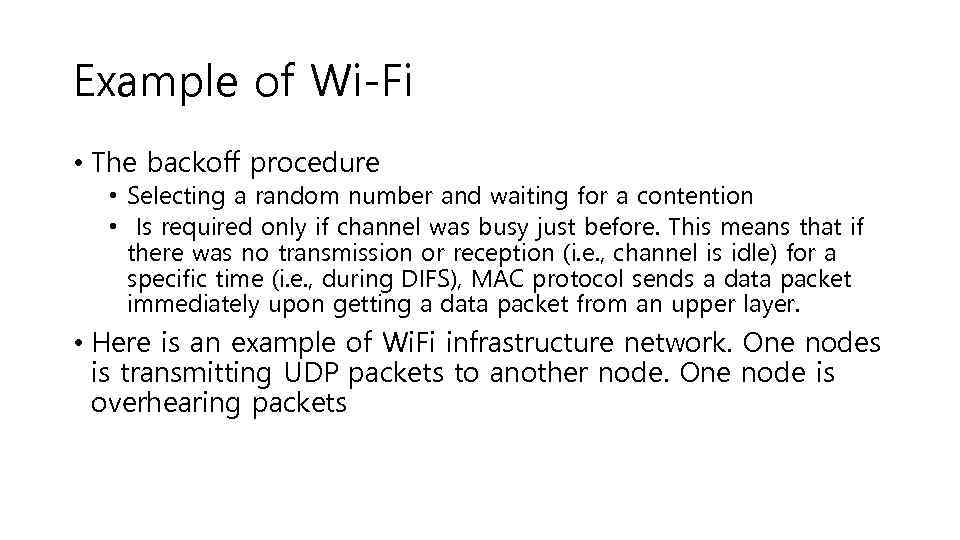
Example of Wi-Fi • The backoff procedure • Selecting a random number and waiting for a contention • Is required only if channel was busy just before. This means that if there was no transmission or reception (i. e. , channel is idle) for a specific time (i. e. , during DIFS), MAC protocol sends a data packet immediately upon getting a data packet from an upper layer. • Here is an example of Wi. Fi infrastructure network. One nodes is transmitting UDP packets to another node. One node is overhearing packets
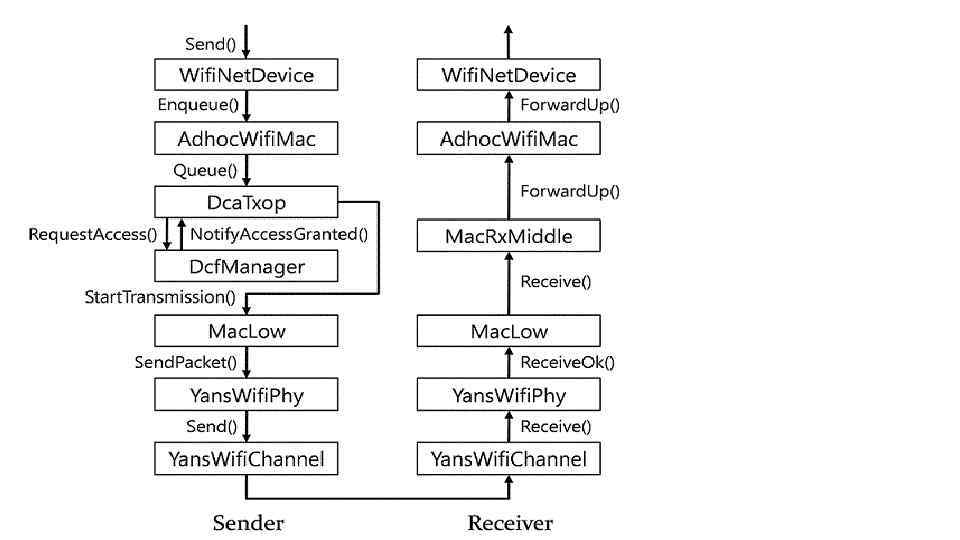
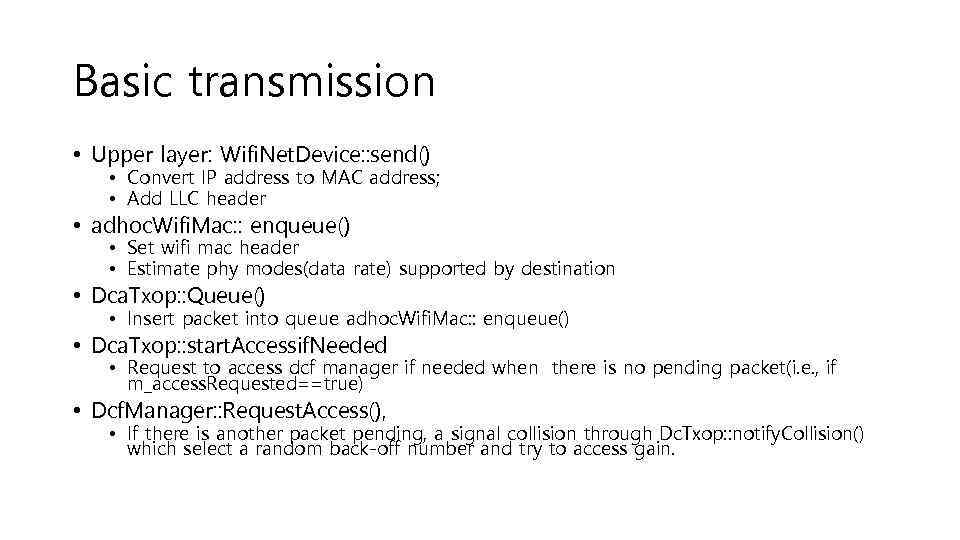
Basic transmission • Upper layer: Wifi. Net. Device: : send() • Convert IP address to MAC address; • Add LLC header • adhoc. Wifi. Mac: : enqueue() • Set wifi mac header • Estimate phy modes(data rate) supported by destination • Dca. Txop: : Queue() • Insert packet into queue adhoc. Wifi. Mac: : enqueue() • Dca. Txop: : start. Accessif. Needed • Request to access dcf manager if needed when there is no pending packet(i. e. , if m_access. Requested==true) • Dcf. Manager: : Request. Access(), • If there is another packet pending, a signal collision through Dc. Txop: : notify. Collision() which select a random back-off number and try to access gain.
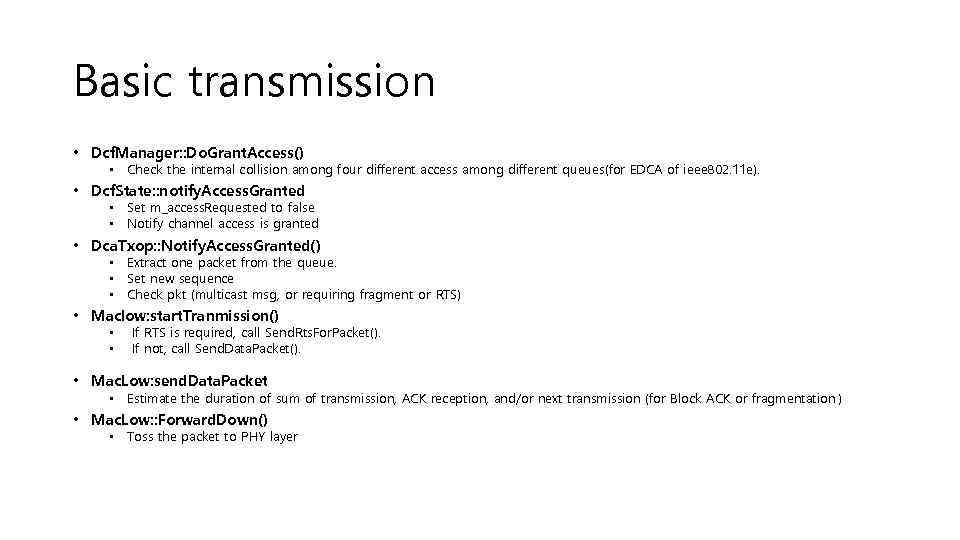
Basic transmission • Dcf. Manager: : Do. Grant. Access() • Check the internal collision among four different access among different queues(for EDCA of ieee 802. 11 e). • Dcf. State: : notify. Access. Granted • Set m_access. Requested to false • Notify channel access is granted • Dca. Txop: : Notify. Access. Granted() • Extract one packet from the queue. • Set new sequence • Check pkt (multicast msg, or requiring fragment or RTS) • Maclow: start. Tranmission() • If RTS is required, call Send. Rts. For. Packet(). • If not, call Send. Data. Packet(). • Mac. Low: send. Data. Packet • Estimate the duration of sum of transmission, ACK reception, and/or next transmission (for Block ACK or fragmentation ) • Mac. Low: : Forward. Down() • Toss the packet to PHY layer
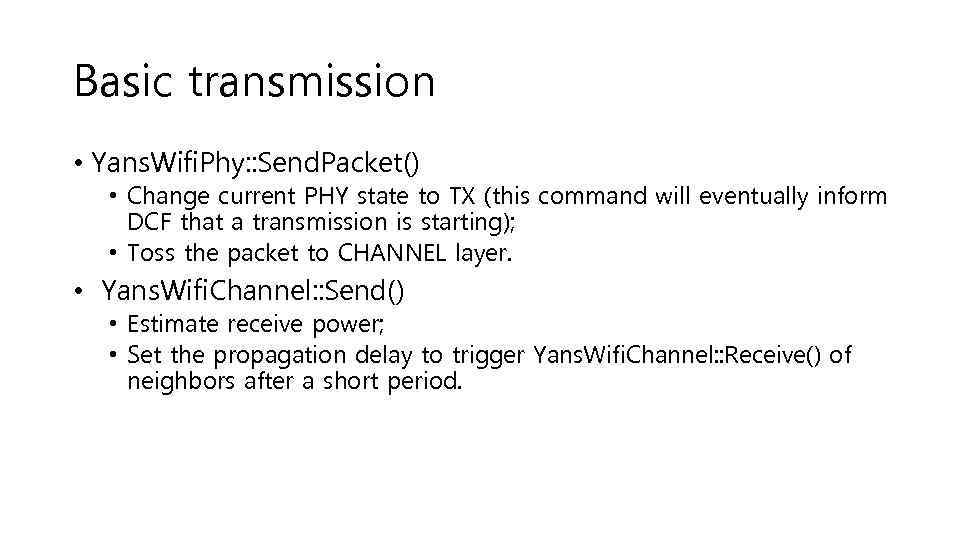
Basic transmission • Yans. Wifi. Phy: : Send. Packet() • Change current PHY state to TX (this command will eventually inform DCF that a transmission is starting); • Toss the packet to CHANNEL layer. • Yans. Wifi. Channel: : Send() • Estimate receive power; • Set the propagation delay to trigger Yans. Wifi. Channel: : Receive() of neighbors after a short period.
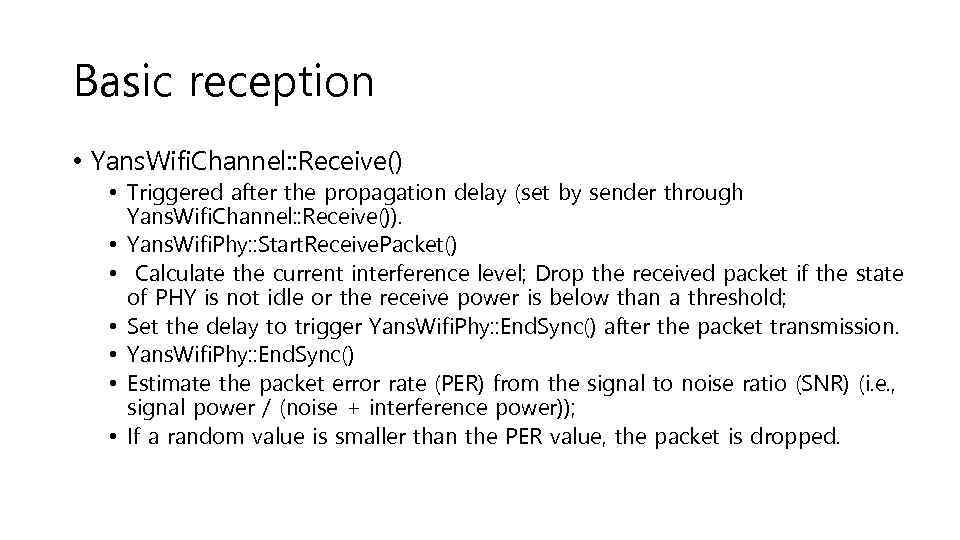
Basic reception • Yans. Wifi. Channel: : Receive() • Triggered after the propagation delay (set by sender through Yans. Wifi. Channel: : Receive()). • Yans. Wifi. Phy: : Start. Receive. Packet() • Calculate the current interference level; Drop the received packet if the state of PHY is not idle or the receive power is below than a threshold; • Set the delay to trigger Yans. Wifi. Phy: : End. Sync() after the packet transmission. • Yans. Wifi. Phy: : End. Sync() • Estimate the packet error rate (PER) from the signal to noise ratio (SNR) (i. e. , signal power / (noise + interference power)); • If a random value is smaller than the PER value, the packet is dropped.
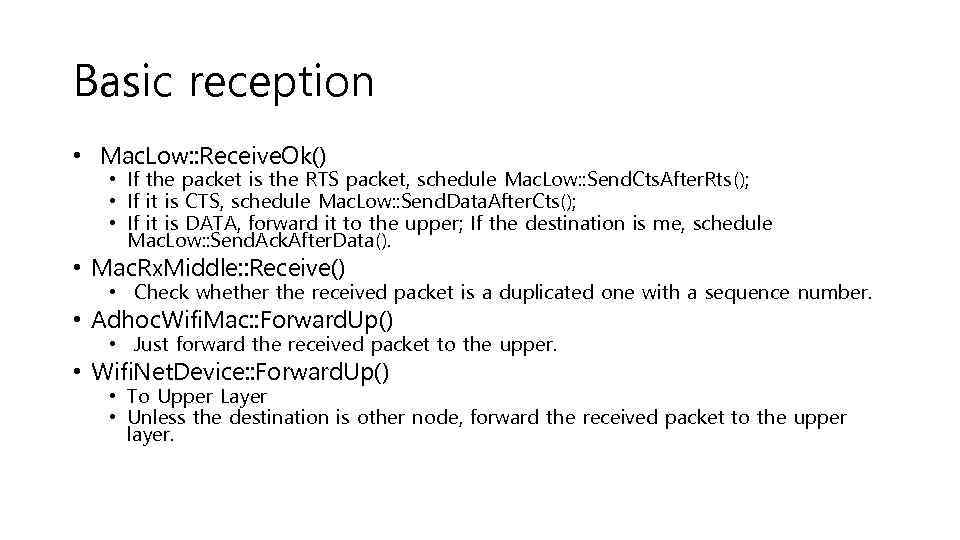
Basic reception • Mac. Low: : Receive. Ok() • If the packet is the RTS packet, schedule Mac. Low: : Send. Cts. After. Rts(); • If it is CTS, schedule Mac. Low: : Send. Data. After. Cts(); • If it is DATA, forward it to the upper; If the destination is me, schedule Mac. Low: : Send. Ack. After. Data(). • Mac. Rx. Middle: : Receive() • Check whether the received packet is a duplicated one with a sequence number. • Adhoc. Wifi. Mac: : Forward. Up() • Just forward the received packet to the upper. • Wifi. Net. Device: : Forward. Up() • To Upper Layer • Unless the destination is other node, forward the received packet to the upper layer.
References • http: //www. nsnam. org/docs/models/html/wifi. html#modifyingwifi-model • http: //www 2. engr. arizona. edu/~junseok/ns 3_wifi. htm • http: //www. nsnam. org/~pei/80211 b. pdf • http: //cutebugs. net/files/wns 2 -yans. pdf
Скачать презентацию NS 3 Wifi By Salah Amean Ahmmed Saeed
NS3_implementation_wifi_Seminar (1).pptx