


 Скачать презентацию NRT Data Management Giuseppe M R Manzella Franco
f6b644825f648d469f9625347cd90475.ppt
- Количество слайдов: 53
 NRT Data Management Giuseppe M. R. Manzella, Franco Reseghetti - ENEA on behalf of the MFS/ADRICOSM VOS group: M. Borghini – CNR – Italy, V. Cardin - OGS – Italy, A. Cruzado – CSIC CEAB – Spain, V. Dadic – IOF – Croatia, F. Grilli – CNR – Italy, C. Galli – CNR – Italy, M. I. Gertman – IOLR – Israel, V. Malacic – MBS – Slovenia, C. Millot – CNRS LOB COM – France, M. Morovic – IOF – Croatia, E. Oszoy – IMS METU – Turkey, C. Tziavos – HCMR – Greece, G. Zodiatis – UC OCY – Cyprus, G. Montanari – Daphne – Italy, S. Serra – Daphne – Italy, N. Smodakla – CMR – Croatia, M. Marini – CNR – Italy, and … many other colleagues … 1
 Outline of the presentation ØMFS- VOS system ØQA protocols ØQC procedures ØData and viewing service ØData access 2
 MFS-VOS in the Mediterranean üStarted in September 1999 üSustained by: üMFSPP (EC-DG Research) üADRICOSM (MATT) üMFSTEP (EC-DG Research) üADRICOSM (IOC, MAE, MATT) 3
 MFS-VOS system ü Activities in the framework Euro. GOOS and Med. GOOS of üSupports the Mediterranean Forecasting System /Adricosm üIncluded in the GMES Ocean component 4
 Requirements An ideal sampling design is based on four goals: - 1. provide repetitive measurements along transects from coast to coast, 2. the transects must cross significant dynamical features of the circulation, 3. the sampling distance should resolve, as well as possible, the mesoscale, 4. the technologies for data collection must be robust and simple, to be used on ships of opportunity, eventually by ship personnel. 5
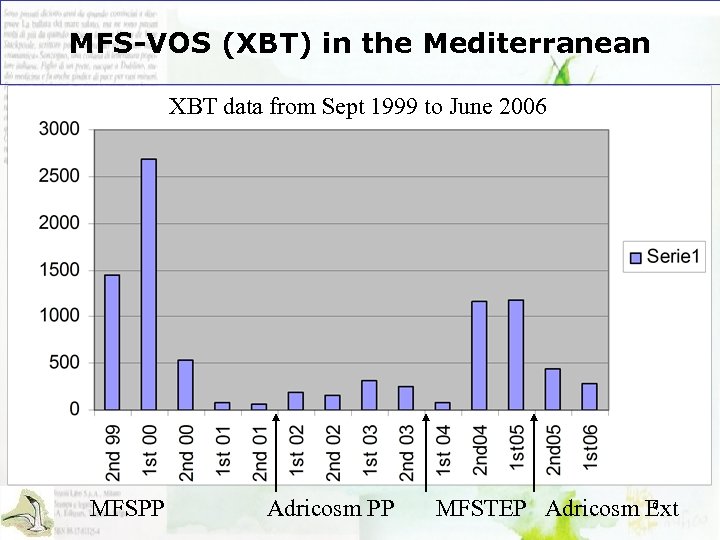 MFS-VOS (XBT) in the Mediterranean XBT data from Sept 1999 to June 2006 MFSPP Adricosm PP 6 MFSTEP Adricosm Ext
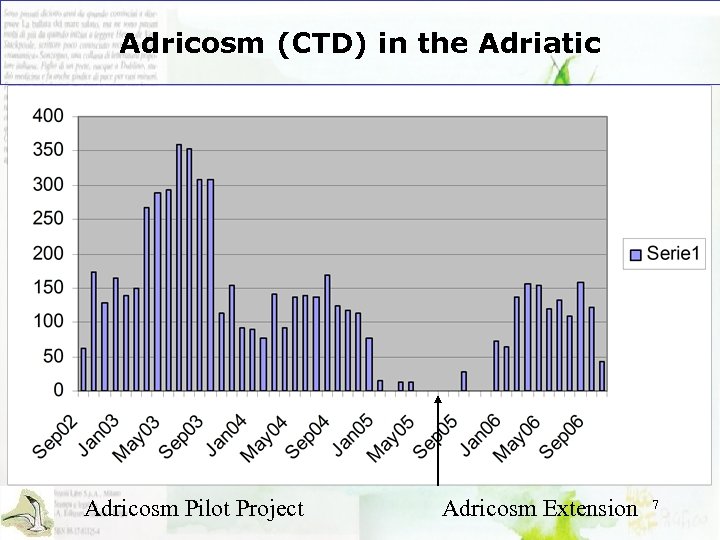 Adricosm (CTD) in the Adriatic Adricosm Pilot Project Adricosm Extension 7
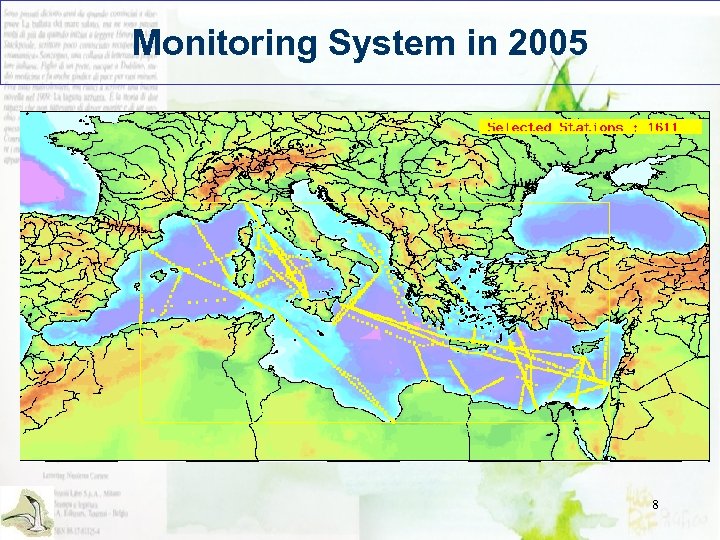 Monitoring System in 2005 8
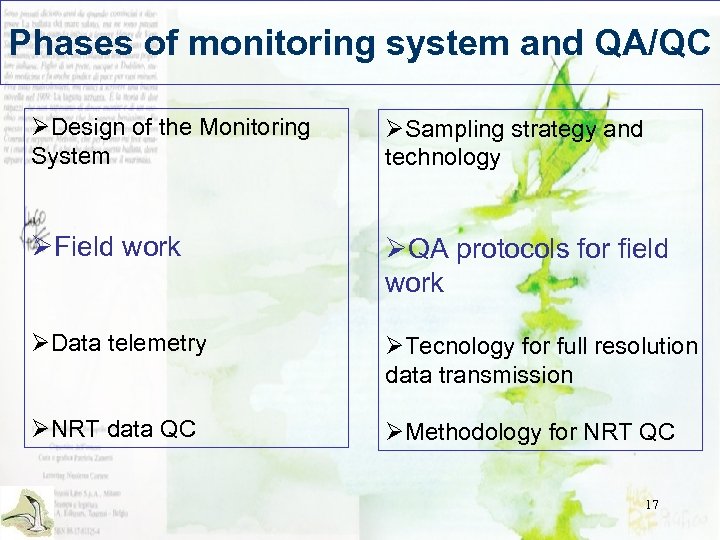
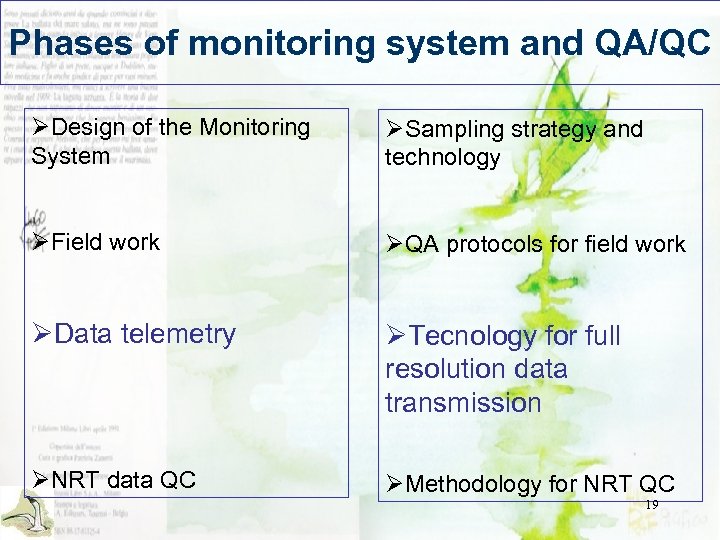
 Phases of monitoring system and QA/QC ØDesign of the Monitoring System ØSampling strategy and technology ØField work ØQA protocols for field work ØData telemetry ØTecnology for full resolution data transmission ØNRT data QC ØMethodology for NRT QC 9
 Design ØDesign of the Monitoring System ØSampling strategy and technology ØField work ØQA protocols for field work ØData telemetry ØTecnology for full resolution data transmission ØNRT data QC ØMethodology for NRT QC 10
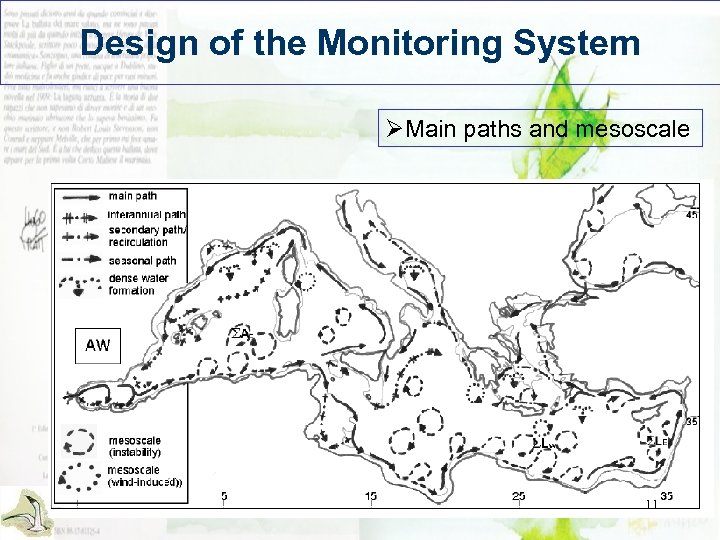 Design of the Monitoring System ØMain paths and mesoscale 11
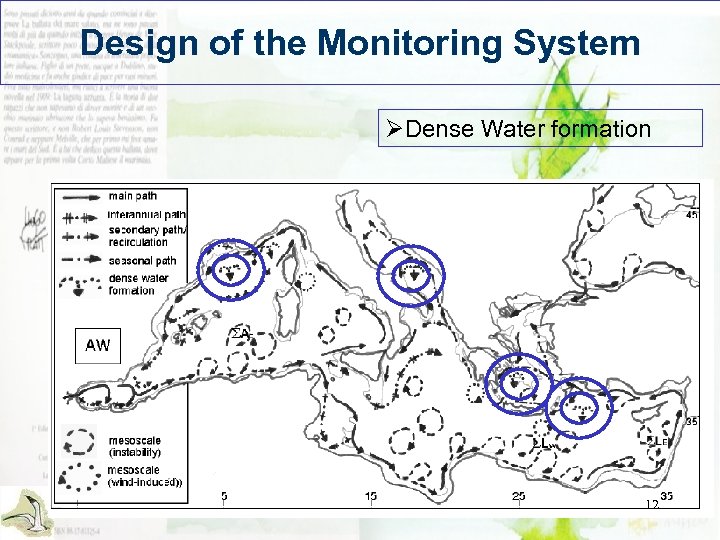 Design of the Monitoring System ØDense Water formation 12
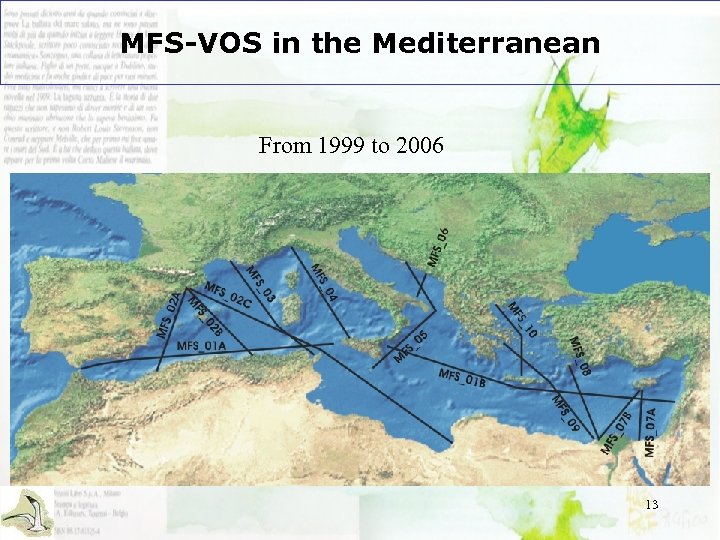 MFS-VOS in the Mediterranean From 1999 to 2006 13
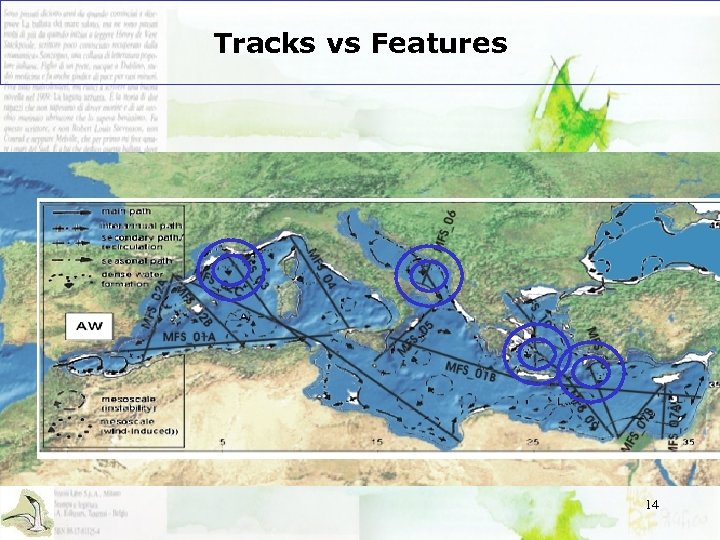 Tracks vs Features 14
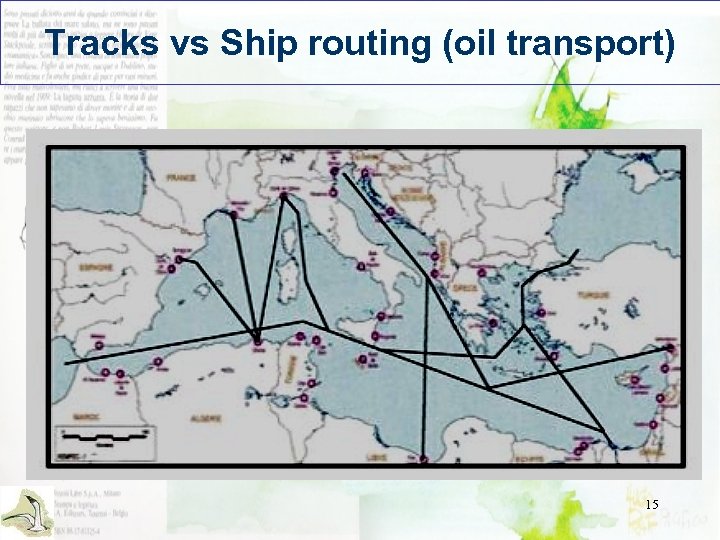 Tracks vs Ship routing (oil transport) 15
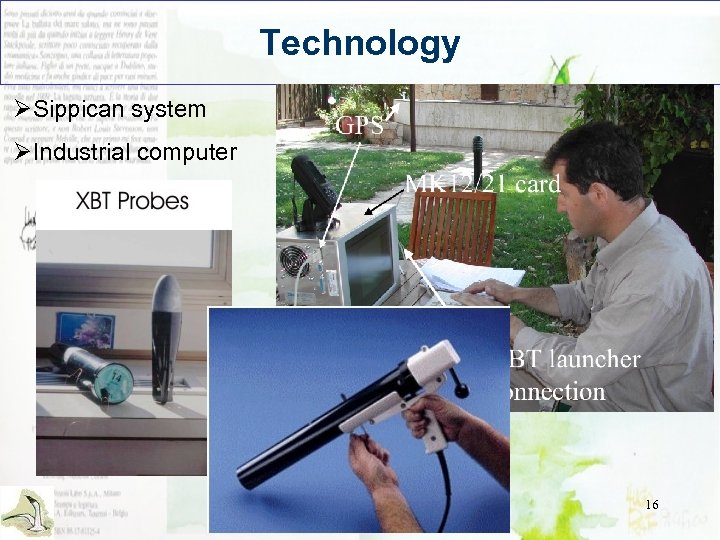 Technology ØSippican system ØIndustrial computer 16
 Phases of monitoring system and QA/QC ØDesign of the Monitoring System ØSampling strategy and technology ØField work ØQA protocols for field work ØData telemetry ØTecnology for full resolution data transmission ØNRT data QC ØMethodology for NRT QC 17
 1. Check List (click) 2. Description of principles 3. Expected Results 4. Responsibility 5. Working Procedures 6. Deviation/Deficiencies 7. Expected data 18
 Phases of monitoring system and QA/QC ØDesign of the Monitoring System ØSampling strategy and technology ØField work ØQA protocols for field work ØData telemetry ØTecnology for full resolution data transmission ØNRT data QC ØMethodology for NRT QC 19
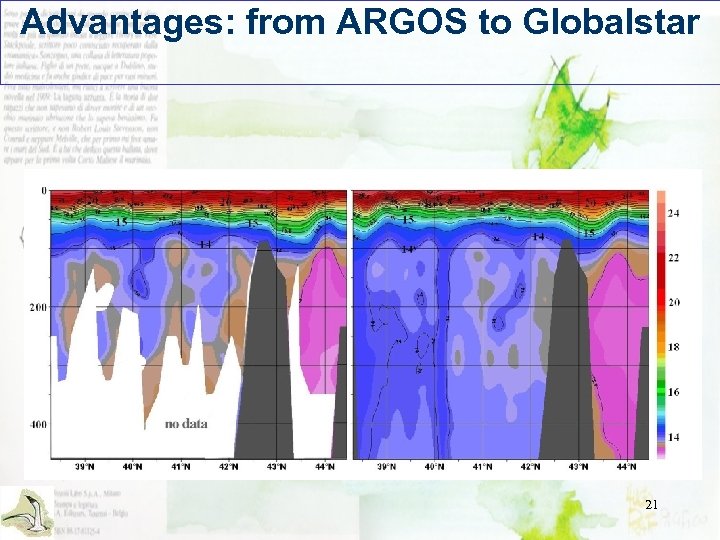
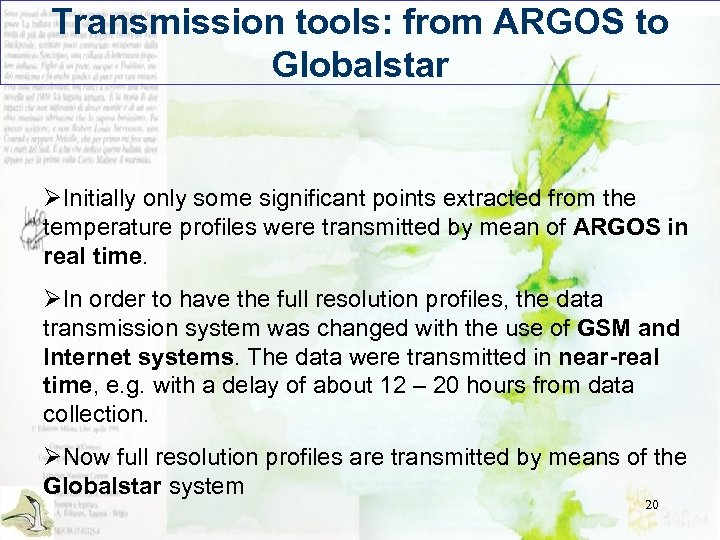 Transmission tools: from ARGOS to Globalstar ØInitially only some significant points extracted from the temperature profiles were transmitted by mean of ARGOS in real time. ØIn order to have the full resolution profiles, the data transmission system was changed with the use of GSM and Internet systems. The data were transmitted in near-real time, e. g. with a delay of about 12 – 20 hours from data collection. ØNow full resolution profiles are transmitted by means of the Globalstar system 20
 Advantages: from ARGOS to Globalstar 21
 Data Flow and QC üData are transmitted from ships to MFS-VOS Thematic Data Centre üData are QC with a unique (improved) NRT procedure 22
 Phases of monitoring system and QA/QC ØDesign of the Monitoring System ØSampling strategy and technology ØField work ØQA protocols for field work ØData telemetry ØTecnology for full resolution data transmission ØNRT data QC ØMethodology for NRT QC 23
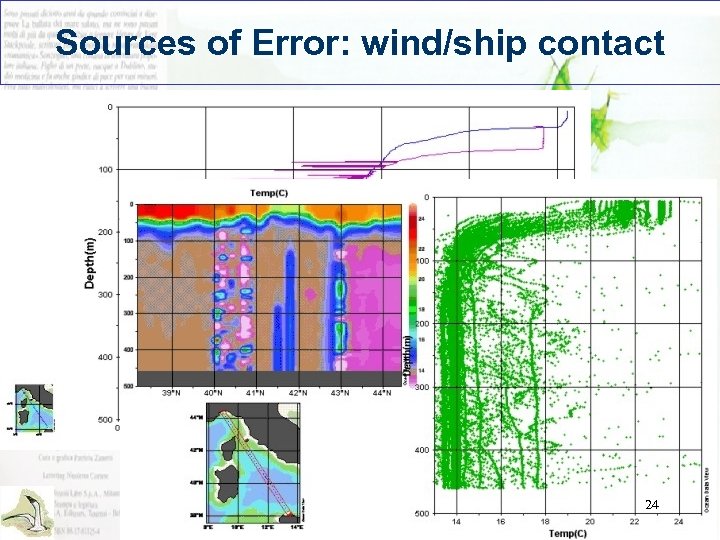 Sources of Error: wind/ship contact 24
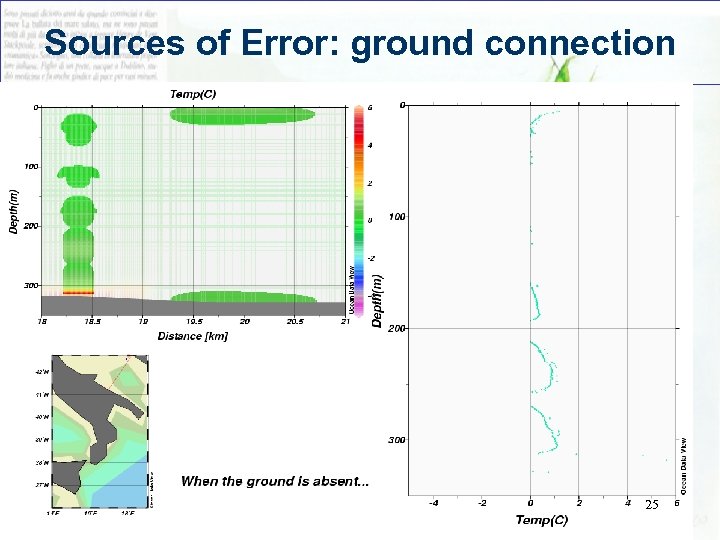 Sources of Error: ground connection 25
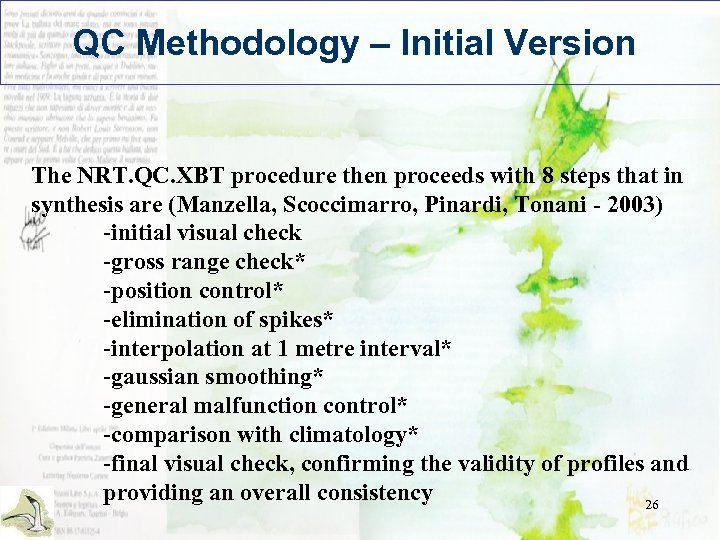 QC Methodology – Initial Version The NRT. QC. XBT procedure then proceeds with 8 steps that in synthesis are (Manzella, Scoccimarro, Pinardi, Tonani - 2003) -initial visual check -gross range check* -position control* -elimination of spikes* -interpolation at 1 metre interval* -gaussian smoothing* -general malfunction control* -comparison with climatology* -final visual check, confirming the validity of profiles and providing an overall consistency 26
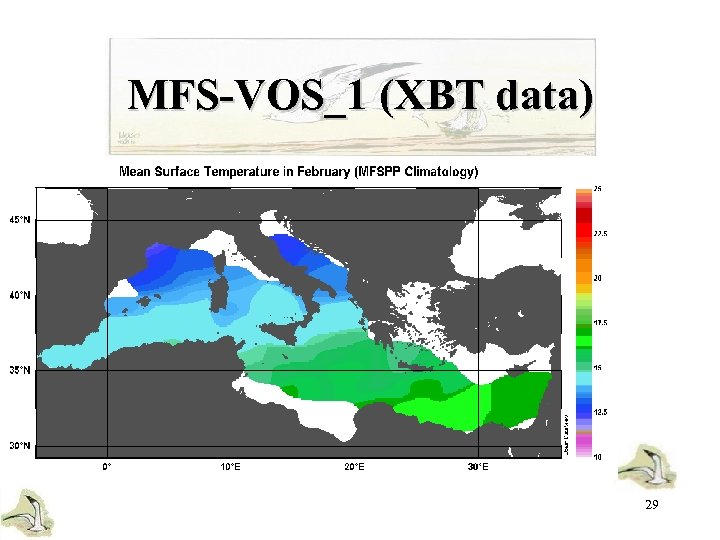
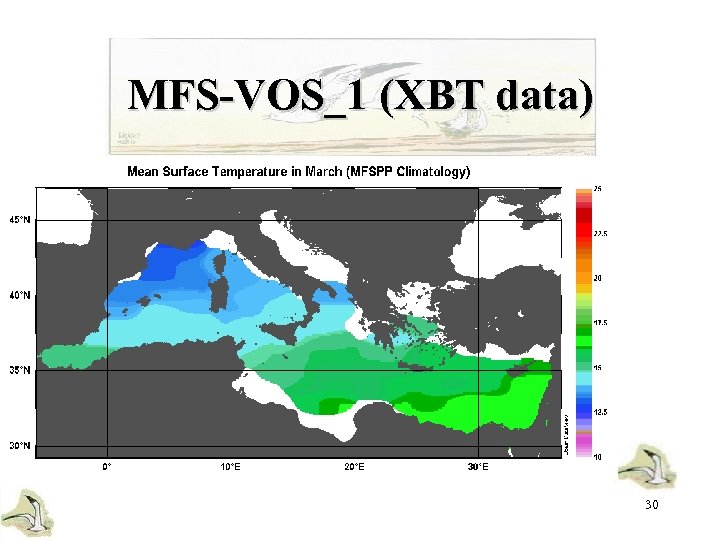
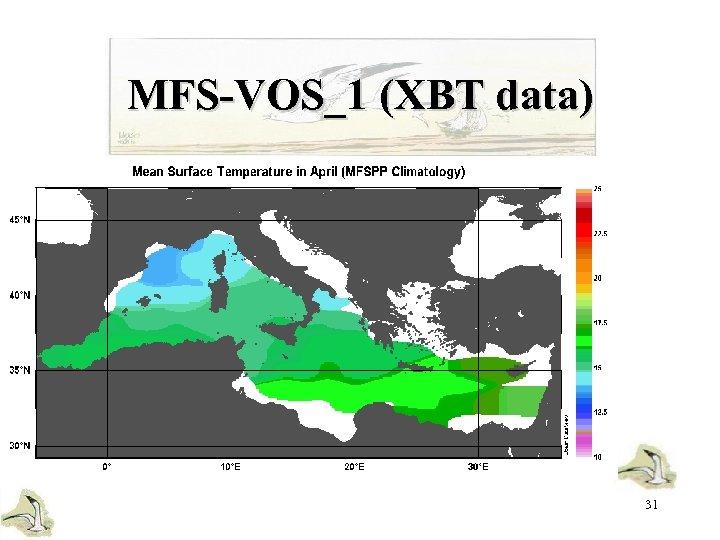
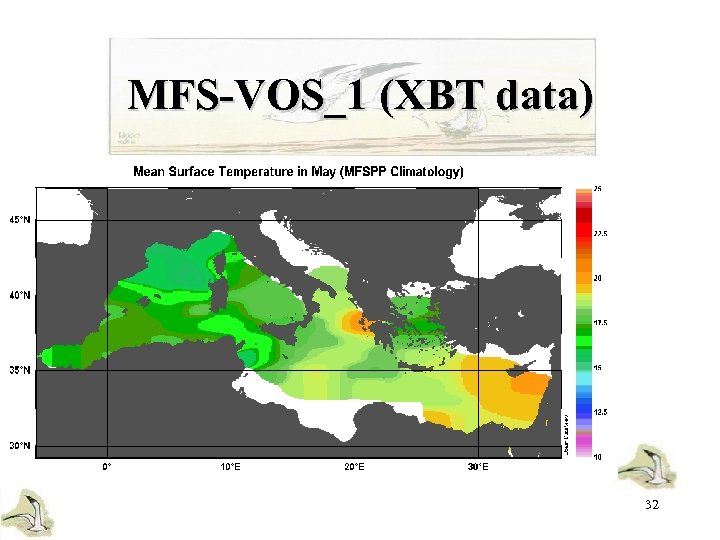
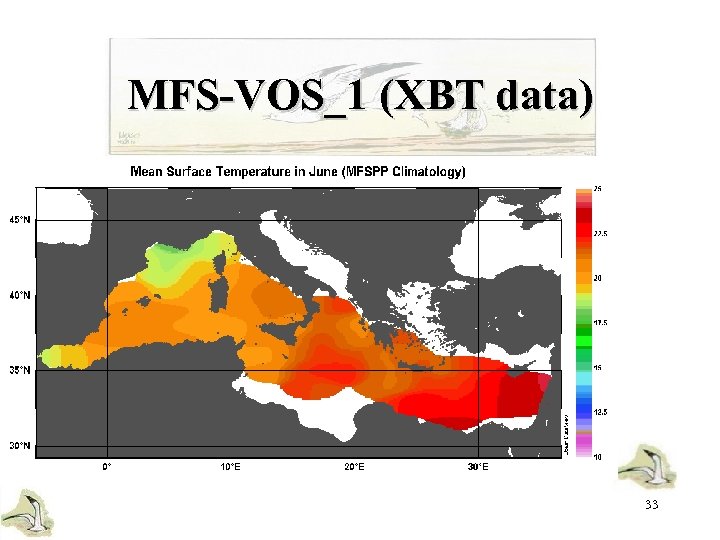
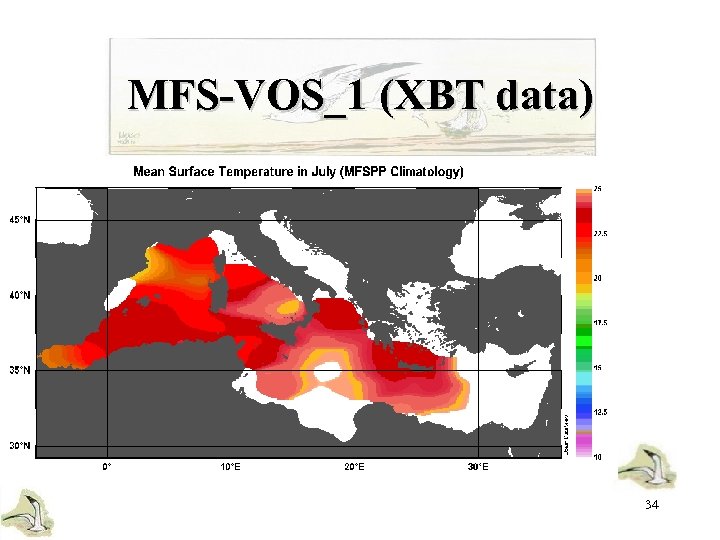
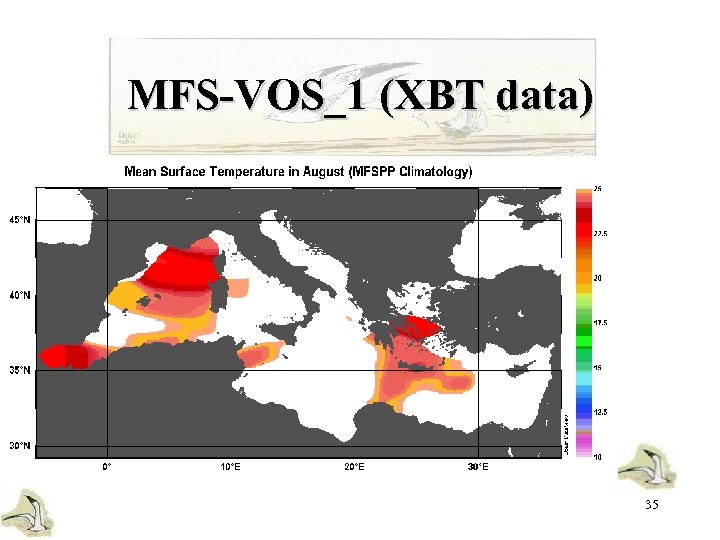
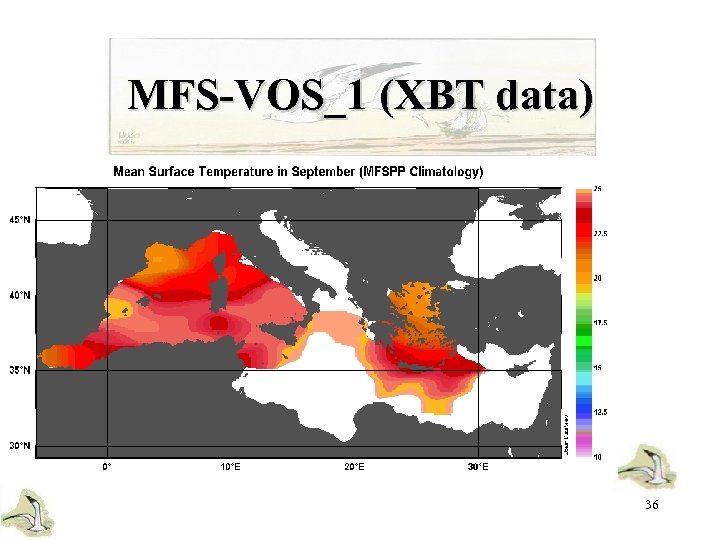
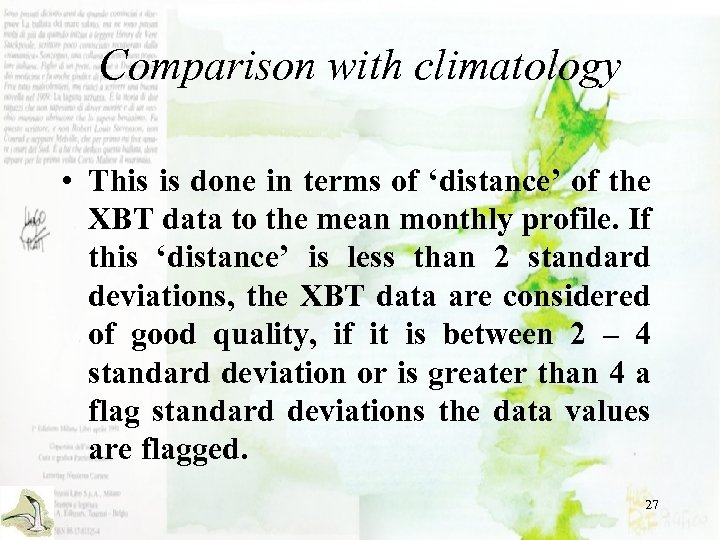 Comparison with climatology • This is done in terms of ‘distance’ of the XBT data to the mean monthly profile. If this ‘distance’ is less than 2 standard deviations, the XBT data are considered of good quality, if it is between 2 – 4 standard deviation or is greater than 4 a flag standard deviations the data values are flagged. 27
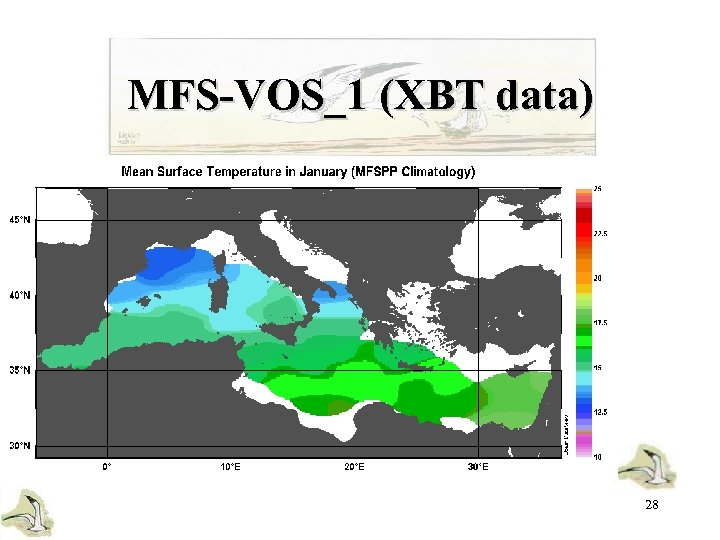 MFS-VOS_1 (XBT data) 28
 MFS-VOS_1 (XBT data) 29
 MFS-VOS_1 (XBT data) 30
 MFS-VOS_1 (XBT data) 31
 MFS-VOS_1 (XBT data) 32
 MFS-VOS_1 (XBT data) 33
 MFS-VOS_1 (XBT data) 34
 MFS-VOS_1 (XBT data) 35
 MFS-VOS_1 (XBT data) 36
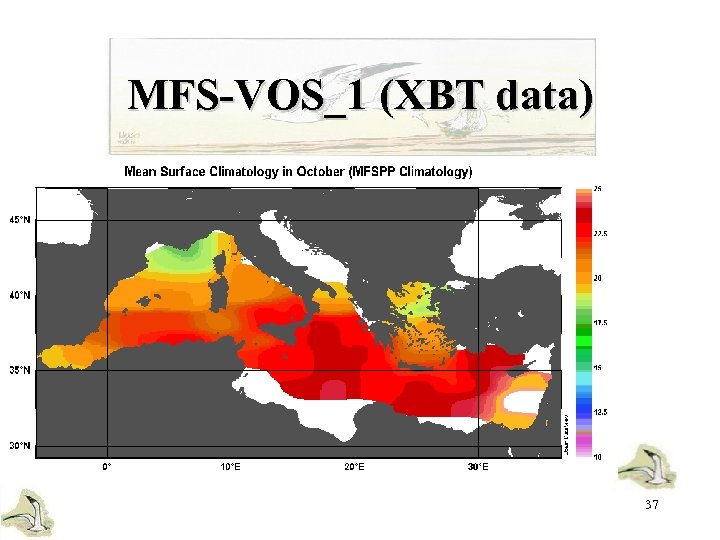 MFS-VOS_1 (XBT data) 37
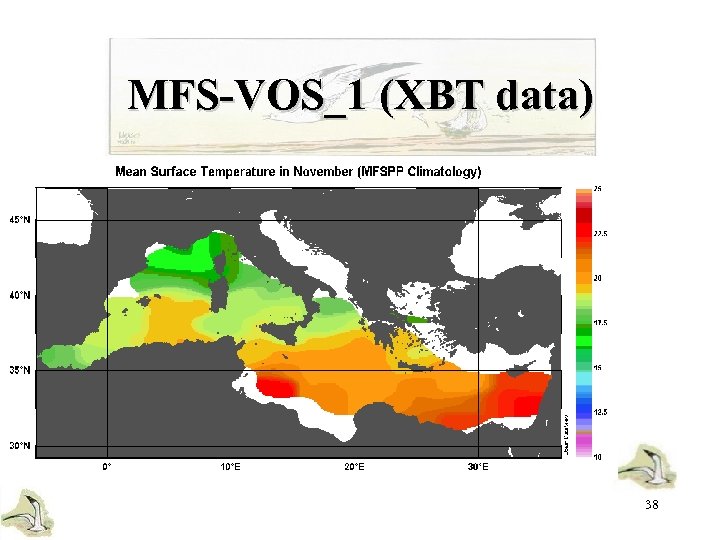 MFS-VOS_1 (XBT data) 38
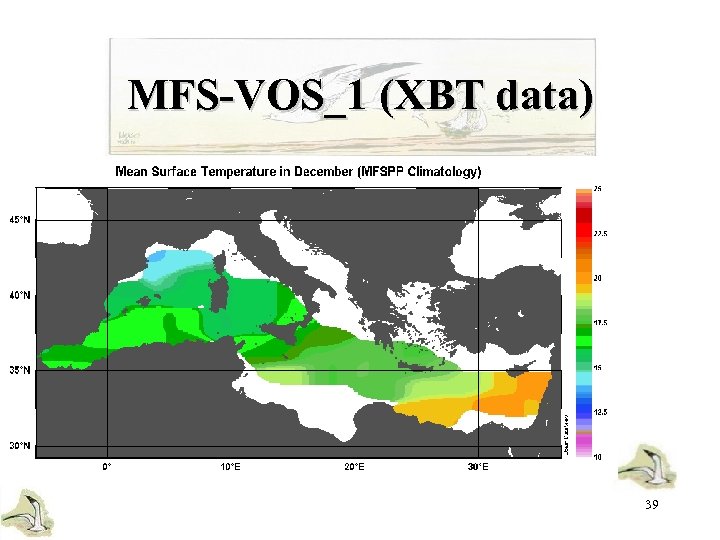 MFS-VOS_1 (XBT data) 39
 QC Methodology Improvement • The use the ACQUISITION TIME (fixed increments due to the 10 Hz sampling rate) as free parameter. • The APPLICATION of Gaussian smoothing before interpolation at 1 metre interval. • START-UP problem Systematic difference at the seasonal thermocline depth. The XBT recording system needs time before it measures stable T values (within 0. 1 ºC). The observed averaged delay is 0. 3 ± 0. 1 s (2. 0 m). Each profile could be rescaled. • NEW FALL RATE COEFFICIENTS seem to be required in Mediterranean for XBTs. • … (Paper by Reseghetti et al. Ocean Science – All improvements will be applied after the approval from SOOP community) 40
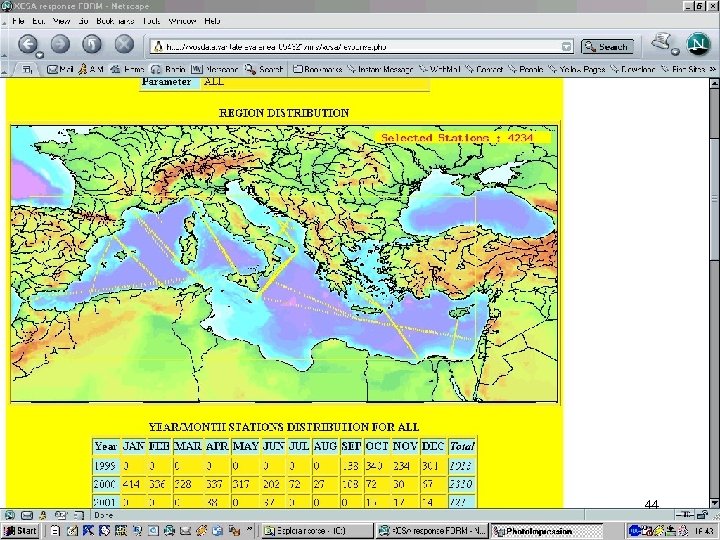
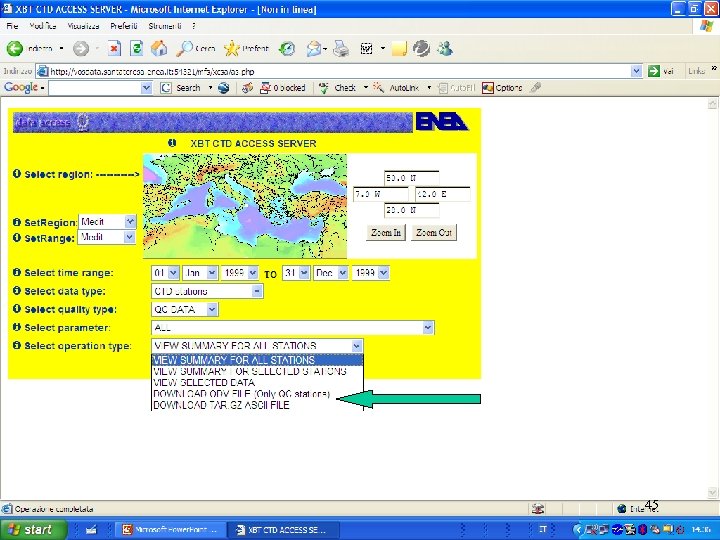
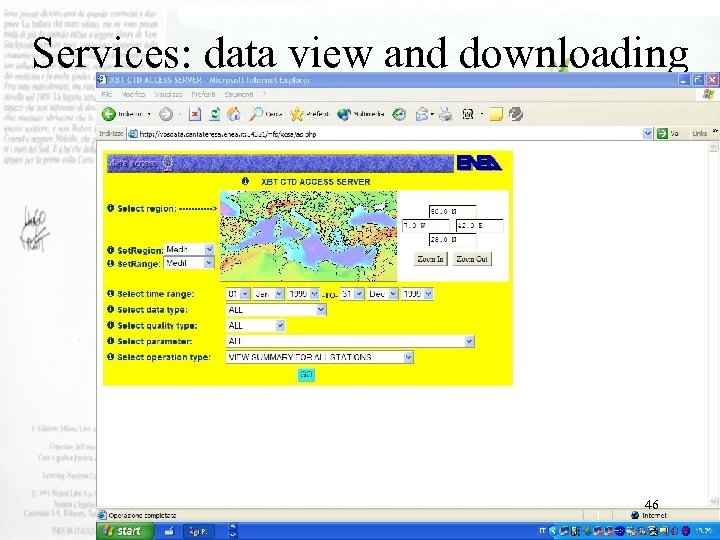
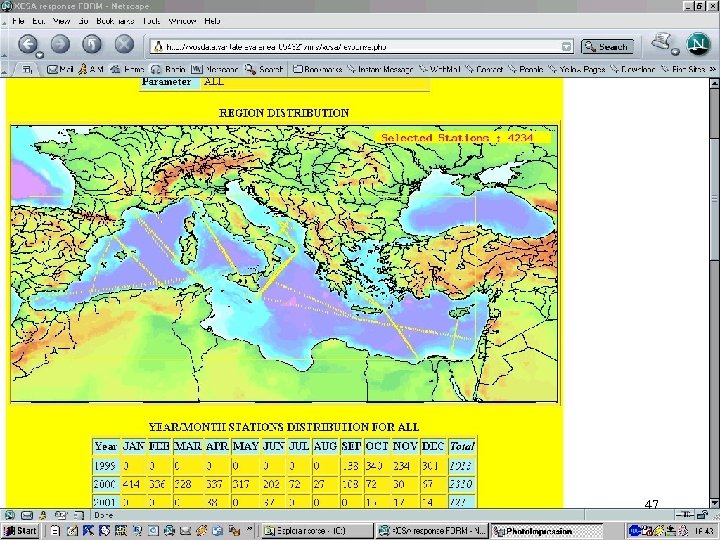
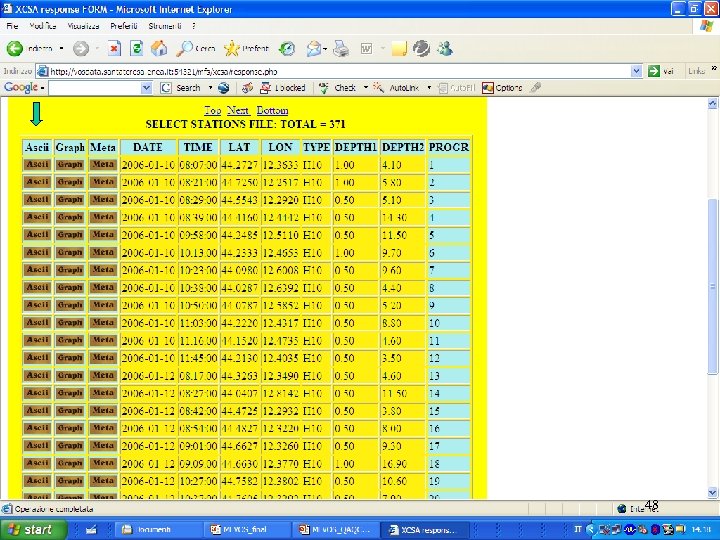
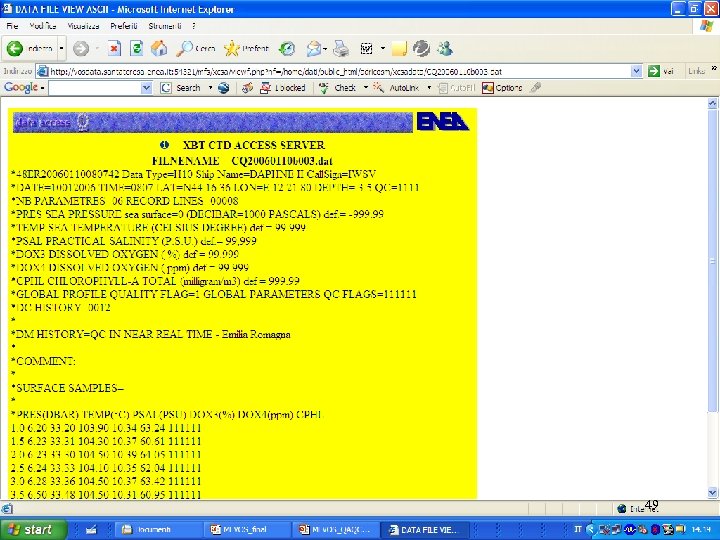
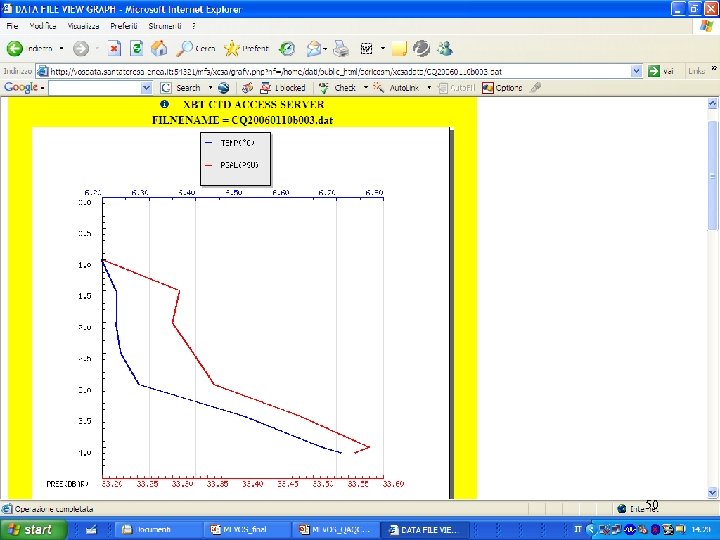
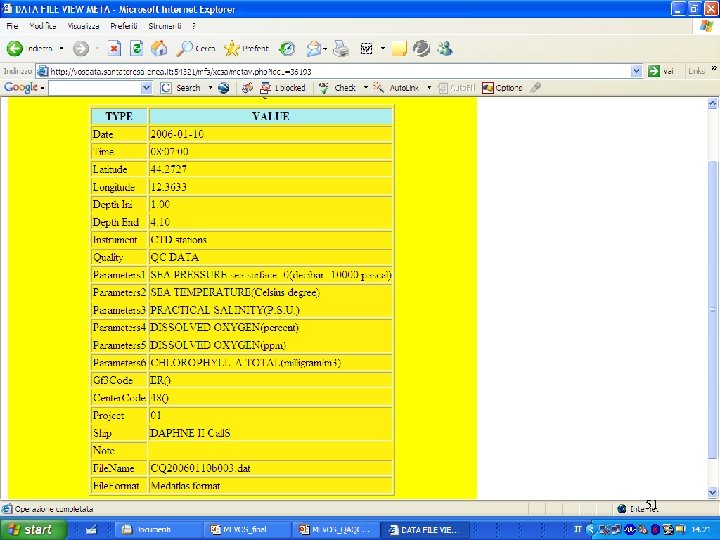
 MFS-VOS Services Data selection through user friendly interface (geographical, temporal, parameter, quality selection) – Data downloading Data view (spatial and temporal distribution, vertical profiles, data, metadata) Format transformation (Med. Atlas, ODV) 41
 42
42
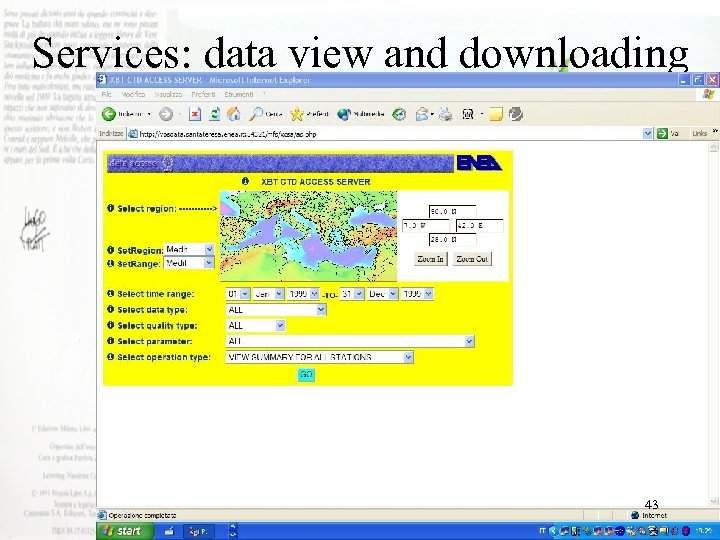 Services: data view and downloading 43
 44
44
 45
45
 Services: data view and downloading 46
 47
47
 48
48
 49
49
 50
50
 51
51
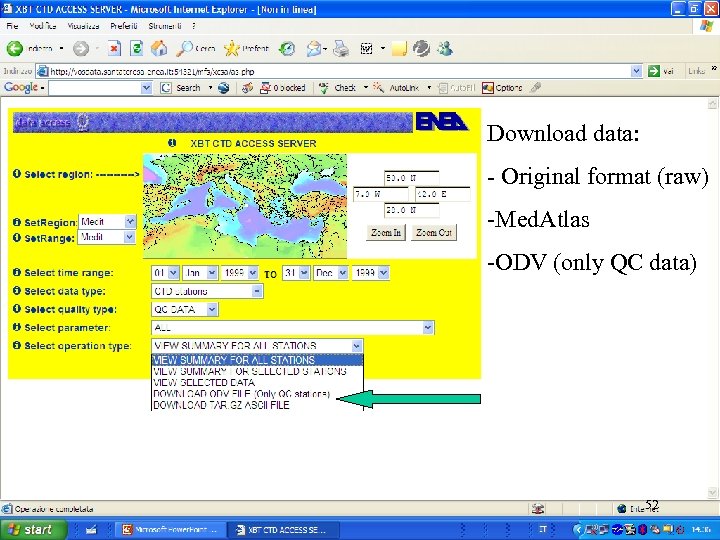 Download data: - Original format (raw) -Med. Atlas -ODV (only QC data) 52
 Other services (not visible in the web) Format transformation from: • EDF (Sippican) to Med. Atlas and ODV • Med. Atlas to ODV (ADRICOSM) • Sea. Bird to Med. Atlas and ODV (ADRICOSM) 53