


 Скачать презентацию — NRL Presentation — Rendezvous Proximity Operations
1a00e433e03fe0effb78976f97db1f89.ppt
- Количество слайдов: 27
 -- NRL Presentation -- Rendezvous, Proximity Operations & Capture for ATV and HTV May 22 -23, 2002 Aeroscience and Flight Mechanics Division GN&C Design and Analysis Branch
 Big Picture • ATV/HTV – Endorse Certificate of Flight Readiness (Safety first) • • • Vehicle Integration/Compatibility with ISS Assessment of mission success Flight Aspects – – – Rendezvous, Proximity Operations, Capture/Docking/Separation, Departure Emphasis on Demonstration mission -- first flight Contingencies – Principal role • • Interface and negotiate with International Partners on behalf of ISSP Independent Assessment of GNC/Flight Systems/Mission Design and ISS Interfaces from perspective of requirements, limitations and capabilities – – • Integration with ISS – – – EG Education May 22 -23, 2002 Analysis of GNC sensors, effectors and algorithms Analysis and review FDIR requirements, design and capabilities Analysis of trajectory requirements, design and safety through simulation Analysis and review of verification methods, coverage and limitations Analysis of vehicle control for docking/capture performance (nominal and contingencies) Analysis and review of monitoring requirements, design, capabilities and options through simulation and prototyping Analysis and review of command control requirements, options and capabilities Development, analysis, and review of ICD, IRD and SSD requirements and verification Formal Reviews (Safety, PDRs, CDRs. . . ) Page 2 Rendezvous Proximity Operations & Capture
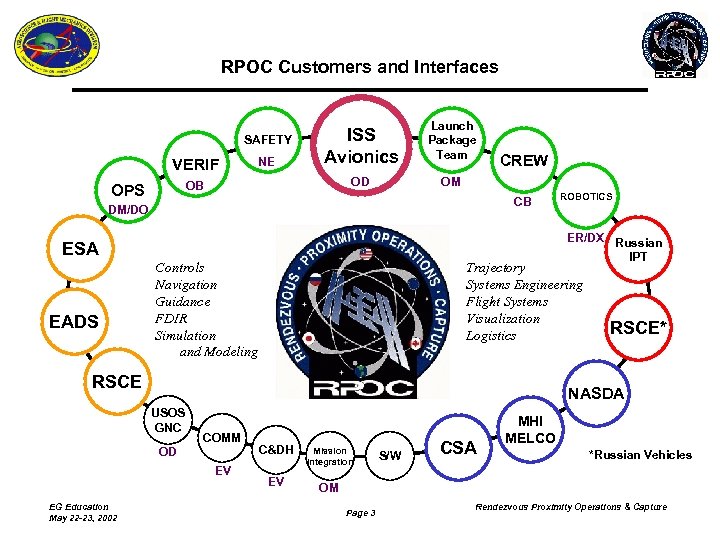 RPOC Customers and Interfaces VERIF NE Launch Package Team OD SAFETY ISS Avionics OM OB OPS CREW CB DM/DO ER/DX Russian IPT ESA EADS Controls Navigation Guidance FDIR Simulation and Modeling Trajectory Systems Engineering Flight Systems Visualization Logistics RSCE* NASDA USOS GNC COMM OD EV EG Education May 22 -23, 2002 ROBOTICS C&DH EV Mission Integration S/W CSA MHI MELCO *Russian Vehicles OM Page 3 Rendezvous Proximity Operations & Capture
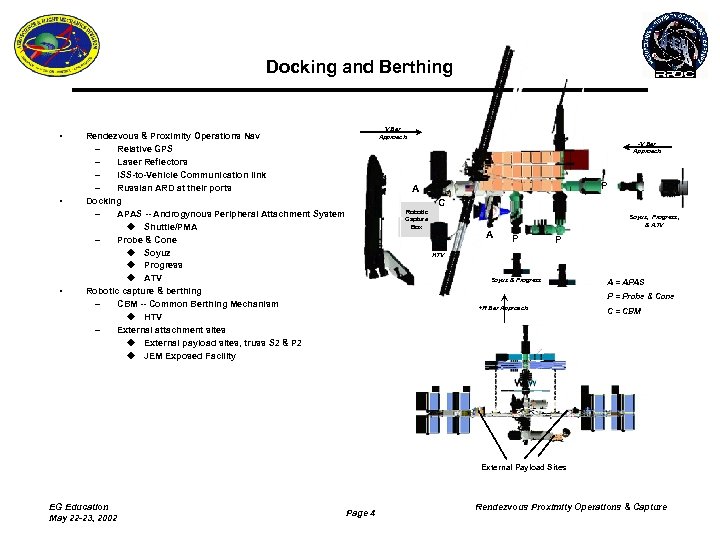 Docking and Berthing • • • V Bar Approach Rendezvous & Proximity Operations Nav – Relative GPS – Laser Reflectors – ISS-to-Vehicle Communication link – Russian ARD at their ports Docking – APAS -- Androgynous Peripheral Attachment System u Shuttle/PMA – Probe & Cone u Soyuz u Progress u ATV Robotic capture & berthing – CBM -- Common Berthing Mechanism u HTV – External attachment sites u External payload sites, truss S 2 & P 2 u JEM Exposed Facility -V Bar Approach P A C Robotic Capture Box Soyuz, Progress, & ATV A P P HTV Soyuz & Progress A = APAS P = Probe & Cone +R Bar Approach C = CBM External Payload Sites EG Education May 22 -23, 2002 Page 4 Rendezvous Proximity Operations & Capture
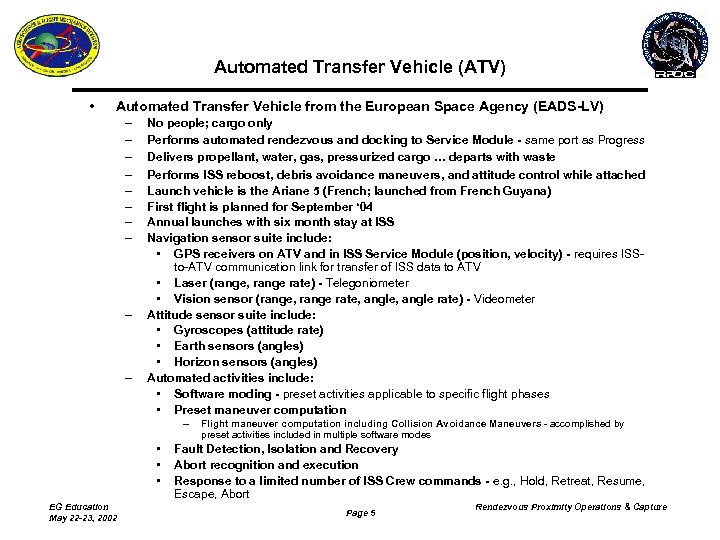 Automated Transfer Vehicle (ATV) • Automated Transfer Vehicle from the European Space Agency (EADS-LV) – – – – – No people; cargo only Performs automated rendezvous and docking to Service Module - same port as Progress Delivers propellant, water, gas, pressurized cargo … departs with waste Performs ISS reboost, debris avoidance maneuvers, and attitude control while attached Launch vehicle is the Ariane 5 (French; launched from French Guyana) First flight is planned for September ‘ 04 Annual launches with six month stay at ISS Navigation sensor suite include: • GPS receivers on ATV and in ISS Service Module (position, velocity) - requires ISSto-ATV communication link for transfer of ISS data to ATV • Laser (range, range rate) - Telegoniometer • Vision sensor (range, range rate, angle rate) - Videometer Attitude sensor suite include: • Gyroscopes (attitude rate) • Earth sensors (angles) • Horizon sensors (angles) Automated activities include: • Software moding - preset activities applicable to specific flight phases • Preset maneuver computation – • • • EG Education May 22 -23, 2002 Flight maneuver computation including Collision Avoidance Maneuvers - accomplished by preset activities included in multiple software modes Fault Detection, Isolation and Recovery Abort recognition and execution Response to a limited number of ISS Crew commands - e. g. , Hold, Retreat, Resume, Escape, Abort Page 5 Rendezvous Proximity Operations & Capture
 ATV the movie EG Education May 22 -23, 2002 Page 6 Rendezvous Proximity Operations & Capture
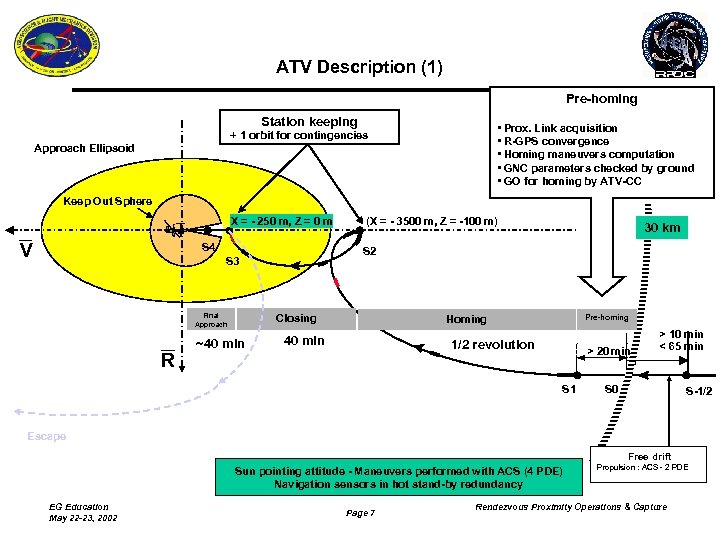 ATV Description (1) Pre-homing Station keeping • Prox. Link acquisition • R-GPS convergence • Homing maneuvers computation • GNC parameters checked by ground • GO for homing by ATV-CC + 1 orbit for contingencies Approach Ellipsoid Keep Out Sphere X = - 250 m, Z = 0 m V S 4 R Closing ~40 min 30 km S 2 S 3 Final Approach (X = - 3500 m, Z = -100 m) Pre-homing Homing 40 min 1/2 revolution > 20 min S 1 > 10 min < 65 min S 0 S-1/2 Escape Free drift Sun pointing attitude - Maneuvers performed with ACS (4 PDE) Navigation sensors in hot stand-by redundancy EG Education May 22 -23, 2002 Page 7 Propulsion : ACS - 2 PDE Rendezvous Proximity Operations & Capture
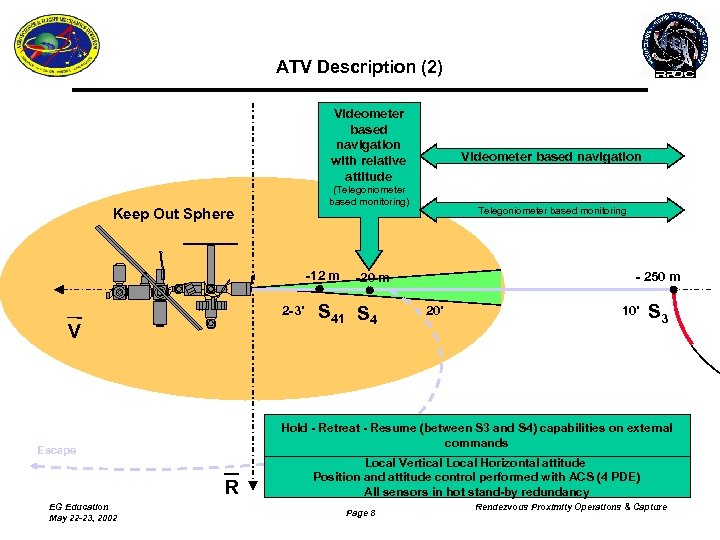 ATV Description (2) Videometer based navigation with relative attitude (Telegoniometer based monitoring) Keep Out Sphere -12 m 2 -3’ V Telegoniometer based monitoring - 250 m -20 m S 41 S 4 20’ 10’ S 3 Hold - Retreat - Resume (between S 3 and S 4) capabilities on external commands Escape R EG Education May 22 -23, 2002 Videometer based navigation Local Vertical Local Horizontal attitude Position and attitude control performed with ACS (4 PDE) All sensors in hot stand-by redundancy Page 8 Rendezvous Proximity Operations & Capture
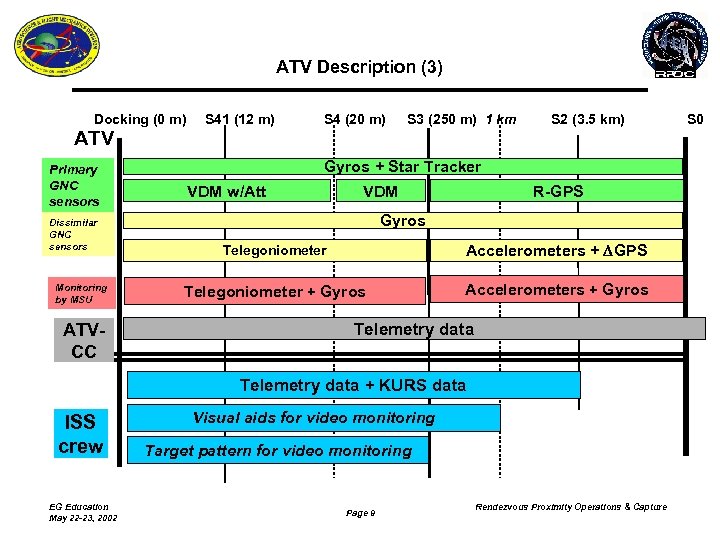 ATV Description (3) Docking (0 m) S 41 (12 m) S 4 (20 m) S 3 (250 m) 1 km S 2 (3. 5 km) ATV Primary GNC sensors Dissimilar GNC sensors Monitoring by MSU ATVCC Gyros + Star Tracker VDM w/Att VDM R-GPS Gyros Telegoniometer Accelerometers + DGPS Telegoniometer + Gyros Accelerometers + Gyros Telemetry data + KURS data ISS crew EG Education May 22 -23, 2002 Visual aids for video monitoring Target pattern for video monitoring Page 9 Rendezvous Proximity Operations & Capture S 0
 HII Transfer Vehicle (HTV) • HII Transfer Vehicle from the National Space Development Agency of Japan (MELCO/MHI) – – – – No people; cargo only Performs automated rendezvous to berthing box…is captured with SSRMS and attached to CBM at Node 2 Nadir Delivers pressurized cargo (experiment payloads, consumables, water, etc, . ) and unpressurized cargo (experiment payloads, batteries) … departs with waste Launch vehicle is the HII-A (Japanese; launched from Tanegashima, Japan) First flight is planned for November ‘ 05 Biannual launches with a two week stay at ISS Navigation sensor suite include: • GPS receivers on HTV and in ISS Japanese Experiment Module (position, velocity) requires ISS-to-HTV communication link for transfer of ISS data to HTV – – • Laser (range, range rate) - Rendezvous Sensor • Accelerometers (acceleration) Attitude sensor suite include: • Gyroscopes (attitude rate) • Earth sensors (angles) Automated activities include: • Software moding - preset activities applicable to specific flight phases • Preset maneuver computation – • • • EG Education May 22 -23, 2002 Flight maneuver computation including Collision Avoidance Maneuvers - accomplished by preset activities included in multiple software modes Fault Detection, Isolation and Recovery Abort recognition and execution Response to a limited number of ISS Crew commands - e. g. , Hold, Retreat, Resume, Abort, Emergency separation from SSRMS, HTV thruster re-activation Page 10 Rendezvous Proximity Operations & Capture
 HTV the movie EG Education May 22 -23, 2002 Page 11 Rendezvous Proximity Operations & Capture
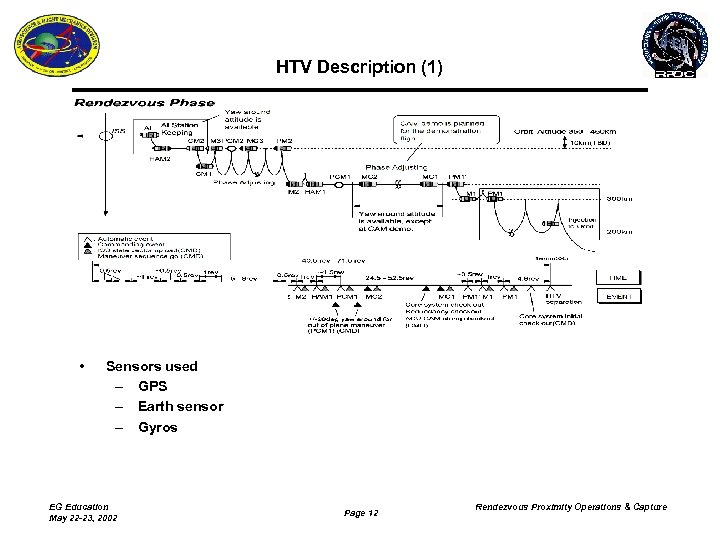 HTV Description (1) • Sensors used – GPS – Earth sensor – Gyros EG Education May 22 -23, 2002 Page 12 Rendezvous Proximity Operations & Capture
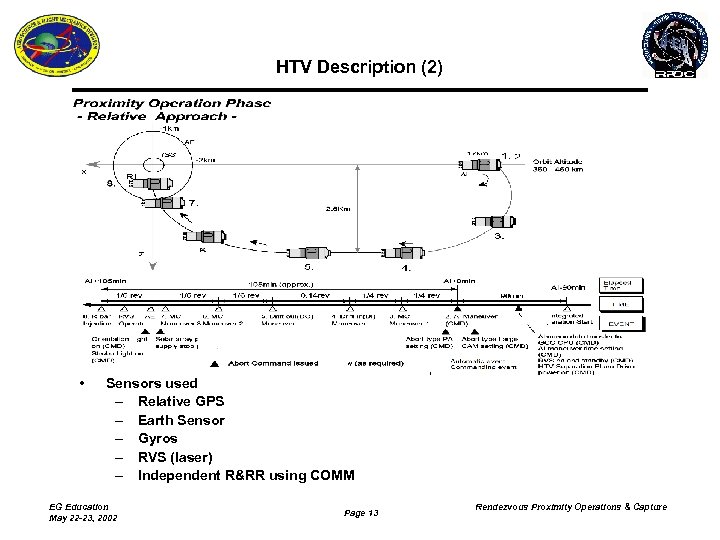 HTV Description (2) • Sensors used – Relative GPS – Earth Sensor – Gyros – RVS (laser) – Independent R&RR using COMM EG Education May 22 -23, 2002 Page 13 Rendezvous Proximity Operations & Capture
 SAFETY OVERVIEW • • System, operations and safety requirements for Rendezvous, Proximity Operations, and Capture (RPOC) are specified in key bilateral/trilateral documents (e. g. , vehicle Segment Specification, ISS to vehicle Interface Requirements Document) All safety critical functions are two-failure tolerant for catastrophic hazard All maneuvers which take vehicle trajectory into ISS “controlled” space require ground control center “GO” authorization and are initiated from default “hold” points A Collision Avoidance Maneuver (CAM) can be commanded at any time by any of the following: a) service vehicle’s Fault Detection, Isolation & Recovery (FDIR) system; b) appropriate ground control center; and c) ISS crew • A monitoring capability, which allows for abort/contingency actions, is available for ISS crew to supervise automatic approach (visual, independent range/range rate data, vehicle GNC data, vehicle FDIR data); ISS crew intervention includes a small number of additional commands to control actions of service vehicle (vehicle dependent) EG Education May 22 -23, 2002 Page 14 Rendezvous Proximity Operations & Capture
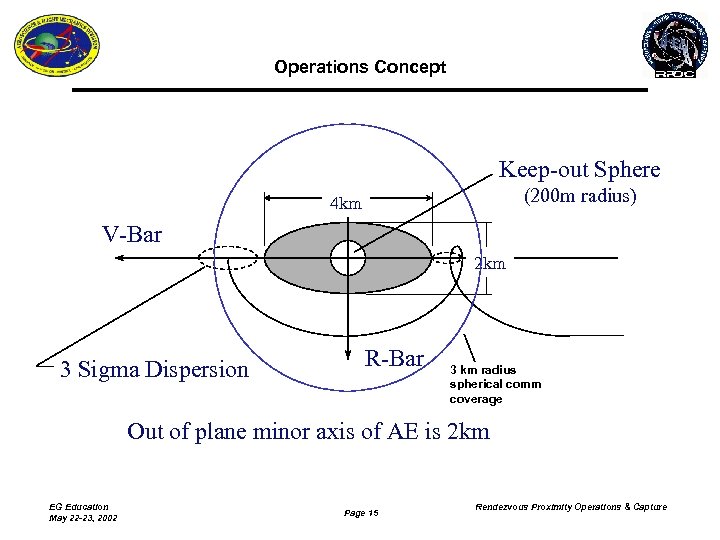 Operations Concept Keep-out Sphere (200 m radius) 4 km V-Bar 2 km 3 Sigma Dispersion R-Bar 3 km radius spherical comm coverage Out of plane minor axis of AE is 2 km EG Education May 22 -23, 2002 Page 15 Rendezvous Proximity Operations & Capture
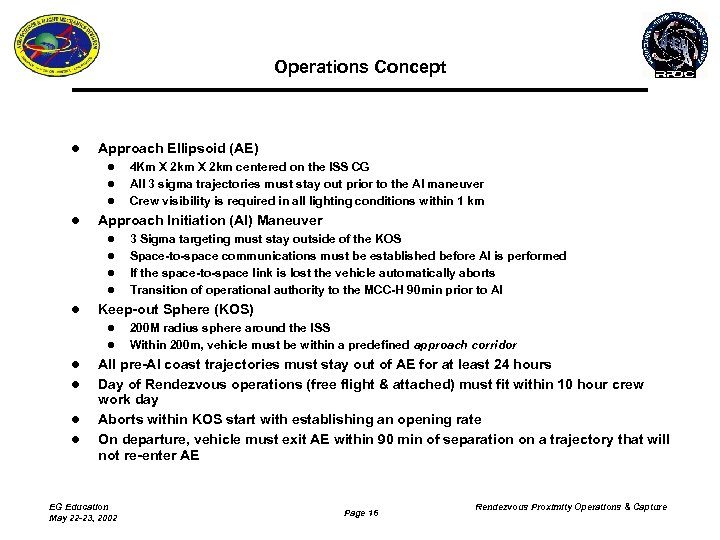 Operations Concept l Approach Ellipsoid (AE) l l Approach Initiation (AI) Maneuver l l l l l 3 Sigma targeting must stay outside of the KOS Space-to-space communications must be established before AI is performed If the space-to-space link is lost the vehicle automatically aborts Transition of operational authority to the MCC-H 90 min prior to AI Keep-out Sphere (KOS) l l 4 Km X 2 km centered on the ISS CG All 3 sigma trajectories must stay out prior to the AI maneuver Crew visibility is required in all lighting conditions within 1 km 200 M radius sphere around the ISS Within 200 m, vehicle must be within a predefined approach corridor All pre-AI coast trajectories must stay out of AE for at least 24 hours Day of Rendezvous operations (free flight & attached) must fit within 10 hour crew work day Aborts within KOS start with establishing an opening rate On departure, vehicle must exit AE within 90 min of separation on a trajectory that will not re-enter AE EG Education May 22 -23, 2002 Page 16 Rendezvous Proximity Operations & Capture
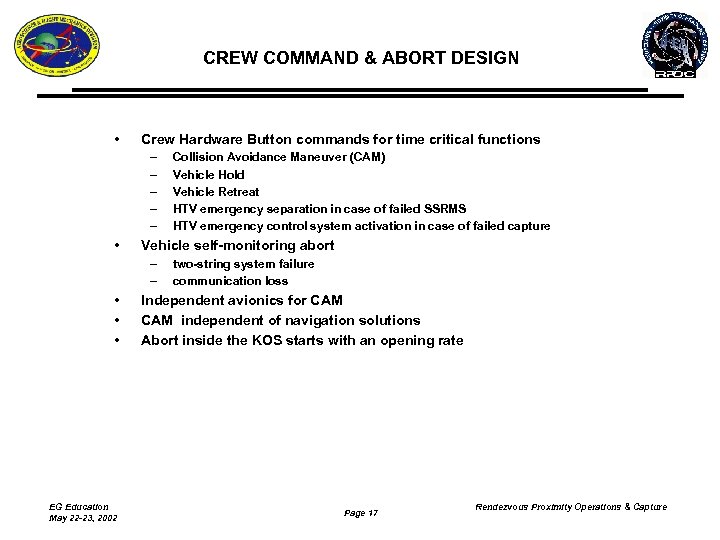 CREW COMMAND & ABORT DESIGN • Crew Hardware Button commands for time critical functions – – – • Vehicle self-monitoring abort – – • • • EG Education May 22 -23, 2002 Collision Avoidance Maneuver (CAM) Vehicle Hold Vehicle Retreat HTV emergency separation in case of failed SSRMS HTV emergency control system activation in case of failed capture two-string system failure communication loss Independent avionics for CAM independent of navigation solutions Abort inside the KOS starts with an opening rate Page 17 Rendezvous Proximity Operations & Capture
 FLIGHT DEMONSTRATION REQUIREMENTS • • The test program shall demonstrate and verify a readiness of the RPOC system including service vehicle, ISS systems, combined vehicle/ISS systems, and the system support facilities which will be used for a safe RPOC at the ISS All safety-critical functions shall be flight demonstrated: • • In a region that is not hazardous to the ISS Prior to when they are needed for ISS safety The technique used by the service vehicle shall be approved by the ISSP Functions to be demonstrated, as a minimum, include: • • • EG Education May 22 -23, 2002 Establishment of the communications link Command/Data telemetry transfer Functionality of GNC systems Collision Avoidance Maneuver Approach, including maintaining the required approach corridor and stationkeeping Emergency termination of approach Capture within predetermined kinematic parameters Complete mechanical mating and establishment of required interfaces Unmating and back-off Functionality of Service Vehicle ground support personnel and equipment Functionality of visual monitoring techniques and systems by ISS crew Page 18 Rendezvous Proximity Operations & Capture
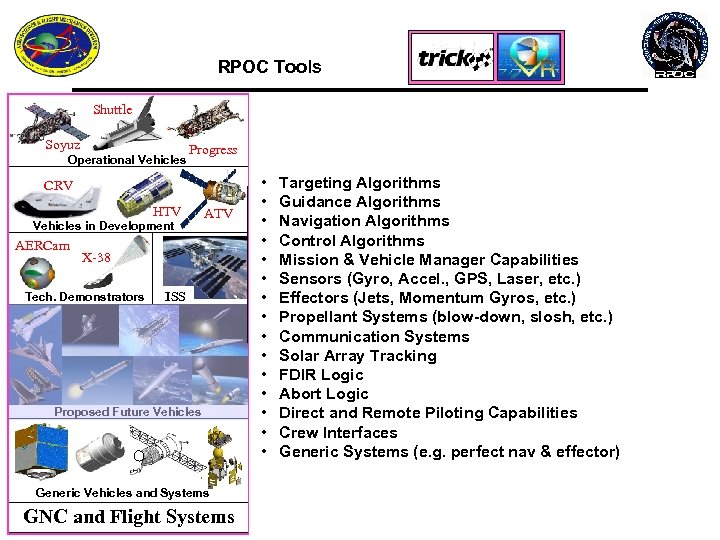 RPOC Tools Shuttle Soyuz Operational Vehicles Progress CRV HTV Vehicles in Development AERCam ATV X-38 Tech. Demonstrators ISS Proposed Future Vehicles Environment • Current, Planned, and Generic Robotic Systems Targeting Algorithms • Guidance Algorithms • Navigation Algorithms • Control Algorithms • Mission & Vehicle Manager Capabilities • Sensors (Gyro, Accel. , GPS, Laser, etc. ) • Effectors (Jets, Momentum Gyros, etc. ) • Propellant Systems (blow-down, slosh, etc. ) GPS • Hardware-in-the-loop Systems Crew-in-the-loop Communication - Multi Body • Solar Array Tracking - Rigid Body - Flex Body • FDIR Logic - Orbital - Robotics • Abort Logic - Multi-Vehicle - Contact • Direct and Remote Piloting Capabilities Sim Control, Monitor & Fault Insertion Visualization Kinematics & Dynamics • Crew Interfaces - Collision Detect • Generic Systems (e. g. perfect nav & effector) - Communications Generic Vehicles and Systems EG Education May and Flight Systems GNC 22 -23, 2002 Page 19 Crew Displays - Monte-Carlo - Optimization Mechanism - Math Libraries Models - Multi-Process Rendezvous Proximity Operations & Multi-Computer - Capture Docking/Berthing Support Tools
 BACKUP CHARTS EG Education May 22 -23, 2002 Page 20 Rendezvous Proximity Operations & Capture
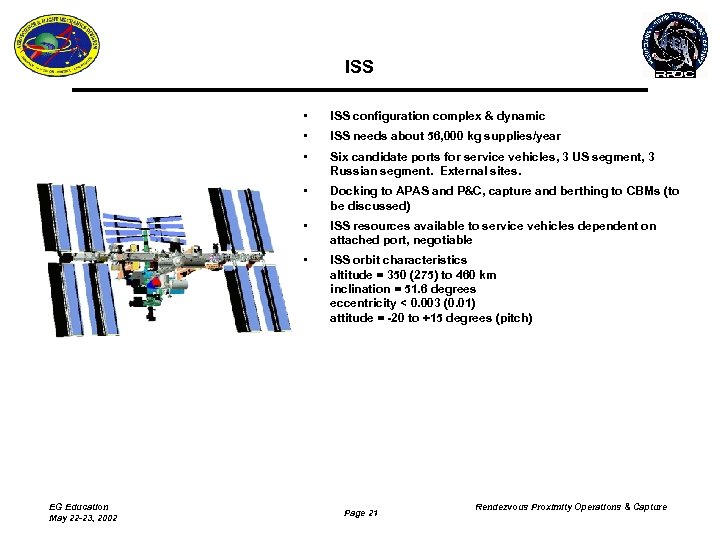 ISS • • ISS needs about 56, 000 kg supplies/year • Six candidate ports for service vehicles, 3 US segment, 3 Russian segment. External sites. • Docking to APAS and P&C, capture and berthing to CBMs (to be discussed) • ISS resources available to service vehicles dependent on attached port, negotiable • EG Education May 22 -23, 2002 ISS configuration complex & dynamic ISS orbit characteristics altitude = 350 (275) to 460 km inclination = 51. 6 degrees eccentricity < 0. 003 (0. 01) attitude = -20 to +15 degrees (pitch) Page 21 Rendezvous Proximity Operations & Capture
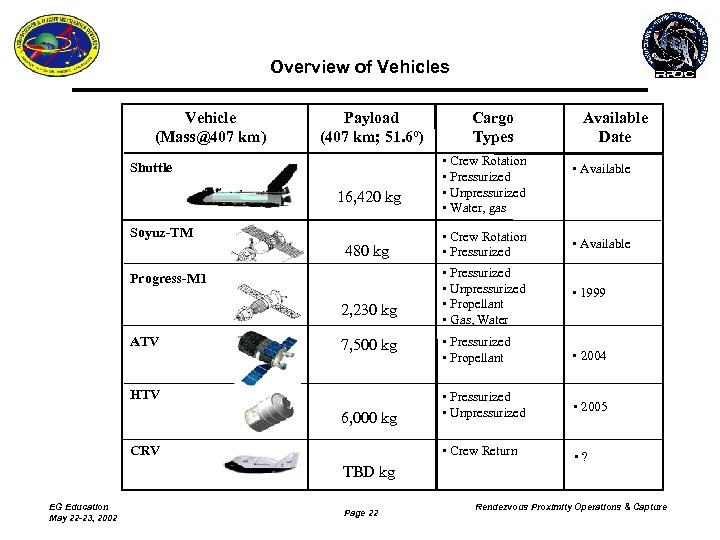 Overview of Vehicles Vehicle (Mass@407 km) Payload (407 km; 51. 6º) Shuttle 16, 420 kg Soyuz-TM Progress-M 1 2, 230 kg 7, 500 kg HTV 6, 000 kg CRV TBD kg EG Education May 22 -23, 2002 • Crew Rotation • Pressurized • Unpressurized • Water, gas Available Date • Available Page 22 • Crew Rotation • Pressurized • Available • Pressurized • Unpressurized • Propellant • Gas, Water • 1999 • Pressurized • Propellant • 2004 • Pressurized • Unpressurized • 2005 • Crew Return 480 kg ATV Cargo Types • ? Rendezvous Proximity Operations & Capture
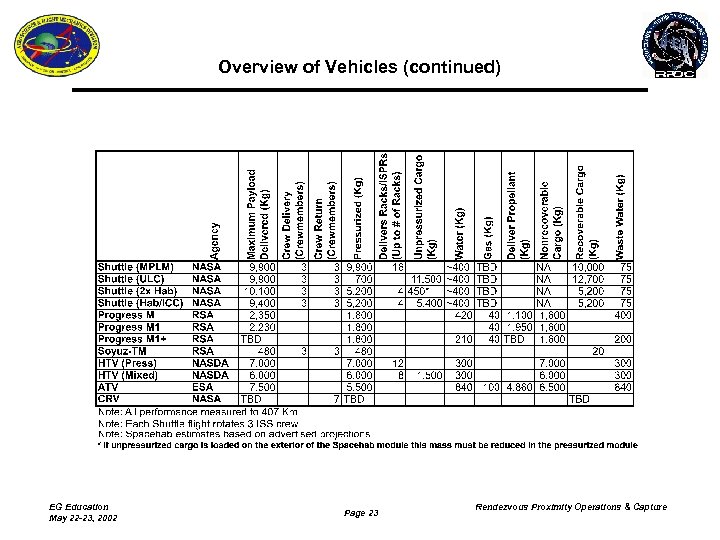 Overview of Vehicles (continued) EG Education May 22 -23, 2002 Page 23 Rendezvous Proximity Operations & Capture
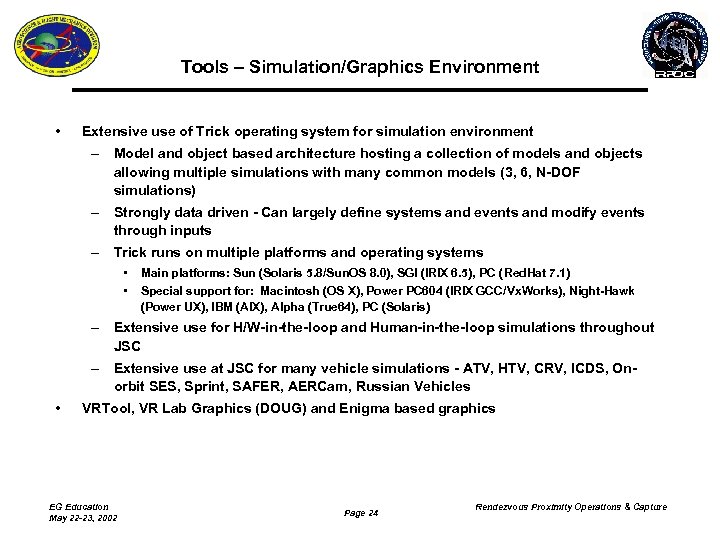 Tools – Simulation/Graphics Environment • Extensive use of Trick operating system for simulation environment – Model and object based architecture hosting a collection of models and objects allowing multiple simulations with many common models (3, 6, N-DOF simulations) – Strongly data driven - Can largely define systems and events and modify events through inputs – Trick runs on multiple platforms and operating systems • • Main platforms: Sun (Solaris 5. 8/Sun. OS 8. 0), SGI (IRIX 6. 5), PC (Red. Hat 7. 1) Special support for: Macintosh (OS X), Power PC 604 (IRIX GCC/Vx. Works), Night-Hawk (Power UX), IBM (AIX), Alpha (True 64), PC (Solaris) – Extensive use for H/W-in-the-loop and Human-in-the-loop simulations throughout JSC – Extensive use at JSC for many vehicle simulations - ATV, HTV, CRV, ICDS, Onorbit SES, Sprint, SAFER, AERCam, Russian Vehicles • VRTool, VR Lab Graphics (DOUG) and Enigma based graphics EG Education May 22 -23, 2002 Page 24 Rendezvous Proximity Operations & Capture
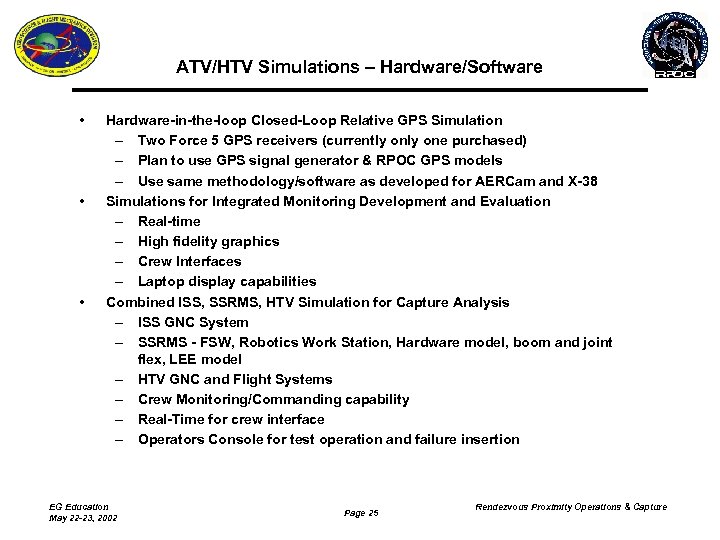 ATV/HTV Simulations – Hardware/Software • • • Hardware-in-the-loop Closed-Loop Relative GPS Simulation – Two Force 5 GPS receivers (currently one purchased) – Plan to use GPS signal generator & RPOC GPS models – Use same methodology/software as developed for AERCam and X-38 Simulations for Integrated Monitoring Development and Evaluation – Real-time – High fidelity graphics – Crew Interfaces – Laptop display capabilities Combined ISS, SSRMS, HTV Simulation for Capture Analysis – ISS GNC System – SSRMS - FSW, Robotics Work Station, Hardware model, boom and joint flex, LEE model – HTV GNC and Flight Systems – Crew Monitoring/Commanding capability – Real-Time for crew interface – Operators Console for test operation and failure insertion EG Education May 22 -23, 2002 Page 25 Rendezvous Proximity Operations & Capture
 ATV/HTV Simulation Summary • • • Simulate All Phases ATV and HTV Near ISS – End part of phasing to proximity operation to capture – Separation and departure – Aborts and re-rendezvous Use Simulations for: – GNC performance analysis – Docking/SSRMS capture analysis – Monitoring development – FDIR analysis – Safety evaluation – ISS integration – Independent Verification Batch Simulations, Avionics-in-the-loop, Human-in-the-loop EG Education May 22 -23, 2002 Page 26 Rendezvous Proximity Operations & Capture
 ATV/HTV Simulation Capabilities • • • Full, Single String, Rendezvous/Proximity Operations GNC for All Phases – Targeting and Guidance used by ATV and HTV and generic – Absolute state navigation • GPS, INS, Generic – Relative state navigation • Relative GPS, laser, vision system, generic – Attitude navigation • Gyro, earth sensor, star tracker, relative attitude, generic – Controls used by ATV and HTV, phase plane, generic – Sensors/Effectors used by ATV, HTV and generic Numerous Flight System Models (comm, C&DH, docking mech. etc. ) Limited multiple string instantiation for FDIR analysis Partial ATV and HTV FDIR capabilities ISS model (GNC, array rotation, collision model, etc. ) Full SSRMS model (dynamics, controls, FSW, crew interface, etc. ) EG Education May 22 -23, 2002 Page 27 Rendezvous Proximity Operations & Capture