 Скачать презентацию November 2011 doc IEEE 802 22 -11 0132
78b3dc6f9b2bfabfcd81f2d58250e4f2.ppt
- Количество слайдов: 79



November 2011 doc. : IEEE 802. 22 -11/0132 r 01 Introduction to IEEE Std. 802. 22 -2011 and its Amendment PAR for P 802. 22 b: Broadband Extension and Monitoring Authors: Abstract This tutorial is to be presented during the IEEE 802 Plenary session in November 2011 in Atlanta. The first part of the tutorial provides an overview of the recently completed standard IEEE std. 802. 22 -2011. The second part of the tutorial is to educate the IEEE 802 community as to why a new P 802. 22 b amendment to the IEEE std. 802. 22 -2011 is needed and what it will do. Notice: This document has been prepared to assist IEEE 802. 22. It is offered as a basis for discussion and is not binding on the contributing individual(s) or organization(s). The material in this document is subject to change in form and content after further study. The contributor(s) reserve(s) the right to add, amend or withdraw material contained herein. Release: The contributor grants a free, irrevocable license to the IEEE to incorporate material contained in this contribution, and any modifications thereof, in the creation of an IEEE Standards publication; to copyright in the IEEE’s name any IEEE Standards publication even though it may include portions of this contribution; and at the IEEE’s sole discretion to permit others to reproduce in whole or in part the resulting IEEE Standards publication. The contributor also acknowledges and accepts that this contribution may be made public by IEEE 802. 11. Patent Policy and Procedures: The contributor is familiar with the IEEE 802 Patent Policy and Procedures <http: //standards. ieee. org/guides/bylaws/sb-bylaws. pdf>, including the statement "IEEE standards may include the known use of patent(s), including patent applications, provided the IEEE receives assurance from the patent holder or applicant with respect to patents essential for compliance with both mandatory and optional portions of the standard. " Early disclosure to the Working Group of patent information that might be relevant to the standard is essential to reduce the possibility for delays in the development process and increase the likelihood that the draft publication will be approved for publication. Please notify the Chair Apurva N. Mody <apurva. mody@ieee. org> as early as possible, in written or electronic form, if patented technology (or technology under patent application) might be incorporated into a draft standard being developed within the IEEE 802. 11 Working Group. If you have questions, contact the IEEE Patent Committee Administrator at <patcom@ieee. org>. Submission Slide 1
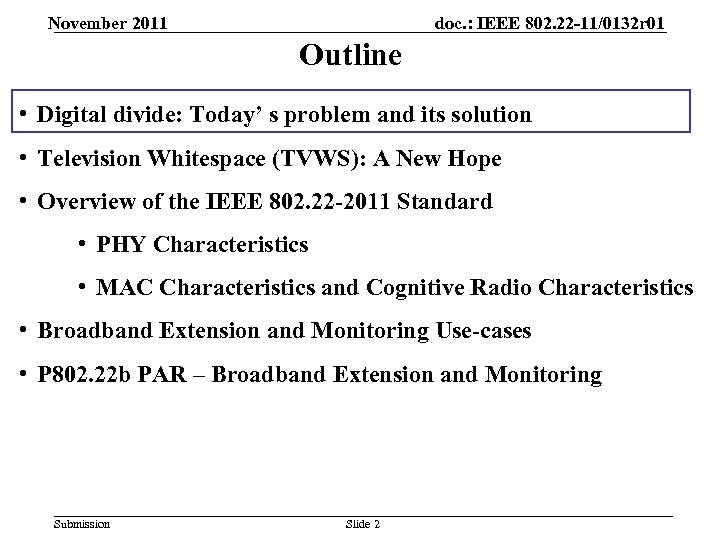
November 2011 doc. : IEEE 802. 22 -11/0132 r 01 Outline • Digital divide: Today’ s problem and its solution • Television Whitespace (TVWS): A New Hope • Overview of the IEEE 802. 22 -2011 Standard • PHY Characteristics • MAC Characteristics and Cognitive Radio Characteristics • Broadband Extension and Monitoring Use-cases • P 802. 22 b PAR – Broadband Extension and Monitoring Submission Slide 2
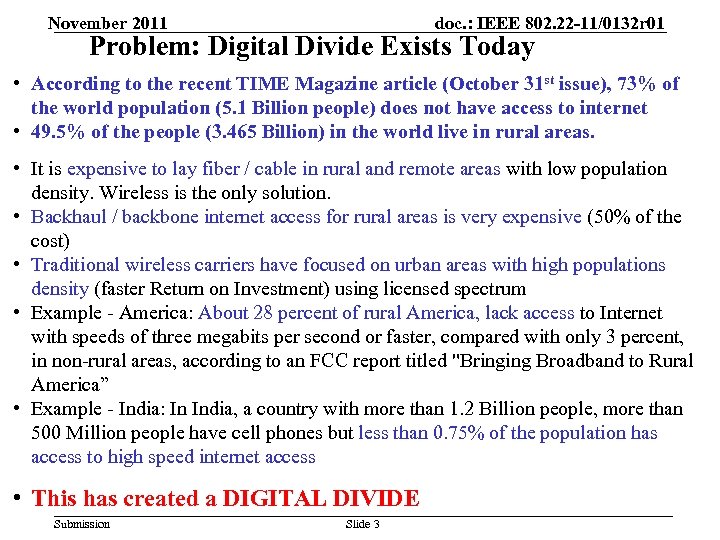
November 2011 doc. : IEEE 802. 22 -11/0132 r 01 Problem: Digital Divide Exists Today • According to the recent TIME Magazine article (October 31 st issue), 73% of the world population (5. 1 Billion people) does not have access to internet • 49. 5% of the people (3. 465 Billion) in the world live in rural areas. • It is expensive to lay fiber / cable in rural and remote areas with low population density. Wireless is the only solution. • Backhaul / backbone internet access for rural areas is very expensive (50% of the cost) • Traditional wireless carriers have focused on urban areas with high populations density (faster Return on Investment) using licensed spectrum • Example - America: About 28 percent of rural America, lack access to Internet with speeds of three megabits per second or faster, compared with only 3 percent, in non-rural areas, according to an FCC report titled "Bringing Broadband to Rural America” • Example - India: In India, a country with more than 1. 2 Billion people, more than 500 Million people have cell phones but less than 0. 75% of the population has access to high speed internet access • This has created a DIGITAL DIVIDE Submission Slide 3
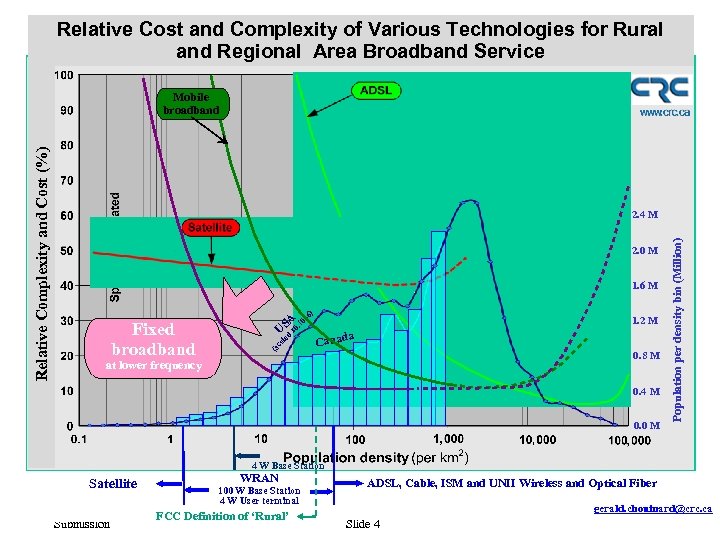
November 2011 and Complexity of Various Technologies for Rural doc. : IEEE 802. 22 -11/0132 r 01 Relative Cost and Regional Area Broadband Service 2. 0 M 10 66 1. 2 M 0. U x ed al Fixed broadband SA ) 1. 6 M a Canad 0. 8 M at lower frequency 0. 4 M 0. 0 M Population per density bin (Million) 2. 4 M (s c Relative Complexity and Cost (%) Mobile broadband 4 W Base Station Satellite Submission WRAN 100 W Base Station 4 W User terminal FCC Definition of ‘Rural’ ADSL, Cable, ISM and UNII Wireless and Optical Fiber Courtesy: Gerald Chouinard: gerald. chouinard@crc. ca Slide 4
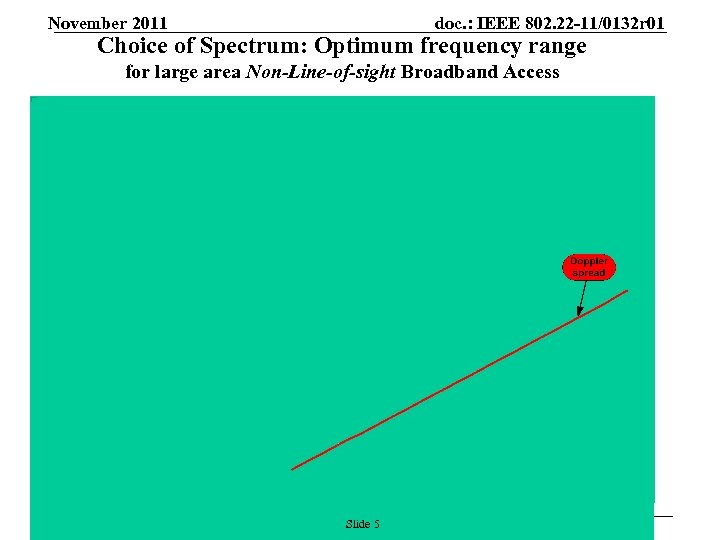
November 2011 doc. : IEEE 802. 22 -11/0132 r 01 Choice of Spectrum: Optimum frequency range for large area Non-Line-of-sight Broadband Access Relative Complexity and Cost (%) Antenna aperture Phase noise Filter selectivity Noise Figure Courtesy: Gerald Chouinard: gerald. chouinard@crc. ca Submission Slide 5
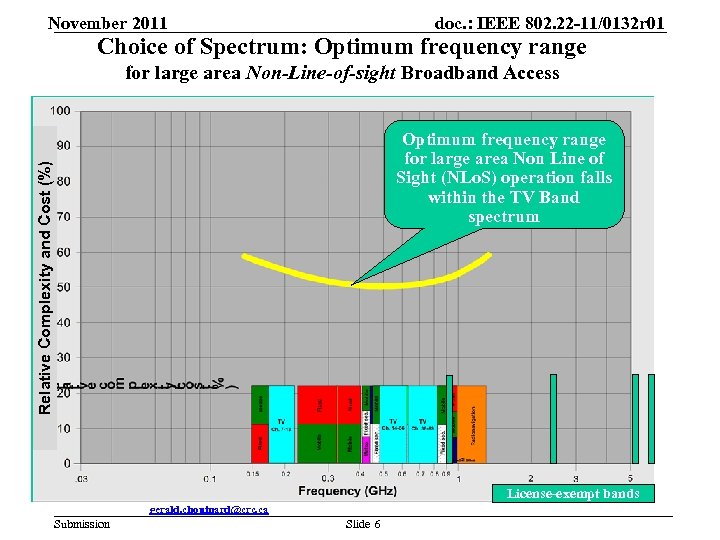
November 2011 doc. : IEEE 802. 22 -11/0132 r 01 Choice of Spectrum: Optimum frequency range for large area Non-Line-of-sight Broadband Access Relative Complexity and Cost (%) Optimum frequency range for large area Non Line of Sight (NLo. S) operation falls within the TV Band spectrum License-exempt bands Courtesy: Gerald Chouinard: gerald. chouinard@crc. ca Submission Slide 6
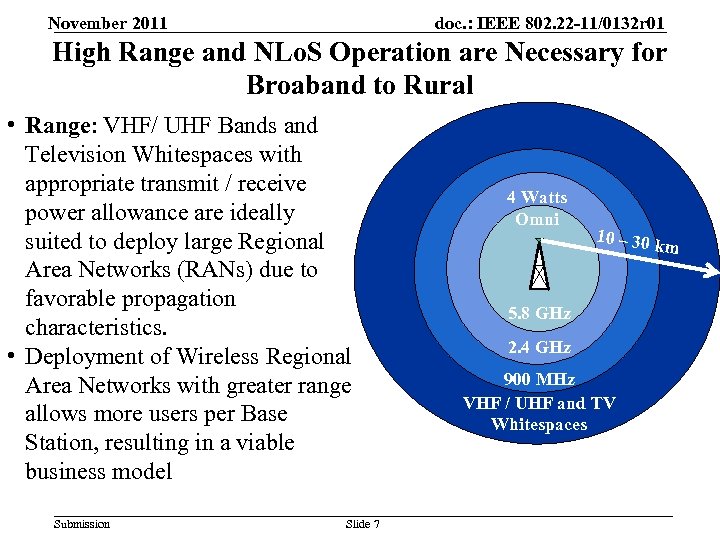
November 2011 doc. : IEEE 802. 22 -11/0132 r 01 High Range and NLo. S Operation are Necessary for Broaband to Rural • Range: VHF/ UHF Bands and Television Whitespaces with appropriate transmit / receive power allowance are ideally suited to deploy large Regional Area Networks (RANs) due to favorable propagation characteristics. • Deployment of Wireless Regional Area Networks with greater range allows more users per Base Station, resulting in a viable business model Submission Slide 7 4 Watts Omni 10 – 30 k m 5. 8 GHz 2. 4 GHz 900 MHz VHF / UHF and TV Whitespaces
November 2011 doc. : IEEE 802. 22 -11/0132 r 01 Outline • Digital divide: Today’ s problem and its solution • Television Whitespace (TVWS): A New Hope • Overview of the IEEE 802. 22 -2011 Standard • PHY Characteristics • MAC Characteristics and Cognitive Radio Characteristics • Broadband Extension and Monitoring Use-cases • P 802. 22 b PAR – Broadband Extension and Monitoring Submission Slide 8
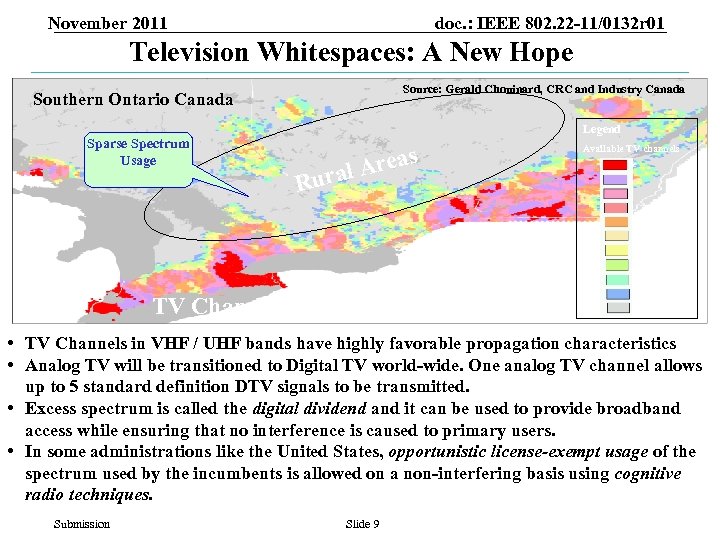
November 2011 doc. : IEEE 802. 22 -11/0132 r 01 Television Whitespaces: A New Hope Source: Gerald Chouinard, CRC and Industry Canada Southern Ontario Canada Legend Sparse Spectrum Usage reas Available TV channels R ural A None 1 2 3 4 5 Urban Areas 6 7 8 TV Channel Availability for Broadband 9 10 and + • TV Channels in VHF / UHF bands have highly favorable propagation characteristics • Analog TV will be transitioned to Digital TV world-wide. One analog TV channel allows up to 5 standard definition DTV signals to be transmitted. • Excess spectrum is called the digital dividend and it can be used to provide broadband access while ensuring that no interference is caused to primary users. • In some administrations like the United States, opportunistic license-exempt usage of the spectrum used by the incumbents is allowed on a non-interfering basis using cognitive radio techniques. Submission Slide 9
November 2011 doc. : IEEE 802. 22 -11/0132 r 01 What can Television Whitespaces do? Wireless Regional Area Networks such as IEEE 802. 22 systems using TV Whitespaces can connect rural areas in emerging markets. • Television Whitespaces (TVWS) will allow broadband wireless access to regional, rural and remote areas under Line of Sight (Lo. S) and Non Line of Sight (NLo. S) conditions. • Other Applications: • Smart grid • Cheap backhaul using multi-profile RAN stations • Triple play for broadcasters (e. g. video, voice and data), • Off-loading cellular telephony traffic to un-licensed spectrum, • Distance learning, civic communications, regional area public safety and homeland security, emergency broadband services, • Monitoring rain forests, monitoring livestock, border protection, • Broadband service to multiple dwelling unit (MDU), multi tenant unit (MTU), small office home office (So. Ho), campuses, etc. Submission Slide 10
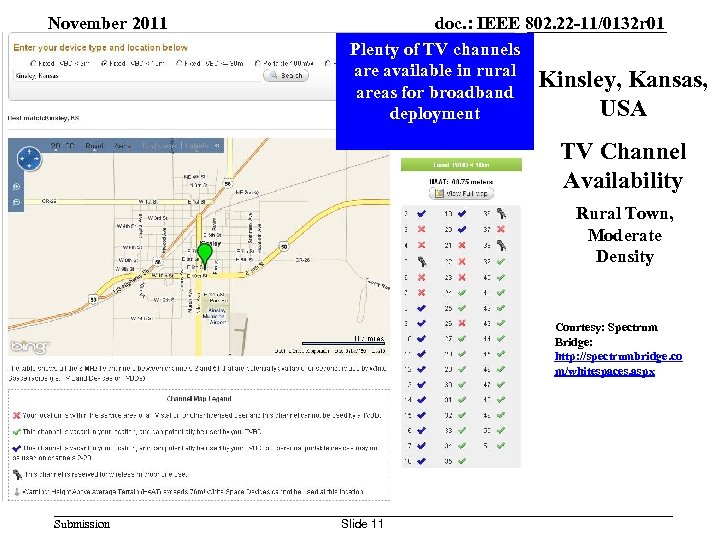
November 2011 doc. : IEEE 802. 22 -11/0132 r 01 Plenty of TV channels are available in rural Kinsley, Kansas, areas for broadband USA deployment TV Channel Availability Rural Town, Moderate Density Courtesy: Spectrum Bridge: http: //spectrumbridge. co m/whitespaces. aspx Submission Slide 11
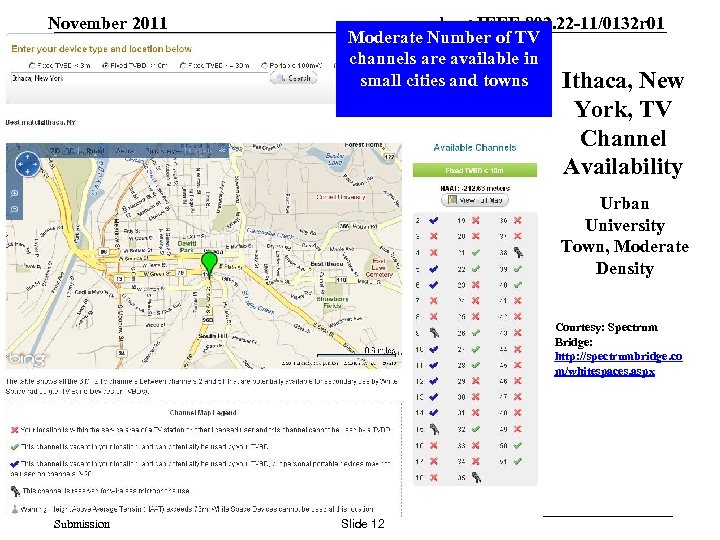
November 2011 doc. : IEEE 802. 22 -11/0132 r 01 Moderate Number of TV channels are available in small cities and towns Ithaca, New York, TV Channel Availability Urban University Town, Moderate Density Courtesy: Spectrum Bridge: http: //spectrumbridge. co m/whitespaces. aspx Submission Slide 12
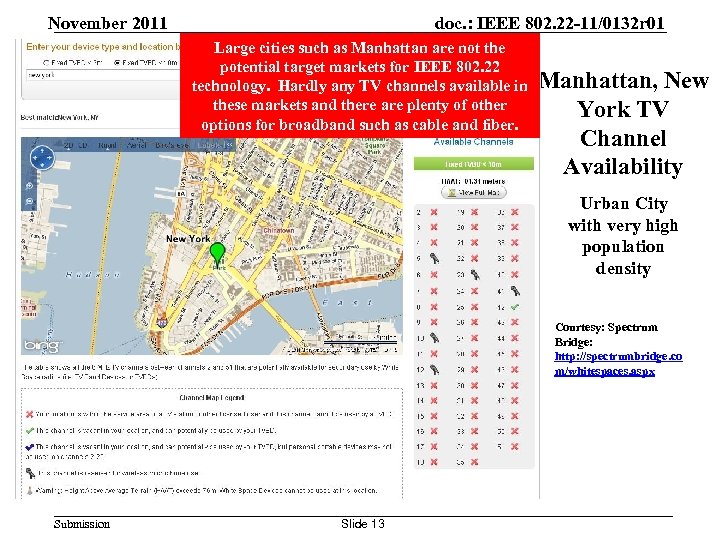
November 2011 doc. : IEEE 802. 22 -11/0132 r 01 Large cities such as Manhattan are not the potential target markets for IEEE 802. 22 technology. Hardly any TV channels available in these markets and there are plenty of other options for broadband such as cable and fiber. Manhattan, New York TV Channel Availability Urban City with very high population density Courtesy: Spectrum Bridge: http: //spectrumbridge. co m/whitespaces. aspx Submission Slide 13
November 2011 doc. : IEEE 802. 22 -11/0132 r 01 Outline • Digital divide: Today’ s problem and its solution • Television Whitespace (TVWS): A New Hope • Overview of the IEEE 802. 22 -2011 Standard • PHY Characteristics • MAC Characteristics and Cognitive Radio Characteristics • Broadband Extension and Monitoring Use-cases • P 802. 22 b PAR – Broadband Extension and Monitoring Submission Slide 14
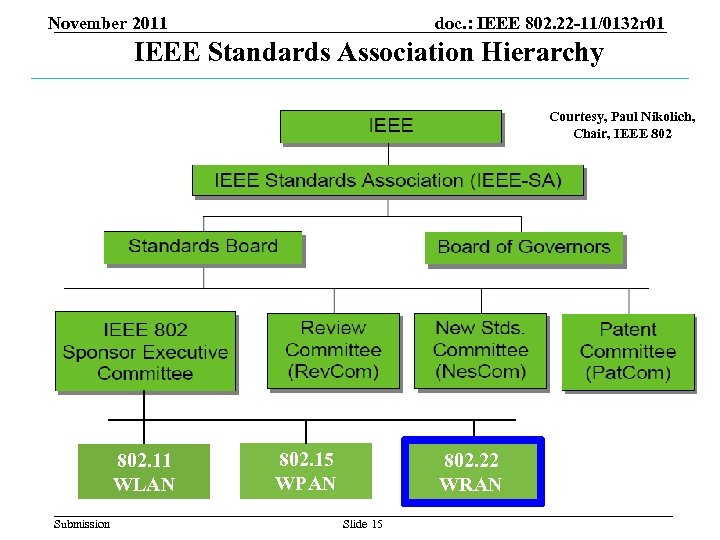
November 2011 doc. : IEEE 802. 22 -11/0132 r 01 IEEE Standards Association Hierarchy Courtesy, Paul Nikolich, Chair, IEEE 802. 11 WLAN Submission 802. 15 WPAN 802. 22 WRAN Slide 15
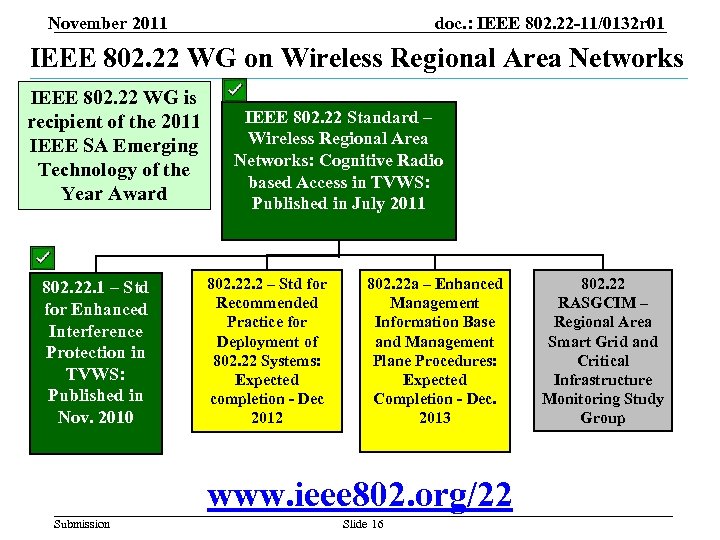
November 2011 doc. : IEEE 802. 22 -11/0132 r 01 IEEE 802. 22 WG on Wireless Regional Area Networks IEEE 802. 22 WG is recipient of the 2011 IEEE SA Emerging Technology of the Year Award 802. 22. 1 – Std for Enhanced Interference Protection in TVWS: Published in Nov. 2010 IEEE 802. 22 Standard – Wireless Regional Area Networks: Cognitive Radio based Access in TVWS: Published in July 2011 802. 2 – Std for Recommended Practice for Deployment of 802. 22 Systems: Expected completion - Dec 2012 802. 22 a – Enhanced Management Information Base and Management Plane Procedures: Expected Completion - Dec. 2013 www. ieee 802. org/22 Submission Slide 16 802. 22 RASGCIM – Regional Area Smart Grid and Critical Infrastructure Monitoring Study Group
November 2011 doc. : IEEE 802. 22 -11/0132 r 01 802. 22 Unique Proposition § First IEEE Standard for operation in Television Whitespaces § First IEEE Standard that is specifically designed for rural and regional area broadband access aimed at removing the digital divide § First IEEE Standard that has all the Cognitive Radio features § Recipient of the IEEE SA Emerging Technology of the Year Award Submission Slide 17
November 2011 doc. : IEEE 802. 22 -11/0132 r 01 Outline • Digital divide: Today’ s problem and its solution • Television Whitespace (TVWS): A New Hope • Overview of the IEEE 802. 22 -2011 Standard • PHY Characteristics • MAC Characteristics and Cognitive Radio Characteristics • Broadband Extension and Monitoring Use-cases • P 802. 22 b PAR – Broadband Extension and Monitoring Submission Slide 18
November 2011 doc. : IEEE 802. 22 -11/0132 r 01 Abstract TV Channel Characteristics IEEE 802. 22 PHY Features Conclusions Contributor Submission Slide 19 November 2011
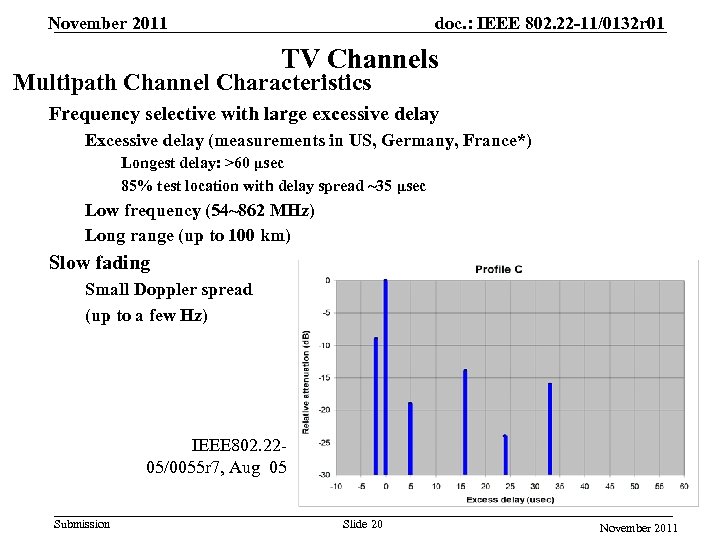
November 2011 doc. : IEEE 802. 22 -11/0132 r 01 TV Channels Multipath Channel Characteristics Frequency selective with large excessive delay Excessive delay (measurements in US, Germany, France*) Longest delay: >60 μsec 85% test location with delay spread ~35 μsec Low frequency (54~862 MHz) Long range (up to 100 km) Slow fading Small Doppler spread (up to a few Hz) * WRAN Channel Modeling, IEEE 802. 2205/0055 r 7, Aug 05 Submission Slide 20 November 2011
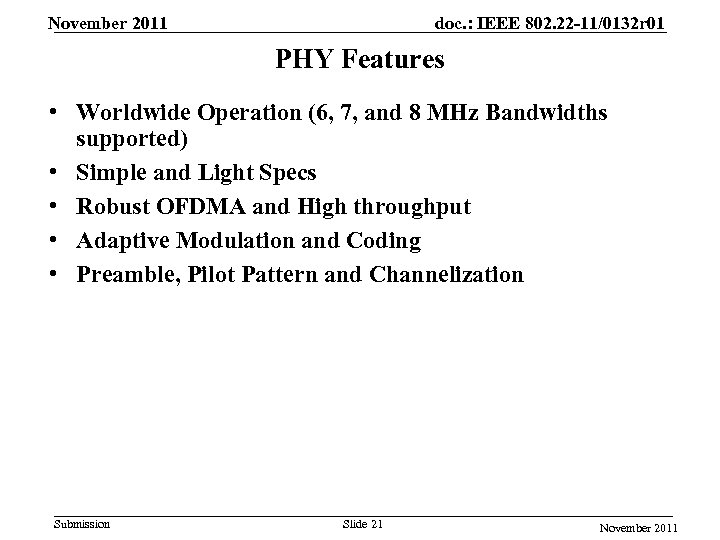
November 2011 doc. : IEEE 802. 22 -11/0132 r 01 PHY Features • Worldwide Operation (6, 7, and 8 MHz Bandwidths supported) • Simple and Light Specs • Robust OFDMA and High throughput • Adaptive Modulation and Coding • Preamble, Pilot Pattern and Channelization Submission Slide 21 November 2011
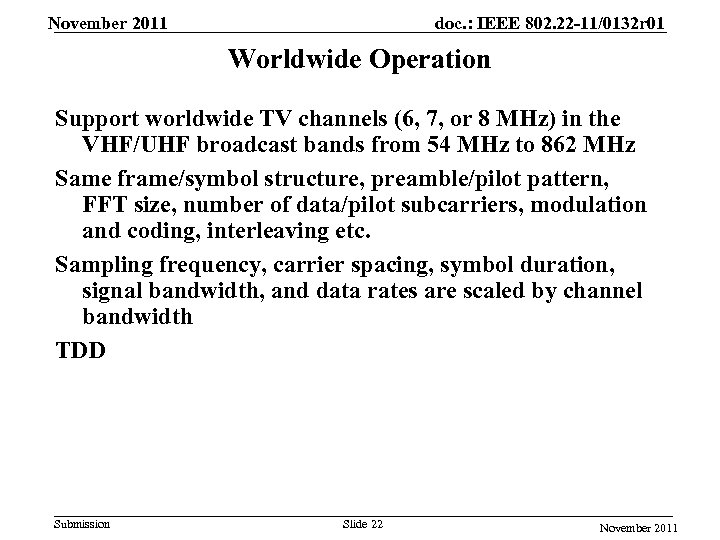
November 2011 doc. : IEEE 802. 22 -11/0132 r 01 Worldwide Operation Support worldwide TV channels (6, 7, or 8 MHz) in the VHF/UHF broadcast bands from 54 MHz to 862 MHz Same frame/symbol structure, preamble/pilot pattern, FFT size, number of data/pilot subcarriers, modulation and coding, interleaving etc. Sampling frequency, carrier spacing, symbol duration, signal bandwidth, and data rates are scaled by channel bandwidth TDD Submission Slide 22 November 2011
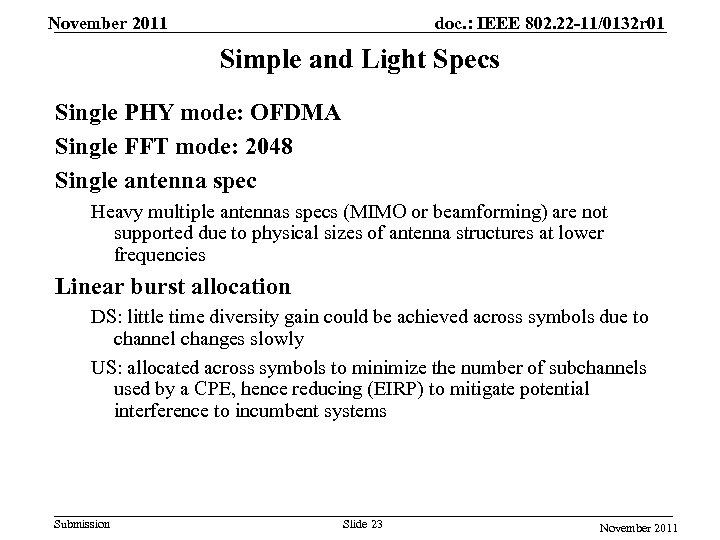
November 2011 doc. : IEEE 802. 22 -11/0132 r 01 Simple and Light Specs Single PHY mode: OFDMA Single FFT mode: 2048 Single antenna spec Heavy multiple antennas specs (MIMO or beamforming) are not supported due to physical sizes of antenna structures at lower frequencies Linear burst allocation DS: little time diversity gain could be achieved across symbols due to channel changes slowly US: allocated across symbols to minimize the number of subchannels used by a CPE, hence reducing (EIRP) to mitigate potential interference to incumbent systems Submission Slide 23 November 2011
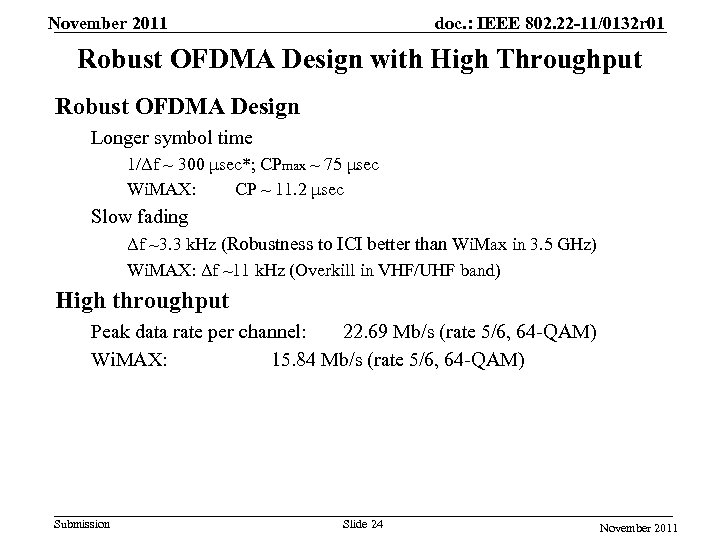
November 2011 doc. : IEEE 802. 22 -11/0132 r 01 Robust OFDMA Design with High Throughput Robust OFDMA Design Longer symbol time 1/Δf ~ 300 μsec*; CPmax ~ 75 μsec Wi. MAX: CP ~ 11. 2 μsec Slow fading Δf ~3. 3 k. Hz (Robustness to ICI better than Wi. Max in 3. 5 GHz) Wi. MAX: Δf ~11 k. Hz (Overkill in VHF/UHF band) High throughput Peak data rate per channel: 22. 69 Mb/s (rate 5/6, 64 -QAM) Wi. MAX: 15. 84 Mb/s (rate 5/6, 64 -QAM) * US 6 MHz TV channel Submission Slide 24 November 2011
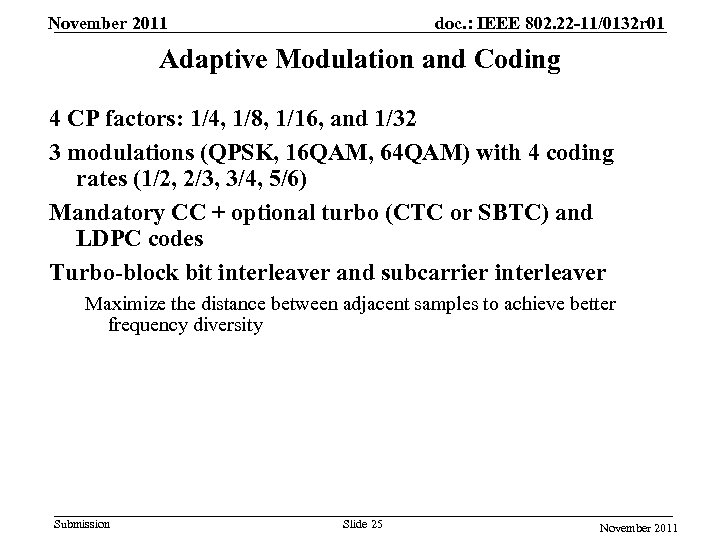
November 2011 doc. : IEEE 802. 22 -11/0132 r 01 Adaptive Modulation and Coding 4 CP factors: 1/4, 1/8, 1/16, and 1/32 3 modulations (QPSK, 16 QAM, 64 QAM) with 4 coding rates (1/2, 2/3, 3/4, 5/6) Mandatory CC + optional turbo (CTC or SBTC) and LDPC codes Turbo-block bit interleaver and subcarrier interleaver Maximize the distance between adjacent samples to achieve better frequency diversity Submission Slide 25 November 2011
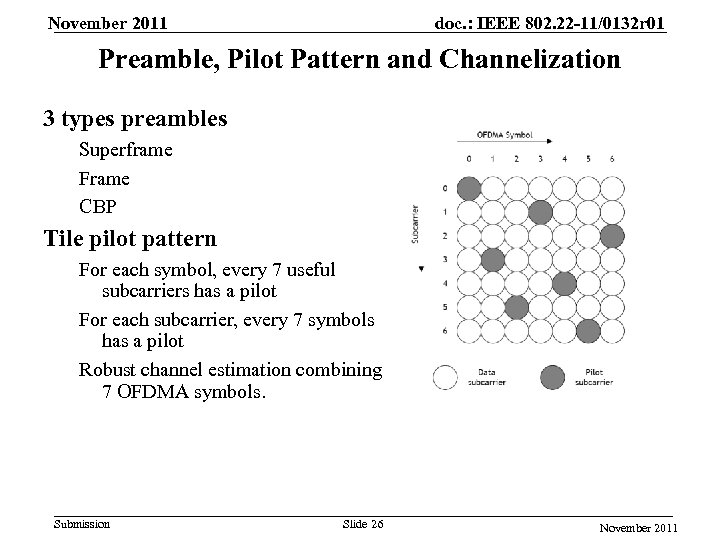
November 2011 doc. : IEEE 802. 22 -11/0132 r 01 Preamble, Pilot Pattern and Channelization 3 types preambles Superframe Frame CBP Tile pilot pattern For each symbol, every 7 useful subcarriers has a pilot For each subcarrier, every 7 symbols has a pilot Robust channel estimation combining 7 OFDMA symbols. Submission Slide 26 November 2011
November 2011 doc. : IEEE 802. 22 -11/0132 r 01 Conclusions - PHY IEEE 802. 22 standard is optimized for VHF/UHF TV channels to provide broadband services with up to 100 km coverage Simple and light specs Robust to large delay spread Robust to Doppler spread Submission Slide 27 November 2011
November 2011 doc. : IEEE 802. 22 -11/0132 r 01 Outline • Digital divide: Today’ s problem and its solution • Television Whitespace (TVWS): A New Hope • Overview of the IEEE 802. 22 -2011 Standard • PHY Characteristics • MAC Characteristics and Cognitive Radio Characteristics • Broadband Extension and Monitoring Use-cases • P 802. 22 b PAR – Broadband Extension and Monitoring Submission Slide 28
November 2011 doc. : IEEE 802. 22 -11/0132 r 01 Abstract This contribution summarizes the MAC and Cognitive Capability (CC) features in the IEEE 802. 22 -2011 Standard. Contributors Submission Slide 29 Nov. 2011
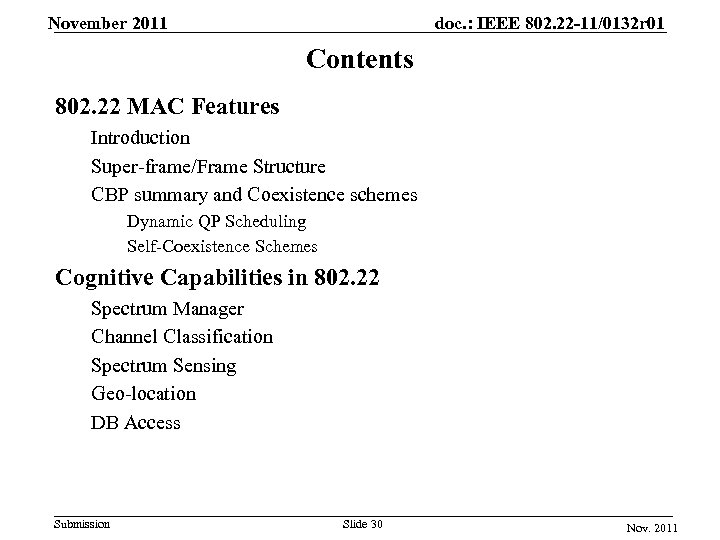
November 2011 doc. : IEEE 802. 22 -11/0132 r 01 Contents 802. 22 MAC Features Introduction Super-frame/Frame Structure CBP summary and Coexistence schemes Dynamic QP Scheduling Self-Coexistence Schemes Cognitive Capabilities in 802. 22 Spectrum Manager Channel Classification Spectrum Sensing Geo-location DB Access Submission Slide 30 Nov. 2011
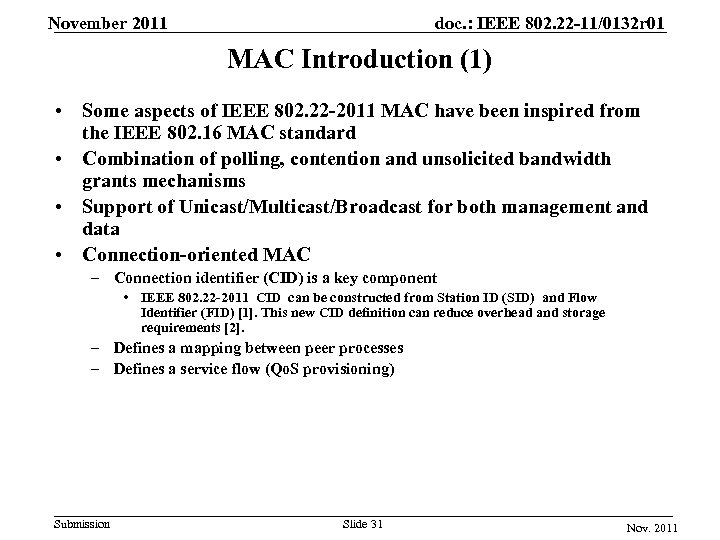
November 2011 doc. : IEEE 802. 22 -11/0132 r 01 MAC Introduction (1) • Some aspects of IEEE 802. 22 -2011 MAC have been inspired from the IEEE 802. 16 MAC standard • Combination of polling, contention and unsolicited bandwidth grants mechanisms • Support of Unicast/Multicast/Broadcast for both management and data • Connection-oriented MAC – Connection identifier (CID) is a key component • IEEE 802. 22 -2011 CID can be constructed from Station ID (SID) and Flow Identifier (FID) [1]. This new CID definition can reduce overhead and storage requirements [2]. – Defines a mapping between peer processes – Defines a service flow (Qo. S provisioning) Submission Slide 31 Nov. 2011
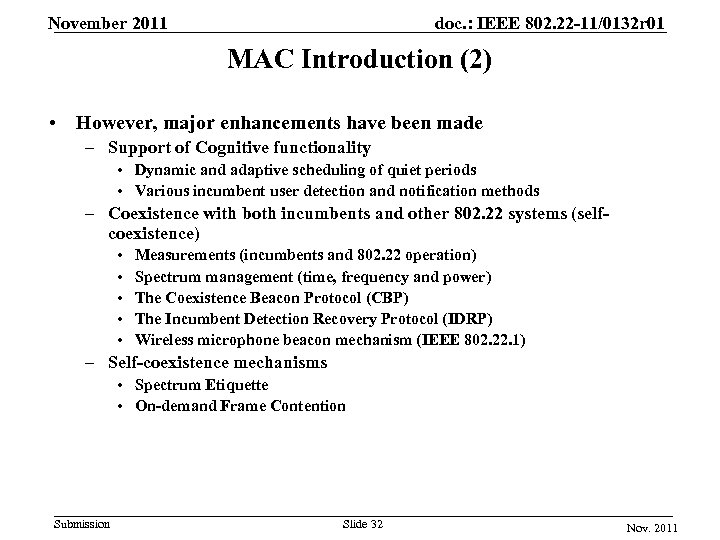
November 2011 doc. : IEEE 802. 22 -11/0132 r 01 MAC Introduction (2) • However, major enhancements have been made – Support of Cognitive functionality • Dynamic and adaptive scheduling of quiet periods • Various incumbent user detection and notification methods – Coexistence with both incumbents and other 802. 22 systems (selfcoexistence) • • • Measurements (incumbents and 802. 22 operation) Spectrum management (time, frequency and power) The Coexistence Beacon Protocol (CBP) The Incumbent Detection Recovery Protocol (IDRP) Wireless microphone beacon mechanism (IEEE 802. 22. 1) – Self-coexistence mechanisms • Spectrum Etiquette • On-demand Frame Contention Submission Slide 32 Nov. 2011
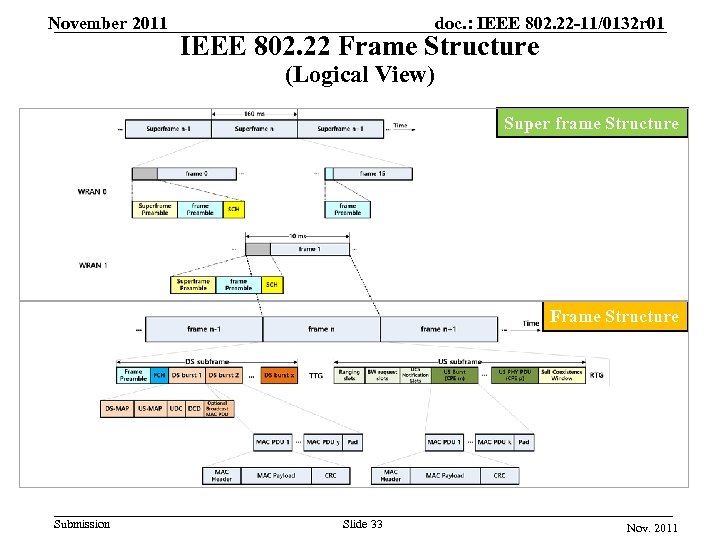
November 2011 doc. : IEEE 802. 22 -11/0132 r 01 IEEE 802. 22 Frame Structure (Logical View) Super frame Structure Frame Structure Submission Slide 33 Nov. 2011
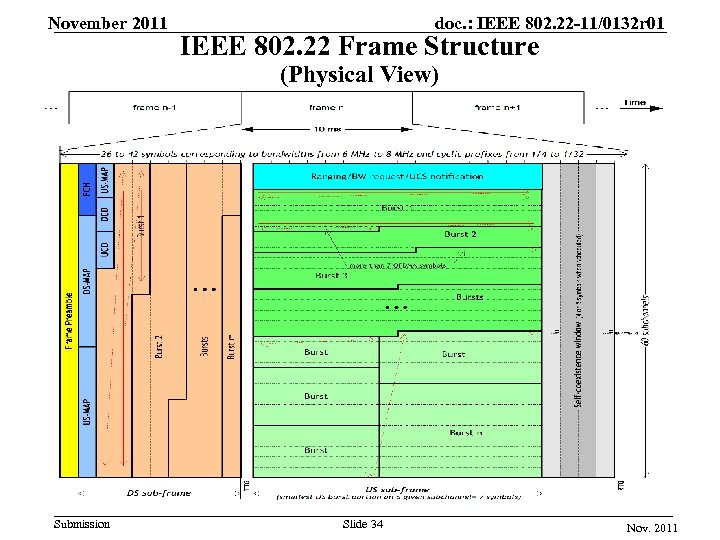
November 2011 doc. : IEEE 802. 22 -11/0132 r 01 IEEE 802. 22 Frame Structure (Physical View) Submission Slide 34 Nov. 2011
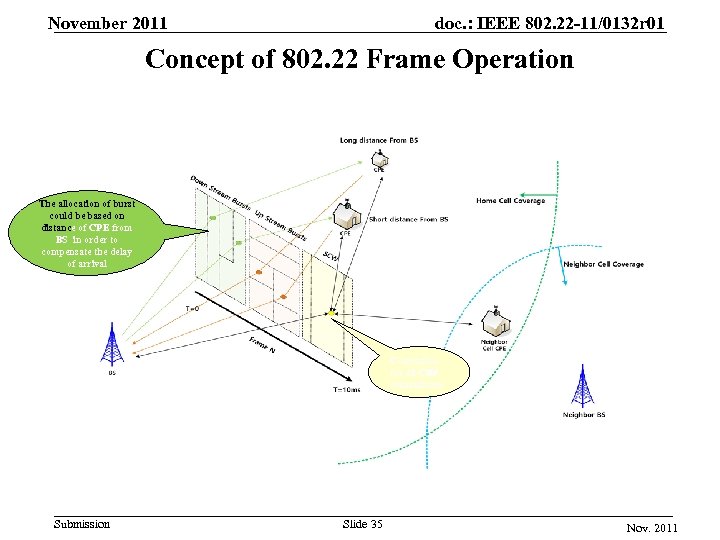
November 2011 doc. : IEEE 802. 22 -11/0132 r 01 Concept of 802. 22 Frame Operation The allocation of burst could be based on distance of CPE from BS in order to compensate the delay of arrival Contention for all CBP transmitters Submission Slide 35 Nov. 2011
November 2011 doc. : IEEE 802. 22 -11/0132 r 01 SCH and CBP Features • The Super-frame Control Header (SCH) – Provides the control information for a WRAN cell – Support the intra-frame and inter-frame quiet periods management mechanisms for sensing – Support coexistence with incumbents and other WRAN cells (self coexistence) • An SCH can include various CBP (Coexistence Beacon Protocol) IEs – – • • Backup channel information IE Frame Contention information IE Terrestrial Geo-location information IE Signature IE, Certificate IEs (CBP frame security) Using SCH, WRAN BS can intelligently manage the operation of its associated CPEs Also, using CBP (Extended version of SCH), WRAN BS can intelligently manage the operation of neighboring WRAN cell under co-existence situation Submission Slide 36 Nov. 2011
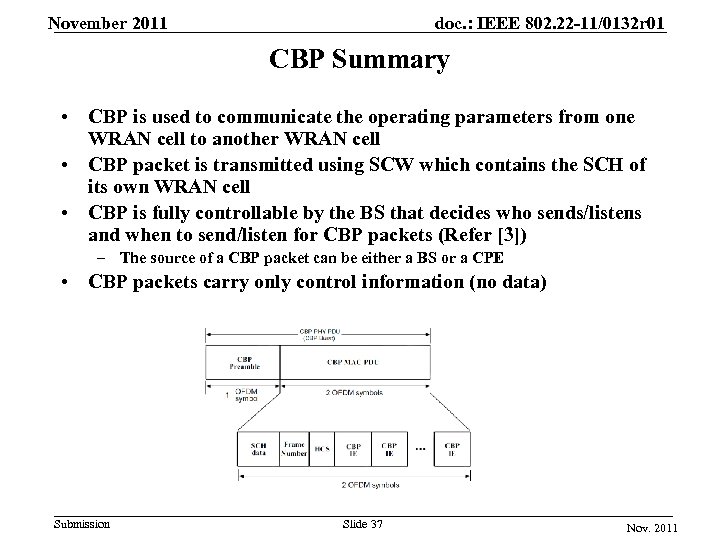
November 2011 doc. : IEEE 802. 22 -11/0132 r 01 CBP Summary • CBP is used to communicate the operating parameters from one WRAN cell to another WRAN cell • CBP packet is transmitted using SCW which contains the SCH of its own WRAN cell • CBP is fully controllable by the BS that decides who sends/listens and when to send/listen for CBP packets (Refer [3]) – The source of a CBP packet can be either a BS or a CPE • CBP packets carry only control information (no data) Structure of a CBP packet Submission Slide 37 Nov. 2011
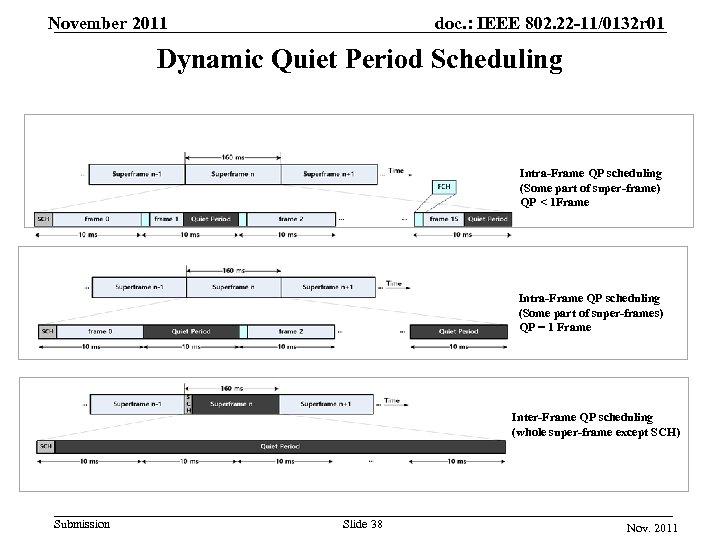
November 2011 doc. : IEEE 802. 22 -11/0132 r 01 Dynamic Quiet Period Scheduling Intra-Frame QP scheduling (Some part of super-frame) QP < 1 Frame Intra-Frame QP scheduling (Some part of super-frames) QP = 1 Frame Inter-Frame QP scheduling (whole super-frame except SCH) Submission Slide 38 Nov. 2011
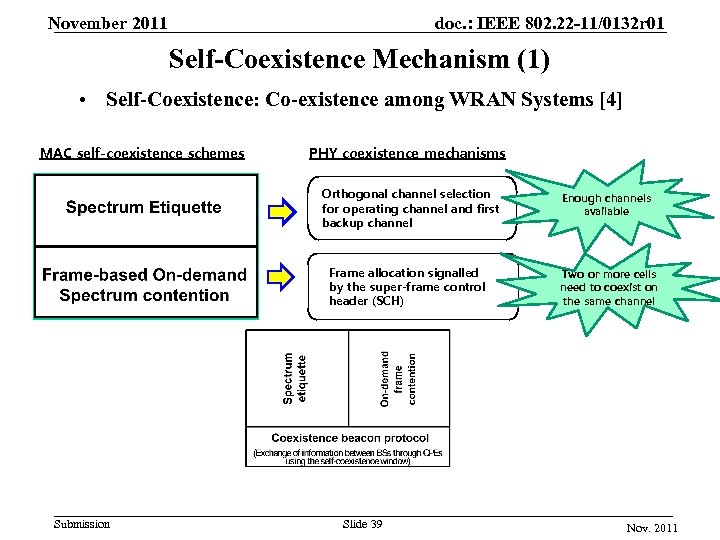
November 2011 doc. : IEEE 802. 22 -11/0132 r 01 Self-Coexistence Mechanism (1) • Self-Coexistence: Co-existence among WRAN Systems [4] MAC self-coexistence schemes PHY coexistence mechanisms Orthogonal channel selection for operating channel and first backup channel Frame allocation signalled by the super-frame control header (SCH) Submission Slide 39 Enough channels available Two or more cells need to coexist on the same channel Nov. 2011
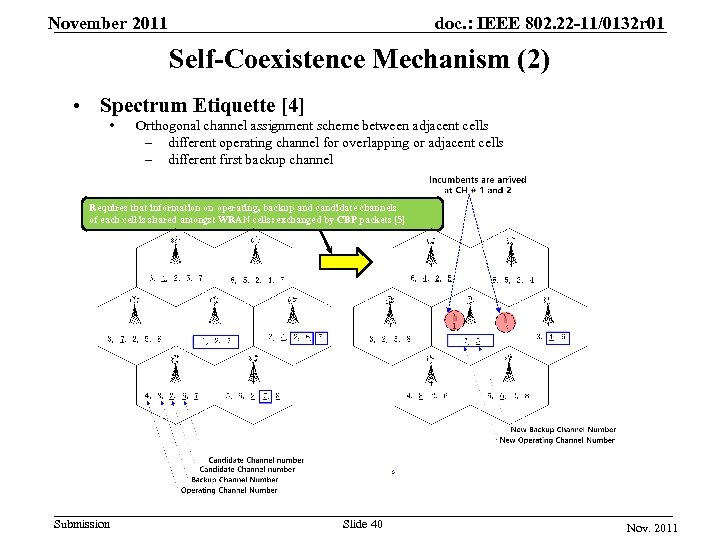
November 2011 doc. : IEEE 802. 22 -11/0132 r 01 Self-Coexistence Mechanism (2) • Spectrum Etiquette [4] • Orthogonal channel assignment scheme between adjacent cells – different operating channel for overlapping or adjacent cells – different first backup channel Requires that information on operating, backup and candidate channels of each cell is shared amongst WRAN cells: exchanged by CBP packets [5] Submission Slide 40 Nov. 2011
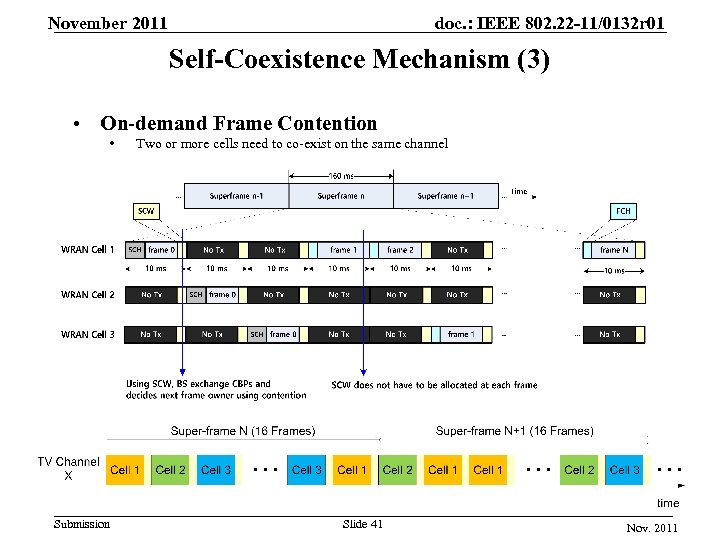
November 2011 doc. : IEEE 802. 22 -11/0132 r 01 Self-Coexistence Mechanism (3) • On-demand Frame Contention • Submission Two or more cells need to co-exist on the same channel Slide 41 Nov. 2011
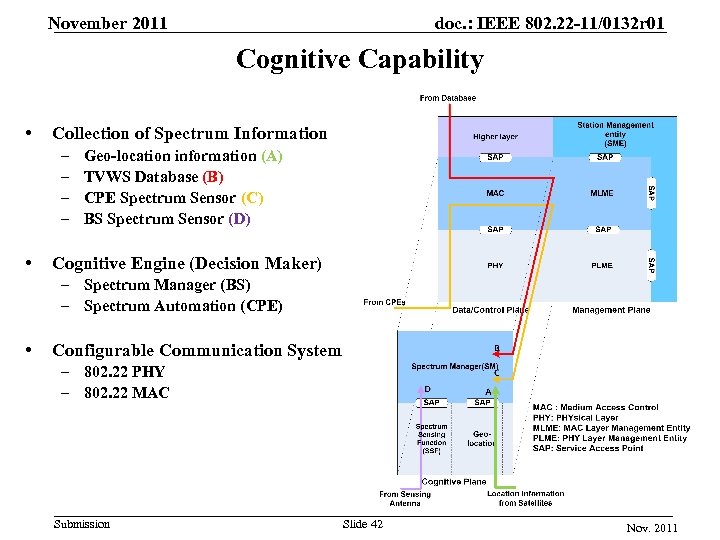
November 2011 doc. : IEEE 802. 22 -11/0132 r 01 Cognitive Capability • Collection of Spectrum Information – – • Geo-location information (A) TVWS Database (B) CPE Spectrum Sensor (C) BS Spectrum Sensor (D) Cognitive Engine (Decision Maker) – Spectrum Manager (BS) – Spectrum Automation (CPE) • Configurable Communication System – 802. 22 PHY – 802. 22 MAC Submission Slide 42 Nov. 2011
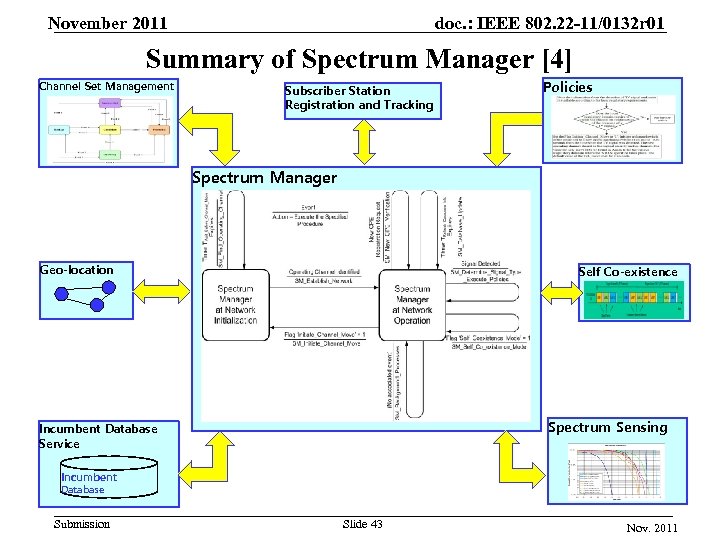
November 2011 doc. : IEEE 802. 22 -11/0132 r 01 Summary of Spectrum Manager [4] Channel Set Management Subscriber Station Registration and Tracking Policies Spectrum Manager Geo-location Self Co-existence Spectrum Sensing Incumbent Database Service Incumbent Database Submission Slide 43 Nov. 2011
![November 2011 doc. : IEEE 802. 22 -11/0132 r 01 SM Channel Classification [5]](https://present5.com/presentation/78b3dc6f9b2bfabfcd81f2d58250e4f2/image-44.jpg "November 2011 doc. : IEEE 802. 22 -11/0132 r 01 SM Channel Classification [5]")
November 2011 doc. : IEEE 802. 22 -11/0132 r 01 SM Channel Classification [5] Two step channel decision External to IEEE 802. 22 System Internal to IEEE 802. 22 System Submission Slide 44 Nov. 2011
![November 2011 doc. : IEEE 802. 22 -11/0132 r 01 Spectrum Sensing [6] •](https://present5.com/presentation/78b3dc6f9b2bfabfcd81f2d58250e4f2/image-45.jpg "November 2011 doc. : IEEE 802. 22 -11/0132 r 01 Spectrum Sensing [6] •")
November 2011 doc. : IEEE 802. 22 -11/0132 r 01 Spectrum Sensing [6] • • IEEE 802. 22 supports spectrum sensing capability by using SSA and SSF Spectrum Sensing Automation (SSA, sensing manager) – All the IEEE 802. 22 devices (BS and CPEs) shall also have an entity called the Spectrum Sensing Automaton (SSA). The SSA interfaces to the Spectrum Sensing Function (SSF) and executes the commands from the SM to enable spectrum sensing • Spectrum Sensing Function (SSF, sensor) – Spectrum sensing is the process of observing the RF spectrum of a television channel to determine its occupancy (by either incumbents or other WRANs). – The base station and all CPEs shall implement the Spectrum Sensing Function (SSF) – The SSF shall be driven by the SSA. The SSF shall observe the RF spectrum of a television channel and shall report the results of that observation to the SM (at the BS) via its associated SSA Submission Slide 45 Nov. 2011
![November 2011 doc. : IEEE 802. 22 -11/0132 r 01 Spectrum Sensing [6] Spectrum](https://present5.com/presentation/78b3dc6f9b2bfabfcd81f2d58250e4f2/image-46.jpg "November 2011 doc. : IEEE 802. 22 -11/0132 r 01 Spectrum Sensing [6] Spectrum")
November 2011 doc. : IEEE 802. 22 -11/0132 r 01 Spectrum Sensing [6] Spectrum Sensing Automation state machine Submission Input/Output of the Spectrum Sensing Function Slide 46 Nov. 2011
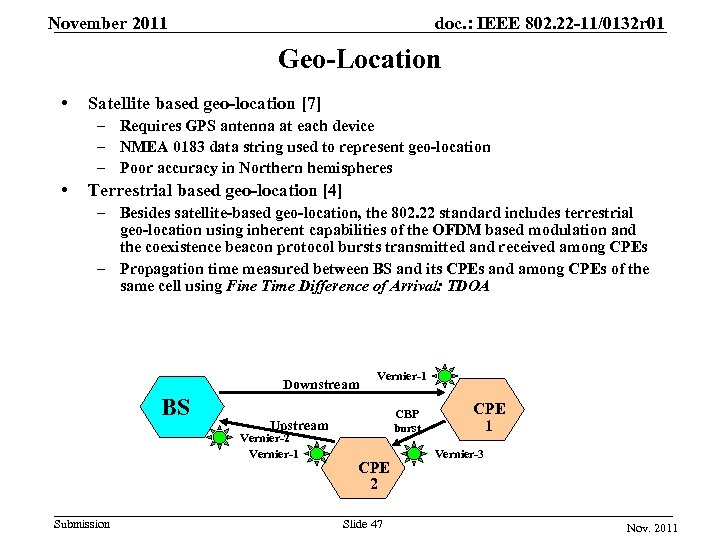
November 2011 doc. : IEEE 802. 22 -11/0132 r 01 Geo-Location • Satellite based geo-location [7] – Requires GPS antenna at each device – NMEA 0183 data string used to represent geo-location – Poor accuracy in Northern hemispheres • Terrestrial based geo-location [4] – Besides satellite-based geo-location, the 802. 22 standard includes terrestrial geo-location using inherent capabilities of the OFDM based modulation and the coexistence beacon protocol bursts transmitted and received among CPEs – Propagation time measured between BS and its CPEs and among CPEs of the same cell using Fine Time Difference of Arrival: TDOA Downstream BS CBP burst Upstream Vernier-2 Vernier-1 Submission Vernier-1 CPE 2 Slide 47 CPE 1 Vernier-3 Nov. 2011
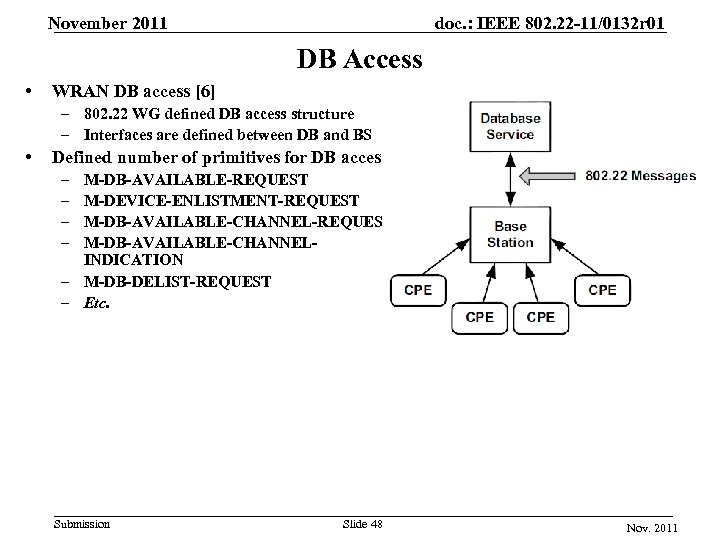
November 2011 doc. : IEEE 802. 22 -11/0132 r 01 DB Access • WRAN DB access [6] – 802. 22 WG defined DB access structure – Interfaces are defined between DB and BS • Defined number of primitives for DB access – – M-DB-AVAILABLE-REQUEST M-DEVICE-ENLISTMENT-REQUEST M-DB-AVAILABLE-CHANNELINDICATION – M-DB-DELIST-REQUEST – Etc. Structure of the IEEE 802. 22 WRAN access to the database service Submission Slide 48 Nov. 2011
November 2011 doc. : IEEE 802. 22 -11/0132 r 01 Outline • Digital divide: Today’ s problem and its solution • Television Whitespace (TVWS): A New Hope • Overview of the IEEE 802. 22 -2011 Standard • PHY Characteristics • MAC Characteristics and Cognitive Radio Characteristics • Broadband Extension and Monitoring Use-cases • P 802. 22 b PAR – Broadband Extension and Monitoring Submission Slide 49
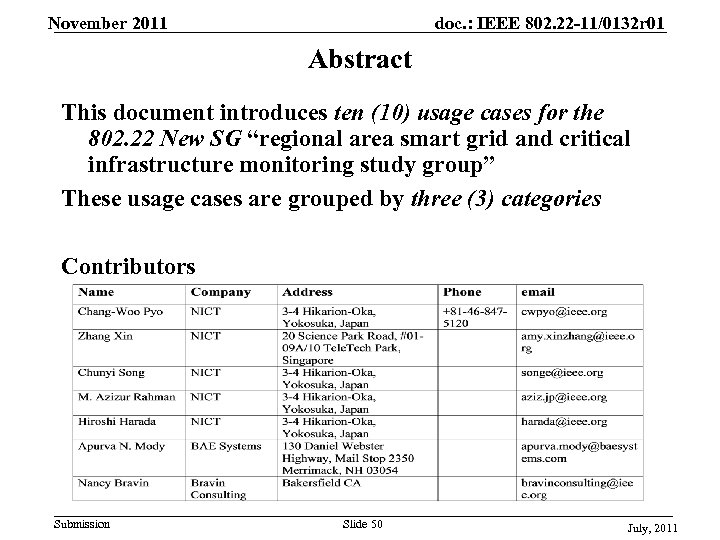
November 2011 doc. : IEEE 802. 22 -11/0132 r 01 Abstract This document introduces ten (10) usage cases for the 802. 22 New SG “regional area smart grid and critical infrastructure monitoring study group” These usage cases are grouped by three (3) categories Contributors Submission Slide 50 July, 2011
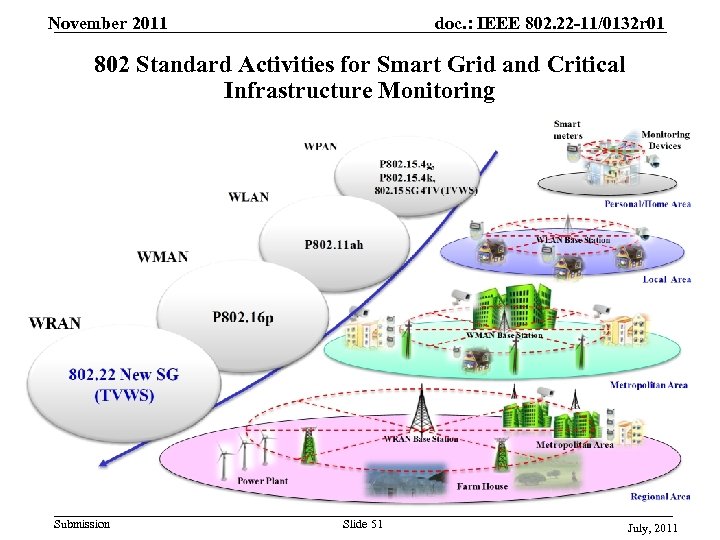
November 2011 doc. : IEEE 802. 22 -11/0132 r 01 802 Standard Activities for Smart Grid and Critical Infrastructure Monitoring Submission Slide 51 July, 2011
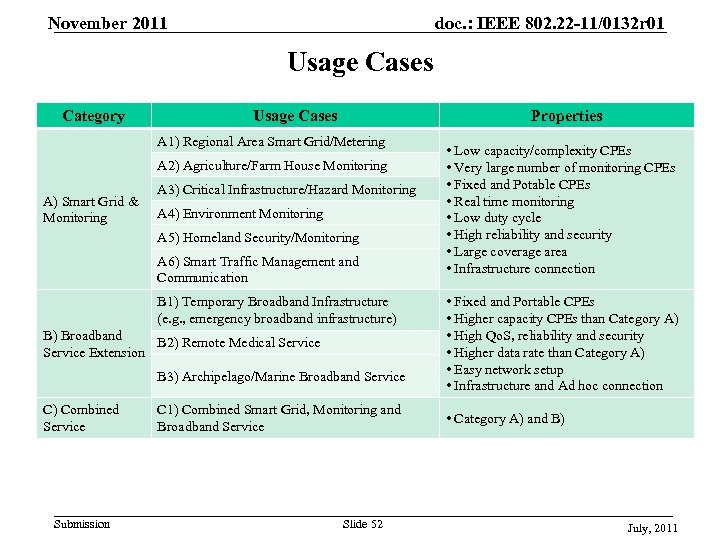
November 2011 doc. : IEEE 802. 22 -11/0132 r 01 Usage Cases Category Usage Cases Properties A 1) Regional Area Smart Grid/Metering A 2) Agriculture/Farm House Monitoring A) Smart Grid & Monitoring A 3) Critical Infrastructure/Hazard Monitoring A 4) Environment Monitoring A 5) Homeland Security/Monitoring A 6) Smart Traffic Management and Communication B 1) Temporary Broadband Infrastructure (e. g. , emergency broadband infrastructure) B) Broadband B 2) Remote Medical Service Extension B 3) Archipelago/Marine Broadband Service C) Combined Service Submission C 1) Combined Smart Grid, Monitoring and Broadband Service Slide 52 • Low capacity/complexity CPEs • Very large number of monitoring CPEs • Fixed and Potable CPEs • Real time monitoring • Low duty cycle • High reliability and security • Large coverage area • Infrastructure connection • Fixed and Portable CPEs • Higher capacity CPEs than Category A) • High Qo. S, reliability and security • Higher data rate than Category A) • Easy network setup • Infrastructure and Ad hoc connection • Category A) and B) July, 2011
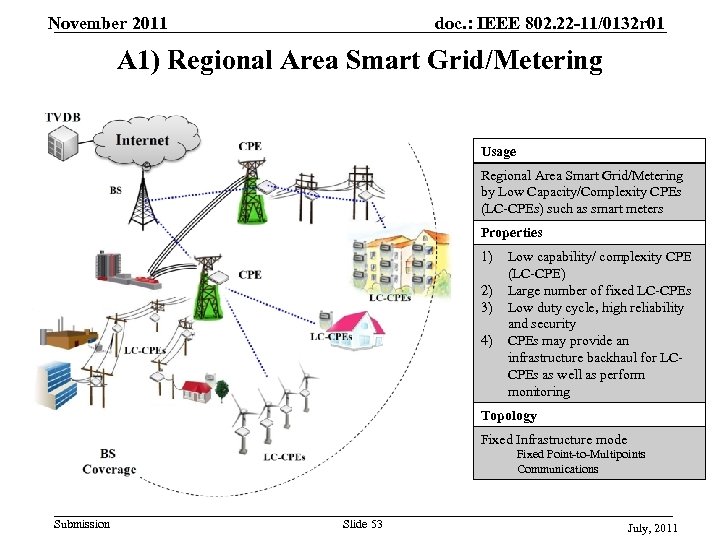
November 2011 doc. : IEEE 802. 22 -11/0132 r 01 A 1) Regional Area Smart Grid/Metering Usage Regional Area Smart Grid/Metering by Low Capacity/Complexity CPEs (LC-CPEs) such as smart meters Properties 1) 2) 3) 4) Low capability/ complexity CPE (LC-CPE) Large number of fixed LC-CPEs Low duty cycle, high reliability and security CPEs may provide an infrastructure backhaul for LCCPEs as well as perform monitoring Topology Fixed Infrastructure mode Fixed Point-to-Multipoints Communications TVDB (TV Database) Submission Slide 53 July, 2011
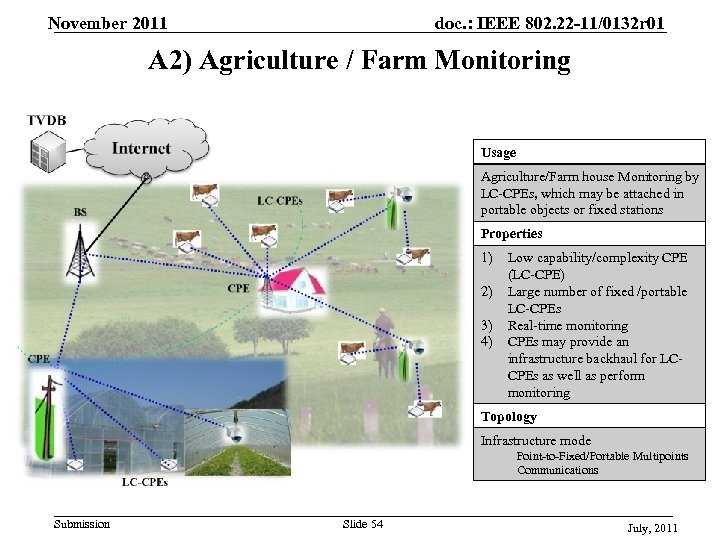
November 2011 doc. : IEEE 802. 22 -11/0132 r 01 A 2) Agriculture / Farm Monitoring CPE Usage Agriculture/Farm house Monitoring by LC-CPEs, which may be attached in portable objects or fixed stations Properties 1) 2) 3) 4) Low capability/complexity CPE (LC-CPE) Large number of fixed /portable LC-CPEs Real-time monitoring CPEs may provide an infrastructure backhaul for LCCPEs as well as perform monitoring Topology Infrastructure mode Point-to-Fixed/Portable Multipoints Communications TVDB (TV Database) Submission Slide 54 July, 2011
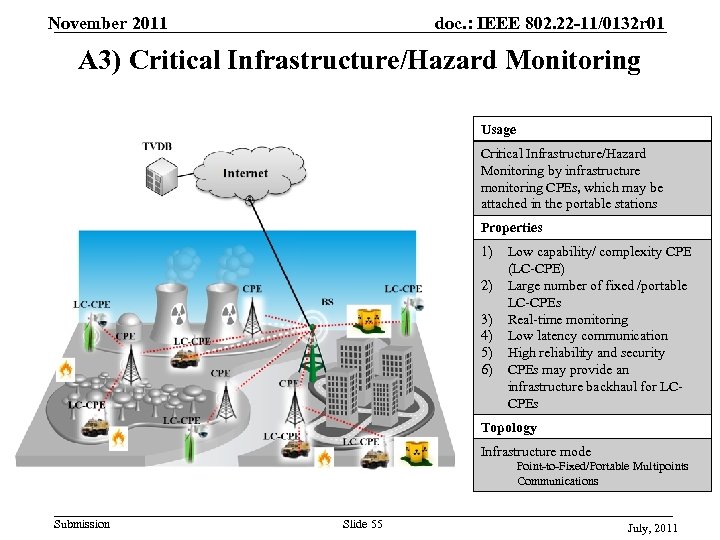
November 2011 doc. : IEEE 802. 22 -11/0132 r 01 A 3) Critical Infrastructure/Hazard Monitoring Usage Critical Infrastructure/Hazard Monitoring by infrastructure monitoring CPEs, which may be attached in the portable stations Properties 1) 2) 3) 4) 5) 6) Low capability/ complexity CPE (LC-CPE) Large number of fixed /portable LC-CPEs Real-time monitoring Low latency communication High reliability and security CPEs may provide an infrastructure backhaul for LCCPEs Topology Infrastructure mode Point-to-Fixed/Portable Multipoints Communications TVDB (TV Database) Submission Slide 55 July, 2011
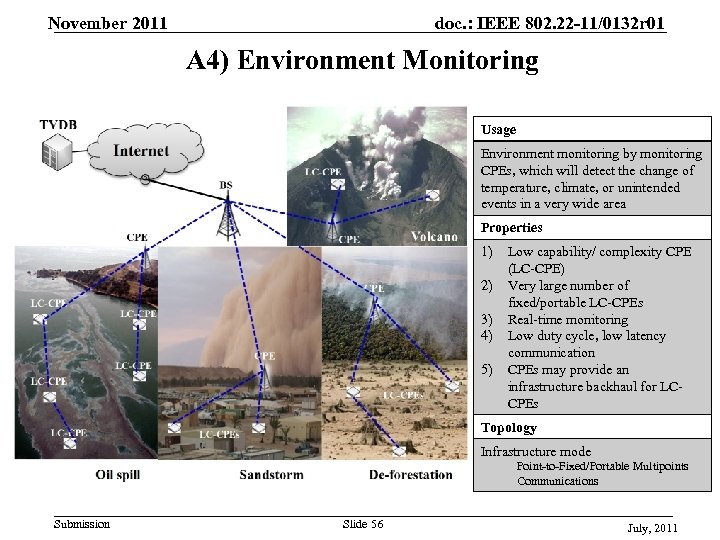
November 2011 doc. : IEEE 802. 22 -11/0132 r 01 A 4) Environment Monitoring Usage Environment monitoring by monitoring CPEs, which will detect the change of temperature, climate, or unintended events in a very wide area Properties 1) 2) 3) 4) 5) Low capability/ complexity CPE (LC-CPE) Very large number of fixed/portable LC-CPEs Real-time monitoring Low duty cycle, low latency communication CPEs may provide an infrastructure backhaul for LCCPEs Topology Infrastructure mode Point-to-Fixed/Portable Multipoints Communications TVDB (TV Database) Submission Slide 56 July, 2011
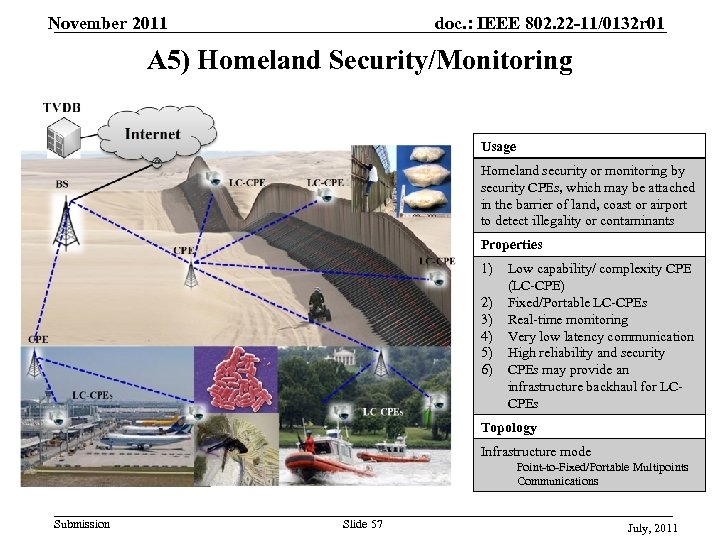
November 2011 doc. : IEEE 802. 22 -11/0132 r 01 A 5) Homeland Security/Monitoring Usage Homeland security or monitoring by security CPEs, which may be attached in the barrier of land, coast or airport to detect illegality or contaminants Properties 1) 2) 3) 4) 5) 6) Low capability/ complexity CPE (LC-CPE) Fixed/Portable LC-CPEs Real-time monitoring Very low latency communication High reliability and security CPEs may provide an infrastructure backhaul for LCCPEs Topology Infrastructure mode Point-to-Fixed/Portable Multipoints Communications TVDB (TV Database) Submission Slide 57 July, 2011
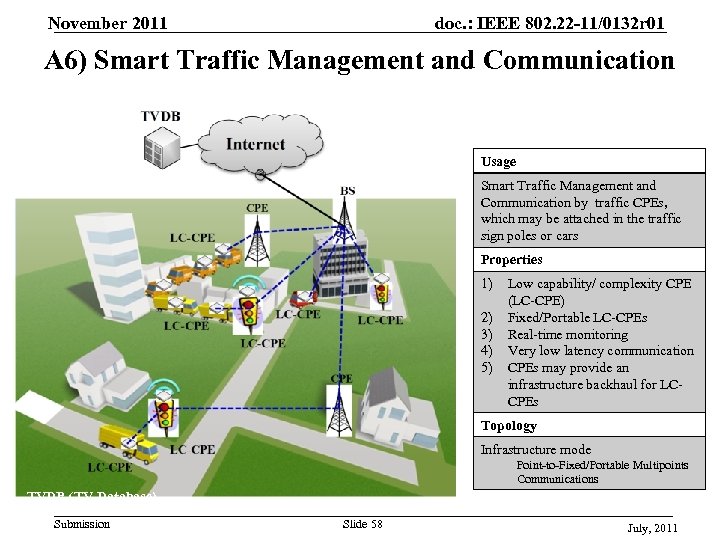
November 2011 doc. : IEEE 802. 22 -11/0132 r 01 A 6) Smart Traffic Management and Communication Usage Smart Traffic Management and Communication by traffic CPEs, which may be attached in the traffic sign poles or cars Properties 1) 2) 3) 4) 5) Low capability/ complexity CPE (LC-CPE) Fixed/Portable LC-CPEs Real-time monitoring Very low latency communication CPEs may provide an infrastructure backhaul for LCCPEs Topology Infrastructure mode Point-to-Fixed/Portable Multipoints Communications TVDB (TV Database) Submission Slide 58 July, 2011
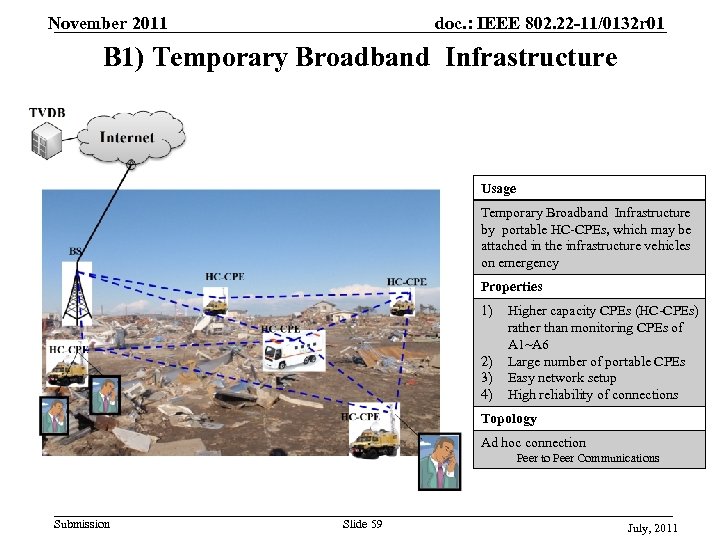
November 2011 doc. : IEEE 802. 22 -11/0132 r 01 B 1) Temporary Broadband Infrastructure Usage Temporary Broadband Infrastructure by portable HC-CPEs, which may be attached in the infrastructure vehicles on emergency Properties 1) 2) 3) 4) Higher capacity CPEs (HC-CPEs) rather than monitoring CPEs of A 1~A 6 Large number of portable CPEs Easy network setup High reliability of connections Topology Ad hoc connection Peer to Peer Communications TVDB (TV Database) Submission Slide 59 July, 2011
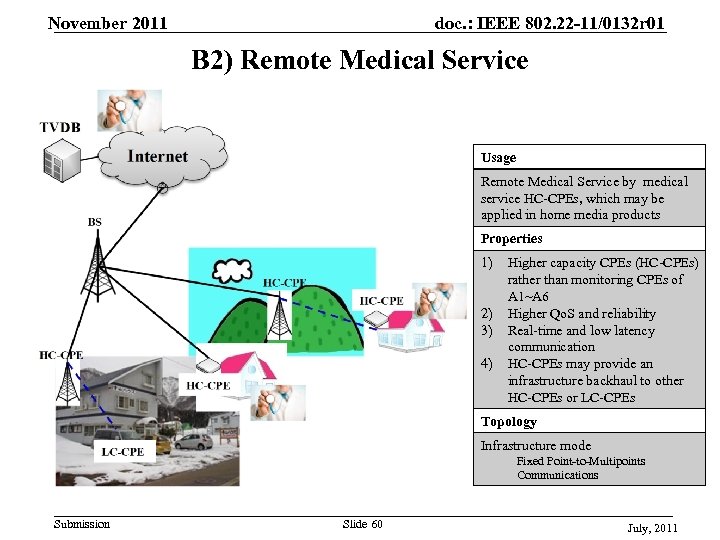
November 2011 doc. : IEEE 802. 22 -11/0132 r 01 B 2) Remote Medical Service Usage Remote Medical Service by medical service HC-CPEs, which may be applied in home media products Properties 1) 2) 3) 4) Higher capacity CPEs (HC-CPEs) rather than monitoring CPEs of A 1~A 6 Higher Qo. S and reliability Real-time and low latency communication HC-CPEs may provide an infrastructure backhaul to other HC-CPEs or LC-CPEs Topology Infrastructure mode Fixed Point-to-Multipoints Communications TVDB (TV Database) Submission Slide 60 July, 2011
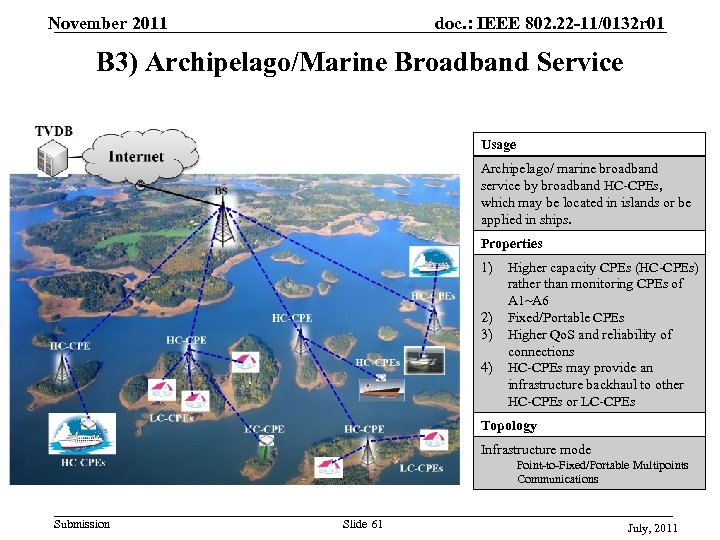
November 2011 doc. : IEEE 802. 22 -11/0132 r 01 B 3) Archipelago/Marine Broadband Service Usage Archipelago/ marine broadband service by broadband HC-CPEs, which may be located in islands or be applied in ships. Properties 1) 2) 3) 4) Higher capacity CPEs (HC-CPEs) rather than monitoring CPEs of A 1~A 6 Fixed/Portable CPEs Higher Qo. S and reliability of connections HC-CPEs may provide an infrastructure backhaul to other HC-CPEs or LC-CPEs Topology Infrastructure mode Point-to-Fixed/Portable Multipoints Communications TVDB (TV Database) Submission Slide 61 July, 2011
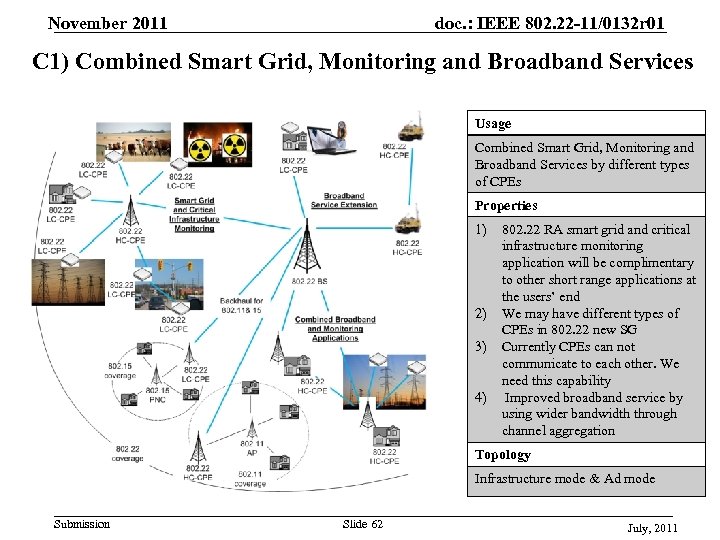
November 2011 doc. : IEEE 802. 22 -11/0132 r 01 C 1) Combined Smart Grid, Monitoring and Broadband Services Usage Combined Smart Grid, Monitoring and Broadband Services by different types of CPEs Properties 1) 2) 3) 4) 802. 22 RA smart grid and critical infrastructure monitoring application will be complimentary to other short range applications at the users’ end We may have different types of CPEs in 802. 22 new SG Currently CPEs can not communicate to each other. We need this capability Improved broadband service by using wider bandwidth through channel aggregation Topology Infrastructure mode & Ad mode Submission Slide 62 July, 2011
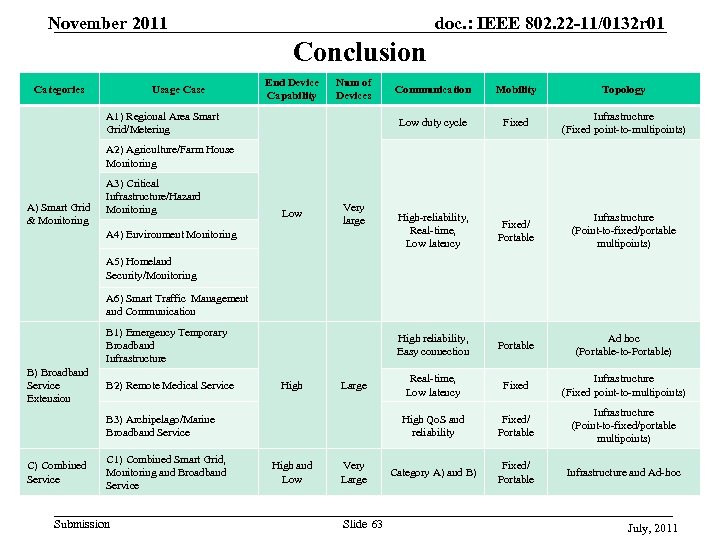
November 2011 doc. : IEEE 802. 22 -11/0132 r 01 Conclusion Categories Usage Case End Device Capability Num of Devices Mobility Topology Low duty cycle Fixed Infrastructure (Fixed point-to-multipoints) High-reliability, Real-time, Low latency Fixed/ Portable Infrastructure (Point-to-fixed/portable multipoints) High reliability, Easy connection Portable Ad hoc (Portable-to-Portable) Real-time, Low latency Fixed Infrastructure (Fixed point-to-multipoints) High Qo. S and reliability A 1) Regional Area Smart Grid/Metering Communication Fixed/ Portable Infrastructure (Point-to-fixed/portable multipoints) Category A) and B) Fixed/ Portable Infrastructure and Ad-hoc A 2) Agriculture/Farm House Monitoring A) Smart Grid & Monitoring A 3) Critical Infrastructure/Hazard Monitoring Low Very large A 4) Environment Monitoring A 5) Homeland Security/Monitoring A 6) Smart Traffic Management and Communication B 1) Emergency Temporary Broadband Infrastructure B) Broadband Service Extension B 2) Remote Medical Service High Large B 3) Archipelago/Marine Broadband Service C) Combined Service C 1) Combined Smart Grid, Monitoring and Broadband Service Submission High and Low Very Large Slide 63 July, 2011
November 2011 doc. : IEEE 802. 22 -11/0132 r 01 Outline • Digital divide: Today’ s problem and its solution • Television Whitespace (TVWS): A New Hope • Overview of the IEEE 802. 22 -2011 Standard • PHY Characteristics • MAC Characteristics and Cognitive Radio Characteristics • Broadband Extension and Monitoring Use-cases • P 802. 22 b PAR – Broadband Extension and Monitoring Submission Slide 64
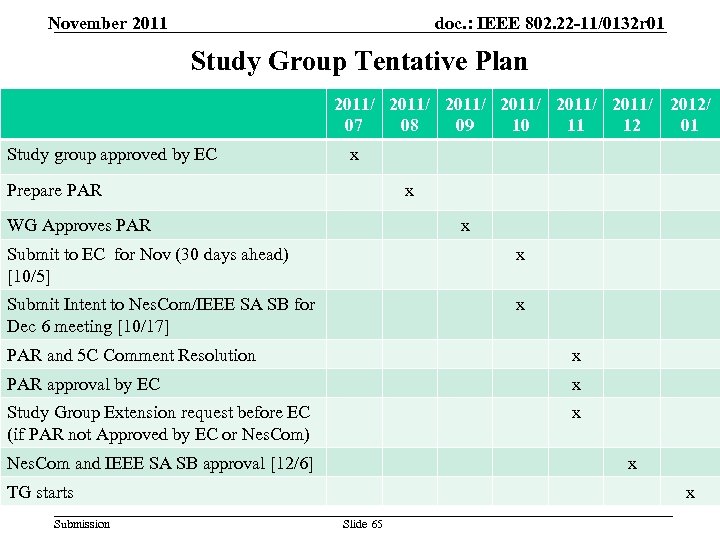
November 2011 doc. : IEEE 802. 22 -11/0132 r 01 Study Group Tentative Plan 2011/ 2011/ 2012/ 07 08 09 10 11 12 01 Study group approved by EC x Prepare PAR x WG Approves PAR x Submit to EC for Nov (30 days ahead) [10/5] x Submit Intent to Nes. Com/IEEE SA SB for Dec 6 meeting [10/17] x PAR and 5 C Comment Resolution x PAR approval by EC x Study Group Extension request before EC (if PAR not Approved by EC or Nes. Com) x Nes. Com and IEEE SA SB approval [12/6] x TG starts Submission x Slide 65
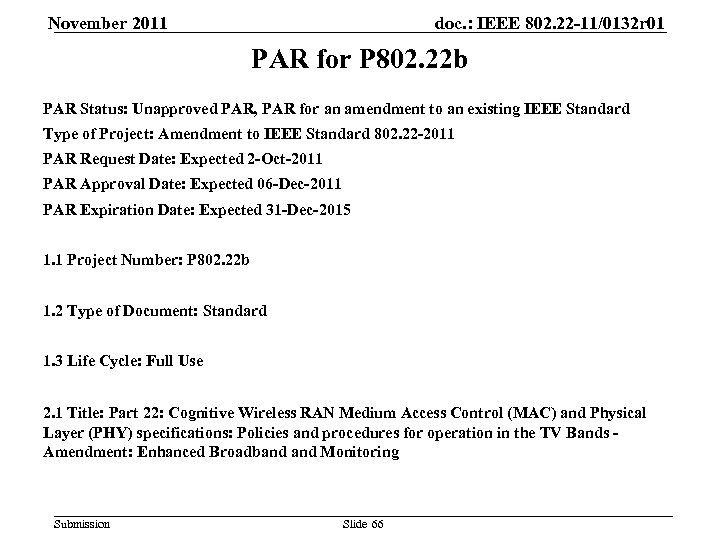
November 2011 doc. : IEEE 802. 22 -11/0132 r 01 PAR for P 802. 22 b PAR Status: Unapproved PAR, PAR for an amendment to an existing IEEE Standard Type of Project: Amendment to IEEE Standard 802. 22 -2011 PAR Request Date: Expected 2 -Oct-2011 PAR Approval Date: Expected 06 -Dec-2011 PAR Expiration Date: Expected 31 -Dec-2015 1. 1 Project Number: P 802. 22 b 1. 2 Type of Document: Standard 1. 3 Life Cycle: Full Use 2. 1 Title: Part 22: Cognitive Wireless RAN Medium Access Control (MAC) and Physical Layer (PHY) specifications: Policies and procedures for operation in the TV Bands - Amendment: Enhanced Broadband Monitoring Submission Slide 66
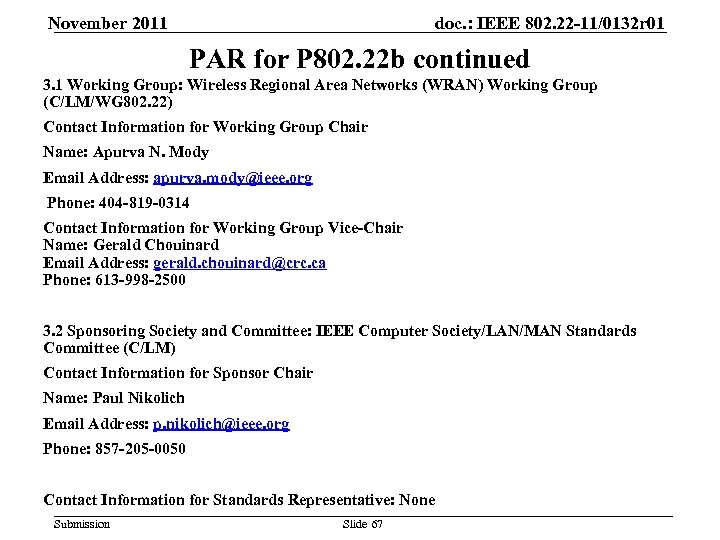
November 2011 doc. : IEEE 802. 22 -11/0132 r 01 PAR for P 802. 22 b continued 3. 1 Working Group: Wireless Regional Area Networks (WRAN) Working Group (C/LM/WG 802. 22) Contact Information for Working Group Chair Name: Apurva N. Mody Email Address: apurva. mody@ieee. org Phone: 404 -819 -0314 Contact Information for Working Group Vice-Chair Name: Gerald Chouinard Email Address: gerald. chouinard@crc. ca Phone: 613 -998 -2500 3. 2 Sponsoring Society and Committee: IEEE Computer Society/LAN/MAN Standards Committee (C/LM) Contact Information for Sponsor Chair Name: Paul Nikolich Email Address: p. nikolich@ieee. org Phone: 857 -205 -0050 Contact Information for Standards Representative: None Submission Slide 67
November 2011 doc. : IEEE 802. 22 -11/0132 r 01 PAR for P 802. 22 b continued 4. 1 Type of Ballot: Individual 4. 2 Expected Date of submission of draft to the IEEE-SA for Initial Sponsor Ballot: 11/2013 4. 3 Projected Completion Date for Submittal to Rev. Com: 06/2014 5. 1 Approximate number of people expected to be actively involved in the development of this project: 40 5. 2 Scope: This standard specifies alternate PHY and necessary MAC amendments to IEEE std. 802. 22 -2011 for operation in VHF/UHF TV broadcast bands between 54 MHz and 862 MHz to support enhanced broadband services and monitoring applications. The standard supports aggregate data rates greater than the maximum data rate supported by the IEEE std. 802. 22 -2011. This standard defines new classes of 802. 22 devices to address these applications and supports more than 512 devices. This standard also specifies techniques to enhance communications among the devices and makes necessary amendments to the cognitive, security & parameters and connection management clauses. Submission Slide 68
November 2011 doc. : IEEE 802. 22 -11/0132 r 01 PAR for P 802. 22 b continued 5. 3 Is the completion of this standard dependent upon the completion of another standard: No 5. 4 Purpose: This document will not have a purpose clause. 5. 5 Need for the Project: There are various broadband services and monitoring applications in the context of wireless regional area networks where communications can be better served by introducing new classes of 802. 22 devices with capabilities appropriate for such applications. In addition, extending regional area broadband services to applications such as real-time and/or near real-time monitoring, emergency broadband services, remote medical services etc, requires higher data rates and greater number of devices. Enhanced technologies become necessary to enable communications among devices to support those applications. None of the features mentioned above can be supported by the IEEE std. 802. 22 -2011 and hence, a new project is required for amendment. 5. 6 Stakeholders for the Standard: The stakeholders include: Manufacturers and users of IEEE Std. 802. 22 -2011 devices and other operating entities to which the standard may need to interface. Submission Slide 69
November 2011 doc. : IEEE 802. 22 -11/0132 r 01 PAR for P 802. 22 b continued 6. 1. a Is the Sponsor aware of any copyright permissions needed for this project? : No 6. 1. b Is the Sponsor aware of possible registration activity related to this project? : No 7. 1 Are there other standards or projects with a similar scope? : No. 7. 2 Joint Development: No. 8. 1 Additional Explanatory Notes: (note for 5. 2 Scope) This amendment supports mechanisms to enable coexistence with other 802 systems in the same band. Submission Slide 70
November 2011 doc. : IEEE 802. 22 -11/0132 r 01 5 Criteria for P 802. 22 b 1. Broad Market Potential a) Broad sets of applicability The proposed amendment will enable a number of new broadband applications in television white spaces (TVWS) in the context of wireless regional area networks by combining broadband services and monitoring applications. b) Multiple vendors and numerous users It is expected that this amendment will be applicable in all markets where the 802. 22 technology will be used. The new features of the amendment are expected to bring new equipment vendors. c) Balanced costs (LAN versus attached stations) It is expected that the new features of the amendment can be implemented with reasonable cost resulting in overall better value for money. Submission Slide 71
November 2011 doc. : IEEE 802. 22 -11/0132 r 01 5 Criteria for P 802. 22 b (Continued) 2. Compatibility The amendment will be compatible with IEEE 802 family of standards, specifically 802 overview and architecture, 802. 1 including 802. 1 D and 802. 1 Q. Submission Slide 72
November 2011 doc. : IEEE 802. 22 -11/0132 r 01 5 Criteria for P 802. 22 b (Continued) 3. Distinct Identity a) Substantially different from other IEEE 802 standards There is no other IEEE 802 standard or project, for combined broadband services and monitoring applications aimed at wireless regional area networks using television white space bands. b) One unique solution per problem (not two solutions to a problem) Combined broadband services and monitoring applications for wireless regional area networks by using television white space bands are not currently considered by any other wireless standard or project. Hence, this is the only solution to this problem. c) Easy for the document reader to select the relevant specification Yes, since the proposed standard will produce an amendment to the IEEE std. 802. 22 -2011. Submission Slide 73
November 2011 doc. : IEEE 802. 22 -11/0132 r 01 5 Criteria for P 802. 22 b (Continued) 4. Technical Feasibility a) Demonstrated system feasibility There a number of examples of successful prototype operation in TVWS by complying with requirements of various regulatory organizations (e. g. , Federal Communications Commission (FCC), USA, Infocomm Development Authority (IDA), Singapore, etc. ). b) Proven technology, reasonable testing Experimental licenses have been issued for operation in TVWS in many countries (e. g. Federal Communications Commission (FCC), USA, Infocomm Development Authority (IDA), Singapore etc). Communications over TVWS are being tested by regulatory organizations in those countries. c) Confidence in reliability Results of TVWS test trial campaigns being carried out by various regulatory organizations provide confidence in the reliability of the proposed project. d) Coexistence of 802 wireless standards specifying devices for unlicensed operation This amendment supports mechanisms to enable coexistence with other 802 systems in the same band. A coexistence assurance document will be produced by the WG as a part of the WG balloting process. Submission Slide 74
November 2011 doc. : IEEE 802. 22 -11/0132 r 01 5 Criteria for P 802. 22 b (Continued) 5. Economic Feasibility a) Known cost factors, reliable data The amendment uses technologies that are well-proven in the market in a cost effective manner. b) Reasonable cost for performance The IEEE 802. 22 systems are designed for operation in rural areas where the population density is likely to be low. However, an IEEE 802. 22 base station (BS) covers a large area typically with 30 km radius implying a reasonable cost per geographical unit of coverage. The CPEs are expected to be inexpensive and hence cost for overall network performance would be reasonable. c) Consideration of installation costs This amendment will be later combined to the base 802. 22 standard resulting in an updated version of IEEE std. 802. 22 -2011. Installation costs will be those of the updated base standard and are expected to be reasonable. Submission Slide 75
November 2011 doc. : IEEE 802. 22 -11/0132 r 01 Conclusions • IEEE 802. 22 standard is optimized for VHF/UHF TV channels to provide broadband services • There is no other IEEE 802 standard or project, for combined broadband services and monitoring applications aimed at wireless regional area networks using television white space bands. • There is no other IEEE 802 Standard that is specifically designed for rural remote area broadband access. • There are various broadband services and monitoring applications in the context of wireless regional area networks where communications can be better served by introducing new classes of 802. 22 devices with capabilities appropriate for such applications. • In addition, extending regional area broadband services to applications such as realtime and/or near real-time monitoring, emergency broadband services, remote medical services etc, requires higher data rates and greater number of devices. • Enhanced technologies become necessary to enable communications among devices to support those applications. None of the features mentioned above can be supported by the IEEE std. 802. 22 -2011 • Hence, a new P 802. 22 b Amendment project is required. Submission Slide 76 November 2011
November 2011 doc. : IEEE 802. 22 -11/0132 r 01 References • IEEE 802. 22 Working Group Website – www. ieee 802. org/22 • IEEE 802. 22 -2011 TM Standard • Apurva Mody, Gerald Chouinard, “Overview of the IEEE 802. 22 Standard on Wireless Regional Area Networks (WRAN) and Core Technologies” http: //www. ieee 802. org/22/Technology/22 -10 -0073 -03 -0000 -802 -22 -overviewand-core-technologies. pdf • 22 -10 -0054 -02 -0000_OFDM-based Terrestrial Geolocation. ppt • 22 -10 -0055 -0000 Multicarrier ranging. ppt • 22 -06 -0206 -00 -0000 Ranging with OFDM Systems. ppt • 22 -11 -0022 -00 -0000 Best Static Tone Locations. ppt Submission Slide 77 Gerald Chouinard, CRC
![November 2011 doc. : IEEE 802. 22 -11/0132 r 01 References [1] “Additional text](https://present5.com/presentation/78b3dc6f9b2bfabfcd81f2d58250e4f2/image-78.jpg "November 2011 doc. : IEEE 802. 22 -11/0132 r 01 References [1] “Additional text")
November 2011 doc. : IEEE 802. 22 -11/0132 r 01 References [1] “Additional text to implement new connection identifier management approach”, 2210 -0137 -02 -0000, Aug. 2010. [2] “New connection identifier approach”, 22 -09 -0112 -05 -0000, Jul. 2010. [3] “Overview of CBP”, 22 -07 -0136 -00 -0000, Apr. 2007. [4] “ 802. 22 Coexistence Aspects ”, 22 -10 -0121 -02 -0000, Sep. 2010. [5] “Channel Management in IEEE 802. 22 WRAN Systems”, IEEE Communication Magazine, vol. 48, No. 9, Sep. 2010. [6] “IEEE P 802. 22 -2011: Standard for Wireless Regional Area Networks Part 22: Cognitive Wireless RAN Medium Access Control (MAC) and Physical Layer (PHY) specifications: Policies and procedures for operation in the TV Bands”, Jul. 2011. [7] “IEEE 802. 22 Wireless Regional Area Networks”, 22 -10 -0073 -03 -0000, Jun. 2010. Submission Gwangzeen Ko, ETRI Nov. 2011
November 2011 doc. : IEEE 802. 22 -11/0132 r 01 Reference 802 -22 -11 -118 r 1 79 Submission
Скачать презентацию November 2011 doc IEEE 802 22 -11 0132
78b3dc6f9b2bfabfcd81f2d58250e4f2.ppt