 Скачать презентацию November 2008 doc IEEE 802 11 -08 1358
293324501acb7500da8881ec0c6fc686.ppt
- Количество слайдов: 21



November 2008 doc. : IEEE 802. 11 -08/1358 r 0 Fast Handover Support for Highly Mobile Users using COTS 802. 11 Cards Date: 2008 -11 -11 Authors: Submission Slide 1 Marc Emmelmann et al. , TU Berlin
November 2008 doc. : IEEE 802. 11 -08/1358 r 0 Abstract The presented Fast Handover Protocol enables seamless handover for highly mobile users, e. g. bullet trains. The system design and proof-of-concept prototype uses COTS 802. 11 cards with modified firmware (nonstandard compliant MAC). Empirical performance evaluation show that the handover delay is below 1 ms for transmission channel characteristics of a bullet train environment. Submission Slide 2 Marc Emmelmann et al. , TU Berlin
November 2008 doc. : IEEE 802. 11 -08/1358 r 0 Introduction n IEEE 802. 11 WLAN n n Matured in reliability Available at very low cost Prevailing to use 802. 11 (hardware) components for system designs apart from traditional WLAN n n Additional (formerly) untypical application areas: n n n Occasionally while giving backward compatibility Process-automation, industrial environment Vehicular communication n Car-to-car: IEEE 802. 11 p n Telemetry services: Remote-based train control (RBTC) Especially for the latter, seamless mobility support is the crucial aspects Focus of this talk: System Design and Implementation of Seamless Handover Support enabling RBTC Submission Slide 3 Marc Emmelmann et al. , TU Berlin n
November 2008 doc. : IEEE 802. 11 -08/1358 r 0 System Requirements • IEEE 802. 11 WLAN – Matured in reliability – Available at very low cost Prevailing to use 802. 11 (hardware) components for system designs apart from traditional WLAN – Occasionally while giving backward compatibility • Additional (formerly) untypical application areas: – Process-automation, industrial environment – Vehicular communication • Car-to-car: IEEE 802. 11 p • Telemetry services: Remote-based train control (RBTC) • • Especially for the latter, seamless mobility support is the crucial aspects Focus of this talk: System Design and Implementation of Seamless Handover Support enabling RBTC Submission Slide 4 Marc Emmelmann et al. , TU Berlin
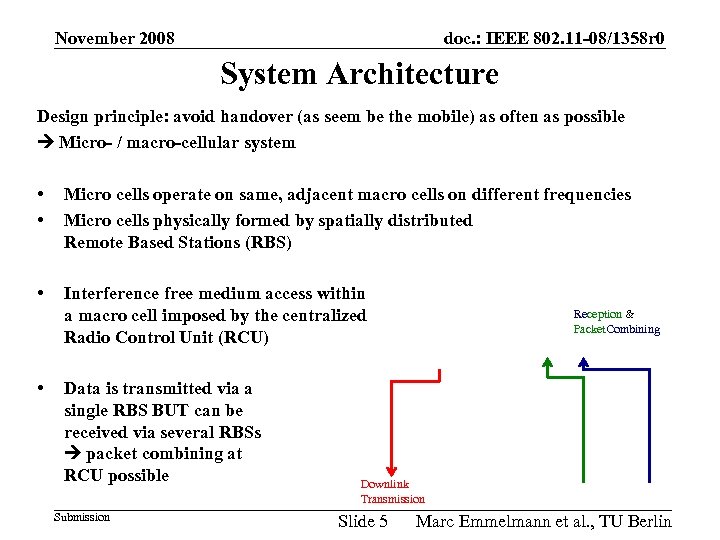
November 2008 doc. : IEEE 802. 11 -08/1358 r 0 System Architecture Design principle: avoid handover (as seem be the mobile) as often as possible Micro- / macro-cellular system • • Micro cells operate on same, adjacent macro cells on different frequencies Micro cells physically formed by spatially distributed Remote Based Stations (RBS) • Interference free medium access within a macro cell imposed by the centralized Radio Control Unit (RCU) • Data is transmitted via a single RBS BUT can be received via several RBSs packet combining at RCU possible Submission Reception & Packet. Combining Downlink Transmission Slide 5 Marc Emmelmann et al. , TU Berlin
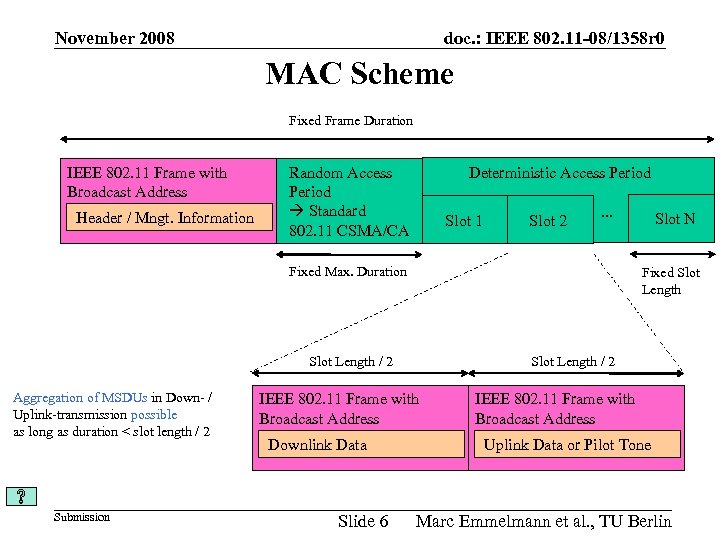
November 2008 doc. : IEEE 802. 11 -08/1358 r 0 MAC Scheme Fixed Frame Duration IEEE 802. 11 Frame with Broadcast Address Header / Mngt. Information Deterministic Access Period Random Access Period Standard 802. 11 CSMA/CA Slot 1 Slot 2 … Fixed Max. Duration Fixed Slot Length / 2 Aggregation of MSDUs in Down- / Uplink-transmission possible as long as duration < slot length / 2 Submission Slot Length / 2 IEEE 802. 11 Frame with Broadcast Address Downlink Data Slide 6 Slot N IEEE 802. 11 Frame with Broadcast Address Uplink Data or Pilot Tone Marc Emmelmann et al. , TU Berlin
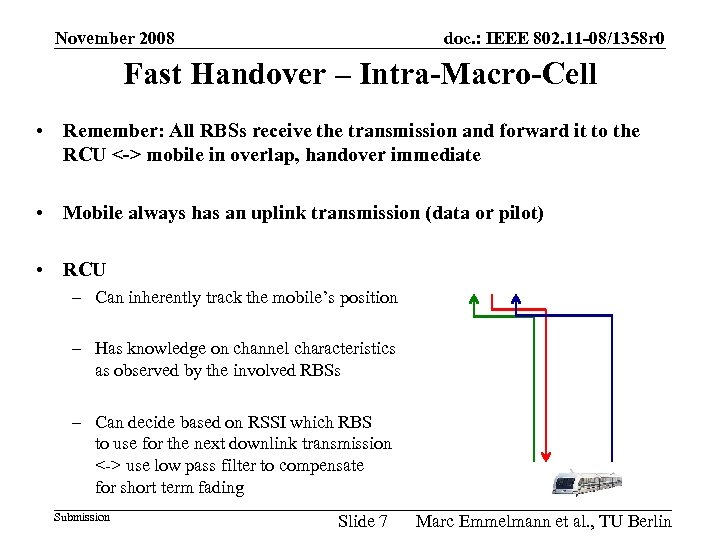
November 2008 doc. : IEEE 802. 11 -08/1358 r 0 Fast Handover – Intra-Macro-Cell • Remember: All RBSs receive the transmission and forward it to the RCU <-> mobile in overlap, handover immediate • Mobile always has an uplink transmission (data or pilot) • RCU – Can inherently track the mobile’s position – Has knowledge on channel characteristics as observed by the involved RBSs – Can decide based on RSSI which RBS to use for the next downlink transmission <-> use low pass filter to compensate for short term fading Submission Slide 7 Marc Emmelmann et al. , TU Berlin
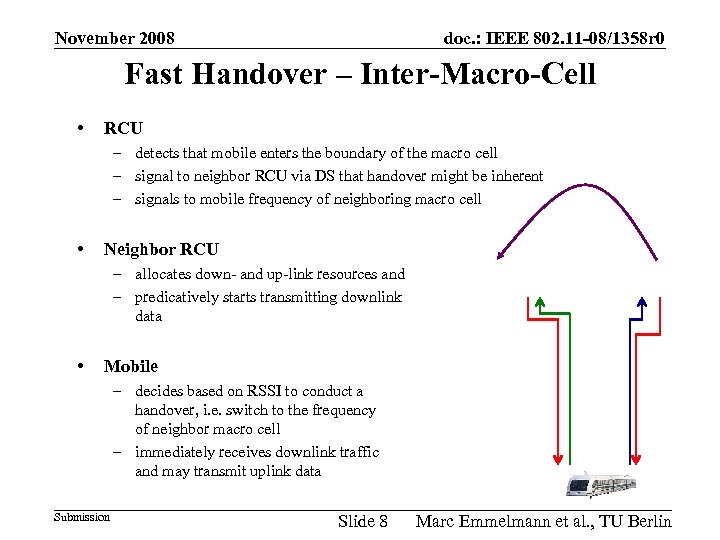
November 2008 doc. : IEEE 802. 11 -08/1358 r 0 Fast Handover – Inter-Macro-Cell • RCU – detects that mobile enters the boundary of the macro cell – signal to neighbor RCU via DS that handover might be inherent – signals to mobile frequency of neighboring macro cell • Neighbor RCU – allocates down- and up-link resources and – predicatively starts transmitting downlink data • Mobile – decides based on RSSI to conduct a handover, i. e. switch to the frequency of neighbor macro cell – immediately receives downlink traffic and may transmit uplink data Submission Slide 8 Marc Emmelmann et al. , TU Berlin
November 2008 doc. : IEEE 802. 11 -08/1358 r 0 PROOF-OF-CONCEPT DEMONSTRATOR & PERFORMANCE EVALUATION Submission Slide 9 Marc Emmelmann et al. , TU Berlin
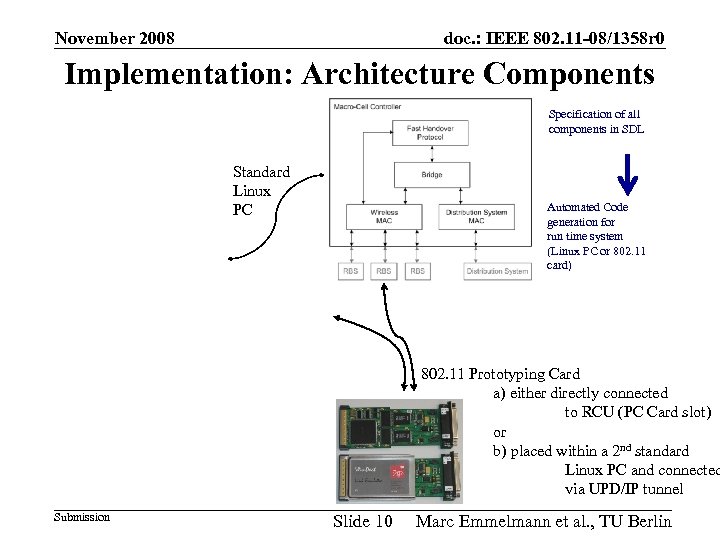
November 2008 doc. : IEEE 802. 11 -08/1358 r 0 Implementation: Architecture Components Specification of all components in SDL Standard Linux PC Automated Code generation for run time system (Linux PC or 802. 11 card) 802. 11 Prototyping Card a) either directly connected to RCU (PC Card slot) or b) placed within a 2 nd standard Linux PC and connected via UPD/IP tunnel Submission Slide 10 Marc Emmelmann et al. , TU Berlin
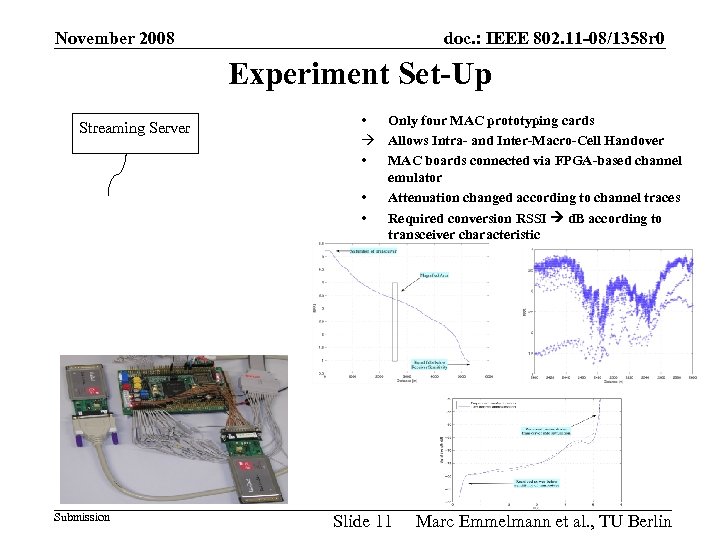
November 2008 doc. : IEEE 802. 11 -08/1358 r 0 Experiment Set-Up Streaming Server Submission • Only four MAC prototyping cards Allows Intra- and Inter-Macro-Cell Handover • MAC boards connected via FPGA-based channel emulator • Attenuation changed according to channel traces • Required conversion RSSI d. B according to transceiver characteristic Slide 11 Marc Emmelmann et al. , TU Berlin
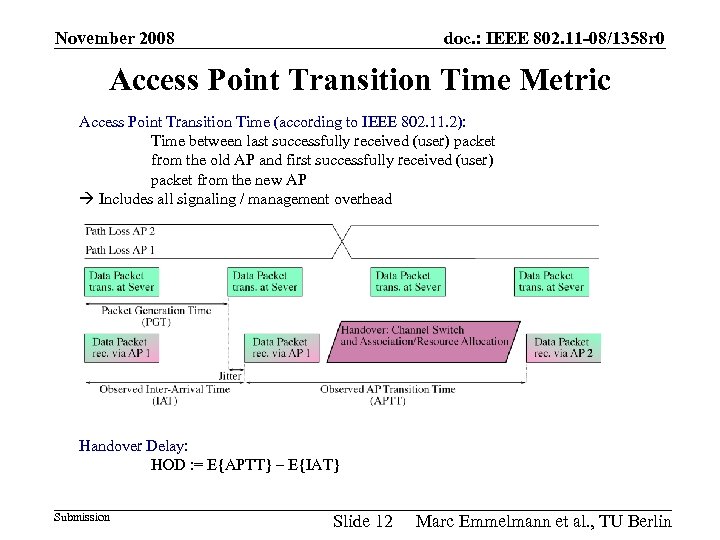
November 2008 doc. : IEEE 802. 11 -08/1358 r 0 Access Point Transition Time Metric Access Point Transition Time (according to IEEE 802. 11. 2): Time between last successfully received (user) packet from the old AP and first successfully received (user) packet from the new AP Includes all signaling / management overhead Handover Delay: HOD : = Ε{APTT} – Ε{IAT} Submission Slide 12 Marc Emmelmann et al. , TU Berlin
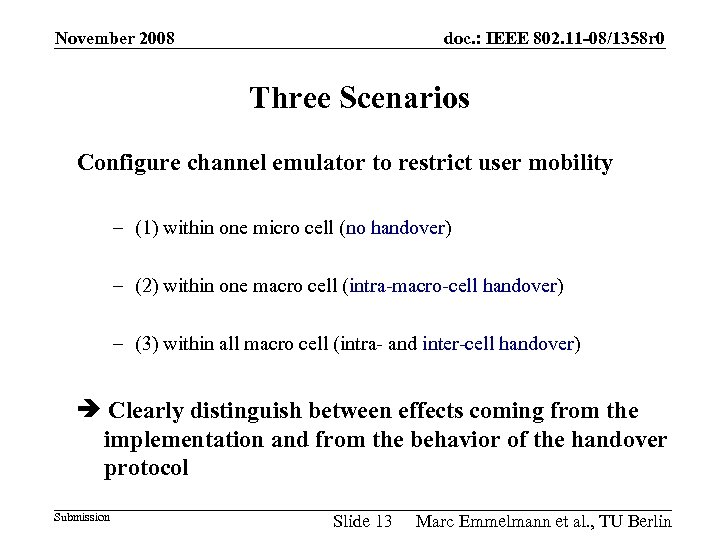
November 2008 doc. : IEEE 802. 11 -08/1358 r 0 Three Scenarios Configure channel emulator to restrict user mobility – (1) within one micro cell (no handover) – (2) within one macro cell (intra-macro-cell handover) – (3) within all macro cell (intra- and inter-cell handover) Clearly distinguish between effects coming from the implementation and from the behavior of the handover protocol Submission Slide 13 Marc Emmelmann et al. , TU Berlin
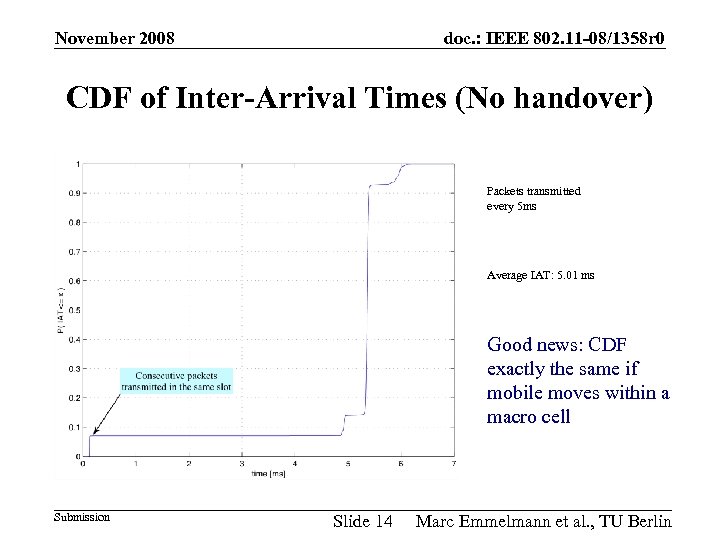
November 2008 doc. : IEEE 802. 11 -08/1358 r 0 CDF of Inter-Arrival Times (No handover) Packets transmitted every 5 ms Average IAT: 5. 01 ms Good news: CDF exactly the same if mobile moves within a macro cell Submission Slide 14 Marc Emmelmann et al. , TU Berlin
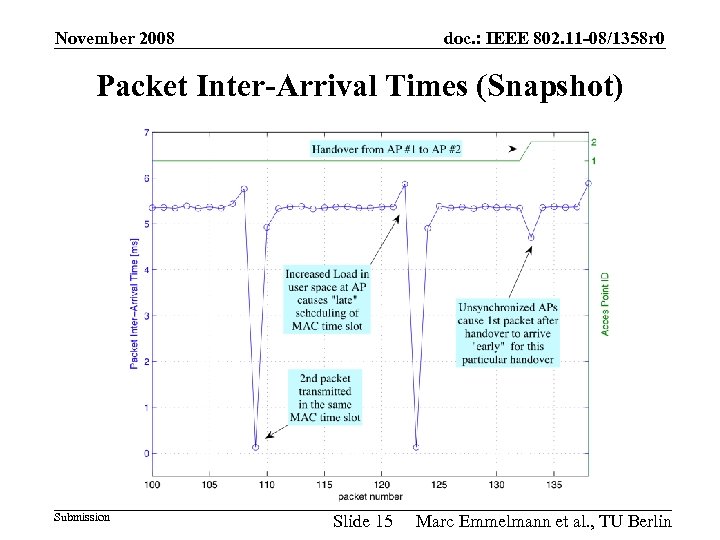
November 2008 doc. : IEEE 802. 11 -08/1358 r 0 Packet Inter-Arrival Times (Snapshot) Submission Slide 15 Marc Emmelmann et al. , TU Berlin
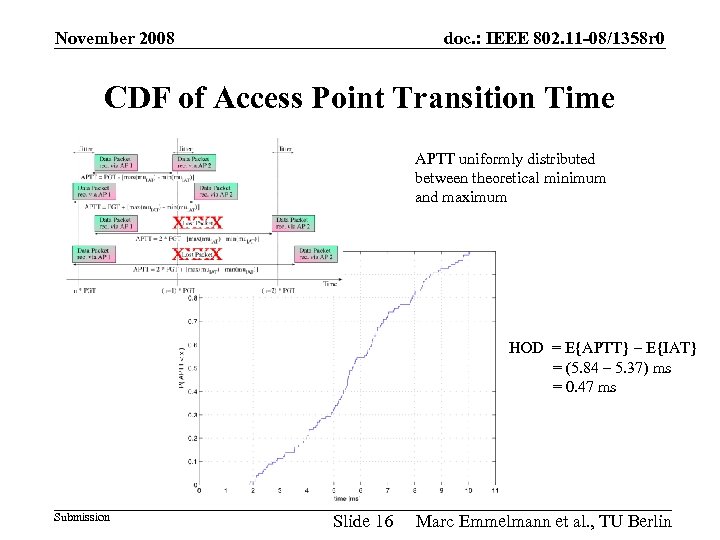
November 2008 doc. : IEEE 802. 11 -08/1358 r 0 CDF of Access Point Transition Time APTT uniformly distributed between theoretical minimum and maximum HOD = E{APTT} – E{IAT} = (5. 84 – 5. 37) ms = 0. 47 ms Submission Slide 16 Marc Emmelmann et al. , TU Berlin
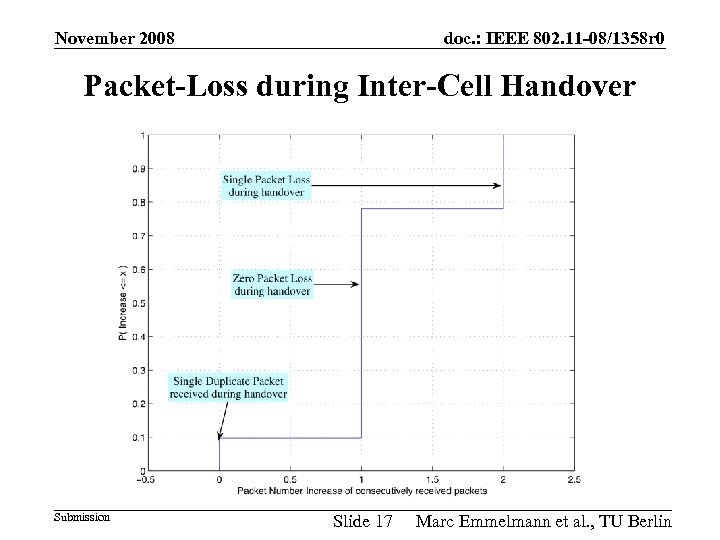
November 2008 doc. : IEEE 802. 11 -08/1358 r 0 Packet-Loss during Inter-Cell Handover Submission Slide 17 Marc Emmelmann et al. , TU Berlin
November 2008 doc. : IEEE 802. 11 -08/1358 r 0 Conclusion • Fast and seamless handover for Real-Time Telemetry is possible using standard COTS IEEE 802. 11 chipsets • Performance evaluation – Based on a proof-of-concept prototype implementation employing channel traces of a high speed train – Using metrics conformant to the IEEE recommended practice for wireless performance prediction – Show that the average handover delay << 0. 5 ms – Empirical access point transition time confirms analytical upper and lower bound Submission Slide 18 Marc Emmelmann et al. , TU Berlin
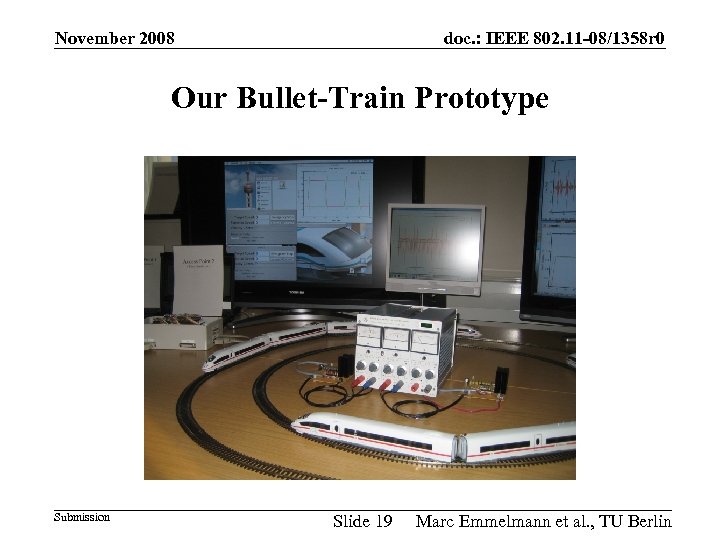
November 2008 doc. : IEEE 802. 11 -08/1358 r 0 Our Bullet-Train Prototype Submission Slide 19 Marc Emmelmann et al. , TU Berlin
November 2008 doc. : IEEE 802. 11 -08/1358 r 0 References • M. Emmelmann, T. Langgärtner, and M. Sonnemann. System Design and Implementation of Seamless Handover Support Enabling Real-Time Telemetry Applications for Highly Mobile Users. In Proc. ACM International Symposium on Mobility Management and Wireless Access (Mobi. Wac 2008), Vancouver, Canada, October 2008, pp. 1 -8, ISBN 978 -1 -60558 -055 -5. (pdf) • Marc Emmelmann. Influence of Velocity on the Handover Delay associated with a Radio-Signal -Measurement-based Handover Decision. In Proc. of IEEE Vehicular Technology Conference (VTC 2005 Fall), Dallas, TX, USA, September 2005. (PDF) • 11 -05/0233 r 1 – Marc Emmelmann. Velocity Effects on RSM-based Handover Decision • 11 -08/1273 r 1 – Sangwoo Lee et al. Hybrid MAC for MANET. • 11 -08/1337 r 0 – Hitoshi Morioka. Broadband Access for High Speed Transportation Submission Slide 20 Marc Emmelmann et al. , TU Berlin
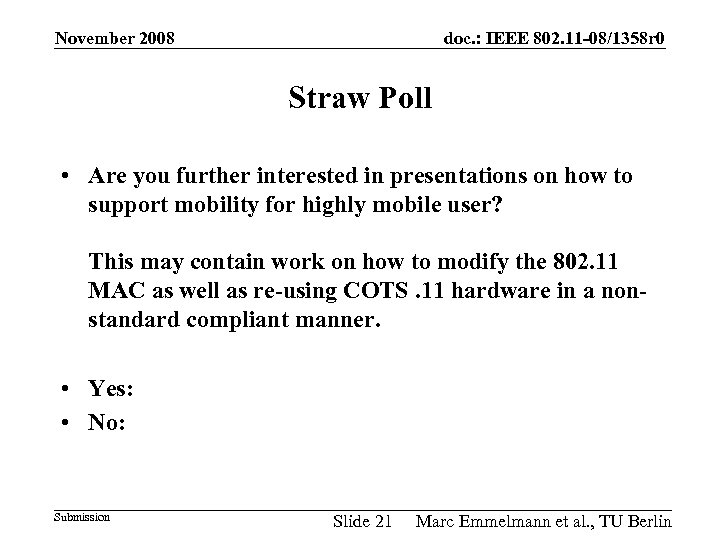
November 2008 doc. : IEEE 802. 11 -08/1358 r 0 Straw Poll • Are you further interested in presentations on how to support mobility for highly mobile user? This may contain work on how to modify the 802. 11 MAC as well as re-using COTS. 11 hardware in a nonstandard compliant manner. • Yes: • No: Submission Slide 21 Marc Emmelmann et al. , TU Berlin
Скачать презентацию November 2008 doc IEEE 802 11 -08 1358
293324501acb7500da8881ec0c6fc686.ppt