


 Скачать презентацию Novel Tools for Functional Magnetic Resonance Image Analysis
10c45773d0b74b161701da398f24ba0b.ppt
- Количество слайдов: 33
 Novel Tools for (Functional) Magnetic Resonance Image Analysis Development and Implementation in the Scientific and Statistical Computing Core Robert W Cox and a cast of several
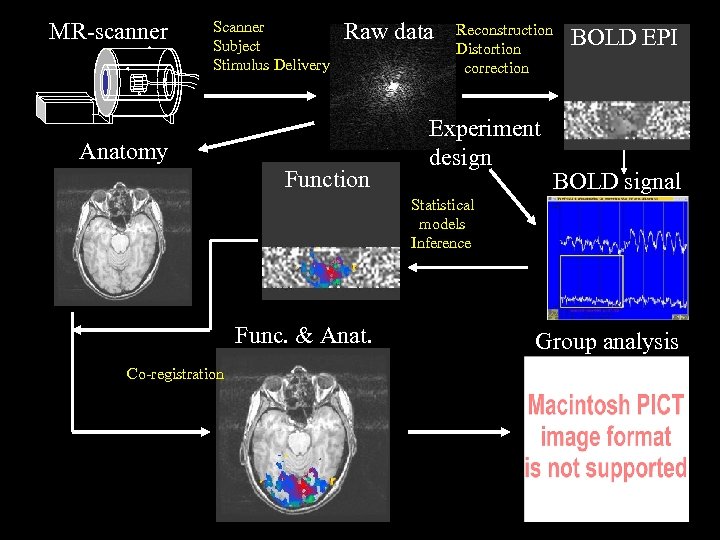 MR-scanner Subject Stimulus Delivery Raw data Anatomy Function Reconstruction Distortion correction Experiment design BOLD EPI BOLD signal Statistical models Inference Func. & Anat. Co-registration Group analysis
 Scientific & Statistical Computing Core • Develop and implement new methodologies to meet user needs • Consult with IRP users/groups regarding Rich source – Experimental design of ideas for – Processing methods and tools novel tools – Statistical inferences • Conduct classes on designing and processing FMRI experiments • Answer FMRI / MRI questions on message board • Distribute & maintain our open-source software tools • Facilitate cross-talk between different FMRI tools: – AFNI, FSL, FMRIstat, Free. Surfer, Caret, SPM, …
 AFNI + SUMA • AFNI = collection of programs for FMRI analysis – Visualization • 2 D, 3 D, time-series, cortical surface (SUMA) – Time Series Analysis • Linear & nonlinear regression – Statistics on 3 D Image Collections • 1 -5 way ANOVA; non-parametrics; SEM – Data editing tools • Spatial and temporal filtering • 3 D image registration • Clustering; ROI drawing & Atlas-based ROIs
 The AFNI / SSCC Philosophy • Enable users to stay close to their data – Save intermediate results – Look at images and data in connected ways • User controls processing steps and parameters – Everyone has an opinion – Special problems need special solutions • Efficient (fast) implementations – Things that are easy and fast to do will get done more often • Help the users – Until our patience runs out
 Next Set of Slides Features Added to AFNI and SUMA in Response to User Requests and / or Problems / Complaints (at least in part)
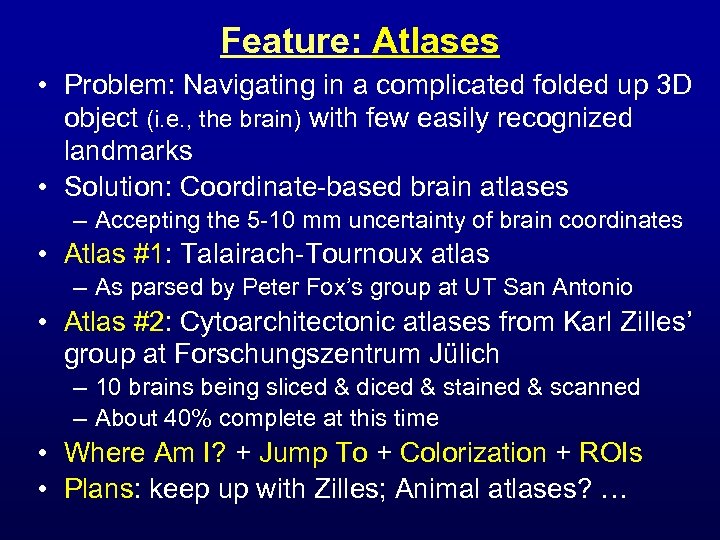 Feature: Atlases • Problem: Navigating in a complicated folded up 3 D object (i. e. , the brain) with few easily recognized landmarks • Solution: Coordinate-based brain atlases – Accepting the 5 -10 mm uncertainty of brain coordinates • Atlas #1: Talairach-Tournoux atlas – As parsed by Peter Fox’s group at UT San Antonio • Atlas #2: Cytoarchitectonic atlases from Karl Zilles’ group at Forschungszentrum Jülich – 10 brains being sliced & diced & stained & scanned – About 40% complete at this time • Where Am I? + Jump To + Colorization + ROIs • Plans: keep up with Zilles; Animal atlases? …
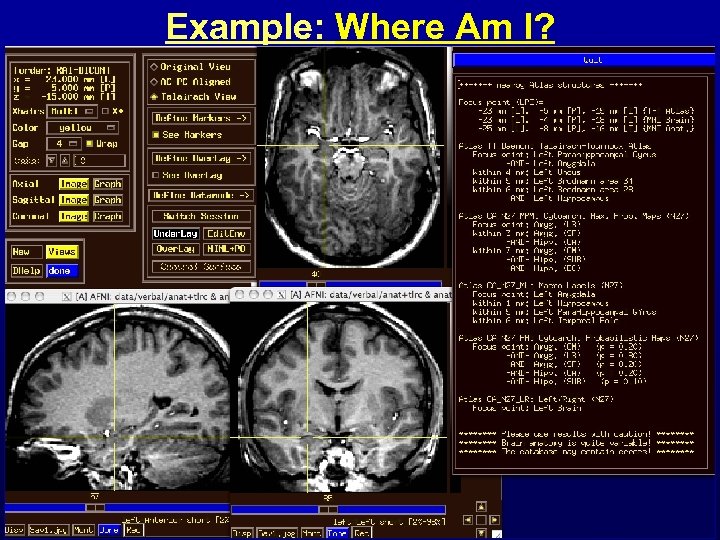 Example: Where Am I?
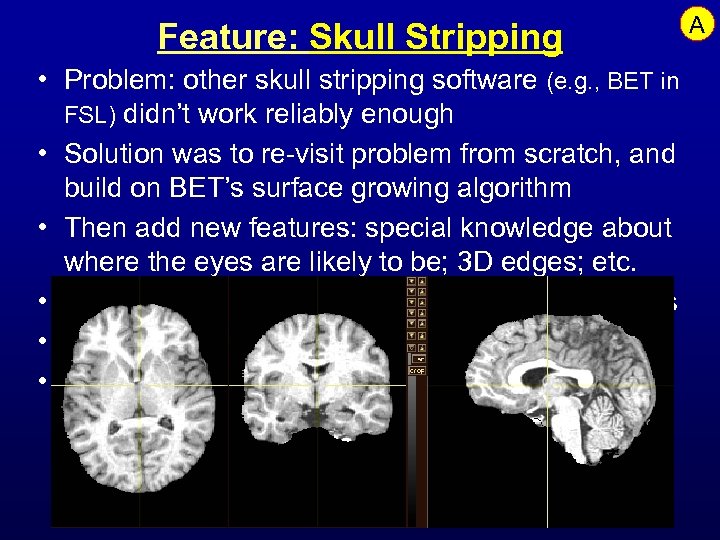 Feature: Skull Stripping • Problem: other skull stripping software (e. g. , BET in FSL) didn’t work reliably enough • Solution was to re-visit problem from scratch, and build on BET’s surface growing algorithm • Then add new features: special knowledge about where the eyes are likely to be; 3 D edges; etc. • Then test it on the hard cases from NIH (ab)users • Extra feature: extend it to monkey images • Plans: continue testing and improvements A
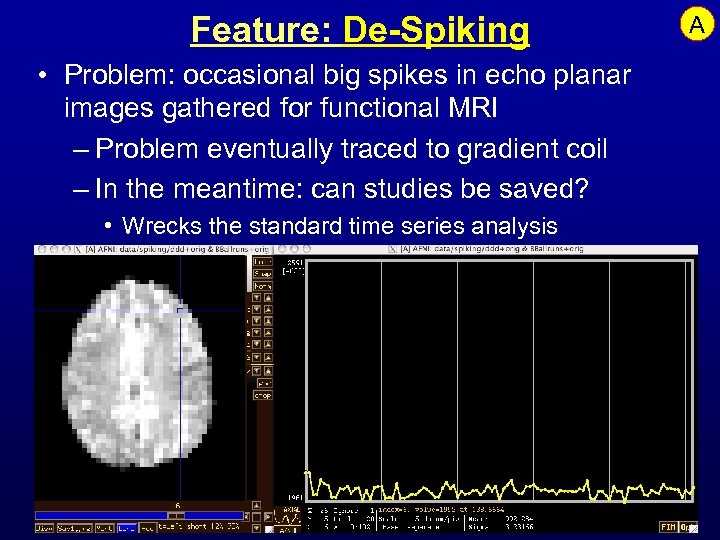 Feature: De-Spiking • Problem: occasional big spikes in echo planar images gathered for functional MRI – Problem eventually traced to gradient coil – In the meantime: can studies be saved? • Wrecks the standard time series analysis A
 Feature: Amplitude Modulated FMRI • Situation: Each stimulus event comes with an auxiliary parameter – May be measured (GSR, reaction time, …) or may be determined by experimenter • Want to determine if FMRI response magnitude is proportional to this auxiliary parameter • Solution was to add amplitude modulated regressors to AFNI’s 3 d. Deconvolve program – Two regressors per condition – First is: each stimulus response identical – Second is: each stimulus response proportional to auxiliary parameter for that stimulus • Plans: 2 -3 params/event; event-wise amplitudes
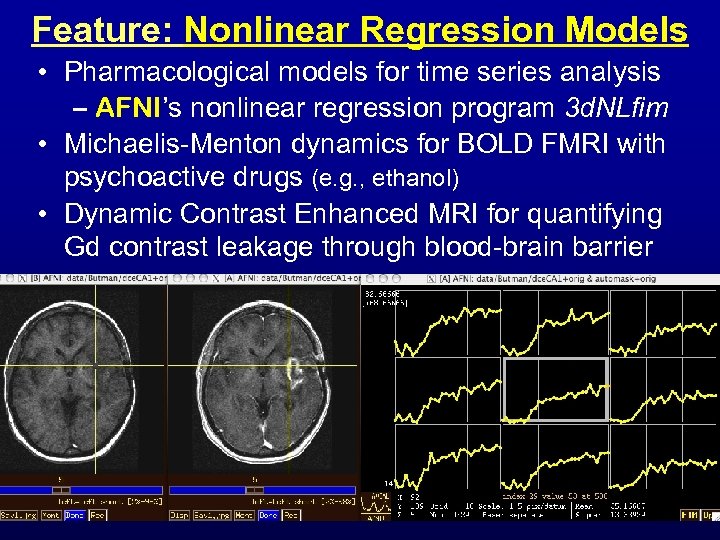 Feature: Nonlinear Regression Models • Pharmacological models for time series analysis – AFNI’s nonlinear regression program 3 d. NLfim • Michaelis-Menton dynamics for BOLD FMRI with psychoactive drugs (e. g. , ethanol) • Dynamic Contrast Enhanced MRI for quantifying Gd contrast leakage through blood-brain barrier
 Feature: Smart Blurring • FMRI time series datasets are often smoothed (blurred) in space to – Reduce noise (by averaging) – Increase intra-subject activation “blob” overlap • Blurring brain & non-brain signals together is silly • When combining data from different scanners (i. e. , multi-center studies), image smoothness varies – Should blur images until they have the same level of smoothness so that inter-scanner combinations make statistical sense • Developed a method for blurring inside a mask that stops when image noise reaches specified level of smoothness:
 Feature: Structural Equation Modeling • SEM is a form of connectivity analysis • Input: correlations between activated ROIs – Regions where the activations fluctuate in strength together will be more highly correlated • Input: connectivity diagram between ROIs • Output: strength of connections • Can also search for “better” fitting connections
 Feature: All-in-One Analysis Program • Common complaint: “AFNI is tooooooo hard to use” • Analysis of single subject data involves several steps, each instantiated in separate programs – Registration, smoothing, normalizing, model analysis • Solution is a program afni_proc. py that will run all these programs in a coherent sequence – Intermediate results are saved to make it possible to track backwards when results are confusing • This script is not intended to let the user avoid understanding the data analysis process!
 Feature: Diffusion Tensor Analysis • Goal: Compute the Diffusion Tensor (etc. ) from Diffusion Weighted image collections – Problem #1: log+linear method is inaccurate in highly anisotropic locations (the cool places to be) – Problem #2: published nonlinear solution methods not available in open-source software • Solution was to create and implement an efficient robust nonlinear method for finding the diffusion tensor D in each voxel – Also, a optional nonlinear image smoother (2 D and 3 D) to reduce noise in homogenous areas • Our code now incorporated into DTI Query, an open-source tractography program from Stanford
 Feature: Inter-Modality Registration • Goal: Efficiently align 3 D volumes acquired with different imaging contrasts • Solution is a general program using histogrambased measurements of image matching (e. g. , mutual information) • This one is still very much a work-in-progress – Works pretty well on “simple” cases (e. g. , wholebrain to whole-brain) – Dealing with partial-brain to whole-brain and with brain images that have holes in them is less reliable right now – Also want to add non-affine warping capabilities
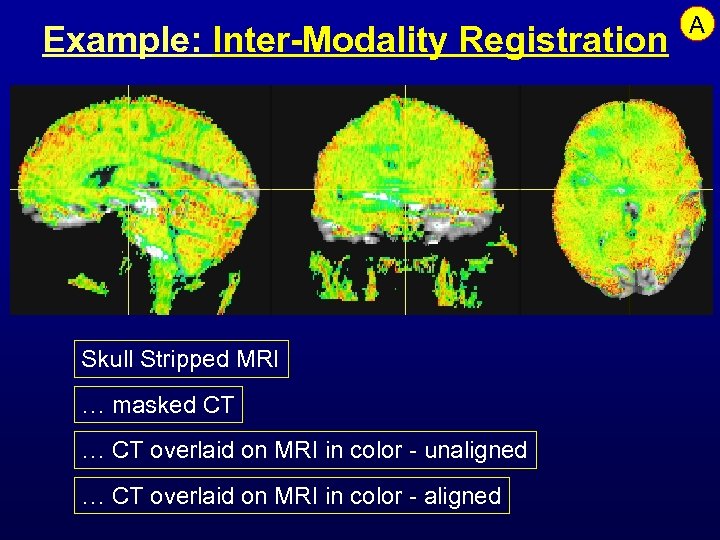 Example: Inter-Modality Registration Skull Stripped MRI … masked CT … CT overlaid on MRI in color - unaligned … CT overlaid on MRI in color - aligned A
 Feature: Analysis of Mn Contrast MRI • Mn is an MRI contrast agent and a calcium analog • Goal: time-dependent in vivo tract tracing in monkeys • Problems abound: – Like FMRI, signal changes are small – Other artifacts from day-to-day scanning are larger – Simple image subtraction isn’t reliable • Next 3 slides: some data and results …
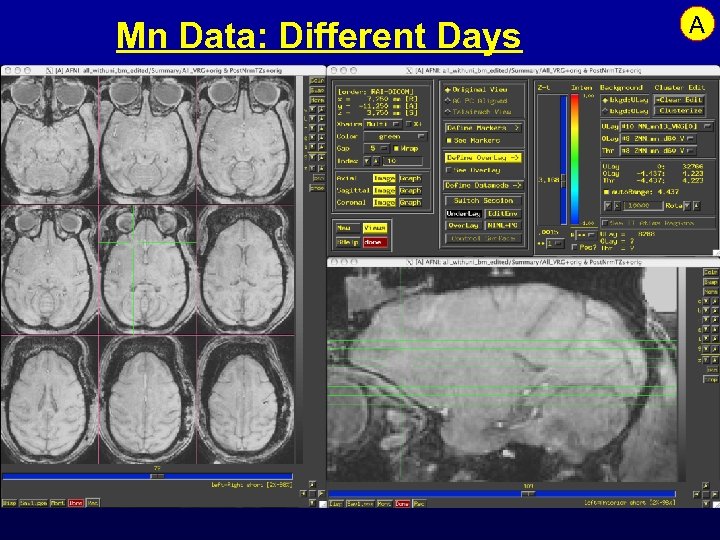 Mn Data: Different Days A
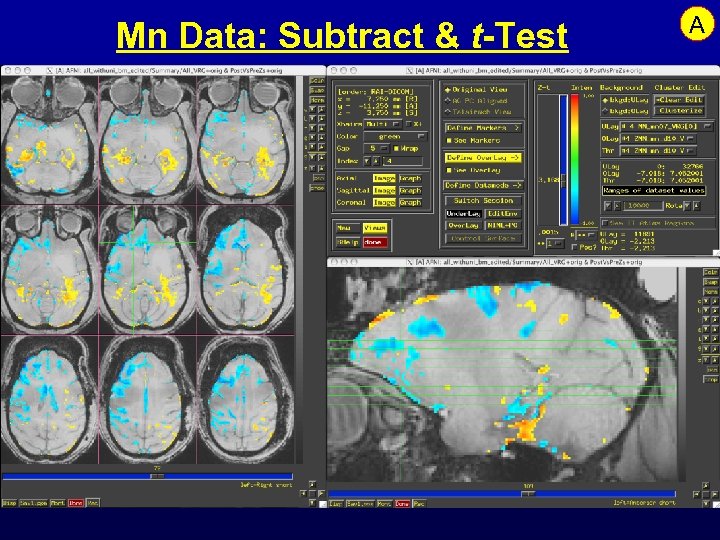 Mn Data: Subtract & t-Test A
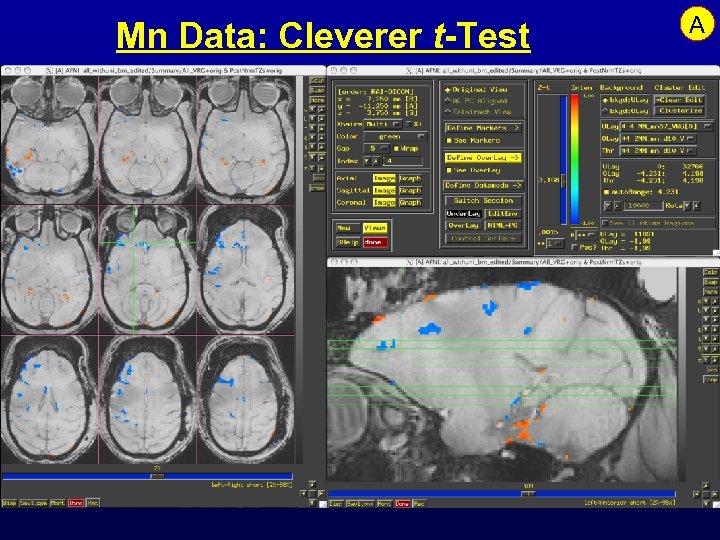 Mn Data: Cleverer t-Test A
 Next Set of Slides Features Added to AFNI and SUMA in Response to Our Own Crazy Thoughts (mostly)
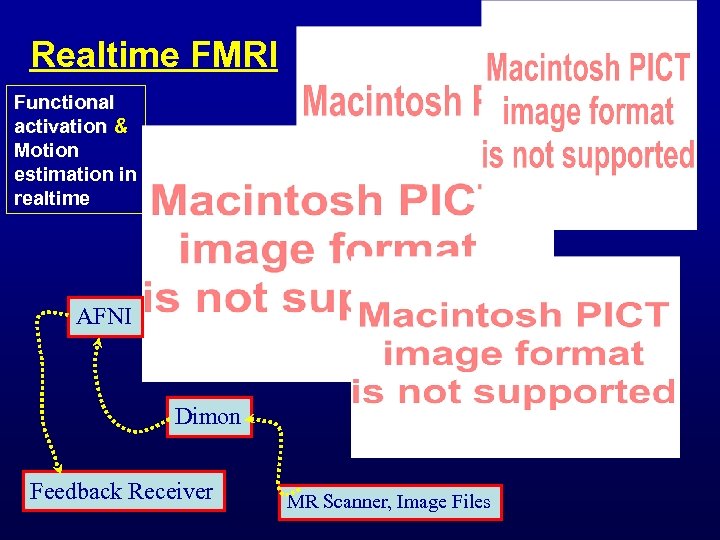 Realtime FMRI Functional activation & Motion estimation in realtime AFNI Dimon Feedback Receiver MR Scanner, Image Files
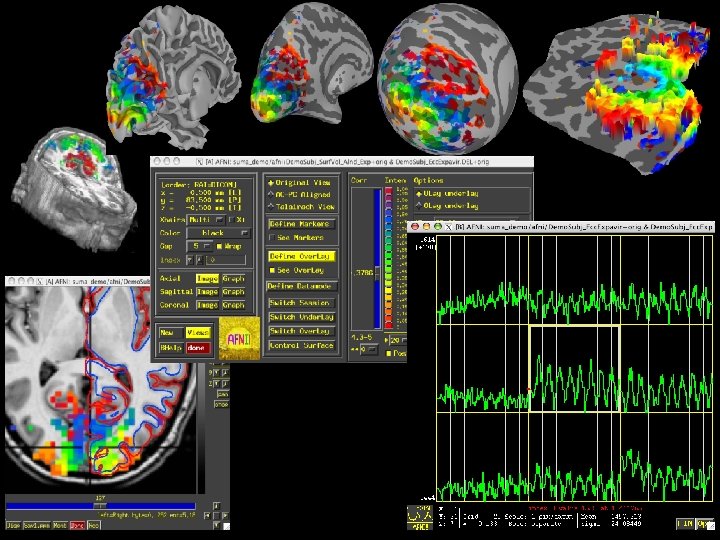
 Surface-Based Analyses • Create cortical surface models, project 3 D data to these surfaces, analyze in that space – Respects geometry and topology of cortex • Most AFNI statistical tools now work with image data defined over surfaces as well as over 3 D volumes • Movie capture from SUMA • Activation map projected from AFNI
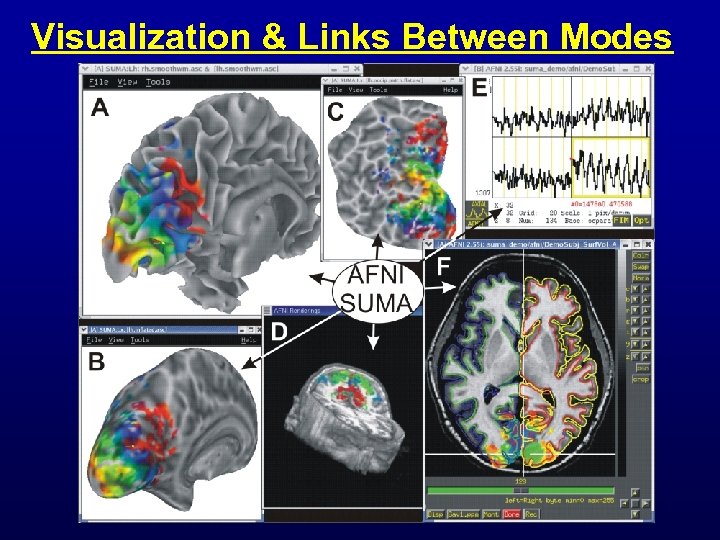 Visualization & Links Between Modes
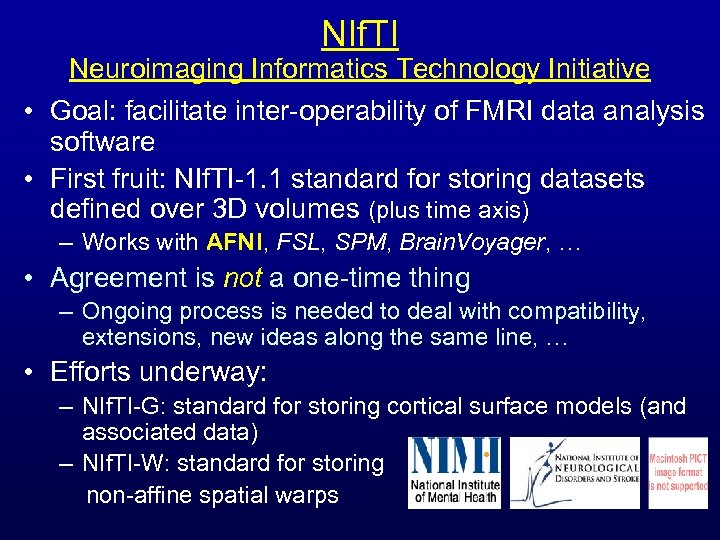 NIf. TI Neuroimaging Informatics Technology Initiative • Goal: facilitate inter-operability of FMRI data analysis software • First fruit: NIf. TI-1. 1 standard for storing datasets defined over 3 D volumes (plus time axis) – Works with AFNI, FSL, SPM, Brain. Voyager, … • Agreement is not a one-time thing – Ongoing process is needed to deal with compatibility, extensions, new ideas along the same line, … • Efforts underway: – NIf. TI-G: standard for storing cortical surface models (and associated data) – NIf. TI-W: standard for storing non-affine spatial warps
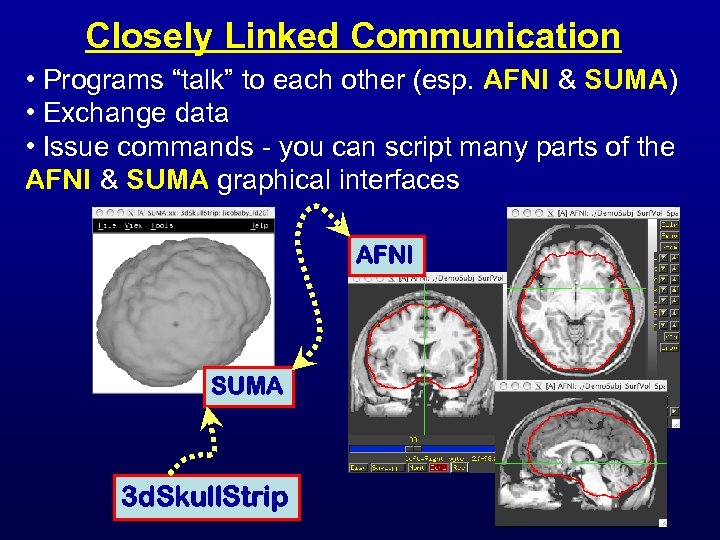 Closely Linked Communication • Programs “talk” to each other (esp. AFNI & SUMA) • Exchange data • Issue commands - you can script many parts of the AFNI & SUMA graphical interfaces AFNI SUMA 3 d. Skull. Strip
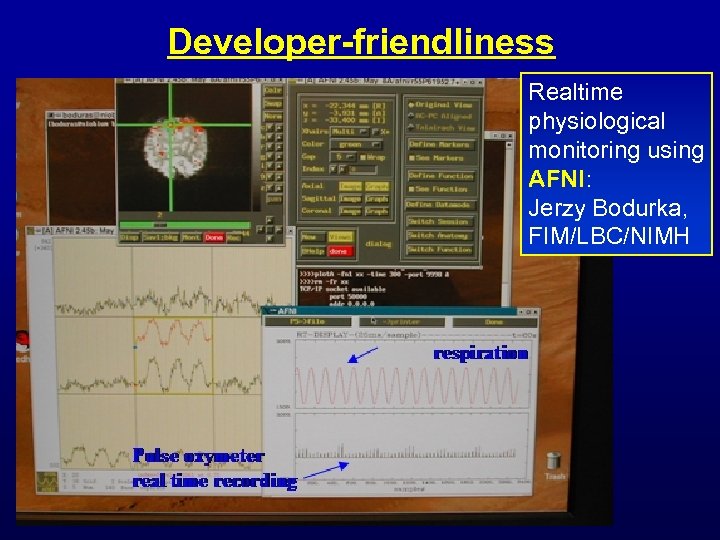 Developer-friendliness Realtime physiological monitoring using AFNI: Jerzy Bodurka, FIM/LBC/NIMH
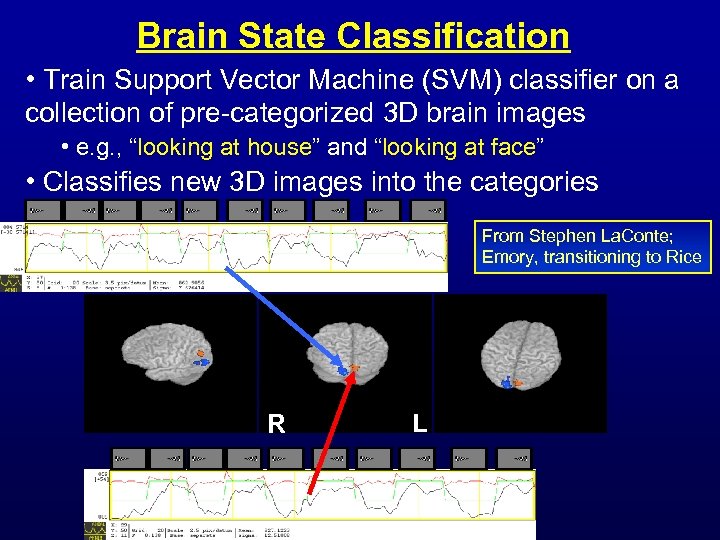 Brain State Classification • Train Support Vector Machine (SVM) classifier on a collection of pre-categorized 3 D brain images • e. g. , “looking at house” and “looking at face” • Classifies new 3 D images into the categories From Stephen La. Conte; Emory, transitioning to Rice R L
 Penultimate Slide • Much of our most fruitful and satisfying work comes from close and ongoing interactions with investigators that have interesting problems – Derived from studies that are pushing the envelope of deriving information from MRI • We are here to provide solutions to problems (of image analysis) – Your current short-term problems (lots of these!) – Your actual longer-term problems – What we think your future needs will be
 Ultimate Slide