


 Скачать презентацию Novel environmental technology related to CO 2 reduction
d8ff559ffc5553ccdb1f85e576e2d039.ppt
- Количество слайдов: 15
 Novel environmental technology related to CO 2 reduction 中華民國九十九年五月二十七日
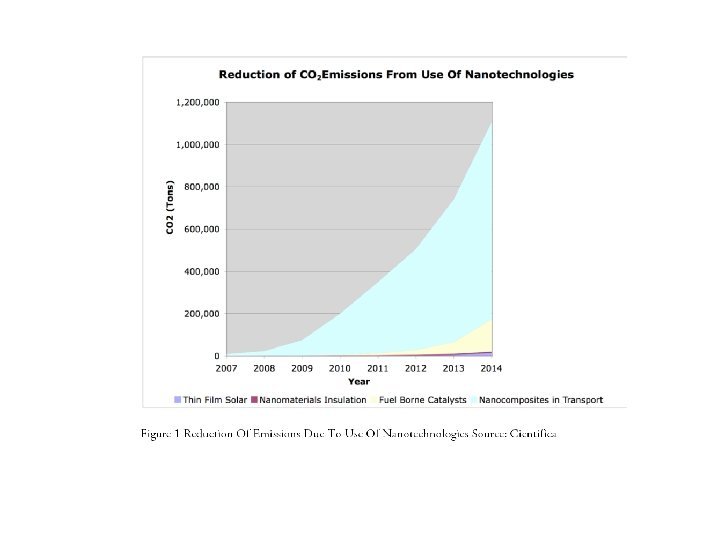
 The Impact Of Nanotechnologies on CO 2 Emissions • The impact of nanotechnologies in emission reductions will be in three main areas, • a) The reduction of emissions from transportation through weight reduction and improved drive train efficiency • b) The use of improved insulation in residential and commercial buildings • c) The generation of renewable photovoltaic energy
 可應用的方向 • 奈米材料的應用 • 薄膜分離技術應用
 nanotechnology applications • Environment and water ü Enhanced membranes for water purification, ü nanostructured filters for removing pollutants ü improved remediation methods (e. g. photo-catalytic techniques).
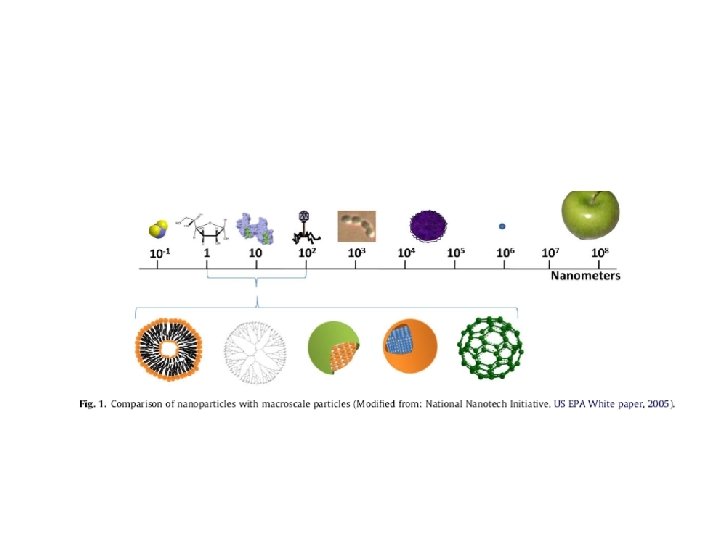
 • • • Nanomaterials are available today in the form of activated materials like carbon or alumina. These materials have high surface areas; however, because of the fine pores, not all the water can easily reach the active surfaces and they are easily plugged. The small size of nanomaterials creates a major challenge. These fine particles or fibers cannot just be added to drinking water; rather, they must be incorporated into filtration media in ways that allow for the contaminants to readily come in contact with the active media. Attention is being given to the development of filters and media that can take advantage of the properties of nanomaterials for removal of contaminants from water. While these materials have been shown to be extremely effective, cost is still a major issue. At one manufacturer, a novel method for making porous ceramics is combined with a proprietary process for making nanomaterials that provides for function-specific filtration media tailored for water cleanup applications, such as the removal of metal ions (e. g. As and Pb), organics or phosphates. These base technologies are reasonably priced, highly effective and have significant potential for reducing a wide range of contaminants in water
 Nanomaterials for Water Cleanup • An increasing use of nanomaterials will be seen in the coming decade because of the significant contaminant removal potential that exists for improving the effectiveness of water purification systems. • The key to successful introduction will be development of affordable systems. One approach is to use a porous ceramic media containing the active nanomaterials. • This approach has beenshown in the laboratory to be effective for arsenic, lead and phosphate removal as well as the breakdown of some organiccontaminants. Field trials are needed to observe the long-term advantages and practical-use applications of these nanomedia products.
 OECD Conference on Potential Environmental Benefits of Nanotechnology: Fostering Safe Innovation-Led Growth Discussed in depth, through case studies, potential applications including in the following areas: • Energy generation, storage and conservation • Agricultural nanotechnology (e. g. pesticide encapsulation, and slow release fertilizers); • Cleaner production (e. g. car emission control); • Water treatment and purification; • Remediation of hazardous sites; • Environmental monitoring of pollutants; and • Green chemistry – synthesis and processing of chemicals. 9
 • Green energy is a term describing what is thought to be environmentally friendly sources of power and energy. Typically, this refers to renewable and non-polluting energy sources. Green energy includes natural energetic • processes which can be harnessed with little pollution. • Anaerobic digestion, geothermal power, wind power, small-scale hydropower, solar power, biomass power, tidal power and wave power fall under such a category.
 salinity gradient power (SGP) • The concept of SGP is already known for a long time and e. g. described in [1] while mentioning the first studies [2] in 1953. In [2] Pattle indicates “When a volume V of a pure solvent mixes irreversibly with a much larger volume of a solution the osmotic pressure of which is P, the free energy lost is equal to PV. The osmotic pressure of seawater is about 20 atmospheres, so that when a river mixes with the sea, free energy equal to that obtainable from a waterfall 680 ft. (about 200 m) high is lost. There thus exists an untapped source of power which has (so far as I know) been unmentioned in the literature. ”
 • A first technique uses in effect the osmotic pressure difference by implementing reverse osmosis membranes [3, 4]. The principle is easy to understand: assume a salt solution A (e. g. sea water= high osmotic pressure) and a solution B (e. g. river water with a low salt concentration) being separated by an osmotic membrane. Only water molecules can pass through such membrane while no salt ions can pass the semi-permeable membrane. • As a result of the osmotic pressure difference between both solutions, the water from solution B thus will diffuse (permeate) through the membrane in order to dilute solution A. Such osmotic pressure effects are very powerful and induce a strong permeate flow which can be used to drive hydraulic turbines and electrical generators to produce electricity from the osmotic effect. In nature, the massive transport of water through tree trunks up to the very top (which can be tens of meters high) is also based on osmosis.
 • • A second technique uses the dialysis concept and is mostly called reversed electrodialysis (not to be confused with EDR which is electrodialysis, but by regularly switching (reversing) dilute and concentrate streams as well as electrode polarity the ED membrane fouling can be controlled). In electrodialysis (ED) a dilute salt solution compartment and a concentrated salt solution compartment are separated in an alternating way by cation and anionconductive membranes (CM and AM). An electric field across the compartments is applied through a cathode and anode. As a result of the electric field, anions move to the anode (+) and cations to the cathode (–). From the alternating series of CM and AM, cations and anions are concentrated in the concentrate chambers while the diluate chambers are diluted (desalinated). ED is therefore a technique to convert a salt solution into two fractions : a diluate and a concentrate. The basics of ED can be found in e. g. [5]. It is then obvious that, when introducing a salt solution with a low concentration and a salt solution with a high concentration in the ED set-up, the process can be reversed in a way that a voltage is created across the electrodes. This voltage can be applied to an electrical device (electrical motor, etc. ) in order to drive such device with SGP based electrical energy. This method is called in this text salinity gradient power by reversed electrodialysis (SGP-RE). The SGPRE concept is explained in more detail in the next sections.
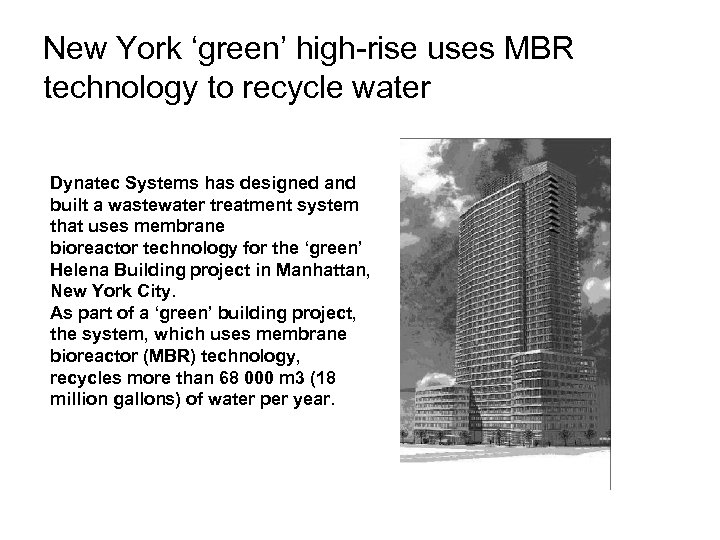 New York ‘green’ high-rise uses MBR technology to recycle water Dynatec Systems has designed and built a wastewater treatment system that uses membrane bioreactor technology for the ‘green’ Helena Building project in Manhattan, New York City. As part of a ‘green’ building project, the system, which uses membrane bioreactor (MBR) technology, recycles more than 68 000 m 3 (18 million gallons) of water per year.
 ‘Green’ COD analyser developed • Aqua Diagnostic says that the standard method is currently the dichromate COD test. However, according to the company, this dated method is slow, limited in sensitivity and requires the addition of toxic chemicals (mercury) to eliminate interferences, such as chloride. • It claims that its Pe. COD analyser is automated and reliable, and offers users the economic benefit of real-time process control and environmental monitoring. Based on the oxidative degradation principle, the innovative aspects of the Pe. COD system lie in the novel approach to generating and quantifying the useful analytical signals with a sensitivity and speed far greater than any standard method. This is achieved in minutes instead of hours, and in μg/l compared with concentrations in excess of 10 mg/l. • Aqua Diagnostic was incorporated in 2005 to commercialise technology developed by the School of Environmental and Applied Sciences at Griffith University, Australia.