 Скачать презентацию NOVA-3 Proposal Advancing Submillimeter Astronomy at Chajnantor Strategic
ebadcb2d6ecb163d712d02400b0aa20c.ppt
- Количество слайдов: 13



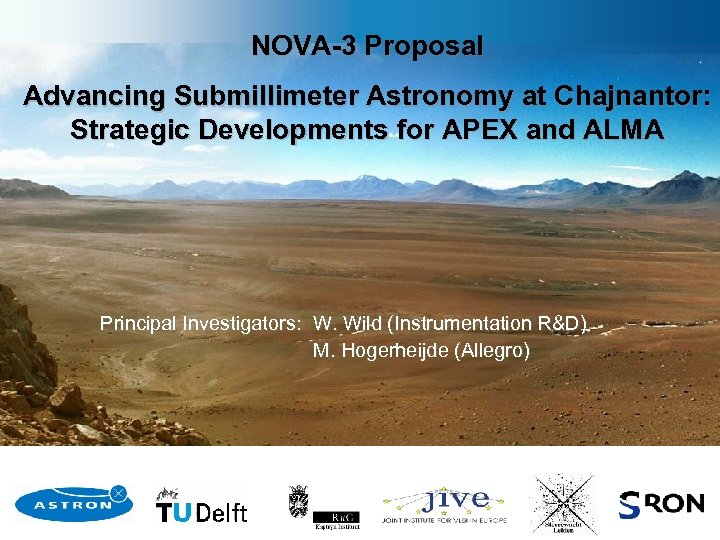
NOVA-3 Proposal Advancing Submillimeter Astronomy at Chajnantor: Strategic Developments for APEX and ALMA Principal Investigators: W. Wild (Instrumentation R&D) M. Hogerheijde (Allegro)
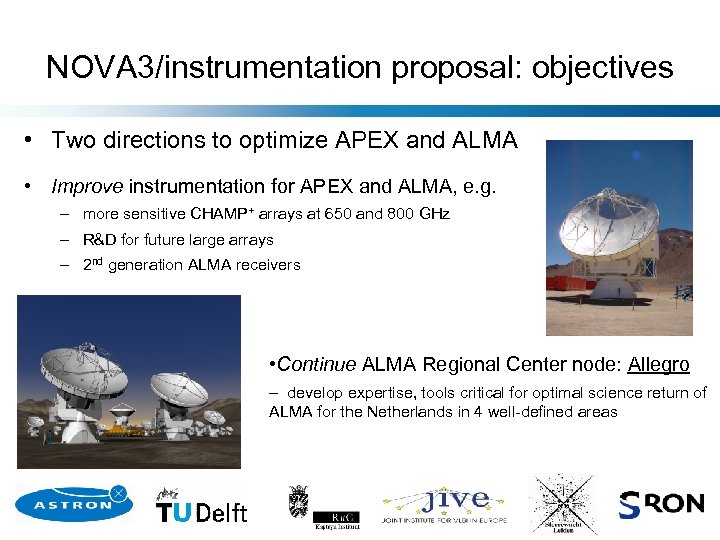
NOVA 3/instrumentation proposal: objectives • Two directions to optimize APEX and ALMA • Improve instrumentation for APEX and ALMA, e. g. – more sensitive CHAMP+ arrays at 650 and 800 GHz – R&D for future large arrays – 2 nd generation ALMA receivers • Continue ALMA Regional Center node: Allegro – develop expertise, tools critical for optimal science return of ALMA for the Netherlands in 4 well-defined areas
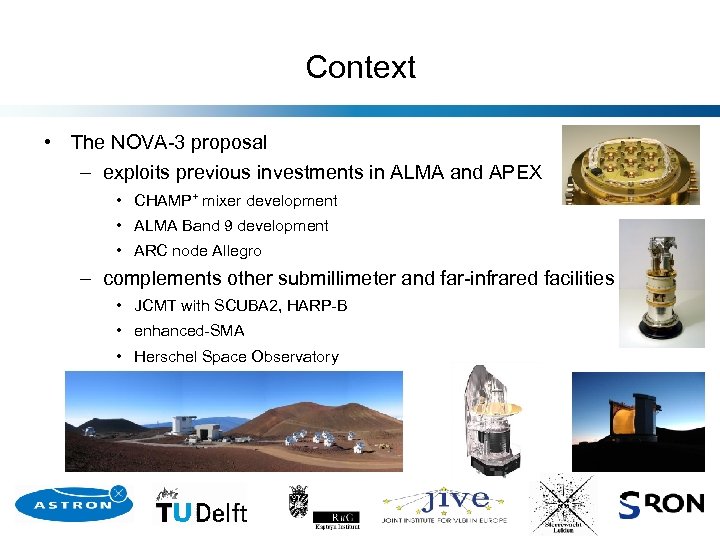
Context • The NOVA-3 proposal – exploits previous investments in ALMA and APEX • CHAMP+ mixer development • ALMA Band 9 development • ARC node Allegro – complements other submillimeter and far-infrared facilities • JCMT with SCUBA 2, HARP-B • enhanced-SMA • Herschel Space Observatory
NOVA-3 proposal status • NOVA Board approved support for the ALLEGRO and ALMA R&D project (with comments) • The project plan will be further negotiated and refined to optimally support Dutch submm astronomy needs • In particular, the technical R&D will focus on a few key developments • We listen carefully during today’s meeting …
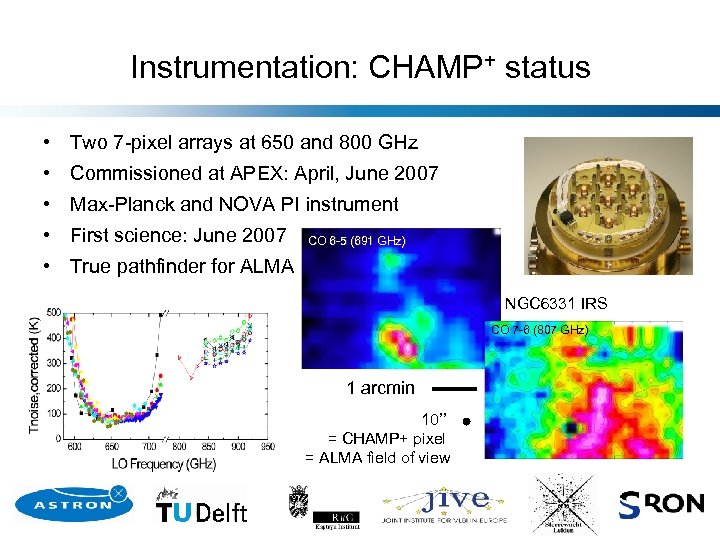
Instrumentation: CHAMP+ status • Two 7 -pixel arrays at 650 and 800 GHz • Commissioned at APEX: April, June 2007 • Max-Planck and NOVA PI instrument • First science: June 2007 CO 6 -5 (691 GHz) • True pathfinder for ALMA NGC 6331 IRS CO 7 -6 (807 GHz) 1 arcmin 10’’ = CHAMP+ pixel = ALMA field of view
Option 1 - CHAMP+ improvement • Better submillimeter mixer arrays for APEX – Wider RF bandwidth at 650 GHz + wider IF b/w: 4– 12 GHz – 25– 50% better sensitivity at 800 GHz ➡ Faster mapping (observing time ~ noise level 2) ➡ Single coverage for wide extragalactic lines; spectral multiplexing for narrow Galactic lines ➡ Improvement now possible through new SIS technology at TUD NOVA: “The proposed upgrade for CHAMP+ will not be supported. ”
Option 2 - APEX improvement • Towards large submillimeter arrays – Need to develop key technology R&D to enable large arrays • New fabrication techniques • Optics and LO coupling • IF system integration and heat dissipation • Lower system complexity – Goal: 19 -pixel array design for APEX ➡ Again: immediate impact on science output ➡ Also useable for future telescopes such as 25 m CCAT
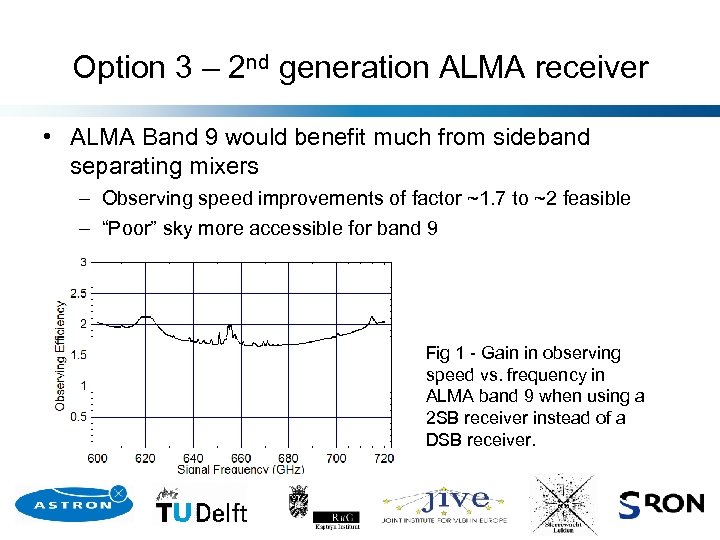
Option 3 – 2 nd generation ALMA receiver • ALMA Band 9 would benefit much from sideband separating mixers – Observing speed improvements of factor ~1. 7 to ~2 feasible – “Poor” sky more accessible for band 9 Fig 1 - Gain in observing speed vs. frequency in ALMA band 9 when using a 2 SB receiver instead of a DSB receiver.
Technical R&D funding Combination of several funding sources to enable and ensure instrumentation R&D ➡ NOVA-3 ➡ FP 7 Radionet (EU contract under negotiation) ➡ Veni Andrey Baryshev ➡ SRON + TU Delft contributions ➡ Synergy ALMA Band 9 ➡ ALMA R&D funds ?
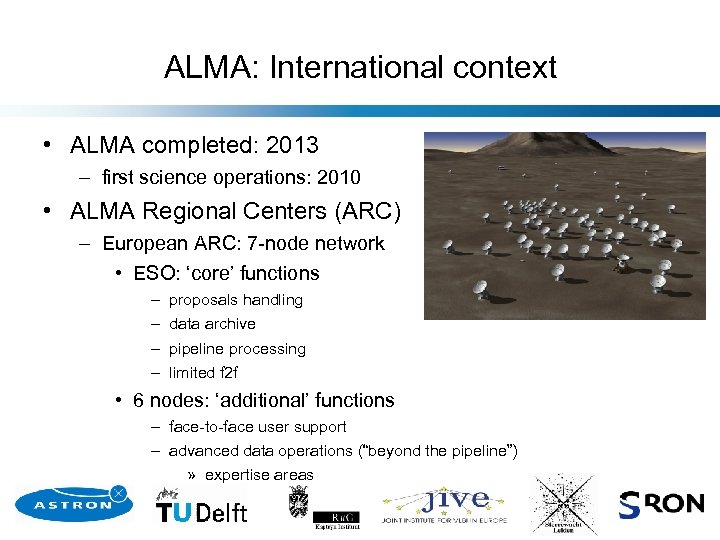
ALMA: International context • ALMA completed: 2013 – first science operations: 2010 • ALMA Regional Centers (ARC) – European ARC: 7 -node network • ESO: ‘core’ functions – – proposals handling data archive pipeline processing limited f 2 f • 6 nodes: ‘additional’ functions – face-to-face user support – advanced data operations (“beyond the pipeline”) » expertise areas
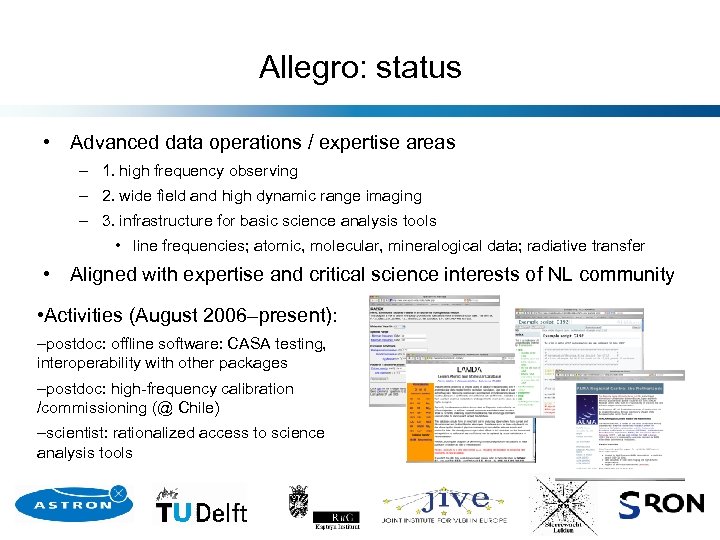
Allegro: status • Advanced data operations / expertise areas – 1. high frequency observing – 2. wide field and high dynamic range imaging – 3. infrastructure for basic science analysis tools • line frequencies; atomic, molecular, mineralogical data; radiative transfer • Aligned with expertise and critical science interests of NL community • Activities (August 2006–present): –postdoc: offline software: CASA testing, interoperability with other packages –postdoc: high-frequency calibration /commissioning (@ Chile) –scientist: rationalized access to science analysis tools
Allegro: development 2009– 2013 • NOVA 3/instrumentation support for development activities during ALMA construction – develop offline software practices: calibration, reduction, imaging – participate in commissioning ALMA – develop high frequency observing and calibration strategies – port expertise for wide field and high dynamic range imaging – expand maintain interface to basic science analysis tools • User support – NOVA 3/Science Support postdoc for user support Early Science • Additional funding opportunities • NWO for user support functions (>2012) • Astronet proposals: RT and mol. data development; ESO COFUND proposal
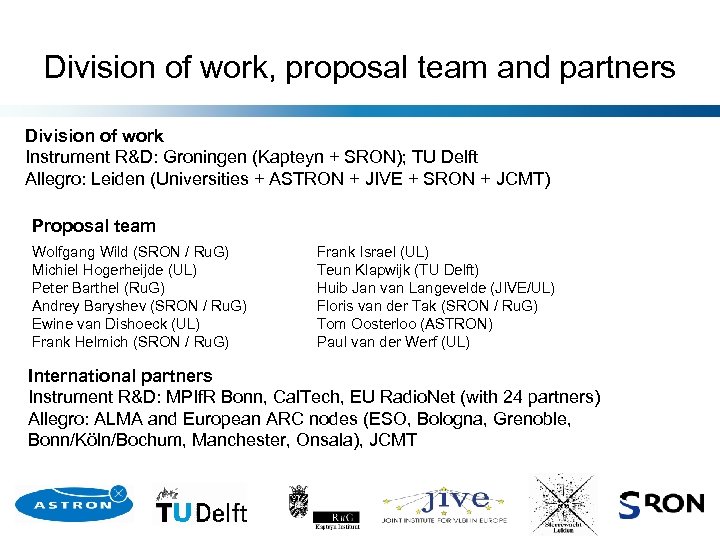
Division of work, proposal team and partners Division of work Instrument R&D: Groningen (Kapteyn + SRON); TU Delft Allegro: Leiden (Universities + ASTRON + JIVE + SRON + JCMT) Proposal team Wolfgang Wild (SRON / Ru. G) Michiel Hogerheijde (UL) Peter Barthel (Ru. G) Andrey Baryshev (SRON / Ru. G) Ewine van Dishoeck (UL) Frank Helmich (SRON / Ru. G) Frank Israel (UL) Teun Klapwijk (TU Delft) Huib Jan van Langevelde (JIVE/UL) Floris van der Tak (SRON / Ru. G) Tom Oosterloo (ASTRON) Paul van der Werf (UL) International partners Instrument R&D: MPIf. R Bonn, Cal. Tech, EU Radio. Net (with 24 partners) Allegro: ALMA and European ARC nodes (ESO, Bologna, Grenoble, Bonn/Köln/Bochum, Manchester, Onsala), JCMT
Скачать презентацию NOVA-3 Proposal Advancing Submillimeter Astronomy at Chajnantor Strategic
ebadcb2d6ecb163d712d02400b0aa20c.ppt