


 Скачать презентацию Nouns What are nouns n Nouns are
f55c8cc8f5e7d5d4c0bad0e7490a209d.ppt
- Количество слайдов: 15
 Nouns
Nouns
 What are nouns? n Nouns are people, places, things, or ideas n Nouns can be common or proper – Proper nouns MUST be capitalized. n Examples: – Common: girl, boy, school, town – Proper: Sally, Tom, MCMS, Tomkinsville
 Concrete and Abstract Nouns n Concrete nouns names something you can see or touch. – Ex. book, house, person n Abstract nouns names ideas, qualities, or characteristics. – Ex. love, idea, time, culture
 Compound Nouns n Nouns made up of two or more words. These can be combined (as in compound word), hyphenated, or more than one word side-by-side. – Ex: birdhouse (compound word), sister-in-law (hyphenated), or dining room (more than one) – Use the rules for making words plural – Hint: compound words, or two words side-byside, add an ‘s’ to the last word, three words: add an ‘s’ to the first word.
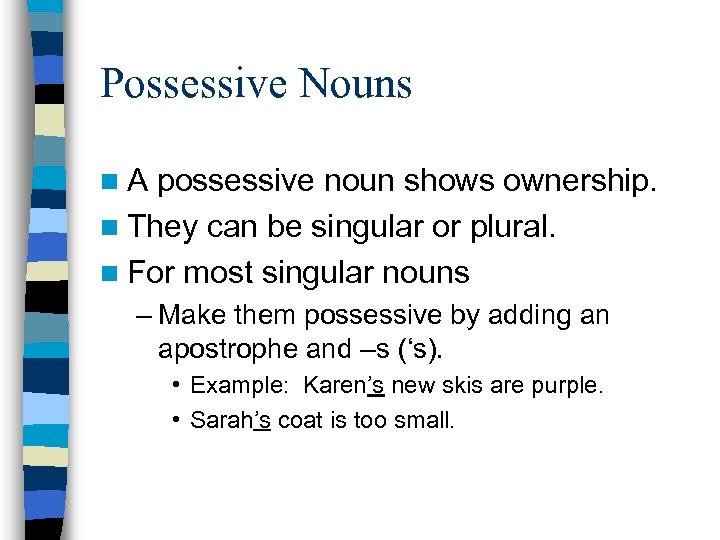 Possessive Nouns n. A possessive noun shows ownership. n They can be singular or plural. n For most singular nouns – Make them possessive by adding an apostrophe and –s (‘s). • Example: Karen’s new skis are purple. • Sarah’s coat is too small.
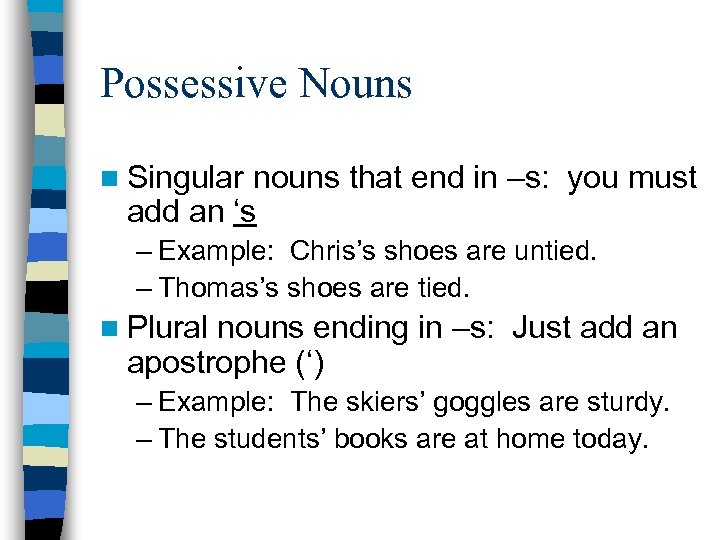 Possessive Nouns n Singular nouns that end in –s: you must add an ‘s – Example: Chris’s shoes are untied. – Thomas’s shoes are tied. n Plural nouns ending in –s: Just add an apostrophe (‘) – Example: The skiers’ goggles are sturdy. – The students’ books are at home today.
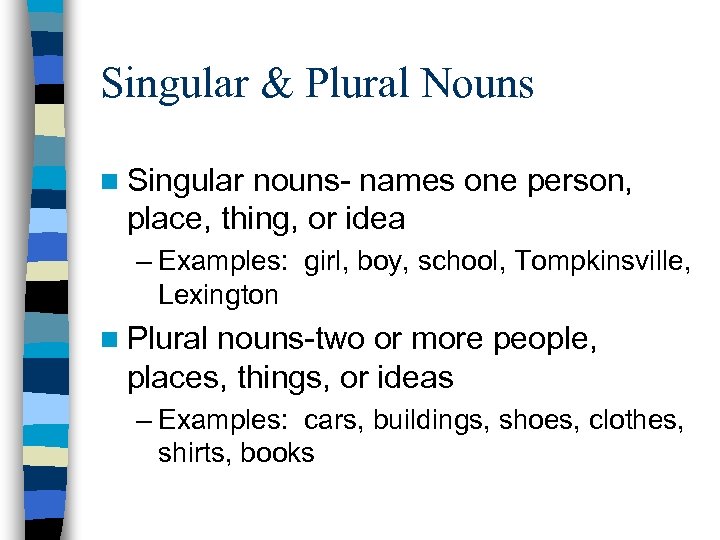 Singular & Plural Nouns n Singular nouns- names one person, place, thing, or idea – Examples: girl, boy, school, Tompkinsville, Lexington n Plural nouns-two or more people, places, things, or ideas – Examples: cars, buildings, shoes, clothes, shirts, books
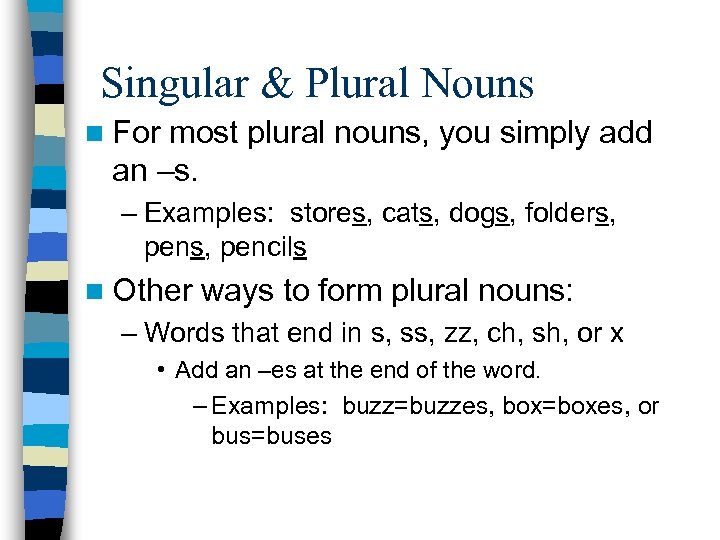 Singular & Plural Nouns n For most plural nouns, you simply add an –s. – Examples: stores, cats, dogs, folders, pencils n Other ways to form plural nouns: – Words that end in s, ss, zz, ch, sh, or x • Add an –es at the end of the word. – Examples: buzz=buzzes, box=boxes, or bus=buses
 Singular & Plural Nouns n If the word ends in –o and has a vowel before it you add an –s. – Examples: studio = studios, stereo=stereos n If the word ends in –o and has a consonant before it, you add –es, usually. – Examples: hero = heroes, potato = potatoes, echo = echoes n Sometimes you only add an –s. – Examples: zero = zeros, photo = photos, piano =pianos.
 Singular & Plural Nouns n Words that end in –y and have a vowel before it, add –s. – Examples: day = days, turkey = turkeys n Words that end in –y and have a consonant before it, change the –y to –i, and add –es, usually. – Examples: family = families, city = cities, penny = pennies
 Singular & Plural Nouns n When a word ends in f or –fe, change the f or –fe to v, and add –es, usually. – Examples: leaf = leaves, wife = wives, life = lives, wolf = wolves n Sometimes you only add an –s. – Examples: roof=roofs, chief=chiefs, belief=beliefs.
 Singular & Plural Nouns n Collective nouns: Names a group of people, places, things – Examples: team, family, class, group, school
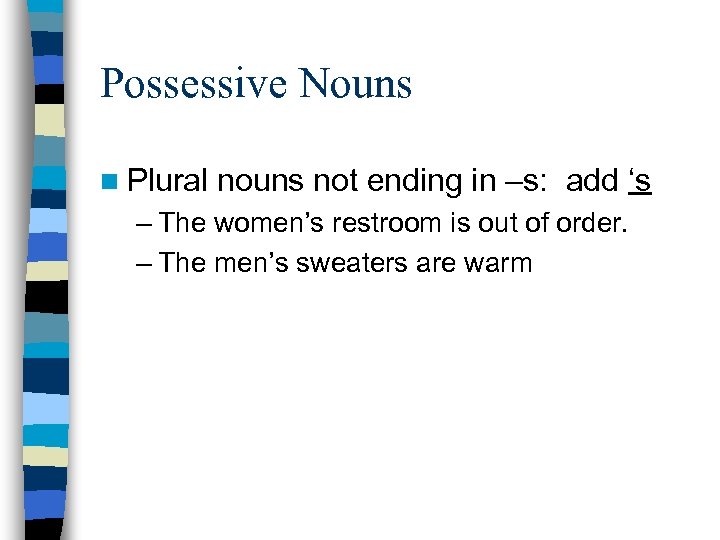 Possessive Nouns n Plural nouns not ending in –s: add ‘s – The women’s restroom is out of order. – The men’s sweaters are warm
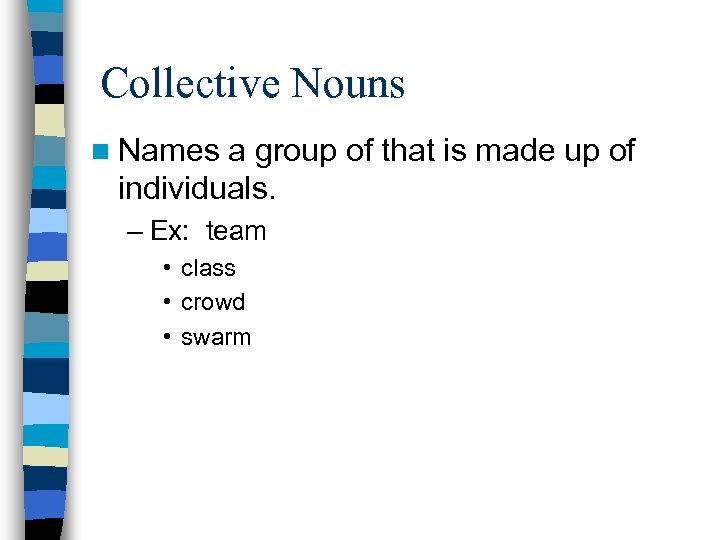 Collective Nouns n Names a group of that is made up of individuals. – Ex: team • class • crowd • swarm
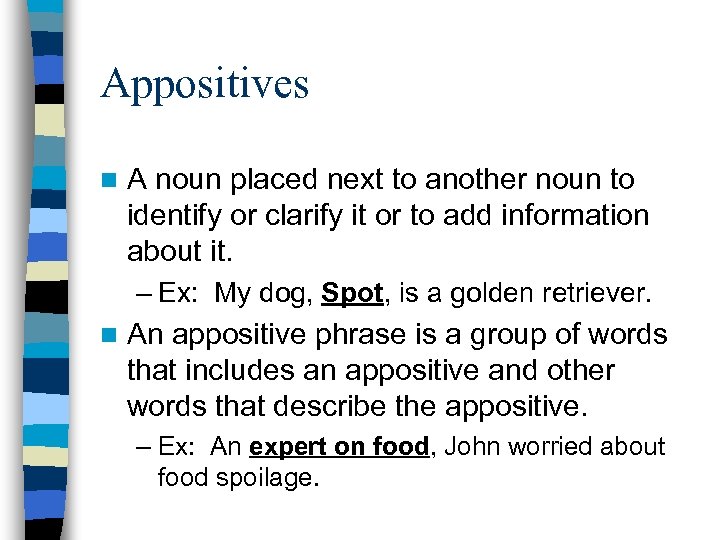 Appositives n A noun placed next to another noun to identify or clarify it or to add information about it. – Ex: My dog, Spot, is a golden retriever. n An appositive phrase is a group of words that includes an appositive and other words that describe the appositive. – Ex: An expert on food, John worried about food spoilage.