


 Скачать презентацию NOUNS FATMA EKİNCİ 1090610150 NOUNS NOUNS
231b927e0ab4605d7508310fc4c9aa32.ppt
- Количество слайдов: 34
 NOUNS FATMA EKİNCİ 1090610150
 NOUNS
NOUNS
 NOUNS What is a noun? The definition of a noun is a word that is used to define a person, animal or living object, place, thing or quality. There are many different kinds of nouns in English.
 Singular Noun Definition ☻ When a noun means one only, it is said to be singular ☻Boy ☻Girl ☻Book ☻Church ☻Box ☻Lamp ☻Cat
 Plural Noun Definition ☻ When a noun means more than one, it is said to be plural ☻Boys ☻Girls ☻Books ☻Churches ☻Boxes ☻Lamps ☻Cats
 ☻ Nouns ending in s, z, x, sh, and ch form the plural by adding - es. ☻Moss mosses ☻Buzz buzzes ☻Box boxes ☻Dish dishes ☻Church churches
 ☻ Nouns ending in - y preceded by a consonant is formed into a plural by changing - y to – ies ☻Lady ladies ☻City cities ☻Army armies
 ☻ Most nouns ending in o preceded by a consonant is formed into a plural by adding es ☻Hero heroes ☻Veto vetoes ☻Buffalo buffaloes
 Irregular Plurals ☻man, men ☻woman, women ☻child, children ☻foot, feet ☻mouse, mice ☻tooth, teeth ☻ox, oxen ☻goose, geese
 What are countable nouns: ☻ A countable noun is a type of noun that can be: ☻ presented in both the singular form and the plural form ☻ represented by a number, such as two cats, five books
 Rules For Using Singular Countable Nouns ¬ A determiner must be used before noun or adverb if adjectives are used such as a, the, this, our etc. ¬ The article “a” or “an” can be used. Rules For Using Plural Countable Nouns ¯ A determiner is optional before noun or adverb if adjectives are used. ¯ The articles "a" or "an" can't be used.
 ¬ Only the number one ¯ Any number bigger than can be used to state the two can be used to state amount. an amount. ¬ Possessive adjectives ¯ Possessive adjectives may be used such as my, may be used such as his, our etc. our, etc. ¬ Quantifiers can't be used. ¯ Quantifiers can be used such as some, any, many, a lot etc.
 ¬ A demonstrative adjectives can be used such as this, those ¯ A demonstrative adjectives can be used such as this, those etc.
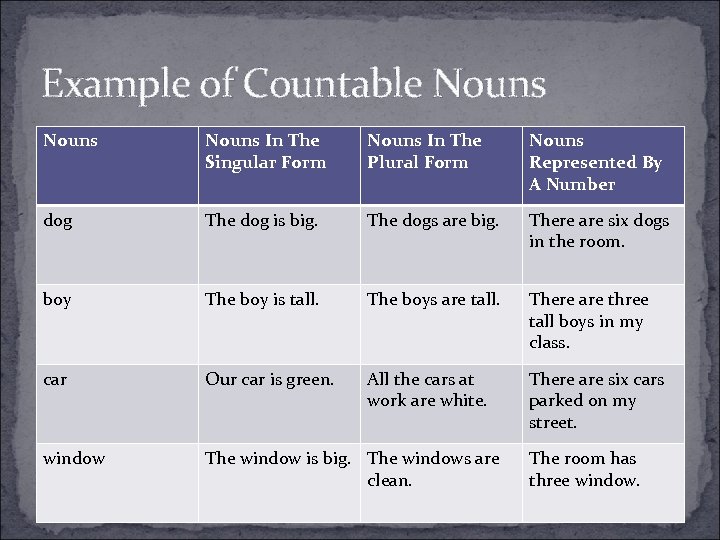 Example of Countable Nouns In The Singular Form Nouns In The Plural Form Nouns Represented By A Number dog The dog is big. The dogs are big. There are six dogs in the room. boy The boy is tall. The boys are tall. There are three tall boys in my class. car Our car is green. All the cars at work are white. There are six cars parked on my street. window The window is big. The windows are clean. The room has three window.
 What are Uncountable nouns? ☺Nouns that can not be represented in the singular form or the plural form ☺For example: water, air, coffee, tea … ☺Nouns that can not be represented by a number are called uncountable nouns ☺It is not possible to say I need 4 air, or 6 sugar.
 Rules for Using Uncountable Nouns: ☼ Uncountable nouns can only be used in the singular tense. ☼ A or an can not be used with uncountable nouns. "The" can be used with uncountable nouns. ☼ Quaintly of uncountable nouns is expressed by the expression "a. . . of. . . ". Examples: a bag of sugar, a bottle of oil.
 What is a collective noun? ☺Collective nouns are nouns that refer to things or people as a unit. ☺Examples: family, police, class, team, crew etc. ☺Collective nouns can be used in both the singular form and the plural form.
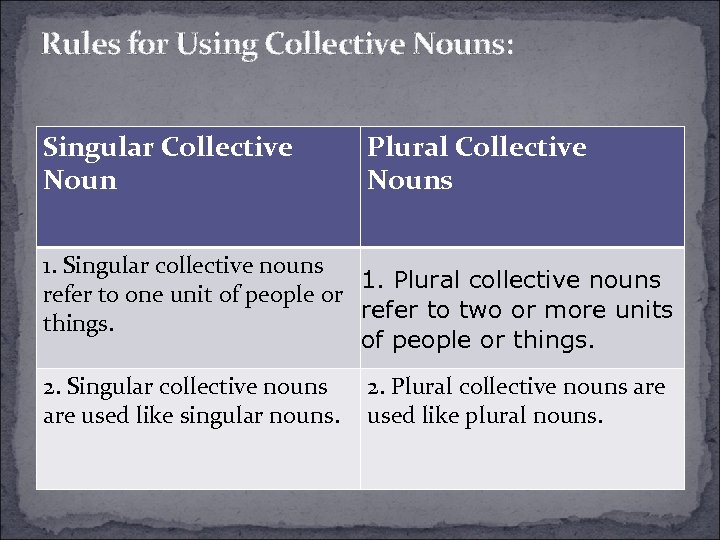 Rules for Using Collective Nouns: Singular Collective Noun Plural Collective Nouns 1. Singular collective nouns 1. Plural collective nouns refer to one unit of people or refer to two or more units things. of people or things. 2. Singular collective nouns are used like singular nouns. 2. Plural collective nouns are used like plural nouns.
 What are common nouns? ☺ A common noun is a noun that refers to a person, thing and place. ☺ Examples: dog, house, picture, computer , windows , paper , people , cat , flower , hospital , milk , bread , trousers , air , water , tea , glass … etc.
 What are proper nouns? ☺ A proper noun is a specific name of a place , a person, or a thing.
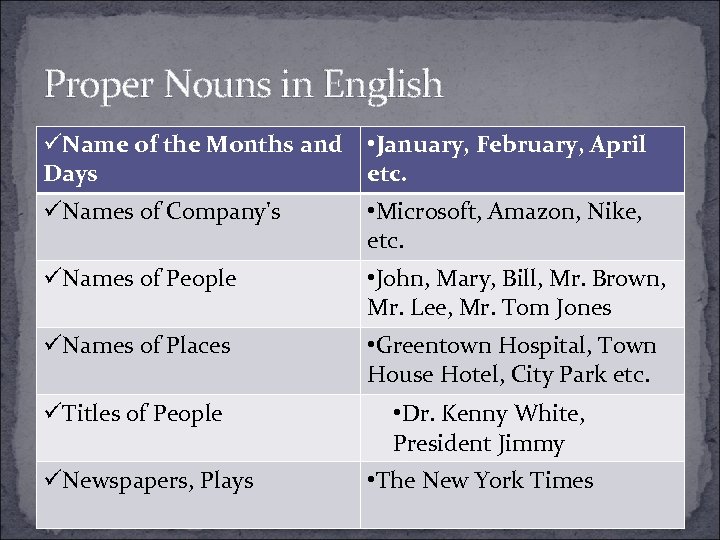 Proper Nouns in English üName of the Months and • January, February, April Days etc. üNames of Company's • Microsoft, Amazon, Nike, etc. üNames of People • John, Mary, Bill, Mr. Brown, Mr. Lee, Mr. Tom Jones üNames of Places • Greentown Hospital, Town House Hotel, City Park etc. üTitles of People • Dr. Kenny White, President Jimmy • The New York Times üNewspapers, Plays
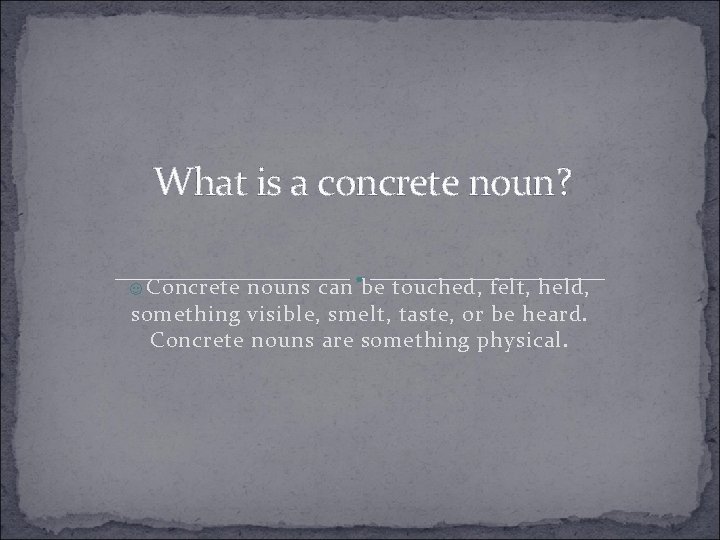 What is a concrete noun? ☺ Concrete nouns can be touched, felt, held, something visible, smelt, taste, or be heard. Concrete nouns are something physical.
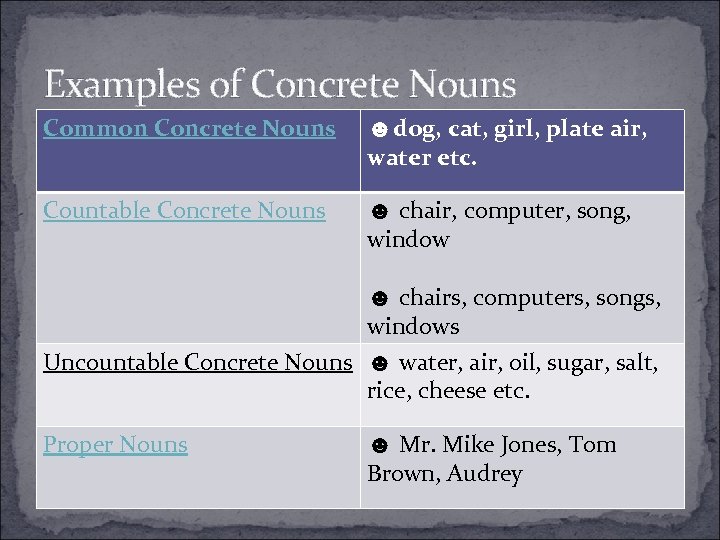 Examples of Concrete Nouns Common Concrete Nouns ☻dog, cat, girl, plate air, water etc. Countable Concrete Nouns ☻ chair, computer, song, window ☻ chairs, computers, songs, windows Uncountable Concrete Nouns ☻ water, air, oil, sugar, salt, rice, cheese etc. Proper Nouns ☻ Mr. Mike Jones, Tom Brown, Audrey
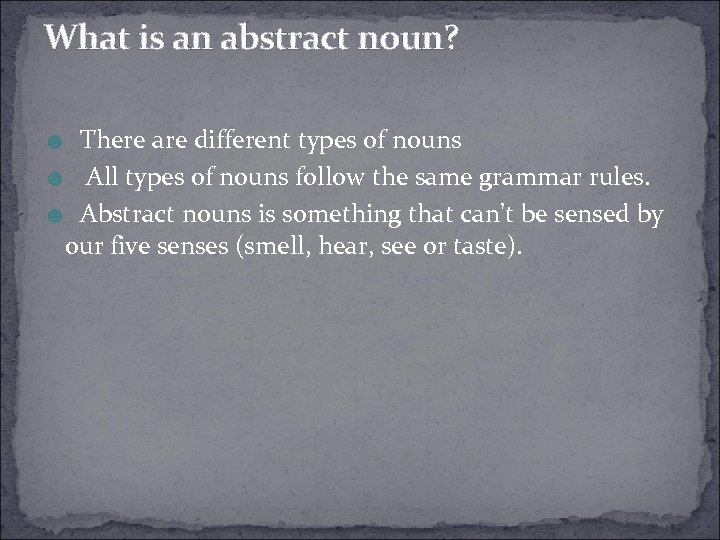 What is an abstract noun? ☻ There are different types of nouns ☻ All types of nouns follow the same grammar rules. ☻ Abstract nouns is something that can't be sensed by our five senses (smell, hear, see or taste).
 ☺ Examples of abstract nouns : ☻ love ☻ hate ☻ violence ☻ culture ☻ taste ☻ feel
 Possessive’s ☻ When we want to show that something belongs to somebody or something, we usually add 's to a singular noun and an apostrophe ' to a plural noun, for example: ☻ the boy's ball (one boy) ☻ the boys' ball (two or more boys)
 ☻ Although we can use of to show possession, it is more usual to use possessive 's. the boyfriend of my sister's boyfriend ☻ We very often use possessive 's with names: This is Mary's car. Where is Ram's telephone? Who took Anthony's pen? I like Tara's hair.
 ☻ When a name ends in s, we usually treat it like any other singular noun, and add 's: This is Charles's chair. ☻ But it is possible (especially with older, classical names) to just add the apostrophe ': Who was Jesus' father?
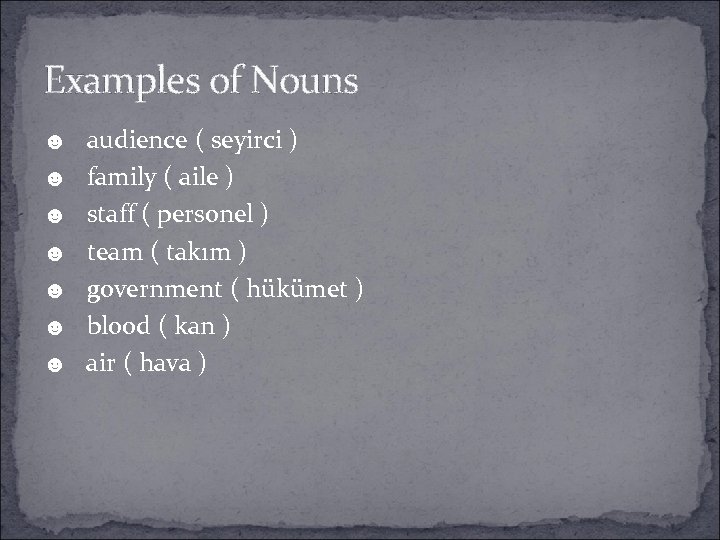 Examples of Nouns ☻ audience ( seyirci ) ☻ family ( aile ) ☻ staff ( personel ) ☻ team ( takım ) ☻ government ( hükümet ) ☻ blood ( kan ) ☻ air ( hava )
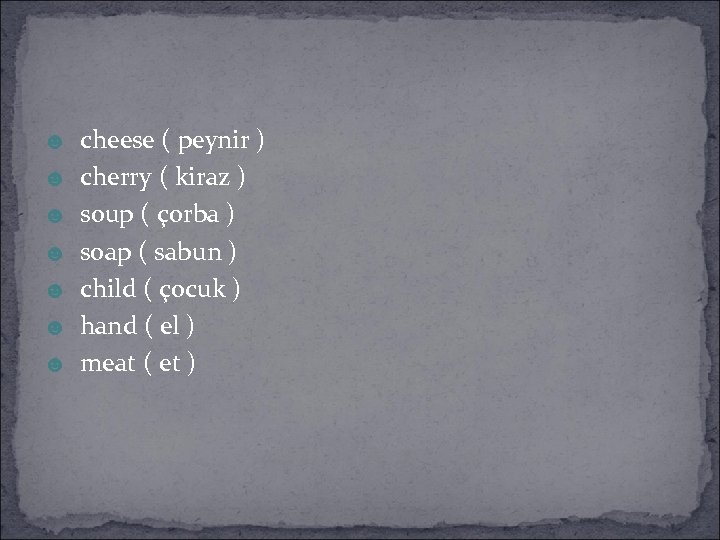 ☻ cheese ( peynir ) ☻ cherry ( kiraz ) ☻ soup ( çorba ) ☻ soap ( sabun ) ☻ child ( çocuk ) ☻ hand ( el ) ☻ meat ( et )
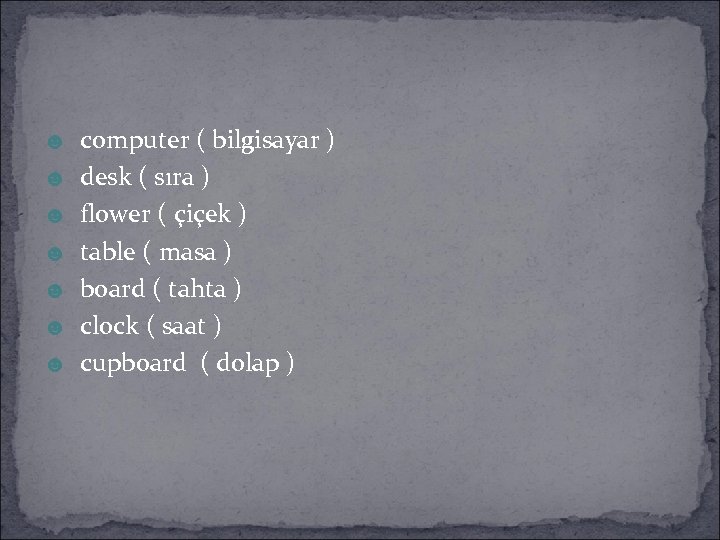 ☻ computer ( bilgisayar ) ☻ desk ( sıra ) ☻ flower ( çiçek ) ☻ table ( masa ) ☻ board ( tahta ) ☻ clock ( saat ) ☻ cupboard ( dolap )
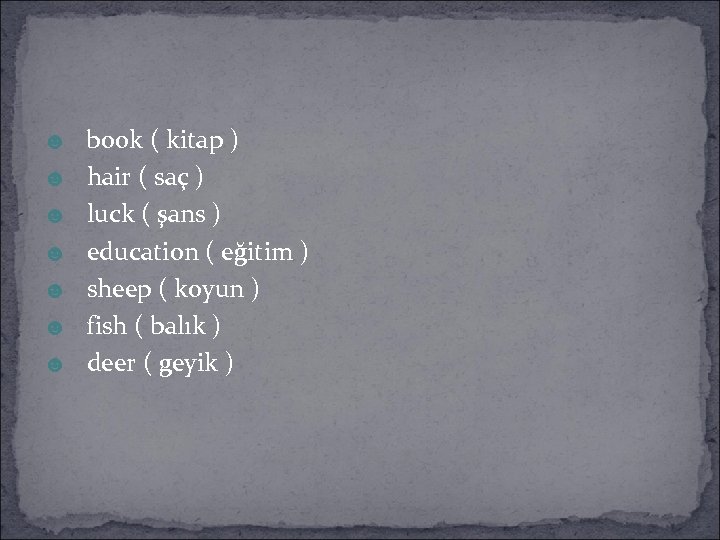 ☻ book ( kitap ) ☻ hair ( saç ) ☻ luck ( şans ) ☻ education ( eğitim ) ☻ sheep ( koyun ) ☻ fish ( balık ) ☻ deer ( geyik )
 Thank You For Your Attention
 ENGLİSH LANGUAGE TEACHİNG FATMA EKİNCİ