


 Скачать презентацию Nouns Expressions of Quantity Unit 4 Grammar
aba86957f0cc4ecdecb7024f4ef2e4ae.ppt
- Количество слайдов: 23
 Nouns & Expressions of Quantity Unit 4 Grammar Form & Function Level 3
 Regular Plural Nouns vs. Irregular Plural Nouns Click on the correct spelling of these REGULAR plural nouns. WRONG bookes Correct – book >> books Correct – factory >> factories WRONG factorys Correct – shelf >> shelves WRONG shelfes Click for next slide.
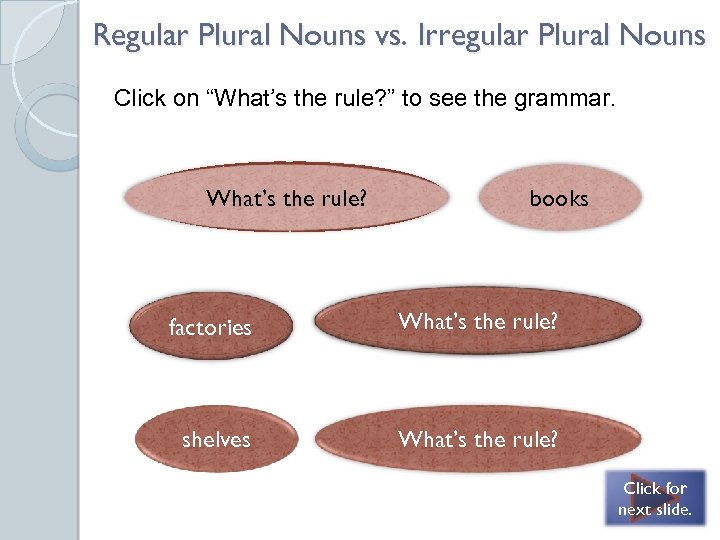 Regular Plural Nouns vs. Irregular Plural Nouns Click on “What’s the rule? ” to see the grammar. Add “-s” to most singular nouns to make What’s the rule? them plural. books factories Change “y” to “i” and What’s the rule? add “-es” shelves Change “f” to “v” and What’s the rule? add “-es” Click for next slide.
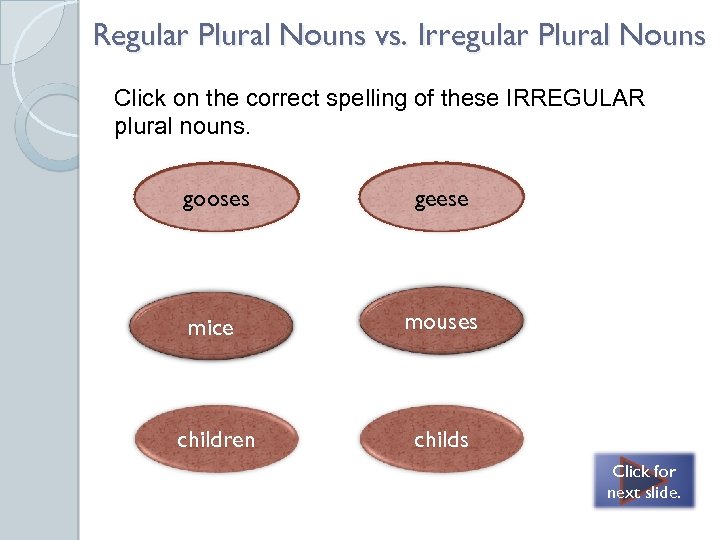 Regular Plural Nouns vs. Irregular Plural Nouns Click on the correct spelling of these IRREGULAR plural nouns. WRONG gooses Correct – goose >> geese Correct – mouse >> mice WRONG mouses Correct – child >> children WRONG childs Click for next slide.
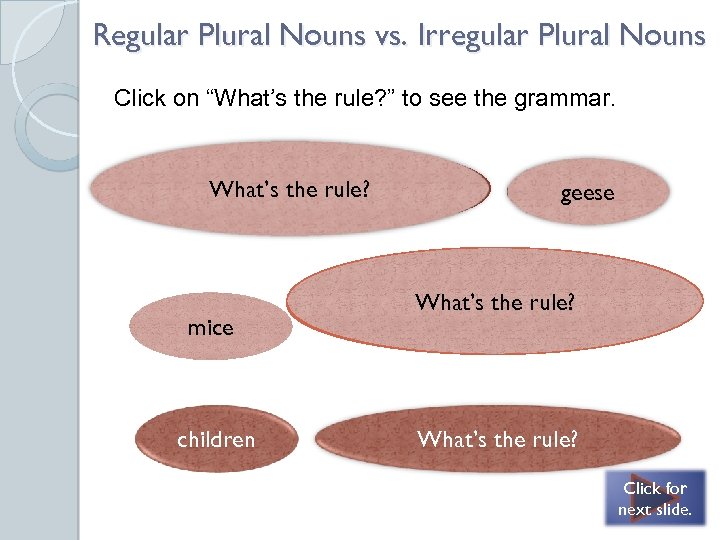 Regular Plural Nouns vs. Irregular Plural Nouns Click on “What’s the rule? ” to see the grammar. Sometimes change “oo” to “ee” – need to memorize when (ex. , What’s the rule? boots is a regular noun). mice children geese Sometimes change the vowels to make it plural – “ou” to “i” (ex. , What’s the rule? house is a regular noun that changes to houses). Sometimes add a syllable What’s the rule? to some nouns – “ren” Click for next slide.
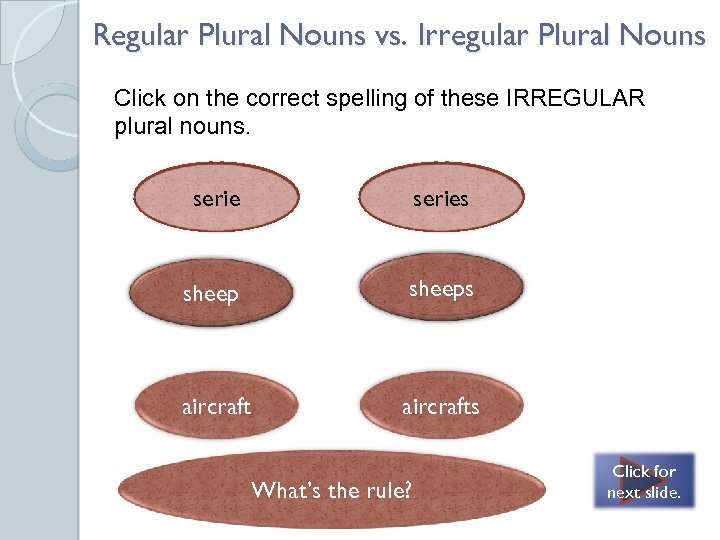 Regular Plural Nouns vs. Irregular Plural Nouns Click on the correct spelling of these IRREGULAR plural nouns. WRONG serie Correct – series >> series Correct – sheep >> sheep WRONG sheeps Correct – aircraft >> aircraft WRONG aircrafts Some nouns have the same What’s the rule? singular and plural form. Click for next slide.
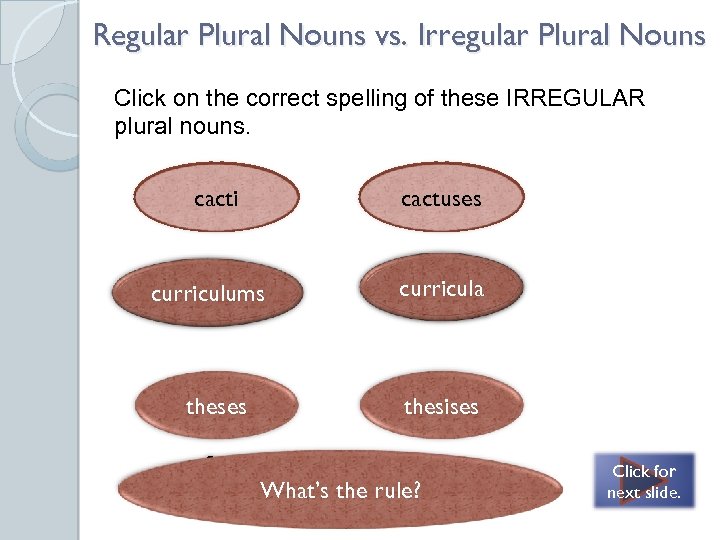 Regular Plural Nouns vs. Irregular Plural Nouns Click on the correct spelling of these IRREGULAR plural nouns. Correct – cactus >> cacti Wrong curriculums Correct – thesis >> theses Wrong cactuses Correct – curriculum curricula >> curricula thesises Wrong Some nouns come from Latin or Greek and the plural endings come What’s the rule? from those languages. Click for next slide.
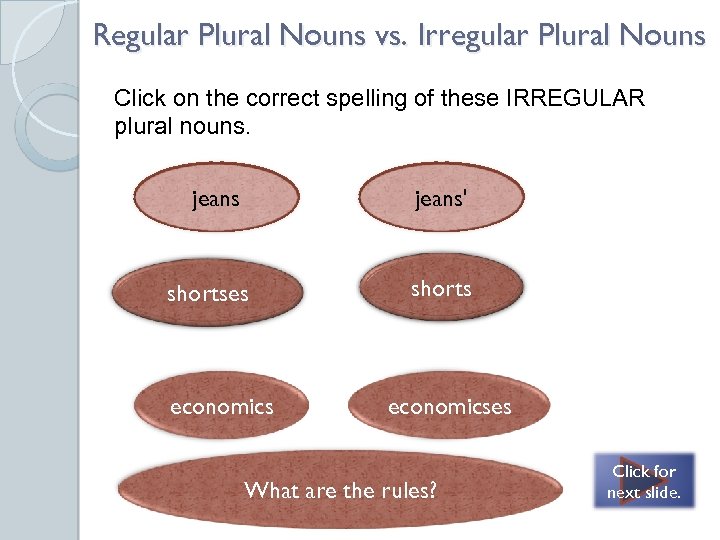 Regular Plural Nouns vs. Irregular Plural Nouns Click on the correct spelling of these IRREGULAR plural nouns. Correct – a pair of jeans >> jeans Wrong jeans' Wrong shortses Correct – a pair of shorts >> shorts Correct – economics >> no plural economicses Wrong Some nouns are only plural and What are only singular. some nouns arethe rules? Click for next slide.
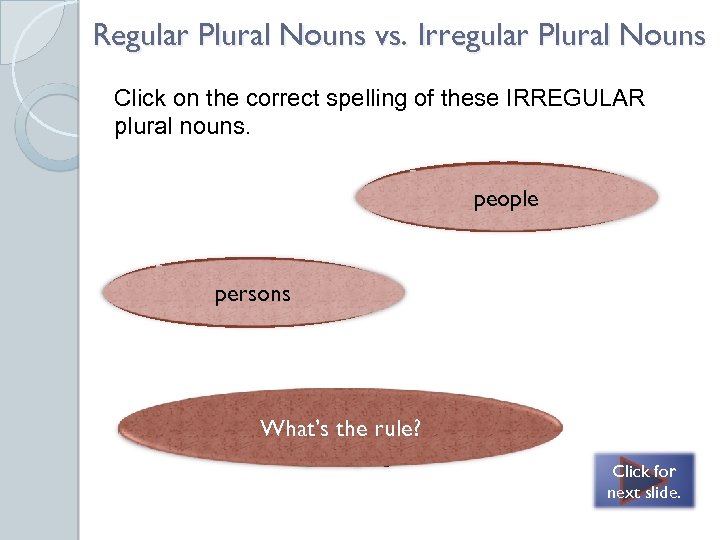 Regular Plural Nouns vs. Irregular Plural Nouns Click on the correct spelling of these IRREGULAR plural nouns. Both are correct plurals – we only people use “persons” in legal language. Both are correct plurals – we onlypersons use “persons” in legal language. The plural of “person” is usually What’s the rule? “people, ” but we can use “persons” in legal language. Click for next slide.
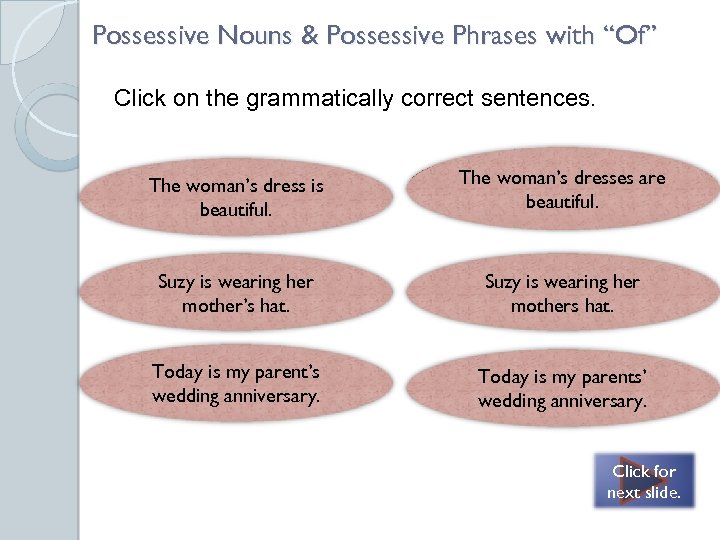 Possessive Nouns & Possessive Phrases with “Of” Click on the grammatically correct sentences. Both are correct – The woman’s dress is possessives can be in front of plural beautiful. nouns. or singular The woman’s dresses are possessives can be in front of plural beautiful. nouns. or singular Correct – Add an Suzy is wearing her Incorrect – need an apostrophe ( ‘ ) mothers hat. Suzy is wearing her apostrophe ( ‘ ) + “-s” to mother’s hat. singular nouns. Incorrect – need an Today is my parent’s apostrophe ( ‘ ) after the wedding anniversary. plural noun “parents” Correct – need an Today is my parents’ apostrophe ( ‘ ) after the wedding anniversary. plural noun “parents” Click for next slide.
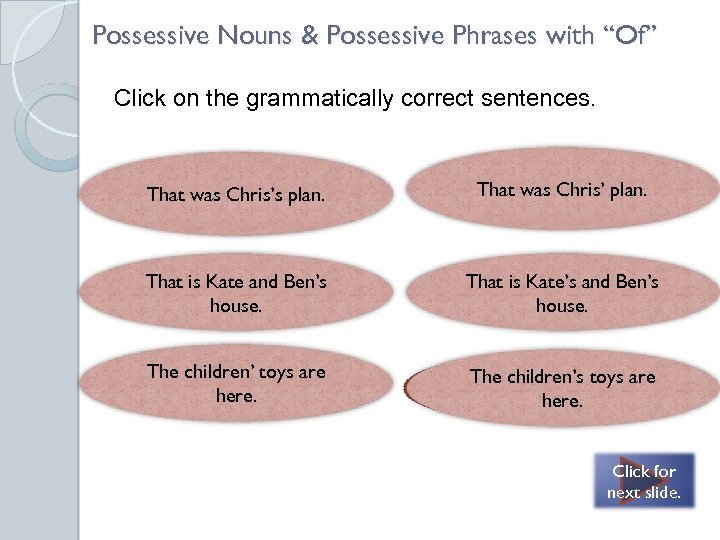 Possessive Nouns & Possessive Phrases with “Of” Click on the grammatically correct sentences. Both are correct – for singular nouns that end in “-s” you can That was “ or just an Chris’s plan. add “ ‘s apostrophe. Both are correct – for singular nouns that end in “-s” you can That was “Chris’ plan. add “ ‘s or just an apostrophe. Correct – Add an apostrophe That is Kate and Ben’s ( ‘ ) + “-s” to the last noun house. only in a possessive phrase. That is Kate’s and Ben’s Incorrect – only need one apostrophe ( ‘ ) house. The children’need an Incorrect – toys are apostrophe ( ‘ ) + “-s” here. Correct – need an apostrophe ( The “-s” because toys are ‘ ) + children’s “children” does not end in “-s” even here. though it is plural. Click for next slide.
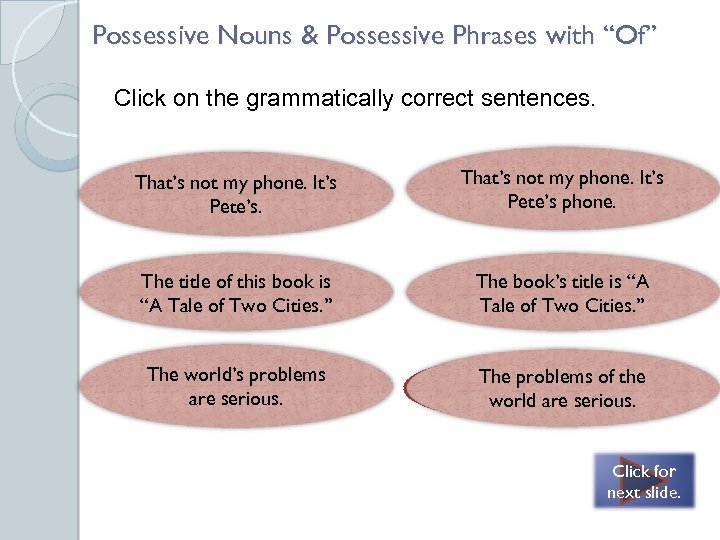 Possessive Nouns & Possessive Phrases with “Of” Click on the grammatically correct sentences. Both are correct – You can That’s not nounphone. It’s omit the my after the possessive noun IF the Pete’s. meaning is very clear. Both are correct – You can That’s not nounphone. It’s omit the my after the possessive noun IF the Pete’s phone. meaning is very clear. Both are correct – With The title of this book is things and locations we can use the “of” possessive phrase “A Tale of Two Cities. ” or “ ‘s”. Both are correct – With The and locations is can things book’s title we “A use the “of”Two Cities. ” Tale of possessive phrase or “ ‘s”. Both are correct – With The world’s problems things and locations we can use the are possessive phrase “of” serious. or “ ‘s”. Both are correct – With things The problems of the and locations we can use the “of” world are serious. ‘s”. possessive phrase or “ Click for next slide.
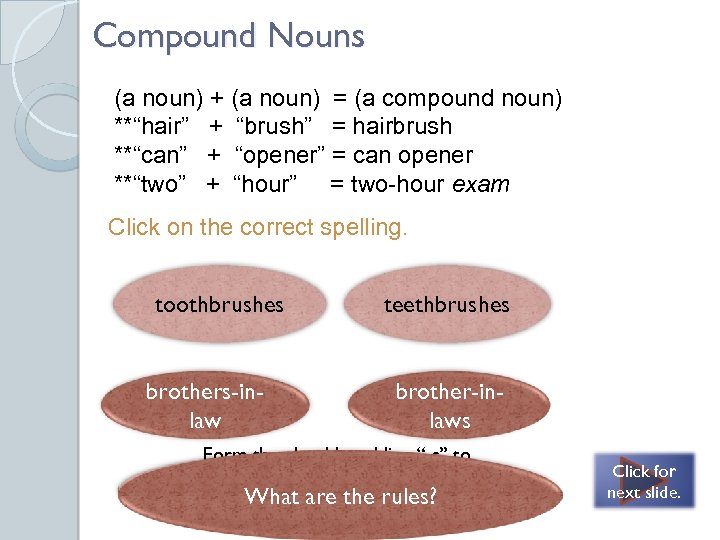 Compound Nouns (a noun) + (a noun) = (a compound noun) **“hair” + “brush” = hairbrush **“can” + “opener” = can opener **“two” + “hour” = two-hour exam Click on the correct spelling. Correct – toothbrush >> toothbrushes Correct – brothers-inin-law >> brotherslaw in-law Wrong teethbrushes brother-in. Wrong laws Form the plural by adding “-s” to the second noun except the “in. What are the rules? law” type. Then add “-s” to the first noun. Click for next slide.
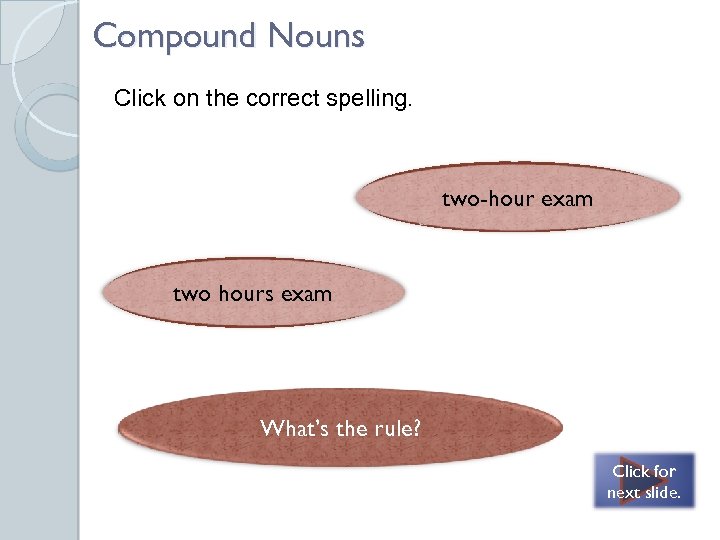 Compound Nouns Click on the correct spelling. Correct – the number makes it plural soexam two-hour you don’t add “-s, ” do use a hyphen. Wrong two hours exam With a number in the compound What’s hypen, but expression, use a the rule? do not add an “-s”. Click for next slide.
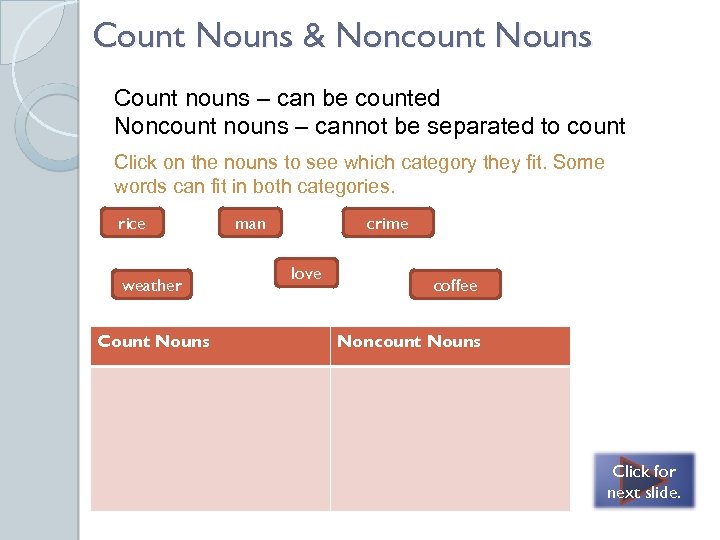 Count Nouns & Noncount Nouns Count nouns – can be counted Noncount nouns – cannot be separated to count Click on the nouns to see which category they fit. Some words can fit in both categories. rice weather Count Nouns man crime love coffee Noncount Nouns Click for next slide.
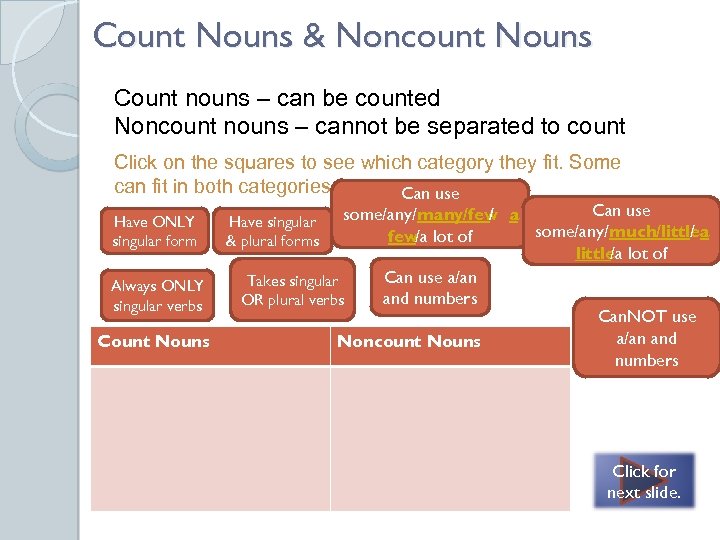 Count Nouns & Noncount Nouns Count nouns – can be counted Noncount nouns – cannot be separated to count Click on the squares to see which category they fit. Some can fit in both categories. Can use Have ONLY singular form Always ONLY singular verbs Count Nouns Can use some/any/many/few a / some/any/much/littlea / few/a lot of little lot of /a Can use a/an Takes singular and numbers OR plural verbs Can. NOT use a/an and Noncount Nouns numbers Have singular & plural forms Click for next slide.
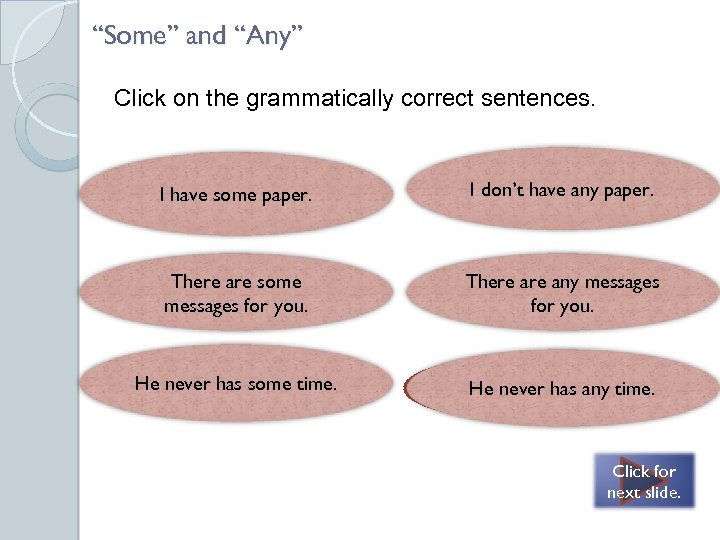 “Some” and “Any” Click on the grammatically correct sentences. Both are correct – Use “some” and “any” with plural I have some paper. nouns and noncount nouns Both are correct – Use “some” and “any” with plural I don’t have any paper. nouns and noncount nouns Correct – Use “some” in There are some positive sentences and “any” in messages for usually. negative sentences you. There any messages Incorrect for you. Incorrect He never has some time. Correct – Use “any” after negative words like He never has any time. “never/seldom/rarely/hardly/ without” Click for next slide.
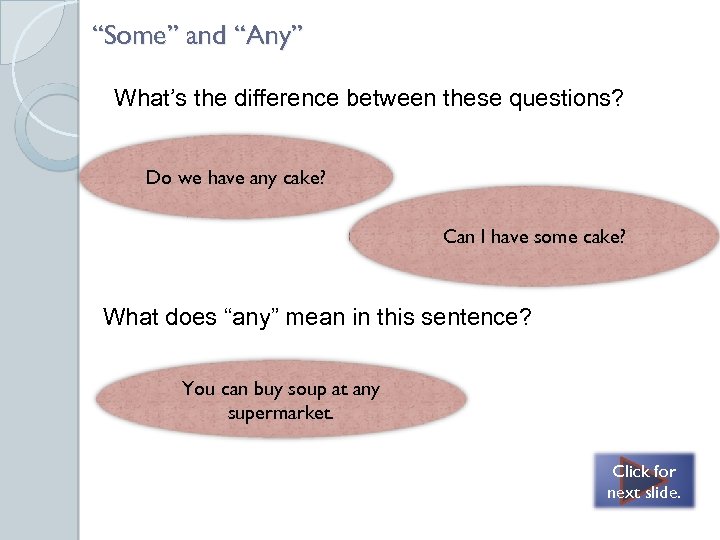 “Some” and “Any” What’s the difference between these questions? Use “any” when you expect a negative answer or don’t Do we have any cake? know what to expect. Use “some” when you expect the answer to be “yes” or you Can I have some cake? want to influence someone to say “yes. ” What does “any” mean in this sentence? You can buy soup at any It doesn’t matter at which supermarket you buy soup. supermarket. Click for next slide.
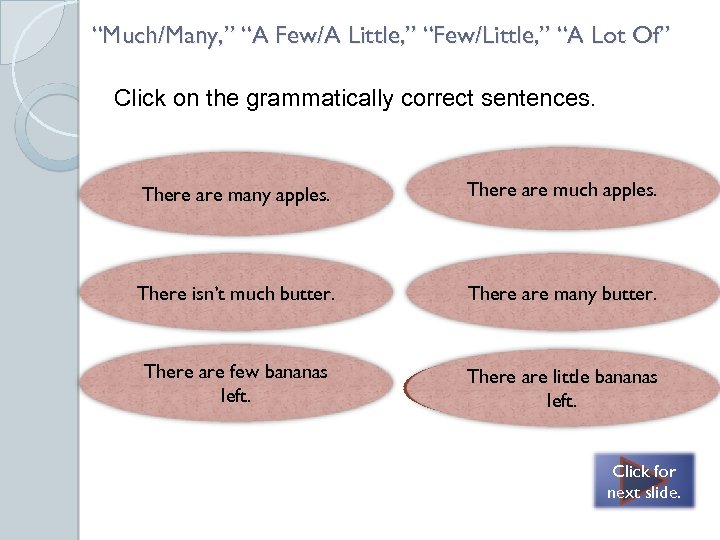 “Much/Many, ” “A Few/A Little, ” “Few/Little, ” “A Lot Of” Click on the grammatically correct sentences. Correct – Use “many” with plural count many apples. There are nouns (or “a lot of”) Wrong There are much apples. There isn’t much butter. noncount nouns (or “a lot of”) Correct – Use “much” with Incorrect There are many butter. There – Use “few” with Correctare few bananas plural count nouns left. There are little bananas Wrong left. Click for next slide.
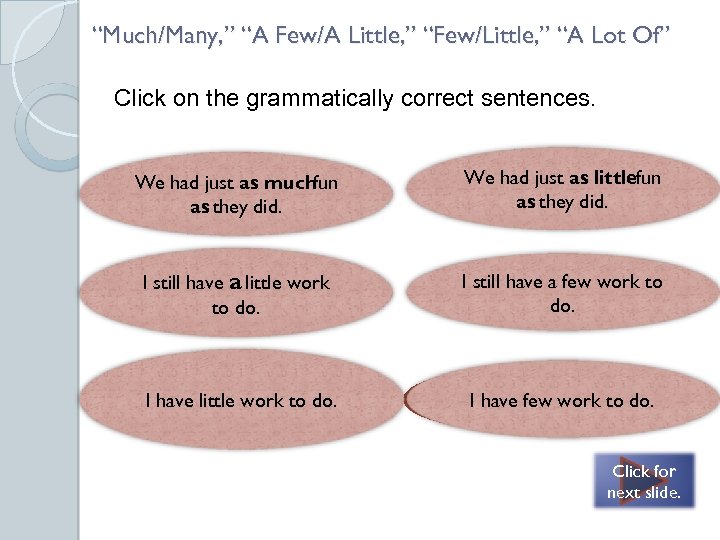 “Much/Many, ” “A Few/A Little, ” “Few/Little, ” “A Lot Of” Click on the grammatically correct sentences. Correct Use “much/many” We had –just as muchfun in affirmative sentences after as they did. “too/as/so/very” We had just as littlefun Wrong as they did. I still have a little work noncount nouns -- “a little/ a few” have to do. meanings positive Correct – Use “a little” with I still have a few work to Incorrect do. Correct – Use “little” with noncount nouns – I have little work to do. “little/few” have negative meanings Wrong I have few work to do. Click for next slide.
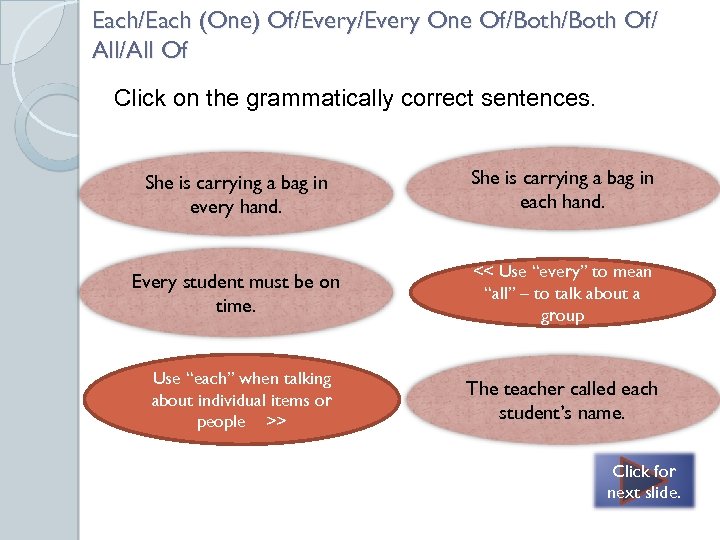 Each/Each (One) Of/Every One Of/Both Of/ All/All Of Click on the grammatically correct sentences. She is carrying a bag in Wrong every hand. Correct – Use “each” for two She is carrying a bag in things or people, “every” for each hand. three or more Every student must be on time. << Use “every” to mean “all” – to talk about a group Use “each” when talking about individual items or people >> The teacher called each student’s name. Click for next slide.
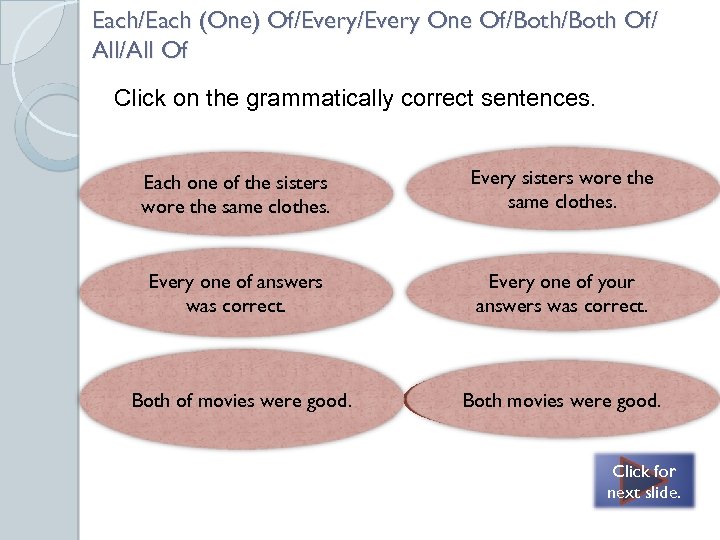 Each/Each (One) Of/Every One Of/Both Of/ All/All Of Click on the grammatically correct sentences. Correct – Use “each of” and Each one of the sisters “every one of” with plural wore the same clothes. count nouns Every sisters wore the Wrong same clothes. Every one of answers Wrong was correct. Use. Every one of your “the/those/these/your” with plural count nouns answers was correct. Wrong Both of movies were good. Correct – Use “both” OR “both of the” to talk about two Both movies were good. things Click for next slide.
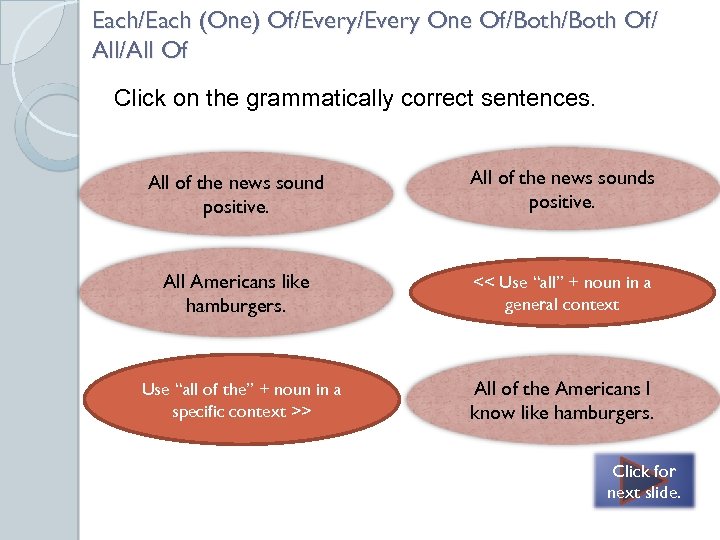 Each/Each (One) Of/Every One Of/Both Of/ All/All Of Click on the grammatically correct sentences. All of the news sound Wrong positive. All of – Use a singular verb Correct the news sounds with “all” + noncount noun positive. All Americans like hamburgers. << Use “all” + noun in a general context Use “all of the” + noun in a specific context >> All of the Americans I know like hamburgers. Click for next slide.