


 Скачать презентацию Nouns A Person Place or Thing August 12
c1765e4a924de2fccd464c1ef33f6129.ppt
- Количество слайдов: 13
 Nouns: A Person, Place or Thing August 12, 2008
 What is a noun? A noun is the subject of a sentence n A noun is a person, place or thing n In the following sentence, what is the noun? n n Jack runs. ‘Jack’ is the noun. An article (a, an, the) usually precedes a noun. Ex: The cat is hiding in the tree.
 Examples of Nouns Brianna n cat n mall n Atlanta n Oxford Middle School n shoes n Judge n
 Types of Nouns Proper Nouns n Common Nouns n Plural Nouns n Possessive Nouns n Concrete Nouns n Abstract Nouns n
 Proper Nouns n n n A proper noun is a specific person, place or thing A proper noun usually begins with a capital letter Examples are days of the week, holidays, religions, months, organizations, institutions and names Oxford Middle School is a proper noun Ally is a proper noun
 Common Nouns A common noun refers to a person, place or thing in a general sense n Common nouns only begin with a capital letter when they are at the beginning of a sentence n Examples include: dog, house, car, sidewalk, school, work, book, newspaper, beach, towel n
 Plural Nouns Plural nouns indicate more than one person or thing n Plural nouns end in ‘s’ or ‘es’ n Examples include: boxes (plural for box), hats (plural for hat), pencils (plural for pencil) n
 Possessive Nouns A possessive noun is a noun that changes its form to show it owns something else n A possessive noun is formed by adding an apostrophe and an ‘s’ (for plural possessive you only add an apostrophe) n Examples: Sophie’s, teacher’s, tree’s n
 Types of Nouns A noun can be more than one type of noun n Mrs. Martin’s class is the best class n In this case, ‘Mrs. Martin’s’ is both a proper noun and a possessive noun. Mrs. Martin is also a concrete noun n
 Concrete Nouns A concrete noun is any object or person that can be experienced through your senses: sight, sound, taste, touch, smell n Example: judge, dog, beach, wave, book n
 Abstract Nouns An abstract noun cannot be experienced through the senses n Examples: thought, memory, childhood, daydream, justice, peace n
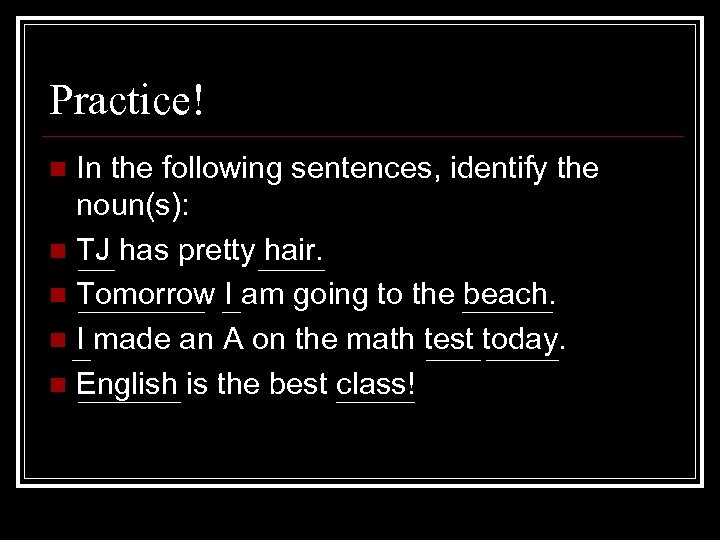 Practice! In the following sentences, identify the noun(s): n TJ has pretty hair. n Tomorrow I am going to the beach. n I made an A on the math test today. n English is the best class! n
 Your turn! n Give at least one example for each of the following: n n n Common noun Proper noun Possessive noun Plural Noun Concrete Noun