


 Скачать презентацию Nouns 1 Kinds of Nouns A Noun
4969bfa540c95b5a265dfdcc42c62d02.ppt
- Количество слайдов: 93
 Nouns 1 Kinds of Nouns
 A Noun is a word used as the name of a person, place or thing. Sallahudeen was a wise king. The noun Sallahudeen refers to a particular king, but the noun king can be applied to any other king as well as to Sallahudeen.
 Kinds of Nouns We call Sallahudeen a Proper Noun, and a king a Common Noun. Mona is a Proper Noun, while girl is a Common Noun. Ali is a Proper Noun, While boy is a Common Noun.
 Cairo is a Proper Noun, While town is a Common Noun. Egypt is a Proper Noun, While country is a Common Noun.
 The word girl is a Common Noun because it is a name common to all girls, while Mona is a Proper Noun because it is the name of a particular girl
 Def. _ A common Noun is a name given in common to every person or thing of the same class or kind. (Common here means shared by all).
 Def. _ A Proper Noun is the name of some Particular person or place. (Proper means one’s own. Hence a Proper Name is a person’s own name)
 Note 1_ Proper Nouns are always written with a capital letter at the beginning. Note 2_ Proper Nouns are sometimes used as Common Nouns; as in: He is the Shakespeare (= the greatest dramatist) of his time.
 Common Nouns include what are called Collective Nouns and Abstract Nouns. A collective Noun is the name of a number (or collection) of persons or things taken together and spoken as one whole; as, Crowd, mob, team, flock, herd, army, fleet, jury, family, nation, parliament, committee.
 A fleet = a collection of ships or vessels. An army = a collection of soldiers. A crowd = a collection of people. The police dispersed the crowd. The French army was defeated in Waterloo. The herd of cattle is passing.
 An Abstract Noun is usually the name of a quality, action, or state considered a part from the object which belongs to; as,
 Quality_ Goodness, kindness, whiteness, darkness, hardness, brightness, honesty, wisdom, bravery. Action_ Laughter, theft, movement, judgment, hatred. State_ Childhood, boyhood, youth, slavery, sleep, sickness, death, poverty. The names of Arts and Science (e. g. , grammar, music, chemistry etc. ) are also Abstract Nouns.
 Abstract Nouns are formed_ (1) From adjectives; as, kindness from kind; honesty from honest. (2) From Verbs; as, Obedience from obey; growth from grow. (3) From Common Nouns; as, Childhood from child; slavery from slave.
 Exercise 1. 2. 3. 4. 5. Point out the nouns in the following sentences, and say whether they are Common, Proper, Collective or Abstract: The crowd was very big. Always say the truth. We all love honesty. Our class consists of twenty pupils. The elephant has great srtrength.
 6. Solomon was famous for his wisdom. 7. Cleanliness is wonderful. 8. We saw a fleet of ships in the harbor. 9. The class is studying grammar. 10. The Nile overflows its banks every year.
 Answers 1. 2. 3. 4. 5. 6. 7. 8. 9. 10. crowd: Collective truth: Abstract honesty: Abstract class: Collective/ pupils: Common elephant: Common/ strength: Abstract Solomon: Proper/ wisdom: Abstract Cleanliness: Abstract. fleet: collective/ harbor: Common class: collective/ grammar: Abstract Nile: Proper/ bank, year: Common
 Regular and Irregular Plural Nouns
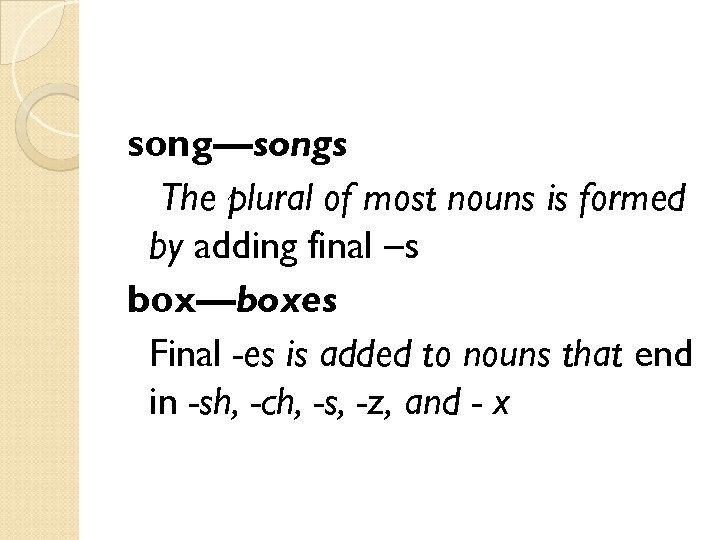 song—songs The plural of most nouns is formed by adding final –s box—boxes Final -es is added to nouns that end in -sh, -ch, -s, -z, and - x
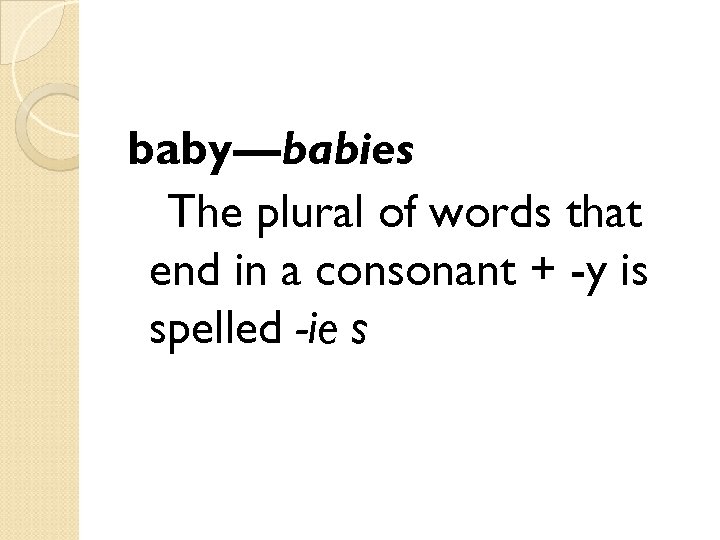 baby—babies The plural of words that end in a consonant + -y is spelled -ie s
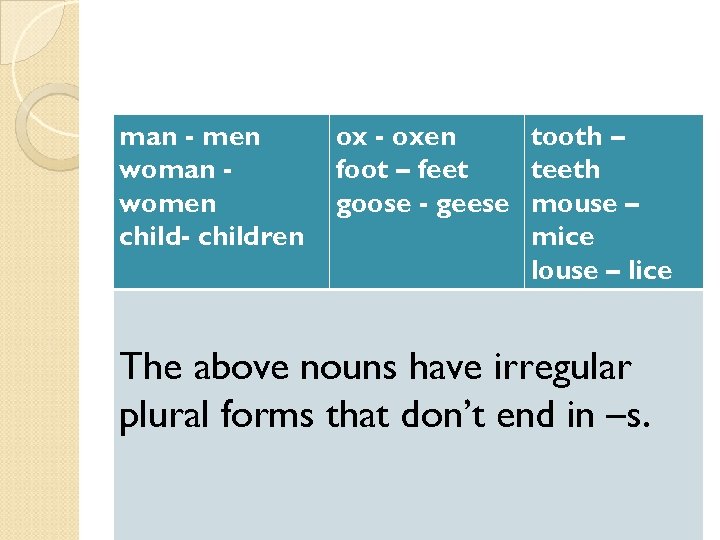 man - men woman women child- children ox - oxen tooth – foot – feet teeth goose - geese mouse – mice louse – lice The above nouns have irregular plural forms that don’t end in –s.
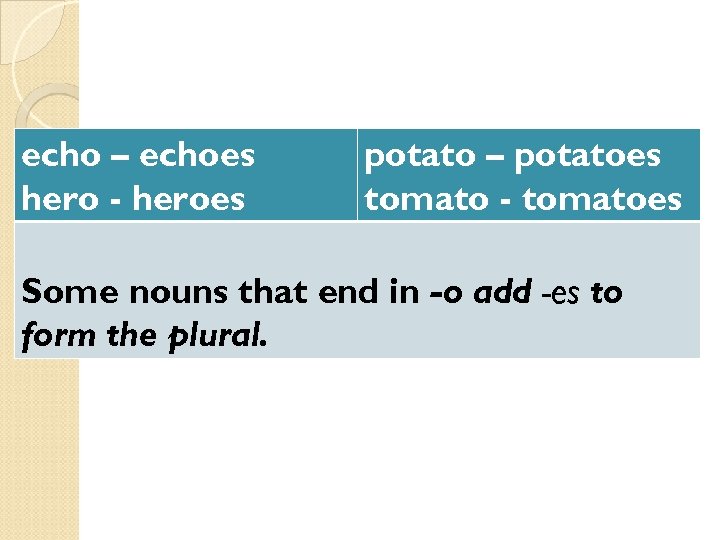 echo – echoes hero - heroes potato – potatoes tomato - tomatoes Some nouns that end in -o add -es to form the plural.
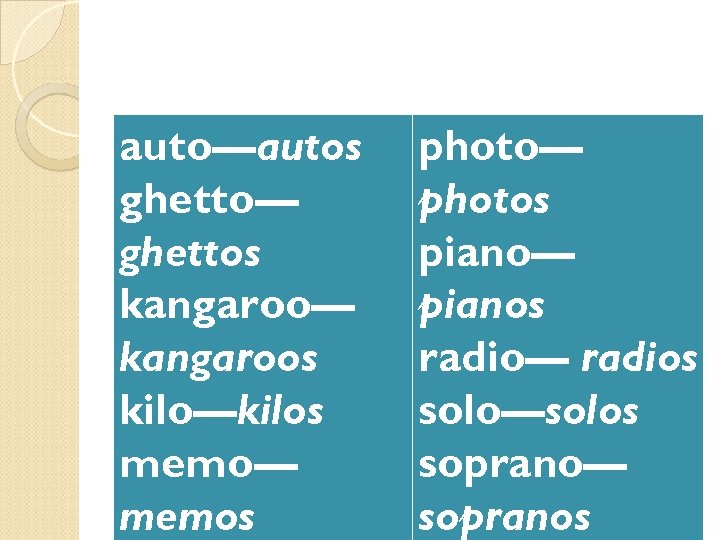 auto—autos ghetto— ghettos kangaroo— kangaroos kilo—kilos memo— memos photo— photos piano— pianos radio— radios solo—solos soprano— sopranos
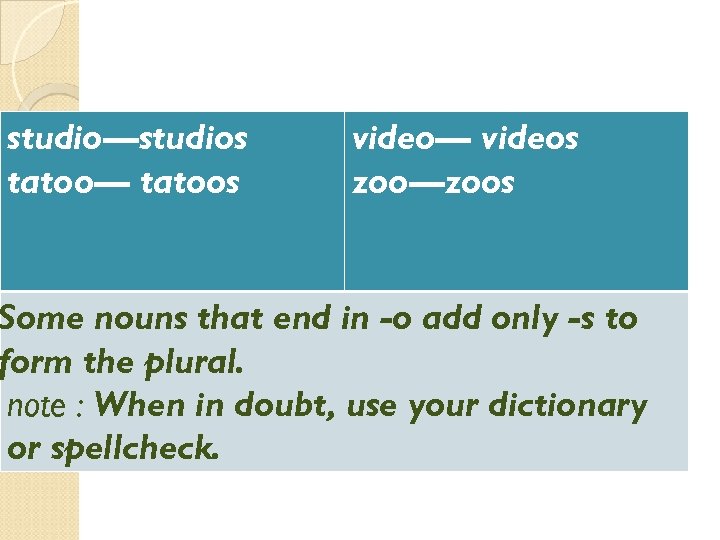 studio—studios tatoo— tatoos video— videos zoo—zoos Some nouns that end in -o add only -s to form the plural. note : When in doubt, use your dictionary or spellcheck.
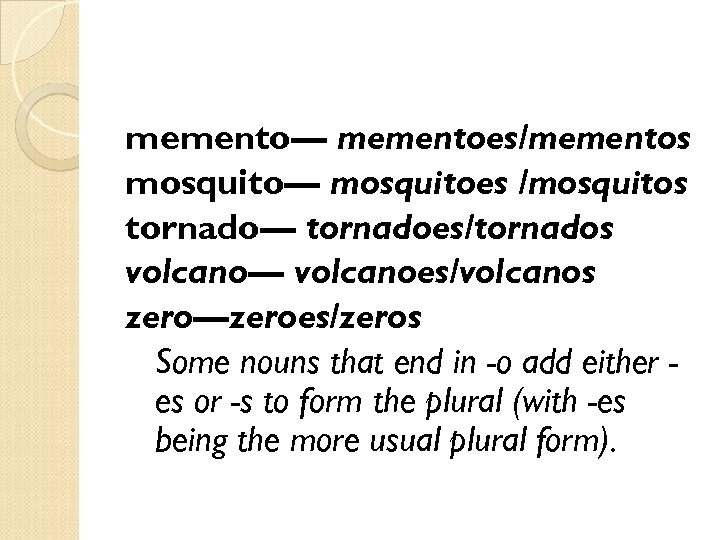 memento— mementoes/mementos mosquito— mosquitoes /mosquitos tornado— tornadoes/tornados volcano— volcanoes/volcanos zero—zeroes/zeros Some nouns that end in -o add either es or -s to form the plural (with -es being the more usual plural form).
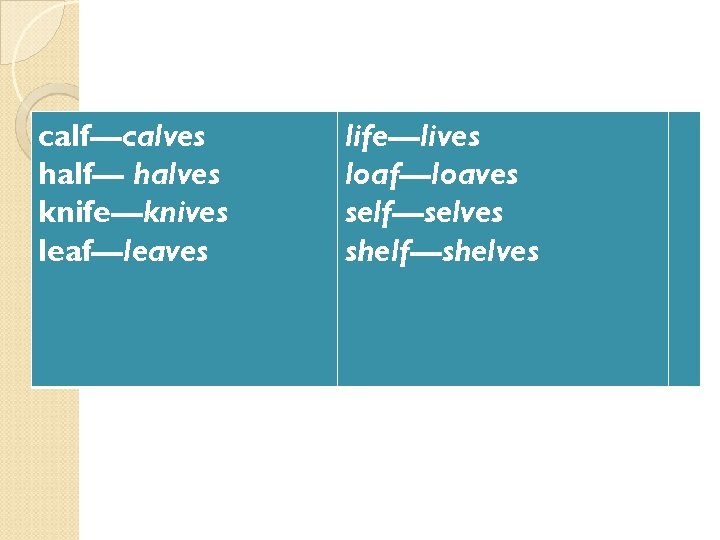 calf—calves half— halves knife—knives leaf—leaves life—lives loaf—loaves self—selves shelf—shelves
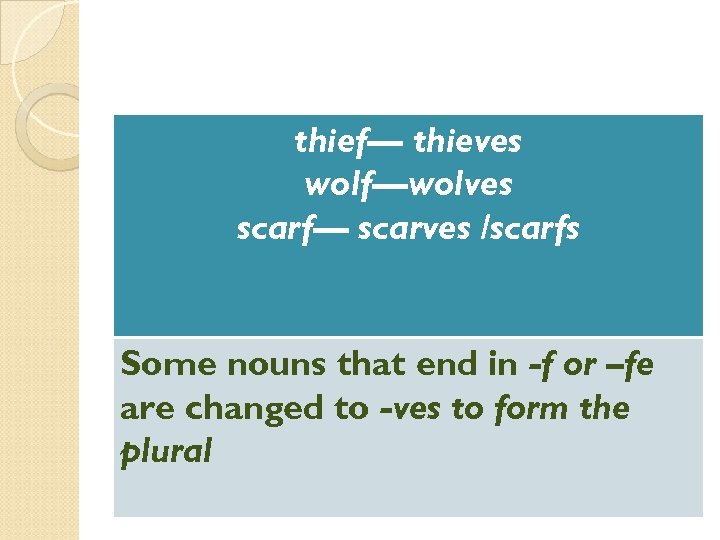 thief— thieves wolf—wolves scarf— scarves /scarfs Some nouns that end in -f or –fe are changed to -ves to form the plural
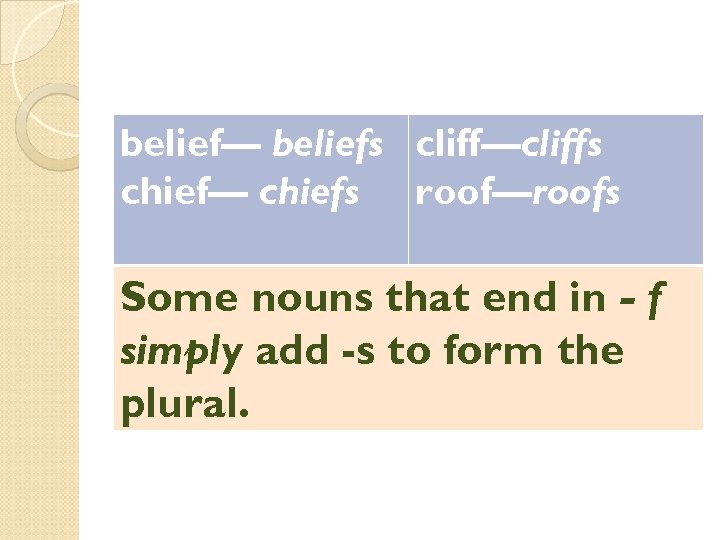 belief— beliefs cliff—cliffs chief— chiefs roof—roofs Some nouns that end in - f simply add -s to form the plural.
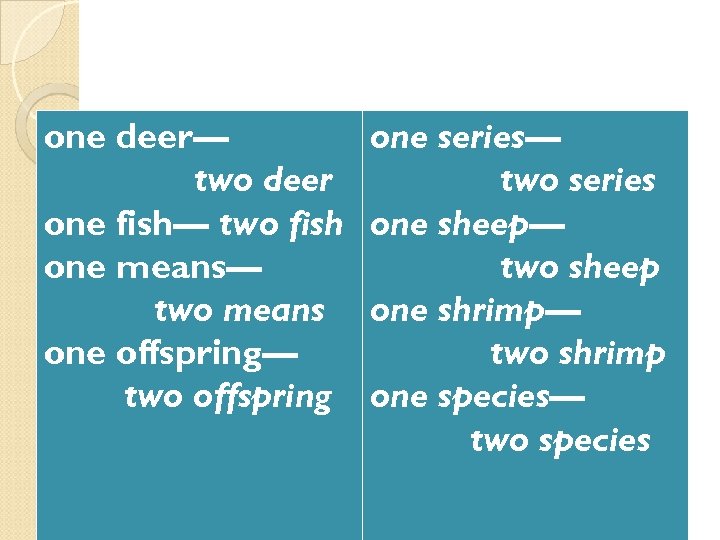 one deer— two deer one fish— two fish one means— two means one offspring— two offspring one series— two series one sheep— two sheep one shrimp— two shrimp one species— two species
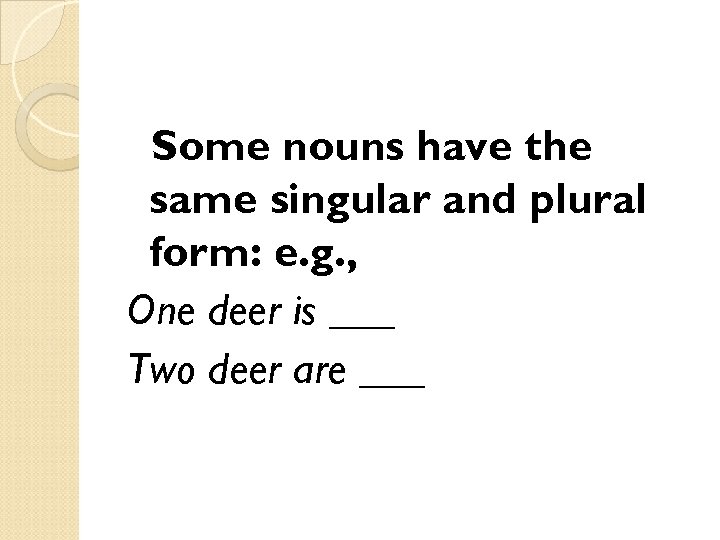 Some nouns have the same singular and plural form: e. g. , One deer is ___ Two deer are ___
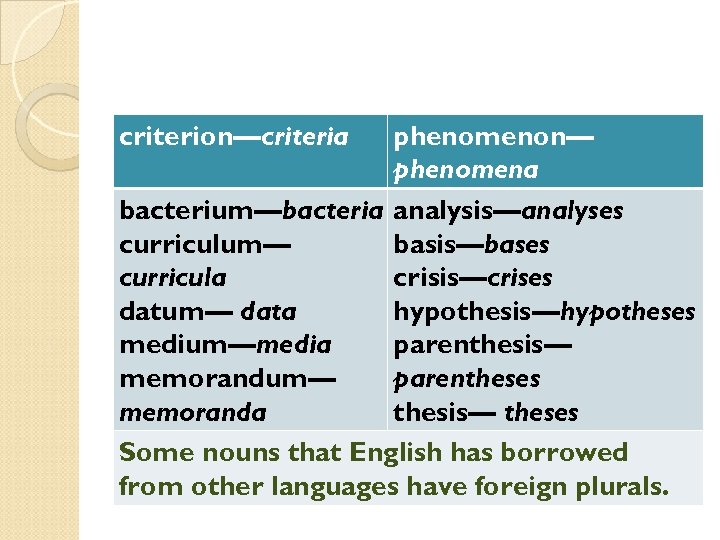 criterion—criteria phenomenon— phenomena bacterium—bacteria analysis—analyses curriculum— basis—bases curricula crisis—crises datum— data hypothesis—hypotheses medium—media parenthesis— memorandum— parentheses memoranda thesis— theses Some nouns that English has borrowed from other languages have foreign plurals.
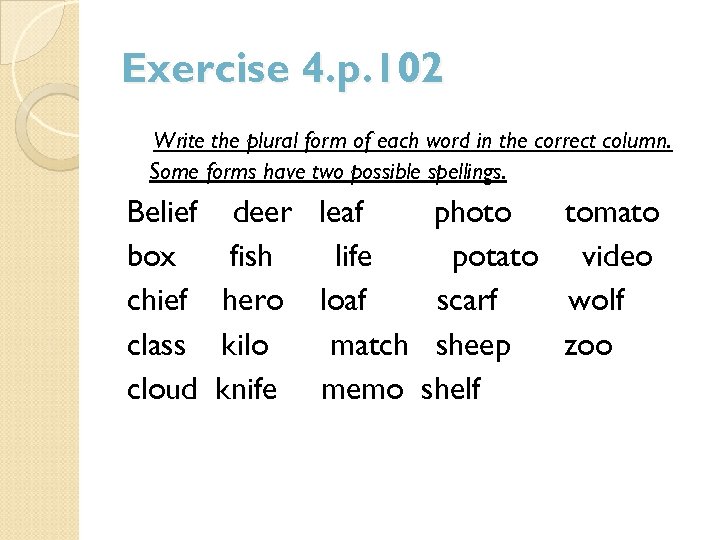 Exercise 4. p. 102 Write the plural form of each word in the correct column. Some forms have two possible spellings. Belief box chief class cloud deer leaf fish life hero loaf kilo match knife memo photo tomato potato video scarf wolf sheep zoo shelf
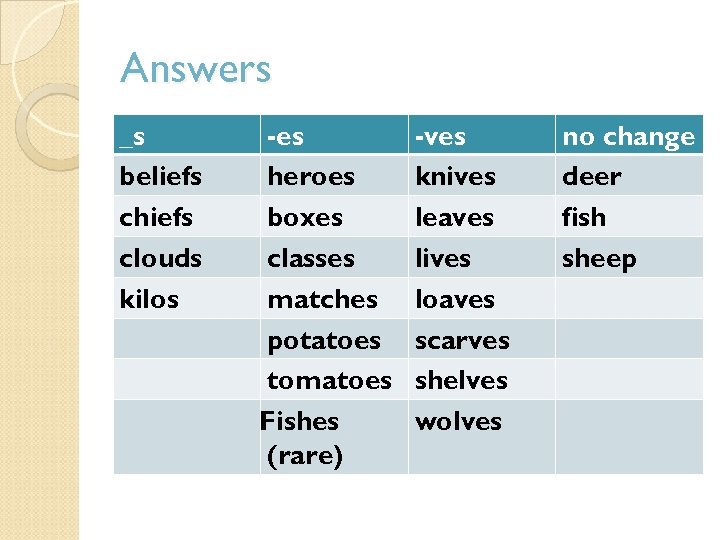 Answers _s beliefs chiefs clouds kilos -es heroes boxes classes matches potatoes tomatoes Fishes (rare) -ves knives leaves lives loaves scarves shelves wolves no change deer fish sheep
 Exercise 5, p. 103 Homework
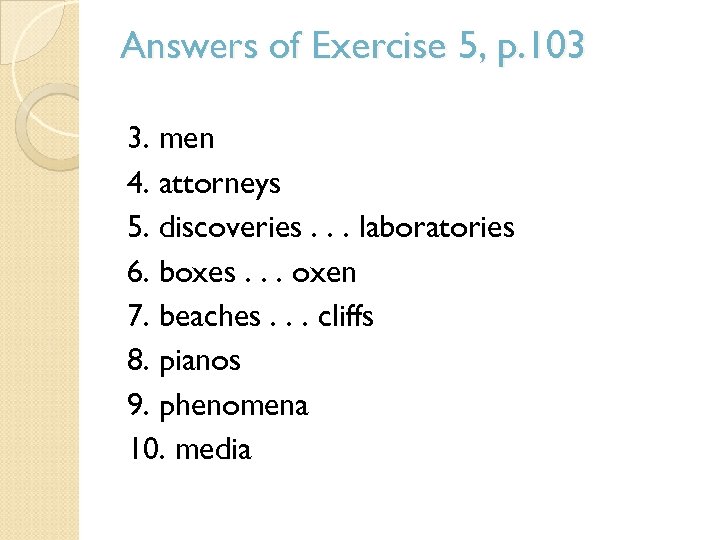 Answers of Exercise 5, p. 103 3. men 4. attorneys 5. discoveries. . . laboratories 6. boxes. . . oxen 7. beaches. . . cliffs 8. pianos 9. phenomena 10. media
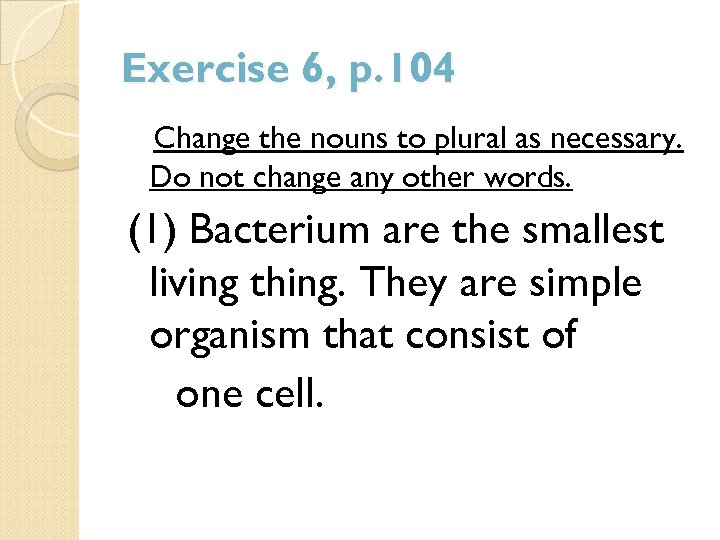 Exercise 6, p. 104 Change the nouns to plural as necessary. Do not change any other words. (1) Bacterium are the smallest living thing. They are simple organism that consist of one cell.
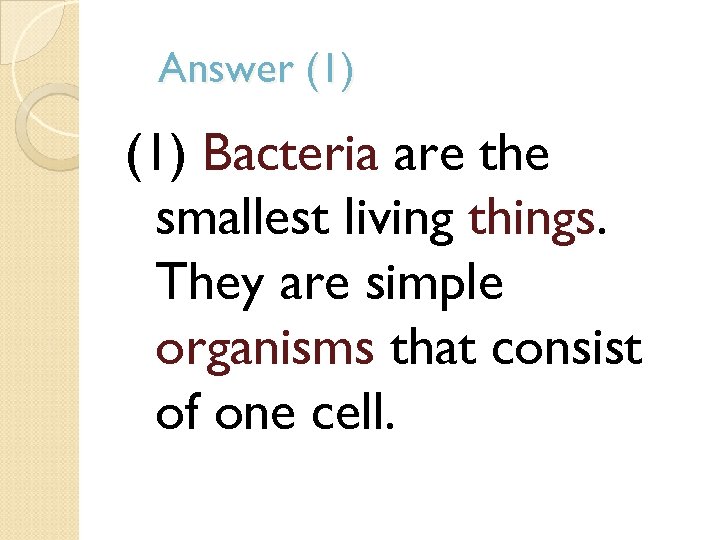 Answer (1) Bacteria are the smallest living things. They are simple organisms that consist of one cell.
 Exercise 6, p. 104 (2) Bacterium exist almost everywhere. They are in the air, water, and soil as well as in the body of all living creature.
 Answer (2) Bacteria exist almost everywhere. They are in the air, water, and soil, as well as in the bodies of all living creatures.
 Exercise 6, p. 104 (3) There are thousand of kind of bacterium. Most of them are harmless to human being, but some cause diseases such as tuberculosis and pneumonia.
 Answer (3) There are thousands of kinds of bacteria. Most of them are harmless to human beings, but some cause diseases such as tuberculosis and pneumonia.
 Exercise 6, p. 104 (4) Virus are also microscopic organism, but virus live in the cell of other living thing. By themselves, they are lifeless particle that cannot reproduce, but inside a living cell they become active and can multiply hundred of time.
 Answer (4) Viruses are also microscopic organisms, but viruses live in the cells of other living things. By themselves, they are lifeless particles that cannot reproduce, but inside a living cell they become active and can multiply hundreds of times.
 Exercise 6, p. 104 (5) Virus cause many disease. They infect human being with such illness as influenza, the common cold, measles, and AIDS (Acquired Immune Deficiency Syndrome).
 Answer (5) Viruses cause many diseases. They infect human beings with such illnesses as influenza, the common cold, measles, and AIDS (Acquired Immune Deficiency Syndrome).
 Exercise 6, p. 104 (6) Virus are tiny. The virus that causes AIDS is 230 million times smaller than the period at the end of this sentence. Some viral infection are difficult or impossible to treat.
 Answer (6) Viruses are tiny. The virus that causes AIDS is 230 million times smaller than the period at the end of this sentence. Some viral infections are difficult or impossible to treat.
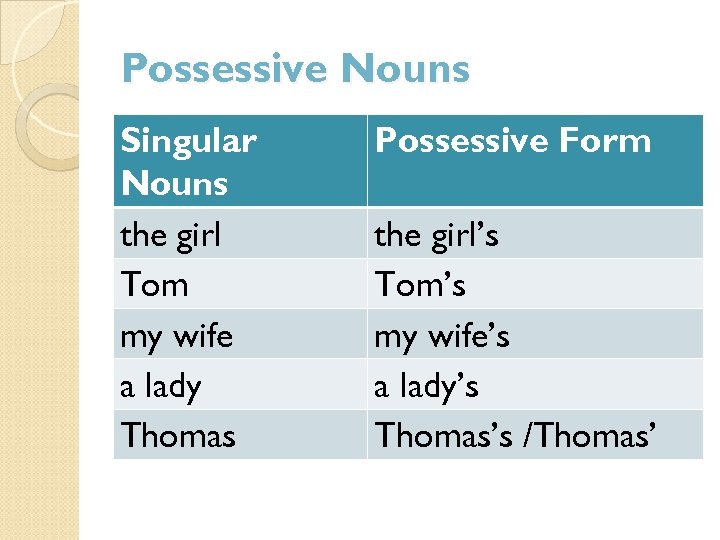 Possessive Nouns Singular Nouns the girl Tom my wife a lady Thomas Possessive Form the girl’s Tom’s my wife’s a lady’s Thomas’s /Thomas’
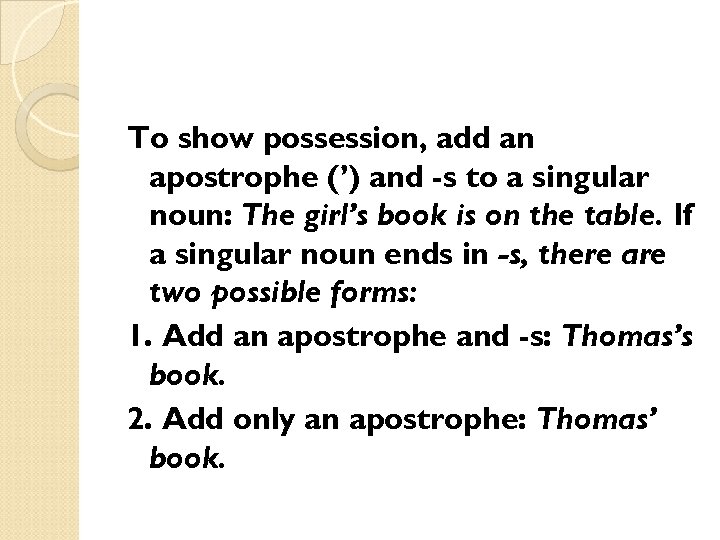 To show possession, add an apostrophe (’) and -s to a singular noun: The girl’s book is on the table. If a singular noun ends in -s, there are two possible forms: 1. Add an apostrophe and -s: Thomas’s book. 2. Add only an apostrophe: Thomas’ book.
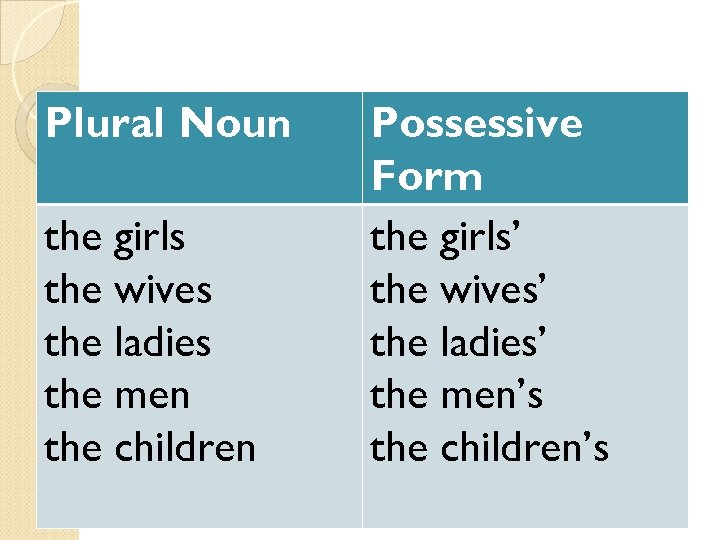 Plural Noun the girls the wives the ladies the men the children Possessive Form the girls’ the wives’ the ladies’ the men’s the children’s
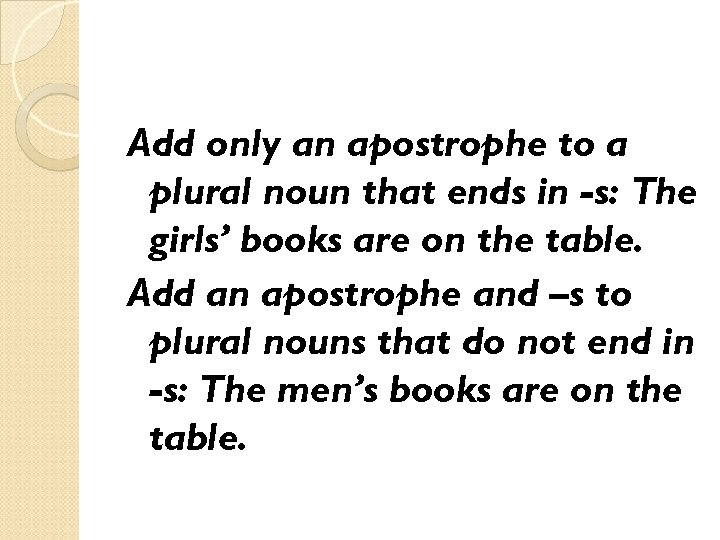 Add only an apostrophe to a plural noun that ends in -s: The girls’ books are on the table. Add an apostrophe and –s to plural nouns that do not end in -s: The men’s books are on the table.
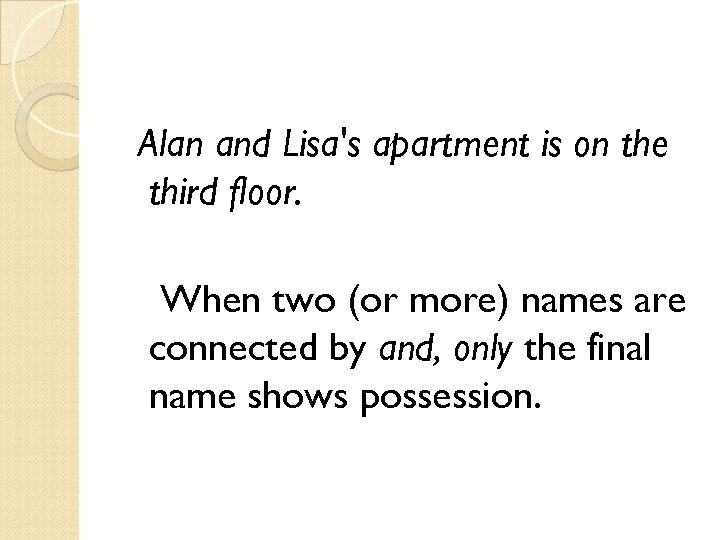 Alan and Lisa's apartment is on the third floor. When two (or more) names are connected by and, only the final name shows possession.
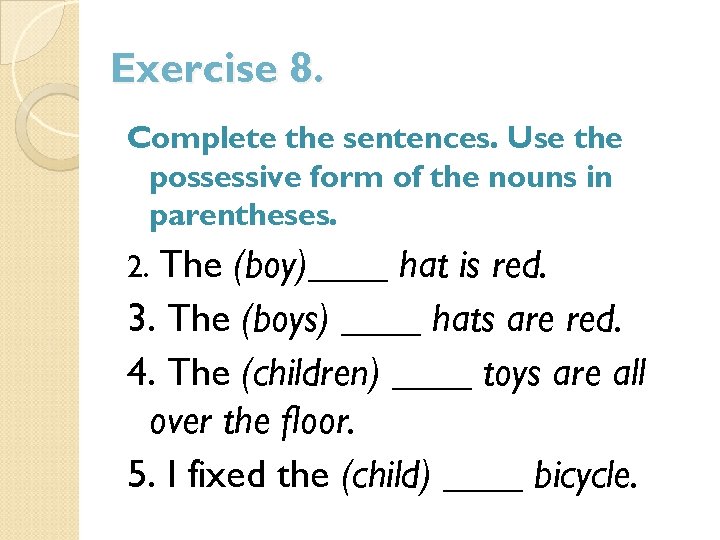 Exercise 8. Complete the sentences. Use the possessive form of the nouns in parentheses. 2. The (boy)____ hat is red. 3. The (boys) ____ hats are red. 4. The (children) ____ toys are all over the floor. 5. I fixed the (child) ____ bicycle.
 6. (Sally)_____ last name is White. 7. (Bess) _____last name is Young. 8. There are many problems in (today) _____world. 9. It would cost me a (month) _____salary to buy that refrigerator. 10. We went to (Jack and Larry) _____ house for dinner.
 Answers (Ex. 8, p 105) 2. boy’s 7. Bess’s/Bess’ 3. boys’ 8. today’s 4. children’s 9. month’s 5. child’s 10. Jack and Larry’s 6. Sally’s
 Exercise 9, p. 105 Correct the errors. Use the possessive nouns by adding apostrophes and final s/-es as necessary. 3. My uncle is my father brother. 4. I have four aunts. All of my aunt homes are within walking distance of my mother apartment. 5. Esteban’s aunt oldest son is a violinist.
 (Answers 3, 4, 5) 3. My uncle is my father’s brother. 4. I have four aunts. All of my aunts’ homes are within walking distance of my mother’s apartment. 5. Esteban’s aunt’s oldest son is a violinist.
 Exercise 9, p. 105 6. Bill wife is a factory worker. 7. I walked into my boss office. 8. I borrowed the secretary pen to fill out the application form. 9. Five astronauts were aboard the space shuttle. The astronaut safe return to earth was a welcome sight to millions of television viewers.
 (Answers 6, 7, 8, 9) 6. Bill’s wife is a factory worker. 7. I walked into my boss’s/boss’ office. 8. I borrowed the secretary’s pen to fill out the application form. 9. Five astronauts were aboard the space shuttle. The astronauts’ safe return to earth was a welcome sight to millions of television viewers.
 Exercise 9, p. 105 10. It is the people right to know what the city is going to do about the housing problem. 11. Quite a few diplomats are assigned to our city. Almost all of the diplomat children attend a special school. 12. A diplomat work invariably involves numerous meetings.
 Answers (10, 11, 12) 10. It is the people’s right to know what the city is going to do about the housing problem. 11. Quite a few diplomats are assigned to our city. Almost all of the diplomats’ children attend a special school. 12. A diplomat’s work invariably involves numerous meetings.
 Exercise 10. p. 106 Correct the errors in the use of possessive nouns by adding apostrophes as necessary. 2. Psychologists have developed many different kinds of tests. A “personality test” is used to evaluate an individuals personal characteristics, such as friendliness or trustworthiness.
 Answer 2 2. Psychologists have developed many different kinds of tests. A “personality test” is used to evaluate an individual’s personal characteristics, such as friendliness or trustworthiness.
 3. Many mythological stories tell of heroes encounters with giants or dangerous animals. In one story, the heros encounter with a dragon saves a village from destruction.
 3. Many mythological stories tell of heroes’ encounters with giants or dangerous animals. In one story, the hero’s encounter with a dragon saves a village from destruction.
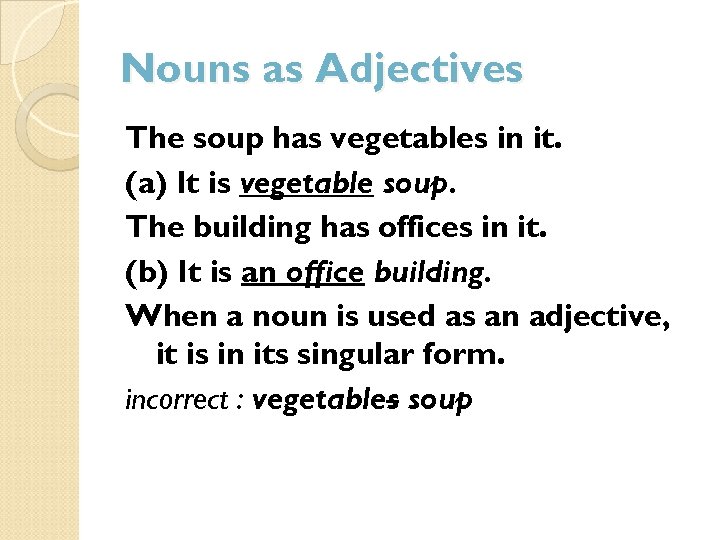 Nouns as Adjectives The soup has vegetables in it. (a) It is vegetable soup. The building has offices in it. (b) It is an office building. When a noun is used as an adjective, it is in its singular form. incorrect : vegetables soup
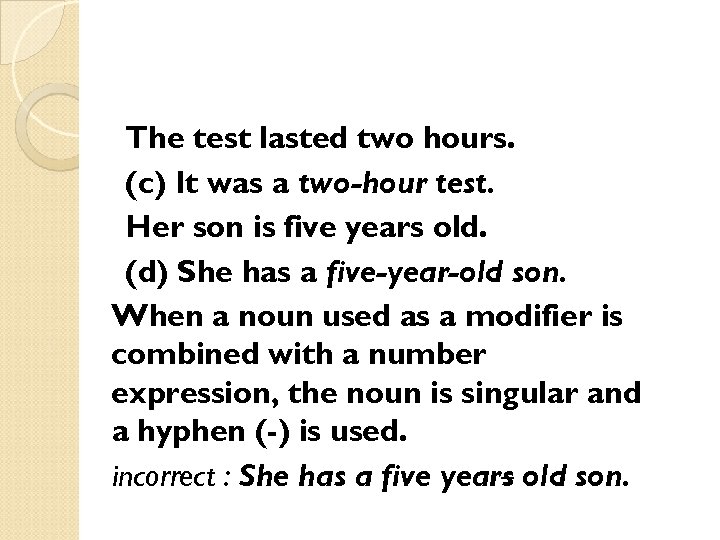 The test lasted two hours. (c) It was a two-hour test. Her son is five years old. (d) She has a five-year-old son. When a noun used as a modifier is combined with a number expression, the noun is singular and a hyphen (-) is used. incorrect : She has a five years old son.
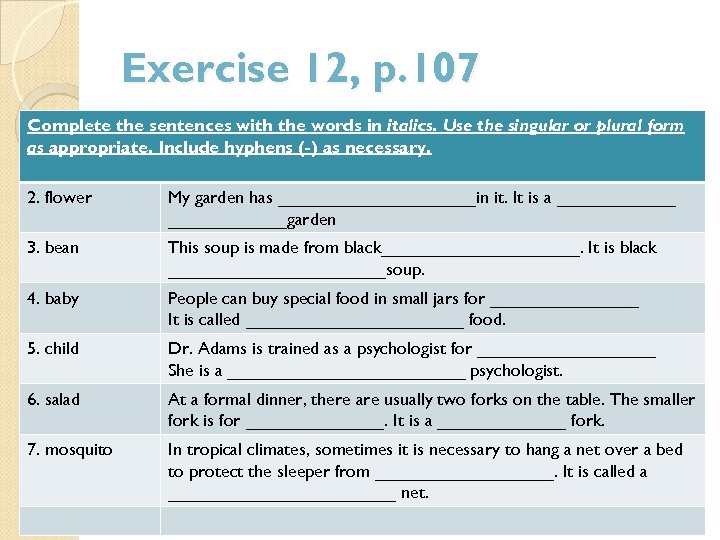 Exercise 12, p. 107 Complete the sentences with the words in italics. Use the singular or plural form as appropriate. Include hyphens (-) as necessary. 2. flower My garden has __________in it. It is a ____________garden 3. bean This soup is made from black__________. It is black ___________soup. 4. baby People can buy special food in small jars for ________ It is called ___________ food. 5. child Dr. Adams is trained as a psychologist for _________ She is a ____________ psychologist. 6. salad At a formal dinner, there are usually two forks on the table. The smaller fork is for _______. It is a _______ fork. 7. mosquito In tropical climates, sometimes it is necessary to hang a net over a bed to protect the sleeper from _________. It is called a ____________ net.
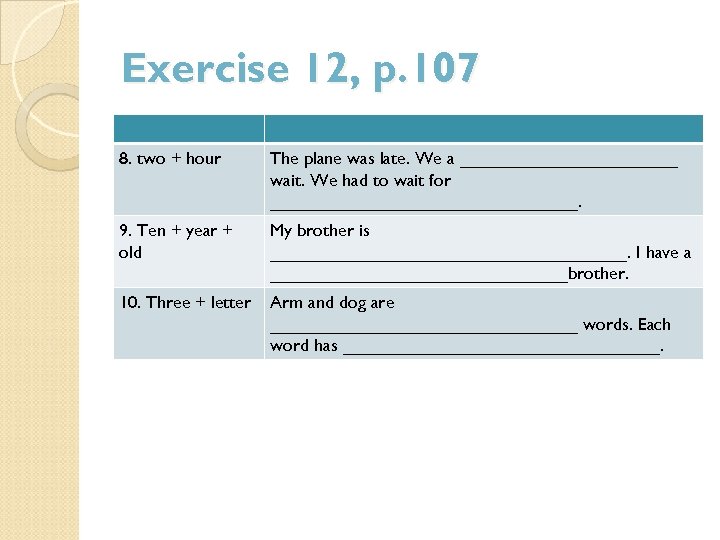 Exercise 12, p. 107 8. two + hour The plane was late. We a ___________ wait. We had to wait for ________________. 9. Ten + year + old My brother is __________________. I have a _______________brother. 10. Three + letter Arm and dog are ________________ words. Each word has ________________.
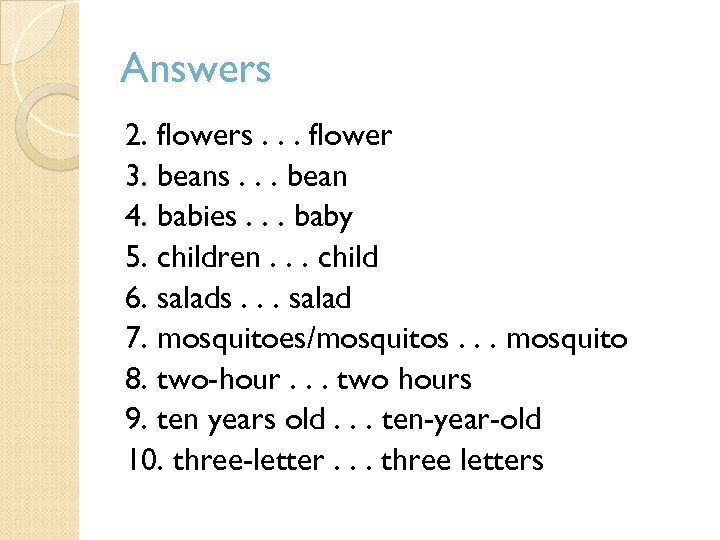 Answers 2. flowers. . . flower 3. beans. . . bean 4. babies. . . baby 5. children. . . child 6. salads. . . salad 7. mosquitoes/mosquitos. . . mosquito 8. two-hour. . . two hours 9. ten years old. . . ten-year-old 10. three-letter. . . three letters
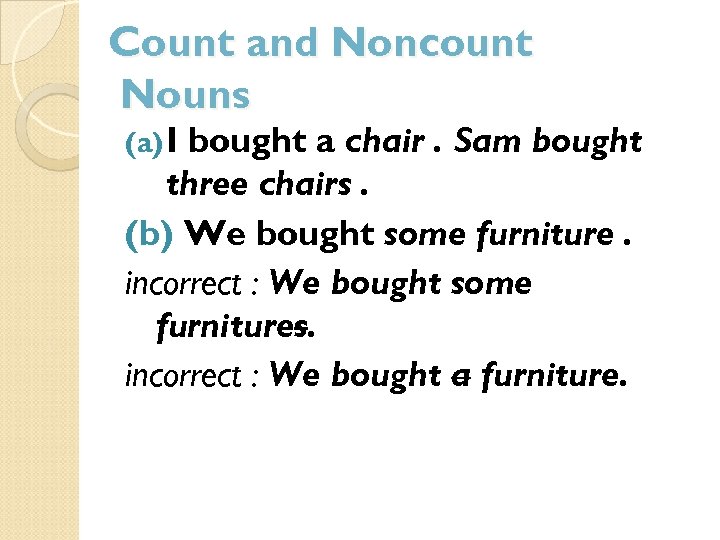 Count and Noncount Nouns (a) I bought a chair. Sam bought three chairs. (b) We bought some furniture. incorrect : We bought some furnitures. incorrect : We bought a furniture.
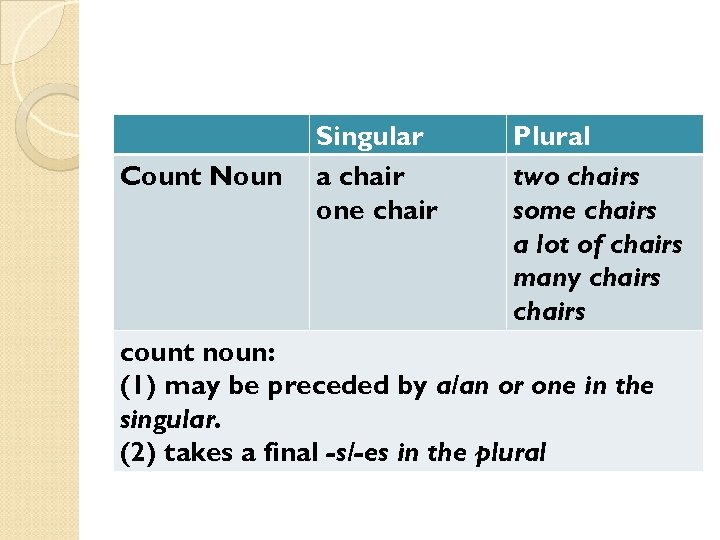 Count Noun Singular a chair one chair Plural two chairs some chairs a lot of chairs many chairs count noun: (1) may be preceded by a/an or one in the singular. (2) takes a final -s/-es in the plural
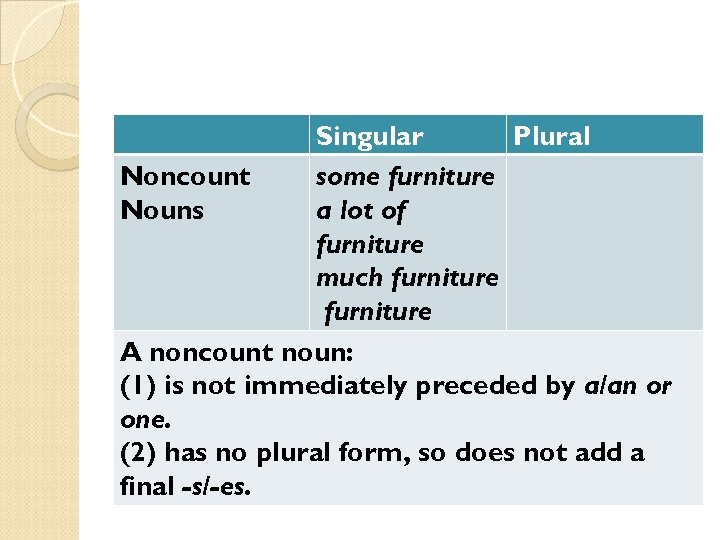 Singular Plural Noncount some furniture Nouns a lot of furniture much furniture A noncount noun: (1) is not immediately preceded by a/an or one. (2) has no plural form, so does not add a final -s/-es.
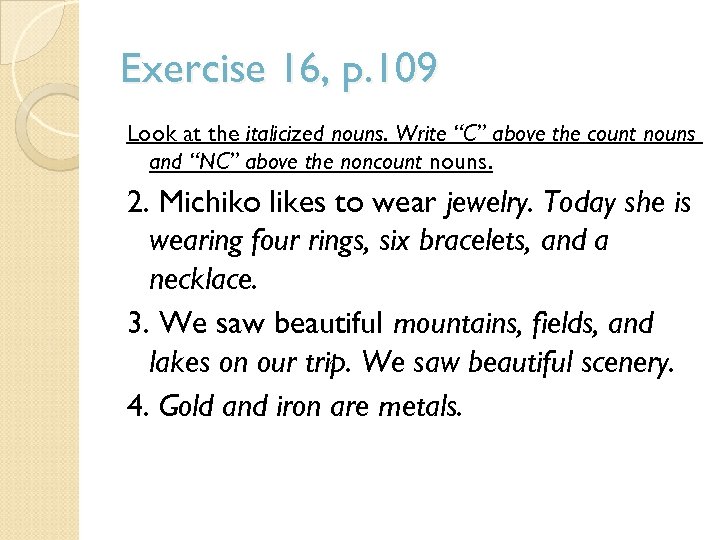 Exercise 16, p. 109 Look at the italicized nouns. Write “C” above the count nouns and “NC” above the noncount nouns. 2. Michiko likes to wear jewelry. Today she is wearing four rings, six bracelets, and a necklace. 3. We saw beautiful mountains, fields, and lakes on our trip. We saw beautiful scenery. 4. Gold and iron are metals.
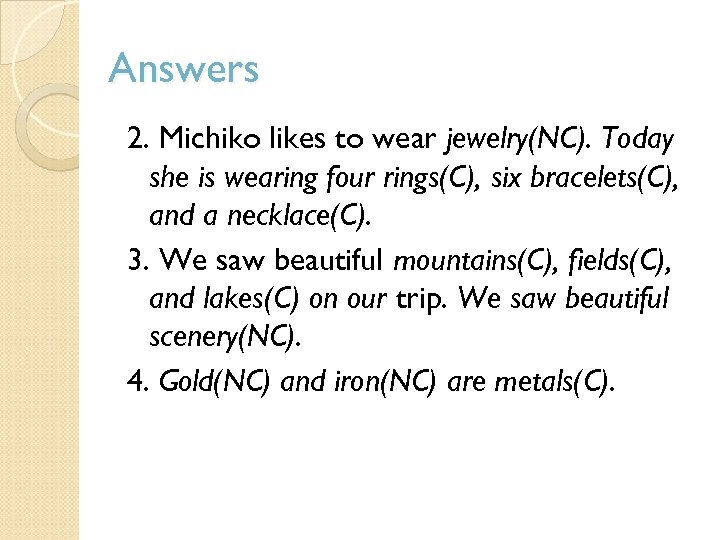 Answers 2. Michiko likes to wear jewelry(NC). Today she is wearing four rings(C), six bracelets(C), and a necklace(C). 3. We saw beautiful mountains(C), fields(C), and lakes(C) on our trip. We saw beautiful scenery(NC). 4. Gold(NC) and iron(NC) are metals(C).
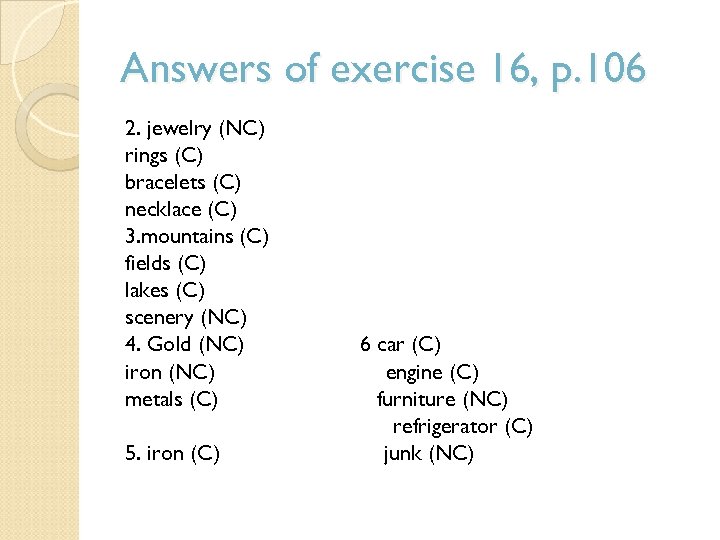 Answers of exercise 16, p. 106 2. jewelry (NC) rings (C) bracelets (C) necklace (C) 3. mountains (C) fields (C) lakes (C) scenery (NC) 4. Gold (NC) iron (NC) metals (C) 5. iron (C) 6 car (C) engine (C) furniture (NC) refrigerator (C) junk (NC)
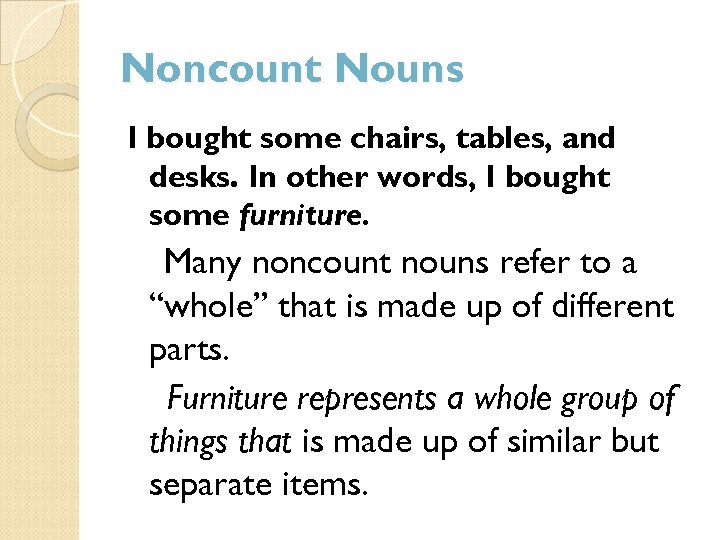 Noncount Nouns I bought some chairs, tables, and desks. In other words, I bought some furniture. Many noncount nouns refer to a “whole” that is made up of different parts. Furniture represents a whole group of things that is made up of similar but separate items.
 I put some sugar in my coffee. Sugar and coffee represent whole masses made up of individual particles or elements.
 To express a particular quantity, some noncount nouns may be preceded by unit expressions: a spoonful of sugar, a glass of water, a cup of coffee, a quart of milk, a loaf of bread, a grain of rice, a bowl of soup, a bag of flour, a pound of meat, a piece of furniture, a piece of paper, a piece of jewelry.
 I wish you luck. Many noncount nouns are abstractions. Luck is an abstract concept, an abstract “whole. ” It has no physical form; you can’t touch it; you can't count it.
 Sunshine is warm and cheerful. A phenomenon of nature, such as sunshine, is frequently used as a noncount noun.
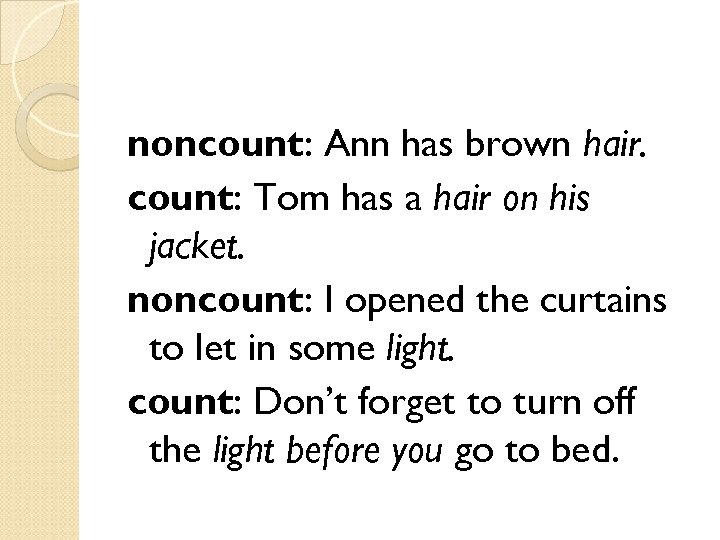 noncount: Ann has brown hair. count: Tom has a hair on his jacket. noncount: I opened the curtains to let in some light. count: Don’t forget to turn off the light before you go to bed.
 Many nouns can be used as either noncount or count nouns, but the meaning is different. (Dictionaries written especially for learners of English as a second language are a good source of information on count /noncount usage of nouns. )
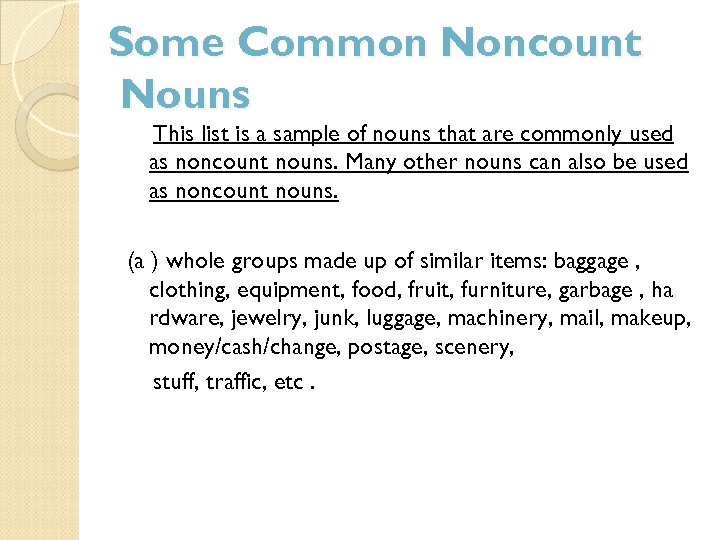 Some Common Noncount Nouns This list is a sample of nouns that are commonly used as noncount nouns. Many other nouns can also be used as noncount nouns. (a ) whole groups made up of similar items: baggage , clothing, equipment, food, fruit, furniture, garbage , ha rdware, jewelry, junk, luggage, machinery, mail, makeup, money/cash/change, postage, scenery, stuff, traffic, etc.
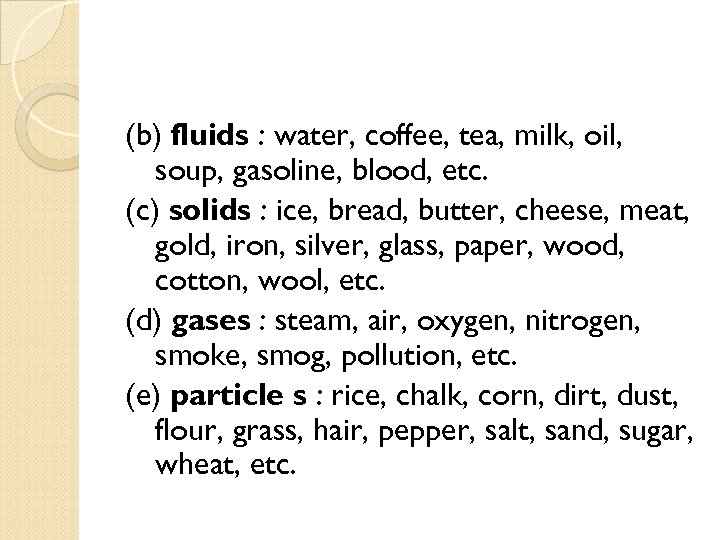 (b) fluids : water, coffee, tea, milk, oil, soup, gasoline, blood, etc. (c) solids : ice, bread, butter, cheese, meat, gold, iron, silver, glass, paper, wood, cotton, wool, etc. (d) gases : steam, air, oxygen, nitrogen, smoke, smog, pollution, etc. (e) particle s : rice, chalk, corn, dirt, dust, flour, grass, hair, pepper, salt, sand, sugar, wheat, etc.
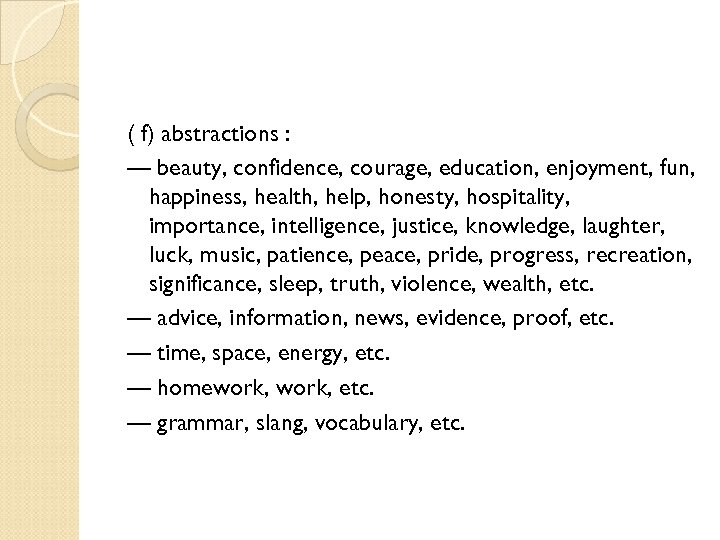 ( f) abstractions : — beauty, confidence, courage, education, enjoyment, fun, happiness, health, help, honesty, hospitality, importance, intelligence, justice, knowledge, laughter, luck, music, patience, peace, pride, progress, recreation, significance, sleep, truth, violence, wealth, etc. — advice, information, news, evidence, proof, etc. — time, space, energy, etc. — homework, etc. — grammar, slang, vocabulary, etc.
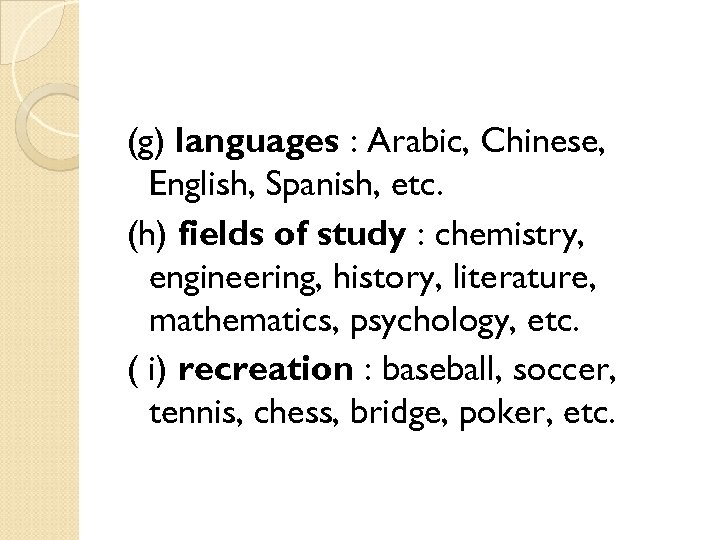 (g) languages : Arabic, Chinese, English, Spanish, etc. (h) fields of study : chemistry, engineering, history, literature, mathematics, psychology, etc. ( i) recreation : baseball, soccer, tennis, chess, bridge, poker, etc.
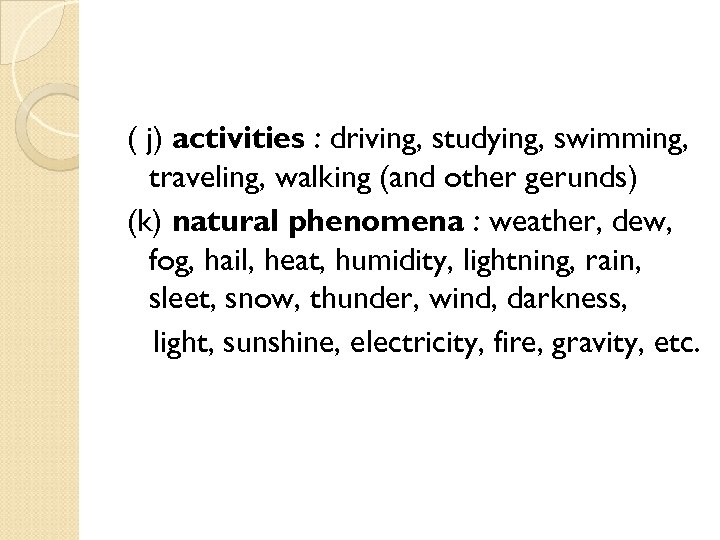 ( j) activities : driving, studying, swimming, traveling, walking (and other gerunds) (k) natural phenomena : weather, dew, fog, hail, heat, humidity, lightning, rain, sleet, snow, thunder, wind, darkness, light, sunshine, electricity, fire, gravity, etc.
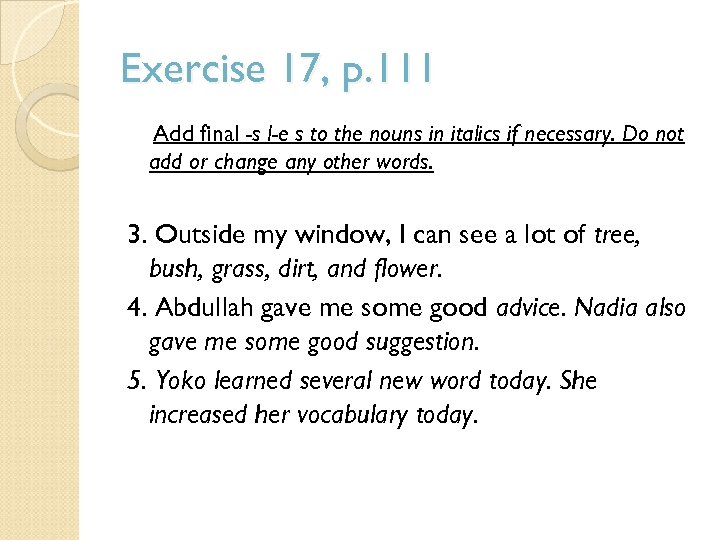 Exercise 17, p. 111 Add final -s l-e s to the nouns in italics if necessary. Do not add or change any other words. 3. Outside my window, I can see a lot of tree, bush, grass, dirt, and flower. 4. Abdullah gave me some good advice. Nadia also gave me some good suggestion. 5. Yoko learned several new word today. She increased her vocabulary today.
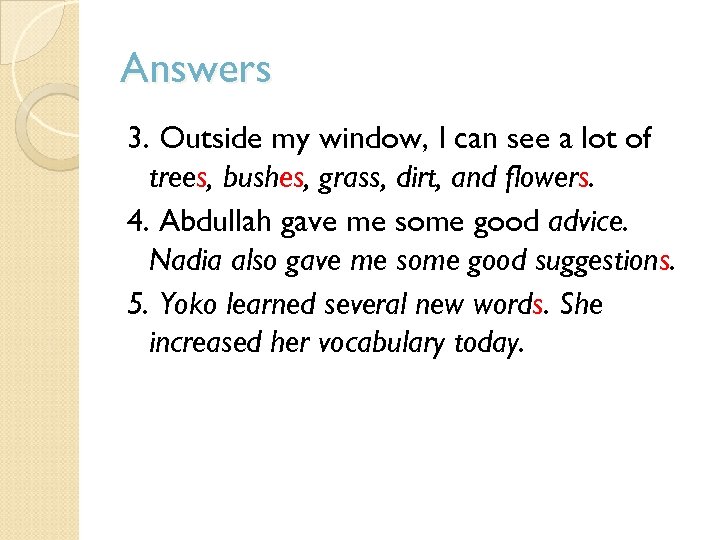 Answers 3. Outside my window, I can see a lot of trees, bushes, grass, dirt, and flowers. 4. Abdullah gave me some good advice. Nadia also gave me some good suggestions. 5. Yoko learned several new words. She increased her vocabulary today.
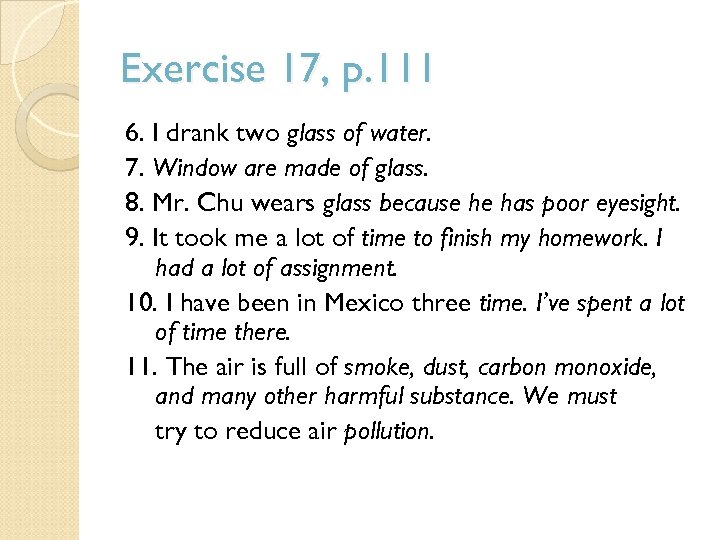 Exercise 17, p. 111 6. I drank two glass of water. 7. Window are made of glass. 8. Mr. Chu wears glass because he has poor eyesight. 9. It took me a lot of time to finish my homework. I had a lot of assignment. 10. I have been in Mexico three time. I’ve spent a lot of time there. 11. The air is full of smoke, dust, carbon monoxide, and many other harmful substance. We must try to reduce air pollution.
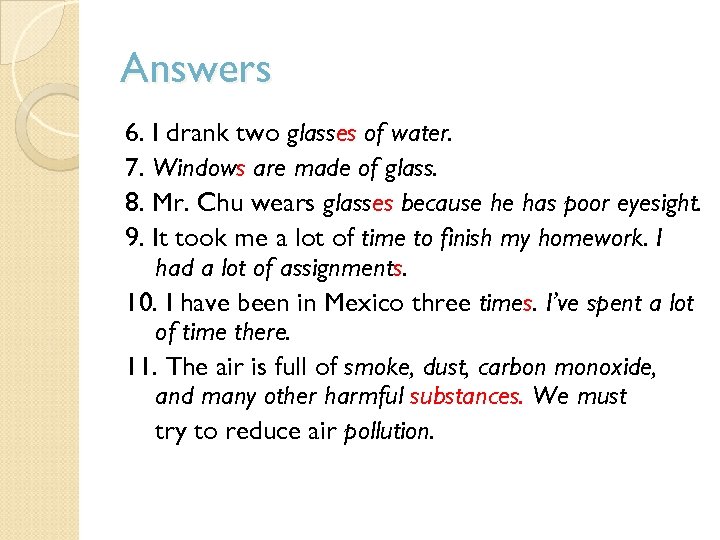 Answers 6. I drank two glasses of water. 7. Windows are made of glass. 8. Mr. Chu wears glasses because he has poor eyesight. 9. It took me a lot of time to finish my homework. I had a lot of assignments. 10. I have been in Mexico three times. I’ve spent a lot of time there. 11. The air is full of smoke, dust, carbon monoxide, and many other harmful substances. We must try to reduce air pollution.
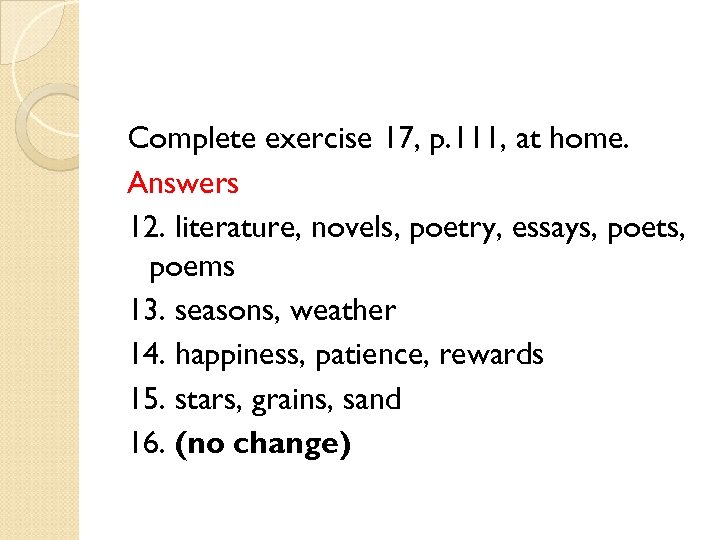 Complete exercise 17, p. 111, at home. Answers 12. literature, novels, poetry, essays, poets, poems 13. seasons, weather 14. happiness, patience, rewards 15. stars, grains, sand 16. (no change)
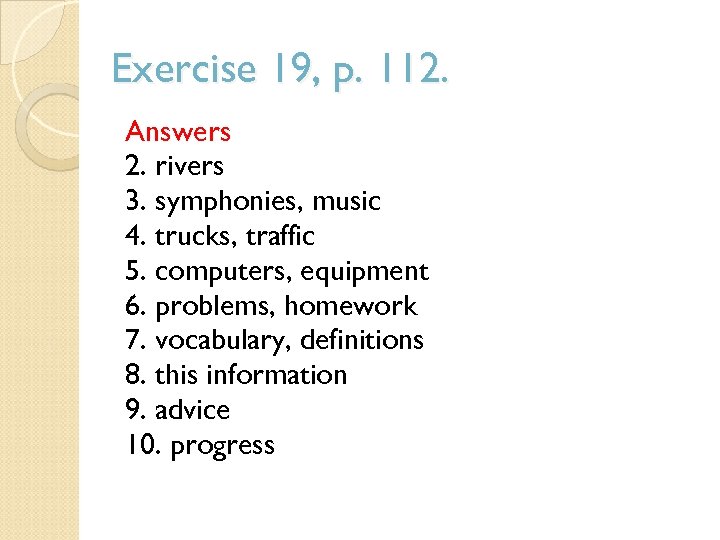 Exercise 19, p. 112. Answers 2. rivers 3. symphonies, music 4. trucks, traffic 5. computers, equipment 6. problems, homework 7. vocabulary, definitions 8. this information 9. advice 10. progress