



 Noun Part II 1. The Category of Case 2. The Category of Article Determination
 Characteristics of Case in English Immanent morphological category Opposition: -’s vs the unmarked form (the genitive case vs the common case) Cf. : the boy’s ball / the boys’ ball
 Views on the Category of Case 1. The "theory of positional cases" (J. C. Nesfield, M. Deutschbein, M. Bryant) The nominative case: Rain falls. The vocative case: Are you coming, my friend? The dative case: I gave John a penny. The accusative case: The man killed a rat. The earth is moistened by rain.
 2. The "theory of prepositional cases" (G. Curme) case (to + Noun, for + Noun) the"genitive" case (of + Noun) the"dative"
 3. The “limited case theory” (H. Sweet, O. Jespersen, A. I. Smirnitsky, L. S. Barkhudarov and others) the possessive or genitive form (strong member) the common, or "non genitive" form (weak member)
 4. The “postpositional theory” (G. N. Vorontsova) combina tion of a noun with apostposition E. g. another stage-struck girl's stage finish→ the stage finish of another stage-struck girl
 Meanings of the Genitive Case 1. “Genitive of possessor" (e. g. Dad’s earnings) 2. “Genitive of integer" (e. g. Patrick’s voice) Subtype: “Genitive of re ceivedqualification“ (e. g. Mr. Dodson’s vanity)
 3. “Genitive of agent" (e. g. the councillor’s attitude) 4. “Genitive of patient" (e. g. Peter’s final expulsion) 5. “Genitive of destination“ (e. g. women’s shoes)
 6. “Genitive of dispensed qualification" (e. g. a girl’s voice) Subtype: “Genitive of com parison" (e. g. the cock’s self-confidence of the man) 7. “Genitive of adverbial" (e. g. yesterday’s encounter)
 8. “Genitive of quantity" (e. g. two months’ time)
 The Problem of Case of English Pronouns The nominative form (I) The objective form (me) The possessive form: - conjoint (my) - absolute (mine)
 Article Determination Semantics The definite article: individualisation of the noun The indefinite article: refers the object to a class of similar nouns Meaningful absence of the article: - countable noun Sg - absolute generalisation (!) - uncountable noun – absolute / relative generalisation - countable noun Pl – absolute / relative generalisation
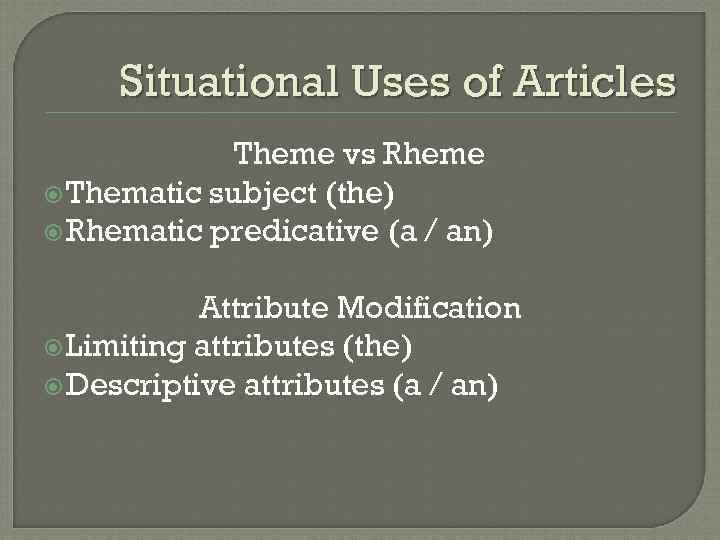 Situational Uses of Articles Theme vs Rheme Thematic subject (the) Rhematic predicative (a / an) Attribute Modification Limiting attributes (the) Descriptive attributes (a / an)
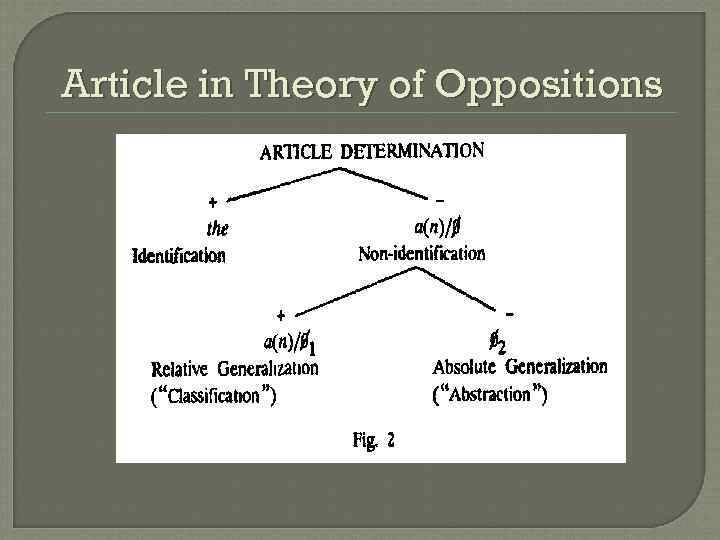 Article in Theory of Oppositions