Скачать презентацию NOTSL Putting your Vendors to Work for You June
04857e014b01b24739bafd950ba57614.ppt
- Количество слайдов: 48
 NOTSL—Putting your Vendors to Work for You June 3, 2005 Cuyahoga County Public Library Parma, Ohio
 Acquiring Books: Approval Plans and Cooperative Collection Management Julia Gammon Head, Acquisitions University of Akron & Chair, Ohio. LINK Collection Building Task Force jgammon@uakron. edu
 Points to Cover l l l “Invention” of Approval Plans today Using Approval Plans for Cooperative Collection Development in Ohio. LINK
 After Lunch Speaker. . .
 Pre-1950 s Book Ordering l l l Hit-or-miss proposition Librarians ordered from: LC proof slips, books reviews, faculty requests Orders sent direct to publishers Long delays Few vendors called No discounts
 Book Buying in the ’ 50 s l l l Farmington Plan Greenway Plan Public Law 480 Special Foreign Currency Program None allowed returns
 The ’ 60 s Revisited… l l Arrival of approval plan Libraries had $$$$$ Instructional programs expanding rapidly Shortage of trained professional staff
 Who Invented the Approval Plan? l l l Richard Abel Reed College Bookstore, Portland Oregon Don Smith librarian at Washington State University News spread in the region Offered books and slip plans
 Richard Abel Company l l l First mention in library press 1966 Librarians flocked to join Advantages: – – – Fast Reduced cost for libraries Systematized collection of materials
 Enter the 70 s… l l l Abel’s fast growth caused problems Financial problems Less money for libraries to spend 1975 bankruptcy B. H. Blackwell bought the assets and created BNA.
 What’s in a Name? l l l “Approval Plans” “Gathering Plans” “Slip Plans” “Blanket Order Plans” “Standing Order Plans “Lease Plans”
 Present Day: Approval Plans Still Flourish l l l Subject Based Publisher Based Foreign Imprints Language Based Children’s books
 Critics say…. l l Abdicating selection responsibility to vendors Vendor’s staff don’t know our needs Library staff review of books takes more time Inertia will cause acceptance of all books!
 Advantages: l l l Speed of delivery Make sure you don’t miss it Allows time for collection managers to focus on other things Evaluations made with books in hand Saves library staff time with vendor’s services Allows library to take advantage of technology
 How to Select an Approval Plan Vendor l l Profile: Is it structured to work with your polices? Publishers: Is the publisher base adequate? Selections: Do the books sent match the profile? Cost: Is there a discount? l l Slips: Are slips and books provided? Reports: Does vendor have useable reports? Staff: How easy is vendor to work with ? Process: Is it accurate, error free and smooth?
 Thoughts on Implementation… l l Do you have buy-in from selectors? Do you have the budget to afford the plan you want? Do you have the procedures and staff in place to make it work? Do you have a collection development policy to assist in profiling with vendor?
 Using Approval Plans (and more) for Cooperative Collection Development in Ohio. LINK
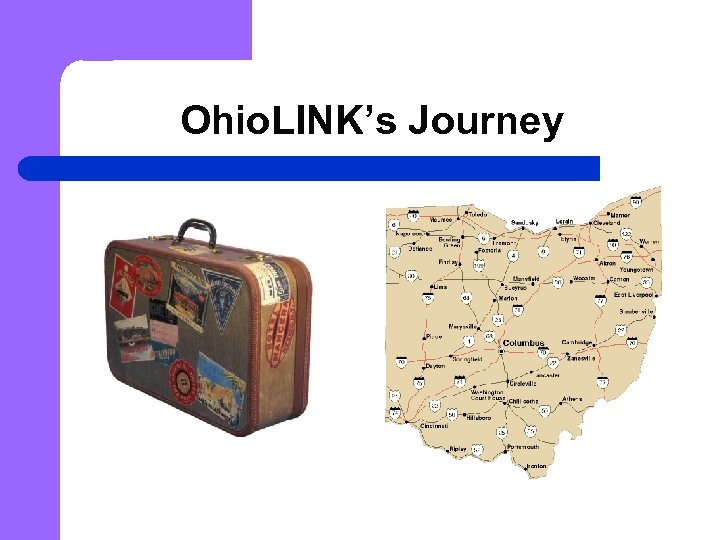 Ohio. LINK’s Journey
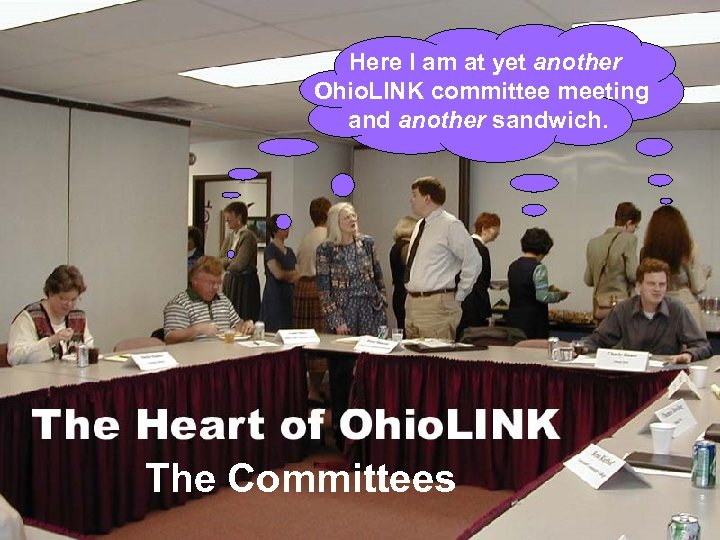 Here I am at yet another Ohio. LINK committee meeting and another sandwich. The Committees
 Ohio. LINK Collection Building Task Force
 We meet often…. . l l l l +5, 560 meetings +31, 100 cups of coffee +18, 200 muffins +20, 800 lunches 4, 000 frequent driver miles 65, 000 hours singing with the radio 8, 000 lunch upgrades
 Ohio. LINK’s Collection Building Task Force (CBTF) Charge l To reduce unnecessary duplication l To increase local CD activities l To expand the amount spent on cooperative purchases l To move beyond books…
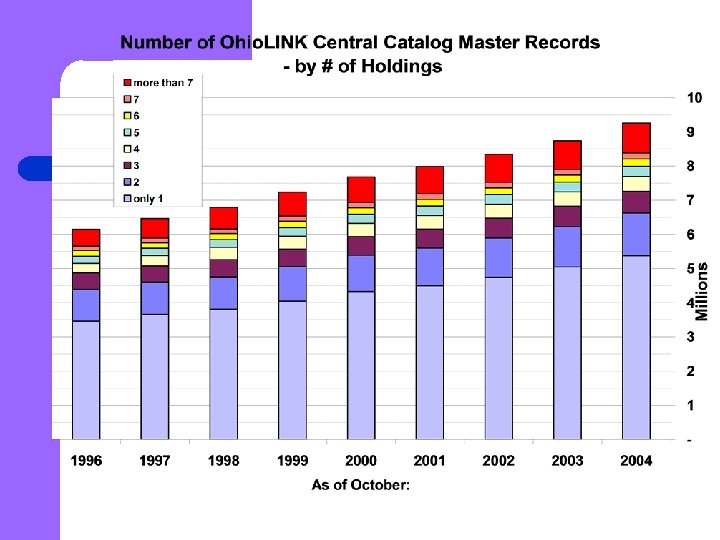
 What did our Ohio. LINK collection look like in 1997?
 Approval Plans: Duplication & Homogenization l In 1997 Tom Sanville, Director of Ohio. LINK found: – – Number of titles with 5 or more copies was increasing But number of unfilled borrowing requests was growing
 Duplication and Homogenization? Why was this happening? l It was attributed to our approval plans. We were all buying, or not buying— the same books!
 Collection Building Task Force: Abridged History l l l 1997 Discussions began 1998 Wrote statewide RFP 1998 Selected vendor—YBP 1999 Libraries began receiving books YBP—Began with 5 customers to 80+ now
 What’s the value of working with a primary vendor? l l l Develop a relationship to force your agenda Bigger stick to get what you want Big & small will get favorable discount Share ideas, processes & expertise Remember: There are no economies of scale for the vendor
 Early Myths & Misconceptions l l l We had a consortial approval plan “supra profile” Participation was mandatory There were set copy limits There was no local autonomy This was going to be a piece of cake!
 What barriers did we face?
 Folks, It Ain’t Easy! l l l Cooperation takes work New relationships need to be developed Not all wanted to switch vendors Processes & procedures can become entrenched Old habits die hard
 How did we remove barriers? l l l Kept it voluntary Invited folks to participate in the process “What it is and what it isn’t” document Designed training & education plan Found librarians “sell” better than vendors Promoted our successes no matter how small
 What makes it work in Ohio? l l Long history of cooperation Shared catalog Shared GOBI Local decision making l l Geographic proximity Compatible vendor Training, education & marketing Trust & shared vision
 YBP’s Tools: GOBI to the rescue l Gobi. Tween l “Not Bought” Reports l Peer Reports
 “Gobi. Tween” Report l l Can check prior to purchase Find out what others are purchasing Find out what books are expected on approval plans or standing orders Make informed decision
 “Not-Bought” Reports l l l Select a time frame Select a searching method Run list on GOBI Evaluate choices Select items to order Any number can play
 “Peer” Reports l l l Compare our collections to others Local, state, national comparison How do we rate?
 Ohio. LINK Cooperative Collection Management is more than just reports……
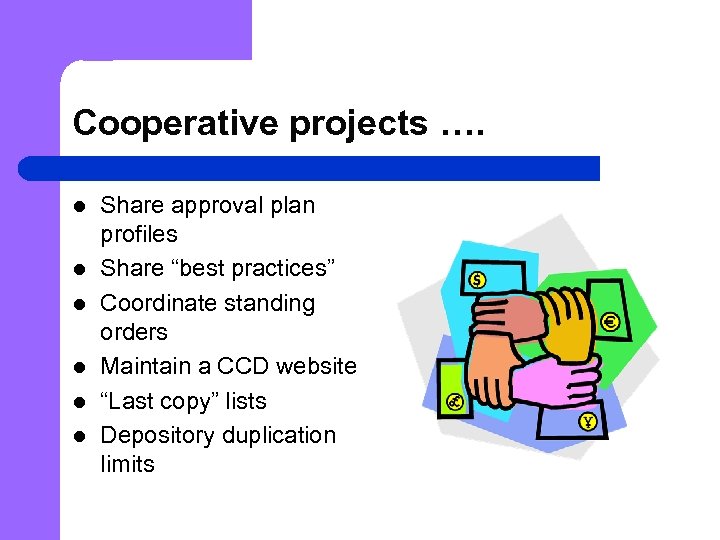 Cooperative projects …. l l l Share approval plan profiles Share “best practices” Coordinate standing orders Maintain a CCD website “Last copy” lists Depository duplication limits
 What are some examples of cooperative projects? l Religion, Art, Math, Engineering, Computer Science, Music etc. l CONSORT— 5 college consortium l RFP for Serials Subscriptions
 Subject Group Listservs l l Purpose: To facilitate CCD & resource sharing 28+ groups on listservs “Anthropology” to “Psychology” Communicate with each other
 Taking the show on the road… l l l Consortial wide meetings Summit meeting: Director level Road Shows: “Building Blocks and Tool Chests” & “Best Practices in CCD” Summit meeting: collection managers “Walking the Walk” Vendor driven training sessions
 What does our Ohio. LINK collection look like today?
 What are we gaining? l l A more diverse collection Ability to influence vendor products Multiple cooperative collection building projects New operational efficiencies
 Cooperative Collection Development in Consortia l l l Word is getting out Interest is high Technology is there Money & staff are tight End Result: More cooperation!
 Cooperative Collection Management is still a journey …not a destination.
 Souvenir of Akron