


 Скачать презентацию Notional C 2 Architectures for MDP and MDA
b578e2fcafc68f1958ea6f143ee5ba94.ppt
- Количество слайдов: 44
 Notional C 2 Architectures for MDP and MDA Dan Boger Information Sciences Department Naval Postgraduate School dboger@nps. edu/831. 656. 3671
 Background • Results from class projects in capstone course for NPS JC 4 I Systems curriculum (CC 4913, Issues and Problems in JC 4 I) • MDP tasked in Spring 2004 • MDA tasked in Spring 2005 • Each represents slightly less than one studentyear of work…concurrent with thesis completion and other courses • And subsequent contemplation and editing by the instructor based upon MDA research efforts over several years
 DCB’s BLUF • This is a system-of-systems issue • OODA/SDA/net-centric implies paradigm of: – – – Sensor systems (hard) Weapons systems (harder) Decision-making systems (hardest) Network of networks (harder) All properly integrated (hardest process changes) (Ed. ) And unimportant platforms on which to locate these important nodes/functions because nodes/functions should drive platform capabilities.
 Tasking • Employ observe, orient, decide and act (OODA) framework to develop a C 2 architecture for MDP (and then MDA). • Examine command relationships. – Why does one actor need to talk to another (IERs)? • Examine all elements of OODA loop but focus on Processes and Organizational structures. • Assume technical interoperability issues will be overcome…!
 Important Considerations • Speed of Decision / Response time / Latencies • Sensor Requirements • Communications Requirements • Decision Processes and Processors (doctrine) • Information trade-offs • Organizations and Commanders • AOR Scope • Threat and Mission • Resources for Commanders • Other command relationships (organic vs. inorganic) • Rules Of Engagement • Legal Requirements and Constraints (LES data/info)
 Scope of the Problem Develop a Maritime Domain Protection (MDP) Architecture capable of discovering and quickly disseminating information pertaining to future or impending: • Acts of Violence, • Weapon Engagement, or other • Hostile Act at any Phase by any adversary. • Originating from a planned Sea base, launched from the Sea, or utilizing the Sea as a conduit. The primary focus is outside of CONUS (>>=12 nm) and not inland waters. Designed to defend CONUS, Alaska, Hawaii. APPROACH: • Identify the key players. • Define the information flow among the key players. • Apply the information flow to a MDP Organization. • Fine tune the scope of the MDP problem. • Leverage existing organizations and systems.
 Litmus Test • Scenario: – Undercover Drug Enforcement Agency Agent in Thailand gets a tipper that an Anthrax shipment will be made on known merchant vessel. • Considerations: – Keep him undercover. – Locate the vessel. – Get the info to the boarding team.
 Maritime Threats • Worldwide – Must be able to differentiate terrorism from criminal activities • • LNG tankers Oil tankers Containerships and WMD/CBRNE Response in int’l waters governed by UNCLOS…
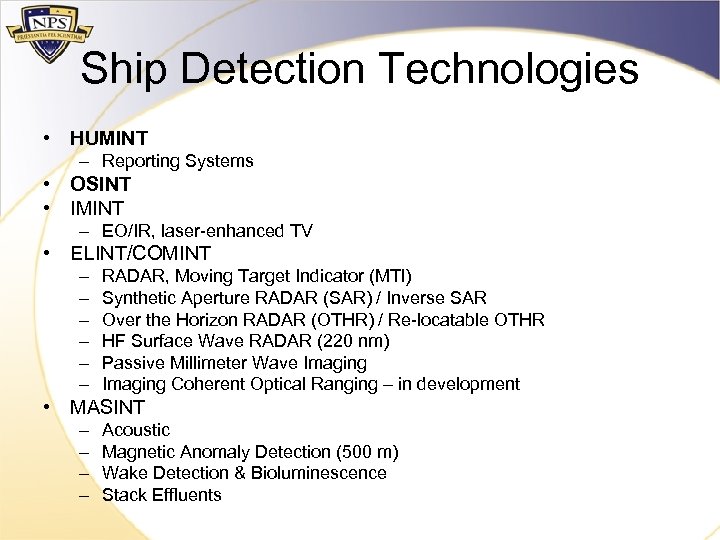 Ship Detection Technologies • HUMINT – Reporting Systems • OSINT • IMINT – EO/IR, laser-enhanced TV • ELINT/COMINT – – – RADAR, Moving Target Indicator (MTI) Synthetic Aperture RADAR (SAR) / Inverse SAR Over the Horizon RADAR (OTHR) / Re-locatable OTHR HF Surface Wave RADAR (220 nm) Passive Millimeter Wave Imaging Coherent Optical Ranging – in development • MASINT – – Acoustic Magnetic Anomaly Detection (500 m) Wake Detection & Bioluminescence Stack Effluents
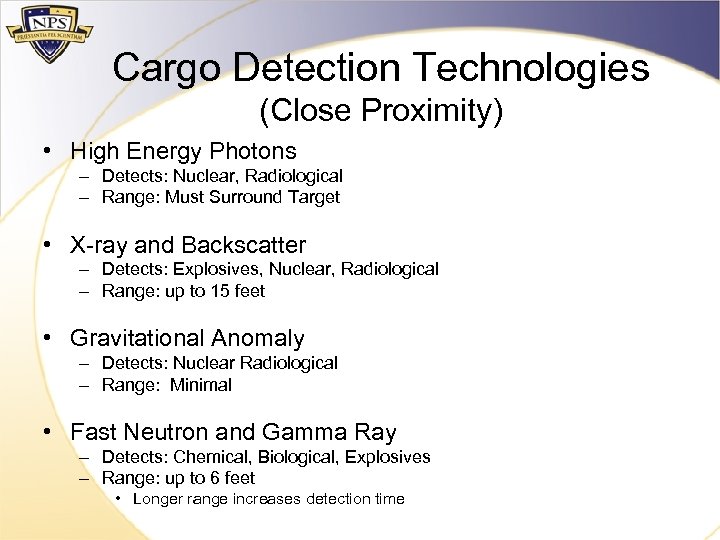 Cargo Detection Technologies (Close Proximity) • High Energy Photons – Detects: Nuclear, Radiological – Range: Must Surround Target • X-ray and Backscatter – Detects: Explosives, Nuclear, Radiological – Range: up to 15 feet • Gravitational Anomaly – Detects: Nuclear Radiological – Range: Minimal • Fast Neutron and Gamma Ray – Detects: Chemical, Biological, Explosives – Range: up to 6 feet • Longer range increases detection time
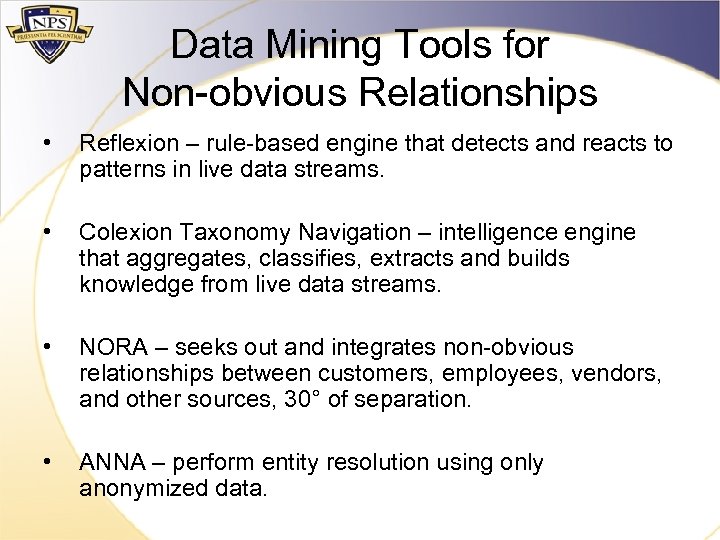 Data Mining Tools for Non-obvious Relationships • Reflexion – rule-based engine that detects and reacts to patterns in live data streams. • Colexion Taxonomy Navigation – intelligence engine that aggregates, classifies, extracts and builds knowledge from live data streams. • NORA – seeks out and integrates non-obvious relationships between customers, employees, vendors, and other sources, 30° of separation. • ANNA – perform entity resolution using only anonymized data.
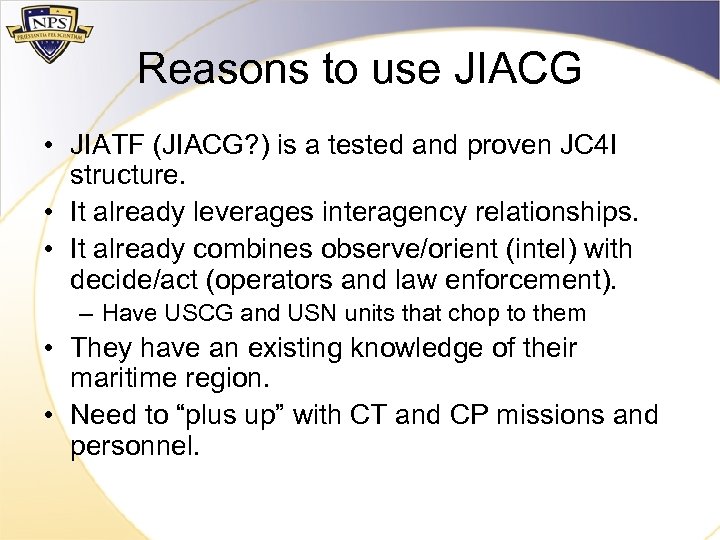 Reasons to use JIACG • JIATF (JIACG? ) is a tested and proven JC 4 I structure. • It already leverages interagency relationships. • It already combines observe/orient (intel) with decide/act (operators and law enforcement). – Have USCG and USN units that chop to them • They have an existing knowledge of their maritime region. • Need to “plus up” with CT and CP missions and personnel.
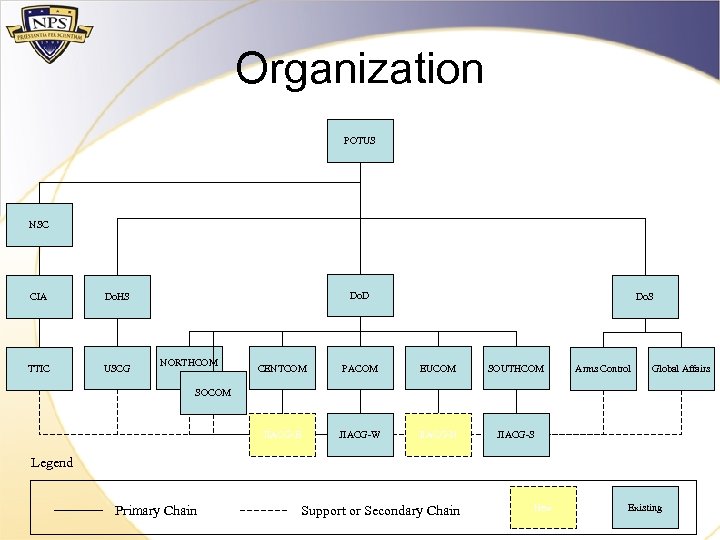 Organization POTUS NSC CIA TTIC USCG Do. D Do. HS NORTHCOM Do. S CENTCOM PACOM EUCOM SOUTHCOM JIACG-E JIACG-W JIACG-N JIACG-S Arms Control Global Affairs SOCOM Legend Primary Chain Support or Secondary Chain New Existing
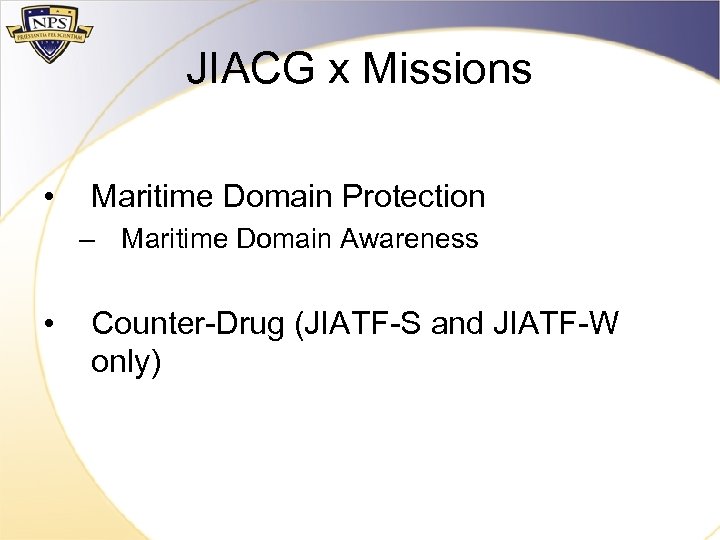 JIACG x Missions • Maritime Domain Protection – Maritime Domain Awareness • Counter-Drug (JIATF-S and JIATF-W only)
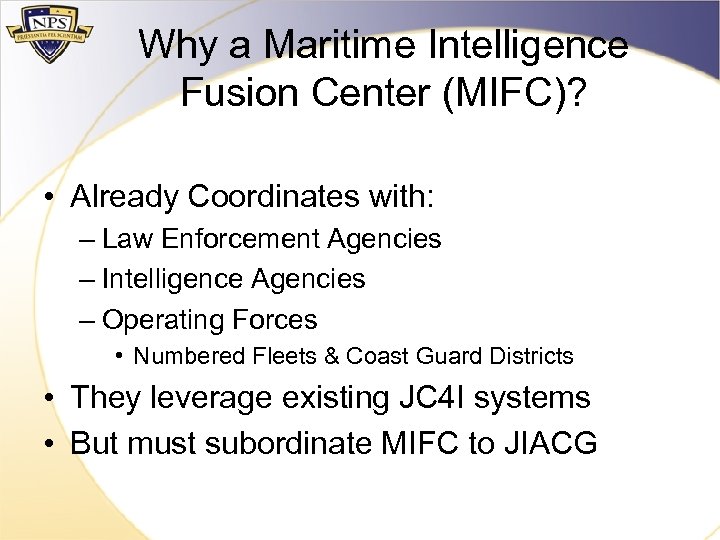 Why a Maritime Intelligence Fusion Center (MIFC)? • Already Coordinates with: – Law Enforcement Agencies – Intelligence Agencies – Operating Forces • Numbered Fleets & Coast Guard Districts • They leverage existing JC 4 I systems • But must subordinate MIFC to JIACG
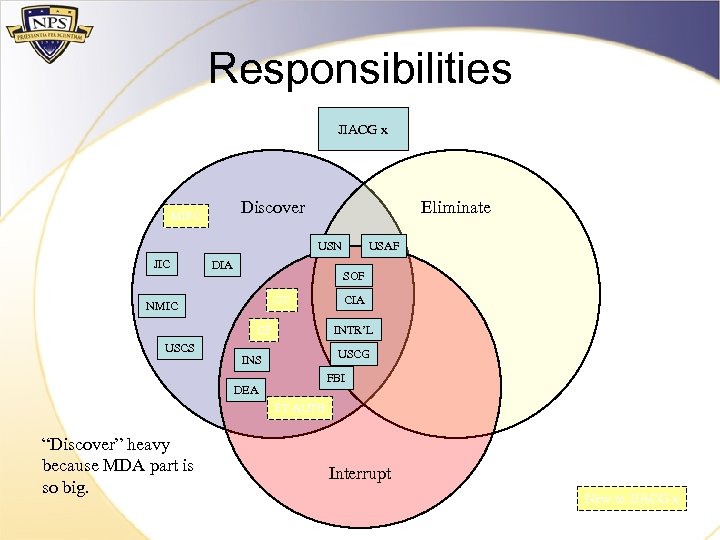 Responsibilities JIACG x Discover MIFC Eliminate USN JIC DIA SOF CT NMIC CIA INTR’L CP USCS USAF USCG INS FBI DEA PT AUTH “Discover” heavy because MDA part is so big. Interrupt New to JIACG x
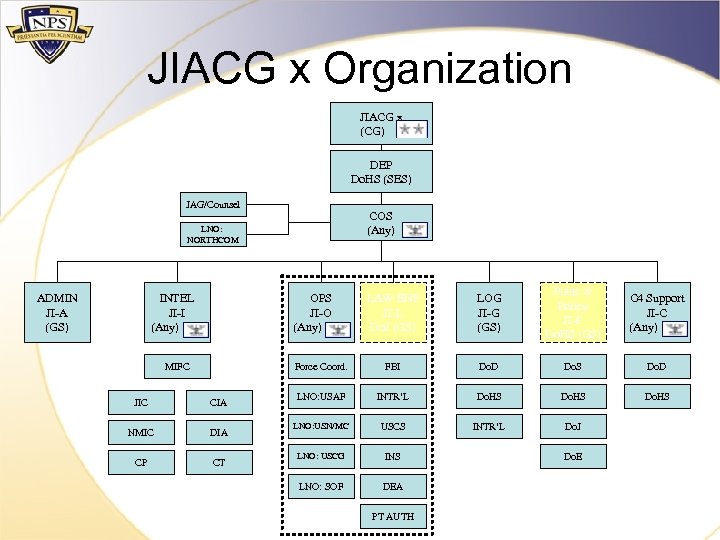 JIACG x Organization JIACG x (CG) DEP Do. HS (SES) JAG/Counsel COS (Any) LNO: NORTHCOM ADMIN JI-A (GS) LAW ENF JI-L Do. J (GS) LOG JI-G (GS) Plans & Policy JI-P Do. HS (GS) C 4 Support JI-C (Any) Force Coord. INTEL JI-I (Any) FBI Do. D Do. S Do. D LNO: USAF INTR’L Do. HS LNO: USN/MC USCS INTR’L Do. J LNO: USCG INS LNO: SOF DEA OPS JI-O (Any) MIFC JIC CIA NMIC DIA CP CT PT AUTH Do. E
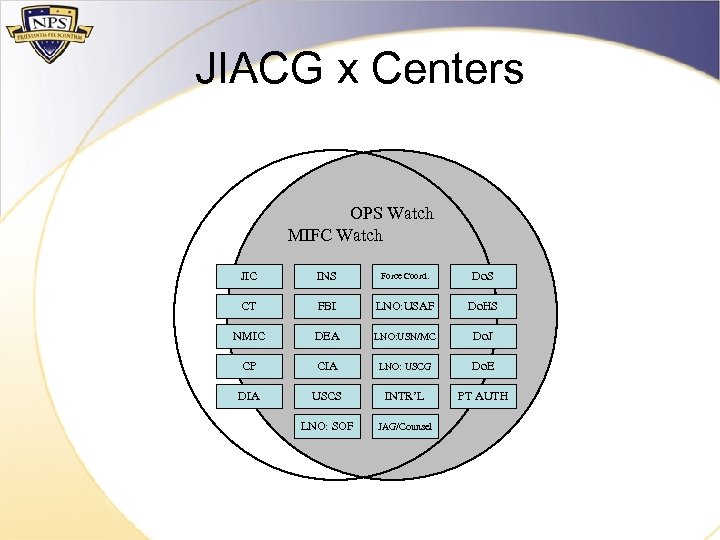 JIACG x Centers OPS Watch MIFC Watch JIC INS Force Coord. Do. S CT FBI LNO: USAF Do. HS NMIC DEA LNO: USN/MC Do. J CP CIA LNO: USCG Do. E DIA USCS INTR’L PT AUTH LNO: SOF JAG/Counsel
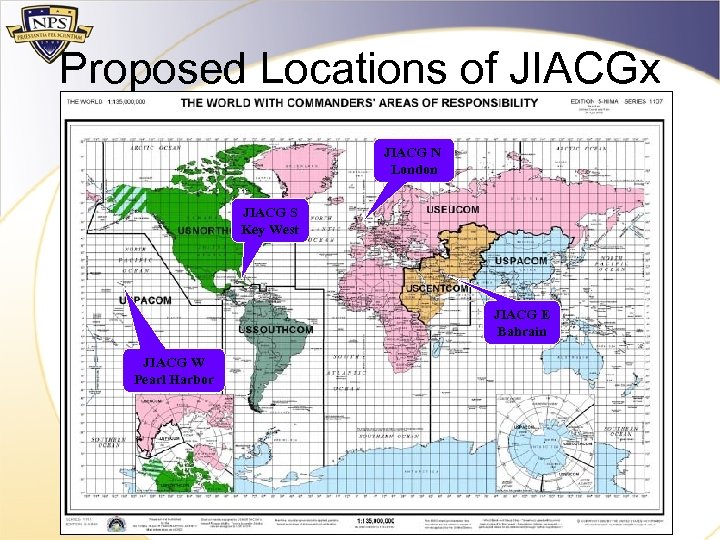 Proposed Locations of JIACGx JIACG N London JIACG S Key West JIACG E Bahrain JIACG W Pearl Harbor
 Litmus Test • Scenario: – Undercover Drug Enforcement Agency Agent in Thailand gets a tipper that an Anthrax shipment will be made on known merchant vessel. • Considerations: – Keep him undercover. – Locate the vessel. – Get the info to the boarding team.
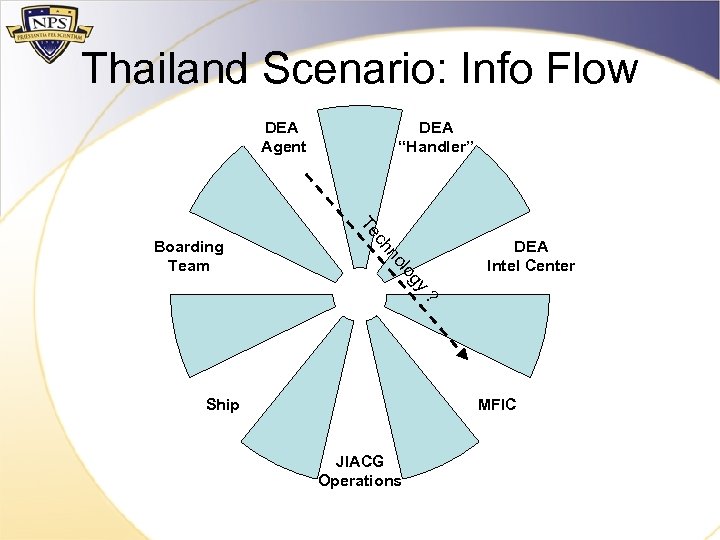 Thailand Scenario: Info Flow DEA “Handler” DEA Agent DEA Intel Center ? gy lo no ch Te Boarding Team MFIC Ship JIACG Operations
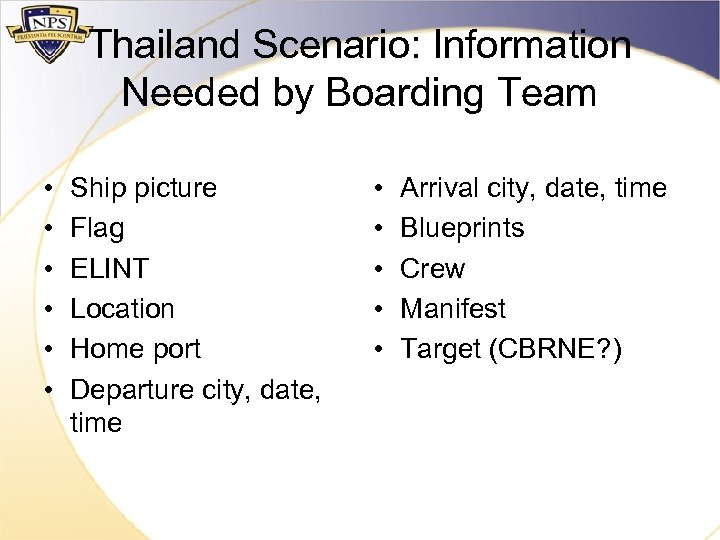 Thailand Scenario: Information Needed by Boarding Team • • • Ship picture Flag ELINT Location Home port Departure city, date, time • • • Arrival city, date, time Blueprints Crew Manifest Target (CBRNE? )
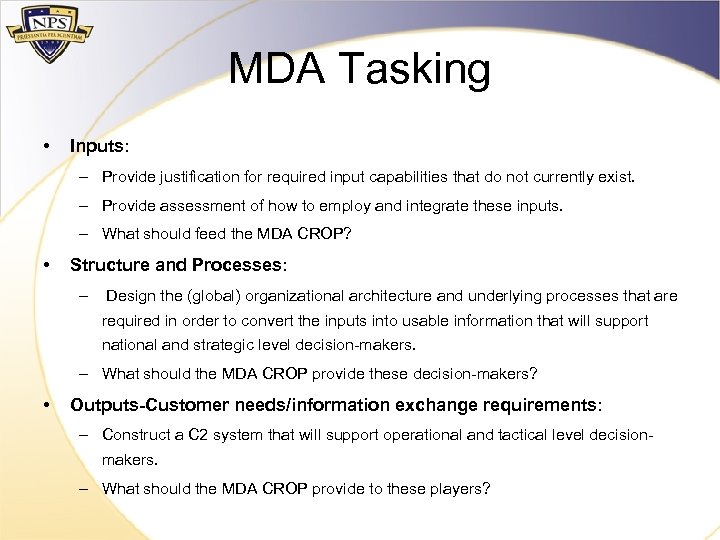 MDA Tasking • Inputs: – Provide justification for required input capabilities that do not currently exist. – Provide assessment of how to employ and integrate these inputs. – What should feed the MDA CROP? • Structure and Processes: – Design the (global) organizational architecture and underlying processes that are required in order to convert the inputs into usable information that will support national and strategic level decision-makers. – What should the MDA CROP provide these decision-makers? • Outputs-Customer needs/information exchange requirements: – Construct a C 2 system that will support operational and tactical level decisionmakers. – What should the MDA CROP provide to these players?
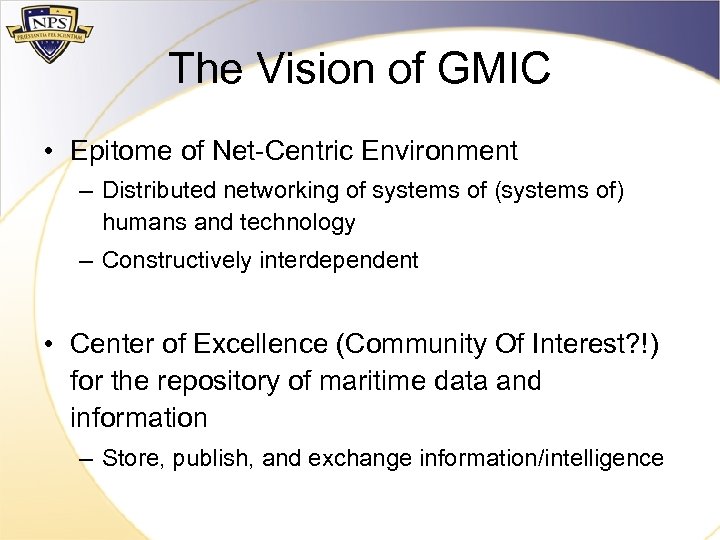 The Vision of GMIC • Epitome of Net-Centric Environment – Distributed networking of systems of (systems of) humans and technology – Constructively interdependent • Center of Excellence (Community Of Interest? !) for the repository of maritime data and information – Store, publish, and exchange information/intelligence
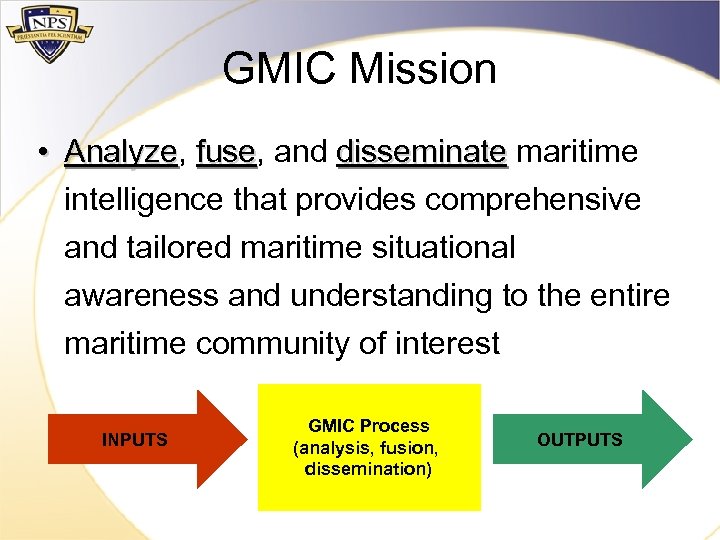 GMIC Mission • Analyze, fuse, and disseminate maritime Analyze fuse disseminate intelligence that provides comprehensive and tailored maritime situational awareness and understanding to the entire maritime community of interest INPUTS GMIC Process (analysis, fusion, dissemination) OUTPUTS
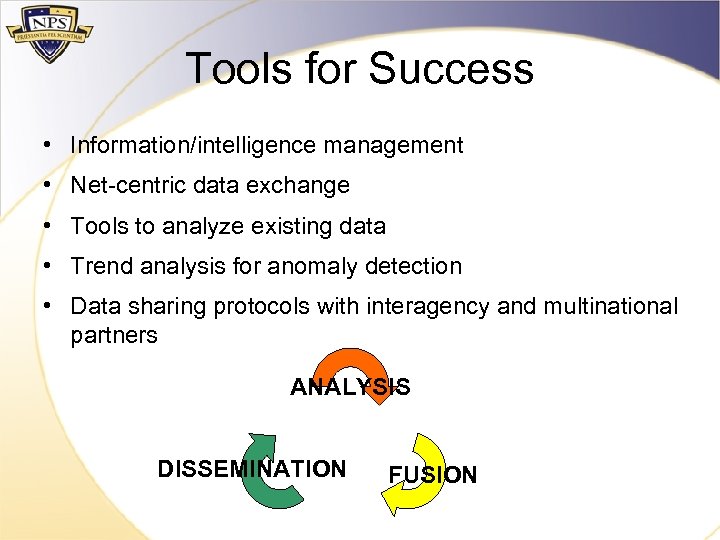 Tools for Success • Information/intelligence management • Net-centric data exchange • Tools to analyze existing data • Trend analysis for anomaly detection • Data sharing protocols with interagency and multinational partners ANALYSIS DISSEMINATION FUSION
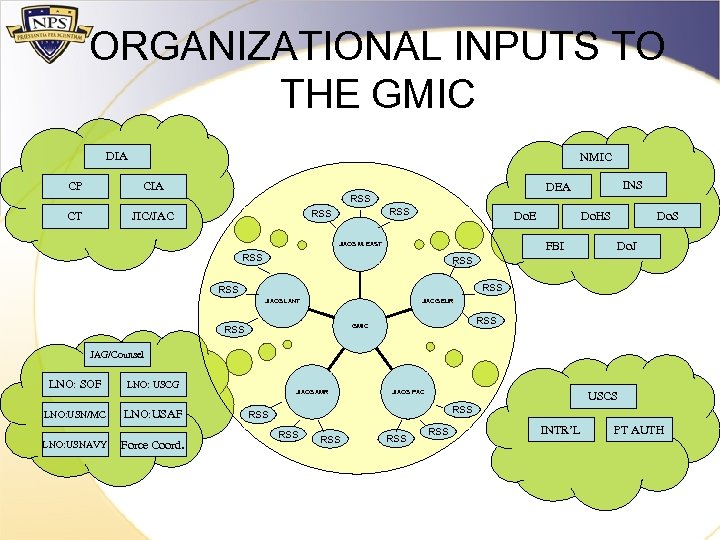 ORGANIZATIONAL INPUTS TO THE GMIC DIA CP NMIC CIA CT RSS JIC/JAC INS DEA RSS Do. E FBI JIACG M. EAST RSS Do. HS Do. J RSS RSS JIACG EUR JIACG LANT RSS GMIC RSS JAG/Counsel LNO: SOF LNO: USN/MC LNO: USNAVY LNO: USCG LNO: USAF Force Coord. JIACG AMR JIACG PAC USCS RSS RSS RSS INTR’L PT AUTH
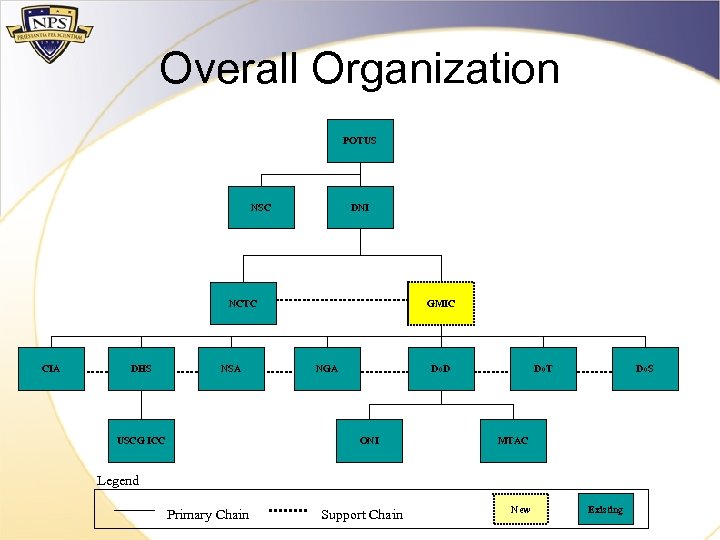 Overall Organization POTUS NSC DNI NCTC CIA DHS NSA USCG ICC GMIC NGA Do. D ONI Do. T Do. S MTAC Legend Primary Chain Support Chain New Existing
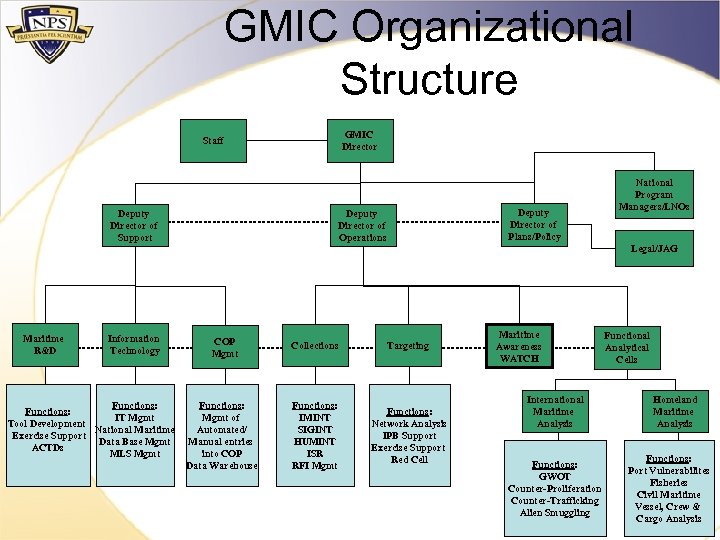 GMIC Organizational Structure GMIC Director Staff Deputy Director of Support Deputy Director of Plans/Policy Deputy Director of Operations National Program Managers/LNOs Legal/JAG Maritime R&D Information Technology Functions: IT Mgmt Tool Development National Maritime Exercise Support Data Base Mgmt ACTDs MLS Mgmt COP Mgmt Collections Targeting Functions: Mgmt of Automated/ Manual entries into COP Data Warehouse Functions: IMINT SIGINT HUMINT ISR RFI Mgmt Functions: Network Analysis IPB Support Exercise Support Red Cell Maritime Awareness WATCH International Maritime Analysis Functions: GWOT Counter-Proliferation Counter-Trafficking Alien Smuggling Functional Analytical Cells Homeland Maritime Analysis Functions: Port Vulnerabilites Fisheries Civil Maritime Vessel, Crew & Cargo Analysis
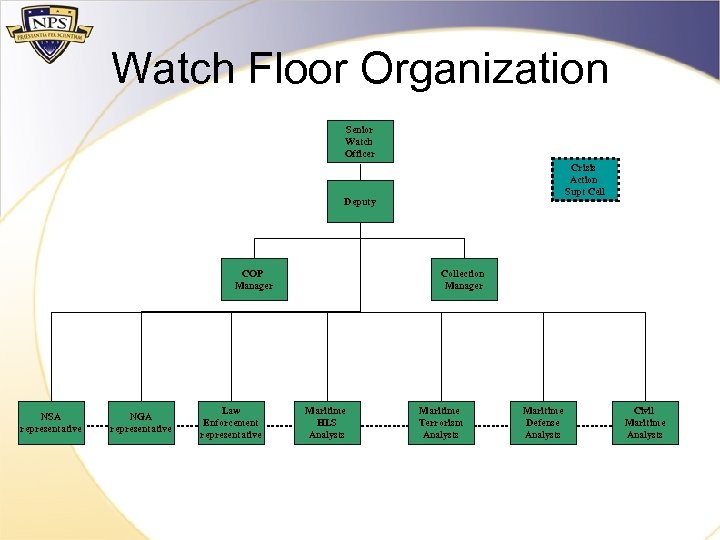 Watch Floor Organization Senior Watch Officer Crisis Action Supt Cell Deputy COP Manager NSA representative NGA representative Law Enforcement representative Collection Manager Maritime HLS Analysts Maritime Terrorism Analysts Maritime Defense Analysts Civil Maritime Analysts
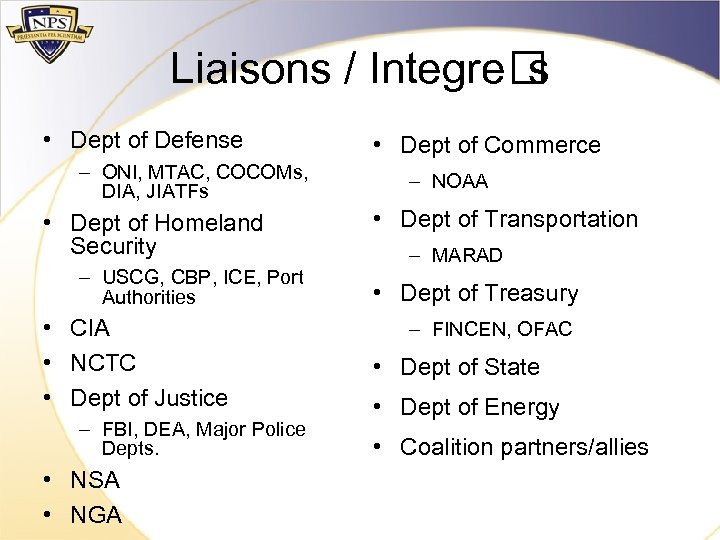 Liaisons / Integre s • Dept of Defense – ONI, MTAC, COCOMs, DIA, JIATFs • Dept of Homeland Security – USCG, CBP, ICE, Port Authorities • CIA • NCTC • Dept of Justice – FBI, DEA, Major Police Depts. • NSA • NGA • Dept of Commerce – NOAA • Dept of Transportation – MARAD • Dept of Treasury – FINCEN, OFAC • Dept of State • Dept of Energy • Coalition partners/allies
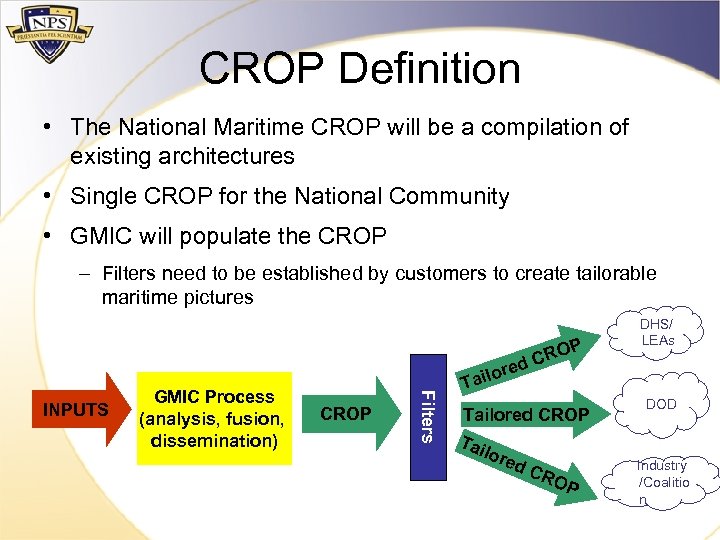 CROP Definition • The National Maritime CROP will be a compilation of existing architectures • Single CROP for the National Community • GMIC will populate the CROP – Filters need to be established by customers to create tailorable maritime pictures P RO d. C e DHS/ LEAs or GMIC Process (analysis, fusion, dissemination) CROP Filters INPUTS Tailored CROP Tai lore d. C RO P DOD Industry /Coalitio n
 Information Contained in the CROP (1) • Conveyances: vessel, ships, aircraft, barges, ferries • People: crew, master, port workers, passengers, civilians • Cargo: containers, vehicles, bulk cargo, liquefied natural gas (LNG), hazardous materials • Ports, waterways, and facilities: port terminals, piers, cranes, petrol facilities • Environment: weather, currents, natural resources, rookeries, fish stocks
 Information Contained in the CROP (2) • Infrastructure: undersea, nuclear power plants, rail heads, transportation nodes, bridges • Maritime geospatial: sea lanes, oceanic regions, coasts & waterways • Threats & activities: identified threats, illegal migration, offshore drilling • Friendly (i. e. , Blue) forces: military, federal, state, local, allied/coalition • Financial transactions: illegal money trails, hidden ownership
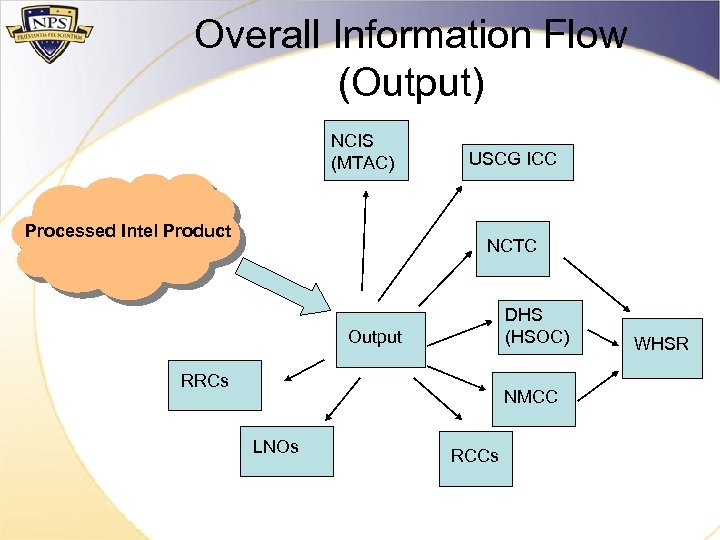 Overall Information Flow (Output) NCIS (MTAC) Processed Intel Product USCG ICC NCTC DHS (HSOC) Output RRCs NMCC LNOs RCCs WHSR
 Methods • Output will be available in a push-pull architecture • All information from CROP will be available; operational/tactical filters can be applied at subordinate levels to best address disclosure constraints • DOD customers will receive output via DISN services (JWICS, SIPR, GCCS) • Mobile users to receive IBS/GBS • LE agencies access RISS and JRIES/HSIN
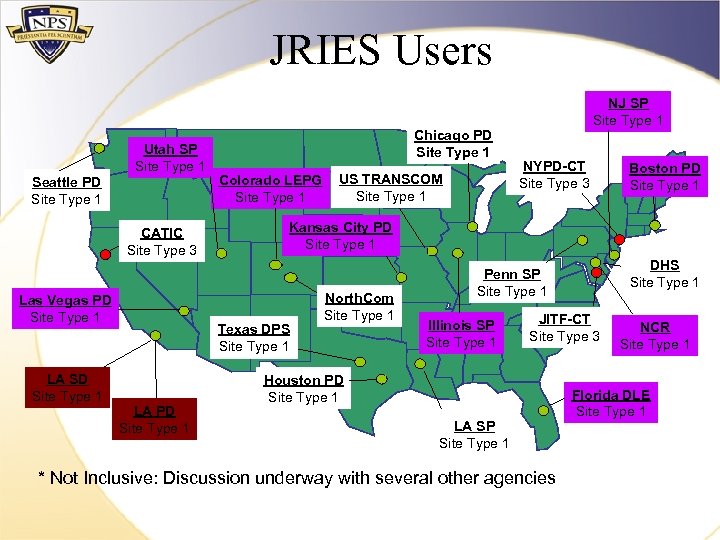 JRIES Users Utah SP Site Type 1 Seattle PD Site Type 1 CATIC Site Type 3 Las Vegas PD Site Type 1 LA SD Site Type 1 Chicago PD Site Type 1 Colorado LEPG Site Type 1 NYPD-CT Site Type 3 Boston PD Site Type 1 Kansas City PD Site Type 1 Texas DPS Site Type 1 LA PD Site Type 1 US TRANSCOM Site Type 1 NJ SP Site Type 1 North. Com Site Type 1 DHS Site Type 1 Penn SP Site Type 1 Illinois SP Site Type 1 JITF-CT Site Type 3 Houston PD Site Type 1 LA SP Site Type 1 * Not Inclusive: Discussion underway with several other agencies NCR Site Type 1 Florida DLE Site Type 1
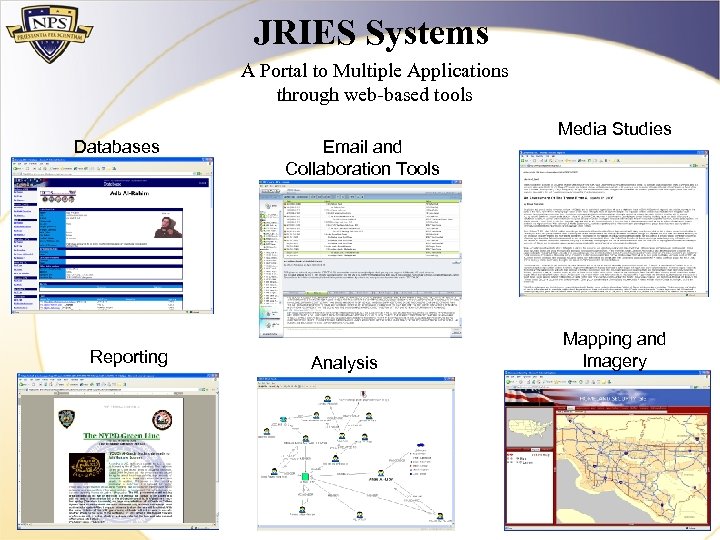 JRIES Systems A Portal to Multiple Applications through web-based tools Databases Reporting Email and Collaboration Tools Analysis Media Studies Mapping and Imagery
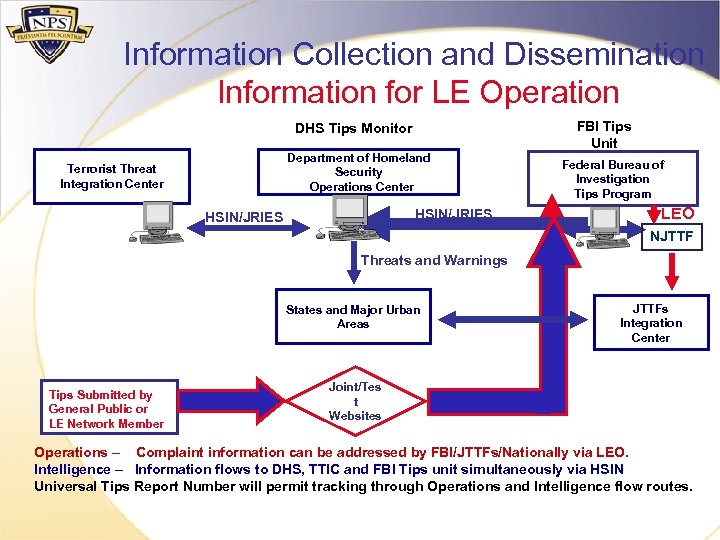 Information Collection and Dissemination Information for LE Operation FBI Tips Unit DHS Tips Monitor Department of Homeland Security Operations Center Terrorist Threat Integration Center HSIN/JRIES Federal Bureau of Investigation Tips Program LEO NJTTF Threats and Warnings States and Major Urban Areas Tips Submitted by General Public or LE Network Member JTTFs Integration Center Joint/Tes t Websites Operations – Complaint information can be addressed by FBI/JTTFs/Nationally via LEO. Intelligence – Information flows to DHS, TTIC and FBI Tips unit simultaneously via HSIN Universal Tips Report Number will permit tracking through Operations and Intelligence flow routes.
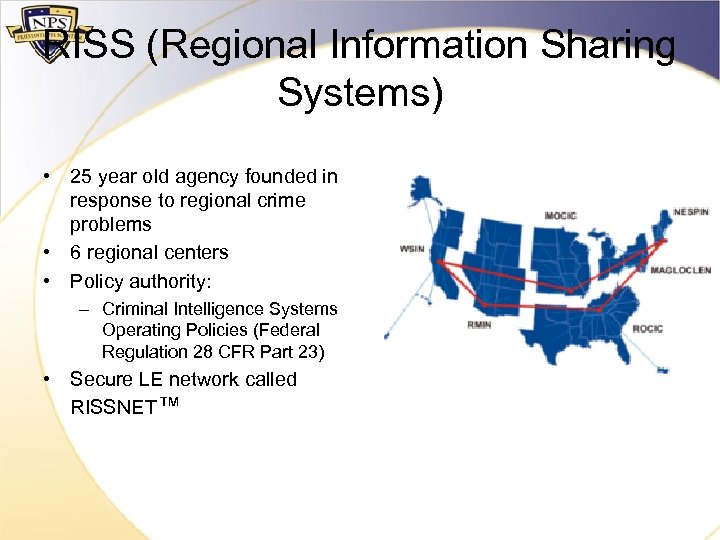 RISS (Regional Information Sharing Systems) • 25 year old agency founded in response to regional crime problems • 6 regional centers • Policy authority: – Criminal Intelligence Systems Operating Policies (Federal Regulation 28 CFR Part 23) • Secure LE network called RISSNET™
 Technology Summary • It’s all about the data – Metadata/tagging – Definitions – XML-ize only what’s important… • Mesh networks and beyond: more work on net management issues • IT can help us with process issues if we let it
 Further Issues and Considerations • Coordinating handoffs: seams • Processes within the organizations: seams • Existing legal and cultural “walls”: seams • This only hints at the seams encountered in a coalition environment
 Bottom Line At the Bottom (BLAB) • Continue streamlining bureaucratic and legal hurdles: seams! • HUMINT is the key to detecting and understanding emerging threats=>coalition partners are critical • OSINT and public networks offer more than you may think • Invest in critical technologies • Further integration of civilian and military organizations • Experiment, experiment, and experiment some more…not only on technologies but also on processes and organizational structures
 QUESTIONS?