 Скачать презентацию Notifiable Transactions Sammy Chau Katherine Man Assistant
8d1cb107886962f4e07fc307a5b6ca45.ppt
- Количество слайдов: 107



Notifiable Transactions Sammy Chau / Katherine Man Assistant Vice President Compliance and Monitoring Department Listing Division, HKEx 1
Agenda I. General II. Definition of transaction III. Classification of transactions and size tests computation IV. Announcement, circular and shareholder approval requirements 2

I. General
• • • Purposes of NT Rules Who are subject to NT Rules? Points to note
Purposes of NT Rules • Assess the impact of a transaction: – Shareholders are informed – Shareholders can vote on significant transactions • Reinforce the general disclosure principle of price-sensitive information
Who are subject to NT Rules? (1) “Listed issuer” means: - the listed issuer itself; and - its subsidiaries. “Subsidiary” includes: (a) “subsidiary undertaking” under the Companies Ordinance; (b) a consolidated subsidiary under HKFRS / IFRS; and (c) an acquisition target to be consolidated in the next audited consolidated accounts. 6
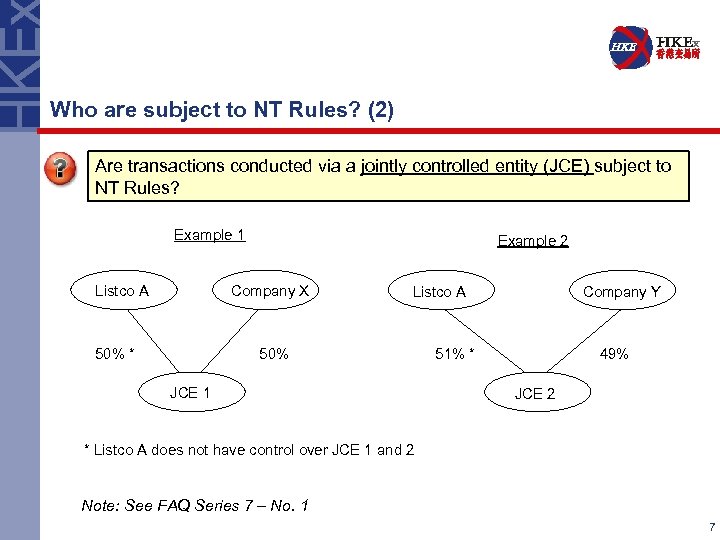
Who are subject to NT Rules? (2) Are transactions conducted via a jointly controlled entity (JCE) subject to NT Rules? Example 1 Listco A Example 2 Company X 50% * Listco A 50% JCE 1 Company Y 51% * 49% JCE 2 * Listco A does not have control over JCE 1 and 2 Note: See FAQ Series 7 – No. 1 7
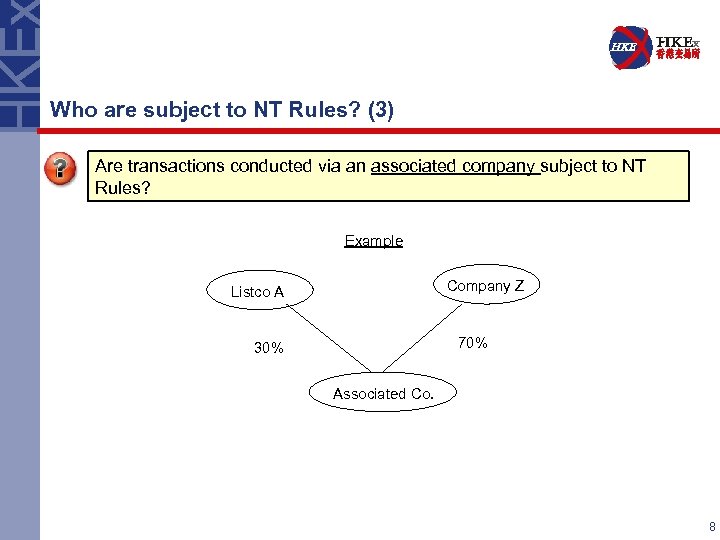
Who are subject to NT Rules? (3) Are transactions conducted via an associated company subject to NT Rules? Example Company Z Listco A 70% 30% Associated Co. 8
Points to note • A notifiable transaction may also be subject to other Rules, e. g. ØDisclosure of price-sensitive information ØAdvances to entities ØConnected transactions ØSpin-offs
II. Definition of transaction
• • Definition of “transaction” Examples
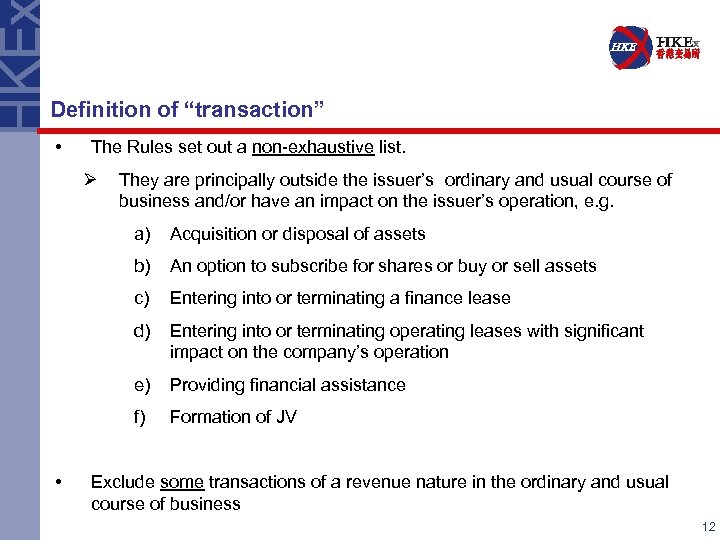
Definition of “transaction” • The Rules set out a non-exhaustive list. Ø They are principally outside the issuer’s ordinary and usual course of business and/or have an impact on the issuer’s operation, e. g. a) b) An option to subscribe for shares or buy or sell assets c) Entering into or terminating a finance lease d) Entering into or terminating operating leases with significant impact on the company’s operation e) Providing financial assistance f) • Acquisition or disposal of assets Formation of JV Exclude some transactions of a revenue nature in the ordinary and usual course of business 12
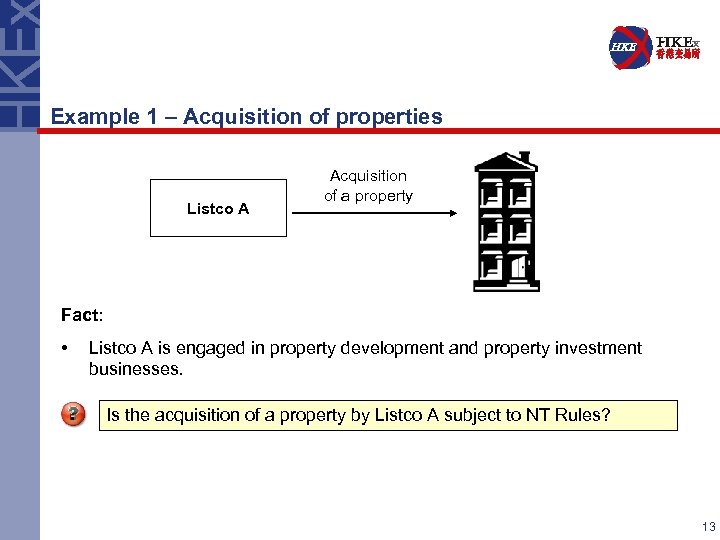
Example 1 – Acquisition of properties Listco A Acquisition of a property Fact: • Listco A is engaged in property development and property investment businesses. Is the acquisition of a property by Listco A subject to NT Rules? 13
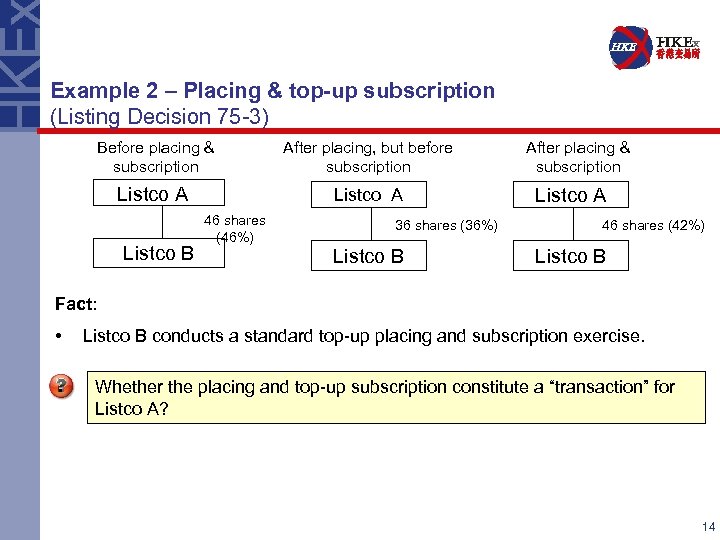
Example 2 – Placing & top-up subscription (Listing Decision 75 -3) Before placing & subscription After placing, but before subscription Listco A Listco B 46 shares (46%) 36 shares (36%) Listco B After placing & subscription Listco A 46 shares (42%) Listco B Fact: • Listco B conducts a standard top-up placing and subscription exercise. Whether the placing and top-up subscription constitute a “transaction” for Listco A? 14
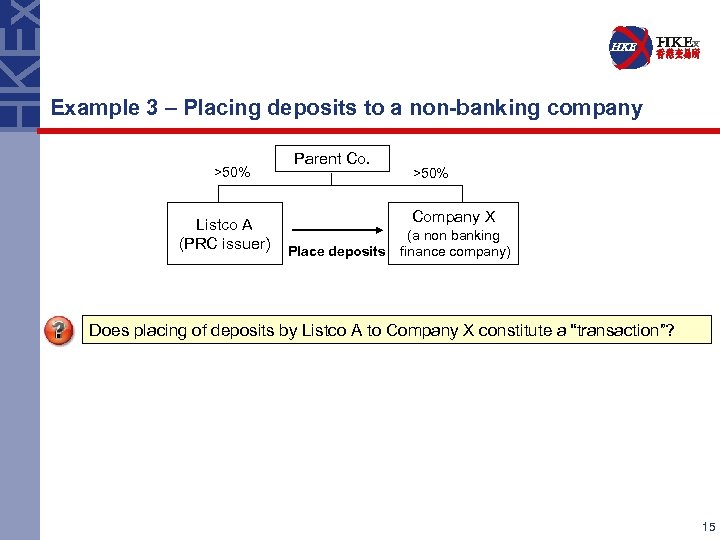
Example 3 – Placing deposits to a non-banking company >50% Listco A (PRC issuer) Parent Co. >50% Company X (a non banking Place deposits finance company) Does placing of deposits by Listco A to Company X constitute a “transaction”? 15
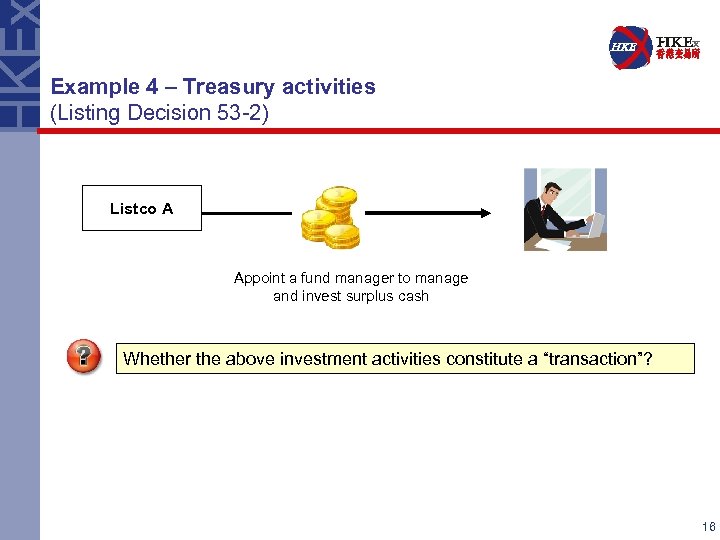
Example 4 – Treasury activities (Listing Decision 53 -2) Listco A Appoint a fund manager to manage and invest surplus cash Whether the above investment activities constitute a “transaction”? 16
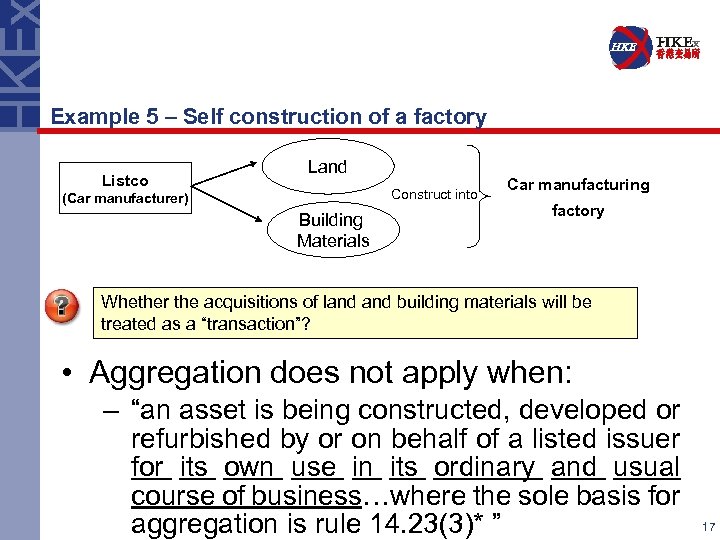
Example 5 – Self construction of a factory Listco Land Construct into (Car manufacturer) Building Materials Car manufacturing factory Whether the acquisitions of land building materials will be treated as a “transaction”? • Aggregation does not apply when: – “an asset is being constructed, developed or refurbished by or on behalf of a listed issuer for its own use in its ordinary and usual course of business…where the sole basis for aggregation is rule 14. 23(3)* ” 17
III. Classification of transactions and size tests computation
• • • Classification of NT 5 size tests General principles Specific circumstances Alternative size tests Aggregation of transactions
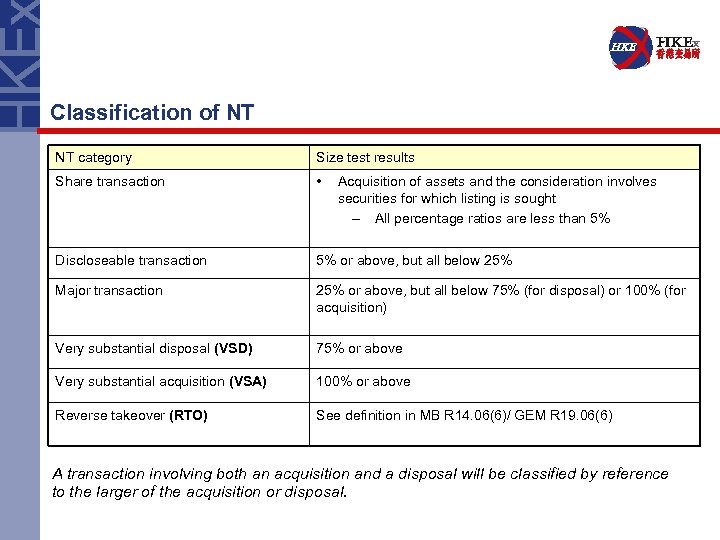
Classification of NT NT category Size test results Share transaction • Discloseable transaction 5% or above, but all below 25% Major transaction 25% or above, but all below 75% (for disposal) or 100% (for acquisition) Very substantial disposal (VSD) 75% or above Very substantial acquisition (VSA) 100% or above Reverse takeover (RTO) See definition in MB R 14. 06(6)/ GEM R 19. 06(6) Acquisition of assets and the consideration involves securities for which listing is sought – All percentage ratios are less than 5% A transaction involving both an acquisition and a disposal will be classified by reference to the larger of the acquisition or disposal.
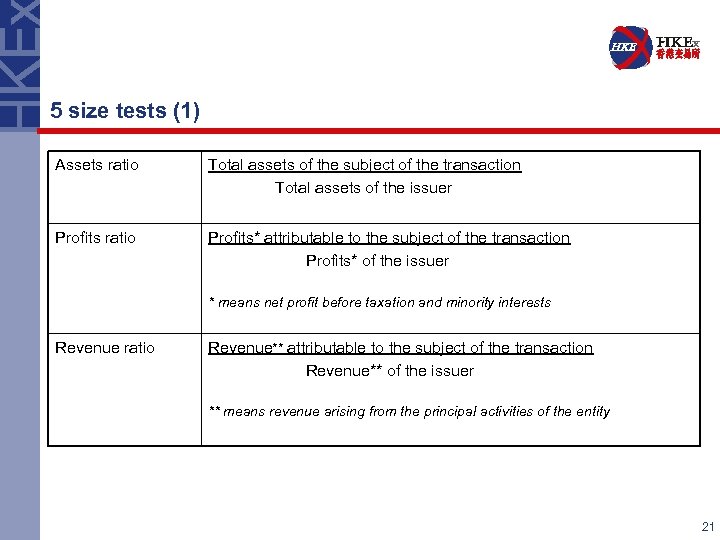
5 size tests (1) Assets ratio Total assets of the subject of the transaction Total assets of the issuer Profits ratio Profits* attributable to the subject of the transaction Profits* of the issuer * means net profit before taxation and minority interests Revenue ratio Revenue** attributable to the subject of the transaction Revenue** of the issuer ** means revenue arising from the principal activities of the entity 21
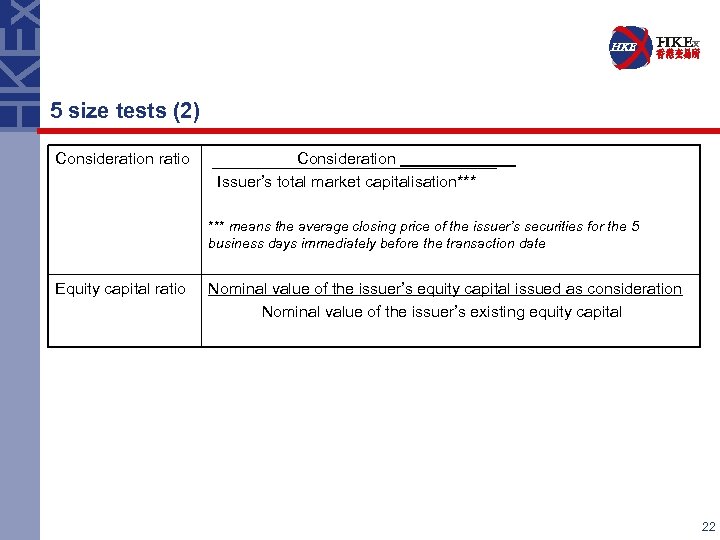
5 size tests (2) Consideration ratio Consideration Issuer’s total market capitalisation*** means the average closing price of the issuer’s securities for the 5 business days immediately before the transaction date Equity capital ratio Nominal value of the issuer’s equity capital issued as consideration Nominal value of the issuer’s existing equity capital 22
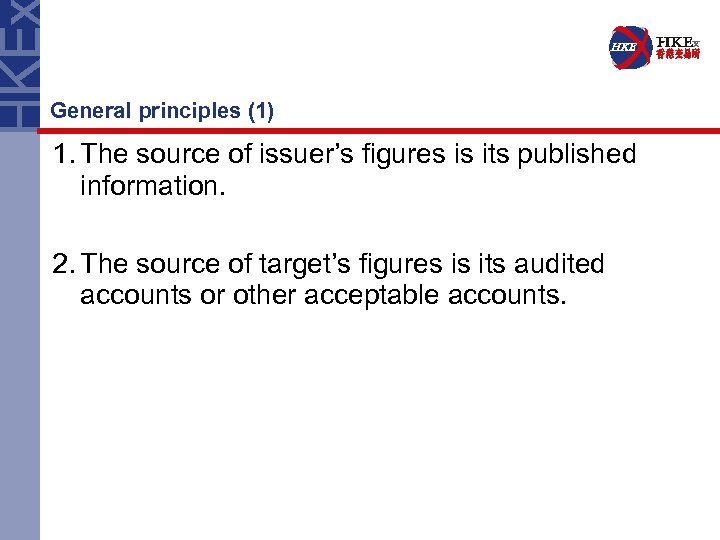
General principles (1) 1. The source of issuer’s figures is its published information. 2. The source of target’s figures is its audited accounts or other acceptable accounts.
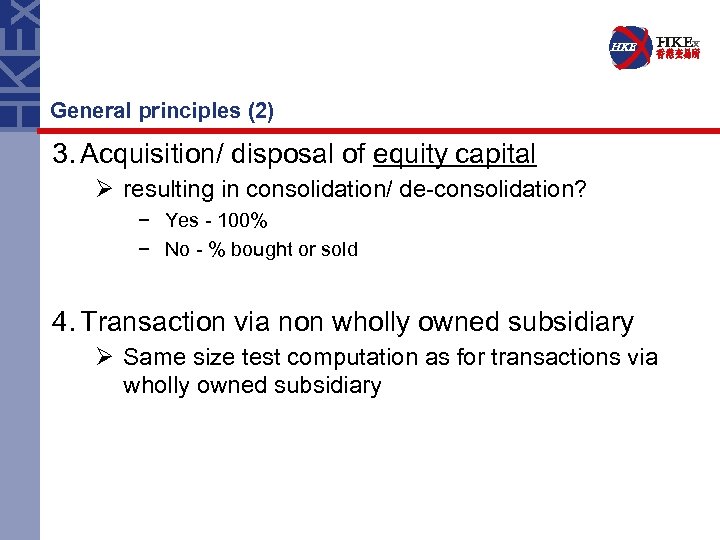
General principles (2) 3. Acquisition/ disposal of equity capital Ø resulting in consolidation/ de-consolidation? − Yes - 100% − No - % bought or sold 4. Transaction via non wholly owned subsidiary Ø Same size test computation as for transactions via wholly owned subsidiary
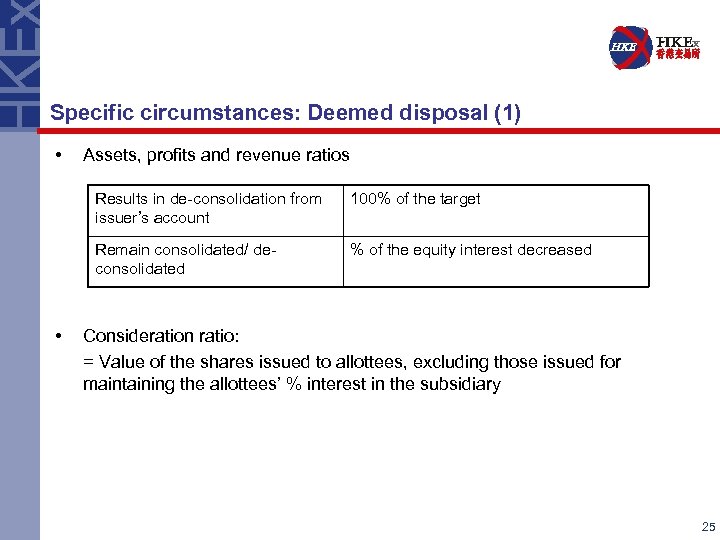
Specific circumstances: Deemed disposal (1) • Assets, profits and revenue ratios Results in de-consolidation from issuer’s account Remain consolidated/ deconsolidated • 100% of the target % of the equity interest decreased Consideration ratio: = Value of the shares issued to allottees, excluding those issued for maintaining the allottees’ % interest in the subsidiary 25
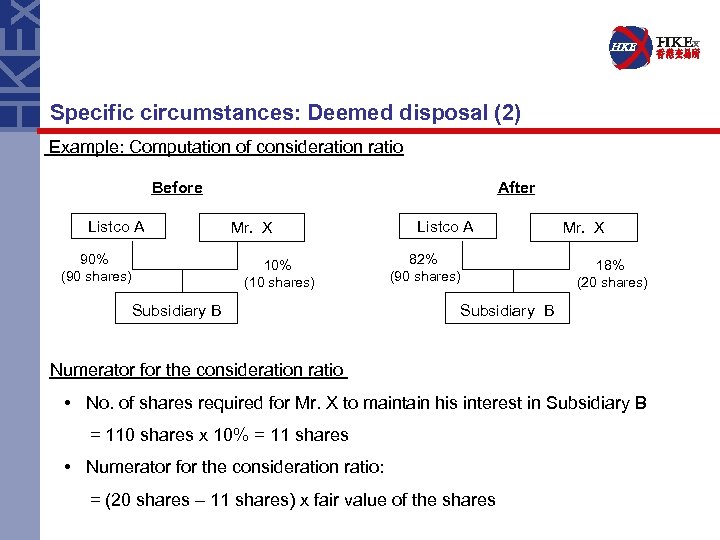
Specific circumstances: Deemed disposal (2) Example: Computation of consideration ratio Before Listco A 90% (90 shares) After Listco A Mr. X 10% (10 shares) 82% (90 shares) Subsidiary B Mr. X 18% (20 shares) Subsidiary B Numerator for the consideration ratio • No. of shares required for Mr. X to maintain his interest in Subsidiary B = 110 shares x 10% = 11 shares • Numerator for the consideration ratio: = (20 shares – 11 shares) x fair value of the shares
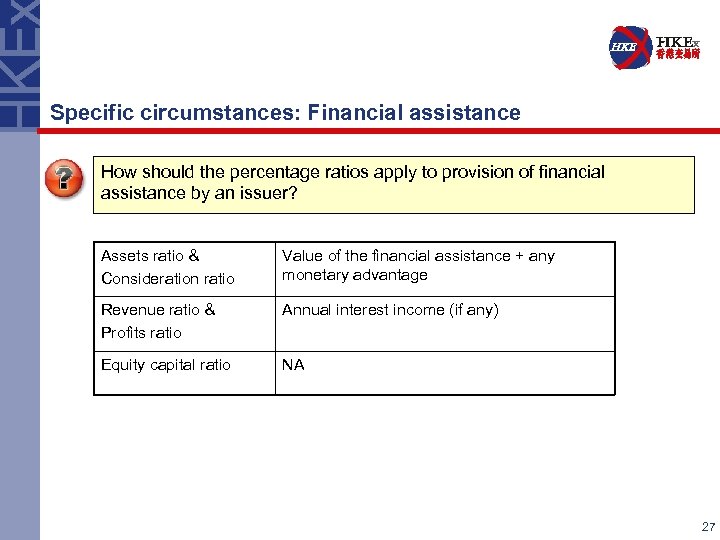
Specific circumstances: Financial assistance How should the percentage ratios apply to provision of financial assistance by an issuer? Assets ratio & Consideration ratio Value of the financial assistance + any monetary advantage Revenue ratio & Profits ratio Annual interest income (if any) Equity capital ratio NA 27
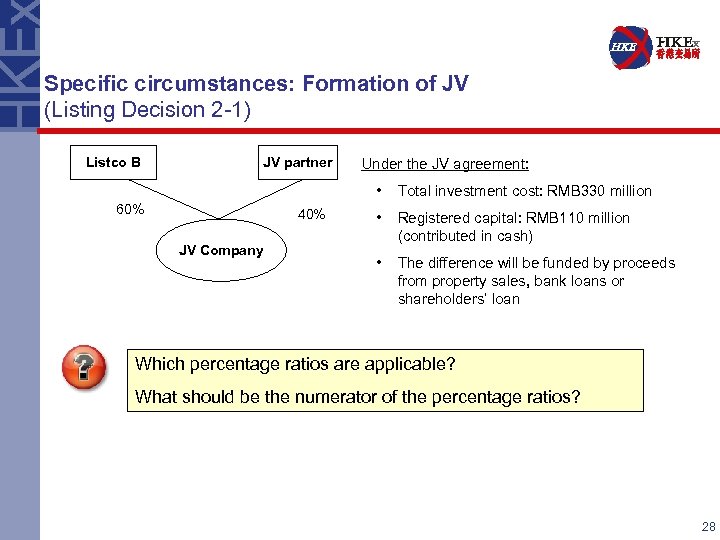
Specific circumstances: Formation of JV (Listing Decision 2 -1) Listco B JV partner Under the JV agreement: • 60% 40% JV Company Total investment cost: RMB 330 million • Registered capital: RMB 110 million (contributed in cash) • The difference will be funded by proceeds from property sales, bank loans or shareholders’ loan Which percentage ratios are applicable? What should be the numerator of the percentage ratios? 28
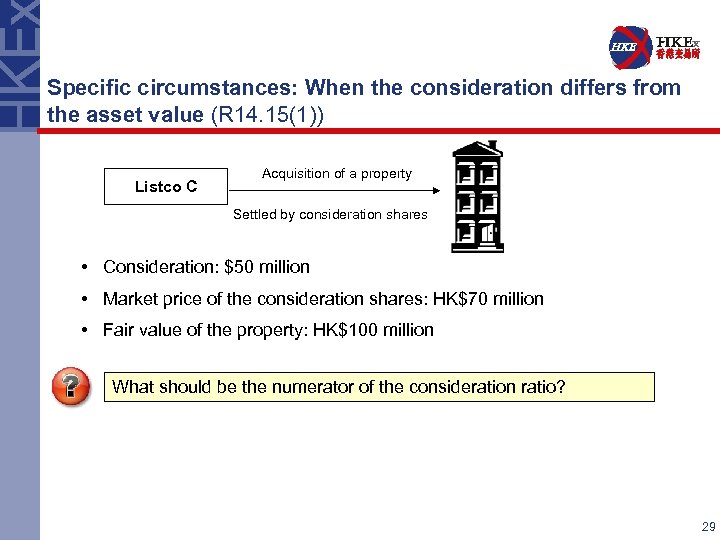
Specific circumstances: When the consideration differs from the asset value (R 14. 15(1)) Listco C Acquisition of a property Settled by consideration shares • Consideration: $50 million • Market price of the consideration shares: HK$70 million • Fair value of the property: HK$100 million What should be the numerator of the consideration ratio? 29
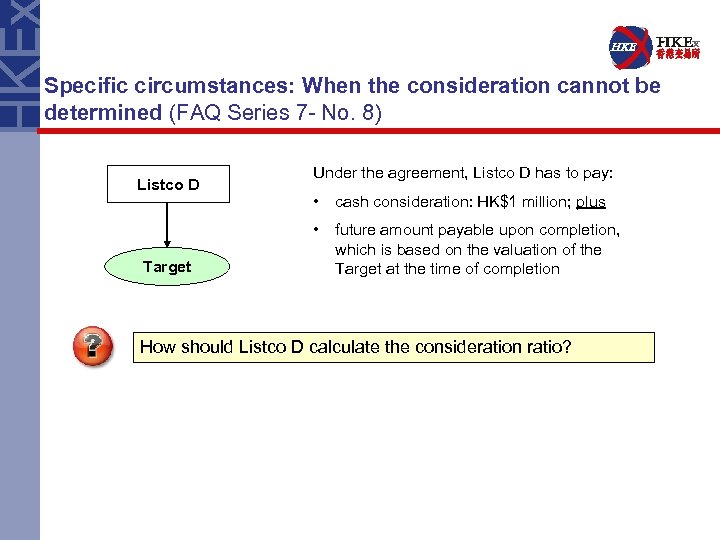
Specific circumstances: When the consideration cannot be determined (FAQ Series 7 - No. 8) Listco D Target Under the agreement, Listco D has to pay: • cash consideration: HK$1 million; plus • future amount payable upon completion, which is based on the valuation of the Target at the time of completion How should Listco D calculate the consideration ratio?
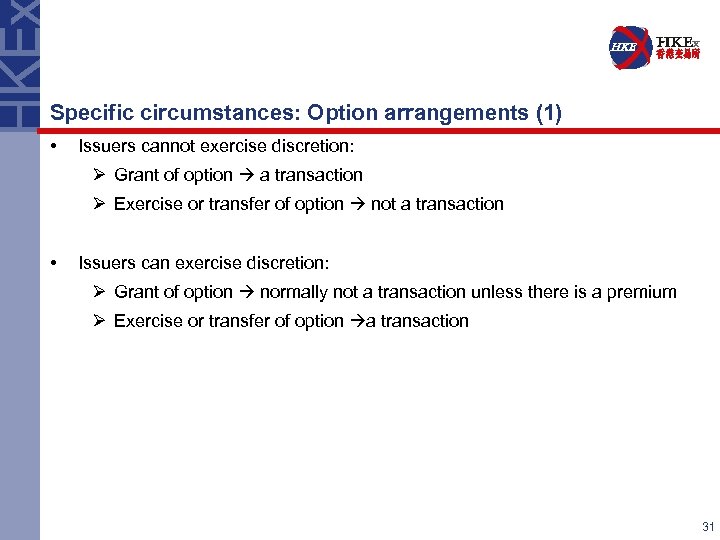
Specific circumstances: Option arrangements (1) • Issuers cannot exercise discretion: Ø Grant of option a transaction Ø Exercise or transfer of option not a transaction • Issuers can exercise discretion: Ø Grant of option normally not a transaction unless there is a premium Ø Exercise or transfer of option a transaction 31
Specific circumstances: Option arrangements (2) Prior approval for exercise of option • At the time of entering into an option, issuer may seek shareholder approval for the exercise of the option. • Shareholder approval is not required upon exercise of the option if: Ø the relevant information is disclosed to shareholders; and Ø no change of the relevant facts at the time of exercise No similar provision in the connected transaction Rules 32
Alternative size tests • We may disregard a size test calculation if: –it produces an anomalous result; or –it is inappropriate to the sphere of activity of the issuer. • Issuers must provide appropriate alternative tests for our consideration. • We will consider:
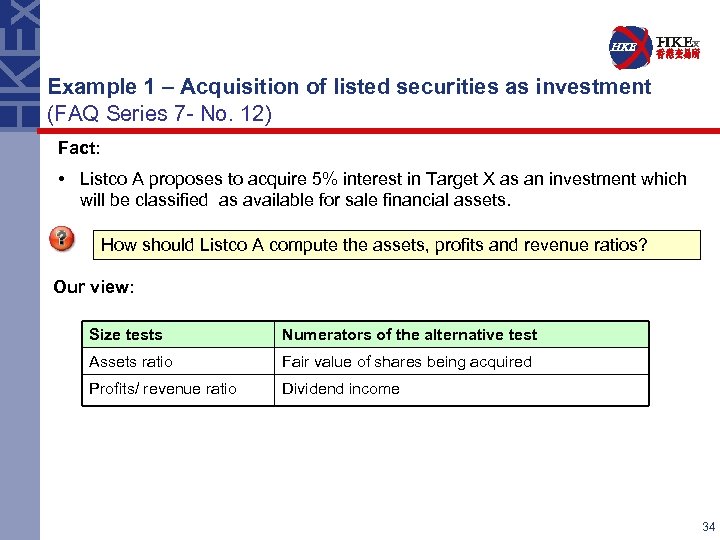
Example 1 – Acquisition of listed securities as investment (FAQ Series 7 - No. 12) Fact: • Listco A proposes to acquire 5% interest in Target X as an investment which will be classified as available for sale financial assets. How should Listco A compute the assets, profits and revenue ratios? Our view: Size tests Numerators of the alternative test Assets ratio Fair value of shares being acquired Profits/ revenue ratio Dividend income 34
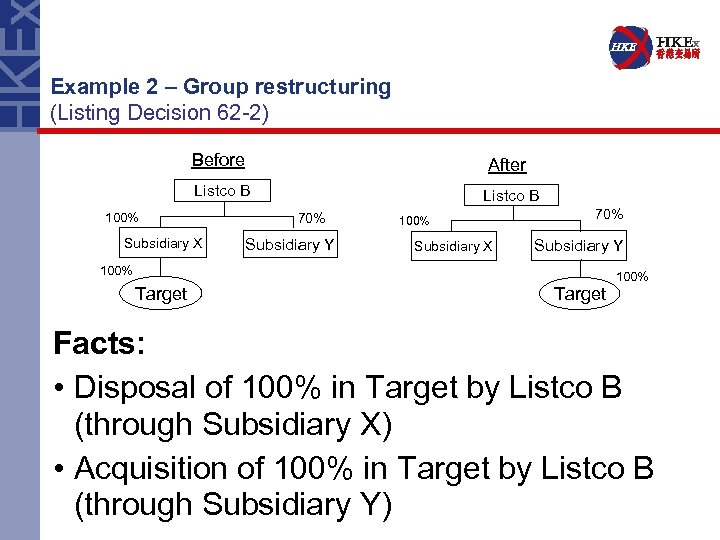
Example 2 – Group restructuring (Listing Decision 62 -2) Before After Listco B 100% Subsidiary X 70% Subsidiary Y 100% Target Facts: • Disposal of 100% in Target by Listco B (through Subsidiary X) • Acquisition of 100% in Target by Listco B (through Subsidiary Y)
Aggregation of transactions • Prevent circumvention of Rules by splitting a transaction • Aggregation of a series of transactions: Ø completed within 12 months or Ø are otherwise related. • Non-exhaustive factors we consider: Ø with the same party or parties connected
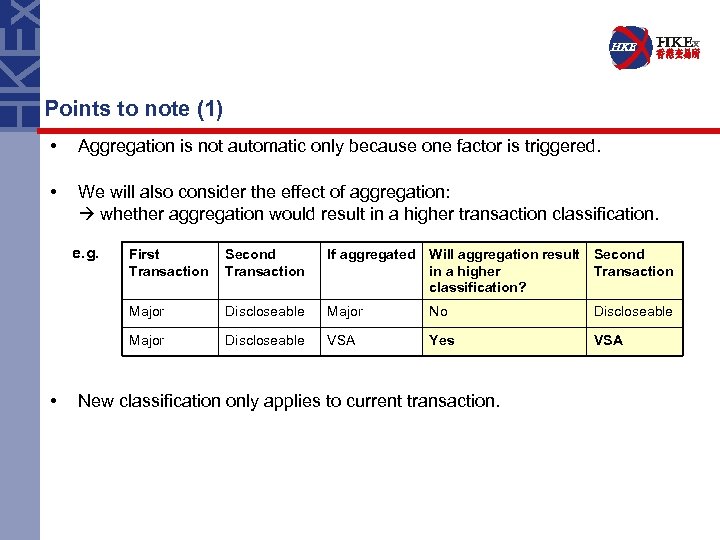
Points to note (1) • Aggregation is not automatic only because one factor is triggered. • We will also consider the effect of aggregation: whether aggregation would result in a higher transaction classification. e. g. Second Transaction If aggregated Will aggregation result Second in a higher Transaction classification? Major Discloseable Major No Discloseable Major • First Transaction Discloseable VSA Yes VSA New classification only applies to current transaction.
Points to note (2) • Prior consultation with the Exchange Exceptions: • The issuer has already decided to aggregate the proposed transaction with the previous transaction(s) • The proposed transaction, even when aggregated with the previous transaction(s), will not be a NT
Example 1 – Acquisition of machinery from related suppliers (Listing Decision 64 -1) Facts: • Listco A proposes to acquire different models of machinery from members of Group X (a major supplier) under different contracts. • The machinery acquired under each contract is functional on its own and does not form part of an assembled machine. • Each contract was negotiated independently. Will the Exchange aggregate acquisitions of machinery? 39
Example 2 – Acquisition of adjacent lands (Listing Decision 64 -2) Facts: • Listco B acquired Land 1 in June. • It acquires Land 2 one month later. • Land 1 and 2 are adjacent to each other. Will the Exchange aggregate acquisitions of Land 1 and 2? • They will be re-developed into a single residential property for sale. 40
IV. Announcement, circular and shareholder approval requirements
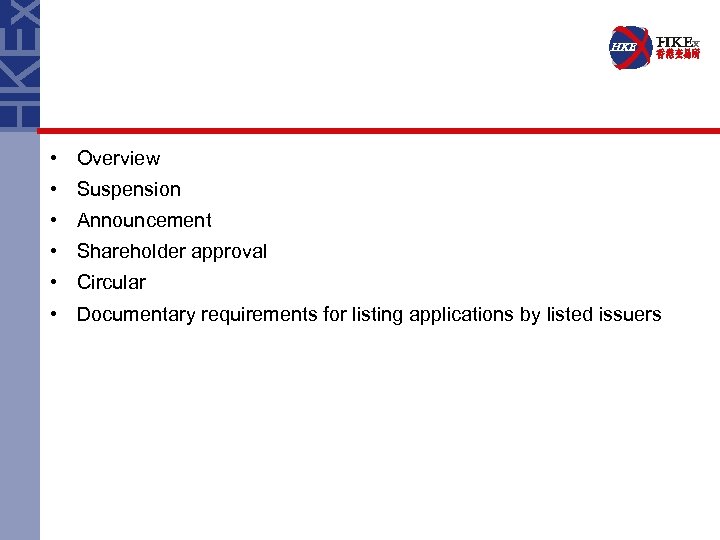
• Overview • Suspension • Announcement • Shareholder approval • Circular • Documentary requirements for listing applications by listed issuers
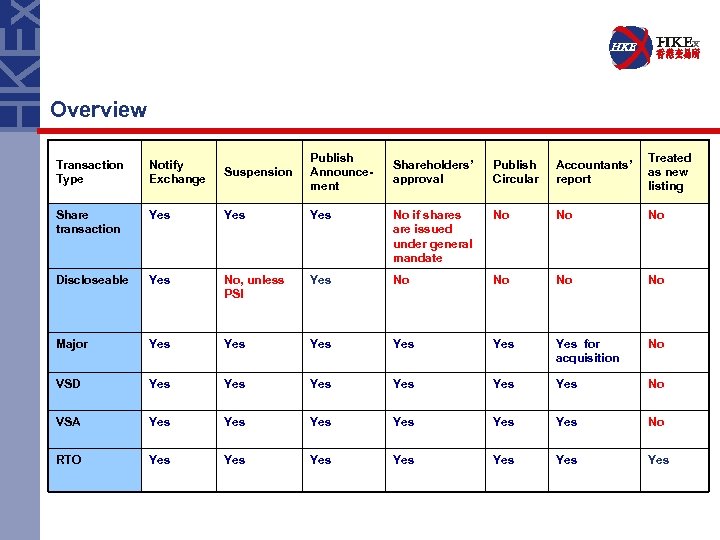
Overview Transaction Type Notify Exchange Suspension Publish Announcement Shareholders’ approval Publish Circular Accountants’ report Treated as new listing Share transaction Yes Yes No if shares are issued under general mandate No No No Discloseable Yes No, unless PSI Yes No No Major Yes Yes Yes for acquisition No VSD Yes Yes Yes No VSA Yes Yes Yes No RTO Yes Yes
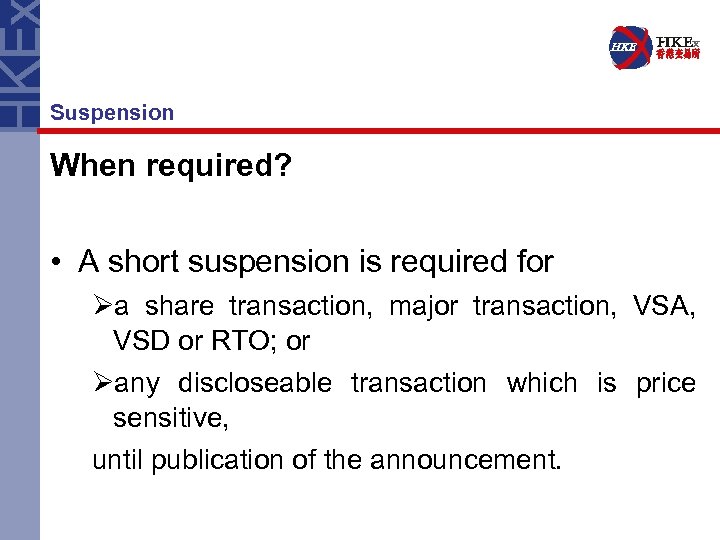
Suspension When required? • A short suspension is required for Øa share transaction, major transaction, VSA, VSD or RTO; or Øany discloseable transaction which is price sensitive, until publication of the announcement.
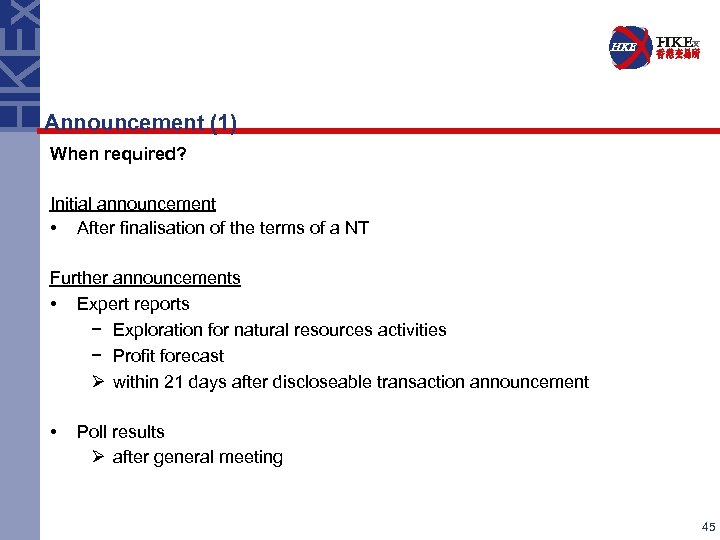
Announcement (1) When required? Initial announcement • After finalisation of the terms of a NT Further announcements • Expert reports − Exploration for natural resources activities − Profit forecast Ø within 21 days after discloseable transaction announcement • Poll results Ø after general meeting 45
Announcement (2) When required? Further announcements (cont’d) • Changes after initial announcement: – termination of a previously announced NT – material change in terms of the NT – material delay in completion of the agreement • Option arrangements: – expiry of the option – option holder notifying the grantor of non-exercise of the option – transfer of the option to a third party 46
Announcement (3) Content requirements • General principle – Information must be clearly presented, and must be accurate and complete in all material respects and not be misleading or deceptive • Specific disclosures e. g. - general nature of the transaction - description of the target - terms of the transaction (e. g. consideration) - reasons for and impact of the transaction 47
Announcement (4) Common pitfalls Frequent omissions: • Principal business activities of the counterparty • Date of the transaction and independence of the counterparty • Value of the subject asset • Net profits of the target asset
Announcement (5) Waivers from disclosure requirements • Granted only in limited circumstances • We will consider: Ømateriality of the information Øalternative disclosures proposed by the issuer Øsufficient information for shareholders/ investors to make an informed investment decision
Example – Waiver from disclosure requirements Facts • Listco A proposes a major acquisition involving issuance of consideration shares change in control • Listco A must disclose the Target’s financial information in the announcement. • Takeovers Code: Disclosure of “unaudited” financial information will constitute profit forecasts, which must be reported by an auditor and/or a financial advisor. Will the Exchange grant waiver? 50
Shareholder approval (1) When required? • Major transaction, VSD, VSA and RTO General principles • Voting should be made on the terms of the subject transaction • All voting at general meetings must be taken by poll • Shareholder approval must be obtained before completion of the transaction Can an issuer obtain a prior mandate from its shareholders for on-market disposal of its investments? 51
Shareholder approval (2) Material interest • Any shareholder that has a material interest in the transaction shall abstain from voting • Factors determining “material interest” include: Øa party to the transaction or his associate? Øany benefit confers upon the shareholder or his associate, which is not available to other shareholders
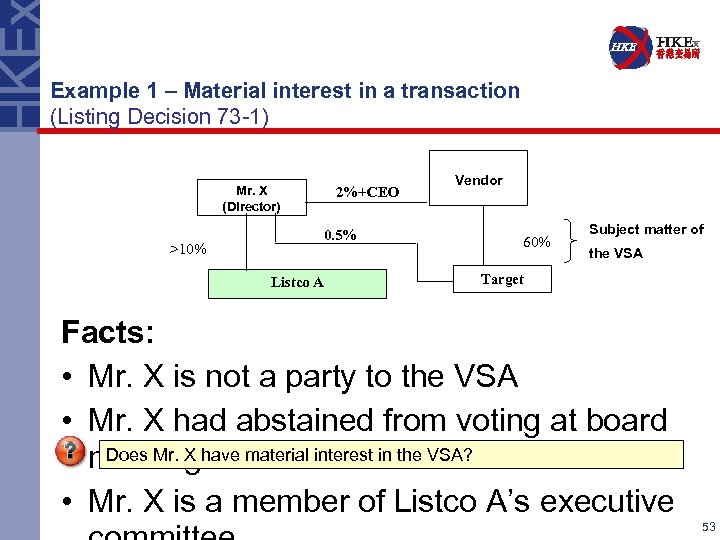
Example 1 – Material interest in a transaction (Listing Decision 73 -1) Mr. X (Director) >10% 2%+CEO 0. 5% Listco A Vendor 60% Subject matter of the VSA Target Facts: • Mr. X is not a party to the VSA • Mr. X had abstained from voting at board Does Mr. X have material interest in the VSA? meetings • Mr. X is a member of Listco A’s executive 53
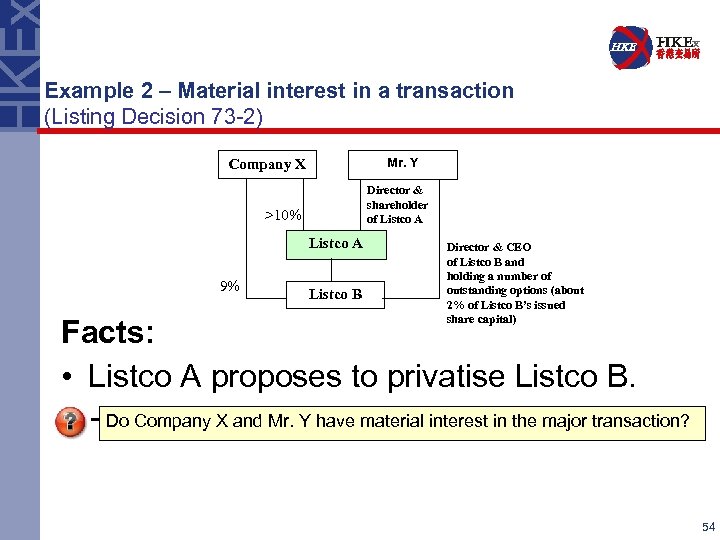
Example 2 – Material interest in a transaction (Listing Decision 73 -2) Mr. Y Company X Director & shareholder of Listco A >10% Listco A 9% Listco B Director & CEO of Listco B and holding a number of outstanding options (about 2% of Listco B’s issued share capital) Facts: • Listco A proposes to privatise Listco B. Do Company X and Mr. Y have material interest in the major transaction? a major transaction for Listco A 54
Written shareholder approval (1) • Allowed for major transactions if: Ø no shareholder needs to abstain from voting; and Ø a “closely allied group of shareholders”, holding more than 50% voting interest, approves the transaction • A “closely allied group of shareholders”: Ø the number of persons in the group Ø their relationship (e. g. past or present business
Written shareholder approval (2) • Not allowed for : Ø VSA, VSD and RTO Ø qualified opinion on the accountants’ report Ø some natural resources acquisitions that become new ventures of the issuer • Other Listing Rules may require shareholder meeting e. g. specific mandate for issue of consideration shares
Subsequent change of terms of a transaction • Material changes of the terms of a transaction after shareholder approval require shareholder re-approval? Example: • Listco A agreed to dispose of a property at a consideration of HK$20 million VSD • The VSD was approved by shareholders. • The parties now proposes to reduce the consideration to HK$10 million before completion major transaction Does the change of consideration constitute a material change in terms? Note: See also FAQ Series 7 – No. 16 57
Circular (1) When required? • Major transaction, VSD, VSA and RTO • The circular must be despatched: Ø within 21 days after publication of the announcement; and Ø at the same time or before the issuer gives notice of the shareholder meeting (if any)
Circular (2) Content requirements • General principle – Information must be clearly presented, and must be accurate and complete in all material respects and not be misleading or deceptive – Sufficient information for shareholders to vote • Specific disclosures e. g. - 3 year historical financial information of the target
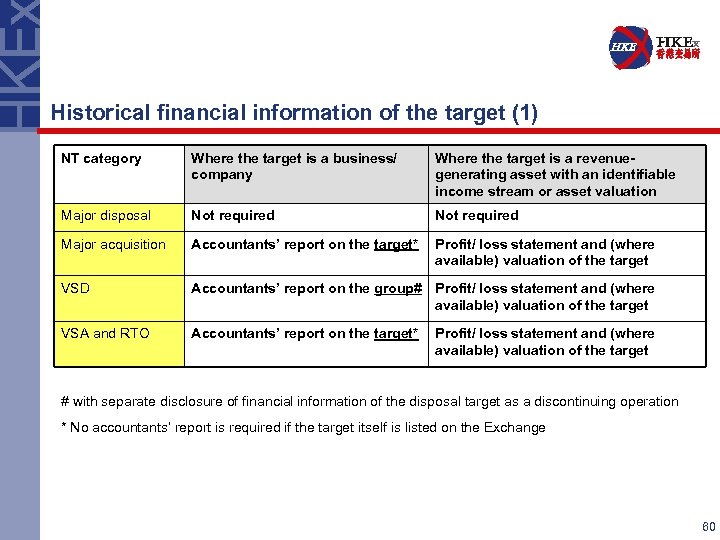
Historical financial information of the target (1) NT category Where the target is a business/ company Where the target is a revenuegenerating asset with an identifiable income stream or asset valuation Major disposal Not required Major acquisition Accountants’ report on the target* Profit/ loss statement and (where available) valuation of the target VSD Accountants’ report on the group# Profit/ loss statement and (where available) valuation of the target VSA and RTO Accountants’ report on the target* Profit/ loss statement and (where available) valuation of the target # with separate disclosure of financial information of the disposal target as a discontinuing operation * No accountants’ report is required if the target itself is listed on the Exchange 60
Historical financial information of the target (2) Accountants’ report • Prepared by qualified and independent CPA • The accounts must: Ø adopt accounting policies materially consistent with those of the issuer Ø conform with HKFRS or IFRS Ø contain financial statements of the target /
Historical financial information of the target (3) Accountants’ report relief • We will consider: ØInformation differences ØAssurance differences ØUnduly burdensome/ impractical • Specific relief in the Rules: Øthe target has not or will not become the issuer’s subsidiary
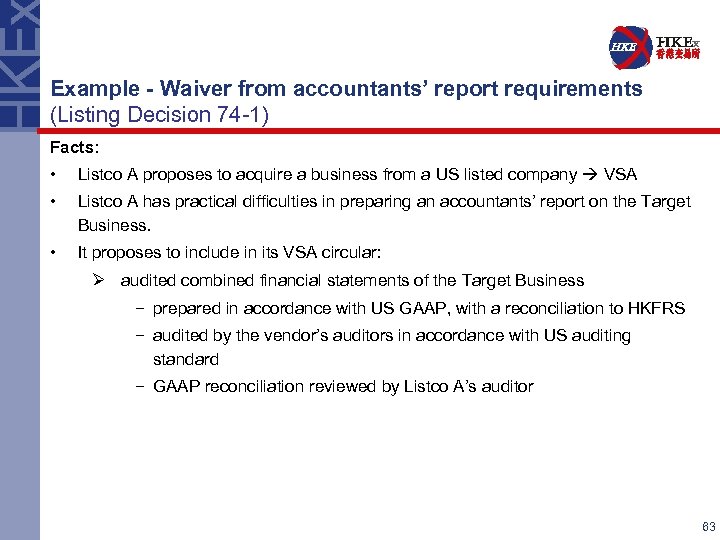
Example - Waiver from accountants’ report requirements (Listing Decision 74 -1) Facts: • Listco A proposes to acquire a business from a US listed company VSA • Listco A has practical difficulties in preparing an accountants’ report on the Target Business. • It proposes to include in its VSA circular: Ø audited combined financial statements of the Target Business − prepared in accordance with US GAAP, with a reconciliation to HKFRS − audited by the vendor’s auditors in accordance with US auditing standard − GAAP reconciliation reviewed by Listco A’s auditor 63
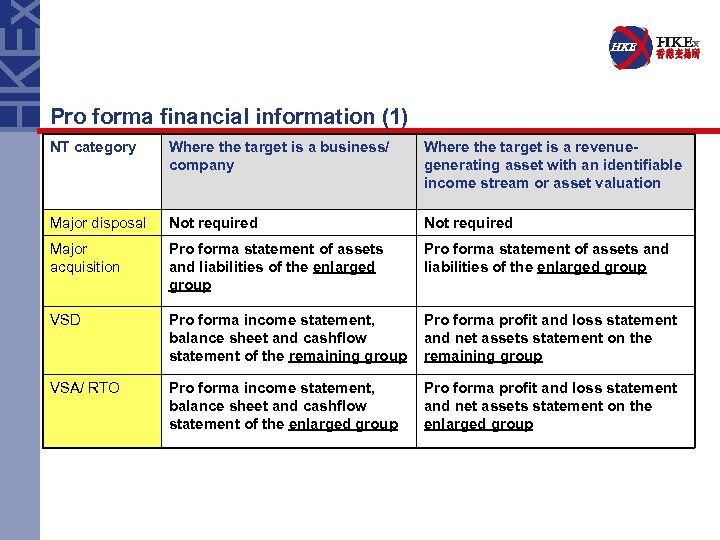
Pro forma financial information (1) NT category Where the target is a business/ company Where the target is a revenuegenerating asset with an identifiable income stream or asset valuation Major disposal Not required Major acquisition Pro forma statement of assets and liabilities of the enlarged group VSD Pro forma income statement, balance sheet and cashflow statement of the remaining group Pro forma profit and loss statement and net assets statement on the remaining group VSA/ RTO Pro forma income statement, balance sheet and cashflow statement of the enlarged group Pro forma profit and loss statement and net assets statement on the enlarged group
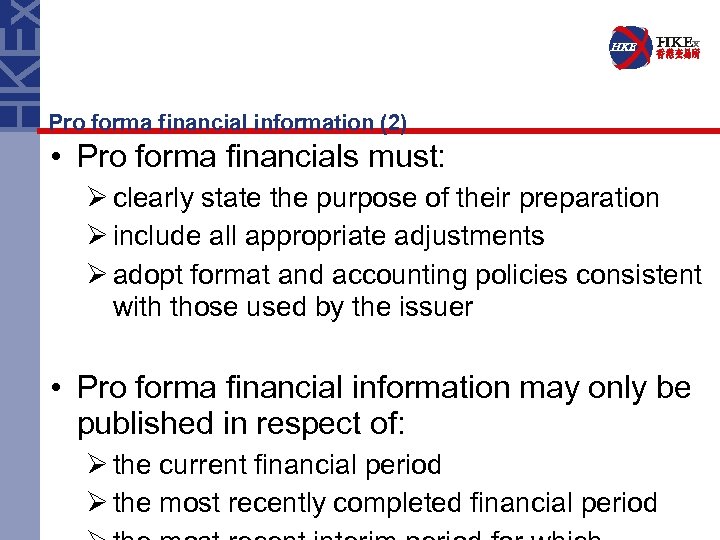
Pro forma financial information (2) • Pro forma financials must: Ø clearly state the purpose of their preparation Ø include all appropriate adjustments Ø adopt format and accounting policies consistent with those used by the issuer • Pro forma financial information may only be published in respect of: Ø the current financial period Ø the most recently completed financial period
Pro forma financial information (3) • The issuer’s unadjusted information must be derived from the most recent : Ø audited published accounts, published interim reports, published interim or annual results announcements; Ø accountants’ report; Ø previously published pro forma financials; or Ø published profit forecast or estimate
Other expert reports (1) Report on profit forecast • Profit forecast is not mandatory • A circular containing a profit forecast must include: Ø reporting accountants’ or auditors’ report − accounting policies − calculations for the forecast
Other expert reports (2) Report on profit forecast (cont’d) • “Profit forecast” includes: • any statement which quantifies the anticipated level of future profits or losses • any profits/ losses estimate for a financial period which has expired but for which the results have not yet been published • any valuation of assets (other than land buildings) or businesses based on discounted
Other expert reports (3) Technical report for mining activities • applicable to Main Board issuers proposing to explore for natural resources as a new venture • must be prepared by a qualified technical adviser • must include information e. g. – estimated reserves
Indebtedness and working capital sufficiency statements Indebtedness statement • statement of “indebtedness” of the group as at the most recent practicable date “most recent practicable date” – normally NOT more than 8 weeks before “group” – include any company which will become a subsidiary of the issuer Working capital sufficiency statement • confirmation if the issuer has sufficient
Documentary requirements for listing applications by listed issuers Recent Rule amendments (Effective 2 November 2009) • simplify Rules for listing applications by listed issuers • remove some requirements • revise timeframe existing for documentary submission of
V. Special considerations for transactions
• Reverse takeovers • Spin-off • Distribution in specie • Cash companies • Sufficiency of operations
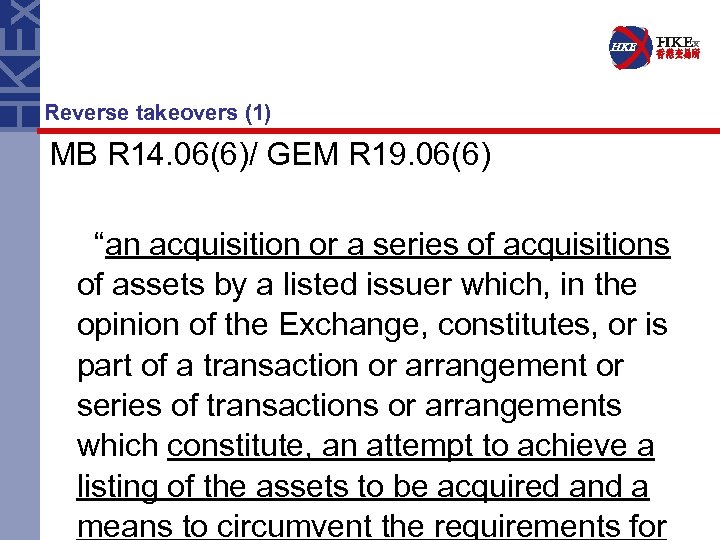
Reverse takeovers (1) MB R 14. 06(6)/ GEM R 19. 06(6) “an acquisition or a series of acquisitions of assets by a listed issuer which, in the opinion of the Exchange, constitutes, or is part of a transaction or arrangement or series of transactions or arrangements which constitute, an attempt to achieve a listing of the assets to be acquired and a means to circumvent the requirements for
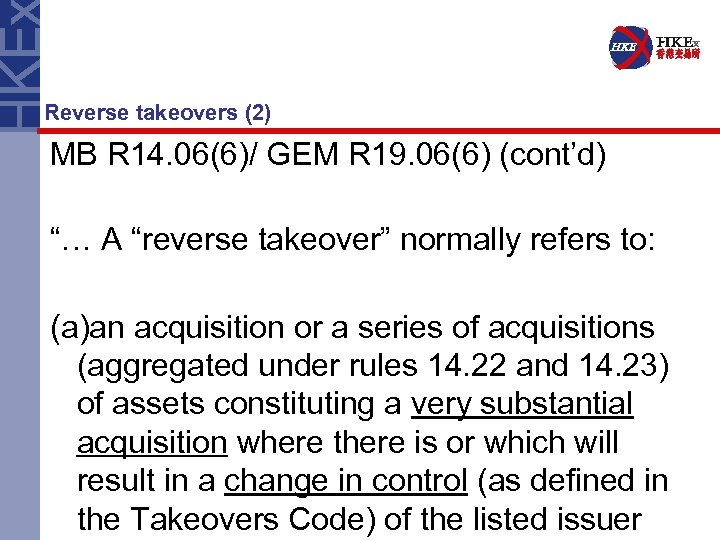
Reverse takeovers (2) MB R 14. 06(6)/ GEM R 19. 06(6) (cont’d) “… A “reverse takeover” normally refers to: (a)an acquisition or a series of acquisitions (aggregated under rules 14. 22 and 14. 23) of assets constituting a very substantial acquisition where there is or which will result in a change in control (as defined in the Takeovers Code) of the listed issuer
Reverse takeovers (3) Application of RTO Rule • What is a RTO? (LC Annual Report 2007) • What is the 24 month restriction? • How do we look at “change in control”?
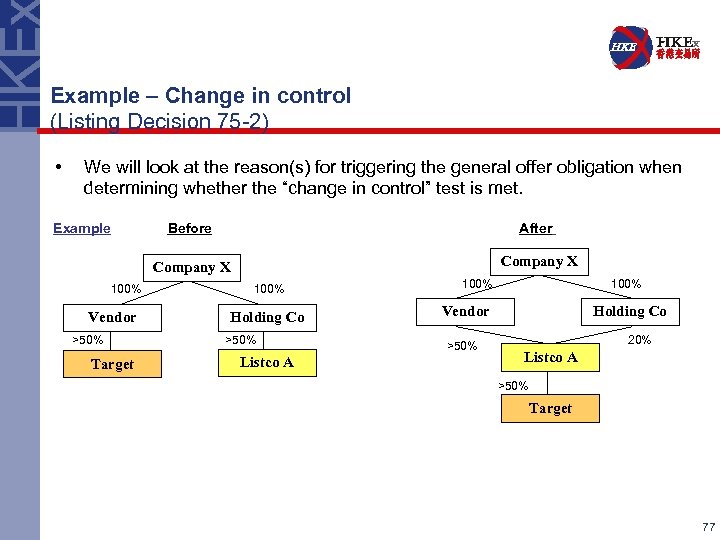
Example – Change in control (Listing Decision 75 -2) • We will look at the reason(s) for triggering the general offer obligation when determining whether the “change in control” test is met. Example 100% Vendor >50% Target Before After Company X Company X 100% Holding Co >50% Listco A 100% Vendor >50% Holding Co 20% Listco A >50% Target 77
Disposal of existing business after change in control (1) • To address circumvention of the RTO rules • An issuer may not dispose of its existing business for a 24 month period after a change in control, unless – assets acquired after the change in control meet the new listing requirement Otherwise, deemed as a new listing
Disposal of business after change in control (2) Listing Committee Annual Report 2008 • The Listing Committee endorsed a waiver: Disposal will be restricted if : – assets injection by new controlling shareholder at the time of and/or after the change in control; and – such asset injection would have resulted in a VSA, taking into account the disposal(s) • We will consider whether the issuer structures its transactions to circumvent the RTO Rules. 79
Spin-off • A proposal that “effects the separate listing on the Exchange or elsewhere of assets or businesses wholly or partly within its existing group” • General principle one business should not support 2 listing status
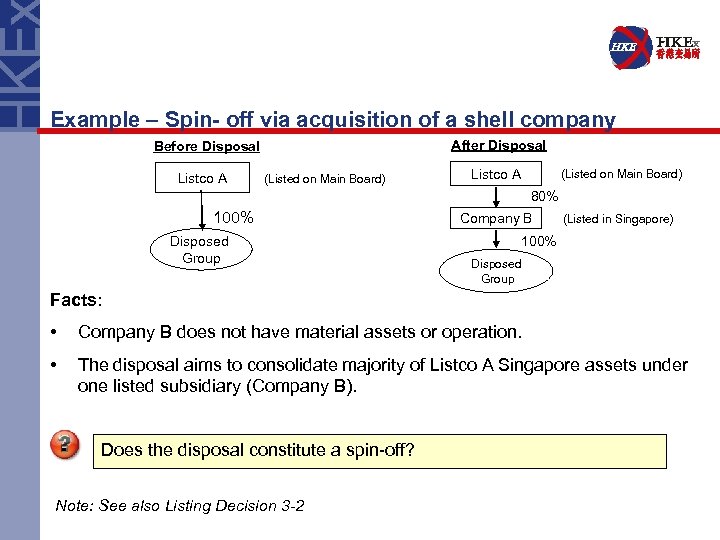
Example – Spin- off via acquisition of a shell company After Disposal Before Disposal Listco A (Listed on Main Board) 80% 100% Disposed Group Company B (Listed in Singapore) 100% Disposed Group Facts: • Company B does not have material assets or operation. • The disposal aims to consolidate majority of Listco A Singapore assets under one listed subsidiary (Company B). Does the disposal constitute a spin-off? Note: See also Listing Decision 3 -2
Distribution in specie • Distributions in specie to shareholders are normally notifiable transactions. • We may impose requirements if the distributions are in substance: – circumvention of the Listing Rules – disposal of assets by the issuer – against the general principles of investor protection
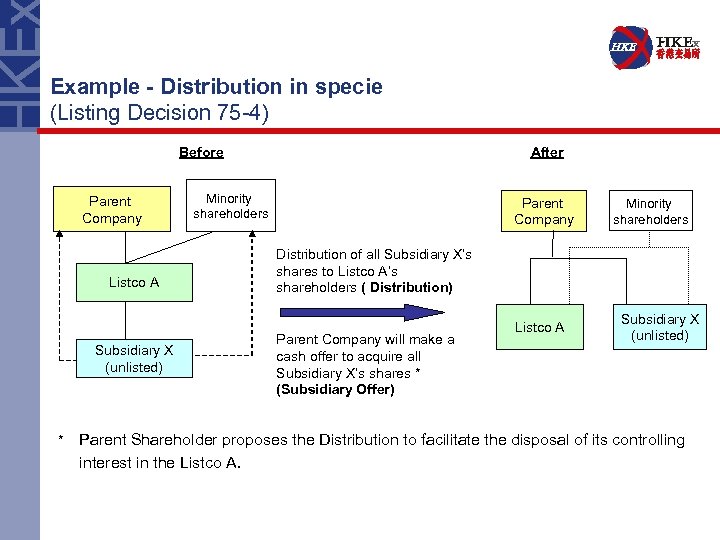
Example - Distribution in specie (Listing Decision 75 -4) Before Parent Company After Minority shareholders Listco A Subsidiary X (unlisted) Parent Company Minority shareholders Distribution of all Subsidiary X’s shares to Listco A’s shareholders ( Distribution) Parent Company will make a cash offer to acquire all Subsidiary X’s shares * (Subsidiary Offer) Listco A Subsidiary X (unlisted) * Parent Shareholder proposes the Distribution to facilitate the disposal of its controlling interest in the Listco A.
Cash companies • Where for any reason the assets of an issuer consist wholly or substantially of cash or short-dated securities, it will not be regarded as suitable for listing and trading in its securities will be suspended. Ø Short-dated securities: securities such as bonds, bills or notes which have less than 1 year to maturity. • We will treat the issuer’s application for
Sufficiency of operation • For continued listing of its securities, an issuer must demonstrate to the Exchange that: Ø it carries out, directly or indirectly, a sufficient level of operations Ø it has tangible assets of sufficient value and/or Ø it has intangible assets of sufficient potential value
Compliance reminders
I. Reminders
• • • Trading suspension Black out period Shareholder meeting notice Continuing connected transactions Access to books and records of disposed companies • Board meeting notification • Book closure notification • Disclosures in monthly returns and next day
Reminders (1) Trading suspension 1. Authorised representatives and company secretary should be contactable to deal with suspension related matters: − respond to our press/ price and trading movement / post-vetting enquiries − inform us of the proposed suspension well in advance − submit written suspension request well in
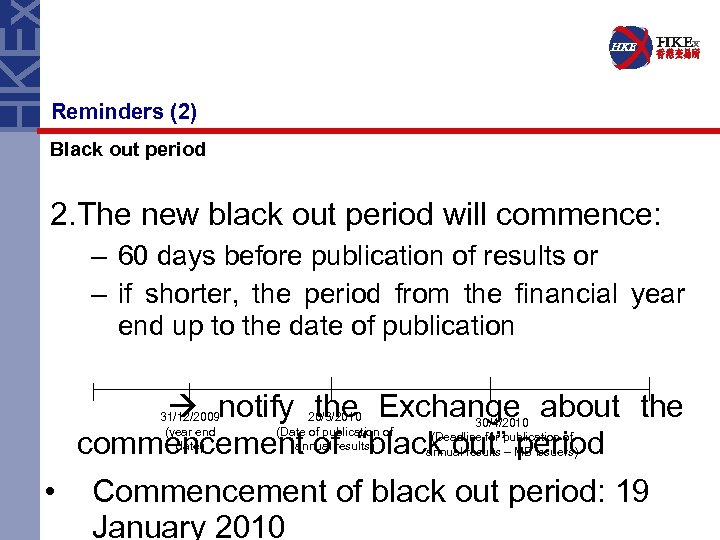
Reminders (2) Black out period 2. The new black out period will commence: – 60 days before publication of results or – if shorter, the period from the financial year end up to the date of publication notify the Exchange about the commencement of “black out” period 31/12/2009 (year end date) • 20/3/2010 (Date of publication of annual results) 30/4/2010 (Deadline for publication of annual results – MB issuers) Commencement of black out period: 19 January 2010
Reminders (3) Shareholder meeting notice 3. Code Provision: Notice of shareholder meeting should be sent – at least 20 clear business days before AGM – at least 10 clear business days before other general meeting (Introduced on 1 January 2009)
Reminders (4) Revised publication deadlines for results announcements (Main Board) 4. Annual results: 3 months after year end - for financial year ending on or after 31 December 2010 5. Interim results: 2 months after period end - for 6 months ending on or after 30 June
Reminders (5) Continuing (CCTs) connected transactions 6. Is there sufficient time for renewing an expiring CCT agreement? Plan for: − renewal of the agreement − publication of announcement, shareholder meeting, appointment of IFA and establishment of IBC
Reminders (6) Access to books and records of disposed companies 9. Ensure that the issuer itself and its auditors can have access to the disposed companies’ books and records for the year end audit
Reminders (7) Board meeting notification 10. Announce at least 7 clear business days before the meeting date
Reminders (8) Book closure notification 11. Announce the book closure date at least 14 days before the closure 12. Disclose the purpose of the book closure (e. g. for dividend entitlements, attendance at the AGM, etc)
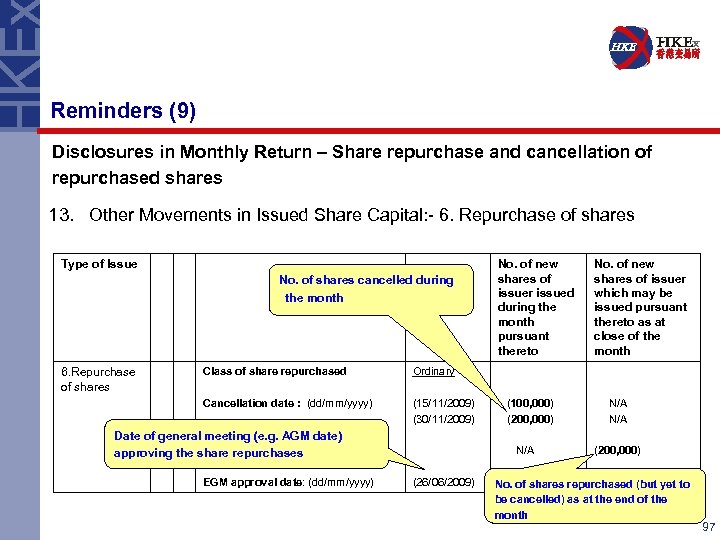
Reminders (9) Disclosures in Monthly Return – Share repurchase and cancellation of repurchased shares 13. Other Movements in Issued Share Capital: - 6. Repurchase of shares Type of Issue No. of shares cancelled during the month No. of new shares of issuer issued during the month pursuant thereto No. of new shares of issuer which may be issued pursuant thereto as at close of the month Class of share repurchased Ordinary Cancellation date : (dd/mm/yyyy) 6. Repurchase of shares (15/11/2009) (30/11/2009) (100, 000) (200, 000) N/A (200, 000) Date of general meeting (e. g. AGM date) approving the share repurchases EGM approval date: (dd/mm/yyyy) (26/06/2009) No. of shares repurchased (but yet to be cancelled) as at the end of the month 97
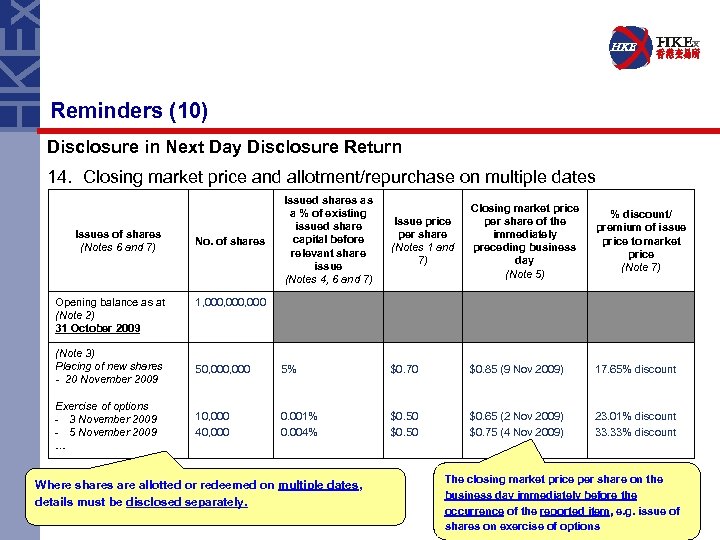
Reminders (10) Disclosure in Next Day Disclosure Return 14. Closing market price and allotment/repurchase on multiple dates Issues of shares (Notes 6 and 7) Opening balance as at (Note 2) 31 October 2009 No. of shares Issued shares as a % of existing issued share capital before relevant share issue (Notes 4, 6 and 7) Issue price per share (Notes 1 and 7) Closing market price per share of the immediately preceding business day (Note 5) % discount/ premium of issue price to market price (Note 7) 1, 000, 000 (Note 3) Placing of new shares - 20 November 2009 50, 000 5% $0. 70 $0. 85 (9 Nov 2009) 17. 65% discount Exercise of options - 3 November 2009 - 5 November 2009 … 10, 000 40, 000 0. 001% 0. 004% $0. 50 $0. 65 (2 Nov 2009) $0. 75 (4 Nov 2009) 23. 01% discount 33. 33% discount Where shares are allotted or redeemed on multiple dates, details must be disclosed separately. The closing market price per share on the business day immediately before the occurrence of the reported item, e. g. issue of shares on exercise of options
II. Year end disclosures
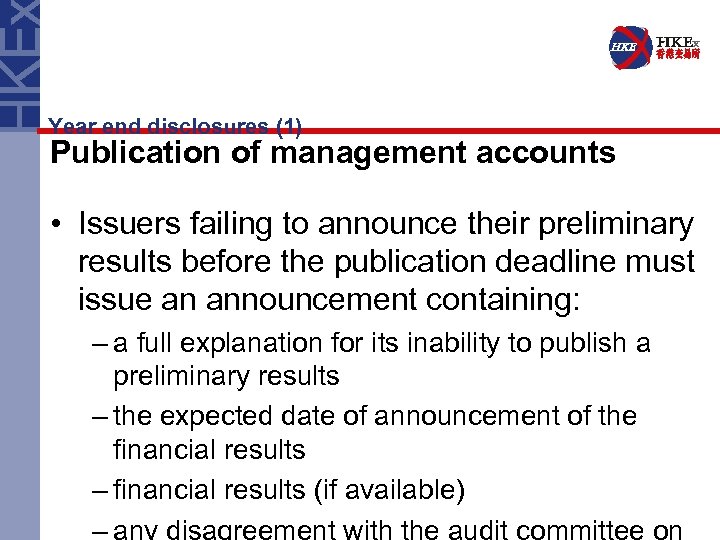
Year end disclosures (1) Publication of management accounts • Issuers failing to announce their preliminary results before the publication deadline must issue an announcement containing: – a full explanation for its inability to publish a preliminary results – the expected date of announcement of the financial results – financial results (if available) – any disagreement with the audit committee on
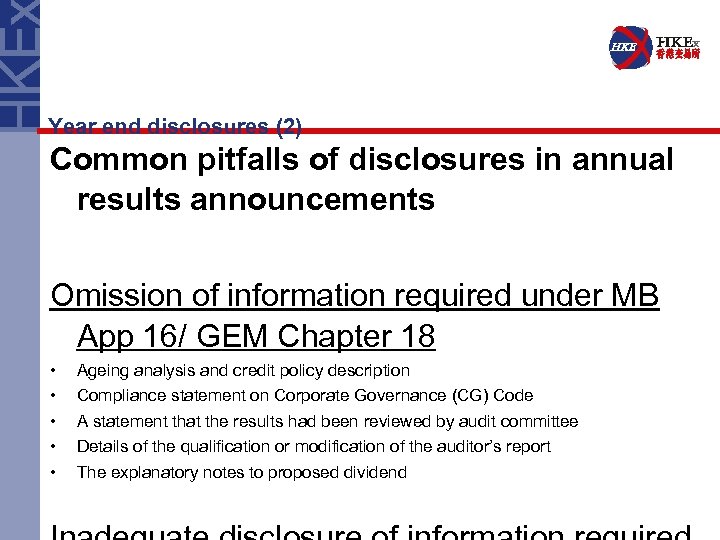
Year end disclosures (2) Common pitfalls of disclosures in annual results announcements Omission of information required under MB App 16/ GEM Chapter 18 • • • Ageing analysis and credit policy description Compliance statement on Corporate Governance (CG) Code A statement that the results had been reviewed by audit committee Details of the qualification or modification of the auditor’s report The explanatory notes to proposed dividend
Year end disclosures (3) Common pitfalls of disclosures in annual reports Omission of information • Disclosures in Corporate Governance Report − e. g. terms of NED appointment, information on remuneration committee • Details of connected transactions • A narrative statement on whether the auditors had reviewed and confirmed compliance • • with CCT annual review Rules Continuing disclosures of advance to entities, financial assistance to affiliated companies, pledge of shares by controlling shareholders, etc Annual confirmation of INED independence Inadequate disclosure • Description of credit policy and ageing analysis • Analytical and in-depth discussion in MD&A section • Details of share option scheme
Year end disclosures (4) Dividend information • Provide sufficient information on dividend proposals including the dividend payment date • Notify shareholders of any withholding tax implication
Reference materials published on the HKEx website (1) • Frequently asked questions on notifiable transactions, connected transactions and issue of securities: (http: //www. hkex. com. hk/listing/suppmat/faq 200811. doc) • Listing Decisions: (http: //www. hkex. com. hk/listing/listdec 2009. htm) • Consultation Conclusions on self-constructed asset: (http: //www. hkex. com. hk/consul/conclusion/cc 200907. pdf) • Consultation paper on proposed changes to requirements for circulars and listing documents of listed issuer: (http: //www. hkex. com. hk/consul/paper/cp 200909 cr_e. pdf) • Consultation paper on New Listing Rules for Mineral and Exploration Companies: (http: //www. hkex. com. hk/consul/paper/cp 200909 m_e. pdf) • Checklists and forms in relation to disclosure, documentary and other specific compliance requirements under the Listing Rules and related administrative procedures: Ø Main Board - http: //www. hkex. com. hk/listing/epp/cft_mb. htm Ø GEM - http: //www. hkex. com. hk/listing/epp/cft_gem. htm
Reference materials published on the HKEx website (2) • Proposed changes to filing and checklist requirements for listing of equity securities: – Consultation conclusion http: //www. hkex. com. hk/consul/conclusion/cp 200906 cc_e. pdf – Revised Rules: http: //www. hkex. com. hk/rule/mb_rupdate 15_cover. htm (MB) and http: //www. hkex. com. hk/rule/gem_rupdate 15_cover. htm (GEM) • Financial statements Review Programme Report 2009 published by HKEx (http: //www. hkex. com. hk/listing/staffint/FRM 2 -09. pdf)
Other reference materials • Auditing guideline - Statement 3. 340 – Prospectuses and the Reporting Accountant, issued by HKICPA (http: //app 1. hkicpa. org. hk/ebook/HKSA_Members_Handbook_Master/volume. III/3_340. pdf) • Accounting Guideline 7 “Preparation of Pro Forma Financial Information for Inclusion in Investment Circulars”, issued by HKICPA http: //www. hkicpa. org. hk/ebook/HKSA_Members_Handbook_Master/volume. II/ag 7. pdf • Hong Kong Standard on Investment Circular Reporting Engagements 300 “Accountants’ Reports on Pro forma Financial Information in Investment Circulars” , issued by HKICPA http: //www. hkicpa. org. hk/ebook/HKSA_Members_Handbook_Master/volume. III/hksir 30 0. pdf • Review report by the Professional Standards Monitoring Committee of the HKICPA (http: //www. hkicpa. org. hk/correspondence/2009 -06 -25/activities_report. pdf)
Thank you
Скачать презентацию Notifiable Transactions Sammy Chau Katherine Man Assistant
8d1cb107886962f4e07fc307a5b6ca45.ppt