


 Скачать презентацию Notes from TTF Experiences N Toge KEK for
58ae3e5499237c0bf738aff772fdeae6.ppt
- Количество слайдов: 14
 Notes from TTF Experiences N. Toge (KEK) for GDE RDB S 2 Rev. 0. 1 Aug. 21, 2006 Rev 0. 1: Aug 21, 2006 1
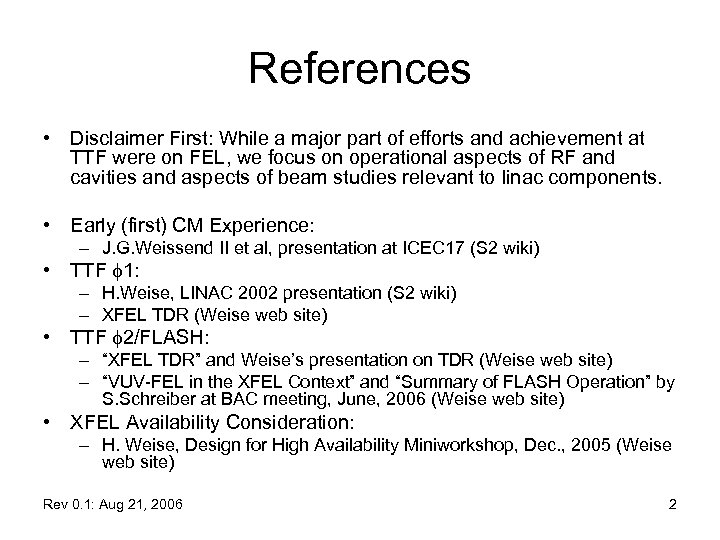 References • Disclaimer First: While a major part of efforts and achievement at TTF were on FEL, we focus on operational aspects of RF and cavities and aspects of beam studies relevant to linac components. • Early (first) CM Experience: – J. G. Weissend II et al, presentation at ICEC 17 (S 2 wiki) • TTF f 1: – H. Weise, LINAC 2002 presentation (S 2 wiki) – XFEL TDR (Weise web site) • TTF f 2/FLASH: – “XFEL TDR” and Weise’s presentation on TDR (Weise web site) – “VUV-FEL in the XFEL Context” and “Summary of FLASH Operation” by S. Schreiber at BAC meeting, June, 2006 (Weise web site) • XFEL Availability Consideration: – H. Weise, Design for High Availability Miniworkshop, Dec. , 2005 (Weise web site) Rev 0. 1: Aug 21, 2006 2
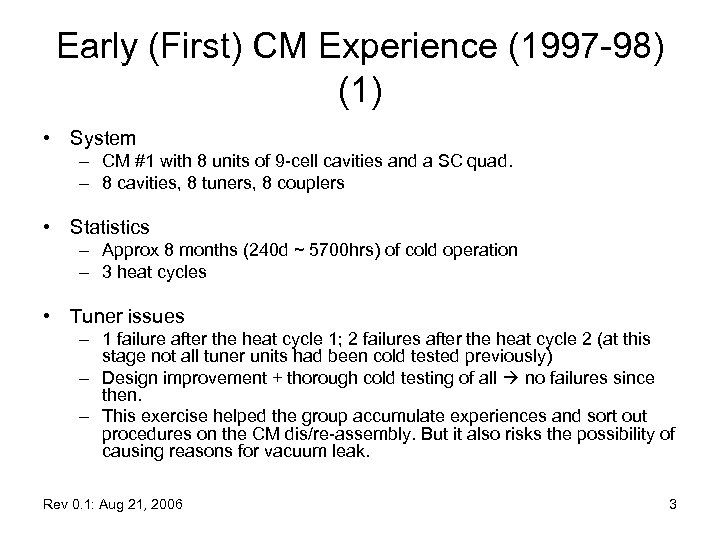 Early (First) CM Experience (1997 -98) (1) • System – CM #1 with 8 units of 9 -cell cavities and a SC quad. – 8 cavities, 8 tuners, 8 couplers • Statistics – Approx 8 months (240 d ~ 5700 hrs) of cold operation – 3 heat cycles • Tuner issues – 1 failure after the heat cycle 1; 2 failures after the heat cycle 2 (at this stage not all tuner units had been cold tested previously) – Design improvement + thorough cold testing of all no failures since then. – This exercise helped the group accumulate experiences and sort out procedures on the CM dis/re-assembly. But it also risks the possibility of causing reasons for vacuum leak. Rev 0. 1: Aug 21, 2006 3
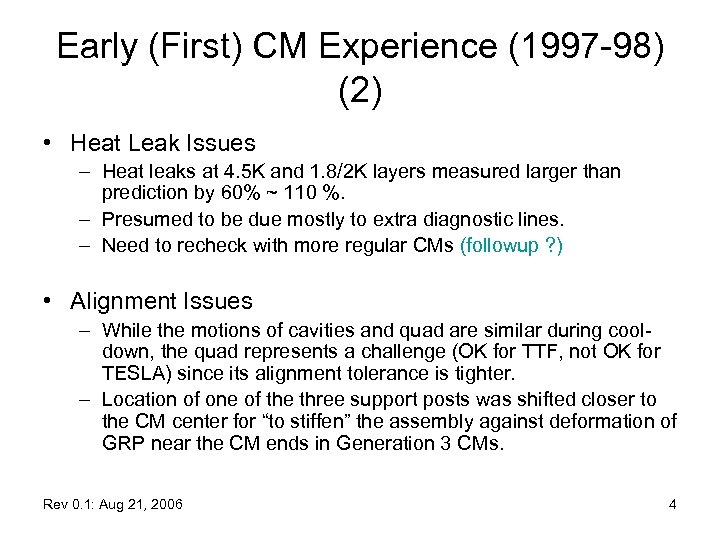 Early (First) CM Experience (1997 -98) (2) • Heat Leak Issues – Heat leaks at 4. 5 K and 1. 8/2 K layers measured larger than prediction by 60% ~ 110 %. – Presumed to be due mostly to extra diagnostic lines. – Need to recheck with more regular CMs (followup ? ) • Alignment Issues – While the motions of cavities and quad are similar during cooldown, the quad represents a challenge (OK for TTF, not OK for TESLA) since its alignment tolerance is tighter. – Location of one of the three support posts was shifted closer to the CM center for “to stiffen” the assembly against deformation of GRP near the CM ends in Generation 3 CMs. Rev 0. 1: Aug 21, 2006 4
 TTF f 1 as of ~2002 (1) • Gun – Laser-driven photocathode in 1. 6 cell L-band NC acc section with 37 MV/m (max). – One 9 -cell L-band SC cavity (beam energy: 4 Me. V 16 Me. V) • Accelerator – 2 x 8 -cavity cryomodules (12. 2 m long) to run in beam operation. Each cavity is 9 -cell. – 1 RF 2 CMs 16 Cavities – So, TTF 2002 is approximately equivalent to 2/3 of one ILC unit. – 6 modules have been built as of 2002 and 3 had been tried out, recording Eacc = 14 ~ 22. 7 MV/m. • Operation Period – – Beam operation time ~ 13, 000 hrs (~ 540 d) with Eacc ~ 14 MV/m # of heat cycles (? ) Total beam Time and cold time with other CMs (? ) Total Cavity Beam Time > 160, 000 hrs ~ 6, 700 d Rev 0. 1: Aug 21, 2006 5
 TTF f 1 as of ~2002(2) • FEL-type operation – Beam parameters (? ) – Eacc ~ 17 MV/m (? ) • Statistics – – 1997 – 2002 ~13, 000 hrs (~ 540 d) 24/7 since 1999 Operation up time ~ 80%, Beam up time ~ 30 -60% in 2001 – Accounting of downtime (? ) Rev 0. 1: Aug 21, 2006 6
 TTF f 1 as of ~2002(3) • Long-pulse mode operation – Rep rate = 5 Hz – 800 ms RF pulse, 1800 x 3 n. C bunches / pulse – CM #2 at ~19 MV/m, CM #3 at 21. 5 MV/m • Statistics – 42 days (~1, 000 hr) – 291 trips (~ 8. 4 /d on average) with cavities or couplers, recovery ~ 1 min • Remarks (by the authors) – “Experiences are positive” – “Good LLRF needed to handle exception conditions. ” – “Cavities in this test were operated close to their limit. ” Rev 0. 1: Aug 21, 2006 7
 TTF f 2 / FLASH (1) • Gun – Max 10 Hz, 1 n. C x 7200 bunches. Laser-driven photocathode in 1. 6 cell L-band NC acc – One 9 -cell L-band SC cavity (beam energy: 4 Me. V 16 Me. V) • Accelerator – Slots for 6 x 8 -cavity cryomodules Each cavity is 9 -cell. So far, 5 CM slots have been occupied – 3 (? ) RF 6 CMs 48 Cavities (40 so far in OPS) – TTF f 2/FLASH is approximately equivalent to 2 ILC units. – Eacc ~ 18 MV/m on average 730 Me. V beam with 5 CMs turned on. Rev 0. 1: Aug 21, 2006 8
 TTF f 2 / FLASH (2) • Operation Statistics – Injector commissioning since Spring 2004. First lasing in early 2005, user operation since Summer, 2005. – July 2005 Feb 2006: ~3600 hr (150 d). ~50% for users, 16% for FEL studies, the rest for acc studies and maintenance. – Beam delivery ~ 64%, 26% tuning /dev/off time, 16% down time, out of the scheduled user beam time (Weise’s reliability report says 11%. Is this because of different denominator or improvement? ) – Downtime beak-down. Klys ~ 30%, cryo (CM and Cryogen? ) ~ 30%. Detailed break-downs? Others from laser, MPS, OPS etc. – Issues of schedule pressure from the duty of FEL runs forced the group to launch user operation before establishing full performance validation. • Installation Issues – Most of the RF sources, such as klystrons, and electronics are outside the tunnels to meet the FLASH schedule. This makes the layout different from what is envisage at XFEL, yet this allows discussion based on hands-on experience with one layout scenario. Rev 0. 1: Aug 21, 2006 9
 TTF f 2 / FLASH (2) • Remarks (Toge) – It would help to see more accounting of RF and cryo problems, if any, from TTF f 2 / FLASH, when we attempt to map this experience to what we should be prepared for Test linac facilities for ILC. – Substantial discussions from TTF/FLASH were found on • Stability (gun laser, LLRF, orbit and optics) • Jitter of longitudinal beam phase space (temperature stabilization is an identified issue) • Commissioning and operation of beam diagnostics • while some such issues might not be as stringent as those demanded at XFEL, the system testing of a similar nature for ILC should pay very close attention over a wide range of related subjects. This is probably not something that we extract too easily from SRF experiences from storage rings. Rev 0. 1: Aug 21, 2006 10
 XFEL Availability Considerations (1) • System Outline – 0. 1 -0. 5 Ge. V: 4 CM = 32 Cavs @12. 5 MV/m; RF station outside tunnel. – 0. 5 -2 Ge. V: 12 CM = 96 Cavs @15. 1 MV/m or 64 Cavs @22. 6 MV/m; (2+1) RF stations inside tunnel. – 20 Ge. V: 100 CM = 800 Cavs @ 21. 7 MV/m or 736 Cavs @23. 6 MV/m; (23+2) RF stations inside tunnel • Requirements – 20 wks of photon beam user operation per year, including tuning shifts • 85% beam delivery • 10% tuning • 5% downtime (to be compatible with what the SR facility users are used to) • Comparison with ILC – XFEL corresponds to approximately 6% of the entire ILC ML, in terms of #CM. About 9%, in terms of #RF stations. Rev 0. 1: Aug 21, 2006 11
 XFEL Availability Considerations (2) • Solution outline – Injector • • • Dual installation Most infrastructure outside the accelerator tunnels De-rated accelerating gradient (12 -15 MV/m) Moderate RF power (20% of available max) Early commissioning – ML • CM replacement assumed unlikely hang from the ceiling • Pulse cables underneath the floor • Prepare for maintenance of klystron and electronics right next to the transportation area. Rev 0. 1: Aug 21, 2006 12
 XFEL Availability Considerations (3) • Solution outline (continued) – Testing before string-assembly • • Individual testing of cavities Conditioning of couplers Cold-temperature testing of tuners Magnet excitation (BTW, no cold feed-through’s) – All CMs to be tested cold + RF before installation – Klystrons, 10 MW rated, will operate at 5. 2 MW – WG distribution system to be tested in units of one acc module length prior to tunnel installation – LLRF expected to be reliable, as inferred from TTF/VUV-FEL experience + redundancy being planned. – Cryogenics Rev 0. 1: Aug 21, 2006 13
 Remarks • It would be nice to see more specific data on component-level failure issues from TTF f 1, TTF f 2/FLASH, and how they have been or are being addressed, because they represent a large amount of opportunities for new comers (i. e. ILC) to learn. • While making the ML components being operational and available, we also need to pay attention to issues related to “stable beam operation” as TTF/XFEL colleagues are emphasizing. • We should examine how the XFEL availability improvement solutions would apply to the ILC case. Should we do the same or should we do much better, etc? • If we (ILC) sort of “skip” being seriously engaged in Euro-XFEL experiences and declare ourselves ready to go ahead with construction of ILC at around 2010, we need to be clear and confident as to why we can say so. Rev 0. 1: Aug 21, 2006 END 14