


 Скачать презентацию Notes 8 Predicate logic and inference ICS 271
3f882ebc4da8b37d49acefb463575087.ppt
- Количество слайдов: 43
 Notes 8: Predicate logic and inference ICS 271 Fall 2006
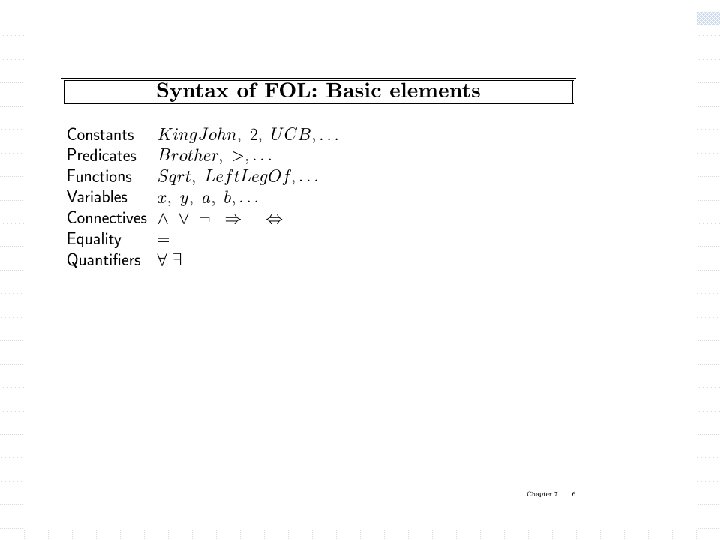
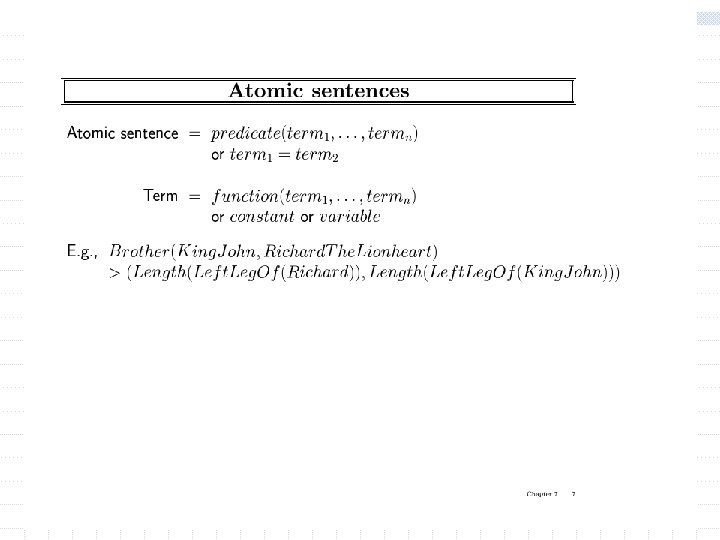
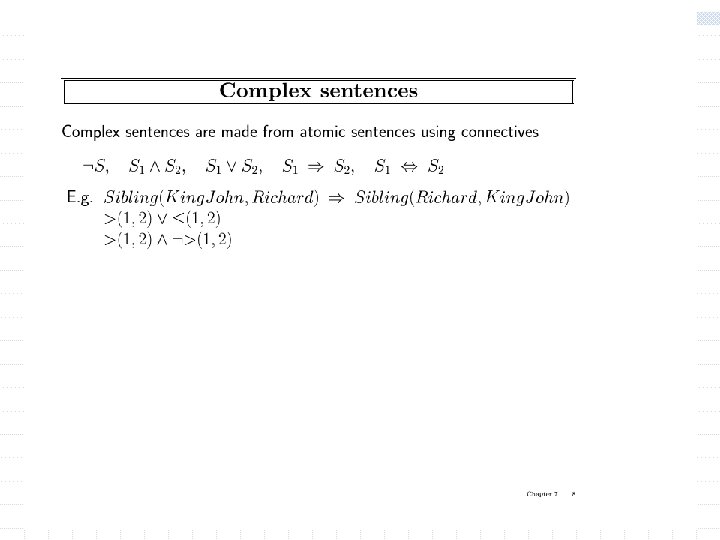
 Outline w New ontology n objects, relations, properties, functions. w New Syntax n Constants, predicates, properties, functions w New semantics n meaning of new syntax w Inference rules for Predicate Logic (FOL) n Resolution n Forward-chaining, Backword-chaining n unification w Readings: Nillson’s Chapters 15 -16, Russel and Norvig Chapter 8, chapter 9

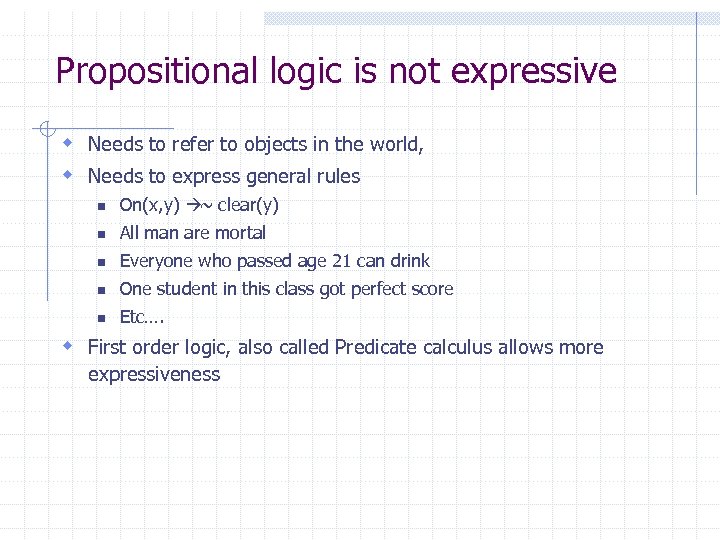 Propositional logic is not expressive w Needs to refer to objects in the world, w Needs to express general rules n On(x, y) ~ clear(y) n All man are mortal n Everyone who passed age 21 can drink n One student in this class got perfect score n Etc…. w First order logic, also called Predicate calculus allows more expressiveness
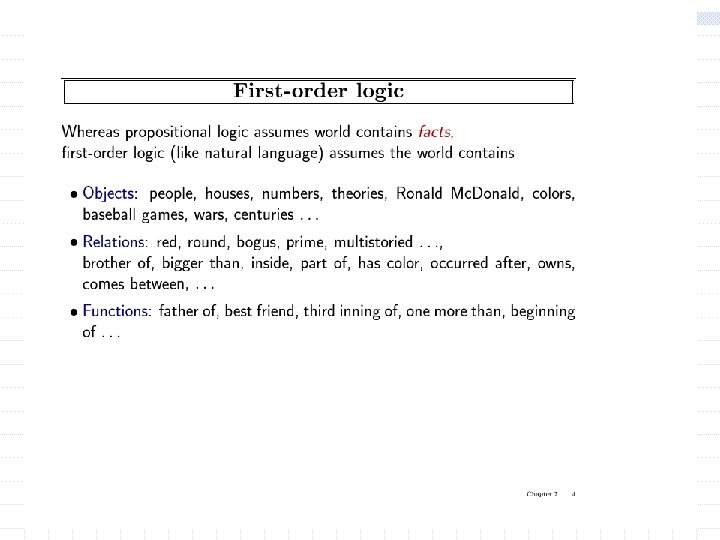
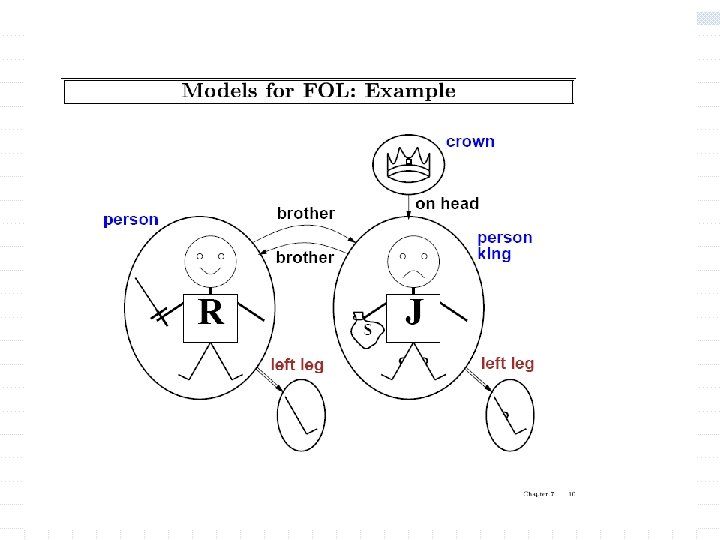
 Semantics: Worlds w The world consists of objects that has properties. n n There are relations and functions between these objects Objects in the world, individuals: people, houses, numbers, colors, baseball games, wars, centuries w Clock A, John, 7, the-house in the corner, Tel-Aviv n Functions on individuals: w father-of, best friend, third inning of, one more than n Relations: w brother-of, bigger than, inside, part-of, has color, occurred after n Properties (a relation of arity 1): w red, round, bogus, prime, multistoried, beautiful
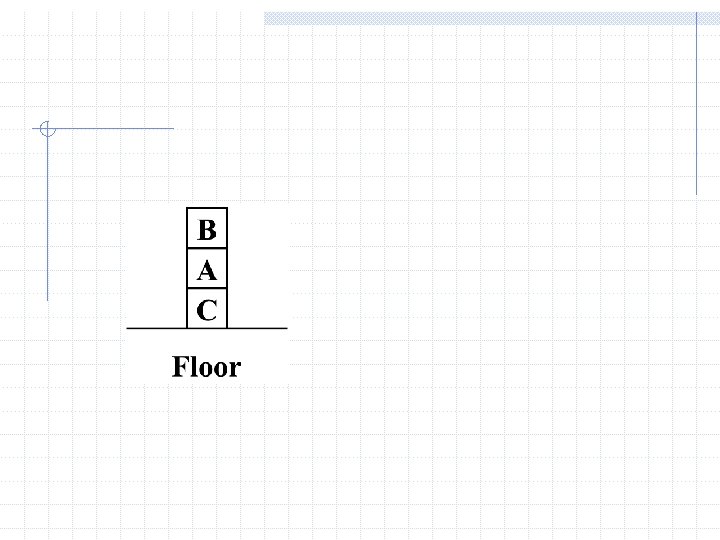
 Semantics: Interpretation w An interpretation of a wff is an assignment that maps n object constants to objects in the worlds, n n-ary function symbols to n-ary functions in the world, n n-ary relation symbols to n-ary relations in the world w Given an interpretation, an atom has the value “true” in case it denotes a relation that holds for those individuals denoted in the terms. Otherwise it has the value “false” n Example: A, B, C, floor, w On, Clear n World: n On(A, B) is false, Clear(B) is true, On(C, F 1) is true…
 Semantics: Models w An interpretation satisfies a wff (sentence) if the wff has the value “true” under the interpretation. w An interpretation that satisfies a wff is a model of that wff w Any wff that has the value “true” under all interpretations is valid w Any wff that does not have a model is inconsistent or unsatisfiable w If a wff w has a value true under all the models of a set of sentences KB then KB logically entails w
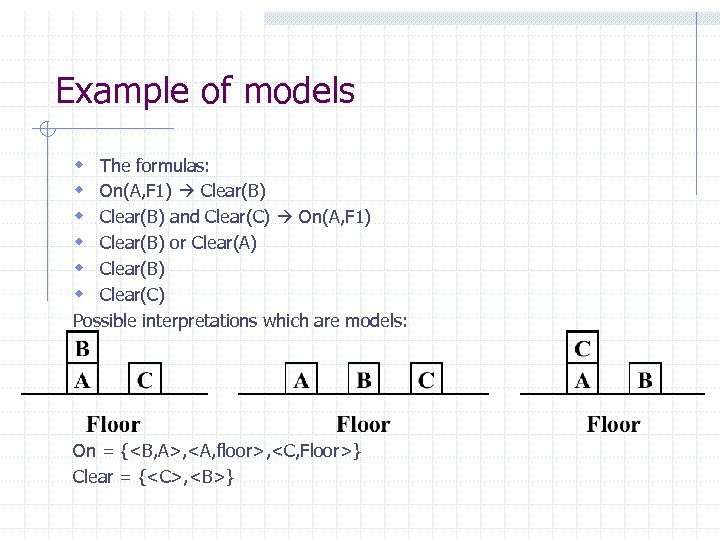 Example of models w w w The formulas: On(A, F 1) Clear(B) and Clear(C) On(A, F 1) Clear(B) or Clear(A) Clear(B) Clear(C) Possible interpretations which are models: On = {
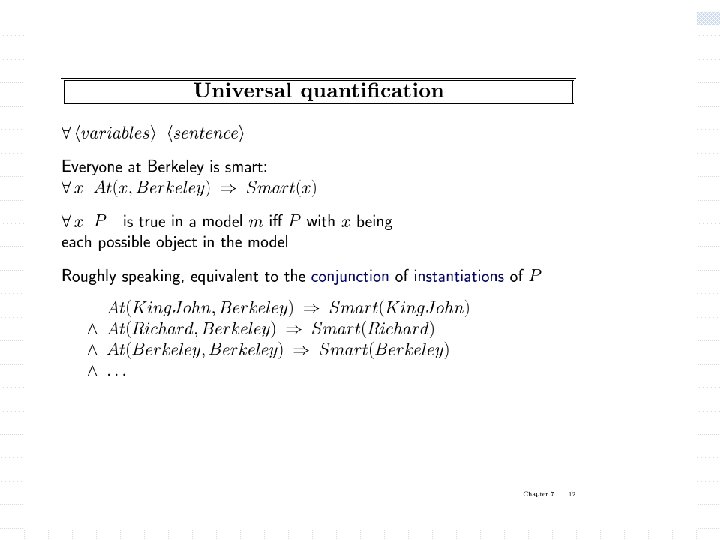
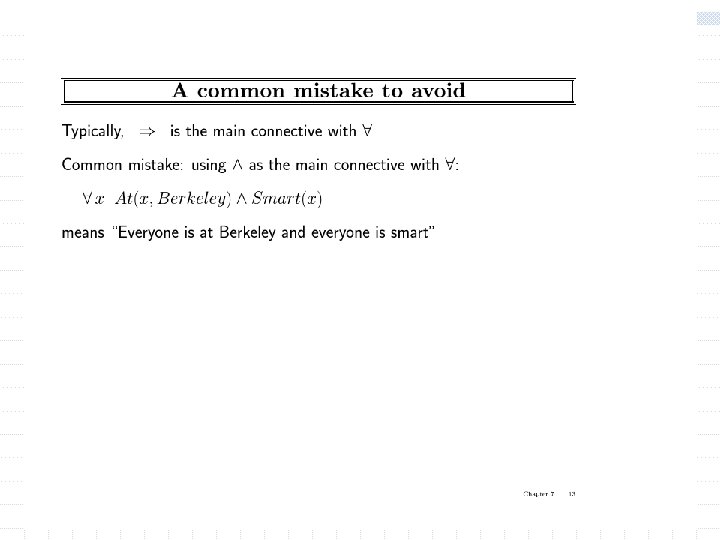
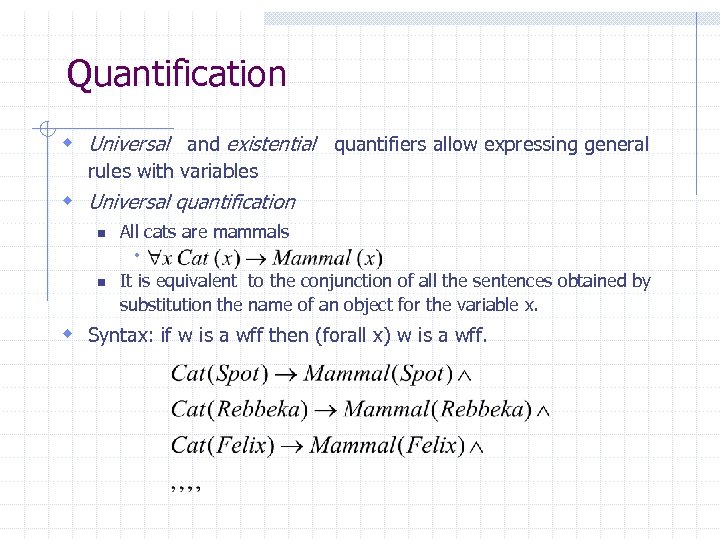 Quantification w Universal and existential quantifiers allow expressing general rules with variables w Universal quantification n All cats are mammals w n It is equivalent to the conjunction of all the sentences obtained by substitution the name of an object for the variable x. w Syntax: if w is a wff then (forall x) w is a wff.
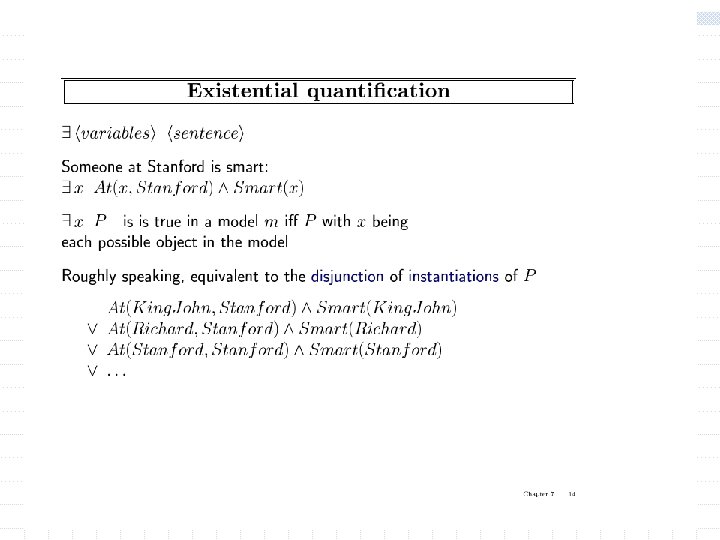
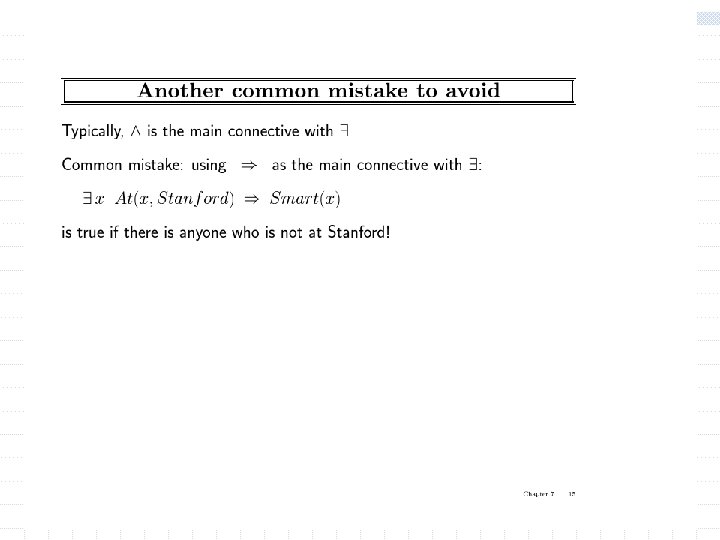
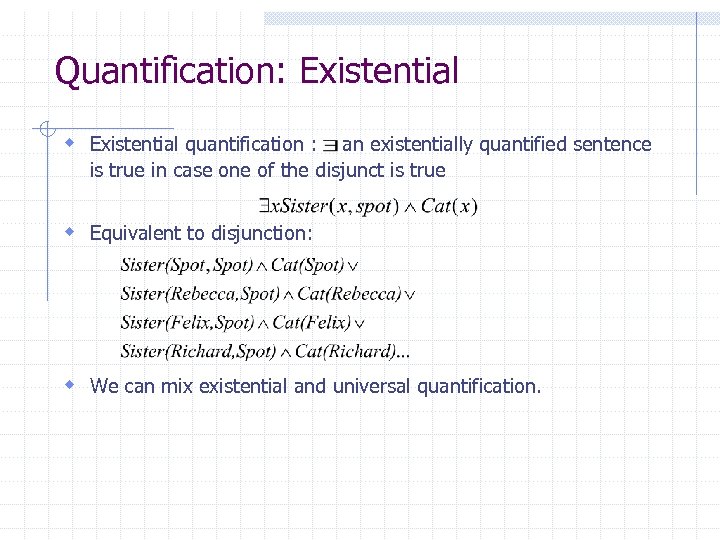 Quantification: Existential w Existential quantification : an existentially quantified sentence is true in case one of the disjunct is true w Equivalent to disjunction: w We can mix existential and universal quantification.
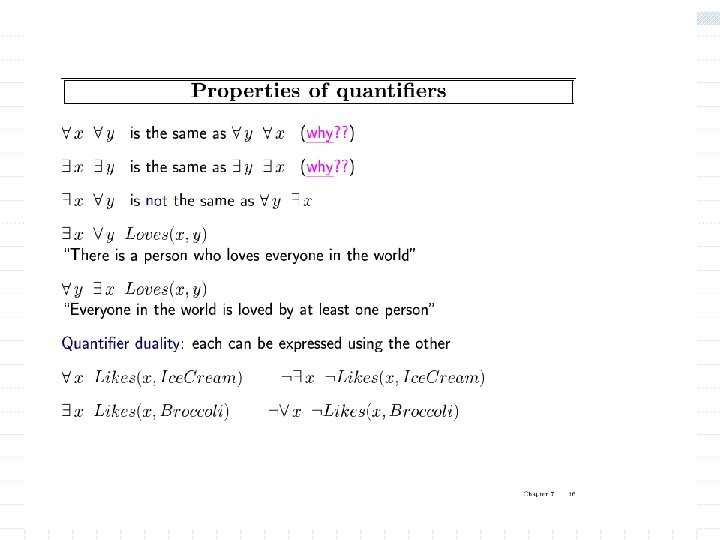
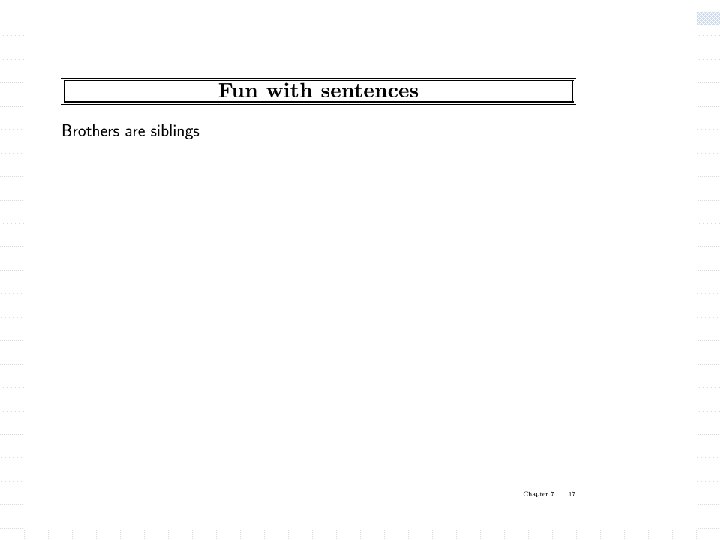
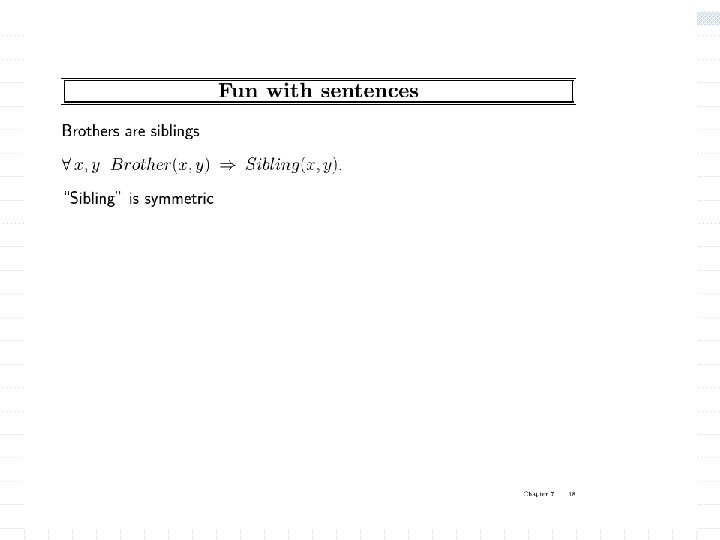
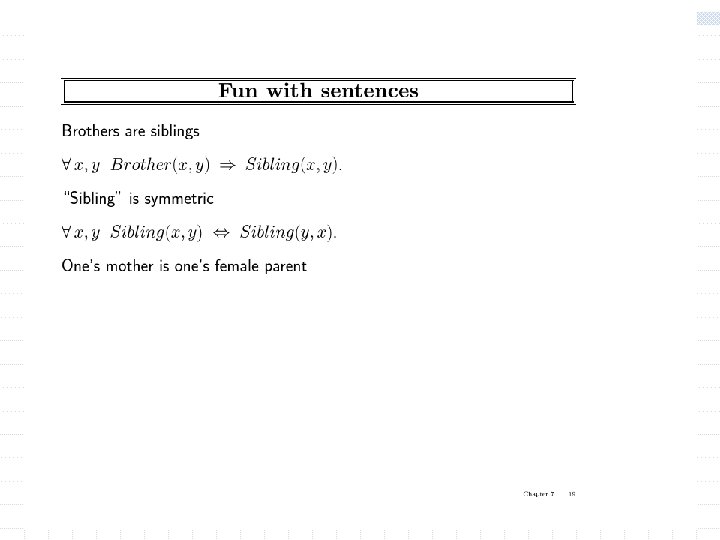
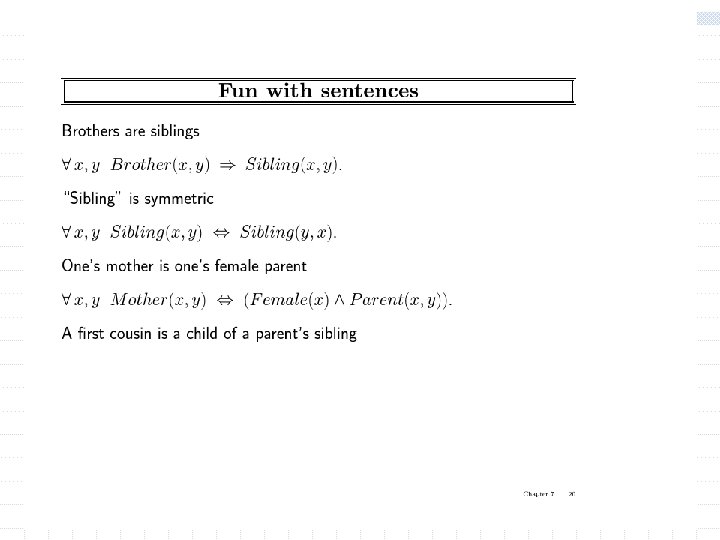
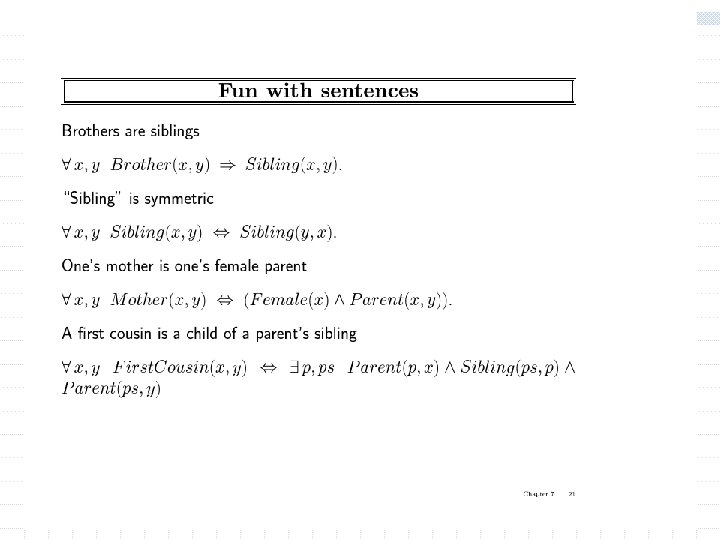
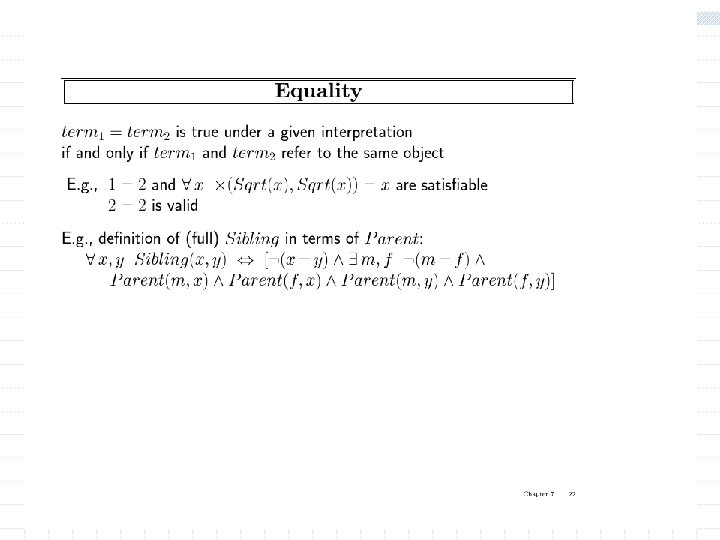
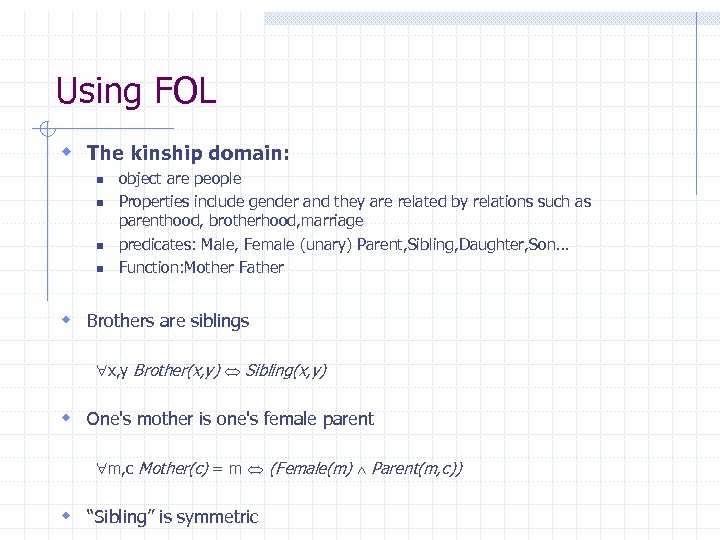 Using FOL w The kinship domain: n n object are people Properties include gender and they are related by relations such as parenthood, brotherhood, marriage predicates: Male, Female (unary) Parent, Sibling, Daughter, Son. . . Function: Mother Father w Brothers are siblings x, y Brother(x, y) Sibling(x, y) w One's mother is one's female parent m, c Mother(c) = m (Female(m) Parent(m, c)) w “Sibling” is symmetric
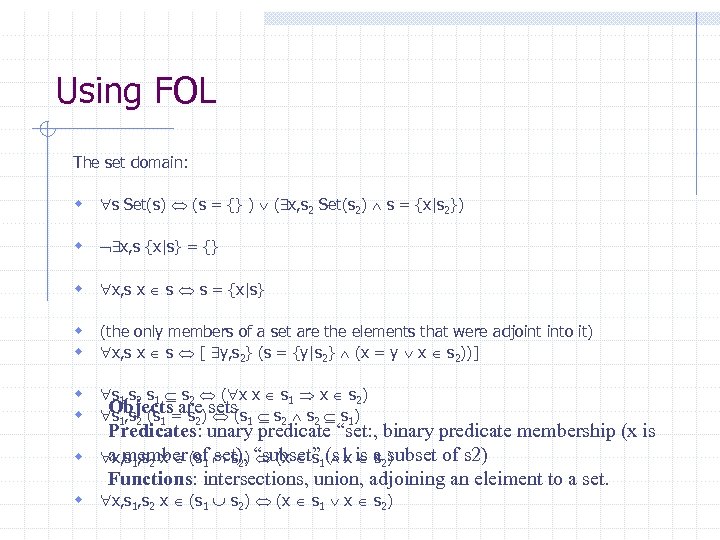 Using FOL The set domain: w s Set(s) (s = {} ) ( x, s 2 Set(s 2) s = {x|s 2}) w x, s {x|s} = {} w x, s x s s = {x|s} w (the only members of a set are the elements that were adjoint into it) w x, s x s [ y, s 2} (s = {y|s 2} (x = y x s 2))] w s 1, s 2 s 1 s 2 ( x x s 1 x s 2) Objects are (s w s 1, s 2 (s 1 = s 2) sets 1 s 2 s 1) Predicates: unary predicate “set: , binary predicate membership (x is a member of set), (x s subset of s 2) w x, s 1, s 2 x (s 1 s 2) “subset” 1 (s 1 is a 2) Functions: intersections, union, adjoining an eleiment to a set. w x, s 1, s 2 x (s 1 s 2) (x s 1 x s 2)
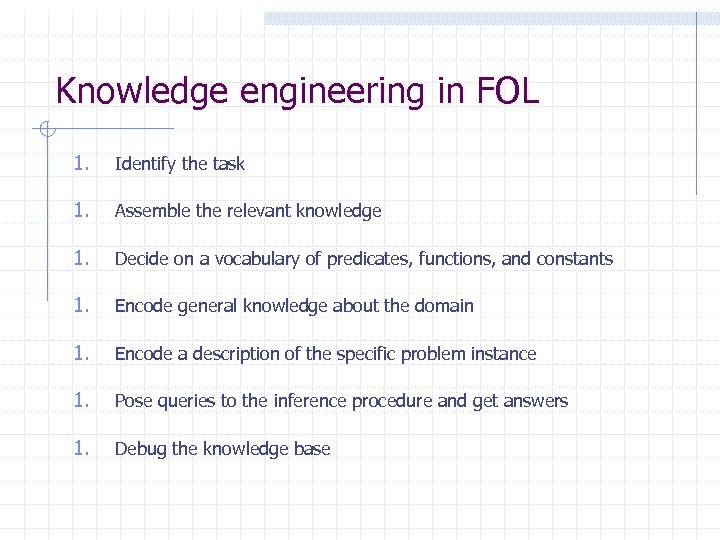 Knowledge engineering in FOL 1. Identify the task 1. Assemble the relevant knowledge 1. Decide on a vocabulary of predicates, functions, and constants 1. Encode general knowledge about the domain 1. Encode a description of the specific problem instance 1. Pose queries to the inference procedure and get answers 1. Debug the knowledge base
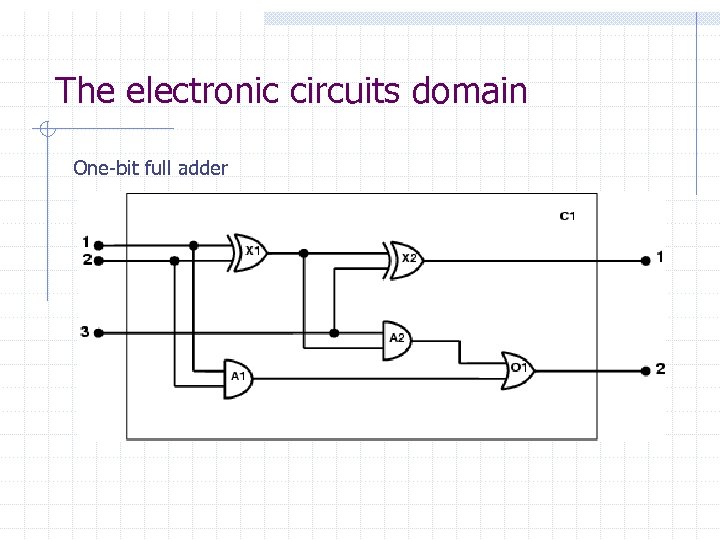 The electronic circuits domain One-bit full adder
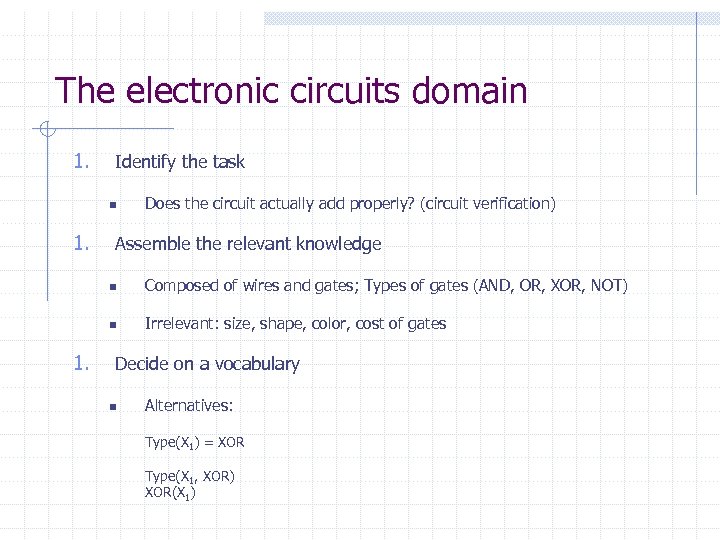 The electronic circuits domain 1. Identify the task n 1. Does the circuit actually add properly? (circuit verification) Assemble the relevant knowledge n n 1. Composed of wires and gates; Types of gates (AND, OR, XOR, NOT) Irrelevant: size, shape, color, cost of gates Decide on a vocabulary n Alternatives: Type(X 1) = XOR Type(X 1, XOR) XOR(X 1)
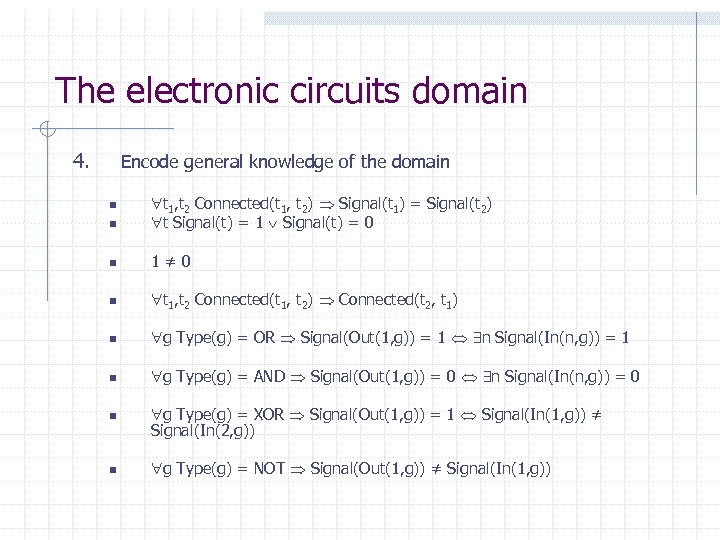 The electronic circuits domain 4. Encode general knowledge of the domain n t 1, t 2 Connected(t 1, t 2) Signal(t 1) = Signal(t 2) t Signal(t) = 1 Signal(t) = 0 n 1≠ 0 n t 1, t 2 Connected(t 1, t 2) Connected(t 2, t 1) n g Type(g) = OR Signal(Out(1, g)) = 1 n Signal(In(n, g)) = 1 n g Type(g) = AND Signal(Out(1, g)) = 0 n Signal(In(n, g)) = 0 n g Type(g) = XOR Signal(Out(1, g)) = 1 Signal(In(1, g)) ≠ Signal(In(2, g)) n g Type(g) = NOT Signal(Out(1, g)) ≠ Signal(In(1, g)) n
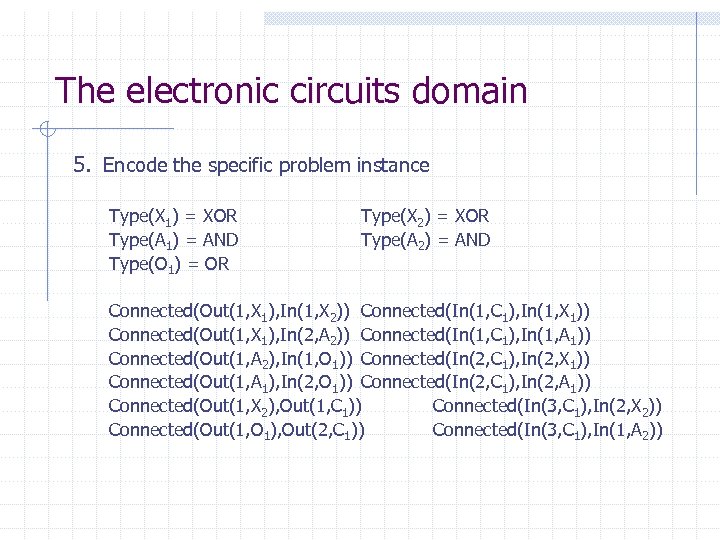 The electronic circuits domain 5. Encode the specific problem instance Type(X 1) = XOR Type(A 1) = AND Type(O 1) = OR Type(X 2) = XOR Type(A 2) = AND Connected(Out(1, X 1), In(1, X 2)) Connected(In(1, C 1), In(1, X 1)) Connected(Out(1, X 1), In(2, A 2)) Connected(In(1, C 1), In(1, A 1)) Connected(Out(1, A 2), In(1, O 1)) Connected(In(2, C 1), In(2, X 1)) Connected(Out(1, A 1), In(2, O 1)) Connected(In(2, C 1), In(2, A 1)) Connected(Out(1, X 2), Out(1, C 1)) Connected(In(3, C 1), In(2, X 2)) Connected(Out(1, O 1), Out(2, C 1)) Connected(In(3, C 1), In(1, A 2))
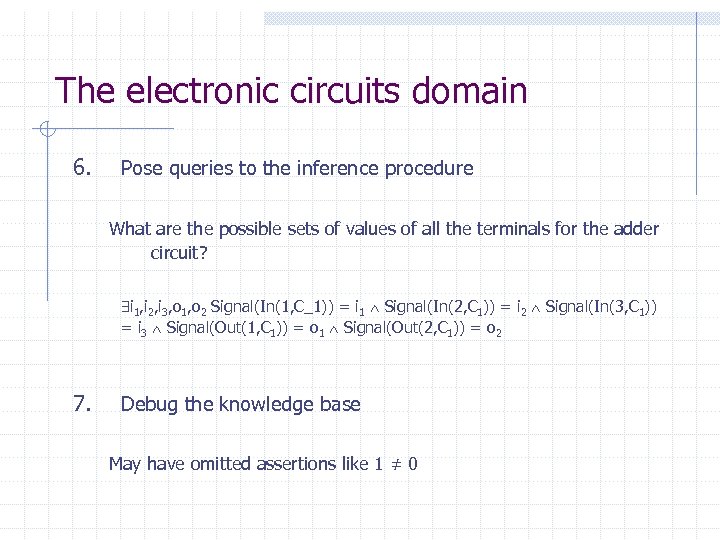 The electronic circuits domain 6. Pose queries to the inference procedure What are the possible sets of values of all the terminals for the adder circuit? i 1, i 2, i 3, o 1, o 2 Signal(In(1, C_1)) = i 1 Signal(In(2, C 1)) = i 2 Signal(In(3, C 1)) = i 3 Signal(Out(1, C 1)) = o 1 Signal(Out(2, C 1)) = o 2 7. Debug the knowledge base May have omitted assertions like 1 ≠ 0
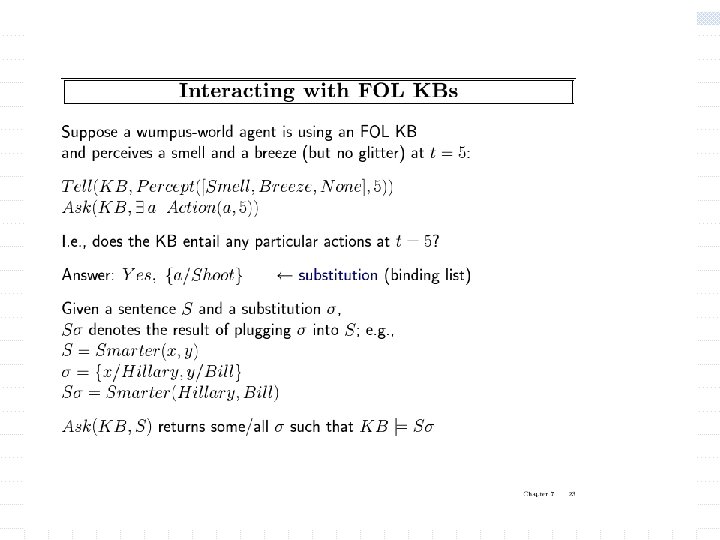
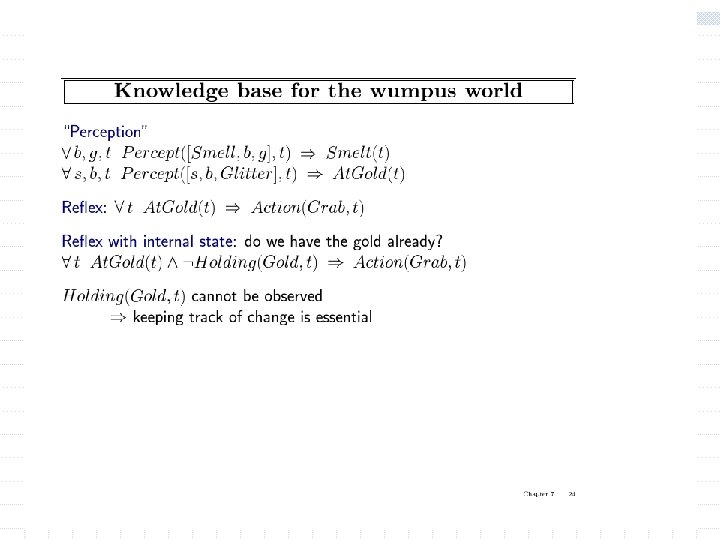
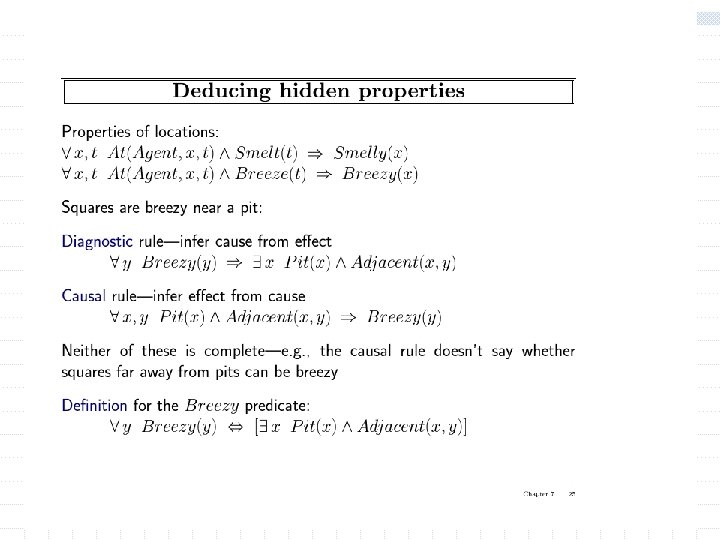
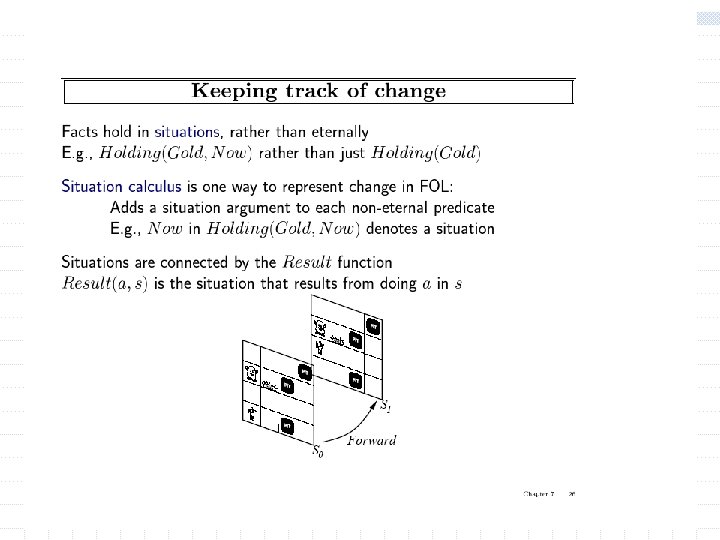
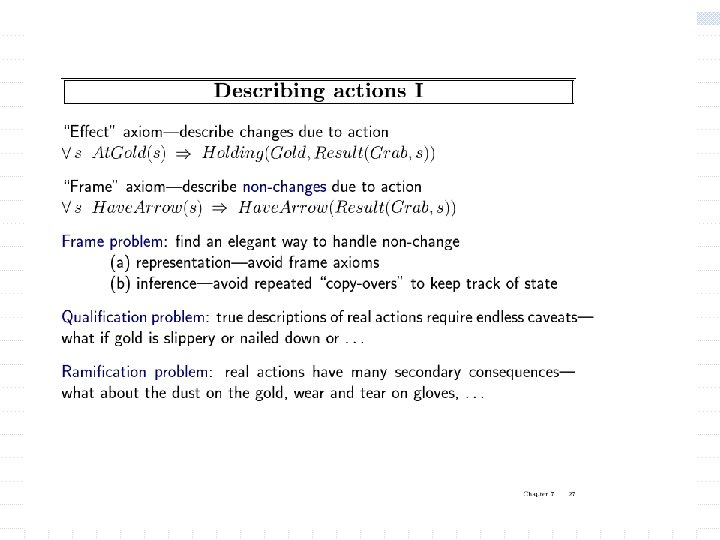
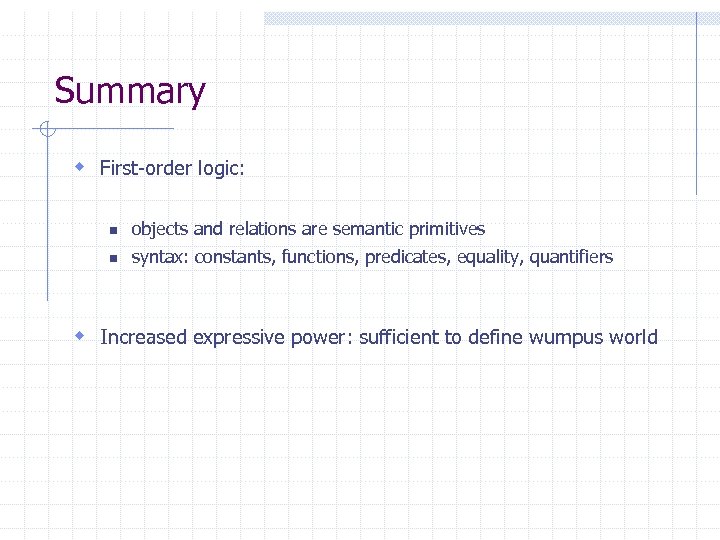 Summary w First-order logic: n objects and relations are semantic primitives n syntax: constants, functions, predicates, equality, quantifiers w Increased expressive power: sufficient to define wumpus world