 Скачать презентацию not pictured below War by developed countries
dcb7c180f5d897d73419df75b89a3d3d.ppt
- Количество слайдов: 34




(not pictured below)
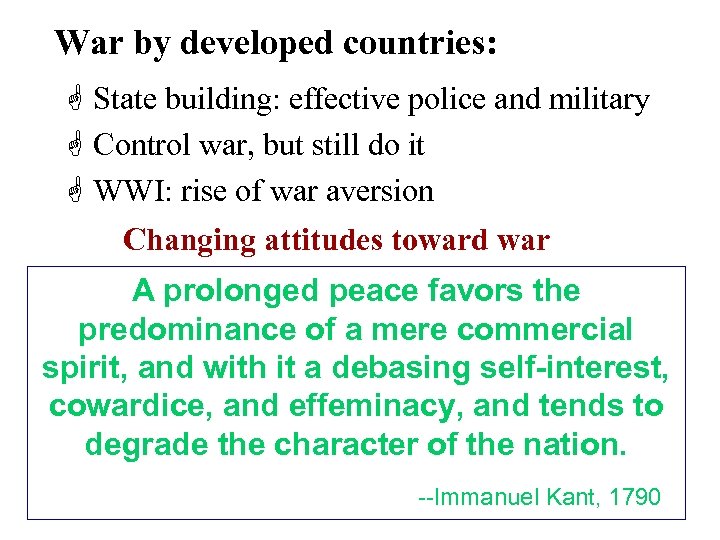
War by developed countries: G State building: effective police and military G Control war, but still do it G WWI: rise of war aversion Changing attitudes toward war A prolonged peace favors the predominance of a mere commercial spirit, and with it a debasing self-interest, cowardice, and effeminacy, and tends to degrade the character of the nation. --Immanuel Kant, 1790
War by developed countries since 1918: GWorld War II GColonial war GCold war GPolicing wars
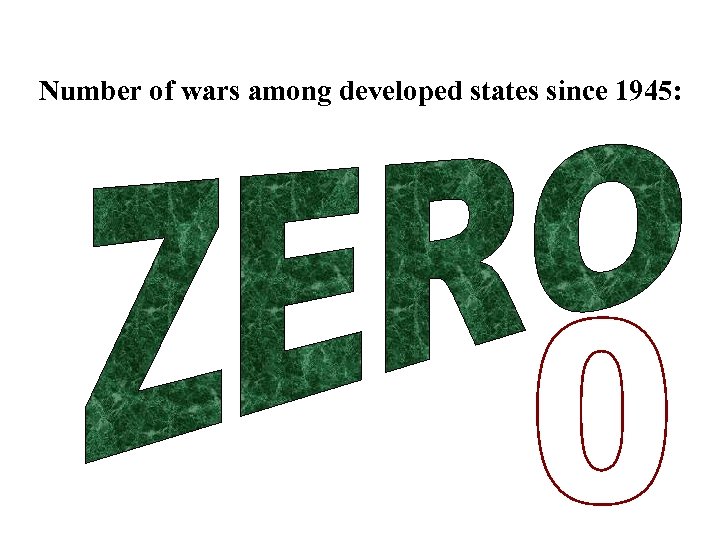
Number of wars among developed states since 1945:
Longest period of peace on the Rhine since the second century B. C. E. , before the Cimbi and the Teutones appeared to challenge the armies of the consul Gaius Marius in the Rhone Valley. --Brad de Long
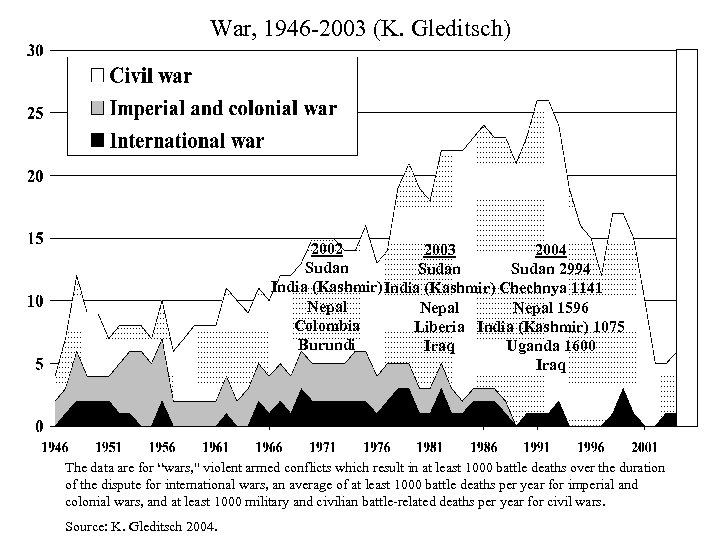
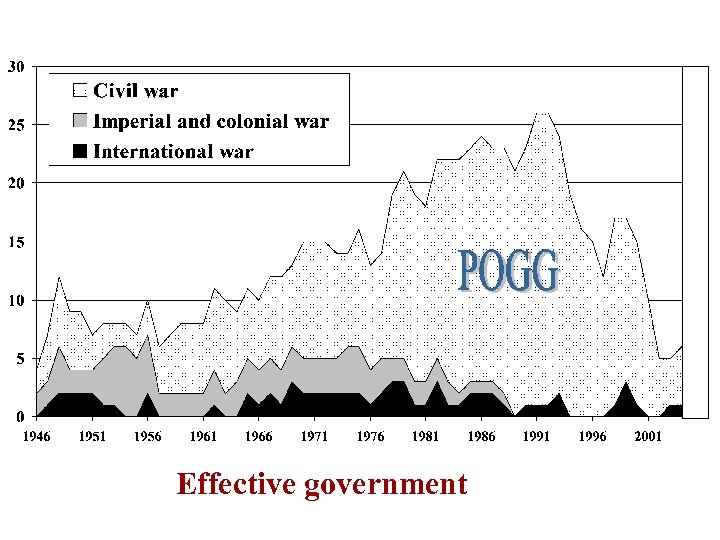
War, 1946 -2003 (K. Gleditsch) 2002 2003 2004 Sudan 2994 India (Kashmir) Chechnya 1141 Nepal 1596 Colombia Liberia India (Kashmir) 1075 Burundi Iraq Uganda 1600 Iraq The data are for “wars, " violent armed conflicts which result in at least 1000 battle deaths over the duration of the dispute for international wars, an average of at least 1000 battle deaths per year for imperial and colonial wars, and at least 1000 military and civilian battle-related deaths per year for civil wars. Source: K. Gleditsch 2004.
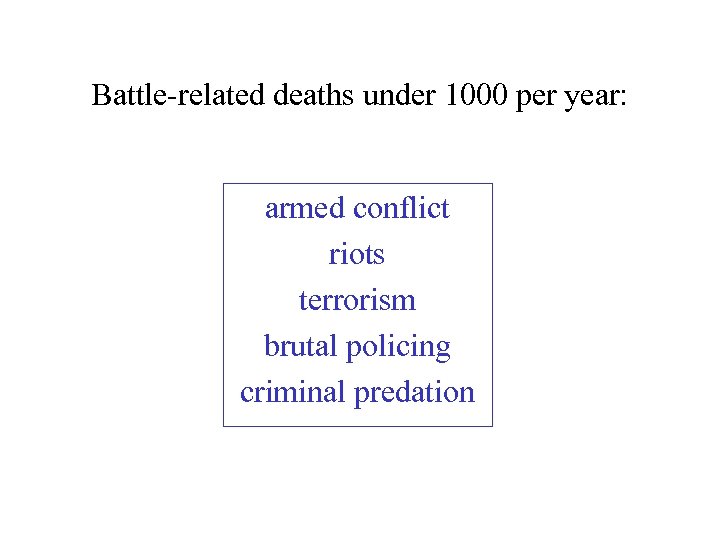
Battle-related deaths under 1000 per year: armed conflict riots terrorism brutal policing criminal predation
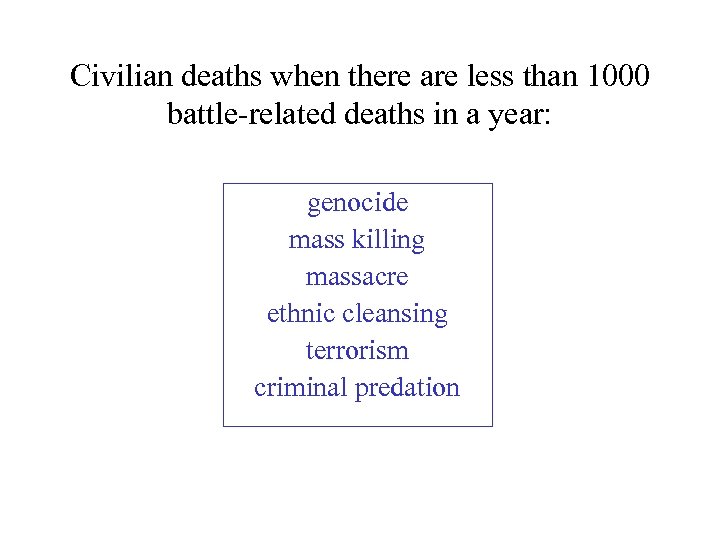
Civilian deaths when there are less than 1000 battle-related deaths in a year: genocide mass killing massacre ethnic cleansing terrorism criminal predation
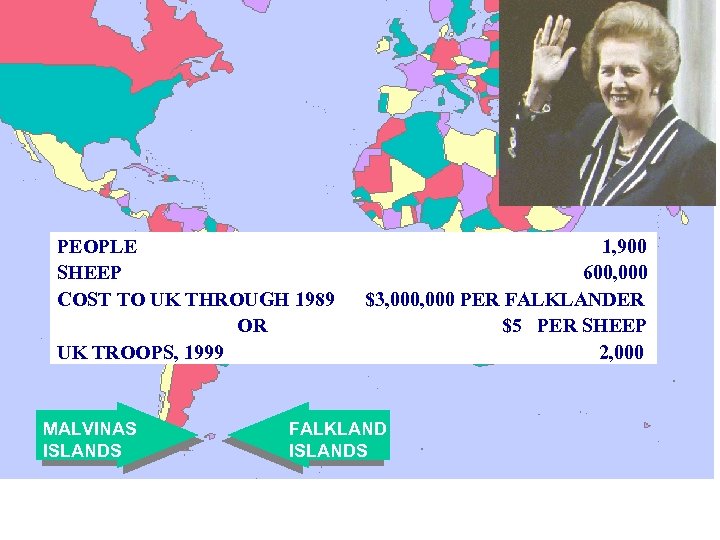
PEOPLE SHEEP COST TO UK THROUGH 1989 OR UK TROOPS, 1999 MALVINAS ISLANDS 1, 900 600, 000 $3, 000 PER FALKLANDER $5 PER SHEEP 2, 000 FALKLAND ISLANDS
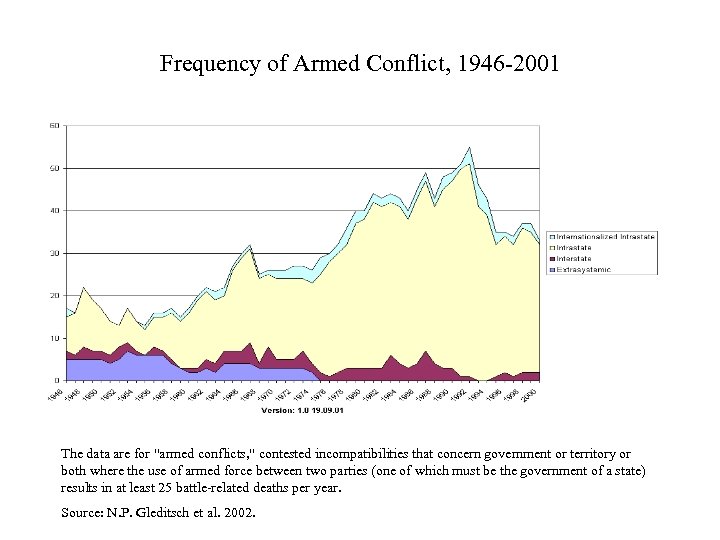
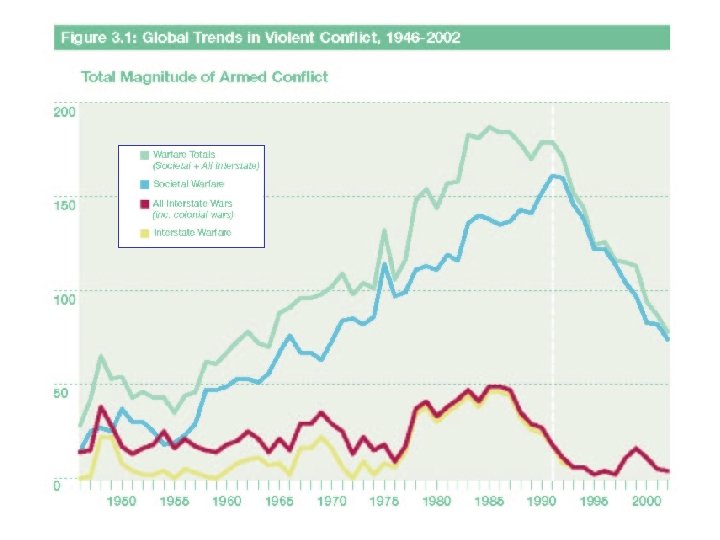
Frequency of Armed Conflict, 1946 -2001 The data are for "armed conflicts, " contested incompatibilities that concern government or territory or both where the use of armed force between two parties (one of which must be the government of a state) results in at least 25 battle-related deaths per year. Source: N. P. Gleditsch et al. 2002.
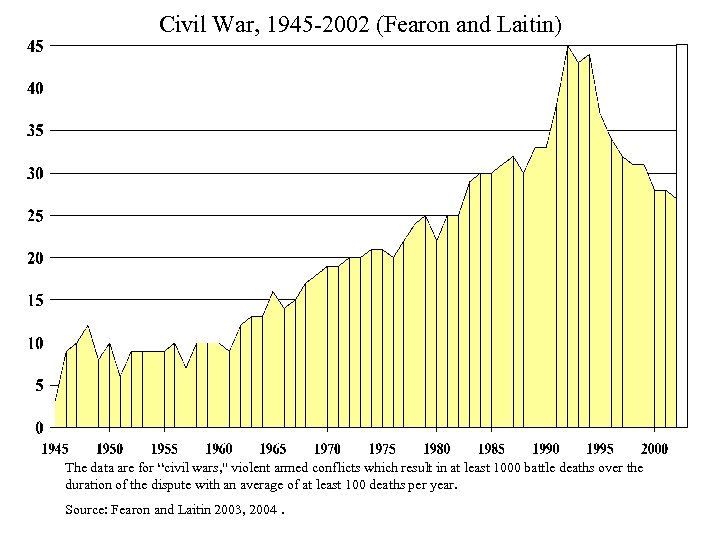
Civil War, 1945 -2002 (Fearon and Laitin) The data are for “civil wars, " violent armed conflicts which result in at least 1000 battle deaths over the duration of the dispute with an average of at least 100 deaths per year. Source: Fearon and Laitin 2003, 2004.
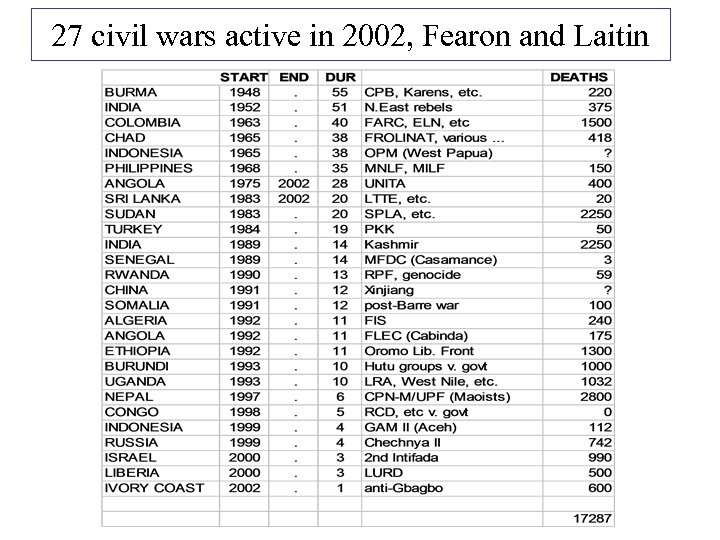
27 civil wars active in 2002, Fearon and Laitin
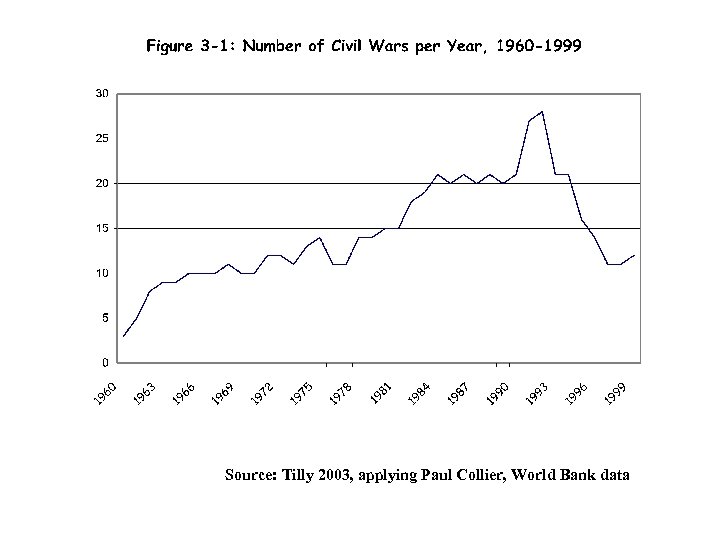
Source: Tilly 2003, applying Paul Collier, World Bank data
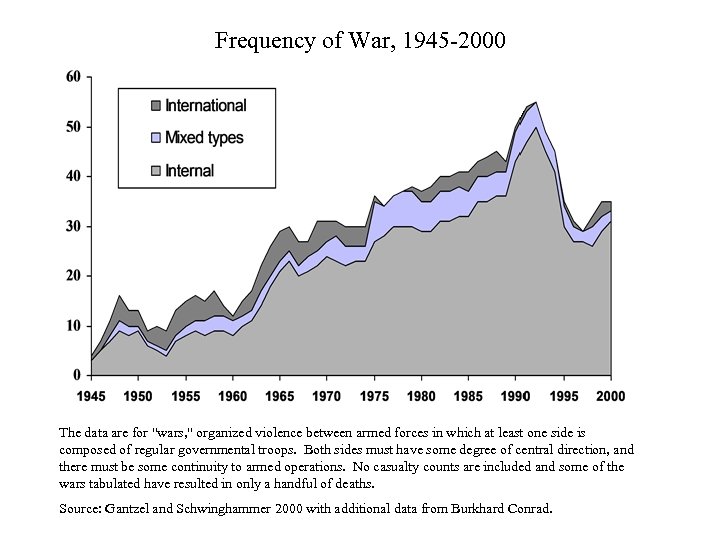
Frequency of War, 1945 -2000 The data are for "wars, " organized violence between armed forces in which at least one side is composed of regular governmental troops. Both sides must have some degree of central direction, and there must be some continuity to armed operations. No casualty counts are included and some of the wars tabulated have resulted in only a handful of deaths. Source: Gantzel and Schwinghammer 2000 with additional data from Burkhard Conrad.

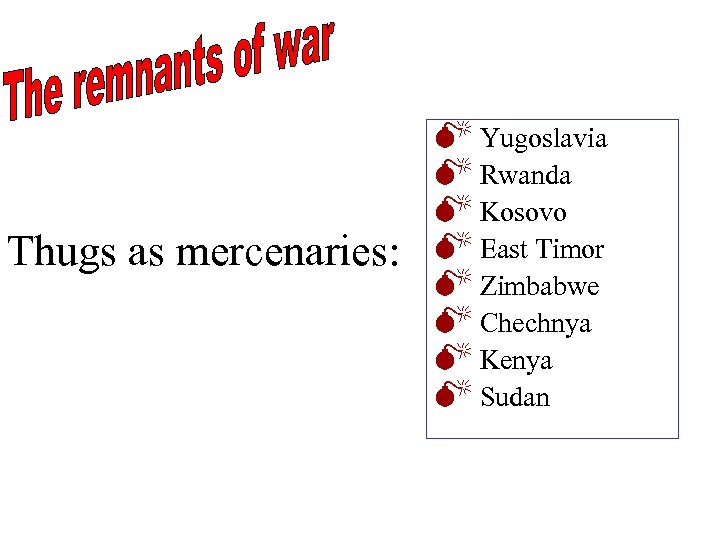
Thugs as mercenaries: M Yugoslavia M Rwanda M Kosovo M East Timor M Zimbabwe M Chechnya M Kenya M Sudan
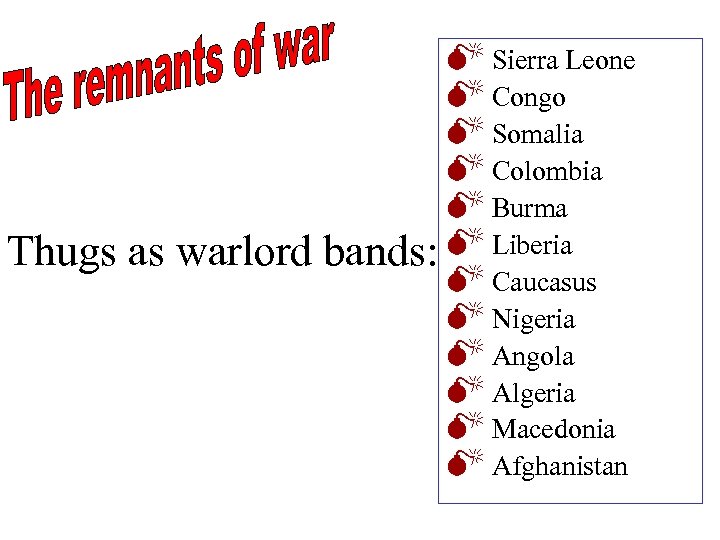
Thugs as warlord M Sierra Leone M Congo M Somalia M Colombia M Burma bands: M Liberia M Caucasus M Nigeria M Angola M Algeria M Macedonia M Afghanistan
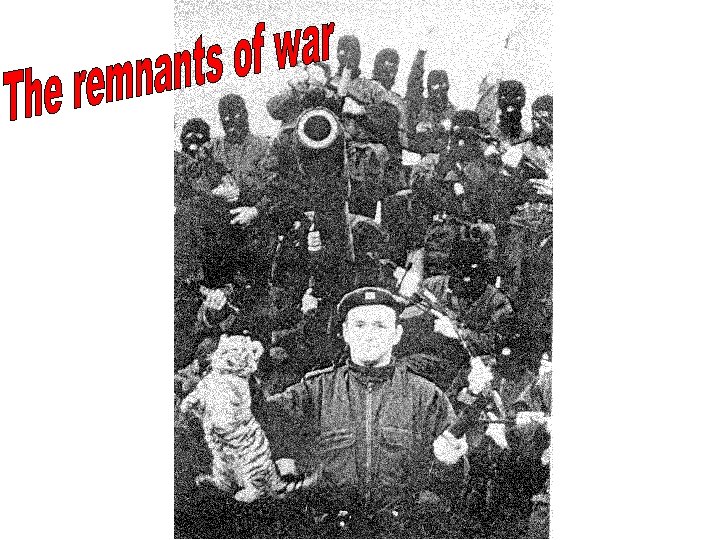
Each dressed as if he had been cast as a thug by a movie director. The atrocities in Bosnia were committed by young urban gangsters in expensive sunglasses. Dangerous primitives
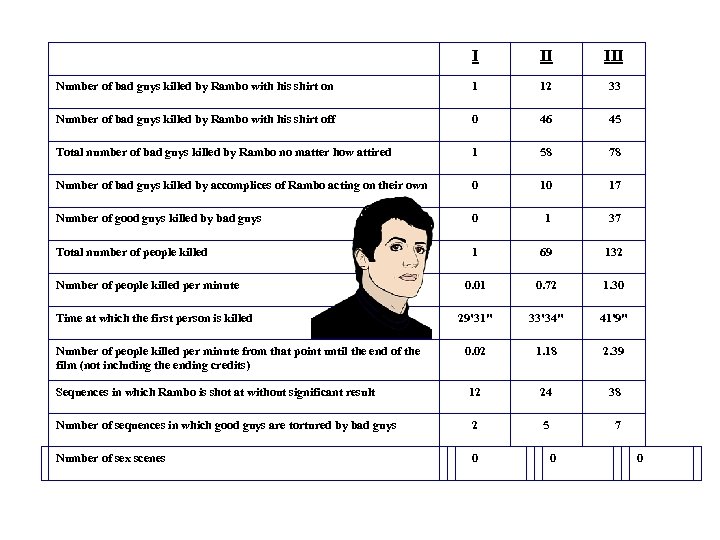
I II III Number of bad guys killed by Rambo with his shirt on 1 12 33 Number of bad guys killed by Rambo with his shirt off 0 46 45 Total number of bad guys killed by Rambo no matter how attired 1 58 78 Number of bad guys killed by accomplices of Rambo acting on their own 0 10 17 Number of good guys killed by bad guys 0 1 37 Total number of people killed 1 69 132 0. 01 0. 72 1. 30 29'31" 33'34" 41'9" 0. 02 1. 18 2. 39 Sequences in which Rambo is shot at without significant result 12 24 38 Number of sequences in which good guys are tortured by bad guys 2 5 7 Number of sex scenes 0 Number of people killed per minute Time at which the first person is killed Number of people killed per minute from that point until the end of the film (not including the ending credits) 0 0
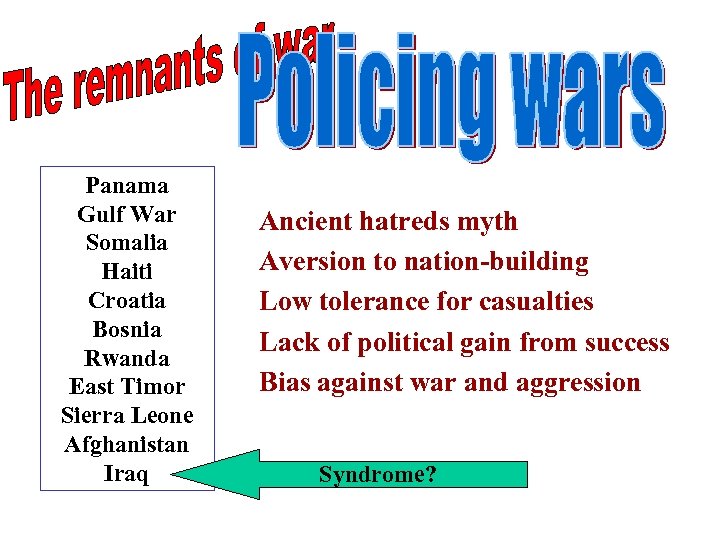
Panama Gulf War Somalia Haiti Croatia Bosnia Rwanda East Timor Sierra Leone Afghanistan Iraq Ancient hatreds myth Aversion to nation-building Low tolerance for casualties Lack of political gain from success Bias against war and aggression Syndrome?

Sri Lanka Israel Iraq insurgency Chechnya
Effective government
NOTICERS: G gwynne dyer www. gwynnedyer. com G united nations 10 stories the world should hear more about: the peacekeeping paradox, may 2004 www. un. org/events/tenstories G prio G gregg easterbrook new republic forthcoming

I’m not so naïve or simplistic to believe we can eliminate war. We’re not going to change human nature anytime soon. Robert S. Mc. Namara, in “Fog of War”

Testosterone Evolution Human nature Aggressive drive Thrill of war Moral equivalent
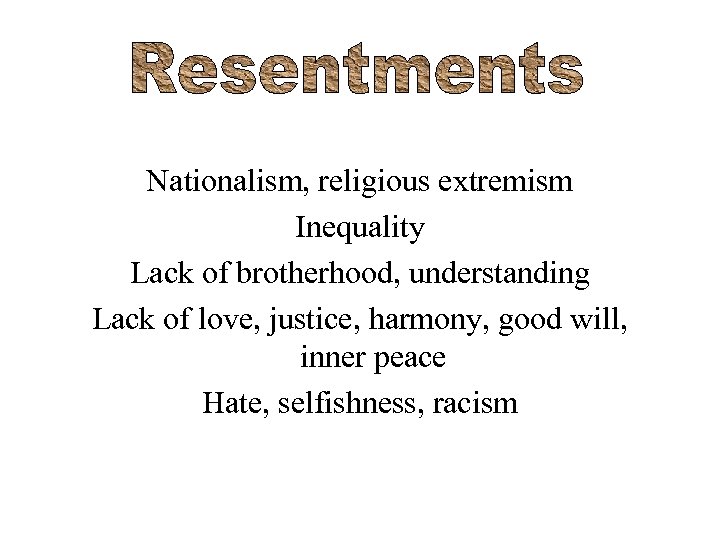
Nationalism, religious extremism Inequality Lack of brotherhood, understanding Lack of love, justice, harmony, good will, inner peace Hate, selfishness, racism
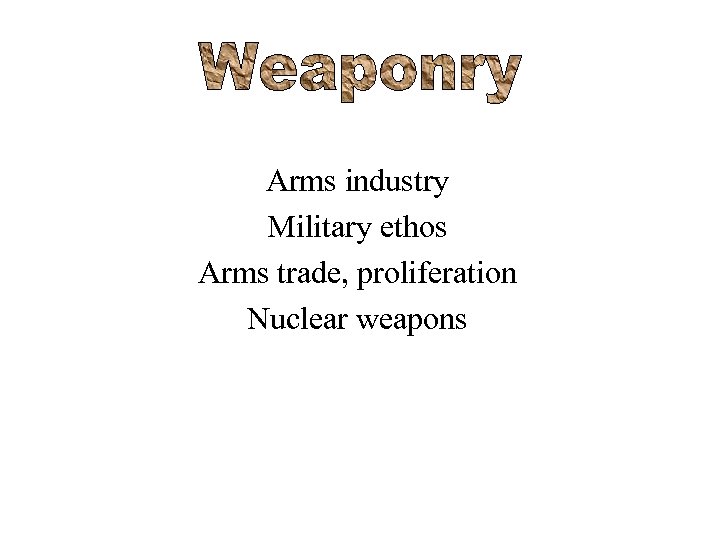
Arms industry Military ethos Arms trade, proliferation Nuclear weapons
Economic development: poverty-prosperity International trade Economic interdependence International communication Economic inequality
State system Nation state International organization World government (vs. anarchy) International law Outlawing, renouncing war Security communities Democracy
RESPONSES: D it ain’t happening D ok, it’s happening, but i still have faith in my fellow man D yeah, but what about inequality in south africa?

the end
Скачать презентацию not pictured below War by developed countries
dcb7c180f5d897d73419df75b89a3d3d.ppt