


 Скачать презентацию Nosotros Commands A command in English has
962aa8f4404d444847a127bae8626c40.ppt
- Количество слайдов: 14
 Nosotros Commands
 A command in English has an understood you: Sit down and shut up. We understand that to mean YOU sit down and YOU shut up.
 In English, we don’t have what we would call a “we” command. A nosotros command in Spanish translates “let’s. ” Hablemos. Comamos. Salgamos. Let’s talk. Let’s eat. Let’s leave. Seeing those three Spanish words should clue you in to how to form a nosotros command: you use the subjunctive. So nosotros commands are easy in the sense that you’ve already learned the verb form but not so easy in the sense that you have a lot to remember in forming the subjunctive. So. . .
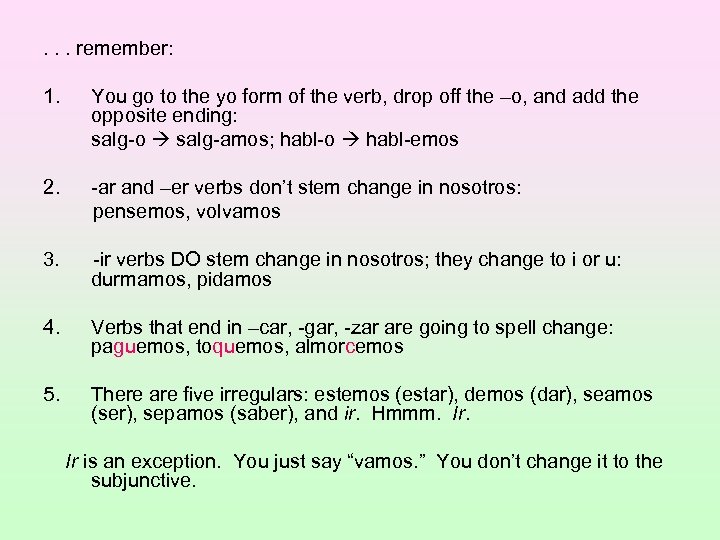 . . . remember: 1. You go to the yo form of the verb, drop off the –o, and add the opposite ending: salg-o salg-amos; habl-o habl-emos 2. -ar and –er verbs don’t stem change in nosotros: pensemos, volvamos 3. -ir verbs DO stem change in nosotros; they change to i or u: durmamos, pidamos 4. Verbs that end in –car, -gar, -zar are going to spell change: paguemos, toquemos, almorcemos 5. There are five irregulars: estemos (estar), demos (dar), seamos (ser), sepamos (saber), and ir. Hmmm. Ir is an exception. You just say “vamos. ” You don’t change it to the subjunctive.
 But there’s a second way to form a nosotros command. You can say vamos + a + infinitive: Vamos a hablar. Vamos a comer. Vamos a salir. Let’s talk Let’s eat. Let’s leave. So both “hablemos” and “vamos a hablar” mean “let’s talk. ” But, of course, “vamos a hablar” can also mean “we are going to talk. So if it isn’t clear from context that you mean “let’s talk, ” you should use “hablemos. ”
 Click here to go to a brief practice.
 OK, now for a complication: you have to put object pronouns on the end of affirmative commands. In high school, you may have heard “siéntate” or “levántate” or “cállate. ” Those are tú commands with reflexive pronouns on the end. So to say “let’s buy it, ” you have to put “it” (lo) on the end of the command: Comprémoslo. And, as you see, when you put a pronoun on the end of it, you have to put an accent mark on the e or a.
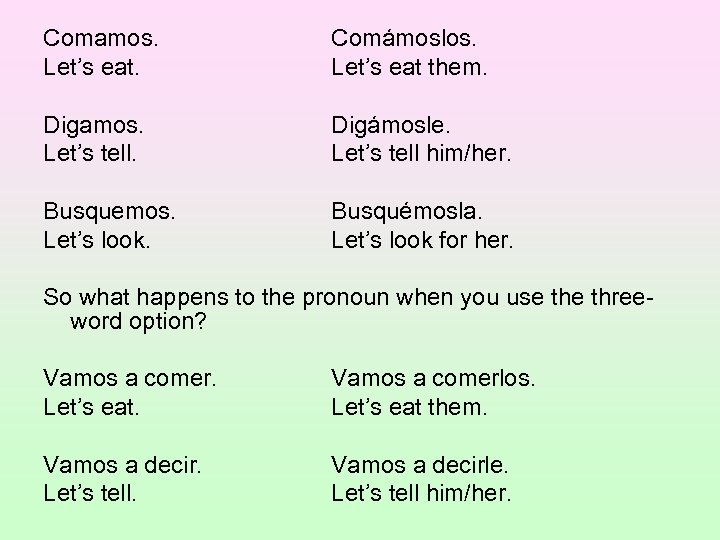 Comamos. Let’s eat. Comámoslos. Let’s eat them. Digamos. Let’s tell. Digámosle. Let’s tell him/her. Busquemos. Let’s look. Busquémosla. Let’s look for her. So what happens to the pronoun when you use threeword option? Vamos a comer. Let’s eat. Vamos a comerlos. Let’s eat them. Vamos a decir. Let’s tell. Vamos a decirle. Let’s tell him/her.
 One little thing here: if you put “nos” on the end of a one-word command, you have to drop the –s off the command: sentemos + nos e sent émos
 Click here to go to a brief practice.
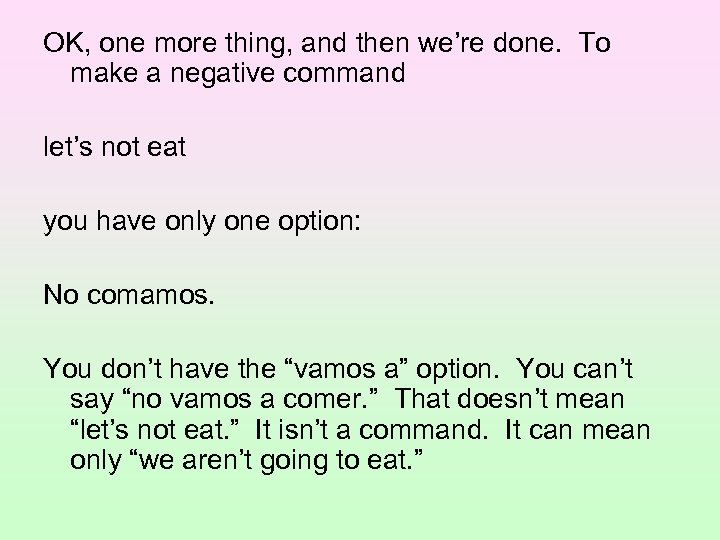 OK, one more thing, and then we’re done. To make a negative command let’s not eat you have only one option: No comamos. You don’t have the “vamos a” option. You can’t say “no vamos a comer. ” That doesn’t mean “let’s not eat. ” It isn’t a command. It can mean only “we aren’t going to eat. ”
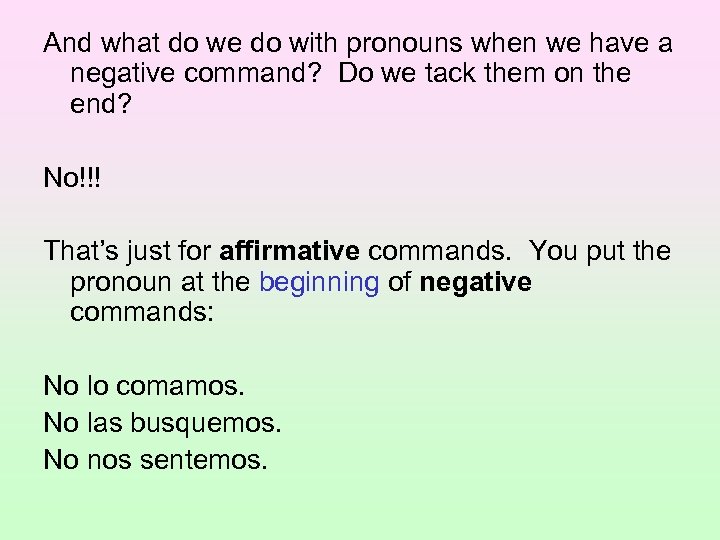 And what do we do with pronouns when we have a negative command? Do we tack them on the end? No!!! That’s just for affirmative commands. You put the pronoun at the beginning of negative commands: No lo comamos. No las busquemos. No nos sentemos.
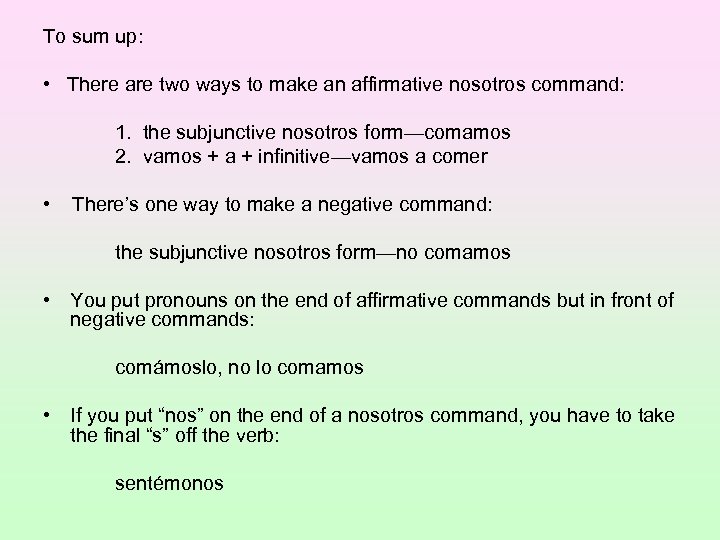 To sum up: • There are two ways to make an affirmative nosotros command: 1. the subjunctive nosotros form—comamos 2. vamos + a + infinitive—vamos a comer • There’s one way to make a negative command: the subjunctive nosotros form—no comamos • You put pronouns on the end of affirmative commands but in front of negative commands: comámoslo, no lo comamos • If you put “nos” on the end of a nosotros command, you have to take the final “s” off the verb: sentémonos
 Click here to go to your homework.