 Скачать презентацию Northwestern Lab for Internet Security Technology LIST
785ddcceb347b47447cd6c2781e87a47.ppt
- Количество слайдов: 19



Northwestern Lab for Internet & Security Technology (LIST) http: //list. cs. northwestern. edu
Personnel Prof. Yan Chen Ph. D. Students Brian Chavez n Yan Gao n Zhichun Li n Yao Zhao n M. S. Students Prasad Narayana n Leon Zhao n Undergraduates n Too many to be listed

Projects The High-Performance Network Anomaly/Intrusion Detection and Mitigation (HPNAIDM) Systems Overlay Network Monitoring and Diagnostics Adaptive Intrusion Detection and Mitigation Systems for Wi. MAX Networks

Our Theme Internet is becoming a new infrastructure for service delivery n n World wide web, Vo. IP Email Interactive TV? Major challenges for Internet-scale services n n Scalability: 600 M users, 35 M Web sites, 2. 1 Tb/s Security: viruses, worms, Trojan horses, etc. Mobility: ubiquitous devices in phones, shoes, etc. Agility: dynamic systems/network, congestions/failures

Battling Hackers is a Growth Industry! --Wall Street Journal (11/10/2004) The past decade has seen an explosion in the concern for the security of information Internet attacks are increasing in frequency, severity and sophistication Denial of service (Do. S) attacks n n n Cost $1. 2 billion in 2000 Thousands of attacks per week in 2001 Yahoo, Amazon, e. Bay, Microsoft, White House, etc. , attacked

Battling Hackers is a Growth Industry (cont’d) Virus and worms faster and powerful n n Melissa, Nimda, Code Red, Slammer … Cause over $28 billion in economic losses in 2003, growing to > $75 billion in economic losses by 2007. Code Red (2001): 13 hours infected >360 K machines - $2. 4 billion loss Slammer (2003): 10 minutes infected > 75 K machines - $1 billion loss Spywares are ubiquitous n 80% of Internet computers have spywares installed
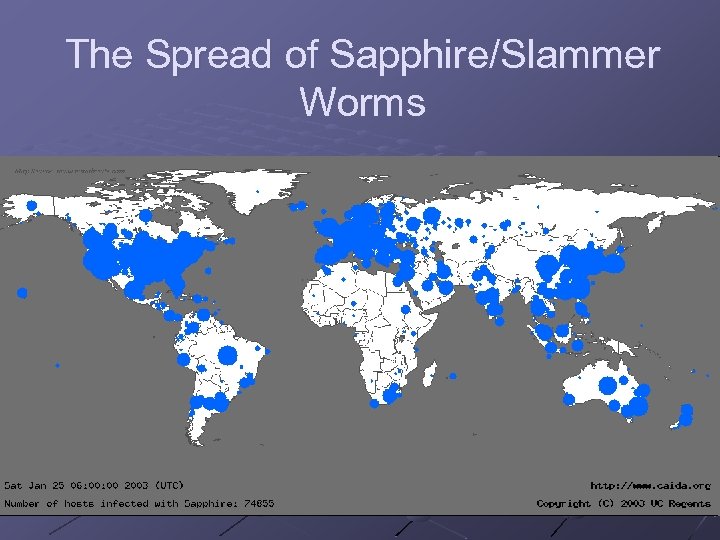
The Spread of Sapphire/Slammer Worms
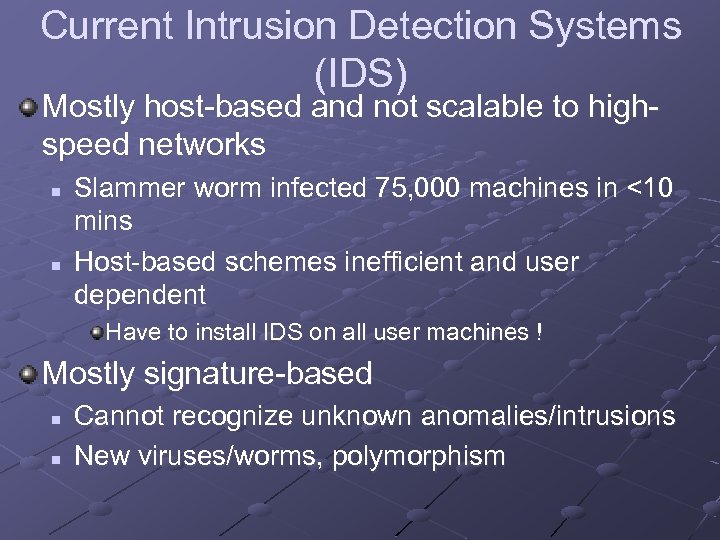
Current Intrusion Detection Systems (IDS) Mostly host-based and not scalable to highspeed networks n n Slammer worm infected 75, 000 machines in <10 mins Host-based schemes inefficient and user dependent Have to install IDS on all user machines ! Mostly signature-based n n Cannot recognize unknown anomalies/intrusions New viruses/worms, polymorphism
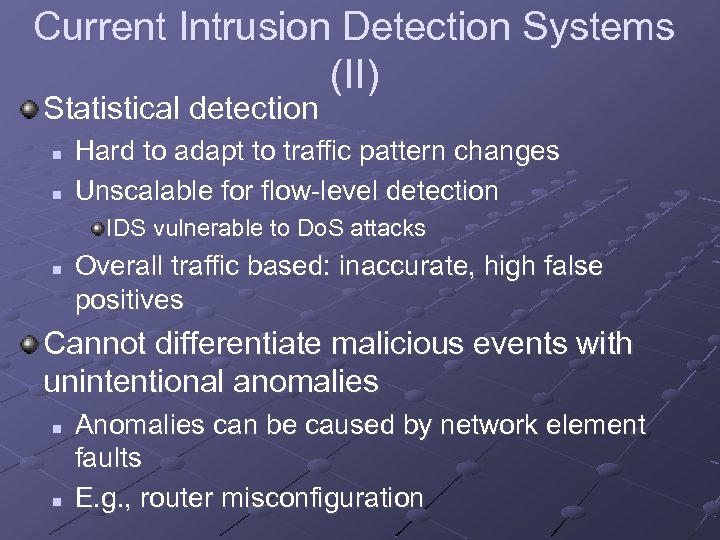
Current Intrusion Detection Systems (II) Statistical detection n n Hard to adapt to traffic pattern changes Unscalable for flow-level detection IDS vulnerable to Do. S attacks n Overall traffic based: inaccurate, high false positives Cannot differentiate malicious events with unintentional anomalies n n Anomalies can be caused by network element faults E. g. , router misconfiguration
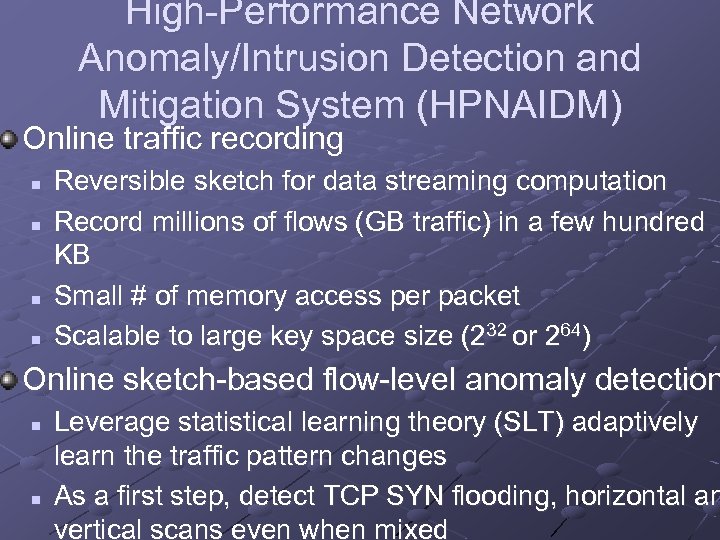
High-Performance Network Anomaly/Intrusion Detection and Mitigation System (HPNAIDM) Online traffic recording n n Reversible sketch for data streaming computation Record millions of flows (GB traffic) in a few hundred KB Small # of memory access per packet Scalable to large key space size (232 or 264) Online sketch-based flow-level anomaly detection n n Leverage statistical learning theory (SLT) adaptively learn the traffic pattern changes As a first step, detect TCP SYN flooding, horizontal an vertical scans even when mixed
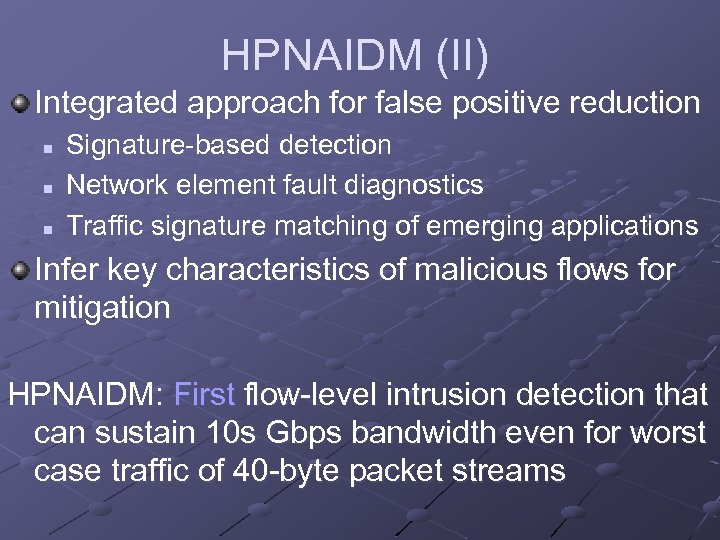
HPNAIDM (II) Integrated approach for false positive reduction n Signature-based detection Network element fault diagnostics Traffic signature matching of emerging applications Infer key characteristics of malicious flows for mitigation HPNAIDM: First flow-level intrusion detection that can sustain 10 s Gbps bandwidth even for worst case traffic of 40 -byte packet streams
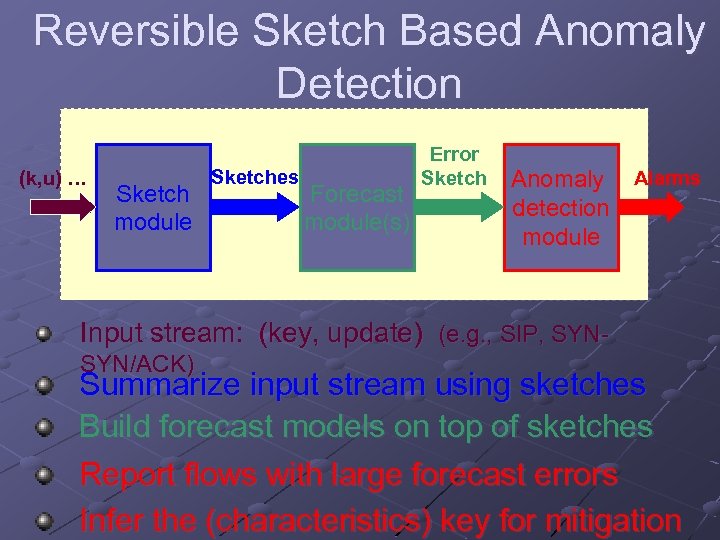
Reversible Sketch Based Anomaly Detection (k, u) … Sketch module Sketches Forecast module(s) Error Sketch Anomaly Alarms detection module Input stream: (key, update) (e. g. , SIP, SYNSYN/ACK) Summarize input stream using sketches Build forecast models on top of sketches Report flows with large forecast errors Infer the (characteristics) key for mitigation
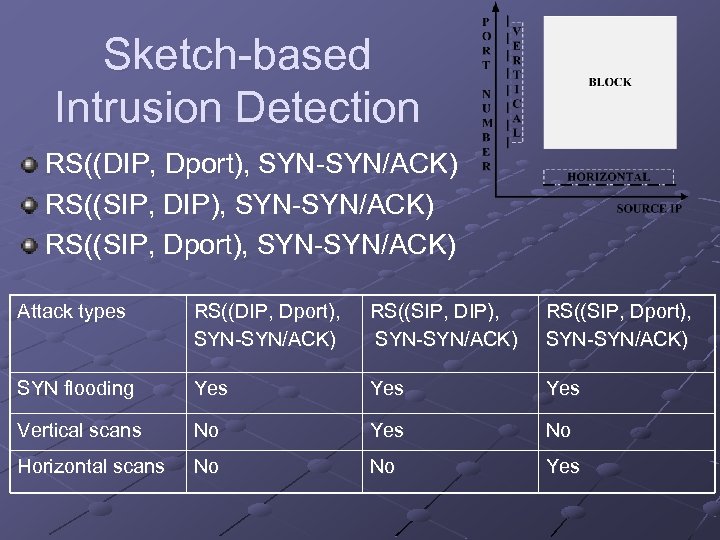
Sketch-based Intrusion Detection RS((DIP, Dport), SYN-SYN/ACK) RS((SIP, DIP), SYN-SYN/ACK) RS((SIP, Dport), SYN-SYN/ACK) Attack types RS((DIP, Dport), SYN-SYN/ACK) RS((SIP, DIP), SYN-SYN/ACK) RS((SIP, Dport), SYN-SYN/ACK) SYN flooding Yes Yes Vertical scans No Yes No Horizontal scans No No Yes
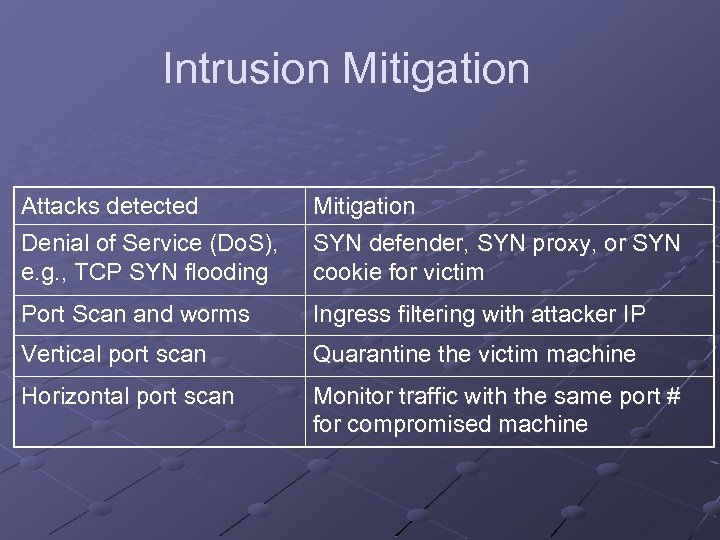
Intrusion Mitigation Attacks detected Denial of Service (Do. S), e. g. , TCP SYN flooding Mitigation SYN defender, SYN proxy, or SYN cookie for victim Port Scan and worms Ingress filtering with attacker IP Vertical port scan Quarantine the victim machine Horizontal port scan Monitor traffic with the same port # for compromised machine
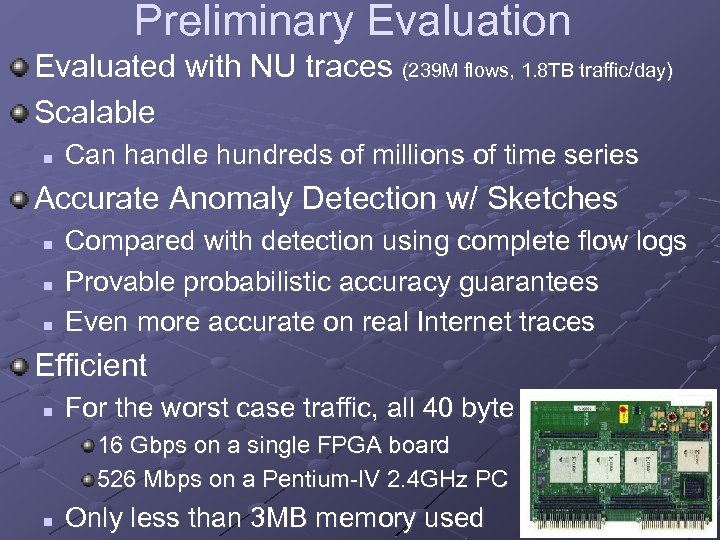
Preliminary Evaluation Evaluated with NU traces (239 M flows, 1. 8 TB traffic/day) Scalable n Can handle hundreds of millions of time series Accurate Anomaly Detection w/ Sketches n n n Compared with detection using complete flow logs Provable probabilistic accuracy guarantees Even more accurate on real Internet traces Efficient n For the worst case traffic, all 40 byte packets 16 Gbps on a single FPGA board 526 Mbps on a Pentium-IV 2. 4 GHz PC n Only less than 3 MB memory used
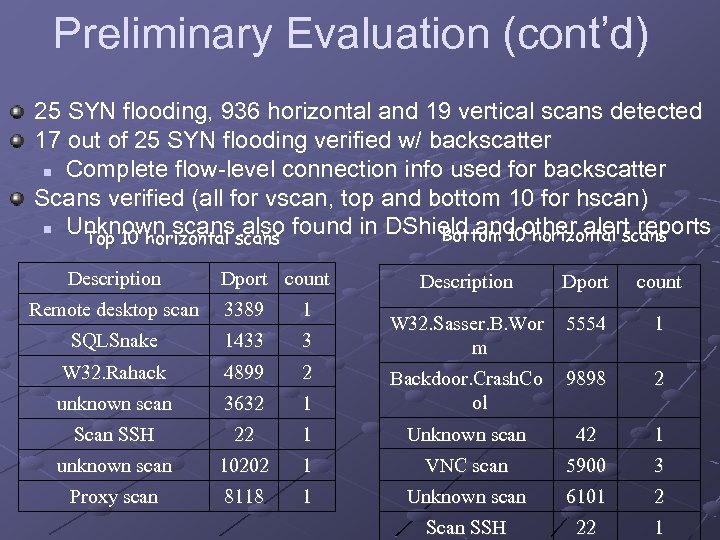
Preliminary Evaluation (cont’d) 25 SYN flooding, 936 horizontal and 19 vertical scans detected 17 out of 25 SYN flooding verified w/ backscatter n Complete flow-level connection info used for backscatter Scans verified (all for vscan, top and bottom 10 for hscan) n Unknown scans also found in DShield and other alert reports Bottom 10 horizontal scans Top 10 horizontal scans Description Dport count W 32. Sasser. B. Wor m 5554 1 9898 2 Remote desktop scan 3389 1 SQLSnake 1433 3 W 32. Rahack 4899 2 unknown scan 3632 1 Backdoor. Crash. Co ol Scan SSH 22 1 Unknown scan 42 1 unknown scan 10202 1 VNC scan 5900 3 Proxy scan 8118 1 Unknown scan 6101 2 Scan SSH 22 1

Sponsors Motorola Department of Energy

Research Methodology & Collaborators Combination of theory, synthetic/real trace driven simulation, and real-world implementation and deployment
Скачать презентацию Northwestern Lab for Internet Security Technology LIST
785ddcceb347b47447cd6c2781e87a47.ppt